INTRODUCTION
The chemical oxygen demand using a potas- sium permanganate (CODMn) has been tradition- ally used as a means of measuring the organic strength of wastes and lakes. The method, how- ever, may not be appropriate in analyzing organ- ic matter due to low oxidation rate, low repro- ducibility with respect to various types of com- pounds, temperature and dilution rates of sam- ples (Sawyer et al., 1994). For these reasons, this method is not still adapted by a Standard Me- thod and not used as an index of the quantity of organic matter, except for some countries includ- ing Korea and Japan.
Organic matter can be determined satisfacto- rily by measuring carbon because organic mat- ters contain a reduced carbon. Photosynthetic
production of organic matter is also commonly measured in units of carbon. Also, concentration of organic carbon is easily measured using a TOC and CHN analyzer (Jørgensen, 1986). The total amount of organic carbon in natural waters generally has been expressed as a sum of dissolv- ed organic carbon (DOC) and particulate organic carbon (POC) rather than total organic carbon (TOC) (Thurman, 1985). Furthermore, there are useful information concerning origins, autoch- thonous or allochthonous, of organic matters th- rough the ratios of POC to chlorophyll a concen- tration and DOC to ultraviolet (UV) absorbance.
There are two methods for analysis of DOC: 1) wet chemical oxidation (WCO) method (1960′);
and 2) high temperature catalytic oxidation (HT- CO) method (1980′). Sugimura and Suzuki (1988) reported that WCO method considerably under- estimated DOC compared with HTCO method.
* Corresponding author: Tel : 033) 252-4443, Fax: 033) 251-3991, E-mail: [email protected]
─
─ 328 ──
Relationships Between Organic Carbon and COD
Mnin a Deep Reservoir, Lake Soyang, Korea
Choi, Kwangsoon*, Bomchul Kim, Hyung--Bong Kim and Seung--Hwan Sa (Department of Environmental Science, Kangwon National University,
Chunchon 200-701, Korea)
소양호에서 유기탄소와 CODMn과의 상관관계. 최광순∙김범철∙김형봉∙사승환 (강원대학 교 환경학과)
현재 우리나라에서 수중의 유기물양의 지표로 사용되고 있는 CODMn법이 지표로서 적합한지를 알아보기 위하여 소양호의 댐앞지점과 유입수를 대상으로 유기물양과 CODMn과의 상관관계를 알 아보았다. 또한 소양호를 표층, 중층, 심층으로 나누어CODMn법에 의한 각 층의 유기물산화정도를 비교하였다. 소양호의 유기물농도와 CODMn비는 계절에 따라 매우 상이하였고, 수층에 따라서도 차이를 보였다. 유입수에서도 홍수기를 전후로 하여 유기물농도와 CODMn비가 유의적인 차이를 보였다. CODMn법에 의한 소양호의 유기물의 산화는 평균40% 정도로 낮은 값을 보였다. 특히 심 층의 유기물은 CODMn법에 의해 산화되는 양이 30% 이하로 매우 낮았다. 이러한 결과는 CODMn
법이 호수와 하천의 유기물양을 제대로 대변하고 있지 못할 뿐 아니라 계절에 따라 유기물의 조성 이 변할 때CODMn법에 의한 유기물산화력이 변한다는 단점을 보여준다.
Key words : Carbon index, Chemical oxygen demand, CODMn: TOC ratio, Lake Soyang
However, several recent studies obtained that the differences between the methods were little (Ogawa and Ogura, 1992; Hedges et al., 1993;
Sharp et al., 1993). Kaplan (1992) also reported a fairly good agreement between the two methods.
Therefore, the replacement of the CODMnmethod by TOC method as index of the quantity of orga- nic matter needs to be considered.
The purpose of this study was to estimate the suitability of CODMn method as an index of the quantity of organic matter in a deep reservoir, Lake Soyang, and its main inf lowing river by comparing the relationships between CODMnand organic carbon concentration.
MATERIALS AND METHODS
Study area
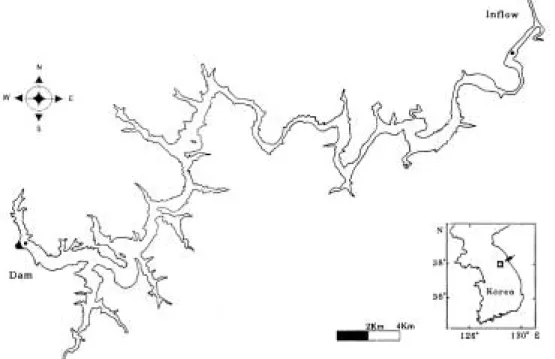
Lake Soyang is the deepest and largest reser- voir in Korea; it was constructed on the North Han River in 1973 (Fig. 1, Table 1). A single in- f low, the Soyang River, contributes 90% of the yearly water inf low to the reservoir. The water- shed contains only a few small towns, and the lake receives little industrial sewage discharge.
The lake is long and narrow, with a total length of 60 km and the mean width of 0.75 km. There are numerous dendritic branches in submerged
valleys that extend up to 5 km from the main stream axis. The residence time of water (Tw = 0.7 yr) in the lake is longer than in any other reservoirs in Korea because the inflow rate is low compared to the large lake volume. A mean an- nual precipitation, based on average of 1987~
1996, was 1316 mm. More than half of this amo- unt falls during summer monsoon in June-Au-
Fig. 1. Map showing sampling stations in Lake Soyang.
Table 1. Hydrological characteristics and utilization of drainage basin of Lake Soyang. Yearly average records from 1995 to 1997.
Shape Dendritic
Circulation type Warm monomitic
Trophic state meso-eutrophic
Surface area (km2) 45
Water capacity (m3) 2.9×10⁹ Yearly average inf low (m3/s) 2.1×10⁹ Yearly average outf low (m3/s) 2.1×10⁹
Maximum depth (m) 110
Water surface elevation (m) 165×195
Mean depth (m) 42
Hydraulic residence time (yr) 0.7 Length of main axis (km) 60 Drainage area (km2) 2675 Urban area in drainage basin (km2) 1 Paddy area in drainage basin (km2) 163 Forest and mountain area (km2) 2563 Total population in drainage area
(persons) 52577
gust when rainfall is concentrated in episodic he- avy showers of over 100 mm/d (Kim et al., 1997).
Methods
To examine vertical and seasonal variations of CODMnand organic carbon, we collected monthly samples from just upstream of the dam, at de- pths of 0, 2, 5, and at 10 m intervals up to 100 m.
Water samples were collected from September 1995 to October 1997. Since Lake Soyang has a marked difference in chemistry among the depth layers during summer, strata of the lake were divided into three layers, according to the depth of the intermediate layer of storm runoff. The upper layer extended from 0 to either 5 or 20 m;
the middle layer extended from 20 to either 50 or 60 m; and the deep layer was below 60 or 70 m.
Surface samples from the Soyang River were collected at weekly intervals in dry seasons (Sep.-May), and three or four times per day during the monsoon season, when water quality varied largely with the discharge rate. Sampling was conducted from April 1995 to October 1996.
Water samples for DOC and POC analyses were f iltered through pre-combusted (450�C), Whatman GF/F f ilters. The f ilters were dried for 1 h at 50�C before measuring POC concentration.
The f iltrate, used for DOC measurement, was collected directly in an acid-cleaned, pre-com- busted (550�C) glass bottle with a Tef lon-lined cap, and frozen at -20�C.
The concentration of DOC was measured by the HTCO method using a Shimadzu 5000 total carbon analyzer with 2.8 g of a 20% Pt catalyst on quartz wool. Analytical precision typically was ±1% (coeff icient of variation) based on three or more measurements of each sample. POC con- centration was measured using a Yanaco MT-5 CHN analyzer. For the determination of CODMn, samples (30 mL) were treated with 5 mN KMnO4
in 1% NaOH in 100�C autoclave for 1 hr. Total oxygen demand (TOD) values were converted from TOC assuming constant stoichimetry for organic matter (O2/C = 32/12).
RESULTS AND DISCUSSION
Rainfall patterns in the Soyang River and seasonal variations of organic carbon and CODMn
In the Soyang River basin, over 70% of the
annual rainfall was concentrated by heavy show- ers occurring several times during summer mon- soon (June though August; Fig. 2a). The total rainfall of 1995 (1,586 mm) in the river basin was higher than the annual average rainfall of the last 10 years (1,316 mm), while the total rainfall of 1996 (952 mm) was considerably lower than the average.
POC concentrations during the study period varied from 0.18 to 5.31 mg C/l (mean 0.76±0.76 mg C/l), and corresponded closely with variations in rainfall (Fig. 2b). Peaks of POC occurred dur- ing the summer monsoon when the water was turbid (about 200 NTU). No increases in POC were observed unless rainfall amounts exceeded 50 mm. During the dry season, the Soyang River displayed nearly constant levels of POC (0.5 mg C/l).
DOC concentrations varied from 1.11 to 4.54 mg C/l (mean 2.08±0.70 mg C/l), and its varia- tion was always not consistent with variations in rainfall (Fig. 2c). In 1995, DOC peak occurred in the f irst heavy rain (on July 9), but in the next shower (on August 24) DOC did not increase in spite of the highest rainfall of 160 mm/day. In 1996 the peaks also occurred during other heavy rains as well as in the f irst heavy rain. Concen- trations of DOC displayed more variation during the dry season.
TOC concentrations varied from 1.58 to 7.49 mg C/l (mean 2.84±1.04 mg C/l), and its seasonal variation was similar to that of DOC, except dur- ing the summer monsoon in 1995 and 1996 (Fig.
2d). Kim et al. (1998) reported that DOC was a major portion of TOC during dry seasons and the ratio of DOC to POC was about 5. However the ratio during the summer monsoon season decre- ased to 1 due to the increase of particle loading from the watershed. Nemeth et al. (1982) report- ed that POC was 0.5 mg C/l in dry seasons and increased rapidly to 9 mg C/l during the rainy season in the Orinoco River of Venezuela, while an increase of DOC was less than POC. Similar results were reported by many researchers (We- tzel and Manny, 1977; Dahm et al., 1981; Thur- man, 1985). It implies that particulate matters during the monsoon dominated relative to dis- solved forms.
CODMnvaried from 1.7 to 9.7 mg O2/l (mean 3.3
±1.2 mg O2/l), and its variation was similar to that of POC, relative to DOC (Fig. 2e). CODMn
was consistently near 3 mg O2/l in spring and
early summer before the monsoon (pre-mon- soon). High CODMn occurred during the summer monsoon, coinciding with the rainfall events.
After the monsoon season (post-monsoon), CODMnwas below 2 mg O2/l.
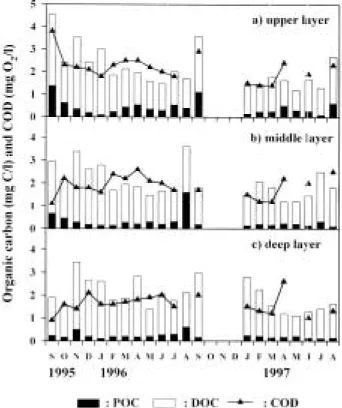
Seasonal variations of organic carbon and CODMnin the three layers of Lake Soyang In the upper layer, the average POC concentra- tion varied from 0.09 to 1.38 mg C/l (mean 0.42±
0.31 mg C/l) (Fig. 3a). POC concentrations were high during summer and early autumn, with ma-
ximal concentrations occurring in September of 1995 and 1996. With winter coming, POC con- centration rapidly decreased to 0.1 mg C/l. Gene- rally, in mesotrophic and eutrophic lakes, phyto- plankton accounts for most of the POC, whereas in oligotrophic lakes abiotic seston accounts for a greater portion of the POC pool (Seki and Na- kano, 1981; Thurman, 1985). Kim et al. (2000) re- ported that POC had a positive linear relation- ship with chlorophyll a in the euphotic zone of Lake Soyang.
Like the case of inf low river, DOC was a major portion of TOC (above 80%) in the upper layer of Lake Soyang, except during summer and early autumn (Fig. 3a). The average DOC concentra- tion varied from 0.90 to 3.18 mg C/l (mean 1.73±
0.68 mg C/l). DOC concentration was consisten- tly near 1.5 mg C/l in spring and early summer.
After the monsoon, DOC concentration increased and reached its peak in September. DOC can be released during photosynthesis by living algae (Mague et al., 1980; Jørgensen, 1986; Sønder- gaard et al., 1985) and dead algae (Hansen et al., 1986). Several researchers reported that DOC
Fig. 2. Seasonal changes of rainfall, POC, DOC, TOC concentrations and CODMnin the inf lowing river into Lake Soyang from April 1995 to October 1996.
Fig. 3. Seasonal changes of POC, DOC and CODMn in three depth layers of Lake Soyang from Septem- ber 1995 to August 1997.
concentration was high during and after algal blooms in a Japanese lake (Hama and Handa, 1983; Fukushima et al., 1996) and in a Korean lake (Kim et al., 1998). In the upper layer, there- fore, the high DOC after the monsoon season may have been due to DOC excretion by phyto- plankton.
In the middle layer, the average POC concen- tration ranged from 0.10 to 1.60 mg C/l (mean 0.30±0.32 mg C/l), and the concentrations were lower than in the upper layer (Fig. 3b). POC con- centration was also high during the summer, especially in 1996 when rainfall was high. The average DOC concentration ranged from 0.98 to 3.09 mg C/l (mean 1.75±0.53 mg C/l), and its proportion to TOC (above 90%) was larger than that in the upper layer (Fig. 19b). DOC in the middle layer also displayed a distinct increase during the summer and early autumn. In Lake Soyang, storm runoff water f lows into the middle layer of the lake during the summer monsoon season because the density of inflow water is usually greater than that of the surface water (Kim et al., 1998). In addition, one half of annual precipitation in Korea is concentrated in several heavy showers during the summer monsoon sea- son in July and August. Therefore, the summer monsoon resulted in high POC and DOC concen- trations in the middle layer of Lake Soyang.
In the deep layer, the average POC and DOC concentrations ranged from 0.10 to 0.60 mg C/l (mean 0.21±0.12 mg C/l) and from 0.90 to 2.94 mg C/l (mean 1.77±0.62 mg C/l), respectively (Fig. 3c). The ranges of POC and DOC were simi- lar to those in the middle layer. The concentra- tion of DOC was high in the late summer and winter, except in April 1996. Choi et al. (2000) reported that DOC concentrations in the deep layer increased when the concentrations of DO declined, and that this phenomenon was most pronounced when the lake bottom was in an ano- xic condition. This f inding is in agreement with previous reports that DOC is released from lake sediments under conditions of low DO (Tipping and Woof, 1983; Matsumoto, 1991). A high DOC concentration in the anoxic deep layer implies that DOC is released from the bottom sediment when organic particles are settled and degraded.
Compared with the deep layers, CODMn in the upper layer was relatively high and variable, ranging from 1.4 to 3.8 mg O2/l (mean 2.2±0.6 mg O2/l) (Fig. 3). No difference in the concentrations
and seasonal variations of CODMn was observed between the middle layer and the deep layer (Fig. 3b, c).
CODMnto TOC ratio
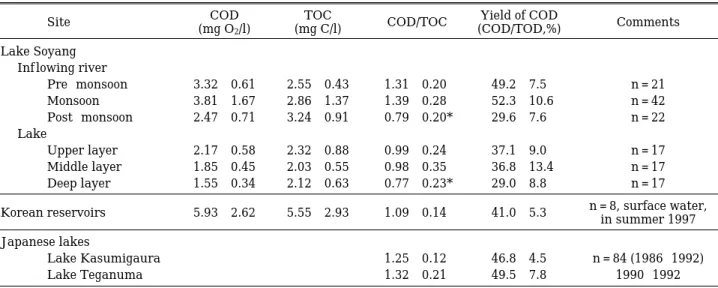
In the inf lowing river CODMn to TOC ratios varied with season, ranging from 0.45 to 2.02 (mean 1.21±0.35). The mean ratio during pre- monsoon was similar to that observed during monsoon (p>0.2 between two seasons by unpair- ed t-test; Table 2). However, the mean ratio dur- ing post-monsoon (0.79±0.20) was signif icantly lower than those observed in other seasons (p<
0.001 between post-monsoon and other seasons by unpaired t-test; Table 2). This difference in the mean ratio indicates that a characteristic of organic matter in the river differed among sea- sons.
In Lake Soyang the mean ratio in the deep lay- er was smaller significantly than those observed in upper and middle layers (p<0.001 between upper and middle layers and deep layer by pair- ed t-test). The ratio in the upper layer was simi- lar to those obtained from surface waters of 8 Korean reservoirs, but it was smaller than those observed in surface water of Lake Kasumigaura and its inf lows (1.25±0.12), in Lake Teganuma (1.32±0.21), Japan (Fukushima et al., 1997) (Table 2).
The ratios also varied seasonally, showing hig- her values in spring (Fig. 4). During the summer monsoon season, turbid runoff from several sto- rm events affected the water quality of the middle layer of Lake Soyang. At this time, the organic matter in the layer has characteristics of allochthonous material (Choi et al., 2000). The ratio of CODMnto TOC in the middle layer (mean 0.98±0.35) was smaller than that observed in the river (mean 1.39±0.28). This difference im- plies that organic matter is degraded through biological and chemical processes during its tran- sportation. Large variation in the ratios were observed during the summer monsoon (SD = 0.28) in the river and in the middle layer (SD = 0.35) of the dam site.
The yield of CODMn
COD values can be converted into concentra- tions of organic carbon assuming constant stoi- chiometry for organic matter (O2/C = 32/12). The CODMnto TOC ratios at the headwater and dam of Lake Soyang were very lower than the stoich-
iometric ratio of 2.67 (Wilander, 1988) and 3.47 for phytoplankton samples (Fukushima et al., 1997). The method of CODMn yielded only 29- 37% of TOC at the dam, while at the headwater the recovery rate was about 29~49% (Table 2).
In addition, the yields varied among seasons and depth layers. Meili (1992) reported that the yield of CODMn differed with lakes (e.g., the clearest lakes; 25~40%, brownwater lakes; 35~50%, for- est streams; 40~60%). This shows that the wi- dely used CODMnmethod provides poor informa- tion about the total amount of organic matter present, especially in the deep layers of the lake, and that the yield of the method strongly de- pends on water quality. Choi et al. (1999) found that most DOC in Lake Soyang is of a refractory nature, not readily degraded by bacteria, and the
amount of refractory DOC increased with depth.
Fukushima et al. (1997) reported that CODMn
method may be an index of biochemical oxygen demand (BOD) rather than TOC.
The present study indicates that the CODMn
method is not a suitable index of the quantity of organic matter at the headwater and dam of Lake Soyang. As pointed out in previous studies, the method underestimated the quantity of or- ganic matter (below 40% of TOC) and its yield varied among seasons and depth layers, implying that the oxidation rate of the method was low and depends largely on water quality. It is, how- ever, not simple to replace CODMn method with TOC method just now because numerous CODMn
data has been accumulated in Korea and Japan.
In addition, it is diff icult to convert the CODMn
value to concentrations of organic carbon becau- se the CODMn to TOC ratios varied with season and depth layer, and because correlations be- tween TOC and CODMn were low. Further rese- arch is needed to convert and replace the CODMn
method by the TOC methods in this and other aquatic systems.
ABSTRACT
Seasonal and vertical variations of organic car- bon and chemical oxygen demand (CODMn) were investigated to estimate a suitability of CODMn
method as an index of the quantity of organic matter in Lake Soyang. Organic matter in the lake may be composed matters resistant to oxi-
Table 2. Summary of CODMnto TOC ratios and the yield of CODMnin Lake Soyang and its inf lowing river.
Site COD TOC COD/TOC Yield of COD Comments
(mg O2/l) (mg C/l) (COD/TOD,%)
Lake Soyang Inf lowing river
Pre-monsoon 3.32±0.61 2.55±0.43 1.31±0.20 49.2±7.5 n = 21
Monsoon 3.81±1.67 2.86±1.37 1.39±0.28 52.3±10.6 n = 42
Post-monsoon 2.47±0.71 3.24±0.91 0.79±0.20* 29.6±7.6 n = 22
Lake
Upper layer 2.17±0.58 2.32±0.88 0.99±0.24 37.1±9.0 n = 17
Middle layer 1.85±0.45 2.03±0.55 0.98±0.35 36.8±13.4 n = 17
Deep layer 1.55±0.34 2.12±0.63 0.77±0.23* 29.0±8.8 n = 17
Korean reservoirs 5.93±2.62 5.55±2.93 1.09±0.14 41.0±5.3 n = 8, surface water, in summer 1997 Japanese lakes
Lake Kasumigaura 1.25±0.12 46.8±4.5 n = 84 (1986-1992)
Lake Teganuma 1.32±0.21 49.5±7.8 1990-1992
* : different signif icantly from the other two data sets.
Fig. 4. Seasonal changes of CODMnto TOC ratios in Lake Soyang.
dation by CODMn method, especially in deep lay- ers. Ratios of CODMnto TOC varied with season and depth layer in Lake Soyang. In the inf lowing river, the ratios after summer monsoon were very low and signif icantly different compared with other seasons (p<0.001 between after sum- mer monsoon and other seasons by unpaired sample t-test). At the dam site the ratio was low in the deep layer. The ratios in deep layer were signif icantly different compared with those of upper and middle layers (p<0.001 by paired sample t-test). In Lake Soyang CODMn yielded only 40% of TOC and the oxidation rate of CODMn varied largely with season and depth.
These results implied that the CODMn does not seem to be an index of organic matter in lakes.
ACKNOWLEDGMENTS
The authors wish to thank the the Korea Sci- ence and Engineering Foundation for a grant in support of this study (KOSEF 951-0505-033-2).
REFERENCES
Choi, K., B. Kim and U. Lee. 2000. Characteristics of dissolved organic carbon in three layers of a deep reservoirs, Lake Soyang, Korea. Internat. Rev.
Hydrobiol. (in press).
Dahm, C.N., S.V. Gregory and P.K. Park. 1981. Orga- nic carbon transport in the Columbia River. Estu- ar. Coast. Shelf Sci. 13: 645-658.
Fukushima, T., J.C. Park, A. Imai and K. Matsu- shige. 1996. Dissolved organic carbon in a eutro- phic lake; dynamics, biodegradability and origin.
Aquat. Sci. 58: 139-157.
Fukushima, T., M. Aizaki, K. Matsushige and A.
Imai. 1997. Index concerning on organic matter in lakes. Jpn. J. Wat. Environ. 20: 238-245.
Hama, T. and N. Handa. 1983. The seasonal varia- tion of organic constiuents in a eutrophic lake, Lake Suwa, Japan. Part II. Dissolved organic ma- tter. Arch. Hydrobiol. 98: 443-462.
Hansen, L., G.F. Krog and M. Søndergaard. 1986.
Decomposition of lake phytoplankton. 1. Dyna- mics of short-term decomposition. Oikos 46: 37- 44.
Hedges, J.I., B.A. Bergamaschi and R. Benner. 1993.
Comparative analyses of DOC and DON in natu- ral waters. Mar. Chem. 41: 121-134.
Jørgensen, N.O.G. 1986. Fluxes of free amino acids in three Danish lakes. Freshwat. Biol. 16: 255-268.
Kaplan, L.A. 1992. Comparison of high-temperature and pursulfate oxidation methods for determina- tion of dissolved organic carbon in fresh water.
Limnol. Oceanogr. 37: 1119-1125.
Kim, B., K. Choi and S. Shim. 1997. Storm runoff of phosphorus from nonpoint sources. The Korea- Japan Symposium on the preservation of water quality and the management of watershed in ri- vers and lakes. National Institute of Environmen- tal Research, Korea. 167-177.
Kim, B., K. Choi, C. Kim, U. Lee, D. Kim and J. Park.
1998. The distribution of dissolved and particu- late organic carbon in Lake Soyang. Kor. J. Lim.
31: 17-24.
Kim, B., K. Choi, C. Kim, U. Lee and Y. Kim. 2000.
Effects of the summer monsoon on the distribu- tion and loading of organic carbon in a deep reser- voir, Lake Soyang, Korea. Wat. Res. 34: 3495- 3504.
Mague, T.H., E. Friberg, D.J. Hudges and I. Morris.
1980. Extracellular release of carbon by marine phytoplankton; a physiological approach. Limnol.
Oceanogr. 25: 262-279.
Matsumoto, G.I. 1991. Geochemical features of the Mcmurdo Valley Lakes, Antarctica. Physical and biochemical processes in Antarctic lakes Antarctic Reaserch Series. 59: 95-118.
Meili, M. 1992. Sources, concentrations and charac- teristics of organic matter in softwater lakes and streams of the Swedish forest region. Hydrobio- logia 229: 23-41.
Nemeth, A., J. Paolini and R. Herrera. 1982. Carbon transport in the Orinoco River: Preliminary re- sults, In: SCOPE/UNEP Transport of carbon and Minerals in Major World Rivers, 52 (Degens, E.T., ed.): 357-364, University of Hamburg, Hamburg.
Ogawa H. and N. Ogura. 1992. Comparison of two methods for measuring dissolved organic carbon in sea water. Nature 356: 696-698.
Sawyer, C.N., P.L. McCarry and G.F. Parkin. 1994.
Chemistry for environmental engineering (4th eds.).: 545-551, McGraw-Hill, Inc., New York.
Sharp, J.H., R. Benner, C.A. Carlson, R. Dow and S.
E. Fitzwater. 1993. Re-evaluation of high-tem- perature combustion and chemical oxidation mea- surements of dissolved organic carbon in seawa- ter. Limnol. Oceanogr. 38: 1774-1782.
Søndergaard, M., B. Riemann and N.O.G. Jørgen- sen. 1985. Extracellular organic carbon (EOC) re- leased by phytoplankton and bacterial production.
Okios 45: 323-332.
Sugimura, Y. and Y. Suzuki. 1988. A high-tempera- ture catalytic oxidation method for the determina- tion of non-volatile dissolved organic carbon in seawater by direct injection of a liquid sample.
Mar. Chem. 24: 105-131.
Tipping, E. and C. Woof. 1983. Seasonal variations in the concentrations of humic substancesin a soft- water lake. Limnol. Oceanogr. 28: 168-172.
Thurman, E.M. 1985. Organic geochemistry of natu- ral waters. Martinus Nijhoff/Dr W. Junk Publi-
shers, Dordrecht, The Netherlands.
Wetzel, R.G. and B. Manny. 1977. Seasonal changes in particulate and dissolved organic carbon and
nitrogen in a hardwater stream. Arch. Hydrobiol.
80: 20-39.