서 론
부영양화가 심화된 정체수역에서의 남조발생
(cyanoba- cterial bloom)
은 수질 관리에 많은 어려움을 주고 있다(Reynolds, 1985; Vincent, 1987).
이들은 수중 용존산소 와 투명도를 현저하게 감소시키고 악취를 발생시키며(
박, 2000),
독소를 생성하여 수중생물이나 가축은 물론 사람의 건강까지 위협을 주고 있다(Carmichael et al., 1988; Dawson, 1998;
이 등, 2002).
최근 다양한 기능성생물을 이용하여 조류를 제어하려는 생물조작과 같은 직 접적인 방법
(Daft et al., 1975; Wright et al., 1981;
Burnham et al., 1984; Fukami et al., 1992; Ohki and Fujita, 1996; Gosselain, 1998; Yamamoto et al., 1998;
Sigee et al., 1999; Fukushima et al., 2000; Bettarel et al., 2003; Kim et al., 2004)
과 수중식물을 이용한 수중 영양물질 흡수를 통한 조류성장 억제와 같은 간접적인 방법(
전과 김, 1999;
신과 박, 2001)
이 보고되고 있다.
이 들은 모두 물리-
화학적 방법(Kasai et al., 1993; Sigee et al., 1999; Ahn et al., 2003)
에 비해 비교적 경제적이고 생─
─ 261 ─ ─
살조세균 적용이 식물플랑크톤 군집과 조류독소 분포에 미치는 영향
김백호*∙정승원∙서종근∙서미연1∙한명수 (한양대학교 자연과학대학 생명과학과,
1서울시 보건환경연구원 환경연구개발팀)
Effects of Biological Control Agent Algicidal Bacterium on the Phytoplankton Community and Microcystin- -LR Contents in a Mesocosm Experiment. Kim, Baik
--H o , * Seung
--Won Jung, Jong
--Kun Seo, Mi
--Y eon Suh
1and Myung
--Soo Han (Department of Life Science, Hanyang University, Seoul 133
--791, Korea;
1Seoul Metropolitan Government, Research Institute of Public Health and Environment, Seoul 137
--130, Korea)
Biological control agents (BCA; algicidal bacterium Xantobacter autotrophycus) plus casitone media, strongly changed physicochemical variables, standing crops of phytoplankton and microcystin-LR phytoplankton in 100-L mesocosm constructed in a small hexagonal pond (3.5 m×5 m). No M. aeruginosa showed by 8 days, and 60%
of total standing crops of phytoplanktons were decreased by the BCA treatment.
BCA treatment also induced a strong decline of cellular extracted microcystin-LR (MCLR) and a remarkable increase of dissolved MCLR with the decrement in standing crops of cyanobacteria. In addition, BCA strongly increased all nutrients, but new outbreak of phytoplanktons hardly showed in the experimental mesocosm.
The field application of BCA to controling the cyanobacterial bloom in large lakes and reservoirs is not relevant due to high concentration of nutrients and toxins.
Thus, a further study is needed to diminish the adverse effects after BCA treatment for water quality preservation.
Key words : biological control agents, algicidal bacteria, Microcystis aeruginosa, mesocosm, phytoplankton community, Microcystin-LR
* Corresponding author: Tel: 02) 2220-0909, Fax: 02) 2296-1741, E-mail: [email protected]
태친화적인 효과를 갖지만 현장에 적용된 사례가 극히 드물고 실험실적 규모의 연구가 대부분이다
(Kim et al., 2003; Kang et al., 2005; Choi et al., 2005).
지금까지 남조류 제어능이 밝혀진 살조세균의 종류는 매우 다양하다
(Yamamoto et al., 1998; Manage et al., 2001; Shinya et al., 2002; Sang et al., 2004; Choi et al., 2005).
이처럼 남조Microcystis aeruginosa
제어에 있어 살조세균을 이용하려는 시도는1)
다른 생물제재에 비해 분리 및 배양이 비교적 쉽고 성장속도가 빠르며, 2)
남조 발생 현장에서 서식하는 박테리아를 직접 분리함으로써 현장 적용시 생태계 교란을 최소화할 수 있고, 3)
다른 기 능성 생물제재와 혼합적용시 상승효과를 기대할 수 있다(Kim et al., 2003).
그러나 살조세균을 이용한 현장 조류 제어 연구는 시행된 사례를 찾기 어렵고,
조류 대발생 현 장에서 서식하는endemic species
일지라도 적용 후 현장 생태계의 예측 불가능한 변화 등의 위험성 때문에 실험 적 연구가 활발하다(Choi et al., 2005). Sang
등(2004)
의 연구에 의하면,
살조세균Xanthobacter autotrophycus HYK0201-SM02 (SM02)
는NB (nutrient broth)
보다Casitone
배지에서 배양할 경우M. aeruginosa
에 대한 살 조능이 높았으며, Casitone
이NB
보다M. aeruginosa
에 대한 독성이 낮고,
살조세균 적용시bacteria
단독처리보 다 효과가 높았다.
따라서 본 연구는 실내에서 남조
M. aeruginosa
제어 능이 밝혀진 살조세균SM02
의 현장에서의 제어능 재현 여부와 수서생태계에 미치는 영향을 평가하기 위하여,
매 년 남조M. aeruginosa
대발생이 일어나는 소형 인공연 못에100 L mesocosm
을 설치하고,
생물제재 처리에 따른 식물플랑크톤 및 조류독소microcystin-LR
의 변화를 조 사하였다.
재료 및 방법
1.
연구장소의 개황본 연구는
2004
년10
월4
일부터10
월13
일까지 총10
일 동안 경기도 양수리 소재 국립환경연구원 한강물환경 연구소 내에 설치한 실험연못에서 실시하였으며,
연못의 바닥과 벽은 모두 콘크리트 재질로 만들어졌고(
수심3 m,
직경5 m),
평상시 약2.75 m
정도의 수심이 유지되도록 설계되었다.
수원은 약15 m
정도 떨어진 북한강 지류로 서 갈수기에 인위적으로 유입되며 강우기에는overflow
를 위하여 여수통로가 설치되어 있다.
연못은 보통 저온 기(12
월초~3
월중순)
에는 결빙되며3
월말부터 해동된다.
실험연못은 매년 봄
~
가을동안M. aeruginosa
가 대발생 하며(10
4~10
5cells mL
-1),
바닥은 약10~15 cm
정도의 저니층이 형성되어 있다.
2. Mesocosm
설치 및 실험디자인Mesocosm
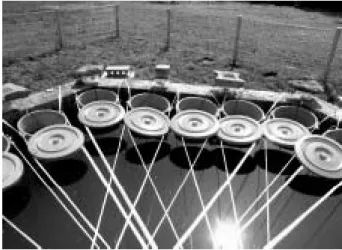
은 플라스틱 재질로 된 바닥이 폐쇄된 원통(
높이1.2 m,
직경60 cm)
을 연못의 가장자리에 밀착하고 강우의 직접적인 영향을 막기 위해 강우시와 야간에는 물통의 상부5 cm
높이에 덮개로 덮어 공기 출입과 강우 를 차단하였다.
물통은 균형을 유지하기 위해 사면을 밧 줄로 고정하고,
각 물통은 살조세균 처리2
일전에 현장수100 L
를 각각 넣고 소형 전기펌프로 실험종료일까지 계 속 하여 부드럽게 순환시켰다(Fig. 1).
실험은 대조군과 실험군으로3
회 반복 실시하였는데,
실험군은mesocosm
내에 현장수를 채우고2
일 동안 안정화시킨 다음,
생물제 재를 처리하였다.
생물제재는100 L mesocosm
에 이미Microcystis aeruginosa
에 대한 살조능이 밝혀진 살조세 균Xanthobacter autotrophycus SM02 (Sang et al. 2004)
을 수중 농도1
×10
7cells mL
-1가 되도록0.5% Casitone
배지와 함께 처리하였다. Casitone (CAS)
와 살조세균(BAC)
이 혼합된 생물제재(CAS±BAC)
처리에 따른mesocosm
내 환경요인,
식물플랑크톤 출현 종수,
각 출현 종의 현존량,
군집지수,
조류독소microcystin-LR
의 변동 을 각각 조사하였다.
3.
환경요인 조사환경요인 조사는 각
mesocosm
의 중심 부분에서(
수심30 cm)
수행하였으며,
수온, pH,
용존산소는 현장에서 직Fig. 1. Photographs of experimental mesocosm construct-
ed in Youkkagji pond.
접
portable multiparameter (Horiba U-10, Japan)
를 이 용하여 측정하였다.
영양염 분석을 위한 시료는 각meso- cosm
에서500 mL
를 채수하여 채수통에 넣고ice box
에 담아 실험실로 운반한 후 수질오염공정시험방법(APHA, 1995)
에 준하여 분석하였다.
아질산성 질소(NO
2-N)
는sulfanilamide solution
과napthyl-ethylenediamine di- hydrochloride solution
을 이용하여 발색시킨 뒤543 nm
에서 흡광도를 측정하여 정량하였다.
질산성 질소(NO
3- N)
는 카드뮴 환원관(Cd-Cu reduction column)
에 시료를 통과시켜 아질산염으로 환원시킨 뒤 아질산 측정방법과 동일한 방법으로 측정하였다.
인산염은(PO
4-P)
은 몰리브 덴산(molibdate solution)
과 반응하여 생기는 황색의 몰리 브덴산 착물을 아스코르빅산(ascorbic acid)
으로 환원시켜 그 흡광도를 측정하였다. Chlorophyll a
는 현장수500 mL
를GF/C (Whatman 1.2 µ m porosity, England) filter
로 여과한 후, 90% acetone 10 mL
를 주입한 시험관에 넣 고 마쇄하여 하룻밤 냉암소에 보관 후, UV/Visible Spec- trophotometer (DU800, Beckman Coulter, Inc., Fuller- ton, California, USA)
를 사용하여multiple wavelength
에서 측정하였다.
4.
식물플랑크톤 현존량생물제재
(CAS±BAC)
처리에 따른 식물플랑크톤의 변 동을 파악하기 위하여 각mesocosm
에서 매일1
회씩10 mL
씩을 취해glutaraldehyde
용액으로(
최종 농도1%)
로 고정시켰다.
농축한 시료는 잘 혼합한 후Sedgwick- Rafter Counting Chamber
에 시료1 mL
을 골고루 옮긴 후10
분 이상 침전시킨 다음 광학현미경(Nikon eclipse 600, Japan)
×200
배 하에서 세포수를 계수하였다.
종 동 정을 위해 광학현미경400~1,000
배(Nikon-eclipse 600, Japan)
하에서 검경하였다.
동일 속(genus)
에서 뚜렷한 식별 형질의 차이를 보이지 않은 것들은 모두 미동정 처 리하였다.
한편,
생물제재처리에 따른 식물플랑크톤 군집 의 변화를 확인하기 위하여 출현된 종수 및 현존량을 근 거로 하여 우점종,
우점도지수(McNaughton, 1967),
다양 도지수(Shannon-Weaver, 1963),
균등도지수(Lloyd and Ghelard, 1964; Pielou, 1966),
풍부도지수(Margalef, 1958)
를 각각 계산하였다.
5.
남조독소Microcystin-LR
측정생물제재 처리에 의한 각
mesocosm
내 조류독소의 변 동을 파악하기 위하여,
처리 전후2
일 간격으로Micro- cystin-LR (MCLR)
를 측정하였다. MCLR
양은 크게1)
조체성
(cell extraction), 2)
용존성(dissolved)
으로 구분하여 효소면역학적 방법(ELISA, enzyme-linked immunosor- bent assay)
으로 분석하였다(Nagata et al., 1997).
분석은 시료400 mL
를GF/C
여과지에 여과 시킨 후 여과지에 걸러진 조체성 시료는 시험관에 넣고methanol 10 mL
를 가하고 동결 보관하였다가 분석하기 전,
동결 보관한 시 료를 해동하여10 µL
를 취하고 증류수990 µL
를micro centrifuge tube
에 넣은 후ELISA
분석에 사용하였다.
용 존성 독소는 해동하여 특별한 처리없이ELISA
분석에 사 용하였다.
독소분석은microcystins ADDA
잔기의mono- clonal antibody
를microplate
의well
에 고정화시킨 반응kit (Mitsubisi Kagaku Bio-clinical Laboratories, Inc.
Tokyo, Japan)
를 사용하였고 검출한계는0.05 µg L
-1이 다. Microcystin standard
는ELISA kit
에서 제공된 표준 물질을50, 100, 200, 400, 1600 pg mL
-1를well plate
에 각각50 µ L
씩 접종하고, microplate reader (Labsystem iEMS Reader MF, FINLAND)
를 이용하여450 nm
에서 측정한 다음,
구해진 검량선을 기준으로 시료 중의MCLR
농도를Ascent S/W (Labsystem)
의4
계수logistic
곡선에 의한 회귀식을 사용하여 정량하였다.
결 과
1.
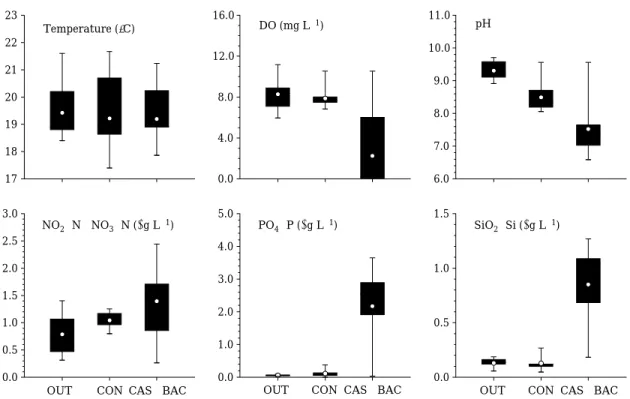
이화학적 환경요인연구기간 동안
mesocosm
의 이화학적 환경요인 중 수 온을 제외한 모든 요인이 대조군과 처리군(CAS±BAC)
간에 뚜렷한 차이를 보였다(Fig. 2).
수온은 평균19.3
�C (17.4~21.7
�C)
로서 외부환경이나 실험군간에 큰 차이를 보이지 않았다.
용존산소는 대조군과mesocosm
외부환경(6.85~8.45 mg L
-1)
은 큰 차이를 보이지 않은 반면, CAS
±BAC
처리군(
평균0.38 mg L
-1)
에서 급속하게 혐기화가 일어났다.
pH
역시 실험초기에9.56
에서 대조군(8.06)
에 비해CAS±BAC
처리군(6.58)
에서 크게 감소하였다.
질산염(NO
2-N±NO
3-N)
은 대조군(
평균= 1.045 mg L
-1)
에 비 해CAS±BAC
처리군(
평균= 1.547 mg L
-1)
에서 약1.5
배 이상 높았다.
인산염(PO
4-P)
과 규산염(SiO
2-Si)
은CAS±BAC
처리 이후 뚜렷하게 증가하였는데,
인산염은 대조군(
평균= 0.138 mg L
-1)
보다CAS±BAC
처리군(
평균= 2.169 mg L
-1)
에서15
배 이상 증가하였다.
규산염 역시 크게 증가하였는데 대조군(
평균= 0.127 mg L
-1)
보다CAS±BAC
처리군(
평균= 0.850 mg L
-1,
범위= 0.183~
1.269)
에서 약6.7
배 높았다.
결국 유해조류 생물제재 처리에 의해 수중 내 뚜렷한
pH
와DO
감소 및 영양염 증 가가 일어났다.
2.
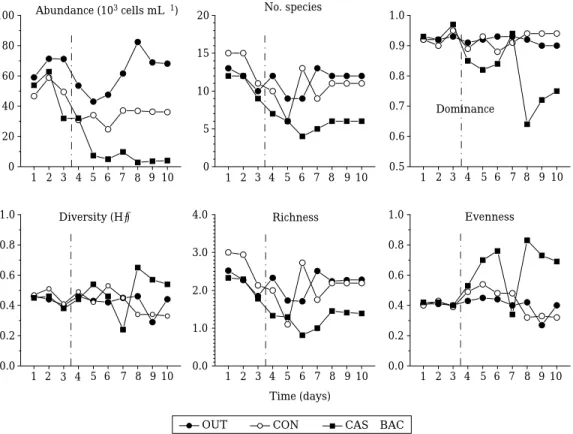
식물플랑크톤 군집변화생물제재 처리 후 식물플랑크톤 군집의 변화는
Fig. 3
과 같다.
실험기간 동안 식물플랑크톤 밀도는 대조군에서 평균3.9
×10
4cells mL
-1(
범위= 2.5~5.9
×10
4cells mL
-1)
로서 변동폭은 크지 않았으나 생물 실험군에서는 평균1.62
×10
4cells mL
-1(
범위= 0.3~6.3
×10
4cells mL
-1)
로 서 약60%
정도 감소되었다.
출현 종수 역시 생물제재 처리에 따라 뚜렷한 감소를 보였는데,
대조군에서 평균11
종(
범위= 6~15
종)
를 보인 반면, CAS±BAC
처리군에 서는 평균7
종(
범위= 4~12
종)
으로 약간 감소하였다.
우 점종 지수는 생물제재를 처리하지 않은 대조군에서 평균0.92 (
범위= 0.88~0.95)
로서Microcystis aeruginosa
의 절대적인 우점을 보였다.
이에 반해 생물제재 처리 후에 는 평균0.88 (
범위= 0.64~0.97)
으로 뚜렷한 감소를 보였 다.
종 다양성 지수(H ′ )
는 대조군의 경우,
평균0.43 (
범위= 0.33~0.53),
생물제재 처리군에서는 평균0.47 (
범위= 0.24~0.57)
로 실험 후반으로 갈수록 증가하였다.
이는 출현 종수의 증가라기보다 현존량의 감소로 인한 상대적인 다양성 지수가 증가한 것으로 판단된다
.
조사기간 중 식물플랑크톤 풍부도지수는 생물제재 처리 전후에 큰 차 이를 보였다.
대조군의 경우 약2.2
±0.5
인 반면,
처리군 은1.5
±0.5
를 나타내어 처리 후의 낮은 종 출현과 낮은 현존량에 기인한 것으로 판단된다.
균등성 지수는 풍부도 와 상반된 결과를 보였다.
대조군의 경우 평균0.42 (
범위= 0.32~0.54)
인 반면,
생물제재 처리군에서는 평균0.58 (
범위= 0.34~0.76)
로서 실험 후반으로 갈수록 큰 차이를 보였다.
결국 실험초기부터 남조M. aeruginosa,
녹조Ankistrodesmus spp.
가 우점하였던mesocosm
내외부 환 경은 식물플랑크톤 군집이 비교적 안정된 반면,
생물제재(CAS±BAC)
처리에 따른 식물플랑크톤 총 현존량 감소 로 인하여 우점도지수는 감소하고 종다양성,
풍부도,
균 등도 지수 등은 증가하였다.
3.
우점종과 엽록소a
변동실험연못의 식물플랑크톤 군집은 실험초기에 남조
Microcystis aeruginosa
와 녹조Ankistrodesmus spp.
가 총 밀도의90%
이상을 점유하였으며,
그밖에 녹조Scenedesmus quadricauda, Ankistrodesmus falcatus
가 약5~7%
를 차지하였다.
시간의 경과에 따라 대조군은17 18 19 20 21 22 23
OUT CON CAS
±BAC OUT CON CAS
±BAC
OUT CON CAS
±BAC Temperature (� C)
0.0 4.0 8.0 12.0
16.0 DO (mg L
-1)
6.0 7.0 8.0 9.0 10.0 11.0 pH
0.0 0.5 1.0 1.5 2.0 2.5 3.0
NO
2-N
±NO
3-N (µg L
-1) PO
4-P (µg L
-1) SiO
2-Si (µg L
-1)
0.0 1.0 2.0 3.0 4.0 5.0
0.0 0.5 1.0 1.5
Fig. 2. Effects of CAS plus BAC on major physicochemical variables during the study period. OUT: outer environment,
CON: control, CAS±BAC: Casitone plus algicidal bacterium.
Mesocosm
외부 밀도의20~30%
정도로 낮았다.
실험 기 간 동안 생물제재의 처리에 상관없이 가장 우점하였던M. aeruginosa
는 대조군의 경우, mesocosm
설치 후3
일 간 일시적인 감소가 일어났으나 다시 증가하여 실험 후 기에는3.0
×10
4cells mL
-1까지 도달한 반면,
생물제재 처리군에서는 처리8
일부터 거의 출현하지 않았다.
제2
우점종인Ankistrodesmus spp.
는 실험 초기부터 완만하 게 감소하였는데,
대조군에서 점차적으로 완만하게 감소 한 반면,
생물제재CAS±BAC
처리군에서는 처리1
일째 부터 급격하게 감소하여 처리4
일째에는 극히 낮은 현존 량(0.28
×10
4cells mL
-1)
을 보였다.
또 다른 우점종Scenedesmus quadricuda
와Ankistrodesmus falcatus
는 실험 초기부터 낮은 현존량을 보였으나CAS±BAC
처리 에 의해 더욱 뚜렷하게 감소하였다(
평균; 1.2
×10
4cells mL
-1� 0.3
×10
4cells mL
-1).
결국 식물플랑크톤 군집은생물제재
CAS±BAC
처리에 의해 대상조류인M.
aeruginosa
뿐만 아니라 다른 우점종들 역시 강한 억제효 과를 받은 것으로 밝혀졌다(Fig. 4).
한편,
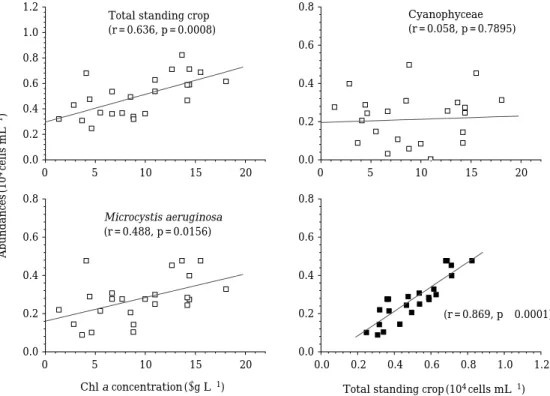
실험기간 동안 생물제재의 처리와 상관없이 전체적으로M. aeruginosa
는 식물플랑크톤 총 밀도
(r = 0.87, p⁄0.0001)
와 엽록소a
양(r = 0.49, p⁄0.05)
과 높은 상관성을 나타낸 반면,
남 조류 총밀도와는 극히 낮은 관계를 보였다(Fig. 5).
4.
조류독소microcystin-LR
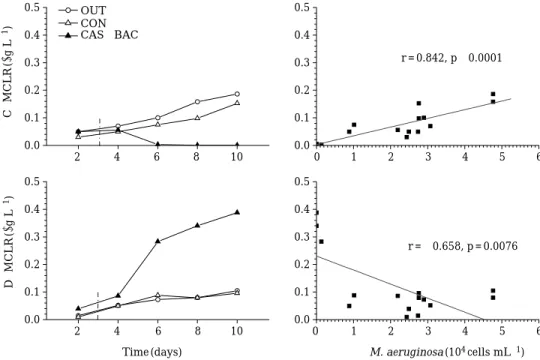
의 변동Mesocosm
외부 및 대조군의microcystin-LR
농도는 조 체성과 용존성 모두 점차적으로 증가하였으나, CAS±BAC
처리에 따라 조체성 독소의 감소 및 용존성 독소의 증가가 일어났다(Fig. 6).
또한CAS±BAC
처리 전에는 조체성이 용존성보다 높았으나 처리 후에는 남조M. aeruginosa
감소로 인한 조체성 감소 및 용존성 증가 가 뚜렷하였다.
특히,
조체성은CAS±BAC
처리3
일째부 터 거의 검출되지 않은 반면,
용존성은 처리3
일째부터 점차 급격하게 증가하여 대조군 용존성 농도의4
배 이상 증가하였다.
결국 독소microcystin-LR
는 남조M.
aeruginosa
밀도와 높은 상관성을 보였는데,
각각 조체성 에 대해 강한 양의 상관(r = 0.842, p⁄0.0001),
용존성에 대해 음의 상관(r = -0.658, p = 0.0076)
을 나타냈다.
1 2 3 4 5 6 7 8 9 10 0.0
0.2 0.4 0.6 0.8 1.0
1 2 3 4 5 6 7 8 9 10 0.0
1.0 2.0 3.0 4.0
1 2 3 4 5 6 7 8 9 10 0.0
0.2 0.4 0.6 0.8 1.0
1 2 3 4 5 6 7 8 9 10 0.5
0.6 0.7 0.8 0.9 1.0
1 2 3 4 5 6 7 8 9 10 0
5 10 15 20
1 2 3 4 5 6 7 8 9 10 0
20 40 60 80 100
Diversity (H′) Richness Evenness
OUT CON CAS±BAC
Dominance No. species
Time (days) Abundance (10
3cells mL
-1)
Fig. 3. Effects of CAS plus BAC on the ecological indices the phytoplankton communities during the study period. OUT:
outer environment, CON: control, CAS±BAC: Casitone plus algicidal bacterium. The dot line means the treatment
time of biological control agent.
0 5 10 15 20 0.0
0.2 0.4 0.6 0.8 1.0 1.2
0 5 10 15 20
0.0 0.2 0.4 0.6 0.8
0 5 10 15 20
0.0 0.2 0.4 0.6 0.8
0.0 0.2 0.4 0.6 0.8 1.0 1.2 0.0
0.2 0.4 0.6 0.8
Total standing crop (10
4cells mL
-1)
Abundances (104 cells mL-1)Chl a concentration (µg L
-1) Total standing crop (r = 0.636, p = 0.0008)
Cyanophyceae (r = 0.058, p = 0.7895)
Microcystis aeruginosa
(r = 0.488, p = 0.0156)
(r = 0.869, p⁄0.0001)
Fig. 5. Correlation between chlorophyll a concentrations and standing crops of phytoplankton, cyanophyceae, and M.
aeruginosa, and between total standing crops of phytoplankton and M. aeruginosa throughout the study.
0 10 20 30 40 50 60
0 10 20 30 40 50 60
1 2 3 4 5 6 7 8 9 10
0 1 2 3
1 2 3 4 5 6 7 8 9 10
0 1 2 3
Abundance (103 cells mL-1)
Time (days)
Microcystis aeruginosa Ankistrodemus sp.
Scenedesmus quadricauda Ankistrodesmus falcatus
OUT CON CAS
±BAC
Fig. 4. Effects of CAS plus BAC on the dominant species (over 90% of total standing crops) during the study period. OUT:
outer environment, CON: control, CAS±BAC: Casitone plus algicidal bacterium. The dot line means the treatment
time of biological control agent.
고 찰
남조 대발생 연못에 설치한
mesocosm
에 살조세균Xantobacter autotrophycus
와Casitone
를 혼합 처리한 결과,
남조Microcystis aeruginosa
의 뚜렷한 감소는 물론 식물플랑크톤 총현존량의 감소가 일어났다.
특히 전자는 처리8
일째 거의 관찰되지 않고,
후자는 약60%
이상의 감소효과를 나타냈다.
뿐만 아니라Ankistrodesmus spp., Scenedesmus quadricauda, Ankistrodesmus falcatus
등 대부분의 우점종이 감소하였으며,
역으로 특정종의 증가 는 관찰되지 않았다.
본 실험에 사용된 살조세균SM02
는 이미Sang
등(2004)
에 의하여 살조능이 밝혀진 균주 로서,
배양M. aeruginosa
에 살조세균pellet
만을 처리하 거나 또는Casitione
과 혼합 처리할 경우 효과적인 살조 능을 보였으나, 1L
규모의 현장수 실험에서Casitone
혼 합 처리군에서만 살조능을 보였다(Sang et al., 2004).
Choi
등(2005)
의 연구에서도 배양M. aeruginosa
에 효과 적인 제어능을 보였던Streptomyces neyagawaensis
역시 현장수에 단독 처리할 경우,
거의 제어효과를 나타내지 않았다.
두 연구에 의하면 결국 살조세균을 이용한 현장 수 남조M. aeruginosa
제어는 살조세균의 배지첨가에 따 른 살조능의 활성을 증가시켰다고 판단된다.
비록100 L
mesocosm
에0.1% Casitone
처리가 남조는 물론 식물플 랑크톤 제어에 매우 효과적이었으나 현장수에 함께 첨가 한 배지Casitone
이 살조세균의 성장에 어떠한 효과를 주었는지 정확히 알 수 없었다. Casitone
처리 이후 지속 적인 감소와8
일째부터 계수범위 미만으로 관찰되는 점 을 고려할 때,
처리한Casitone
은 시간의 경과에 따라 살 조세균이 이용하였을 것으로 사료되었다.
다만 처리한 살 조세균과 현장수 내에 존재하였던 박테리아와의 먹이경 쟁 등(Lovejoy et al., 1998)
과 같은 살조세균의 거동에 대한 다양한 연구가 계속되어야 할 것이다.
생물제재 처리 이후
mesocosm
내pH,
용존산소의 감소 와 영양염의 증가가 일어났다.
특히pH
의 감소는 식물플 랑크톤의 감소와 밀접한 관계를 보이며(Horne and Goldman, 1994),
용존산소의 감소는Casitone
첨가에 의 한 살조세균 및 수계 내 박테리아의 활성 증가로 판단된 다(Lewis et al., 1986).
또한 급격한 영양염의 증가는 유 기물Casitone
유입으로 인한 결과이며(Horne and Goldman, 1994),
인산염(PO
4-P)
과 규산염(SiO
2)
의 농도 가 급증하였는데 살조세균의 투입시 나타나는 일반적인 현상이지만(Jung et al. 2004; Kang et al. 2005; Choi et al. 2005),
특히 인산염의 경우,
대조군보다15
배 이상의 급격한 증가를 가져왔는데,
이는 살조세균을 이용한 조류 제어에 있어 매우 부정적인 결과로 판단되며 규산염 역2 4 6 8 10
0.0 0.1 0.2 0.3 0.4 0.5
2 4 6 8 10
0.0 0.1 0.2 0.3 0.4 0.5
0 1 2 3 4 5 6
0.0 0.1 0.2 0.3 0.4 0.5
0 1 2 3 4 5 6
0.0 0.1 0.2 0.3 0.4 0.5 OUT
CON CAS
±BAC
M. aeruginosa (104
cells mL
-1) Time (days)
D-MCLR (µg L-1)C-MCLR (µg L-1)
r = 0.842, p⁄0.0001
r = -0.658, p = 0.0076
Fig. 6. Variation of the concentrations of microcystin-LR after the treatment of CAS plus BAC, and relation to the
abundance of M. aeruginosa throughout the study.
시
6.5
배 이상의 높은 증가를 가져왔으나,
다른 규조의 성장은 관찰되지 않았다.
이런 결과들은 생물제재를 이용 한 남조M. aeruginosa
의 제어에 있어 배지를 포함한 살 조세균의 적용이 수계 내 영양염이나 용존산소의 급격한 변화를 가져와 다른 수중생물에도 심각한 영향을 미칠 수 있음을 시사해 주고 있다.
다만,
퇴적층(sediment)
이 없는mesocosm
내부에서 지속적인 물의 교란으로 인한 섬모충, HNF,
동물플랑크톤 등의 섭식활동이나 퇴적층에 의한 영양물질의 흡수 등이 원활치 못하고 살조세균에 의한 식물플랑크톤 분해 및 사멸과정에서 무기이온들이 그대로 수중에 용출되었을 것으로 사료되었다.
생물제재의 처리에 따른 남조류 감소와 더불어
mesocosm
내microcystin-LR
중 조체성 독소는 처리3
일 째부터 검출 되지 않았으며,
반대로 용존성 독소는 점차 증가하였다.
조체성 독소의 미검출은 살조세균에 의해Microcystis aeruginosa
가 감소되면서 대부분이 수중으로 용출되었을 것으로 판단된다.
김 등(1999)
은 호수에서 존 재하는microcystin
은 대부분 조류 세포 내에 존재하며 조류 세포를 제거하면 동시에 제거된다고 보고하였다.
그 러나 본 연구에서Microcystis
분해에 따른 용존성 독소 의 증가는 다른 수중생물이나 수서생태계의 심각한 교란 인자로 작용할 가능성이 매우 높다.
결국 하절기Microcystis aeruginosa
의 대발생을 보이는 대청호(
오 등, 1999),
낙동강(Ha et al., 2003),
주암호(Kim and Hwang, 2004)
등이 인근 지역의 주요 상수원인 점을 감 안한다면,
생물제재를 이용한 상수원 저수지의 남조류 제 어는 사실상 어려울 것으로 판단된다.
아울러 비록 공원 내 소형 연못과 같은 작은 수역일지라도 수온 감소와 함 께 남조세포의 사멸 및 분해 시 유리되는 용존성 독소의 증가에 대한 적극적인 대책이 필요하다고 사료되었다.
적 요
매년 남조
Microcystis aeruginosa
가 대발생하는 인공 연못에100 L mesocosm
를 설치하고 생물제재(Xanto- bacter autotrophycus±Casitone)
를 혼합 처리한 결과,
환 경요인의 변화(pH, DO
감소,
영양염 증가)
와 함께 식물플 랑크톤 군집의 뚜렷한 변화가 관찰되었다.
생물제재 처리 후M. aeruginosa
는 점차 감소하여8
일에는 관찰되지 않 았고,
식물플랑크톤 총 밀도의 약60%
이상이 감소하였 다.
또한 남조의 소멸과 함께 조체성 독소의 감소 및 용 존성 독소가 증가하였으며,
뚜렷한 영양물질의 증가에도 불가하고 현존량이 증가하는 종은 나타나지 않았다.
이러한 영양물질이나 용존성 독소의 증가는 생물제재 를 이용한 남조류 제어가 상수원 저수지와 같은 장소보 다는 규모가 작은 연못이나 저수지 등에 적합하며
,
생물 제재 처리 이후 수질변화에 대한 적극적인 수질관리 대 책이 마련되어야 할 것으로 판단되었다.
감사의 말씀
이 논문은
2004
년 한국학술진흥재단의 지원에 의하여 연구되었으며(KRF-2004-050-C00018),
본 연구수행에 협조해 주신 국립환경연구원 한강물환경연구소에 감사드 립니다.
참 고 문 헌