390
확장 SELECT 방법에 의한 새우조망의 꽃새우( Trachysalambria curvirostris) 망목 선택성
박창두✽·박해훈·김정년1
국립수산과학원 시스템공학과, 1국립수산과학원 자원관리과
Size Selectivity of a Shrimp Beam Trawl for
the Southern Rough Shrimp Trachysalambria curvirostris with the Extended SELECT Method
Chang-Doo Park
✽, Hae-Hoon Park, and Jung Nyun Kim
1Fisheries System Engineering Division, NFRDI, Busan 619-705, Korea
1
Fisheries Resources Management Division, NFRDI, Busan 619-705, Korea
Southern rough shrimp
Trachysalambria curvirostris
is exploited mainly by small shrimp beam trawl in coastal regions of Korea. To determine the size selectivity of a shrimp beam trawl for this species, a series of comparative fishing experiments was conducted in the sea adjacent to Geoje Island off the southern cost of Korea in June and November, 2010, using codends with four different mesh sizes(14.2, 17.8, 25.5, and 35.3 mm). The extended Share Each Length’s Catch Total(SELECT) analysis method, based on a multinomial distribution, was applied to the fishing data to obtain a master selection curve. The model with the estimated split parameters fit the catch data best. The master selection curve was estimated to be: s(R
)=exp(15.183R
-7.872)/[1+exp(15.183R
-7.872)], where the relative carapace length,R
, is the ratio of carapace length to mesh size. The relative carapace length for 50% retention was 0.518, and the selection range was 0.145. The results suggest that codends with a larger mesh size allow more small- sized shrimps to escape.Key words:
Trachysalambria curvirostris
, Shrimp, Beam trawl, Selectivity, SELECT method서 론
꽃새우(Southern rough shrimp,
Trachysalambria curvirostris
) 는 우리나라, 일본, 중국, 대만, 태국, 호주 등에 분포하며 산업 적으로 중요한 어업 대상종이다(NFRDI, 2001 ; Yamada et al., 2007 ; Cha et al., 2004). 우리나라 연안에서 어획되는 꽃새우는 주로 남해안과 서해안에 분포하고 있으며 Beam trawl의 일종인 새우조망 및 연안조망에 의하여 어획되고 있다. 현재 우리나라 에서는 새우 자원의 지속적 유효이용을 위하여 충청남도와 전라 북도 연안에서 조업하는 연안조망은 5월부터 9월 사이에 망목 크기 25 mm 보다 큰 어구를 사용하여 꽃새우를 어획하도록 규 정되어 있고, 전라남도 및 경상남도에서 조업하는 새우조망은 각각 9월부터 6월, 10월부터 4월 사이에 망목크기 16 mm 이상 을 사용하여 조업하도록 규정하고 있다.지금까지 꽃새우의 생물학적 특성에 관해서는 Cha et al.
(2004)에 의한 서해안 꽃새우의 성숙과 성장에 관한 연구, Oh et al. (2003)에 의한 거문도 연안 꽃새우의 성숙과 성장 연구, Yamada et al. (2007)에 의한 Tokyo만 꽃새우의 성장과 성숙 연
구 등이 있다. 새우조망에 대한 꽃새우의 망목 선택성 연구는 일 본 Seto 내해 및 Osaka 만에서 수행된 Tokai et al. (1990)의 연 구와 Nishikawa et al. (1994)의 연구가 있으나, 상호 차이가 있 는 선택성 결과를 나타내고 있고 우리나라 연안에서 조업하는 새우조망 또는 연안조망에 대한 꽃새우의 망목 선택성 연구는 없는 실정이다.
일반적으로 연근해에 서식하는 어업자원의 지속적 유효 이 용을 위해서는 장래 성장하여 재생산에 기여하는 치어의 혼획을 감소시키는 것이 중요하다. 이를 위해서는 어구의 망목 선택성 을 활용하여 치어는 해중에서 망목을 통하여 빠져 나가게 하고 상품성 있는 개체만을 선택적으로 어획하는 것이 바람직하다.
본 연구에서는 우리나라 남해안에서 조업하는 새우조망에 대 한 꽃새우의 망목선택성 추정을 위하여 끝자루의 망목크기가 다 른 새우조망을 사용하여 시험 조업을 수행하고 SELECT(Share Each Length’s Catch Total) 방법을 적용하여 그 결과를 해석하 였다(Millar and Walsh, 1992 ; Millar and Fryer, 1999 ; Jeong et al., 2000 ; Harada et al., 2007). 또한, 기존 연구 내용과의 비 교 분석을 통하여 우리나라 연안에서 조업하는 새우조망에 대한 꽃새우의 망목 선택성을 명확히 하였다.
*Corresponding author: [email protected] Kor J Fish Aquat Sci 44(4), 390-396
DOI : http://dx.doi.org / 10.5657/KFAS.2011.0390
한수지, 44(4), 390-396, 2011
391
재료 및 방법
시험조업 및 조사
시험 조업에 사용한 새우조망(NFRDI, 2002 ; Oh et al., 2003
; Oh et al., 2004)은 발줄 12.5 m, 뜸줄 10.2 m, 자루그물 17 m, 끝자루 3 m이었다. 시험 어구의 끝자루 망목 크기(본 연구에서 는 내경을 나타낸다)는 각각 14.2, 17.8, 25.5, 35.3 mm를 사용 하였다. 시험 조업은 2010년 6월과 11월에 수행하였다. 시험조 업 선박은 4.9톤급 새우조망 어선 2척을 용선하여 수행하였으며 교호(交互) 조업법(Alternate haul)으로 시험하였다. 즉, 끝자루 의 망목크기가 다른 어구를 각각 30분씩 예망하는 방법으로 시 험하였다.
시험 어구에 포획된 어획물은 새우류, 어류, 게류, 연체류 등으로 분류하여 중량을 측정하였다(NFRDI, 2001, 2004 ; OFCFJ, 2009). 어획된 새우는 종류에 따라 분류하였다(Cha et al., 2004 ; Choi et al., 2002 ; Araki and Hayashi, 2002 ; Hayashi, 1988). 새우류의 경우, 어획 개체수가 많은 경우에는 일정량을 표본 추출하여 갑장(Carapace length, CL)을 측정하 였다. 새우류 중에서 망목선택성 대상 어종인 꽃새우는 모든 어 획 개체의 갑장을 측정하였다. 어류, 게류 등은 개체별 중량(g) 을 측정하였다.
망목 선택성 곡선 추정
어구의 망목선택성곡선 추정 방법에는 Kitahara 방법 (Kitahara, 1968 ; Park et al., 2003), Tokai and Kitahara 방법 (Tokai and Kitahara, 1989), SELECT 방법(Millar and Walsh, 1992) 등이 있다. 본 연구에서 예망어구 등에 많이 적용되는 SELECT 방법을 확장 적용하였다(Fujimori and Tokai, 2001 ; Park et al., 2004 ; Wileman et al., 1996 ; Yamashita, 2009). 새 우 조망에 대한 꽃새우의 망목선택성 곡선을
s
(R
ij)이라 하면 망 목크기m
i(i
=1,2,3,…,k
)인 새우조망에 갑장계급l
j(j
=1,2,3,…,n) 인 새우의 어획 개체수c
ij 는 이하의 수식으로 표현된다.(1)
여기서p
i는 망목크기별 조우 확률(split parameter)이고 이 다. 또한,R
ij는 상대 갑장으로서l
j/m
i 로 표현된다. 본 연구에서 는p
i를 어획노력량(조업 회수)의 비율로 나타낸 경우(p
-fixed model)와 추정한 경우(p
-estimated model)로 구분하여 해석하 였다. 또한, 새우 조망의 선택성 곡선을 나타내는 수식s
(R
ij)은 이하의 Logistic 식으로 표현하였다. 여기서a
와b
는 곡선의 파 라미터이다.(2)
갑장계급
l
j인 새우가 망목크기m
i인 새우 조망에 어획될 비 율Ø
ij은 이하와 같이 표현된다. 수식의C
j는 망목크기가 다른 각각의 새우 조망에 어획된 갑장 계급 lj의 새우 개체수를 나타낸다.
(3)
SELECT 모델에 있어서 갑장
l
j인 새우가 망목크기m
i인 새우 조 망에 어획될 비율은 식(1)과 (3)으로부터 아래와 같이 주어진다.(4)
각 수식의 파라미터는 이하의 대수 함수를 최대화함으로서 추정 할 수 있다.
(5)
여기서
L
은 우도를 나타낸다. 본 연구에서는 어구와의 조우 확 률이 일정하다고 가정한 모델(p
-fixed model)과 조우 확률을 추 정한 모델(p
-estimated model) 중에서 어느 쪽 모델이 보다 적절 한가를 검토하기 위하여 AIC 값을 비교하였다(Akaike, 1974).AIC 값은 최대대수우도를 MLL, 파라미터 수를 Q라고 하면 AIC = -2MLL+2Q로 주어지며 AIC 값이 작은 모델이 양호한 모델로 판정된다. 또한, 어구의 망목선택성을 평가하는 지표로 서 아래의 수식으로 표현되는 50%상대선택갑장
R
50과 선택범 위S.R.
(=R
75-R
25)을 나타내었다(Wileman et al., 1996).(6)
연구 결과
시험조업 결과
새우조망을 사용한 어획 자료는 6월 시험에서는 어구 사고 등으로 망목크기 14.2 mm와 25.5 mm의 자료만 확보되었고 11월 시험에서는 각 망목크기별 어획 자료가 모두 확보되었다 (Table 1). 시험 어구에 어획된 새우류의 어획 비중은 망목 크기 에 따라 다소 차이는 있으나, 망목크기 35.3 mm의 경우를 제외 하면 25-31%의 범위였다(Table 1). 어획된 새우류 중에서 마루 자주새우(Sand shrimp,
Crangon hakodatei
)가 61% 정도를 차 지하였고 꽃새우(Trachysalambria curvirostris
)가 13%, 그라비 새우(Chinese ditch prawn,Palaemon gravieri
)가 25%, 남방도 화새우(Pandalus gracilis
)가 4% 정도를 차지하였다. 계절에 따 른 꽃새우의 갑장 조성을 보면 6월에는 갑장 14 mm에 최빈치 (mode)가 나타나고 11월에는 갑장 10 mm에 최빈치(mode)가 나타났다(Fig. 1). 또한, 6월에 비교적 큰 개체가 어획되었고 11 월에는 상대적으로 큰 개체의 어획비율이 감소하는 것을 알 수 있다.시험어구에 어획된 어류의 비율은 망목크기가 증가할수 록 높아지는 경향을 나타내었다(Table 1). 어류는 약 20여종
∑= k =
i pi
1 1
s( R
ij)=exp(a+bR
ij) /[1+exp(a+bR
ij)]R
50= - a / b , S.R. = (2ln3) / b
새우조망의 꽃새우 망목 선택성
Ø (Rij)= pi Nj s(Rij) pi Nj s(Rij)
k
i=1
loge L= ( cij loge Ø(Rij))
n
j=1 k
i=1
Øij= cij cij = cij Cij k
i=1
박창두·박해훈·김정년
392
이 어획되었으며 주요 어종은 꼼치(
Liparis tanakai
) 19.6%, 달 강어(Lepidotrigla microptera
) 7%, 문치가자미(Pleuronectes yokohamae
) 2.4%, 아귀(Lophiomus setigerus
) 16.6%, 붕장어 (Conger myriaster
) 3.1% 등이었다. 연체류는 참문어(Octopus vulgaris
), 참갑오징어(Sepia esculenta
), 낙지(Octopus minor
),쭈꾸미(
Octopus ocellatus
)가 어획되었다. 게류는 꽃게(Portunus trituberculatus
), 점박이꽃게(Portunus sanguinolentus
), 원숭 이게(Carcinoplax longimana
), 두점박이민꽃게(Charybdis bimaculata
)가 어획되었다.망목선택성 곡선
시험조업 결과로부터 얻어진 망목 크기별 꽃새우의 갑장 조 성을 Fig. 2에 나타내었다. 망목 크기가 각각 14.2, 17.8, 25.5 mm로 증가함에 따라 꽃새우의 최빈치(mode)는 10, 12, 14 mm 로 이동하고 망목크기 35.3 mm에서는 어획량이 적어 최빈치가 명확하지 않다.
시험 어구에 어획된 꽃새우의 갑장조성 자료를 활용하여 각 각의 망목크기별 어구에 어획되는 비율
Ø
ij를 구하고 조우 확률 이 일정하다고 가정한 모델(p
-fixed model)과 조우 확률을 추정 한 모델(p
-estimated model)의 어획비율Ø
(R
ij)를 계산하였다 (Fig. 3). 조우확률 일정 모델(p
-fixed model)의 경우에는 망목크기 14.2, 25.5, 35.3 mm의 갑장이 큰 범위에서 관측치와 추정치 사이에 다소 일치하지 않는 부분이 보인다. 조우확률 추정 모델 (
p
-estimated model)의 경우에는 망목크기 17.8, 35.3 mm의 갑 장이 큰 범위에서 관측치와 추정치 사이에 다소 일치하지 않는 부분이 있다.Fig. 2. Carapace length distributions of the southern rough shrimp
Trachysalambria curvirostris
caught in the experimental nets.Fig. 1. Seasonal catch frequency of the southern rough shrimp
Trachysalambria curvirostris
caught in the experimental nets.0.0 0.1 0.2 0.3 0.4
0 4 8 12 16 20 24 28 32
Carapace length (mm)
Frequency
June (N=296) November (N=1305)
Carapace length (mm)
0 4 8 12 16 20 24 28 32
0 100 200 300 400
Catch in number
N = 813 mesh size
14.2 mm
0 4 8 12 16 20 24 28 32
0 50 100 150
Catch in number
N = 380 mesh size
0 4 8 12 16 20 24 28 32
0 10 20 30 40
Catch in number
N = 100 mesh size
25.5 mm
0 4 8 12 16 20 24 28 32
0 2 4 6 8 10
Catch in number
N =22 mesh size
35.3 mm
0.0 0.1 0.2 0.3 0.4
0 4 8 12 16 20 24 28 32
Carapace length (mm)
Frequency
June (N=296) November (N=1305)
Carapace length (mm)
0 4 8 12 16 20 24 28 32
0 100 200 300 400
Catch in number
N = 813 mesh size
14.2 mm
0 4 8 12 16 20 24 28 32
0 50 100 150
Catch in number
N = 380 mesh size
0 4 8 12 16 20 24 28 32
0 10 20 30 40
Catch in number
N = 100 mesh size
25.5 mm
0 4 8 12 16 20 24 28 32
0 2 4 6 8 10
Catch in number
N =22 mesh size
35.3 mm Classification
Mesh size of net (mm)
14.2 17.8 25.5 35.3
weight(g) ratio weight(g) ratio weight(g) ratio weight(g) ratio
No. of hauls 2 1 2 1
Shrimps 7,257 0.26 2,416 0.31 2,860 0.25 170 0.07 Fishes 14,223 0.51 3,858 0.50 7,825 0.69 1,967 0.81 Mollucca 2,309 0.08 170 0.02 304 0.03 140 0.06 Crabs 3,715 0.13 1,049 0.14 427 0.04 51 0.02 Others 201 0.01 269 0.03 - - 1 12 0.05 Total 27,705 1 .00 7,762 1.00 11,416 1.00 2,440 1.00 Table 1. Catch weight and ratios of each species caught in the experimental gears
새우조망의 꽃새우 망목 선택성
393
Fig. 4. Estimated master selection curves of the shrimp beam trawl for southern rough shrimp
Trachysalambria curvirostris
caught in the experimental nets.0.0 0.2 0.4 0.6 0.8 1.0
0.0 0.2 0.4 0.6 0.8 1.0 1.2 1.4 1.6 Carapace length / Mesh size
Retention probability
p-fixed p-estimated 14.2 mm
p-fixed
0 0.2 0.4 0.6 0.8 1
0 5 10 15 20 25 30 0 5 10 15 20 25 30
0 5 10 15 20 25 30 0 5 10 15 20 25 30
0 5 10 15 20 25 30 0 5 10 15 20 25 30
0 5 10 15 20 25 30 0 5 10 15 20 25 30
Catch proportion . 14.2 mm p-estimated
0 0.2 0.4 0.6
Catch proportion.
17.8 mm
0 0.2 0.4 0.6
Catch proportion
25.5 mm
0 0.1 0.2
0 0.2 0.4 0.6 0.8 1
0 0.2 0.4 0.6
0 0.2 0.4 0.6
0 0.1 0.2
Carapace length (mm)
Catch proportion. Catch proportion .Catch proportion.Catch proportionCatch proportion.35.3 mm
17.8 mm
25.5 mm
Carapace length (mm) 35.3 mm
Observed
Expected Observed
Expected
Observed Expected Observed
Expected
Observed
Expected Observed
Expected
Observed Expected Observed
Expected
Fig. 3. Plots of the proportion taken in each mesh size to the total catch and fitted curves for the two models with
p
-estimated(left) andp
-fixed (right).각 모델에서 계산된 파라미터
a
,b
및p
의 값과 선택률 50%를 나타내는 50%상대선택갑장
R
50, 선택범위S.R
.(=R
75-R
25)를 Table 2에 나타내었다. 또한, 이들 선택 곡선의 파라미터 추정치 를 사용하여 각 모델의 망목 선택성 곡선 Master Curve를 Fig. 4 에 나타내었다. 망목 선택성 곡선 Master Curve를 보면 조우확 률 일정 모델(p
-fixed model)이 조우확률 추정 모델(p
-estimated model)보다 약간 우측에 위치하고 있고, 각 모델의 50%상대 선택갑장은 0.518, 0.599로서 조우확률 추정 모델(p
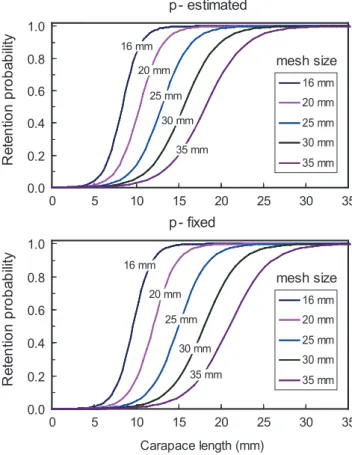
-estimated model)이 다소 작은 값을 나타낸다는 것을 알 수 있다.각 모델로부터 계산된 파라미터에 기초하여 망목크기별 선 택 곡선을 나타내면 Fig. 5와 같다. 망목크기별 선택 곡선으로부 터 망목크기가 16, 20, 25, 30, 35 mm로 증가함에 따른 50% 선 택갑장을 계산하면 조우확률 추정 모델(
p
-estimated model)의394
경우에는 각각 8.3, 10.4, 13.0, 15.6, 18.1mm를 나타내고 조우 확률 일정 모델(
p
-fixed model)의 경우에는 각각 9.6, 12.0, 15.0, 18.0, 21.0을 나타낸다.Fig. 5. Selection curves of shrimp beam trawl for the southern rough shrimp
Trachysalambria curvirostris
caught in the experi- mental nets.고 찰
우리나라 서해안 외연도 및 남해안 거문도 연안에서 채집된 꽃새우의 군성숙 갑장은 각각 15.4 mm 및 18.9 mm로 보고되어 있다(Cha et al., 2004 ; Oh et al., 2003). 또한, 지역에 따라 다소 차이는 있으나, 꽃새우의 산란 시기는 6-8월이고 어장에 신규 가 입하는 개체는 8월 또는 9월에 나타나며 이후 계속 성장하여 산 란 시기에 최대의 갑장을 나타낸다. 본 연구에서 나타낸 6월과 11월의 꽃새우 갑장조성을 보면 6월의 개체 크기가 11월의 개 체 크기에 비하여 상당히 큰 것으로 나타났다(Fig. 1). 이것은 본 연구가 수행된 거제도 연안의 꽃새우도 외연도나 거문도 연안에 서식하는 꽃새우와 비슷한 생물 생태학적 특성을 가진 영향으로 판단된다.
본 연구에서 망목선택선 곡선의 추정을 위하여 적용한 두 모 델(
p
-estimated,p
-fixed)의 AIC 값을 비교하면 조우확률 추정 모델(p
-estimated model)이 조우확률 일정 모델(p
-fixed model) 에 비하여 다소 작은 값을 나타내고 있다. 따라서 본 연구에 서는 새우조망의 망목선택성 곡선으로서 조우확률 추정 모델 (p
-estimated model)의 결과를 채택한다. 조우확률 추정 모델 (p
-estimated model)의 경우, 망목크기 17.8, 35.3 mm의 갑장이 큰 범위에서 관측치와 추정치 사이에 다소 일치하지 않는 부분 이 있었다(Fig. 3). 이것은 비교적 갑장이 큰 꽃새우가 어획되는 6월 시험에서 어구 사고 등으로 망목크기 14.2 mm와 35.3 mm 의 어획 결과가 포함되지 못한 영향이다. 본 연구에서 사용한 교 호(交互) 조업법(Alternate haul)으로 시험할 경우, Cover net으 로 인한 Masking effect나 끝자루와 Cover net의 상대적인 크 기 또는 망목크기를 고려할 필요는 없으나, 어장에 분포하는 생 물이 균등하게 분포하지 않을 수 있고 예망 조건을 항상 동일하 게 유지할 수 없는 경우가 발생하므로 조우확률p
를 추정하는 SELECT 방법이 망목선택성 해석에 적합하다고 생각된다. 특히, 본 연구에서와 같이 망목크기별 어획노력량이 동일하지 않은 경 우의 망목선택성 곡선 추정에는 SELECT 방법이 적합하다.본 연구의 망목선택성 결과로부터 망목크기가 16, 20, 22.5, 25, 27, 30, 35 mm로 증가함에 따른 꽃새우의 50%선택갑장은 각각 8.3, 10.4, 11.6, 13.0, 14.0, 15.6, 18.1 mm이다. Tokai et al. (1990)이 일본 Seto 내해 연안에서 망목크기가 다른 새우조 망에 Cover net을 부착하여 시험조업을 수행하고 3종류의 3차 식 스플라인 함수를 결합하여 해석한 꽃새우의 망목선택성 결 과로부터 망목크기가 16, 20, 22.5, 25, 27, 30, 35 mm인 어구의 50%선택갑장을 계산하여 보면 각각 8.3, 10.4, 11.8, 13.1, 14.2, 15.8, 18.4 mm이다. Nishikawa et al.(1994)이 Osaka 만에서 Cover net을 부착하여 수행한 연구결과에 의하면 망목크기가 각 각 22.5, 25.0, 27.0 mm인 어구의 50% 선택체장(Body length of 50% retention)은 각각 35, 37, 40 mm이었으며 갑장으로 환 산(체장, BL=3.2942CL+4.0557)하면 9.4, 10.0, 10.9 mm이었 다. 이들 결과를 비교하여 보면 교호(交互) 조업법(Alternate haul)으로 시험하고 확장 SELECT 방법으로 해석한 결과와 박창두·박해훈·김정년
Table 2. Parameter estimates of the extended SELECT method for shrimp beam trawl
0.0 0.2 0.4 0.6 0.8 1.0
Retention probability
20 mm 16 mm
25 mm 30 mm 35 mm mesh size
35 mm 25 mm 20 mm 16 mm
p- estimated
0.0 0.2 0.4 0.6 0.8 1.0
Carapace length (mm)
Retention probability
35 mm 30 mm 25 mm 20 mm 16 mm
p- fixed
0 5 10 15 20 25 30 35
0 5 10 15 20 25 30 35
20 mm 16 mm
25 mm 30 mm 35 mm mesh size
35 mm 30 mm 25 mm 20 mm 16 mm
35 mm 30 mm 25 mm 20 mm 16 mm Parameter
and MLL *1 Model
p -estimated p -fixed Logistic parameters ofmaster curve
s(R)=exp(a + bR )/[1 +exp(a +bR)], where R =l/m
a -7.872 -8.950
b 15.183 14.950
R 50 *2 0.518 0.599
S.R. *3 0 .145 0.147
Split parameter p for each mesh size
14.2 mm 0.5077 0.3333
17.8 mm 0.2283 0.1667
25.5 mm 0.2264 0.3333
35.3 mm 0.0375 0.1667
MLL -1371.4 -1398.6
MLL(full) -1346.4
AIC*4 2752.8 280l.2
*1, Maximum log-likelihood. *2, Relative carapace length of 50% retention
*3, Se1ection range. *4, Akaike’s informati on cri teri on.
395
Cover net을 부착하여 시험하고 3종류의 3차식 스플라인 함수 를 적용한 Tokai et al. (1990)의 결과가 상당히 일치하는 것을 알 수 있다. 그러나 Nishikawa et al. (1994)의 결과는 본 연구에 서 얻어진 결과보다 상당히 작은 값을 나타낸다. 이와 같은 차이 가 발생하는 것은 조업해역 또는 어구 형태에 기인하는 것도 있 으리라 생각되나, Nishikawa et al. (1994)의 선택성 곡선이 객 관적인 수식으로 표현되지 못한 영향으로 생각된다.
어구의 망목선택성 시험에 있어서 Cover net을 부착하여 시 험할 경우, Cover net과 끝자루의 망지가 겹쳐져 대상 생물이 끝 자루의 망목을 통하여 탈출하는 것을 방해하는 Masking effect 가 발생할 수 있으며 이를 피하기 위해서는 끝자루 크기에 비하 여 1.5배 이상인 Cover net 부착이 필요하다(Tokai et al., 1990 ; Wileman et al., 1996). 또한, Cover net이 망목 선택성을 가지고 있으므로 Cover net의 망목크기는 시험 어구의 망목크기와 충 분히 차이가 나는 망지를 사용하지 않을 경우에는 선택 범위가 부분적으로 겹치게 되어 선택성이 과대평가될 수 있다(Jeong et al., 2000). Tokai et al. (1990)은 끝자루의 1.5배 크기의 Cover net을 사용하여 시험하였으므로 시험결과에 나타나는 Masking effect는 피할 수 있었다고 생각된다. 그러나 Tokai et al. (1990) 이 적용한 방법은 3차식 함수 3종류를 사용하고 있고 선택률과 망목크기, 갑장 사이에서 좌표를 원점으로 이동하는 변수
m
0와l
0를 계산하여야 하므로 추정해야 할 파라미터 수가 많고 50%선택갑장을 계산하는 것도 다소 복잡하다. 일반적으로 모델의 적합도를 고려하면 AIC의 비교에서 볼 수 있는 바와 같이 추정 하는 파라미터의 수가 적을수록 좋은 모델로 평가된다(Akaike, 1974 ; Park et al., 2000). 따라서 본 연구에서 채용한 로지스틱 함수는 새우조망의 망목 선택성 곡선의 추정에 적절하다고 생각 된다.
본 연구에서 수행된 망목선택성 결과로부터 50% 상대선 택갑장
R
50(=l/m
)은 0.518이다. Cha et al. (2004) 및 Oh et al.(2003)의 연구결과에 의하면 서해안 외연도 및 남해안 거문 도 연안에 서식하는 꽃새우의 군성숙 갑장은 각각 15.4 mm 및 18.9mm로 보고하고 있으므로 이들 갑장에 해당하는 망목크기 를 계산하면 각각 29.7 mm 및 36.5 mm를 나타낸다. Yamada et al. (2007)의 연구 결과에 의하면 일본 Tokyo만에 서식하는 꽃새 우의 성숙갑장은 17.0 mm이며 갑장 17.0 mm의 꽃새우가 50%
어획되는 망목크기는 32.8 mm이다. Nishikawa et al. (1994) 은 선별작업의 경감과 소형 새우류의 보호를 위하여 망목크기 를 27 mm로 확대하여도 새우류의 양륙량에 미치는 영향은 적 을 것으로 예측하였다. 본 연구에서 얻어진 결과는 금후 꽃새우 자원의 지속적 유효이용을 위한 적정망목 크기의 선정에 도움이 될 것으로 생각된다. 새우조망의 적정 망목크기는 연안 해역에 서식하는 꽃새우의 재생산과 지속적 이용에 관한 연구뿐만 아니 라 사회경제적 측면을 동시에 고려하여 결정되므로 금후 꽃새우 의 합리적 자원관리와 경제적 이용에 관한 자원경제학적 연구 수 행이 필요하다.
새우조망의 꽃새우 망목 선택성
사 사
본 연구는 국립수산과학원(혼획 저감 연구, RP-2011-FE-005) 의 지원에 의해 수행되었습니다. 해상에서 시험조업에 협력하여 주신 거제시 어업인 여러분께 깊이 감사드립니다. 또한, 시험조 업 및 자료 정리에 협조하여 주신 여러 연구원님께도 감사의 뜻 을 전합니다.
참고문헌
Akaike H. 1974. A new look at the statistical model identification. IEEE Trans Autom Contr AC-19, 716-723.
Araki A and Hayashi KI. 2002. Population ecology of
Palaemon gravieri
(Yu, 1930)(Decapoda, Caridea, Pandalidae) in Osaka Bay, Japan. J National Fisheries University 50, 75-81.Cha HK, Oh CW and Choi JH. 2004. Biology of the cocktail shrimp,
Trachysalambria curvirostris
(Decapoda : Panaeidae) in the Yellow Sea of Korea. J Mar Biol Ass UK 84, 351-357.Choi JH, Kim JN, Kim ST and Cha HK. 2002. Population dynamics of
Crangon hakodatei
from coastal area of Geoje Island, Korea. J Korean Fish Soc 35, 380-385.Fujimori Y and Tokai T. 2001. Estimation of gill net selectivity curves by maximum likelihood method. Fish Sci 67, 644- 654.
Harada M, Tokai T, Kimura M, Hu F and Shimizu K. 2007.
Size selectivity of escape holes in conger tube traps for inshore hagfish
Eptatretus burgeri
and white-spotted congerConger myriaster
in Tokyo bay. Fish Sci 73, 477- 488.H a y a s h i K I . 1 9 8 8 . S p e c i fi c s t a t u s o f
Pa n d a l u s gracilis(
Decapoda, Caridea, Pandalidae). Nippon Suisan Gakkaishi 54, 71-75.Kitahara T. 1968. Mesh selectivity curve of sweeping trammel net for branquillos. Bull Japan Soc Sci Fish 34, 759-763.
Jeong EC, Park CD, Park SW, Lee JH and Tokai T. 2000. Size selectivity of trap for male red queen crab
Chionoecetes japonicus
with the extended SELECT model. Fish Sci 66, 494-501.Millar RB and Walsh SJ. 1992. Analysis of trawl selectivity studies with an application to trouser trawl. Fish Res 13, 205-220.
Millar RB and Fryer RJ. 1999. Estimating the size-selection curves of towed gears, traps, nets and hooks. Rev Fish Biol Fish 9, 89-116.
National Fisheries Research & Development Institute. 2001.
Shrimps of the Korean waters. Hanguel, Busan, Korea,
396
1-187.
National Fisheries Research and Development Institute. 2002.
Fishing Gear of Korea. Hanguel, Busan, Korea, 115-120.
National Fisheries Research & Development Institute. 2004.
Commercial fishes of the coastal & offshore waters in Korea. Hanguel, Busan, Korea, 1-333.
Nishikawa T, Tanda M and Nagahama T. 1994. Mesh selectivity of small otter trawl targeting Southern rough shrimp
Trachypenaeus curvirostris
in Osaka bay. Hyogo Suishi Kenpo 31, 1-8.Oh TY, Choi JH, Cha HK, Kim JI, Koh JL, and Lee JH. 2003.
Maturation and growth of
Trachypenaeus curvirostris
in the coastal water of Geomundo, Korea. Bull Korean Soc Fish Tech 39, 120-127.Oh TY, Cho YB, Park GJ, Jeong SB, Kim MS and Lee JH.
2004. Mesh selectivity of beam trawl for shrimps, Korea.
Bull Korean Soc Fish Tech 40, 86-94.
Overseas Fishery Cooperation Foundation of Japan. 2009.
Names and Illustrations of Fishes from the East China Sea and the Yellow Sea - Japanese·Chinese·Korean -.
Nihon Shiko Printing Co., LTD, Nagasaki, Japan, 1-784.
Park CD, Jeong EC, Shin JK, An HC and Fujimori Y. 2004.
Mesh selectivity of encircling gill net for gizzard shad
Konosirus punctatus
in the coastal sea of Korea. Fish Sci 70, 553-560.Park CD, An HC, Cho SK and Baik CI. 2003. Size selectivity
박창두·박해훈·김정년
of gill net for male snow crab,
Chionoecetes opilio
. Bull Korean Soc Fish Tech 39, 143-151.Tokai T, Ito H, Masaki Y and Kitahara T. 1990. Mesh selectivity curves of a shrimp beam trawl for Southern rough shrimp,
Trachypenaeus curvirostris
and Mantis shrimpOratosquilla oratoria
. Nippon Suisan Gakkaishi 56, 1231-1237.Tokai T and Kitahara T. 1989. Methods of determining the mesh selectivity curve of trawlnet. Nippon Suisan Gakkaishi 55, 643-649.
Wileman DA, Ferro RST, Fonteyne R and Millar RB. 1996.
Manual of methods of measuring the selectivity of towed fishing gears. ICES Cooperative Research Report 215, Copenhagen, Denmark, 1-126.
Yamada R, Kodama K, Yamakawa T, Horiguchi T and Aoki I. 2007. Growth and reproductive biology of the small penaeid shrimp,
Trachysalambria curvirostris
in Tokyo Bay. Mar Biol 151, 961-967.Yamashita H, Shiode D and Tokai T. 2009. Longline hook selectivity for red tilefish
Branchiostegus japonicus
in the East China Sea. Fish Sci 75, 863-874.2011년 4월 5일 접수 2011년 5월 11일 수정 2011년 6월 7일 수리