• 검색 결과가 없습니다.

Effect of Antioxidant Supplementation in Freezing Extender on Porcine Sperm Viability, Motility and Reactive Oxygen Species

N/A
N/A
Protected

Academic year: 2021

Share "Effect of Antioxidant Supplementation in Freezing Extender on Porcine Sperm Viability, Motility and Reactive Oxygen Species"

Copied!
7
0
0

로드 중.... (전체 텍스트 보기)

전체 글

(1)

https://doi.org/10.12750/JET.2017.32.1.9

Effect of Antioxidant Supplementation in Freezing Extender on Porcine Sperm Viability, Motility and Reactive Oxygen Species

Sang-Hyoun Park and Il-Jeoung Yu

Department of Theriogenology and Reproductive Biotechnology, College of Veterinary Medicine and Bio-safety Research Institute, Chonbuk National University, Iksan 54596, Republic of Korea

ABSTRACT

The present study was aimed to determine the effect of green tea extract (GTE) and beta-mercaptoethanol (β-ME) supplementation in boar sperm freezing extender on sperm motility, viability and reactive oxygen species (ROS) level.

Experimental groups were allocated into Lactose-egg yolk (LEY) without antioxidant (control), GTE (1,000 mg/L GTE in LEY) and β-ME (50 μM β-ME in LEY). Spermatozoa extended with LEY were cooled to 5°C for 3 h and then kept at 5°C for 30 min following dilution with LEY containing 9% glycerol and 1.5% Equex STM (final sperm concentration: 1 × 10

8

/mL). Spermatozoa were loaded into straws and frozen in nitrogen vapor for 20 min. Following thawing at 37°C for 25 sec, sperm viability and ROS level were measured using fluorescent double stain Fertility®

and cytometry, respectively. Motility and viability of GTE supplemented-group were higher than those of control and β-ME without significance. ROS level in GTE group showed significantly lower than control (P < 0.05). In conclusion, GTE supplementation in boar sperm freezing extender can reduce ROS generation during freezing.

(Key words: beta-mercaptoethanol, boar spermatozoa, green tea extract, reactive oxygen species)

†Corresponding author address: Il-Jeoung Yu Tel.: +82-63-850-0948, Fax: +82-63-850-0910 E-mail address: [email protected]

INTRODUCTION

Recently, oxidative stress has been identified as a significant cause affecting male fertility. Reactive oxygen species (ROS) is the breakdown product of oxygen that causes oxidative stress and can be detrimental to spermatozoa function and survival as well (de Lamirande and Gagnon, 1995).

Sperm cryopreservation is associated with an oxidative stress induced by ROS that exert physical and chemical changes on the sperm membrane (Watson, 1995). Reduction in sperm motility, viability, DNA integrity and fertilizing potential induced by excessive ROS during various procedures in sperm preservation have been reported (de Lamirande and Gagnon, 1992; Hu et al., 2008; Waterhouse et al., 2010).

Yamaguchi and Funahashi (2012) have demonstrated that supplementation of strong antioxidant in the sperm thawing solution, such as beta-mercaptoethanol (β-ME) would protect against the lipid peroxidation associated with ROS. In light of the above information, we hypothesized that β-ME might be used as an antioxidant in boar sperm freezing. Malo et al.

(2010; 2011) reported that the effect of natural antioxidant

(rosemary) supplementation in freezing extender on boar sperm cryopreservation. Among the various natural antioxidants, green tea (GT: Camellia sinensis) contains many types of catechins, which have strong antioxidant activity (Dufresne and Farnworth, 2001). Catechins can inhibit the effect of superoxide, hydrogen peroxide, hydroxyl radicals and nitric oxide produced by various chemicals (Schroeder et al., 2003). The (-) epigallocatechin-3-gallate (EGCG) of catechins has been used in in vitro fertilization (IVF) media (Kaedei et al., 2012).

However, there are many components in green tea extract (GTE) such as (-)-epicatechin (EC), (-)-epigallocatechin (EGC), (-)-epicatechin gallate (ECG) as well as EGCG.

Therefore, we hypothosized that GTE might induce more strong antioxidative effect on boar sperm cryopreservation.

To the best of our knowledge, the present study is the first

study to compare the effect of GTE and β-ME on boar sperm

freezing. The objective of the present study was to evaluate

sperm quality and ROS level following boar sperm

cryopreservation using the extender containing GTE or β-ME.

(2)

MATERIALS and METHODS

Chemicals

Unless indicated otherwise, all chemicals were purchased from Sigma-Aldrich (St. Louis, MO, USA) and solutions were prepared with high purity water (6114VF, Sartorius AG, Goettingen, Germany). Equex STM paste was obtained from Nova Chemical Sales Inc. (Scituate, MA, USA).

Preparation of Green Tea Extract

Green tea powder (GTP) was obtained from Bioland (GTP-020968, Seoul, Korea). Green tea extract (GTE) stock was prepared by modifying Yu et al. (2002). GTE stock of 100,000 mg/l was prepared by solving GTP in triple distilled water and filtered by 1.2 µm (17593-k, Sartorius, Goettingen, Germany). High performance liquid chromatography analysis of 100,000 mg/l GTE revealed 45.9 mg/l of catechin, 141 mg/l of epicatechin, 297.4 mg/l of gallocatechin, 424.3 mg/l epigallocatechin, 392.7 mg/l of gallocatechin gallate and 392.7 mg/l of epigallocatechin gallate. All were determined by chromatography method (6430 LC/MS/MS, Agilent, Santa Clara, USA) at the Center for University-wide Research Facilities in Chonbuk National University (Park and Yu, 2015;

2016).

Collection of Semen

Eight boars (2 Duroc jersey and 6 Yorkshire) were used for this experiment. The semen collected using gloved-hand technique was filtered through four layers of sterile gauze to remove the gel particle. The sperm-rich fraction of ejaculates with greater than 75% motile and 80% morphologically normal spermatozoa was used in this study. The collected semen was pooled to reduce individual differences. The pooled semen were extended (1 : 1[v : v]) in Beltsville thawing solution (BTS; 37 mg/ml glucose, 1.25 mg/ml EDTA, 6 mg/ml sodium citrate, 1.25 mg/ml sodium bicarbonate, 0.75 mg/ml potassium chloride, 0.6 mg/ml penicillin and 1 mg/ml streptomycin) (Pursel and Johnson, 1975). The diluted spermatozoa were assessed for volume, sperm concentration and percentage of motile spermatozoa. Immediately after evaluation, the diluted spermatozoa were stored at 24℃ for 2 h.

Sperm Freezing-thawing Protocol

The freezing extenders used in the experiments were composed of freezing extender 1 (FE 1) and freezing extender 2 (FE 2). FE 1 was composed of lactose egg yolk (LEY) extender (80 ml of lactose solution, 20 ml of egg yolk and 0.1% antibiotic-antimycotic in 100 ml sterile non-pyrogenic water). FE 2 consisted of LEY extender supplemented with 9% (v : v) glycerol and 1.5% (v : v) Equex STM. Semen was processed according to the freezing procedure (Guthrie and Welch, 2006). Briefly, semen diluted in BTS was centrifuged at 850 × g for 15 min at room temperature. Following removing supernatant, sperm pellet was resuspended with FE 1 to a concentration of 1.5 × 10

8

/ml. Sperm suspensions were cooled gradually from 24°C to 5°C for 3 h. The sperm was maintained at 5°C for 30 min after a second dilution step to 1 × 10

8

/ml with FE 2 at 5°C. The cooled sperm was loaded into 0.5 ml straws and sealed.

Ten minutes before liquid nitrogen (LN

2

)vapor cooling, a styrofoam box (29.5 × 18.7 × 24 cm

3

) was filled with LN

2

to a depth of 5 cm and a rack with two bars was set on 7 cm from the surface of the LN

2

. The straws were then aligned horizontally for 20 min on the rack in the LN

2

vapor and then plunged into LN

2

for storage. Straws from each group were thawed by immersion in a circulating water bath at 37°C for 25 sec before use in experiments. The cooling rates were 30.6°C/min from 5°C to -15°C, 88.2°C/min from -15 to -60.0°C and 14.7°C/min from -60°C to -116.0°C (Rahman et al., 2016).

Sperm Motility

Semen (10 μl) was placed on a slide and cover-slipped. The percentage of progressive motile sperm was estimated under microscopic examination at 400 × magnification (Yu, 2014).

The mean of six successive estimations was recorded as the final motility score. Sample identity was hidden from the operator and the samples were randomly numbered to avoid operator bias in subjective evaluation. Samples in each group were assessed in duplicate (Rahman et al., 2016). The mean of eight successive estimates was recorded as the final motility score.

Sperm Viability

The integrity of the plasma membrane of the sperm was

measured (Yu, 2014) using the fluorescent double-stain

(3)

Fertilight

®

(MolecularProbesInc.,Eugene,OR, USA). For each replicate sample, two slides were prepared and appropriately 200 spermatozoa were counted per slide. The number of green or red fluorescent spermatozoa was counted under a fluorescence microscope (Axio, Carl Zeiss, Goettingen, Germany) fitted with a 488 nm excitation filter and the percentage of spermatozoa with an intact membrane (green fluorescence in sperm head) was calculated.

Sperm Intracellular ROS Level

2′,7′-dichlorodihydrofluorescein diacetate (H

2

DCFDA;

Molecular Probes Inc.) was used to detect H

2

O

2

(Guthrie and Welch, 2006). The working solutions of 20 mM H

2

DCFDA was prepared in dimethyl sulfoxide. Aliquots of 500 μl of semen sample (1 × 10

6

sperm/ml) were mixed with H

2

DCFDA to final concentrations of 200 μM. For simultaneous differentiation of living from dead sperm, propidium iodide (PI) (final concentration, 2 μM) was added to H

2

DCFDA-treated sperm. Samples stained with H

2

DCFDA and PI was incubated at 25°C for 60 min. After incubation, samples were analyzed using flow cytometry. Data were expressed as the percentage of viable sperm with H

2

O

2

(high DCF fluorescence). The mean fluorescence (MFI) of DCF was measured to evaluate intracellular mean H

2

O

2

per the viable sperm population (Park and Yu, 2016). The samples were analyzed using a FACScalibur flow cytometry (Becton Dickinson, San Jose, CA, USA) equipped with a 15 mW air-cooled 488 nm argon-ion laser. A forward- and side-scatter gate was used to separate the sperm cells from debris. All non-sperm events were excluded from further analysis. The MFI, FL1 (DCF) signals were detected through a 530/30 nm band-pass filter. The FL2 (PI) signals were detected through a 585/42 nm band-pass filter. The FACSCalibur is capable of distinguishing 1024 channels and both red and green fluorescence intensities of individual cells. Ten thousand sperm cell events were recorded in the list mode with a flow rate of

< 200 events/second. MFI of DCF was analyzed using Cell Quest Pro software (Becton Dickinson, San Jose, CA, USA).

Experimental Design

Effect of GTE and β-ME supplementation in the freezing extender on boar sperm freezing

Experimental groups were allocated into control, GTE and β -ME. GTE stock (100,000 mg/l) or β-ME stock (5 mM) were

supplemented into the freezing extender (1 : 100 [v/v]). The final concentration of GTE and β-ME in the freezing extender was 1,000 mg/l and 50 μM, respectively. In an attempt to determine the effect of GTE and β-ME on boar sperm freezing, sperm was frozen in only LEY extender or LEY supplemented with GTE or β-ME. Sperm motility, viability and ROS level were evaluated.

Statistical Analyses

Five replicates were conducted for each experiment.

Percentage data were subjected to arcsin transformation before analysis. All data are presented as means ± SE and were analyzed using ANOVA followed by Duncan’s multiple range test. Statistical Analysis System ver. 8x software (SAS, Cary, NC, USA) was used. p < 0.05 was considered statistically significant.

RESULTS and DISCUSSION

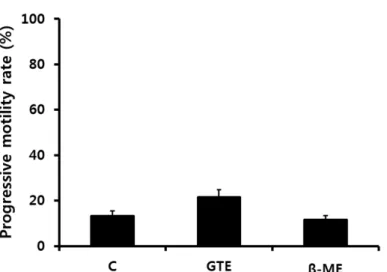
The effect of GTE and β-ME supplementation in freezing

extender of boar sperm on progressive sperm motility is

presented in Fig. 1. The percentage of sperm motility in GTE

group was higher than the control and β-ME groups without

significance. Sperm viability between the groups is shown in

Fig. 2. There was similar pattern between the results of

viability and motility. On the other hand, intracellular

hydrogen peroxide in sperm cryopreserved with the extender

containing GTE showed significantly lower level (p < 0.05)

than control (Fig. 3, Fig. 4). However, there were no

significant differences between β-ME and GTE groups or β

-ME and control. Boar spermatozoa among mammalian

animal’s sperm are highly sensitive to the freeze-thaw process,

which causes considerable cell damage. Bailey et al. (2000)

reported that cryoinjury may be induced by ROS generated

during the process of freezing. Antioxidants in freezing

extender are usually used to reduce this damage (Breininger et

al., 2005; Hu et al., 2008). In this study, we estimated the

antioxidative effects of GTE and β-ME in boar sperm

cryopreservation. GTE supplementation in freezing extender

showed significantly (p < 0.05) lower ROS level than the

control group. Dufresne and Farnworth (2001) reported that

GT as a natural antioxidant has strong antioxidant capability

by inhibiting the activity of superoxide, hydrogen peroxide and

(4)

Fig. 1. Effect of antioxidant supplementation on progressive motility during boar sperm freezing. C: control, GTE: green tea extract, β-ME:

beta-mercaptoethanol. The data represent means ± SE.

Fig. 2. Effect of antioxidant supplementation on viability during boar sperm freezing. C: control, GTE: green tea extract, β-ME:

beta-mercaptoethanol. The data represent means ± SE.

Fig. 3. Effect of antioxidant supplementation on the hydrogen peroxide (H

2

O

2

) level during boar sperm freezing. C: control, GTE: green

tea extract, β-ME: beta-mercaptoethanol. The data represent means ± SE. Values with different superscript are significantly different

(p < 0.05).

(5)

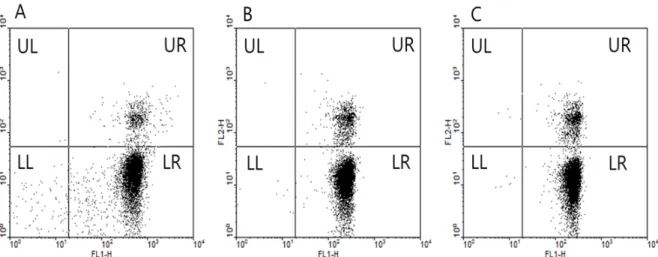
Fig. 4. Flow cytometric analysis of sperm labeled with DCFDA/PI. A: control, B: GTE C: β-ME. The upper panel shows dot plot cytograms to measure the sperm population upon the level of intracellular H2O2 following cryopreservation. The LL quadrant represents viable sperm with a low intracellular H

2

O

2

level, while the LR shows viable sperm with a high intracellular H

2

O

2

level. The UL quadrant shows dead sperm with a low intracellular H

2

O

2

level. The UR shows dead sperm with a high intracellular H

2

O

2

level.

hydroxyl radicals (Schroeder et al., 2003). Ponglowhapan et al. (2004) reported that polyphenols of GT bind to the components of the sperm membrane and subsequently prevent the membrane lipid peroxidation induced by ROS. Moreover, the polyphenols inhibit egg yolk oxidation in a semen extender and preserve semen quality (Hyon, 2004). Wittayarat et al.

(2012) reported that polyphenols of GTE are more potent antioxidants than Vitamin C, Vitamin E and rosemary extract.

More detailed research for the mechanisms of ROS reduction in future study could provide more evidence about the action of GTE as an antioxidant during boar sperm cryopreservation.

On the other hand, β-ME acts as an antioxidant by increasing intracellular enzymatic synthesis of glutathione (GSH) in many species cell (Ishii et al., 1981; Ohmori and Yamamoto, 1983; de Matos et al., 1996). This GSH synthesis is highly dependent on the availability of cysteine (Rathbun and Murray, 1991). To accomplish intracellular enzymatic synthesis of GSH, there is the suitable environment. That is, enzyme has its own optimal temperature for its proper function. β-ME was commonly used in media for oocyte maturation and embryo development at the temperature between 37.5°C and 39°C depends on species (Abeydeera et al., 1998; Funahashi,2005). In the present study, we added β -ME in freezing medium in which exposed at lower temperature from 4°C to -196°C. Therefore, temperature might not be appropriate for GSH synthesis. Gadea et al. (2004)

reported that cryopreservation process reduces the GSH content in sperm. Moreover, the thawing process increases the oxidation of GSH into oxidized GSH (Chatterjee and Gagnon, 2001). In considering the temperature sensitivity of such antioxidant, its function might not be acting at lower temperature during freezing.

It is concluded that GTE supplementation in freezing extender can reduce ROS generation during boar sperm freezing. Therefore we suggest GTE might be used as an antioxidant in porcine sperm freezing.

REFERENCES

Abeydeera LR, Wang WH, Cantley TC, Prather RS and Day BN. 1998. Presence of beta-mercaptoethanol can increase the glutathione content of pig oocytes matured in vitro and the rate of blastocyst development after in vitro fertilization. Theriogenology 50:747-756.

Bailey JL, Bilodeau JF and Cormier N. 2000. Semen cryopreservation in domestic animals: a damaging and capacitating phenomenon. J. Androl. 21:1-7.

Breininger E, Beorlegui NB, O'Flaherty CM. and Beconi MT.

2005. Alpha-tocopherol improves biochemical and dynamic

parameters in cryopreserved boar semen. Theriogenology

63:2126-2135.

(6)

Chatterjee S and Gagnon C. 2001. Production of reactive oxygen species by spermatozoa undergoing cooling, freezing, and thawing. Mol. Reprod. Dev. 59:451-458.

Dufresne CJ and Farnworth ER. 2001. A review of latest research findings on the health promotion properties of tea.

J. Nutr. Biochem. 12:404-421.

Funahashi H. 2005. Effect of beta-mercaptoethanol during in vitro fertilization procedures on sperm penetration into porcine oocytes and the early development in vitro.

Reproduction 130:889-898.

Guthrie HD and Welch GR. 2006. Determination of intracellular reactive oxygen species and high mitochondrial membrane potential in Percoll-treated viable boar sperm using fluorescence-activated flow cytometry. J. Anim. Sci.

84:2089-2100.

Gadea J, Sellés E, Marco MA, Coy P, Matás C, Romar R and Ruiz S. 2004. Decrease in glutathione content in boar sperm after cryopreservation. Effect of the addition of reduced glutathione to the freezing and thawing extenders.

Theriogenology 62:690-701.

Hu JH, Li QW, Jiang ZL and Li WY. 2008. Effects of different extenders on DNA integrity of boar spermatozoa following freezing-thawing. Cryobiology 57:257-262.

Hyon SH. 2004. A non-frozen living tissue bank for allotransplantation using green tea polyphenols. Yonsei.

Med. J. 45:1025-1034.

Ishii T, Hishinuma I, Bannai S and Sugita Y. 1981.

Mechanism of growth promotion of mouse lymphoma L1210 cells in vitro by feeder layer or 2-mercaptoethanol.

J. Cell. Physiol. 107:283-293.

Kaedei Y, Naito M, Naoi H, Sato Y, Taniguchi M, Tanihara F, Kikuchi K, Nagai T and Otoi T. 2012. Effects of (-)-epigallocatechin gallate on the motility and penetrability of frozen-thawed boar spermatozoa incubated in the fertilization medium. Reprod. Domest. Anim. 47:880-886.

de Lamirande E and Gagnon C. 1992. Reactive oxygen species and human spermatozoa. I. Effects on the motility of intact spermatozoa and on sperm axonemes. J. Androl. 13:368- 378.

de Lamirande E and Gagnon C. 1995. Capacitation-associated production of superoxide anion by human spermatozoa.

Free Radic. Biol. Med. 18:487-495.

Malo C, Gil L, Gonzalez N, Martínez F, Cano R, de Blas I and Espinosa E. 2010. Anti-oxidant supplementation improves

boar sperm characteristics and fertility after cryopreservation:

comparison between cysteine and rosemary (Rosmarinus officinalis). Cryobiology 61:142-147.

Malo C, Gil L, Cano R, Martínez F and Galé I. 2011.

Antioxidant effect of rosemary (Rosmarinus officinalis) on boar epididymal spermatozoa during cryopreservation.

Theriogenology 75:1735-1741.

de Matos DG, Furnus CC, Martinez AG and Matkovic M. 1996.

Stimulation of glutathione synthesis of in vitro matured bovine oocytes and its effect on embryo development and freezability. Mol. Reprod. Dev. 45:451-457.

Ohmori H and Yamamoto I. 1983. Mechanism of augmentation of the antibody response in vitro by 2-mercaptoethanol in murine lymphocytes. III. Serum-bound and oxidized 2-mercaptoethanol are available for the augmentation. Cell Immunol. 79:186-196.

Park SH and Yu IJ. 2015. Evaluation of Toxicity of Green Tea Extract in Chilled Boar Spermatozoa. J. Emb. Trans.

30:1-6.

Park and Yu IJ. 2016. Effects of Green Tea Extract on Sperm Quality, Reactive Oxygen Species and Lipid Peroxidation in Long-term Liquid Preservation of Boar Spermatozoa. J.

Vet. Clin. 33:356-361.

Ponglowhapan S, Essén-Gustavsson B and Linde-Forsberg C.

2004. Influence of glucose and fructose in the extender during long-term storage of chilled canine semen.

Theriogenology 62:1498-1517.

Pursel VG and Johnson LA. 1975. Freezing of boar spermatozoa: fertilizing capacity with concentrated semen and a new thawing procedure. J. Anim. Sci. 40:99-102.

Rahman Md A, Park SH and Yu IJ. 2016. Effect of monosaccharides in glycerol-free tris extender on reactive oxygen species and apoptosis in dog sperm cryopreservation.

CryoLetters 38:51-57.

Rathbun WB and Murray DL. 1991. Age-related cysteine uptake as rate-limiting in glutathione synthesis and glutathione half-life in the cultured human lens. Exp. Eye.

Res. 53:205-212.

Schroeder P, Klotz LO and Sies H. 2003. Amphiphilic properties of (-)-epicatechin and their significance for protection of cells against peroxynitrite. Biochem. Biophys.

Res. Commun. 307:69-73.

Watson PF. 1995. Recent developments and concepts in the

cryopreservation of spermatozoa and the assessment of

(7)

their post-thawing function. Reprod. Fertil. Dev. 7:871-891.

Waterhouse KE, Gjeldnes A, Tverdal A, De Angelis PM, Farstad W, Håård M and Kommisrud E. 2010. Alterations of sperm DNA integrity during cryopreservation procedure and in vitro incubation of bull semen. Anim. Reprod. Sci.

117:34-42.

Wittayarat M, Kimura T, Kodama R, Namula Z, Chatdarong K, Techakumphu M, Sato Y, Taniguchi M and Otoi T.

2012. Long-term preservation of chilled canine semen using vitamin C in combination with green tea polyphenol.

Cryoletters 33:318-326.

Yamaguchi S and Funahashi H. 2012. Effect of the addition of beta-mercaptoethanol to a thawing solution supplemented

with caffeine on the function of frozen-thawed boar sperm and on the fertility of sows after artificial insemination.

Theriogenology 77:926-932.

Yu IJ. 2014. Canine sperm cryopreservation using glucose in glycerol-free Tris. Cryoletters 35:101-107.

Yu YG, Shim MH and Chae JW. 2002. The anti-oxidative stress effect of antioxidants in the cell using DCFH-DA. J.

Soc. Cos. Sci. Ko. 28:12-57.

Received March 02 2017, Revised March 03, 2017,

Accepted March 15, 2017

수치

Fig. 1. Effect of antioxidant supplementation on progressive motility during boar sperm freezing
Fig. 4. Flow cytometric analysis of sperm labeled with DCFDA/PI. A: control, B: GTE C: β-ME

참조

관련 문서

Oxidative injury and inflamma- tory periodontal disease: The challenge of anti-oxidants to free radicals and reactive oxygen species.. The role of oxygen and

This study is to determine the effect of peer abusive supervision on the organizational silence and service oriented organizational citizenship behaviors

The present study used the guinea pig CPI model to investigate the effect of hypoxia on the development of mature neurons and to evaluate the relationship

In this study, two experiments were conducted to understand the effects of additional charge on the detailed growth mechanism of Alq 3 and to determine the effect of

In future studies focused on antioxidant effect and active oxygen reduction in resistance exercise using thera-band will be conducted in-depth research that

In the present study we investigated the proliferation effect of human oral cancer KB cell treated with pulsatilla koreana extract.. We analyzed the effects of this

Effects of combined calcium and vitamin D supplementation on insulin secretion, insulin sensitivity and β -cell function in multi-ethnic vitamin D-deficient

In the present study, the behavior of Mg sheet with strain rates will be observed and the effect of microstructure, texture and PB treatment on high rate tensile