Duration of Preservation Affect the Quality of Chilled Black Bengal Buck Semen
Md Gulshan Anowar Pradhan1, Md Saidur Rahman1,2*, Woo-Sung Kwon2, Dipendra Mishra1, Md Mostofa Kamal1,3, Mohammad Musharraf Uddin Bhuiyan1 and Mohammed Shamsuddin1
1Department of Surgery and Obstetrics, Bangladesh Agricultural University, Mymensingh 2202, Bangladesh.
2Department of Animal Science & Technology, School of Bioresource & Bioscience, Chung-Ang University, Anseong 456-756, Republic of Korea
3Department of Reproduction, Obstetrics and Herd Health, Ghent University, B-9820 Merelbeke, Belgium.
ABSTRACT
The study focuses on the quality assessment of Black Bengal buck semen preserved at chilled condition. In this in vitro trial, collected semen from Black Bengal bucks was preserved at chilling temperature (4~5℃) in tris-glucose- citrate yolk medium of 1:5 ratios for four days. Artificial Vagina (AV) method was utilized to collect semen from buck. General evaluation of semen includes the color, mass activity and density were measured by direct visual exami- nation. However, computer-assisted sperm analysis (CASA) and phase contrast microscopy were used to figure out the motility (%), hyper-activated (HYP) motility (%) and number of abnormal spermatozoa (%) initially, and at every 24 h intervals. The result revealed that spermatozoa preserved at chilling temperature showed significantly (P<0.05) lower motility and HYP motility with the progression of preservation. The number of phenotypically abnormal sper- matozoa significantly (P<0.05) increased following preservation. Although significant positive correlation (r=0.945;
P<0.05) was existed between % motile and % HYP motile spermatozoa however, the % of morphologically abnormal spermatozoa was negatively correlated with % motile (r=0.997; P<0.05) and % HYP motile spermatozoa (r=0.946;
P<0.01). Therefore, we concluded that the quality of chilled semen progressively losses its viability and doesn’t remain useable after certain period of preservation with respect to its motility and morphology.
(Key words : Black Bengal buck, semen, chilled, preservation, spermatozoa)
*Correspondence : E-mail : [email protected]
INTRODUCTION
Artificial insemination (AI) has gain widespread acceptance in the cattle industries of most developed countries but it has not yet received such widespread acceptance in the goat breed- ing industries (Leboeuf et al., 2000). The preservation of semen and its quality assessment based on sperm features including total and progressive motility, morphology and DNA quality, has been studied extensively in males of different species in- cluding the bull, pig, ram and human (Love, 2011). However, similar reports on buck semen are not available in literature.
On the other hand, other has reported that the buck semen re- presents less persistency during preservation in relation to the semen of other domestic animal species (Apu, 2012). In that case the suggested causes for poor preservation competence of buck semen have been ranged from detrimental effects of buck seminal plasma on the subsequent viability of spermatozoa in vitro (Leboeuf et al., 2000) to improper handling of semen du- ring processing of semen for preservation (Sullivan, 1978).
However, Zamfirescu and Nadolu (2009) reported that the buck semen has high probability to preserve and can be used for AI.
After preservation of fresh buck semen it become very im- portant to maintain its quality specially the percentage of mo- tile and normal/abnormal spermatozoa before using it for AI because of only the good quality and motile spermatozoa is responsible for the fertilization of the oocyte in the female reproductive tract through capacitation (Yanagimachi, 1994).
Several researchers were studied on buck semen preservation at different conditions including both frozen and chilled. Al- though, preservation of semen in frozen condition provide satis- factory viability over time (Zamfirescu and Nadolu, 2009) but viability in chilled condition is remain questionable. Zhao et al. (2009), reported the 48% motility of spermatozoa even after 13 days of chilling (21-fold dilution with egg yolk-extender) th- rough renewed of the extender in every 48 h during of pre- servation. However, to date, there has been no publication of detailed the survival rate of Black Bengal buck semen pre- served in chilled condition. As such, a comprehensive in vitro
study is needed, and therefore, the current research was de- signed to investigate the effect of preservation time on sperm viability based on sperm quantitative features include total and HYP motility and morphology of spermatozoa preserved at chilled (4~5℃) condition.
MATERIALS AND METHODS
1. Selection and Management of Bucks
Four Black Bengal bucks age ranged from 34~45 months with similar body condition scores (BCS) were selected from Bangladesh Agricultural University (BAU) veterinary clinic goat farm. All of the buck were able to produce semen, con- taining >80% morphologically normal spermatozoa with a satis- factory motility and concentration. The bucks were reared in a separate shed and kept isolated from does during study pe- riod. They were reared in semi-intensive system and allowed grazing under supervision of an attendance for 7~8 h daily.
Each buck was fed with rice grain (100 gm/buck/day), wheat bran (200 gm/buck/day), and oil cake (50 gm/buck /day) with salt. Clean and safe water was made available at all time. The bucks were dewormed routinely with oral administration of morantel citrate (Deminth®, Reneta Ltd. Bangladesh) at the dose rate of 15 mg/kg body weight after examining fecal samples for helminthes eggs.
2. Experimental Design
The entire experiment was performed following four steps i.e. 1. the preparation of Artificial Vagina (AV) and collection of semen, 2. evaluation of fresh semen, 3. extension and pre- servation of the collected semen and 4. re-examination of pre- served semen at the interval of 24, 48, 72 and 96 h of preser- vation to observed the percentage of motile and morphological abnormalities if any.
1) Preparation of AV and Collection of Semen
The semen was collected through Artificial Vagina (AV) method at a frequency of once in a week. Donor bucks were allowed usually at least 2 times false mounts before collection of final ejaculates. The bucks were trained previously to eja- culate in AV. The penis-end of the AV was lubricated with non-spermicidal gel (Sterile Lubricating Jelly®, First Priority, Inc. USA). At the other end of the AV a plastic cone was attached with a calibrated collecting plastic tube. Before col- lection, the prepuce of the buck was wiped by normal saline
water to clean and prevent the contamination of semen. During collection the AV was held in right hand along the buck's flank. The open end was facing towards the penis and down- wards at an angle of 45°. When buck mounted, the erected penis was carefully directed to the open end of the AV to per- mit vigorous upward and forward thrusts, which stimulate the ejaculation. The buck was allowed to withdraw its penis im- mediately after ejaculation into the AV. The graduated col- lecting tube was separated from the cone and its open end was closed with a plastic cap and labeled. After collection, semen was kept at 37℃ in water-bath until the media and reagents were added.
2) Evolution of Fresh Semen the Motility and Morphology The routine evaluation of fresh semen was done imme- diately after collection as described previously (Suttiyotin and Thwaites, 1993). The volume, color, density, and mass activity of spermatozoa in fresh ejaculate of individual buck were re- corded by direct visual examination. A Computer-assisted sperm analysis (CASA, SAIS Plus version 10.1, Medical Supply) was used for analyses of sperm motility (%). Briefly, 10 μl of sample was placed in a Makler chamber (Makler). The filled chamber was then placed on a 37℃ heated stage. Using a 10×
objective in phase contrast mode, the image was relayed, digitized, and analyzed by SAIS. The movement of the at least 250 sperm cells was recorded for each sample from random fields (>5). Sperm motility was assessed by recording the per- centage of motility (MOT) and non-motile spermatozoa. Motile spermatozoa were classified into spermatozoa with progressive (hyper activated motile) and those with non-progressive moti- lity. To examine the acrosome, mid piece and tail morphology of the spermatozoa, semen samples were fixed in buffered for- mal-saline at the same temperature (37℃). Formal saline was prepared by dissolving di-sodium hydrogen phosphate with two molecules water (34.7 m mol), Potassium di-hydrogen pho- sphate (18.7 mmol), Sodium chloride (92.6 mmol) and formal- dehyde (1.54 mmol) in 1 liter distilled water. The abnormality found in formal saline fixed spermatozoa was observed under phase contrast microscopy; whereas at least 200 spermatozoa were examined from each replicate each day, at 1,000× magni- fication. Categorization of morphologic features included per- centages of normal sperm and abnormalities (aberrations of the head, acrosomes, and midpiece; detached heads, coiled and bent tails). If multiple abnormalities were identified on indivi- dual sperm, all were recorded, thus the actual frequency of
each abnormality in the population was determined.
3) Processing and Preservation of Semen
Egg yolk citrate diluent was used for the preservation of semen at chilling temperature (4~5℃) at 1:5 ratio for 4 days.
The egg yolk extender was prepared freshly for use according to Herman and Madeen (1963). A stock solution for trisglu- cose-citratediluents was prepared by dissolving tris, glucose and citrate in 85 ml distilled water. The pH of the extender was adjusted to 7.4. The processing was done at room tempe- rature within 5~10 minutes. Thus the semen were processed and preserved in test tubes at 4℃ in a kit box holded in a dark environment and finally stored in refrigerator at 4~5℃
temperature during study period.
4) Evaluation of Preserved Semen
Computer-assisted sperm analysis (CASA, SAIS Plus ver- sion 10.1, Medical Supply) and phage contrast microscopy were used to check the % motility and morphology of semen at 24, 48, 72, and 96 h hourly during preservation (described previ- ously).
3. Statistical Analysis
The data were analyzed in SPSS (v. 16.0). F-test was used to compare the semen parameter at different time of preser- vation whereas Pearson's correlation coefficient was used to determine the relationship between sperm motility and abnor- mality following preservation. P<0.05 was considered signifi- cantly different. All data are expressed as mean ± SEM.
Table 1. Parameter of freshly collected buck semen
Buck No.
Age (m)
Body weight
(kg)
Scrotal circumference
(cm)
Fresh semen color
Density Volume/
ejaculate(ml)
Mass activity
Individual motility (%)
Normal sperm (%)
Concentration (million/ml) (mean± SE)
1 46 34.37 21.43 3.3±0.5 3.1±0.5 0.50±0.01 3.2±0.50 79.27±0.63 90.19±0.78 2,852.67±0.88
2 35 22.51 20.65 3.2±1.1 3.4±0.5 0.47±0.01 3.3±0.50 79.28±0.49 90.23±0.13 2,704.33±2.02
3 40 29.58 17.11 4±1.2 3.6±0.5 0.35±0.02 3.2±0.45 77.94±0.47 92.27±0.09 2,350.60±0.88
4 35 22.48 19.68 3.3±0.0 3.5±0.5 0.39±0.01 3.4±0.50 78.42±0.05 91.67±0.09 2,433.33±1.20
F-test S* NS* NS* NS* S*
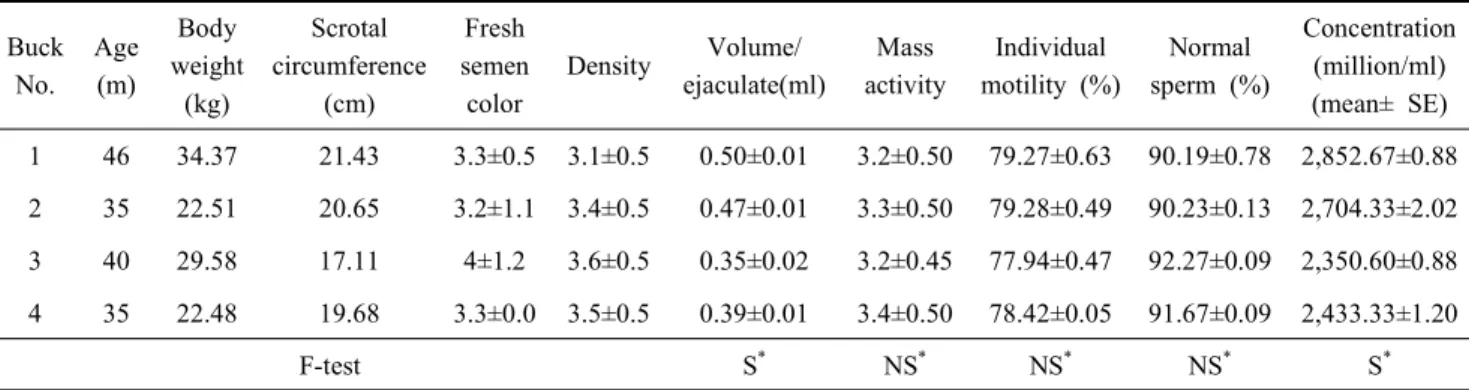
The data are the mean of 5 replicates ± SEM. Color of semen has been described as 1= opalescent; 2= milky white; 3= yellowish white and 4= creamy white; Density has been defined as 1= watery; 2= milky; 3=thin creamy and 4= creamy; Mass activity has been characterized as 1= no perceptible motion; 2=few spermatozoa moving without waves; 3= movement with slow waves and 4= vigorously moving with rapid waves. NS*= within same column, mean values are non-significant at the P>0.05 level by F-test; S*= within same column, mean values are significant at the P>0.05 level by F-test.
RESULTS
1. Variation among Freshly Collected Buck Semen Parameter The semen was collected from the four different bucks with similar body condition but different age, body weight and sc- rotal circumference. There was no significant difference in the mass activity, motility and concentration of normal spermato- zoa in freshly collected semen (P>0.05). However, significant variation was noted in volume per ejaculate and concentration of spermatozoa (Table 1) (P>0.05).
2. Effect of Preservation on Motility, Heper-activated (HYP) Motility and Abnormality of Spermatozoa
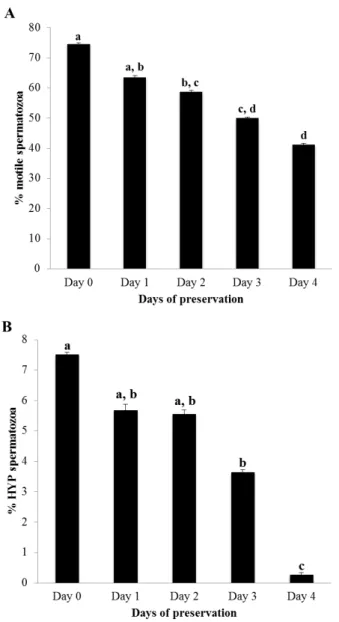
Significant decreases % of motile and heper-activated (HYP) motile spermatozoa were illustrated following preser- vation of buck semen. Lowered motility of spermatozoa was noted on day 3 and 4 compare with first two days of preser- vation (day 0 & day 1) (Fig. 1A). However, day 3 and 4 were represented significantly (P>0.05) reduced HYP motility of spermatozoa in buck semen in contrast with first day of pre- servation (Fig. 1 B). Moreover, both parameters were positively correlated following preservation (P>0.05, R=0.965) (Fig. 2).
Our study was also demonstrated the increased sperma- tozoal abnormalities in buck semen following preservation (Fig. 3). The mean percentage of abnormal spermatozoa on first (day 0), second (day 1), third (day 2), forth (day 3) and fifth (day 4) day of preservation were 5.88, 7.16, 8.16, 9.23 and 10.24% respectively. The difference in the percentage of abnormal spermatozoa among preservation times were signifi-
Fig. 1. Percentage of spermatozoa following preservation. (A) Per- centage of motile spermatozoa follows preservation. (B) Percentage of hyper-activated motile (HYP) spermatozoa follows preservation. Data are expressed as the mean ± SEM, n=5. Values with different superscripts (a, b, c, d) indicate significant differences between each groups on one-way ANOVA (P<0.05).
cant (P>0.05). However, height abnormalities were found at the last day of preservation (day 4) in compare with other (Fig. 3).
3. Relationship among Number of Abnormal, Motile and HYP Motile Spermatozoa
It was noteworthy that number of abnormal spermatozoa were significantly increased (P<0.01) as the number of motile and HYP motile spermatozoa decreased following preserva-
Fig. 2. The correlation between hyper-activated motile (HYP) vs motile spermatozoa. Each datum point represents the mean of the motile and HYP spermatozoa of independent repli- cates.
Fig. 3. Percentage of morphologically abnormal spermatozoa in respect to preservation. a, b within each variable, values followed by the same letter are not significantly different according to the one-way ANOVA test P<0.05.
tion. Moreover, it was not surprising that number of motile spermatozoa were significantly (P<0.001) higher compare with HYP motile spermatozoa. The correlation between abnormal vs motile and HYP motile spermatozoa are shown in Fig. 4.
Since, both motile (P<0.01; R=997, Fig. 4A) and HYP motile (P<0.01; R=997, Fig. 4B) spermatozoa showed negative cor- relation with occurrence of abnormal spermatozoa.
(A)
(B)
Fig. 4. The correlation of abnormal spermatozoa with motile and hyper-activated motile (HYP) spermatozoa. (A) The corre- lation between abnormal vs motile spermatozoa. (B) The correlation between abnormal vs HYP spermatozoa. Oc- currence of abnormal spermatozoa correlates negatively with both motile and HYP spermatozoa. Each datum point represents the mean of the abnormal motile and HYP spermatozoa of independent replicates.
DISCUSSION
Current study focuses on the relationship between sperm qualitative features i.e. motility, hyper activated motility and spermatozoa abnormality and duration of preservation at chil- ling condition (4~5℃). Although, de novo spermatozoa motion
kinematics (motility, morphology) is not always cor- relate to its fertility moreover, to date it is the most widely used tech- nique to access the qualitative value of semen sample in diffe- rent species of animal worldwide (Wise et al., 2003).
The average volume (ml) and concentration (million/ml) of spermatozoa in semen were higher in buck No. 1 in this present study (Table 1). This variation might due to difference in scrotal circumference of individual buck which was pre- viously demonstrated by Singh et al. (1985); Viller; Salamon 1993 and Bakshi et al. (1987). Karatzas et al. (1997) and Karagiannidis et al. (2000) reported that the volume of buck semen increased during the breeding seasons because the acces- sory glands become more active during that period. Addi- tionally, the efficiency of semen collector also can affect the total ejaculatory volume of semen (Rahman et al., 2012a & b).
Significant decreases % of motile and HYP motile sper- matozoa were illustrated following preservation of buck semen in the current study. The causes of declining of those sperm parameters might related with reduced metabolism, exhaustion of reserved energy in spermatozoa, fluctuation of temperature in refrigerator, effect of metabolic by-products such as spermi- cidal endotoxins, seasonal difference (Karatzas et al., 1997;
Karagiannidis et al., 2000) and detrimental effect of seminal plasma on the subsequent viability of spermatozoa (Leboeuf et al., 2000). In addition, sperm mitochondrial defects after pre- servation have been mentioned by O’Connell et al. (2002) and a correlation has been found with loss of motility. It is well accepted that motile spermatozoa is the prerequisite for achiev- ing successful fertilization. Itach et al. (2011) reported that insufficient sperm motility is a common cause of subfertility or infertility in domestic animal and human. According to Love (2011), reduced percentage of in vitro fertilization (IVF) rate and acrosomal reaction (AR) are due to inseminating the oocyte by the spermatozoa containing lower HYP motility spermatozoa in stallion. On the contrary Wise et al. (2003) stated that de novo spermatozoa motion kinematics (motility and morphology) is not always correlate to its fertility. This result might due to considering the different breeds of animal at different climatic condition.
In general, sperm motility describes the ability of sperm to move properly towards an egg or the quality of the sperm, which is a reason in successful pregnancies (Quill and Gar- bers, 2002). However, a finest motility of spermatozoa is res- ponsible for the fertilization of the oocyte through a sequence of biochemical changes in the female reproductive tract, known
as capacitation. Following capacitation spermatozoon can bind to the zona pellucida of the egg and undergo the acrosome reaction (Yanagimachi, 1994) so far. Without any technolo- gical interference, we may assume that a non-motile or abnor- mally-motile sperm are not going to fertilize the oocyte. There- fore, assessing the portion of a sperm population that is motile is possibly the most widely-used measure of accessing semen quality (Farrell et al., 1998).
Our study was also demonstrated the increased spermato- zoal abnormalities in buck semen following preservation (Fig.
3). Three different types of morphological abnormality were considered in this study which includes head abnormality (de- tached head, acrosomal abnormality, and presence of proximal/
distal cytoplasmic droplet) mid-piece abnormality (broken neck, deformed mid-piece) and tail abnormalities (bent tail, coiled tail, tail coiled around the neck and double folded tail). How- ever, the occurrence of particular defects following preser- vation was insignificant (data not shown). The most probable reason for this morphological abnormality seems to be the physical and chemical environments to which a spermatozoon is exposed during the preservation. On the other hand, Me- deiros et al. (2002) and Ozkavukcu et al. (2008) noted that the spermatozoal cell water exchange during the early stages of the preservation causes cell swellings and shrinkages which may be intolerable for the majority of organelles and might predispose to spermatozoal morphological abnormality.
It was noteworthy that number of abnormal spermatozoa were significantly increased (P<0.01) as the number of motile and HYP motile spermatozoa decreased following preservation.
Our current result supports the previous study on chilled pre- served semen by Shamsuddin and Rodriguez-Martinez (1994) and Sugulle et al. (2006). However, it is also reported that the proportion of morphologically abnormal spermatozoa in semen correlates negatively with fertility estimates (Rodriguez-Martin et al., 1994). According to Herman and Madeen (1963) buck semen is not recommended for AI if the proportion of normal spermatozoa is below 80%.
In conclusion our study highlighted the relationship between motility (computer assisted motility analysis) and the morpho- logy of buck spermatozoa following preservation. We showed that the quality of the preserved semen deteriorate severely largely after 2 days of preservation. Therefore, we concluded that the quality of chilled semen progressively losses its via- bility and doesn’t remain useable after day 2 with respect to its motility and morphology.
ACKNOWLEDGEMENTS
This research was supported by the Ministry of Education, Government of Bangladesh (GoB) being implemented at the Department of Surgery and Obstetrics, Bangladesh Agricultural University, Bangladesh.
REFERENCES
Apu AS. 2012. Fertility of Fresh and Frozen-thawed Black Bengal Goat Spermatozoa: Fertility of Fresh and Frozen- Thawed Goat Semen. 1st ed, Lambert Academic Publishing, Germany, pp. 1-104.
Bakshi S, Patil AV, Srivas AK, Jagtap DZ and More BK.
1987. Studies on semen evaluation and fertility rate of Ang- ra and 7/8 Angra bucks. Livestock Adviser 12: 13-18.
Farrell PB, Presicce GA, Brockett CC and Foote RH. 1998.
Quantification of bull sperm characteristics measured by computer-assisted sperm analysis (CASA) and the relation- ship to fertility. Theriogenology 49: 871-879.
Herman HA and Madeen FW. 1963. The Artificial Insemi- nation of Dairy Cattle and Beef Cattle: A Hand Book and Laboratory Manual. Locas Brothers, Columbia, pp: 21-41.
Itach SBS, Finklestein M, Etkovitz N and Breitbart H. 2001.
Hyper-activated motility in sperm capacitation is mediated by phospholipase D-dependent actin polymerization. Dev.
Biol. 362: 154-161.
Karagiannidis AS, Varsakeli and Karatzas G. 2000. Charac- teristics and seasonal variations in the semen of Alpine, Sa- anen and Damascas goat bucks born and raised in Greece.
Theriogenology 53: 1285-1293.
Karatzas GA, Karagiannidis Varsaleli S and Brikas P. 1997.
Fertility of fresh and frozen thawed goat semen during the non-breeding season. Theriogenology 48: 1049-1059.
Leboeuf BB, Restall and Salamon S. 2000. Production and storage of goat semen for artificial insemination, Anim. Re- prod. Sci. 62: 113-141.
Leon H, Porras AA, Galina CS and Navarro-Fierro R. 1991.
Effect of the collection method on semen characteristics of Zebu and European type cattle in the tropics, Therioge- nology 36: 349-355.
Love CC. 2011. Relationship between sperm motility, morpho- logy and the fertility of stallions. Theriogenology 76: 547- 557.
Marx D, Klempp K and Bohmm S. 1975. Gynaecomastia in
a buck. Sexual activity, semen quality and milk quality.
Zuchthygiene 10: 125-135.
Medeiros CMO, Forell F, Oliveira ATD and Rodrigues JL.
2002. Current status of sperm cryopreservation: Why isn’t it better? Theriogenology 57:327-44.
O’Connel M, McClure N and Lewis SEM. 2002. The effects of cryopreservation on sperm morphology, motility and mitochondrial function. Hum. Reprod. 17:704-9.
Ozkavukcu S, Erdemli E, Isik A, Oztuna D and Karahuse- yinoglu S. 2008. Effects of cryopreservation on sperm parameters and ultrastructural morphology of human sper- matozoa. J. Assist. Reprod. Genet. 25:403-11.
Quill AT and Garbers LD. 2002. Sperm motility activation and chemoattraction. In: Fertilization, Hardy, D.M. (Ed.).
Academic Press, Carlifornia, pp: 29-29.
Rahman MS, Shohag AS, Kamal MM, Bari FY and Sham- suddin M. 2012a. Preovulatory follicular and subsequent luteal size influence pregnancy success in water buffaloes.
J. Reprod. Dev. 58:219-22.
Rahman MS, Shohag AS, Kamal MM, Parveen N and Sham- suddin M. 2012b. Application of ultrasonography to inves- tigate postpartum anestrus in water buffaloes. Reprod. Dev.
Biol. 36:103-108.
Rodriguez-Martin E, de la Hoz MF, Dura Ros MJ and Blanco CF. 1994. Evaluating the patient with orthopedic problems.
Rev. Enferm. 17: 68-71.
Shamsuddin M and Rodriguez-Martinez H. 1994. Fine struc- ture of bovine blastocysts developed either in serum-free medium or in conventional co-culture with oviduct epithe- lial cells. Zentralbl. Vet. Med. Ser. A. 41: 307-316.
Singh DK, Sinha MP, Singh RA, Singh CSP and Singh KK.
1985. Comparative study on seminal quality of pure and cross-bred bucks. Indian Vet. Med. J. 9: 50-58.
Sugulle AH, Bhuiyan MMU and Shamsuddin M. 2006. Bree- ding soundness of bulls and the quality of their frozen semen used in cattle artificial insemination in Bangladesh.
Livestock Research for Rural Development 18: Article #54.
Sullivan JJ. 1978. Morphology and motility of spermatozoa.
In: Physiology of Reproduction and Artificial Insemination of Cattle. Salisbury, G. M., VanDemark, K. I. and Lodge, J. R. (eds.) Freman and Company, Sanfranciscio, USA, pp.
286-320.
Suttiyotin P and Thwaites CJ. 1993. Evaluation of ram semen- motility by a swim-up technique. J. Reprod. Fertil. 97:
339-345.
Viller D and Salamon S. 1993. Fertility following insemina- tions frozen-thawed reconcentrated and unconcentrated ram semen. Australian J. Biol. Sci. 27: 423-426.
Wise T, Lunstra DD, Rohrer GA and Ford JJ. 2003. Rela- tionships of testicular iron and ferritin concentrations with testicular weight and sperm production in boars. J. Anim.
Sci. 81: 503-511.
Yanagimachi R. 1994. Mammalian fertilization. In "The Phy- siology of Reproduction" (E. Knobil and J. D. Neill, eds.), Raven Press, New York, pp. 189-317.
Zamfirescu S and Nadolu D. 2009. Results concerning the freezing probability of buck semen and fecundity after artificial insemination of local goat. Lucrari Stiintifice Univ. de Stiinte Agricole si Medicina Veterinara, Seria Zootehnie 52: 80-84.
Zhao BT, Han D, Xu CL, Luo MJ, Chang ZL and Tan JH.
2009. Protocol optimization for long-term liquid storage of goat semen in a chemically defined extender. Reprod. Do- mest. Anim. 44:865-872.
(접수: 2013. 4. 28 / 심사: 2013. 4. 28 / 채택: 2013. 5. 14)