1)
†
To whom correspondence should be addressed.
National Institute of Agricultural Sciences, RDA E-mail: [email protected](J. Son)
E-mail: [email protected](M. Kong)
Wetland Function Evaluation and Expert Assessment of Organic Rice-Fish Mixed Farming System
Hongsik Nam・Kwanglai Park・Nanhee An・Sangmin Lee・Junglai Cho・Bongrae Kim * ・
Jongahk Lim ** ・Changwon Lee *** ・Seonu Choi **** ・Changhyun Kim ***** ・Minjae Kong ******,† ・Jinkwan Son ******,†
Dept. of Agricultural Environment, National Institute of Agricultural Sciences, RDA
* Company limited by shares, Jinsolwon
** Jeollanam-do Ocean & Fisheries Science Institute
*** Jeollabuk-do Institute of Fisheries Technology
**** Jeollabuk-do Agricultural Research and Extension Services
***** Department of Landscape Architecture, Dankook University
****** Dept. of Agricultural Engineering, National Institute of Agricultural Sciences, RDA
유기농 벼-담수어 복합영농의 습지기능평가 및 전문가 조사
남홍식・박광래・안난희・이상민・조정래・김봉래
* ・임종악 ** ・이창원 *** ・최선우 **** ・김창현 ***** ・공민재 ******,† ・손진관 ******,†
농촌진흥청 국립농업과학원 농업환경부
*
진솔원**
전라남도 해양수산과학원***
전라북도 수산기술연구소****
전라북도농업기술원*****
단국대학교 녹지조경학과******
농촌진흥청 국립농업과학원 농업공학부(Received : 13 April 2018, Revised: 14 May 2018, Accepted: 14 May 2018)
Abstract
A mixed farming system that includes organic rice production and freshwater fish farming is being called into attention in Korean agricultural industry and rural areas in order to improve farm management and environmental conservation. This study was conducted to evaluate the environmental and ecological value of such mixed farming practices. Expert assessment and rapid assessment method (RAM) of wetland evaluation were employed for this study. Experts have responded that biodiversity conservation including amphibian and reptile habitat (2.39), aquatic insect habitat (2.36), Fishery habitat (2.34), vegetation diversity (2.13), avian habitat (2.05), and experience and education were the most important function of mixed farming. The wetland function evaluation conducted using modified RAM indicated that rice-fish mixed system showed improvements in most of the evaluated functions, compared to the conventional rice paddies. The overall wetland function of rice paddies in rice-fish mixed system was greatly improved as compared with the conventional rice paddies. Rice paddies are known to play an important role in biodiversity maintenance, and provide ecosystem services such as climate modulation and carbon reduction.
Rice-fish mixed system of farming may not only improve various ecosystem services of rice paddies, but may increase farm income through value added fish farming, as well as promotion of social services such as education and maintenance of tradition. Additional research is needed for quantitative analysis of the values gained from the most improved wetland function when mixed farming system is actually put into practice, and to utilize the results in advertising of the organic rice, and in various sectors such as food, education and direct payment policy.
Key words : Mixed Ecological Agriculture, Freshwater Fish, Wetland Function Evaluation
1. Introduction
Agricultural industry and rural areas in Korea are experiencing difficulties in farm management due to aging rural population, polarization of farmland scale, and the decrease of full-time farmers. To overcome such threats and difficulties, many efforts are being in rural communities, including training new farmers(Woo et al., 2018), increasing farm income(Park et al., 2016), reviving rural economy(You, 2001), expanding welfare in rural areas (Choi and Hwang, 2013), developing alternative crops(Han et al., 2017), and building horticulture facilities(Shin, 2016). In the case of rice, the greater decrease in demand than the decrease in production since 2000's, which has led to an oversupply of rice(Kim et al., 2018).
Of demand due to the global increase in environmentally friendly and safe agricultural products, organic agriculture has increasing annually. Organic farms have generated higher income compared to conventional farms, and diverse farming practices has been used for organic food production in Korea(Lee, 2010; Jung, 2007; Lee et al., 2010; Ahn et al., 2012). In addition organic agricultural practices have improved the competitiveness of rice production industry, and have brought various benefits including safe food product, environment conservation, generation of habitat for aquatic life, improvement of soil physical properties, and increase of soil microbes(Wright et al.,1999; Park et al., 2010; Lee et al., 2011a; Park et al., 2012). Despite the aforementioned benefits, however, problems regarding pests, soil management, cropping system, and rice crop varieties resulted in the decrease of rice consumption and competitiveness in the market(Kim et al., 2018; Lee et al., 2011b; Lee et al., 2017; Son and Han, 2010). Therefore, mixed farming system that produce freshwater fish such as catfish, pond loach, and giant river prawn along with
rice has been well recognized.
The history and tradition of rice-fish mixed farming system can be seen in ancient (206 BC) pottery with rice and fish symbols, and in stone tablets from Sukhothai era in thailand(Halwart and Gupta, 2004). The combination of rice and provides carbohydrate, calcium, essential amino acids, vitamin A, various minerals, and proteins(Kim, 1997).
The combination also symbolizes richness and stability as well as ecological connection through reservoir, rivers, waterway, ponds and rice paddies.
To practice rice-fish mixed farming system, organically managed rice paddies are more suitable rather conventional rice paddies where chemical fertilizers and pesticides are used.
Organically managed rice paddies embrace greater varieties and individuals of aquatic life including benthic invertebrates than conventionally managed paddies, add citations. Organic rice production provides a more stable environment for rice and freshwater fish production in terms of ecological food chain, role of freshwater fish as a natural food source, water purification for nitrogen, phosphorus, and suspended solids.
Nationally, pond loach production technology was developed in the early 2000s by Jinhae Inland Waters Institute, which was then extended to Nawon in 2006, and Sanchung in 2009. Currently, the rice-fish mixed farming system mainly used in Gyeongnam, Jeonbuk, and Chungnam provinces. Preceeding studies in mixed-farming include pond loach farming in rice paddies by Lee et al.(2013) and Lee et al.(2014), biological control of disease-transmitting mosquitoes using Chinese minnow and pond loach(Kim et al., 1994), and analysis of factors affecting changes in Chinese weatherfish community by different agricultural practices(Han et al., 2013b). Recently, many edible freshwater life(including catfish, Chinese weatherfish, pond loach, crucian carp, leather carp, Chinese mitten crab) and inedible freshwater life(including fancy carp and goldfish)
요 약
우리나라 농업․농촌은 경영 개선을 위해 유기농 쌀 생산과 더불어 담수어를 생산하는 복합영농이 시작되었다. 본 연구는 복합영농이 환경, 생태적 기능에 얼마나 가치가 있는지 알아보았다. 연구방법은 전문가 평가와 습지평가체계(RAM)를 분석하였다. 전문가 조사 결과 양서파충류 서식처(2.39), 수서곤충 서식처(2.36), 어류 서식처(2.34), 식생다양성(2.13), 조류 서식처(2.05) 등 생물다양성 분야와 체험/생태교육(2.29) 기능이 1순위로 구분되었다. Modified RAM를 통해 관행논과 복합논의 습지기능평가를 실시한 결과 복합논이 대부분의 평가기능 항목에서 기능이 향상 되는 것으로 평가되었다.
보전가치 판단기준은 관행논 향상에서 복합논 보전으로 가치가 향상 되었다. 연구결과 복합영농은 관행논에 비해 습지 기능이 탁월하게 개선되는 것을 평가를 통해 알 수 있었다. 논은 국가 생물다양성 유지에 지대한 역할을 수행하며, 기후조절, 탄소저감 등 다양한 생태계서비스를 제공하는 공간으로 평가받는다. 복합영농 실현은 논의 다양한 생태계서비스 기능을 증진시켜 줄 뿐 아니라 물고기 생산이라는 부가가치를 통한 농가의 소득증대와 그로 인한 체험, 전통계승 등의 사회적 기능 증진에도 유용 할 수 있다. 본 연구결과를 바탕으로 습지기능평가가 높게 개선된 항목과 전문가들로부터 높은 개선이 예상된 항목을 실재 운영 시 정량 평가 및 조사하여 생산되는 물고기과 쌀의 친환경 이미지를 제고시키고 브랜드, 음식, 체험, 논농업 직불제 등 다양한 분야로 활용하도록 연구를 추가적으로 추진해야 할 것으로 판단된다.
핵심용어 : 복합생태농업, 담수어, 복합영농, 습지기능평가
are being considered by the Inland Water Institutes as the potential freshwater life to be produced in mixed farming, e.g., giant river prawn, freshwater shrimp, slender bitterling, and Chinese ninespine stickeback. However, research in freshwater fish other than pond loach and Chinese weatherfish is still lacking.
Rice paddies have been recognized as wetlands in 2008 Ramsar convention in Changwon, and are known to provide various ecosystem services(Maltby, 2009; Ramsar, 2008;
Ramsar, 2014). Therefore, this study seeks to evaluate structural changes in paddies, and environment conservation effects through organic practices in rice-fish mixed farming, using rapid assessment method(RAM) from Tilton et al.(2001) which was used in Kong et al.(2014). Expert assessment was employed to analyze and prioritize positive and negative aspects of the rice-fish mixed farming system in order to determine improvements in ecosystem services and the environment.
2. Materials and methods
2.1 Structure and study site of rice-fish mixed farming system.
Due to the structural limitations of rice paddies, a relatively deep water channel was constructed around the edge of the paddies to allow freshwater fish to inhabit in the mixed farming rice paddies. A waterway was constructed so that rice plant growth and machinery operation would not be affected(Fig. 1).
Mundang-ri Hongdong-myun Hongsung-gun in Chungnam province was selected for this study, because the
grower community aimed to practice rice-fish mixed farming, and organic rice production was already practiced in some areas.
2.2 Ecosystem service and function selection for expert survey
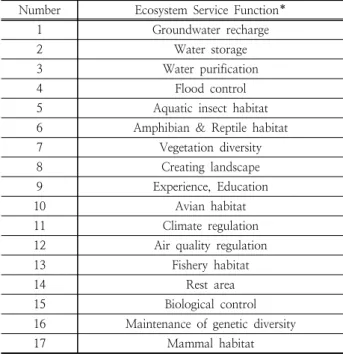
A total of ecosystem functions of rural area listed in Son et al.(2015) were used for the expert survey in this study(Table 1).
Son et al.(2015) analyzed 11 studies related to ecosystem services, and selected 17, ecosystem functions that should
Table 1. The expert survey items on the ecosystem functions.
Number Ecosystem Service Function*
1 Groundwater recharge
2 Water storage
3 Water purification
4 Flood control
5 Aquatic insect habitat
6 Amphibian & Reptile habitat
7 Vegetation diversity
8 Creating landscape
9 Experience, Education
10 Avian habitat
11 Climate regulation
12 Air quality regulation
13 Fishery habitat
14 Rest area
15 Biological control
16 Maintenance of genetic diversity
17 Mammal habitat
* Survey items listed in Son et al.(2015)
Fig. 1. Two-dimensional cross section of conventional(left) and mixed farming system of rice paddies(right).
be considered during, development projects such as the land-use conversion of the ecosystem, etc.. The important ecological functions selected include groundwater recharge, water storage, water purification, flood control, aquatic insect habitat, amphibian and reptile habitat, vegetation diversity, creating landscape, experience and education, avian habitat, climate regulation, air quality regulation, fishery habitat, rest area, biological control, maintenance of genetic diversity, and mammal habitat.
2.3 Expert survey and responses
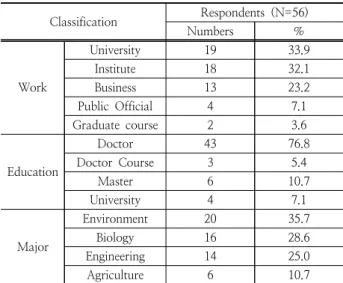
The survey was conducted to seek expert opinion on the effect of rice-fish mixed farming on the ecosystem and rural environment, without considering the farm income. The ecological and social functions of paddies which may be positively or negatively affected by the mixed farming practice were evaluated using a Likert scale(-3, -2, -1,
Table 2. The general information of survey respondents.
Classification Respondents (N=56)
Numbers %
Work
University 19 33.9
Institute 18 32.1
Business 13 23.2
Public Official 4 7.1
Graduate course 2 3.6
Education
Doctor 43 76.8
Doctor Course 3 5.4
Master 6 10.7
University 4 7.1
Major
Environment 20 35.7
Biology 16 28.6
Engineering 14 25.0
Agriculture 6 10.7
0, +1, +2, +3). The collected data were analyzed using SPSS software (WIN 18.0). A total of 56 professionals responded to the survey, including 13 people from business corporations(23.6%), 18 from research institutes(32.7%), and 19 from universities(34.5%)(Table 2). Respondents with the highest degree of education included 43 respondents who had doctorate degrees(78.2%), and 3 ph.D candidates (5.4%). The fields of expertise of respondents were environment(20 respondents, 35.7%), biology(16 respondents, 28.6%), engineering(14 respondents, 25.0%), and agriculture(6 respondents, 10.7%).
2.4 Wetland evaluation and determination of conservation values
In this study, the modified RAM from Koo(2009) was used for wetland evaluation and analysis.
The modified RAM identified eight wetland functions, and each function was evaluated through 4 to 9 evaluation factors to give an average grade to a given wetland, which was then categorized into a grade of high value(>2.4), moderate value(1.7 to 2.3), or low value(<1.7)(Appendix 1, Table 3).
Furthermore, wetlands could be categorized into different priority groups according to their function and criteria as given in Table 3. If a wetland is found to be high value, both domestically and internationally, the wetland is designated as protected area with absolute conservation goals.
3. Results and Discussion
3.1 Expert assessment of the ecosystem functions The expert survey was sent to the experts on the member list of academic society related to wetlands via e-mail. A
Table 3. Conservation value criteria.
Preservation priority Criteria Conservation, Restoration strategy
First, Consider conservation
International or domestic protection value if found in the protected Species of Korea or habitat.
A typical, rare case of high conservation value.
Absolute Conservation
High
Individual function evaluation value is "high" as table the total function of 1/2 or more.
If the total value of the average is 2.4 or higher.
Evaluation elements of "High" to the table element is overall assessment elements of 1/2 or more.
Conservation
Moderate
Individual function evaluation value "high" feature one or more, full function of 1/2 is less than.
If the total value of the average is 1.7, less than 2.4.
Evaluation elements of "High" to the whole element of the element table 1/2 is less than.
Evaluation elements of "high", but the elements of a "Middle" all the elements of more than 1/2.
Improvement
Low In the case of all other cases. Restoration or Improvement
total of 56 experts in the fields of agriculture, engineering, biology and environment were invited to respond on the 7 point(-3 to +3) Likert scale, about the potential improvements in function of rice-fish mixed farming system as wetlands.
Our results showed that the average rating of the 17 potentially improved functions from the practice of rice-fish mixed farming ranged from 0.89 to 2.39, and the highest rating function was amphibian and reptile habitat(Table 4). The construction of a channel around the rice paddies would provide habitat for amphibians and reptiles, contributing to an increase in the species varieties and population. Similarly, functions related to biodiversity such as aquatic insect habitat(2.36), fishery habitat(2.34), and vegetation diversity(2.13) were expected to greatly improve.
Furthermore, experience and educational value was highly rated(2.29) due to the potential fishing and ecological field experience opportunities. Depending on the field of expertise, the expert assessment of the 17 ecological functions of rice-fish mixed farming differed. For example, experts from the field of engineering gave lower ratings to the potential aquatic insect habitat and flood control functions of the mixed farming system compared to the experts from other fields, which was statistically significant. Experts from the
Table 5. Rating of wetland functions of rice-fish mixed farming based on expert assessment.
Consider rankings Function
First
Amphibian & reptile habitat Aquatic insect habitat
Fishery habitat Experience and education
Vegetation diversity Avian habitat Second
Groundwater recharge Water storage Maintenance of genetic diversity
Biological control Third
Water purification Mammal habitat Creating landscape Exception
Climate regulation (carbon fixation) Rest area
Air quality regulation (heat island effect mitigation) Flood control
field of engineering tended to give lower ratings to the potential improvements in the other 15 functions, but was not statistically significant.
Survey responses were statistically analyzed to classify the 17 functions into first, second, and third rating categories based on their potential for improvement through rice-fish
Table 4. Expert assessment of potential ecological functions expected from rice-fish mixed farming.
Functions
Field
Mean
(n=56) F-test
1)Agriculture (n=6)
Engineering (n=14)
Biology (n=16)
Environment (n=20)
Amphibian & reptile habitat 2.67
bC2.00
aEF2.50
abF2.50
abD2.39
FN.S
Aquatic insect habitat 2.67
bC1.93
aDEF2.56
bF2.40
abD2.36
F3.184*
Fishery habitat 2.67
aC2.21
aF2.31
aDEF2.35
aCD2.34
FN.S
Experience and education 2.50
aBC2.21
aF2.38
aEF2.20
aCD2.29
FN.S
Vegetation diversity 2.50
bBC1.71
aBCDEF2.31
abDEF2.15
abCD2.13
FN.S
Avian habitat 2.00
aABC1.79
aCDEF2.25
aCDEF2.10
aCD2.05
EFN.S
Groundwater recharge 2.50
aBC1.64
aBCDEF1.50
aABCD1.70
aBC1.71
DEN.S
Water storage 2.67
bC1.50
aBCDEF1.44
aABC1.70
aBC1.68
DEN.S
Maintenance of genetic diversity 2.50
aBC1.57
abBCDEF1.81
abBCDEF1.35
bAB1.66
DEN.S
Biological control 1.83
aABC1.50
aBCDEF1.75
aBCDEF1.45
aAB1.59
DN.S
Water purification 1.83
aABC1.64
aBCDEF1.38
aAB1.30
aAB1.46
CDN.S
Mammal habitat 1.67
aABC1.21
aABCDEF1.63
aBCDE1.25
aAB1.39B
CDN.S
Creating landscape 1.50
aAB1.14
aABCDE1.25
aAB1.45
aAB1.32B
CDN.S
Climate regulation 1.17
aA0.86
aABC1.25
aAB1.10
aAB1.09
ABCN.S
Rest area 1.33
aA0.93
aABCD1.00
aAB1.00
aA1.02
ABN.S
Air quality regulation 1.33
aA0.71
aAB0.75
aA1.25
aAB0.98
ABN.S
Flood control 1.83
bABC0.29
aA0.69
aA1.20
abAB0.89
A3.305
*F-test
2)2.590
**3.053
***5.519
***5.916
***14.503
***-
* Test result is statistically significant at the P = 0.5 level( * ),P = 0.01 level( ** ), 0.001 level( *** ); NS = Not significant result., Duncan : width a<b<c…, length A<B<C…,
1) The result is according field types, Lower case letters.,
2) The result is according ecosystem function, Capital letters.
mixed farming(Table 5). According to the standard error and statistical analysis result, four functions that were not deemed not likely to significantly improve (climate regulation, rest area, air quality regulation, and flood control) were excluded and classified as exceptions.
3.2 Expert opinions on ecosystem functions Expert assessment indicated that all of the 17 studied ecosystem functions will be improve from the practice of rice-fish mixed farming. List citations have concluded that rice paddies has been evaluated as a space providing public service for diverse environments. However, other studies have also expressed concerns on the negative effect on the environment and ecosystem resulting from drying paddies during winter and fertilizer and organic matter application.
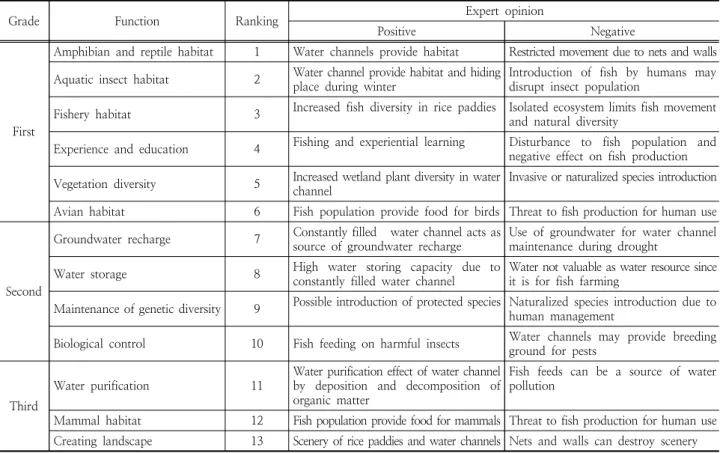
Therefore, experts subjective opinions along with the evaluation through surveys were sought for consideration in the future research(Table 6).
In regards to habitat creation for amphibians and reptiles, the depth and area of open water would increase in rice-fish mixed farming, which providing breeding and hiding places for amphibians and reptiles such as frogs and toads. On the other hand, concerns that fencing and wall structures installed for fish farming, restricting the movement of amphibians and reptiles, have been raised. Similarly, as aquatic insect habitat, it was suggested that paddies during midsummer drainage or winter periods may serve as a shelter, but introduced fish may feed on aquatic insects, leading to a disturbance and decrease in the aquatic insect population. As fish habitat, a deeper channel of water constructed for fishery may accommodate a higher diversity of fish population, but introduction of new species apart from the artificially selected species would be not likely to occur due to the isolated nature of the system. The rice-fish mixed farming system would provide opportunity for experiential education not only in the rice paddies looking at rice plant growth, but also in fishing and collecting aquatic organisms to understand the ecosystem. Such activities may enhance the perceived value of organically grown rice, and fishing activity may be developed into a community fair, which may diversify the source of rural income. However, some experts commented that fishing activities would have little influence on rural income, but if field trips and activities are carried out early in the season not long after the release of young fish into the system, fish growth may be negatively affected, and would compromise the original goal of freshwater fish farming. Although many experts anticipated vegetation diversity would greatly improve as water channels provide habitat for different submerged, floating and
emerged plants commonly found in wetlands, they worried that human management would introduce invasive or naturalized species, leading to lower vegetation diversity.
An increase in avian population that feed on freshwater fish was deemed as an expected result, but since the purpose of rice-fish mixed farming is to produce fish stock, to avoid threatened by birds, bird prevention measures such as fencing, nets, and scarecrows are required. Therefore, the increase in bird species diversity may ironically be detrimental to the management of fishery in the system.
In rice-fish mixed farming water infiltration constantly occurs due to the presence of water channels. Therefore, groundwater recharge function of the mixed farming system is expected to be improved compared to the conventional rice paddies. However, if the water depth required for fish farming is not fully supplied by rainwater or surface water, groundwater would be utilized, making the system not appropriate for groundwater recharge. Water channels in the mixed farming system is constantly filled with water, so water storage capability is expected to be higher than that of conventional paddies, during the winter period.
However, evaporation is also expected to be increased and it was suggested that surface water in the channel would not provide any value as a water resource since any surface water inflow to the channel is used for the purpose of fish farming. There were expectations that rice-fish mixed farming system would contribute to the conservation of regionally or nationally protected species and to the maintenance of genetic diversity. However, it was also suggested that the created which environment is limited to local scale for fish farming, and human interference may be more favourable to naturalized Presence of fish may biologically control pests through preying. However the water channel may provide breeding ground and habitat for mosquitoes and flies, leading to an increased pest population.
Water purification is a typical function of a wetland, and water flow may temporarily be slowed resulting in deposition of suspended solids and organic matter if water channels are formed around rice paddies. Also, microbes and aquatic plants are expected to help organic matter decomposition and absorption of eutrophication-causing nutrients such as nitrogen and phosphorus. However, fish feeds input for fish farming has been identified as a possible source of water pollution. Freshwater fish population may attract mammals such as badgers, raccoons, and otter that feed on fish.
However increased mammal population can impede fish farming which is main objective of this research. Creating landscape for rice-fish mixed farming would provide a view
of non-typical rice paddies, but it was pointed out that nets and blocking structures may destroy the scenery.
3.3 Wetland function evaluation using modified RAM Along with expert assessment and comments on ecological functions as wetlands of rice-fish mixed farming, the modified RAM was used to evaluate conventional rice paddies and rice-fish mixed farming(Table 7). Evaluation categories consisted of eight wetland functions including floral diversity and wildlife habitat, fishery and herptile habitat, flood and storm water storage, runoff attenuation, water quality protection, shoreline and stream bank protection, aesthetics and recreation, and groundwater
recharge. Each function was evaluated using 4 to 9 scales, and the point for each score given in appendix 1.
For fishery and herptile habitat function, the degree of interspersion of open water and cover, hydroperiod, and vegetation type elements were graded as 'high'(3 points), resulting the mixed farming gaining a higher average grade than the conventional paddies. The result showed that mixed farming was rated as 'high'(average 2.4) in every wetland function except for flood and storm water storage.
In detail, among the 52 evaluation elements, rice-fish mixed farming was rated higher than conventional rice paddies in 12 elements. In the floral diversity and wildlife habitat function category, the degree of community
Table 6. Expert opinion on construction of rice-fish mixed farming system.
Grade Function Ranking Expert opinion
Positive Negative
First
Amphibian and reptile habitat 1 Water channels provide habitat Restricted movement due to nets and walls Aquatic insect habitat 2 Water channel provide habitat and hiding
place during winter Introduction of fish by humans may disrupt insect population
Fishery habitat 3 Increased fish diversity in rice paddies Isolated ecosystem limits fish movement and natural diversity
Experience and education 4 Fishing and experiential learning Disturbance to fish population and negative effect on fish production Vegetation diversity 5 Increased wetland plant diversity in water
channel Invasive or naturalized species introduction
Avian habitat 6 Fish population provide food for birds Threat to fish production for human use
Second
Groundwater recharge 7 Constantly filled water channel acts as
source of groundwater recharge Use of groundwater for water channel maintenance during drought
Water storage 8 High water storing capacity due to
constantly filled water channel Water not valuable as water resource since it is for fish farming
Maintenance of genetic diversity 9 Possible introduction of protected species Naturalized species introduction due to human management
Biological control 10 Fish feeding on harmful insects Water channels may provide breeding ground for pests
Third
Water purification 11 Water purification effect of water channel by deposition and decomposition of organic matter
Fish feeds can be a source of water pollution
Mammal habitat 12 Fish population provide food for mammals Threat to fish production for human use Creating landscape 13 Scenery of rice paddies and water channels Nets and walls can destroy scenery
Table 7. Wetland function evaluation of conventional rice paddy and rice-fish mixed farming paddy.
Evaluated function Conventional rice paddy Rice-fish mixed farming paddy
Average Grade Average Grade
1. Floral Diversity and Wildlife Habitat 2.50 High 2.83 High
2. Fishery and Herpetile Habitat 2.20 Moderate 2.80 High
3. Flood/Storm Water Storage 2.33 Moderate 2.33 Moderate
4. Runoff Attenuation 2.13 Moderate 2.50 High
5. Water Quality Protection 2.22 Moderate 2.44 High
6.Shoreline /Stream Bank Protection 2.00 Moderate 2.40 High
7. Aesthetics and Recreation 2.56 High 2.67 High
8. Groundwater Recharge 2.50 High 2.50 High
interspersion was rated as low in conventional rice paddies, but high in rice-fish mixed farming. This was attributed to the potential increase in the wetland plants around the water channel.
Under the fishery and herptile habitat function category, the conventional rice paddy was rated as moderate in the degree of interspersion of open water and cover, and vegetation type elements, but rice-fish mixed farming was rated as high in the same elements. Thus, structural changes in rice paddies may improve wetland functions. In the flood and storm water storage function category, there was no difference in the ratings between conventional paddy and rice-fish mixed farming, similar to the result of expert assessment. As there would be no structural change in the water inflow or outflow, the two systems received the same rating in the runoff attenuation category, and rice-fish mixed farming was rated high. In the water quality protection category, the mixed farming system was rated high in the hydroperiod and channel or sheet flow elements mainly due to structural changes in the system. Son et al.(2010) reported that water quality protection and shoreline and stream bank protection functions can be enhanced through control of inflow and outflow. Among 9 evaluation elements in the aesthetics and recreation category, conventional rice paddy was rated as moderate for interspersion of vegetation, but rice-fish mixed farming was rated as high. These results are similar to those of Choi et al.(2017), where wetlands with diverse distribution of aquatic plants are rated as high, and the creation of water channel in the mixed farming system may potentially provide similar environment for vegetation diversity.
Kong et al.(2014) also reported that wetland functions that important in valuation and conservation of wetlands are degree of interspersion of open water and cover, and vegetation area width. Therefore, the structural changes from conventional rice paddies to rice-fish mixed farming and the practice of organic farming would enhance wetland functions and provide a stable environment for wetland ecosystem.
Conservation value of wetlands are determined with evaluation element, function evaluation, and average value.
Among 52 evaluation elements, 19 elements were given 3 points(high) for conventional rice paddies, but due to structural changes in rice-freshwater fish farming, the mixed farming system received 3 points in 31 evaluation elements(Table 8). In the functions categories, conventional rice paddies received high ratings in 3 functions whereas the mixed farming system received high ratings in 7 functions.
This enhancement in wetland functions was attributed to
Table 8. Conservation valuation of conventional rice paddies and rice-freshwater mixed farming system.
Valuation standard
Valuation result Conventional
rice paddy
Rice-fish mixed farming paddy
Evaluation element
3 points 19 31
2 points 30 19
1 point 3 2
valuation Improvement Conservation
Function
High 3 7
Moderate 5 1
Low - -
Valuation Improvement Conservation
Average
Value
average 2.31 2.56
Conservation
value Improvement Conservation
the increase in open water area, vegetation cover, and diversity through structural changes in the mixed farming system. As a result of comprehensive wetland conservation value assessment, conventional rice paddies were given conservation strategy rating of 'improvement' required in all of the three evaluation standards (evaluation element, function evaluation, and average value), whereas the whereas the rice-fish mixed farming were given conservation strategy rating of 'conservation', indicating that conservation value as wetlands was higher for the mixed farming system.
Therefore, based on the result from wetland conservation value assessment and expert opinions and survey results, mixed farming paddies were considered more suitable for mixed agriculture, compared to conventional paddies.
Further studies on mixed and combined agriculture appropriate for the environment in Korea are required to enhance wetland functions, sustainable agriculture, and stable ecological environment.
4. Conclusion
Many efforts are being made by the Korean agricultural industry and rural communities to improve agriculture management. Organic production of agricultural products has created higher income relative to conventional agriculture, and diverse methods are practiced nationally to produce organic products. This study was conducted to investigate the value of rice-fish mixed farming on rural environment and ecosystem.
The degree of ecosystem service improvement expected from the practice of rice-fish mixed farming was evaluated through expert surveys on rural ecosystem services and
functions identified in a preceding study. Rapid assessment method (RAM) was used to assess the functionality of mixed farming system as wetlands, and expert survey responses on the positive and negative aspects of the mixed farming on wetland functions were pooled to identify expected ecological improvement.
Survey responses from 56 experts on 17 potentially improved wetland functions resulted in average ratings in the range of 0.89 to 2.39, and amphibians and reptile habitat was the highest rating function. Functions related to biodiversity such as aquatic insect habitat(2.36), fishery habitat(2.34), vegetation diversity(2.13), avian habitat(2.05) were given high ratings, and experience and educational function also received a high rating(2.29) due to increased opportunity for ecological experience. Survey responses were statistically analyzed and the functions were classified into first, second, and third rating categories.
Expert survey and analysis revealed that all ecological functions would increase from rice-fish mixed farming. It was suggested that relatively deeper water and increased open water surface in the mixed system would create habitat and breeding ground for amphibians and reptiles, but also, that artificial screens and walls used for fish farming may restrict movement of amphibians and reptiles. Aquatic insects and fish habitat creation function was also similarly evaluated. Avian and mammal habitat was expected to improve in the mixed system, but for the purpose of this research, it was suggested that birds and mammals might damage the farming system. Therefore, further research is required to construct a system that would harmonize with the surrounding environment. The mixed farming system was suggested as having potential to become an educational space for experiential learning of ecosystem, fishing and collecting insects and plants. Water channels would also allow introduction of diverse wetland plant species such as submerged, emerged, and floating plants, but careful management and control of naturalized species would be required. Water channel and ponds that can be constantly filled with water would have positive effect on surface water and groundwater recharge and water purification, but the effect is small, and if not properly managed, would have adverse effect on water quality therefore, careful management was suggested.
Wetland function assessment through the modified RAM revealed that most of the wetland functions improved in the mixed farming system. In detail, 12 out of 52 evaluation elements were rated higher in the mixed farming system compared to conventional rice paddies, especially in the degree of interspersion of open water and cover, and
vegetation type were rated highly due to creation of water channel in the mixed farming system. Moreover, hydroperiod and channel or sheet flow were also improved by water channel. Based on the assessment results, the conservation value increased in the wetland function category, with conventional rice paddies receiving high ratings in 3 functions, whereas the mixed farming system received high ratings in 7 functions. Wetland conservation strategy rating improved from 'improvement' in conventional rice paddies to 'conservation' in mixed farming in all evaluation standards.
Rice paddies play an important role in national biodiversity maintenance, and also provide ecosystem services such as climate regulation and carbon sequestration. However, proper management of rice paddies is critical as pesticide and fertilizer application can cause non-point source pollution. From this perspective, practice of rice-fish mixed farming not only enhances ecosystem services provided by rice paddies, but also increases farm income through fish farming and provide social services such as ecological education and traditional activities. Additional research is needed for quantitative analysis of the values gained from the most improved wetland function when mixed farming system is actually put into practice, and to utilize the results in advertising of the organic rice, and in various sectors such as food, education and direct payment policy.
Acknowledgement
This work was carried out with the support of "Cooperative Research Program for Agriculture Science & Technology Development (Project No. PJ012684)" Rural Development Administration, Republic of Korea
References
Ahn, I, Park, JS, Kim, SH, Maeng, WY and Lee, IE (2012).
Comparative Analysis of Technical System by Six Organic Rice Cultivation Type in the Southern Provinces,
Korean J. of Organic Agriculture
, 20(4), pp. 535-542.[Korean Literature][DOI http://dx.doi.org/10.11625/KJOA.2012.20.4.535]
Choi, JY, Kim, SK, Yun, JH and Joo. GJ (2017). Wetland Assessment and Improvement of Evaluation Index Using Rapid Assessment Method (RAM).
Korean J. of Ecology and Environment
, 50(3), pp. 314-324.[Korean Literature][DOI https://doi.org/10.11614/KSL.2017.50.3.314]
Choi, YJ and Hwang, JI (2013). A Study on the Welfare Service
for Rural Elderly,
The Korea Society of Community Living Science Conference Catalog
, pp. 130-130.[Korean Literature]Guilpart, A, Roussel, JM, Aubin, J, Caquet, T, Marle, M and Le Bris, H (2012). The use of benthic invertebrate community and water quality analyses to assess ecological consequences of fish farm effluents in rivers,
Ecological Indicators
, 23, 356-365.[DOI https://doi.org/10.1016/j.ecolind.2012.04.019]
Halwart, M, Gupta, MV (2004).
Culture of fish in rice fields
, FAO and The World Fish Center.Han, KH, Cho, HJ, Cho, HR, Lee, HS, Ok, JH, Seo, MJ, Jung, KH, Zhang, YS and Seo, YH (2017). Effects of Alternative Crops Cultivation on Soil Physico-chemical Characteristics and Crop Yield in Paddy Fields,
Korean J.
of Environmental Agriculture
, 36(2): 67-72.[Korean Literature][DOI https://doi.org/10.5338/KJEA.2017.36.2.11]
Han, MS, Cho, KJ, Nam, HK, Kang, KK, Na, YE, Kim, MR and Kim, MH (2013b). Variation in Population Size of Mudfish by Agricultural Practices in Paddy Fields,
Korean J. of Environmental Agriculture
, 32(1), pp. 24-34.[Korean Literature]Han, MS, Nam, HK, Kang, KK, Kim, MR, Na, YE, Kim, HR and Kim, MH (2013a). Characteristics of Benthic Invertebrates in Organic and Conventional Paddy Field,
Korean J. of Environmental Agriculture
, 32(1), pp.17-23.[Korean Literature]
Jung, MC (2007). Analysis of Economic Effects and Distribution Structure for Environment-friendly Rice's Production,
Korean J. of Organic Agriculture
, 15(1), pp.43-58.[Korean Literature]
Kim, HC, Kim, MS and Yu, HS (1994). Biological Control of Vector Mosquitoes by the Use of Fish Predators, Moroco oxycephalus and Misgurnus anguillicaudatus in the Laboratory and Semi-Field Rice Paddy,
Korean J. of Entomology
, 24(4), pp. 269-284.[Korean Literature]Kim, IS (1997).
Illustrated encyclopedia of fauna and flora of Korea
, 37, Freshwater fishes, Ministry of Education, Seoul, Korea.[Korean Literature]Kim, JJ, Cho, NW, and Kim, JI (2018).
New government rice industry policy supply and demand forecast
, Korea Rural Economic Institute and other research reports, pp.401~421.[Korean Literature]
Kong, MJ, Lee, BM, Kim, NC and Son, JK (2014). The Analysis of Function and Factors for the Value Assessment of Ecosystem Service at Rice Paddy Wetland,
J. of wetlands research
, 16(2), pp. 251-259.[Korean Literature]Kong, MJ, Lee, BM, Kim, NC, and Son, JK (2014). The Analysis of Function and Factors for the Value Assessment of Ecosystem Service at Rice Paddy Wetland,
J. of Wetlands
Research
, 16(2), pp. 251-259.[Korean Literature]Koo, BH (2009). Wetland Ecology,
Landscape Book Publisher
.[Korean Literature]Lee, CR, Ok, JH, An, MS, Lee, SB, Park, KL, Hong, SG, Kim, MG, and Park, CB (2017). Soil Chemical Properties of Long-term Organic Cultivation Upland,
Korean J. of Organic Agriculture
, 25(1), pp. 161-170.[Korean Literature][DOI http://dx.doi.org/10.11625/KJOA.2017.25.1.161]
Lee, ST, Lee, YH, Kim, ES, and Song, WD (2010). Influence of Cultivated Regions for Rice Organic Farming,
Proceedings of the 2010 Conference of the Korean J. of Soil Science and Fertilizer
, KoreanJ. of Soil Science and Fertilizer
, pp.103.[Korean Literature]
Lee, ST, Seo, DC, Cho, JS, Kim, ES, Song, WD and Lee, YH (2011a). Influence of Cultivated Regions in Organic and Conventional Farming Paddy Field,
Korean J. of Soil Science and Fertilizer
, 44(3), pp. 408-414.[Korean Literature]Lee, YH (2010). Evaluation of No-tillage Rice Cover Crop Cropping Systems for Organic Farming.
Korean J. of Soil Science and Fertilizer
. 43, pp. 200-208.[Korean Literature]Lee, YH (2010). Evaluation of No-tillage Rice CoverCrop Cropping Systems for Organic Farming,
Korean J. of Soil Science and Fertilizer
, 43(2), pp. 200-208. [Korean Literature]Lee, YH, Ahn, BK and Kwak, YS (2011b). Impacts of Organic Farming System on the Soil Microbial Ecology in No-till Paddy,
Korean J. of Soil Science and Fertilizer
, 44(6), pp.814-818.[Korean Literature]
Lee, YS, Han, H.G, Lim, SG, Kim, KS, Kang, EJ and Cheong, CJ (2014). The Effects of Various Rice and Loach Densities on Water Quality, Loach Growth, and Rice Production in Paddy Fields,
J. of Korean Society of Environmental Technology
, 15(4), pp. 263-269.[Korean Literature]Lee, YS, Han, HG, Lim, SG, Kim, KS and Cheong, CJ (2013).
Physico-Chemical Characteristics in the Sediments in Loach Farms, J. of Korean Society of Environmental Technology, 14, pp. 315-323.[Korean Literature]
Maltby, E (2009). Functional Assessment of Wetlands : Towards Evaluation of Ecosystem Services,
Woodhead Publishing
, Oxford Cambridge New Delhi.Park, JH, Nam, SH, Kim, YO, Kwon, OD and An, KN (2010).
Comparison of Quality, Physiochemical and Functional Property between Organic and Conventional Rice,
J. of the Korean Society of Food Science and Nutrition
, 39(5), pp.725-730.[Korean Literature]
Park, KL, Kong, MJ, Kim, NC and Son, JK (2012). Analysis of vegetation characteristics of organic rice paddy for value assessment of the rice paddy wetland,
J. of Wetlands
Research
, 14(1), pp. 59-73.[Korean Literature]Park, SH, Park, MH, Uhm, JY, Lim, JE, Lim, KS, Lim, HB, and Jang, JC (2016). A strategy to increase farm income through community activation, Policy Research Report,
Korea Rural Economic Institute
, pp. 1-199. [Korean Literature]Ramsar (2008). Draft Resolution X.31, Enhancing Biodiversity in Rice Paddies as Wetland Systems,
10th Meeting of the Conference of the Parties to the Convention on Wetlands
, Changwon.Ramsar (2014). Ramsar Homepage [Internet Literature]
Shin, DC (2016). Industrial Trend of Domestic and International Controlled Horticulture, Horticulture abstracts, 36.[Korean Literature]
Son, JK, Kim. NC and Kang. BH (2010). The Type Classification and Function Assessment at Small Palustrine Wetland in Rural Area,
The Korea Society of Environmental Restoration Technology
, 13(6), pp. 171-131.[Korean Literature]Son, JK, Kong, MJ, Kang, DH and Lee, SY (2015). A study on the improvement of Ecosystem Service Function for the Protected Horticulture Complex in Agricultural Landscape.
J. of the Korean Society of Rural Planning
, 21(4), pp. 45-53.[Korean Literature][DOI http://dx.doi.org/10.7851/ksrp.2015.21.4.045]
Son, SM and Han, DH (2000). Assessment of Environmentally
Sound Function on the Increasing of Soil Fertility by Korean Organic Farming,
Korean Society of Soil Science and Fertilizer
, 33(3), pp. 144.[Korean Literature]Tilton, DL, Karen, S, Brian, B and William, T (2001). A wetland protection plan for the lower one subwatershed of the rouge river,
Aquatic Botany
, 28, pp. 227-242.Wi, EU, Park, JH and Shin, MS (2013). Comparison of Physicochemical Properties and Cooking Quality of Korean Organic Rice Varieties,
Korean J. of Food Cookery Science
, 29(6), pp. 785-594.[Korean Literature][DOI ttp://dx.doi.org/10.9724/kfcs.2013.29.6.785]Woo, BJ, Lee, HY and Han, BH (2018),
Agricultural Structure and Farming Economy, How It's Changing?
, Korea Rural Economic Institute and other research reports, pp.69~93.[Korean Literature]
Wright, SF, Starr, JL and Paltineanu, IC (1999). Changes in aggregate stability and concentration of glomalin during tillage management transition.
Soil Science Society of America Journal
. 63, pp. 1825-1829.You SO (2001). A Study on the Development of Rural Areas and Methods of Envrionmental Equipment according to Green Tourism,
J. of Rural Tourism
, 8(2), pp.32-56.[Korean Literature]