Print ISSN: 2288-4637 / Online ISSN 2288-4645 doi:10.13106/jafeb.2020.vol7.no12.927
Internal Control Effectiveness and Business Survival:
Evidence from Thai Food Businesses
Kornchai PHORNLAPHATRACHAKORN
1, Khajit NA KALASINDHU
2Received: September 10, 2020 Revised: November 08, 2020 Accepted: November 16, 2020
Abstract
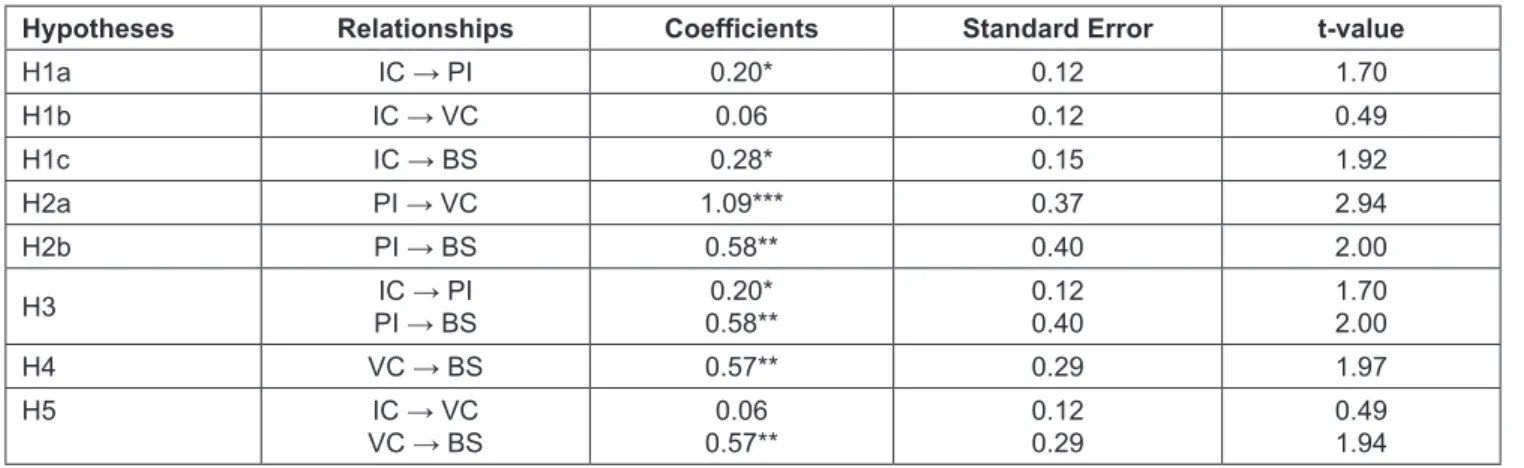
This study aims at investigating the effects of internal control effectiveness on business survival of food businesses in Thailand through the mediators of productivity improvement and value creation. In this study, 155 food businesses in Thailand are the samples of the study. The results show that internal control effectiveness has a significant influence on productivity improvement and business survival. Productivity improvement critically affects value creation and business survival while value creation is an important determinant of business survival.
However, internal control effectiveness has no relationship with value creation. Also, productivity improvement explicitly mediates the internal control effectiveness-business survival relationships. In summary, internal control effectiveness can enhance firms’ sustainable competitive advantage, superior performance and long-term survival. Firms need to focus on internal control effectiveness through investing their assets and resources and utilizing their abilities, competencies and capabilities in order to continuously develop and improve their appropriate concepts and characteristics in an organization. Better internal control effectiveness definitely leads to more long-term survival.
To generalize the research results, future research needs to collect data from other businesses and industries. Increased response rate of the study is important for future research to verify and confirm the research results.
Keywords: Internal Control Effectiveness, Business Survival, Productivity Improvement, Value Creation JEL Classification Code: M41, M40
and analyzed competitive situations and conditions, integrated existing knowledge from several disciplines, and present best business approaches through effective techniques and strategies for fitting with current and future operations. Successful techniques and strategies reflect firms’ useful capabilities to long-term stability, growth and survival. In this study, internal control systems become beneficial strategic mechanisms in helping firms improve their operational effectiveness, create their organizational values and encourage their growth and survival in future and long-term perspectives. They represent good governance, corporate social responsibility and business ethics in firms’ businesses. Thus, the effectiveness of internal control system is important for succeeding, surviving and sustaining in uncertain environments.
Interestingly, internal control effectiveness plays an important role in determining productivity improvement, value creation, and business survival. Here, internal control effectiveness is the ability of firms to assure for compliance objectives, reporting objectives, and business objectives and strategic goals (Wang, 2015). It can ensure a degree of firms’
business operations provided for a realization of related goals and achieved targets, a level of their reported accounting numbers conforming to generally accepted accounting
1
First Author and Corresponding Author. Associate Professor, Faculty of Management Sciences and Information Technology, Nakhon Phanom University, Thailand [Postal Address: Nai Mueang, Mueang Nakhon Phanom District, Nakhon Phanom 48000, Thailand]
Email: [email protected]
2
Assistant Professor, Faculty of Management Sciences and Information Technology, Nakhon Phanom University, Thailand.
Email: [email protected]
© Copyright: The Author(s)
This is an Open Access article distributed under the terms of the Creative Commons Attribution Non-Commercial License (https://creativecommons.org/licenses/by-nc/4.0/) which permits unrestricted non-commercial use, distribution, and reproduction in any medium, provided the original work is properly cited.