Print ISSN: 2288-4637 / Online ISSN 2288-4645 doi:10.13106/jafeb.2021.vol8.no5.1055
Critical Factors for Organizational Commitment:
An Empirical Study in Vietnam
Dan Thanh LY1, Van Chon LE2, Quang Thong BUI3, Nhu-Ty NGUYEN4
Received: February 10, 2021 Revised: April 05, 2021 Accepted: April 15, 2021
Abstract
How to manage a business effectively and successfully is the most important goal of all businesses on their way to expand and develop.
Most researchers have confirmed that highly committed employees may perform better than less committed ones. The paper aims to find out what critical factors really affect employee’s commitment for success of a business. The findings show that three factors having impacts on organizational commitment are leadership, meeting effectiveness and job satisfaction. Particularly, leadership positively affects meeting effectiveness with weight of 0.838. It is believed that if employees feel satisfied with their job, they become more committed to their organization. In addition, it is evident that meeting effectiveness positively affects organizational commitment with weight of 0.296. Last but not the least, in the relationship between meeting effectiveness and organizational commitment, there is a mediator of job satisfaction with the indirect effect of 0.454 and its bootstrap errors at 0.053. It emphasizes the importance of meetings in workplaces. In order to make subordinates satisfied with their jobs, every conflict or problem needs to be thoroughly resolved in meetings. That’s why meeting effectiveness has a significant effect on job satisfaction. Furthermore, whether meetings are effective or not is based on leaders or meeting organizers.
Keywords: Leadership, Job Satisfaction, Meeting Effectiveness, Organizational Commitment, Business Success JEL Classification Code: M10, M21, G30, L25
challenges of competition themselves and from large firms (Bowen et al., 2009).To be successful, businesses have to do a mix of strategies in advance for both external and internal factors, especially for human resources management (Guest, 2010; Hornsby & Kuratko, 1990; Lussier & Pfeifer, 2001). The previous studies show that strategic management factors along with organizational commitment increase the performance of employees and work achievement (Rustamasji, 2018).
Job satisfaction, leadership, meeting effectiveness and organizational commitment are the main factors for this research journey. It is believed that there is an integrated relationship among them. In every organization, meetings are the common activities for a variety of purposes such as performing and reaching vital goals, communicating and exchanging ideas or making changes and similar activities.
However, most meetings are considered to be ineffective even though much time and effort is devoted (Allen, 2012).
Actually, from the literature of meeting effectiveness, leaders or meeting organizers play the very essential role (Nixon &
Littlepage, 2014). For instance, whenever conflicts occur in a meeting, leaders or meeting organizers will be those who make the final decision. They control whatever activities during the discussion time. Most conflicts on work can be peacefully
1 First Author. [1] Ho Chi Minh City University of Economics and Finance (UEF); [2] School of Business, International University (IU);
[3] Vietnam National University, Ho Chi Minh City, Vietnam.
2 [1] School of Business, International University (IU); [2] Vietnam National University, Ho Chi Minh City, Vietnam.
3 [1] School of Business, International University (IU); [2] Vietnam National University, Ho Chi Minh City, Vietnam.
4 Corresponding Author. [1] School of Business, International University (IU); [2]Vietnam National University, Ho Chi Minh City, Vietnam [Postal Address: Quarter 6, Linh Trung Ward, Thu Duc, Ho Chi Minh City, 700000, Vietnam]
Email: [email protected]; [email protected]
© Copyright: The Author(s)
This is an Open Access article distributed under the terms of the Creative Commons Attribution Non-Commercial License (https://creativecommons.org/licenses/by-nc/4.0/) which permits unrestricted non-commercial use, distribution, and reproduction in any medium, provided the original work is properly cited.
1. Introduction
The practice of strategic management has become one of
the most interesting subjects for most research papers. How to
manage the business effectively and successfully is the vital
goal of all businesses on their way to expand and develop
(Hornsby & Kuratko, 1990). Bowen and Morara (2009) states
that SMEs have been faced with the threat of failure and
resolved through meetings. If given-solutions aim to improve team effectiveness, they will bring positive experience and benefits to related-problem members (Esquivel & Kleiner, 1996; Guetzkow & Gyr, 2015). Thanks to meetings, subordinates feel satisfied with their job because during interactions, they have chances to exchange information, clarify ideas, build common ground, contribute ideas and so forth (Meinecke & Lehmann, 2015). In fact, effective meetings will encourage subordinates to contribute more efforts and increase more commitment to their workplace. In other words, if subordinates feel satisfied with their jobs, they will express their strong desire to keep the membership with their organization (Mowday et al., 1978; Steers, 1977).
The paper aims to find out what critical factors really affect organizational commitment for business success. The study has been conducted to demonstrate the interactions and relationships among these main constructs, which are leadership, meeting effectiveness, job satisfaction and organizational commitment. The authors design a survey based on the three research questions: How to make meetings more effective? How does meeting effectiveness affect organizational commitment? What will mediate the influence between meeting effectiveness and organizational commitment? This study contributes to the body of the literature in the field of meeting effectiveness, job satisfaction and organizational commitment from theoretical perspective.
Even though, the concept of meeting has become popular these days in academic research environment worldwide due to its essential role in working life, it is still rather subdued in Vietnam. Furthermore, the interaction and relationship between meeting effectiveness and organizational commitment haven’t been studied. The new findings show that there is an impact of job satisfaction as a mediator for meeting effectiveness on organizational commitment.
First, the paper reviews four main factors: meeting effectiveness, leadership, job satisfaction and organizational commitment. Next, the survey of Five-point Likert scale is used to measure those factors with two hundred and forty- nine respondents who worked at about 34 Vietnamese organizations from a variety of sectors such as banking, health service, airlines, education and business. Finally, quantitative research is performed by using EFA, CFA analysis and SEM. The results show that leadership directly affects meeting effectiveness; and meeting effectiveness influences organizational commitment with the mediation of job satisfaction.
2. Literature Review 2.1. Meeting Effectiveness
Generally, meetings play a vital role in organizations because they strategically produce consequential outcomes.
They can also be considered as the central points for organizational activities that are essential for members (Jarzabkowski & Seidl, 2008). Typical kinds of meeting are listed as board meetings, committee meetings, departmental meetings and the like (Baker, 2010). If the meetings aim at facilitating employees and organizations to achieve their goals, they obviously become organizational tools that bring benefits (Rogelberg et al., 2006).
As a result, meeting effectiveness needs to be focused for gaining organizational members’ higher performance.
Actually, it was tightly involved in decision satisfaction and goal attainment. Several studies claim that to be effective, meetings need to be open, task-focused and impartial in communication (Allen et al., 2014; Nixon & Littlepage, 2014). To strengthen the same viewpoint, Bagire (2015) states that the effective meeting shouldn’t lack a clear purpose and a specific agenda, date, duration and materials and moreover emphasizes that whether a meeting is effective or not is mainly relied on the chairperson’s central role in leading the meeting (Bagire et al., 2015). Even though factors such as irrelevant topics, excessive time length and poor or inadequate preparation may affect meeting productivity (Nicholas & Jay, 2001; Pattiruhu et al., 2020), the important one is the role of team leaders or facilitators who control a meeting (Volkema & Fred, 1996). Specifically, an organization is mainly influenced by the host who has the strongest power in making the final decision (Lestari et al., 2020; Nguyen et al., 2021; Nguyen & Khoa, 2020).
It is referred as leadership.
2.2. Leadership
From the literature of meeting effectiveness, it can be inferred that the leaders play most essential role (Nixon
& Littlepage, 2014). In current situation with a highly diverse workforce, leadership is the decisive factor for any organization’s success. It needs to be trained and improved (Men, 2014). The common style is named “diversity- friendly” or “simpatico”. Generally, a diversity leader works as a corporate manager, that is, he or she leads subordinates in an impartial, effective and communicative way.
Moreover, such a diversity leader is expected to have those characteristics which are Sensitive, Impartial, Mediators, Patient, Amiable, Teachers, Involved, Communicators, and Optimistic (Hopkins & Hopkins, 1998).
According to Simola et al. (2012), transformational
leadership is most recommended. Leaders of this type have
the responsibilities to transform, motivate and encourage
their subordinates in order to reach their expectation ethically
at work (Bass & Riggio, 2006; Simola et al., 2012). In other
words, it consists of four dimensions such as idealized
influence, inspirational motivation, intellectual stimulation
and individualized consideration (Judge & Bono, 2000;
Simola et al., 2012). In fact, followers always expect to be under the control of inspirational leaders who direct them in uncertainty and facilitate them to perform their talents (Bass
& Riggio, 2006).
Another type of leadership that is most preferred is charisma. Emotionality is the main dimension in this type, the nature of which is not very rational. For instance, problem- solving is not mostly based on authority but rather on personal characteristics (Marjosola & Takala, 2000) and evidently, leaders are hard to effectively achieve goals by just only through followers’ efforts and specialty (Andersen, 2006).
From another perspective, Fry et al. (2007) highly appreciates this type of servant leadership. Four main characteristics of this type are being a servant first, serving people’s needs; serving through listening; serving through people building and serving through leadership creation (Fry et al., 2007). Sharing the same viewpoint, Men (2014) emphasizes transformational one in which leaders motivate followers by appealing to their higher-order needs and induce employees to look beyond their selfish interests for the sake of the group or the organization (Men, 2014 ).
Above all, leadership becomes the most decisive factor in an organization for its success and thus, leaders are suggested to be provided essential skills, for examples, formulating vision for an organization or setting effective objectives and plans to implement that vision in practice (Kirkpatrick
& Locke, 1991). Obviously, in reality, the meeting will be more effective if it is led by the transitional or charismatic leadership. Therefore, the authors posit:
H1: Leadership will be positively related to Meeting effectiveness.
2.3. Job Satisfaction
The concept of job satisfaction has been defined in various ways. According to previous studies, it is expressed as an emotion that relates to a person’s overall evaluation with respect to their work environment and is considered to be involved in five facets: pay, promotions, peers, superiors and the work itself (Alegre et al., 2015; Yousef, 2017; Bui et al., 2021). Similarly, Steel et al. (2018) emphasizes that job satisfaction is considered as the cognitive evaluation of the well-being quality of one’s job, such as with pay, coworkers or supervisors (Steel et al., 2014; Nguyen, 2021; Johl et al., 2015). To put it in another way, some authors define it as the pleasurable emotional state originating from the organization’s appraisal for those who are supported to achieve their job values (Lu et al., 2016). Furthermore, in Judge’s study, he also confirms that job satisfaction is described as a pleasure or positive emotional state resulting from the appraisal of one’s job or job experiences (Judge & Klinger, 2008). In fact, job attitudes and well-being have the relationship with meeting
demands and therefore, the more effective the meeting is, the more satisfied the subordinates feel (Burnfield et al., 2006;
Cao et al., 2021). Importantly, it is an integrated factor of organizational behavior that needs to be interested, supervised and improved in order to avoid unmeasurable reactions of dissatisfaction (Masadeh et al., 2019).
As mentioned above, meeting effectiveness is positively linked to employee creativity through job satisfaction (Alonderiene & Majauskaite, 2016). Thus:
H2: Meeting effectiveness is positively related to Job satisfaction.
2.4. Organizational Commitment
Previously, there was an ambiguity in the concepts of organizational commitment and organizational identification.
However, recently these terms have been discussed theoretically and tested empirically by Gautam et al. (2004). The authors strongly conclude that whereas organizational identification is self-referential or self-definitional, commitment is not and that while identification is related to perceived similarity and shared fate with the organization, commitment is formed by exchange-based factors known as the relationship between the individual and the organization (Gautam et al., 2004).
Employees feel more attachment to the organizational goals and values toward organizational commitment (Buchanan, 1974; Cook & Wall, 1980). As reviewed by Mowday et al.
(1978), the concept of organizational commitment is defined as from the two main perspectives: behaviors and attitude.
It is the relation between an individual’s identification and involvement with the organization in which people work for.
Moreover, organizational commitment can be symbolized by at least three elements “1) a strong belief in arid acceptance of the organization’s goals and values; 2) a willingness to exert considerable effort on behalf of the organization; and 3) a strong desire to maintain membership in the organization”
(Mowday et al., 1978; Steers, 1977) and is a process of identification (Reichers, 1985). This leads to the following hypotheses:
H3: Job satisfaction will be positively related to Organizational commitment.
H4: Job satisfaction will mediate the relationship between Meeting effectiveness and Organizational commitment.
H5: Meeting effectiveness is positively related to Organizational commitment.
3. Methodology
The data for the research is based on the survey of two
hundred and forty-nine respondents who are working at about
34 Vietnamese organizations from a variety of sectors such
as banking, health service, airlines, education and business.
The firm requirement is that they all are subordinates with various titles from middle managers to staff, but not in the top management board. The questionnaires contained four factors: leadership, meeting effectiveness, job satisfaction and organizational commitment and were distributed as hard copies that required handwritten responses. Five-point Likert scale is used to measure those factors with 28 items: totally disagree, disagree, neutral, agree, totally agree. A total of 249 completed handouts of questionnaires are done within six months in Ho Chi Minh City and other neighboring provinces in southern Vietnam were returned and were found to be valid. Quantitative research is conducted by non- probability sampling method by using EFA, CFA analysis and SEM.
It is so strict because inherently Vietnamese people belong to high-context culture in which most of them tend to be indirect and nonverbal in their communication. This stereotype of culture deeply influences their mind. That’s why, in every meeting, the subordinates seem to be silent and agreeable without questioning even though they have different view point from their boss. Therefore, with the aim of understanding the subordinates and knowing how effective the meeting should be so that they feel satisfied after exchanging ideas, making changes and fulfilling the consensus, the authors decide to survey those who are all subordinates. Due to this culture, a boss is considered as the highest decision making person who has full control of meetings and directs his subordinates to meet any decided actions.
4. Results
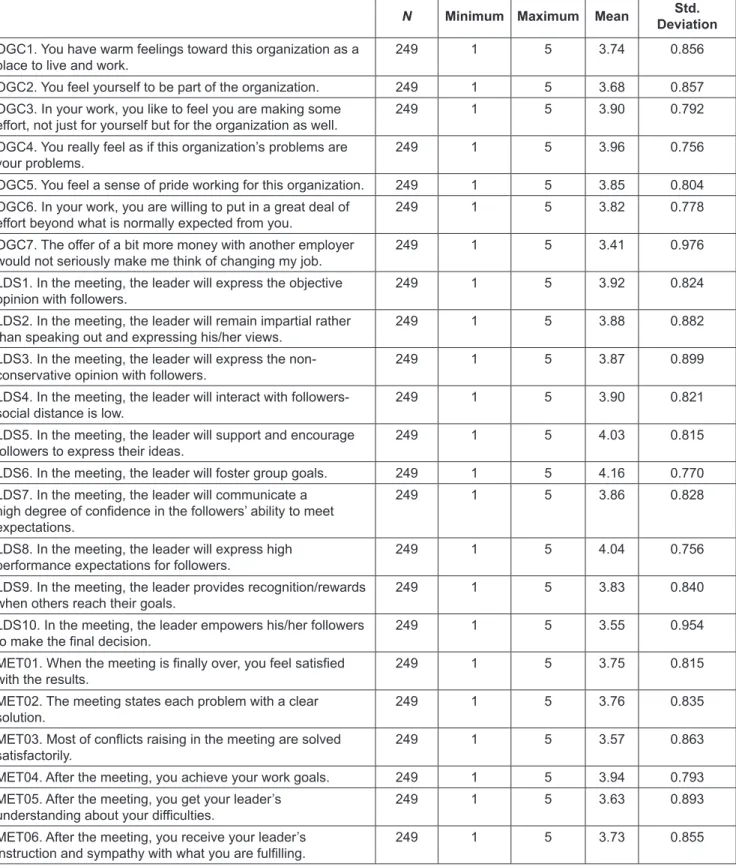
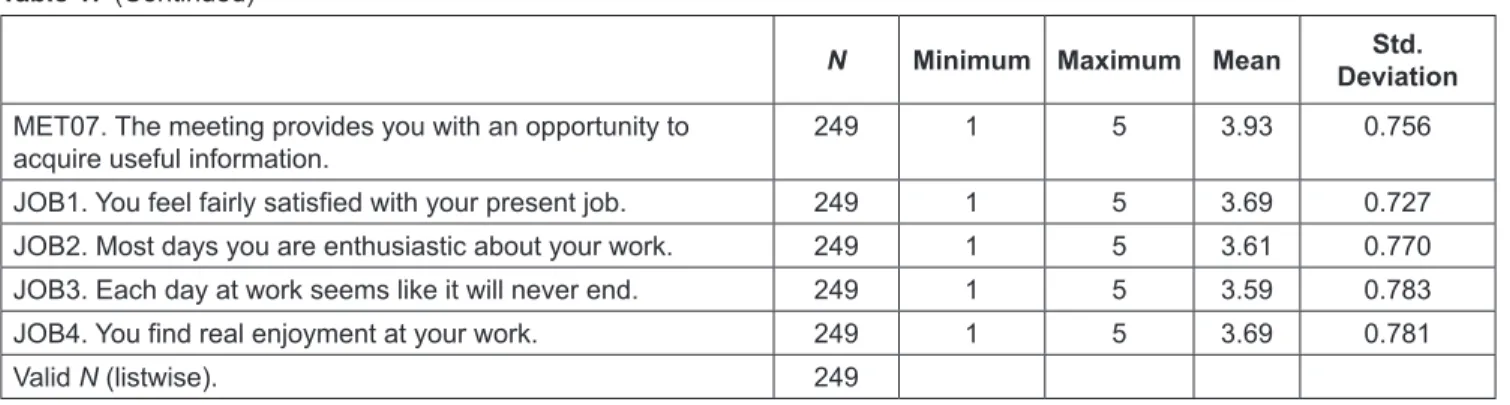
To ensure the items in the questionnaire to be valid and reliable, the questionnaire is surveyed by two hundred and forty nine participants. The descriptive statistics result shows that it ranges with mean from 3.55 to. 4.16 and its standard deviations fluctuate from 0.727 to 0.976. Moreover, Cronbach’s Alpha ratio is 0.916 (> 0.8) with 28 items (see Table 1).
Next step is EFA factor analysis. It is classified into two phases. Phase one is for independent variables, and phase two is for the dependent one.
In the first phase, three independent variables which are leadership, meeting effectiveness and job satisfaction are included in EFA factor analysis with principal components method and rotation Varimax. Specifically, KMO equals to 0.939 (≥ 0.5) and sig. 0.001 (≤ 0.05), therefore Bartlett’s Test is statistically significant (see Table 2).
After Rotation method Varimax with Kaiser Normalization, 21 items of independent variables are separated into three factors. Factor 1 consists of nine items named Leadership: LDS1, LDS2, LDS3, LDS4, LDS5, LDS6, LDS7, LDS8, LDS9. However, LDS9 is eliminated
because the difference of factor loadings between two factors is less than 0.3. Factor 2 involves six items called Meeting effectiveness: LDS10, MET1, MET2, MET3, MET5 and MET6. Last but not least, Job satisfaction is for Factor 3 contain four items: JOB1, JOB2, JOB3 and JOB4.
The evaluation of Cronbach’s Alpha after EFA analysis for 3 factors: Leadership, Meeting effectiveness and Job satisfaction are simultaneously at 0.922; 0.863; and 0.888.
They all are accepted. (see Table 3).
In the second phase, the dependent variable
“Organizational Commitment” is evaluated by EFA analysis.
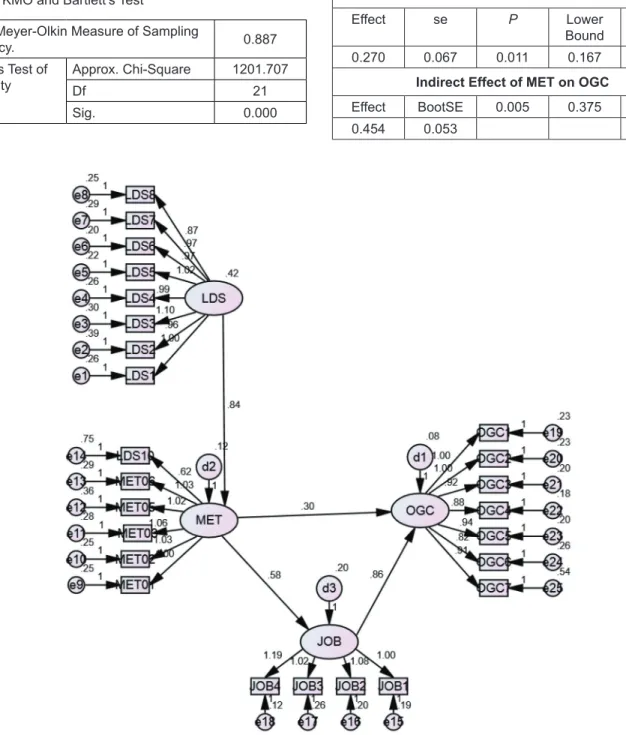
The result is that the evaluation of Cronbach’s Alpha for dependent variable “Organizational Commitment” is 0.916 which is accepted. Furthermore, KMO equals to 0.887 (≥ 0.5) and sig. 001 (≤ 0.05) that also mean the Bartlett’s Test is statistically significant and all factor loadings are more than 0.486. (see Table 4)
The results of CFA factor analysis of the research model are presented in Figure 1. They are presented as follow: P = 0.000; CFI = 0.915; TLI = 0.906; GFI = 0.822; RMSEA = 0.075. According to the conditions with P < 0.05; CFI, TLI, GFI ≥ 0.8 and RMSEA ≤ 0.08, they all meet the requirements.
Considering the above conditions, the model is consistent with the market data.
All parameters are statistically significant with P-value
< 0.05. According to the regression weight between factors shown, while Leadership positively affects Meeting Effectiveness with weight of 0.838, Meeting Effectiveness positively affects Organizational Commitment with weight of 0.296. Specifically, when Leadership goes up by 1 standard deviation, Meeting effectiveness goes up by 0.838 standard deviation and when Meeting effectiveness goes up by 1 standard deviation, Organizational Commitment goes up by 0.296 standard deviation. Similarly, with weight of 0.576, Meeting Effectiveness has a positive effect on Job Satisfaction and Job Satisfaction has the weight of 0.864 in the relationship with Organizational Commitment. (See Table 5 below).
Finally, in analysis of the moderating effect of JOB on MET and OCG, there is a significant total effect of Meeting effectiveness and Organizational commitment with P-value
< 0.05 and its regression weight is 0.725 with bootstrap standard errors 0.055. It ranges from 0.651 lower bound to 0.809 upper bound. MET directly affects OGC with weight of 0.270 at bootstrap standard errors 0.067. Its lower bound and upper bound are 0.167 and 0.372 respectively. However, the indirect effect of Job satisfaction on the interaction between Meeting effectiveness and Organizational commitment is slightly higher at 0.454 with errors of 0.053. The 95%
confidence interval for the indirect effect (0.035, 0.543) infers that the indirect effect of “Meeting effectiveness” on
“Organizational commitment” is statistically significant. This
is the evidence for Job satisfaction as a mediator (see Table 5).
Table 1: Descriptive Statistics
N Minimum Maximum Mean Std.
Deviation OGC1. You have warm feelings toward this organization as a
place to live and work. 249 1 5 3.74 0.856
OGC2. You feel yourself to be part of the organization. 249 1 5 3.68 0.857
OGC3. In your work, you like to feel you are making some
effort, not just for yourself but for the organization as well. 249 1 5 3.90 0.792 OGC4. You really feel as if this organization’s problems are
your problems. 249 1 5 3.96 0.756
OGC5. You feel a sense of pride working for this organization. 249 1 5 3.85 0.804 OGC6. In your work, you are willing to put in a great deal of
effort beyond what is normally expected from you. 249 1 5 3.82 0.778
OGC7. The offer of a bit more money with another employer
would not seriously make me think of changing my job. 249 1 5 3.41 0.976
LDS1. In the meeting, the leader will express the objective
opinion with followers. 249 1 5 3.92 0.824
LDS2. In the meeting, the leader will remain impartial rather
than speaking out and expressing his/her views. 249 1 5 3.88 0.882
LDS3. In the meeting, the leader will express the non-
conservative opinion with followers. 249 1 5 3.87 0.899
LDS4. In the meeting, the leader will interact with followers-
social distance is low. 249 1 5 3.90 0.821
LDS5. In the meeting, the leader will support and encourage
followers to express their ideas. 249 1 5 4.03 0.815
LDS6. In the meeting, the leader will foster group goals. 249 1 5 4.16 0.770
LDS7. In the meeting, the leader will communicate a high degree of confidence in the followers’ ability to meet expectations.
249 1 5 3.86 0.828
LDS8. In the meeting, the leader will express high
performance expectations for followers. 249 1 5 4.04 0.756
LDS9. In the meeting, the leader provides recognition/rewards
when others reach their goals. 249 1 5 3.83 0.840
LDS10. In the meeting, the leader empowers his/her followers
to make the final decision. 249 1 5 3.55 0.954
MET01. When the meeting is finally over, you feel satisfied
with the results. 249 1 5 3.75 0.815
MET02. The meeting states each problem with a clear
solution. 249 1 5 3.76 0.835
MET03. Most of conflicts raising in the meeting are solved
satisfactorily. 249 1 5 3.57 0.863
MET04. After the meeting, you achieve your work goals. 249 1 5 3.94 0.793
MET05. After the meeting, you get your leader’s
understanding about your difficulties. 249 1 5 3.63 0.893
MET06. After the meeting, you receive your leader’s
instruction and sympathy with what you are fulfilling. 249 1 5 3.73 0.855
5. Discussion
In this study, it is found that leadership has a positive effect on meeting effectiveness. As the definition of leadership, it is referred as a process to influence organizational members to achieve their goals or results (Alonderiene & Majauskaite, 2016). In real organizational practices, meetings are led by meeting organizers or leaders who control them and make final decisions for any matters or conflicts occurring during the meeting. Apparently, whether meetings are effective or not depends on meeting organizers or leaders. As supposed by hypothesis 2 that meeting effectiveness will be positively related to job satisfaction, it definitely has a significant effect on job satisfaction. According to Burnfield et al. (2006), perceived meeting effectiveness has a strong and direct effect on subordinates’ attitude and well-being. Meetings play the vital role to coordinate and integrate employee work activities and fulfill their interdependent tasks (Burnfield et al., 2006). The findings also show that job satisfaction has a positive influence on organizational commitment.
From previous studies, the concept of employee commitment to organizations is defined in several ways and as reviewed by Mowday et.al. (1978), it is mainly related to subordinates’ behaviors and attitude. That’s why job satisfaction works as a predictor of organizational
Table 3: EFA Result – Rotated Component Matrix Component
1 2 3
LDS1 0.657
LDS2 0.673
LDS3 0.679
LDS4 0.756
LDS5 0.838
LDS6 0.800
LDS7 0.695
LDS8 0.627
LDS9 0.530 0.550
LDS10 0.670
MET01 0.648
MET02 0.668
MET03 0.680
MET04
MET05 0.709
MET06 0.556
MET07
JOB1 0.825
JOB2 0.837
JOB3 0.759
JOB4 0.819
Eigenvalue 5.190 3.661 3.002
Cumulative 64.872 61.014 75.043
Cronbach Alpha 0.922 0.863 0.888
N Minimum Maximum Mean Std.
Deviation MET07. The meeting provides you with an opportunity to
acquire useful information. 249 1 5 3.93 0.756
JOB1. You feel fairly satisfied with your present job. 249 1 5 3.69 0.727
JOB2. Most days you are enthusiastic about your work. 249 1 5 3.61 0.770
JOB3. Each day at work seems like it will never end. 249 1 5 3.59 0.783
JOB4. You find real enjoyment at your work. 249 1 5 3.69 0.781
Valid N (listwise). 249
Table 1: (Continued)
Table 2: KMO and Bartlett’s Test
Kaiser-Meyer-Olkin Measure of Sampling
Adequacy. 0.939
Bartlett’s Test of
Sphericity Approx. Chi-Square 3656.950
Df 210
Sig. 0.000
Table 5: Mediating with Regression Analysis Total Effect of MET on OGC
Effect se P Lower
Bound Upper
Bound
0.725 0.055 0.004 0.651 0.809
Direct Effect of MET on OGC
Effect se P Lower
Bound Upper
Bound
0.270 0.067 0.011 0.167 0.372
Indirect Effect of MET on OGC
Effect BootSE 0.005 0.375 0.543
0.454 0.053
Table 4: KMO and Bartlett’s Test
Kaiser-Meyer-Olkin Measure of Sampling
Adequacy. 0.887
Bartlett’s Test of
Sphericity Approx. Chi-Square 1201.707
Df 21
Sig. 0.000
Figure 1: Results of CFA Concepts of Research Model (Standardized)
commitment. With these interactive effects, job satisfaction
mediates the relationship between meeting effectiveness
and organizational commitment. To some extent, it is
explained that whenever subordinates feel satisfied with
their job through meetings, they will more commit to their
organizations.
6. Conclusion
The findings show three factors having an impact on organizational commitment. It emphasizes the importance of meetings in workplaces. In order to make subordinates satisfied with their job, every conflict or problem needs to be thoroughly resolved in meetings. That’s why meeting effectiveness has a significant effect on job satisfaction.
Furthermore, whether meetings are effective or not is based on leaders or meeting organizers. Thus, leadership has a positive role to play for meeting effectiveness with weight of 0.838. Previous studies have confirmed that highly committed employees may perform better than less committed ones (Steers, 1977). Obviously, if employees feel satisfied with their job, they become more committed to their organization. From the above-mentioned, it is evident that meetings effectiveness positively affects organizational commitment with weight of 0.296. Last but not the least, in the relationship between meeting effectiveness and organizational commitment, there is a mediator of job satisfaction with the indirect effect of 0.454 and its bootstrap errors at 0.053.
References
Alegre, I., Machuca, M. M., & Mirabent, J. B. (2015). Antecedents of employee job satisfaction: Do they matter? Journal of Business Research. https://doi.org/10.1016/j.jbusres.2015.10.113 Allen, J. A. (2012). Employees’ feelings about more meetings.
Management Research Review, 35(5). https://doi.
org/10.1108/01409171211222331
Allen, J. A., Willenbrock, N. L., & Landowski, N. (2014). Linking pre-meeting communication to meeting effectiveness. Journal of Managerial Psychology, 29, 1064–1081. https://doi.org/
10.1108/jmp-09-2012-0265
Alonderiene, R., & Majauskaite, M. (2016). Leadership style and job satisfaction in higher education institutions International Journal of Educational Management, 30(1), 140–164. https://
doi.org/10.1108/ijem-08-2014-0106
Andersen, J. A. (2006). Leadership, personality and effectiveness The Journal of Socio-Economics, 35. https://doi.org/10.1016/j.
socec.2005.11.066
Bagire, V., Byarugaba, J., & Kyogabiirwe, J. (2015). Organizational meetings: management and benefits Journal of Management Development, 34(8), 960–972. https://doi.org/10.1108/jmd-03- 2014-0023
Baker, H. (2010). Writing Meeting Minutes and Agenda. Lancashire, UK: Universe of Learning Ltd.
Bass, B. M., & Riggio, R. E. (2006). Transformational Leadership.
London: Lawrence Erlbaum Associates, Inc. https://doi.
org/10.4324/9781410617095
Bowen, M., Morara, M., & Mureithi, S. (2009). Management of Business Challenges among Small and Mircro enterprises in Nairobi-Kenya. KCA Journal of Business Management, 2(1).
https://doi.org/10.4314/kjbm.v2i1.44408
Buchanan, B. (1974). Building Organizational Commitment:
The Socialization of Managers in Work Organizations Administrative Science Quarterly, 19(4), 533–546. https://doi.
org/10.2307/2391809
Bui, T. Q., Nguyen, N. T., Nguyen, K. K., & Tran, T. T. (2021).
Antecedents Affecting Purchase Intention of Green Skincare Products: A Case Study in Vietnam. The Journal of Asian Finance, Economics and Business, 8(3), 1295–1302. https://
doi.org/10.13106/jafeb.2021.vol8.no3.1295
Burnfield, J. L., Steven, G., Rogelberg, S. G., Leach, D. J., & Warr, P. B.
(2006). “Not Another Meeting!” Are Meeting Time Demands Related to Employee Well-Being? Journal of Applied Psychology, 91(1), 86–96. https://doi.org/10.1037/0021-9010.91.1.83 Cao, M. M., Nguyen, N. T., & Tran, T. T. (2021). Behavioral Factors
on Individual Investors’ Decision Making and Investment Performance: A Survey from the Vietnam Stock Market. The Journal of Asian Finance, Economics and Business, 8(3), 845–853. https://doi.org/10.13106/jafeb.2021.vol8.no3.0845 Cook, J., & Wall, T. (1980). New work attitude measures of trust,
organizational commitment and personal need non-fulfilment.
Journal of Occupational Psychology, 53, 39–52. https://doi.
org/10.1111/j.2044-8325.1980.tb00005.x
Esquivel, M. A., & Kleiner, B. H. (1996). The importance of conflict in work team effectiveness Team Performance Management: An International Journal, 2(3), 42–48. https://
doi.org/10.1108/13527599610126265
Fry, L. W., Matherly, L. L., Whittington, J. L., & Winston, B. E.
(2007). Spiritual Leadership as an Integrating Paradigm for Servant Leadership. Integrating Spirituality and Organizational Leadership. https://doi.org/10.1057/978-1-137-60194-0_7 Gautam, T., Dick, R. V., & Wagner, U. (2004). Organizational
identification and organizational commitment: Distinct aspects of two related concepts. Asian Journal of Social Psychology, 7, 301–315. https://doi.org/10.1111/j.1467-839x.2004.00150.x Guest, D. E. (2010). Human resource management: when research
confronts theory. The International Journal of Human Resource Management, 12(7). https://doi.org/10.1080/09585190110067837 Guetzkow, H., & Gyr, J. (1954). An Analysis of Conflict in
Decision-Making Groups. Human Relations, 7(3), 367–382.
https://doi.org/10.1177/001872675400700307
Hopkins, W. E., & Hopkins, S. A. (1998). Diversity Leadership: A mandate for the 21st Century Workforce.
The Journal of Leadership Studies, 5(3). https://doi.org/
10.1177/107179199900500311
Hornsby, J. S., & Kuratko, D. F. (1990). Human resource management in small business. Journal of Small Business Management, 28(3).
Jarzabkowski, P., & Seidl, D. (2008). The Role of Meetings in the Social Practice of Strategy. Organization Studies, 29(11), 1391–1426. https://doi.org/10.1177/0170840608096388 Johl, S. K., Kaur, S., & Cooper, B. J. (2015). Board characteristics
and firm performance: Evidence from Malaysian public listed firms. Journal of Economics, Business and Management, 3(2), 239–243. https://doi.org/10.7763/joebm.2015.v3.187
Judge, T. A., & Bono, J. E. (2000). Five-Factor Model of Personality and Transformational Leadership. Journal of Applied Psychology, 85(5), 751–765. https://doi.org/10.1037/0021-9010.85.5.751 Judge, T. A., & Klinger, R. (2008). Job Satisfaction - Subjective
Well-Being at Work. International Journal of Public Administration, 40(1), 77–88. https://doi.org/10.1080/019006 92.2015.1072217
Kirkpatrick, S. A., & Locke, E. A. (1991). Leadership: Do traits matters? Academy of Management Executive, 5(2). https://doi.
org/10.5465/ame.1991.4274679
Lestari, S. D., Leon, F. M., Widyastuti, S., Brabo, N. A., &
Putra, A. H. P. K. (2020). Antecedents and consequences of innovation and business strategy on performance and competitive advantage of SMEs. The Journal of Asian Finance, Economics, and Business, 7(6), 365–378. https://doi.
org/10.13106/jafeb.2020.vol7.no6.365
Lu, L., Lu, A. C. C., Gursoy, D., & Neale, N. R. (2016). Work engagement, job satisfaction, and turnover intentions International Journal of Contemporary Hospitality Management, 28(4). https://doi.org/10.1108/ijchm-07-2014-0360
Lussier, R. N., & Pfeifer, S. (2001). A Crossnational Predition Model for Business Success. Journal of Small Business Management, 39(3), 228–239. https://doi.org/10.1111/0447-2778.00021 Marjosola, I. A., & Takala, T. (2000). Charismatic leadership,
manipulation and the complexity of organizational life. Journal of Workplace Learning. https://doi.
org/10.1108/13665620010332750
Masadeh, R., Almajali, D. A., Alrowwad, A., & Obeidat, B.
(2019). The role of knowledge management infrastructure in enhancing job satisfaction: A developing country perspective.
Interdisciplinary Journal of Information, Knowledge, and Management, 4. https://doi.org/10.28945/4169
Meinecke, A. L., & Lehmann-Willenbrock, N. (n.d.). Social Dynamics at Work: Meetings as a Gateway. The Cambridge Handbook of Meeting Science, 325–356. https://doi.org/10.
1017/cbo9781107589735.015
Men, L. R. (2014). Strategic Internal Communication: Transforma- tional Leadership, Communication Channels, and Employee Satisfaction. Management Communication Quarterly, 28(2), 264–284. https://doi.org/10.1177/0893318914524536
Men, L. R. (2014). Why Leadership Matters to Internal Communication: Linking Transformational Leadership, Symmetrical Communication, and Employee Outcomes.
Journal of Public Relations Research, 26, 256–279. https://doi.
org/10.1080/1062726x.2014.908719
Mowday, R. T., Steers, R. M., & Porter, L. W. (1978). The measurement of Organizational Commitment: A progress report. Technical report. https://doi.org/10.1037/t08840-000 Nicholas, C. R., & Jay, F. N. (2001). Meeting Analysis: Findings
from Research and Practice. https://doi.org/10.1109/
hicss.2001.926253
Nixon, C. T., & Littlepage, G. L. (2014). Impact of meeting procedures on meeting effectiveness. Journal of Business
and Psychology, 6, 361–369. https://doi.org/10.1007/
bf01126771
Nguyen, N. T. (2021). The Influence of Celebrity Endorsement on Young Vietnamese Consumers’ Purchasing Intention. (2021).
The Journal of Asian Finance, Economics, and Business, 8(1), 951–960. https://doi.org/10.13106/JAFEB.2021.VOL8.
NO1.951
Nguyen, M. T., & Khoa, B. T. (2020). Improving the Competitiveness of Exporting Enterprises: A Case of Kien Giang Province in Vietnam. The Journal of Asian Finance, Economics, and Business, 7(6), 495–508. https://doi.org/10.13106/jafeb.2020.
vol7.no6.495
Nguyen, N. T., Nguyen, L. H. A., & Tran, T. T. (2021). Purchase Behavior of Young Consumers Toward Green Packaged Products in Vietnam. (2021). The Journal of Asian Finance, Economics, and Business, 8(1), 985–996. https://doi.
org/10.13106/JAFEB.2021.VOL8.NO1.985
Pattiruhu, J. R., & Paais, M. (2020). Effect of liquidity, profitability, leverage, and firm size on dividend policy. The Journal of Asian Finance, Economics, and Business, 7(10), 35–42. https://
doi.org/10.13106/jafeb.2020.vol7.no10.035
Reichers, A. E. (1985). A Review and Reconceptualization of Organizational Commitment The Academy of Management Review, 10(3), 465–476. https://doi.org/10.5465/amr.1985.4278960 Rogelberg, S. G., Leach, D. J., Warr, P. B., & Burnfield, J. L. (2006).
“Not Another Meeting!” Are Meeting Time Demands Related to Employee Well-Being? Journal of Applied Psychology, 91(1), 86–96. https://doi.org/10.1037/0021-9010.91.1.83 Rustamasji. (2018). The effect of strategic management and
organizational commitment on employees’ work achievement.
Management Science Letters, 9. https://doi.org/10.5267/j.
msl.2018.12.009
Simola, S., Barling, J., & Turner, N. (2012). Transformational leadership and Leader’s Mode of Care Reasoning Journal of Business Ethics, 229–237. https://doi.org/10.1007/s10551-011- 1080-x
Steel, P., Schmidt, J., Bosco, F., & Uggerslev, K. (2018). The effects of personality on job satisfaction and life satisfaction: A meta- analytic investigation accounting for bandwidth–fidelity and commensurability. Human Relations, 72(2), 217–247. https://
doi.org/10.1177/0018726718771465
Steers, R. M. (1977). Antecedents and Outcomes of Organizational Commitment Administrative Science Quarterly, 22(1), 46–56.
https://doi.org/10.2307/2391745
Volkema, R. J., & Fred Niederman, F. (1996). Planning and Managing Organizational Meetings: An Empirical Analysis of Written and Oral Communications The Journal of Business Communication, 33, 275–296. https://doi.org/10.1177/002194369603300304 Yousef, D. A. (2017). Organizational Commitment, Job Satisfaction
and Attitudes toward Organizational Change: A Study in the Local Government. International Journal of Public Administration, 40(1), 77–88. https://doi.org/10.1080/019006 92.2015.1072217