1. Introduction
Rayleigh wave is widely used for non-destructive evaluation(NDE) field because of its many advantages. First, it can propagates along long distance with the structures which need to get inspected. Second, while it is decayed rapidly with depth direction, it can ideally move to the far filed with a surface without any energy loss. Because most of pipes and tanks could be degraded with fractures and corrosions on the surface, the analysis of Rayleigh wave scattering pattern gives us valuable information to diagnose their soundness.
Simply, such surface defects are counted as cavities on the surface in two-dimensional case.
Many analytical studies of wave scattering by a cavity have been published. However, in order to deal with irregular geometries, numeri- cal approach is also needed. Compared to finite
element method(FEM), boundary element method (BEM) is more suited for the numerical analysis of wave scattering by cracks, cavities, or inclusions in elastic media since there are many advantages[1]. The most important advantage of BEM is that it needs discretized boundary rather than entire domain. It results in time and memory saving and helps us handle wider domain than the one by FEM. Moreover, when the analysis of wave propagation in two- dimensional elastic half-space is needed, BEM approach is robust method since discritization over the boundary of a half-space is required to enforce the boundary conditions.
In order that BEM is used in 2-D to analyze wave scattering pattern in semi infinite domain, the boundary of each end should be truncated to construct an open boundary instead of general closed boundary for computational purpose while all types of wave have geometrical attenuation
A Treatment for Truncated Boundary in a Half-Space with 2-D Rayleigh Wave BEM
Taeho Ju*, Younho Cho* , Haidang Phan* and Jan D. Achenbach**
Abstract Analysis of two-dimensional Rayleigh wave scattering pattern by a surface defect is studied through modified boundary element method. BEM proposed in this paper has special treatment at each end of boundary which should have the Rayleigh wave go away without any generation of virtual reflections. It is shown that treatment for truncated boundary which is used to model two-dimensional Rayleigh waves' behavior in an elastic half-space is successfully implemented. To check numerical results' accuracy, time domain IFFT signal of the displacements is presented. Improvement on getting rid of unwanted influence of truncated boundary induced by 2-D Rayleigh waves on a flat surface of an elastic half-infinite medium is shown. As a final goal, the numerical results of Rayleigh wave scattering trend are plotted and they are compared with theoretical curves to prove its accuracy.
Keywords: BEM, Cavity, Truncated Boundary, Rayleigh Wave, Elastic Half-Space [Original paper]
Journal of the Korean Society for Nondestructive Testing Vol. 31, No. 6 (2011. 12)
[Received: September 26, 2011, Revised: November 2, 2011, Accepted: December 8, 2011] *School of Mechanical Engineering, Pusan National University, Busan, 609-735, Korea, **Northwestern University, Evanston, IL 60208, USA,
Corresponding Author: [email protected]
in 3-D[2]. In two-dimensional case, Rayleigh waves propagate along the surface of the half-space without attenuation. So, the spurious reflections of elastic waves at the end of domain are normally significant causing huge numerical error. There are many ways to handle the truncated boundary such as adding a small amount of damping to the material[3] or mapping the unconsidered part of boundary into finite region[4].
In this paper, a BEM simulation results are shown with special treatment for the truncated boundary to see behavior of scattered Rayleigh waves by a cavity with better result than previous study.
2. Formulation
The technique for modification on coefficient matrix of Rayleigh wave BEM presented by I.
Arias and J. Achenbach[4] is applied in this article to correct the error introduced by the truncation of infinite boundary to account for the contribution of the omitted part of the boundary. In this approach, it is assumed that the numerical solution takes the known far-field general form of Rayleigh waves in the omitted part of the boundary, in principle, of unknown amplitude and phase. This assumption is used here to rewrite the integrals that represent the contribution of the omitted part or the boundary as the product of integrals of known quantities on the omitted part of the boundary and the unknown amplitudes and phases of the far-field Rayleigh waves. In order to eliminate these unknowns, the assumed far-field Rayleigh waves are matched to the nodal values at the end nodes of the computational boundary.
Consequently, the coefficients of the original BEM displacement system matrix associated with the end nodes are modified.
The frequency domain boundary integral equation for a point ξ on the boundary Γ in the
absence of body forces may be obtained from the reciprocal theorem of elastodynamics
2 1 ),
( )]
, ( ) , , (
) , ( ) , , ( [ ) , ( ) (
,
,
x d x u x t
x t x u u
c
(1)
where and are the full-space frequency domain elastodynamic fundamental solution displacement and traction tensors, respectively[4]. Note that and
represent the component of displacements and tractions on the boundary at the point due to a unit time-harmonic load of angular frequency applied at the point in direction . Also, , are frequency domain displacements and tractions on the boundary, stands for the angular frequency and is called the jump coefficient given by
where represents the Kronecker delta.
The jump coefficients for corner points can be derived by an indirect approach as described in reference[3]. The integrals (1) are interpreted in the sense of the Cauchy principal value.
The fundamental solutions of displacement and traction tensor, and are given in[3]
(2)
(3)
with
(4)
Here, is the density of the material, ,
, are transverse, longitudinal and Rayleigh wave velocities respectively, , are wave numbers of transverse and longitude waves respectively, , , are the modified Bessel functions of the first kind and zero, first and second order, and , are dependent on the material property and given as follows
(5) Depending on the equations (2)-(3) and the idea of Rayleigh wave correction[4], a BEM code has been written in FORTRAN for calculation of the scattering of two-dimensional surface waves by a cavity in a half-space. The boundary conditions applying for the scattered field are the traction values obtained theoretically at the position of the cavity boundary but in the opposite directions. With this idea, the problem has been solved numerically by the direct frequency domain boundary element method which allows the undamped Rayleigh waves propagating along the infinite surface to escape the computational domain without producing spurious reflections from its limits.
3. Verification on the Accuracy of BEM Code
Before evaluating scattered Rayleigh wave pattern, in this section the accuracy of BEM code used in this paper is checked. In the following calculation example, the boundary is divided into 2000 constant elements and total length is 0.8 m. To describe propagation of Rayleigh waves in a two-dimensional half-space by transducer which has a band, loading is added to the material as Gaussian distribution form as Fig. 1.
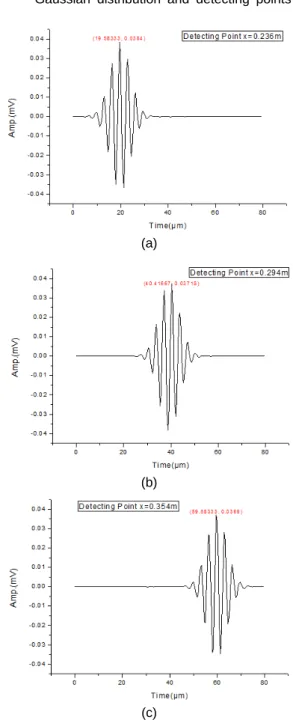
As a next step, IFFT is implemented with 3 points shown in Fig. 1 to check that this
Fig. 1 Schematic diagram of loading condition with Gaussian distribution and detecting points
(a)
(b)
(c)
Fig. 2 Amp. of displacement at (a) , (b) , (c)
program appropriately expresses Rayleigh wave.
The detecting point moves to the right according to Fig. 2. and it is shown for the signal to be shifted to the right as fast as Rayleigh wave velocity.
The second procedure to prove its accuracy is to check if there is reflection by truncated boundary. Fig. 3 shows that displacement caused by Rayleigh wave seems to be unstable at the end. However, it is shown that there is no reflection with the treatment for the truncated boundary in Fig. 4.
Fig. 4 presents modified BEM code has Rayleigh waves go through the truncated boundary without any generation of reflections.
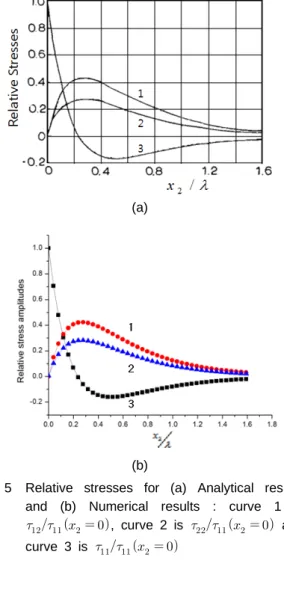
As a final check point, The propagation of Rayleigh waves in a two-dimensional geometry half-space without any defects on the surface should show non-attenuating amplitudes on the surface and decayed amplitudes inside of the material. The previous study by Jan. D.
Achenbach, shows that stresses along the depth direction made by Rayleigh waves have specific features[5]. The comparisons between numerical and analytical results for relative stresses along the depth’s direction are shown in Fig. 5. In this comparison, sub-index 1 denotes the horizontal direction which is also the propagation direction while sub-index 2 denotes the vertical direction which is the depth direction. The stresses are referred to the horizontal normal stress on the surface and they are plotted versus the ratio of depth and the wavelength .
Through purposed procedures, it can be absolutely confirmed that the modified BEM represents the two-dimensional Rayleigh wave with high accuracy and its possibility of analysis for the cavity problem.
(a)
(b)
Fig. 5 Relative stresses for (a) Analytical results and (b) Numerical results : curve 1 is
, curve 2 is and curve 3 is
Fig. 3 Reflection by truncated boundary
Fig. 4 No reflection by truncated boundary
4. Analysis of Wave Scattering by a Cavity
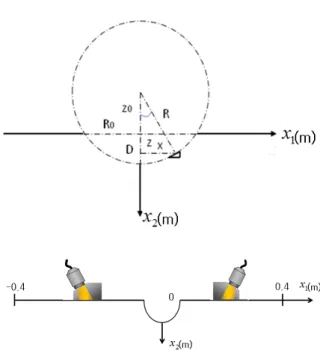
The numerical approach that we have proposed in this paper can work for an arbitrary geometry of the cavity. For the purpose of simplification in calculation, however, in this section we consider a two-dimensional cylindri- cal cavity as Fig. 6.
Ratio of displacement() is plotted in the condition with keeping the width of cavity fixed
× , while its depth changes
× → × where the detecting point is counted far field (more than 10).
Numerical results are compared with the one obtained by analytical method.
Obviously, the total ratio of vertical amplitudes of the scattered and incident waves depends on cavity geometry including depth and width
( , , 0)
Sc In
A z
F f D R A z
Increasing the size of cavity, the comparison shown in Fig. 7 has good agreement.
5. Conclusions
With modification of ordinary BEM coefficient matrix, boundaries can be truncated to describe semi-infinite domain without any reflection from the limits of boundaries.
BEM code presented in this paper represents reasonable Rayleigh wave's behavior with its velocity verification and check of attenuation characteristic along the depth direction.
As a final goal, it has been shown in this article that by modifying conventional BEM with adding special treatment for the truncated boundaries, the scattering of two-dimensional surface waves by a cavity in an elastic half-space can be analyzed.
The approach presented in this article may be extended to apply for other kinds of defects such as cracks, voids and corrosions with considerations of the method the loads are applied over the defects.
Acknowledgement
This work was supported by a 2-Year Research Grant of Pusan National University.
Fig. 6 Surface defect modeling
0.00 0.03 0.06 0.09 0.12 0.15 0.18
0.00 0.02 0.04 0.06 0.08 0.10 0.12 0.14 0.16
Analytical results BEM results
kD RatioofVerticaldisplacementASc/AIn
Fig. 7 Comparisons between analytical and numerical results of the total ratio of vertical amplitudes of the scattered and incident waves versus for frequencies
References
[1] Y. Cho and J. L. Rose, "An elasto- dynamic hybrid boundary element study for elastic guided wave interactions with a surface breaking defect," International Journal of Solid and Structures, pp.
4103-4124 (2000)
[2] W. M. Rucher, E. Schlemmer and K. R.
Richer, "The solution of 3D multiple scattering problems using the boundary element method," IEEE Transactions on
Magnetics, pp. 3132-3135 (1994)
[3] J. Dominguez, "Boundary Elements in Dynamics," Computational Mechanics Publications, Elsevier, Southampton
[4] I. Arias and J. D. Achenbach, "Rayleigh wave correction for the BEM analysis of two-dimensional elastodynamic problems in a half-space," International Journal for Numerical Methods in Engineering, pp.
2131-2146 (2004)
[5] J. D. Achenbach, "Wave Propagation in Elastic Solids," Elsevier, New York (1973)