1. INTRODUCTION
Global warming is an ongoing process and CO
2is known as one of the biggest causes of global warming. Atmospheric CO
2is inex- tricably linked to plant growth and thus directly affects the growth of the trees and forests (Sampson, 2014). As a result of recent global
warming and climate change, evergreen tree species in warm temperate forest zones ex- panded their distribution extents (Jung et al., 2014). In this aspect, Japanese cedar ( Cryptomeria japonica) is also one of those in Korea, and is likely to be recognized as more useful forest resources corresponding to climate change in warm temperate forest areas.
Original Article
Study on Red and Black Heartwood Properties of Cryptomeria Japonica in Southern Region of Korea
1Kyung-Rok Won
2⋅Su-Young Jung
3⋅Byung-Oh Yoo
3⋅Nam-Euy Hong
4⋅Hee-Seop Byeon
2,†ABSTRACT
The heartwood (HW) of Japanese cedar (Cryptomeria japonica) has usually a reddish color. But some trees have black-colored heartwood (BHW). BHW of Japanese cedar has a low commercial value because of the appearance. Therefore, in this study, a comparative analysis was conducted to evaluate the differences in the physical, mechanical, and inorganic element properties, and decay resistance of red-colored heartwood tree (RHW) and BHW. The physical properties showed significant difference between sapwood (SW) and HW, but there was no significant difference between RHW and BHW. From the results of mechanical properties, no sig- nificant difference was recognized in SW of RHW, HW of RHW, SW of BHW, and HW of BHW. There were decay resistance differences between RHW and BHW in HW, and between HW and SW in both RHW and BHW, respectively. The magnesium (Mg), potassium (K), and calcium (Ca) contents had significant differences between SW and HW in both RHW and BHW. In this present study, the decay resistances and the contents of Mg and K were higher in HW than in SW both for RHW and BHW, while these measurements were lower in RHW than in BHW. Therefore, BHW was considered to be worthy as a high-quality material as RHW.
Keywords : Cryptomeria japonica, black-colored heartwood tree, physical properties, mechanical properties, de- cay, weight loss
1Date Received October 23, 2017, Date Accepted October 30, 2017
2College of Agriculture & Life Science, IALS, Gyeongsang National University, Jinju 52828, Republic of Korea 3Southern Forest Resources Research Center, National Institute of Forest Science, Jinju 52817, Republic of Korea 4Department of Development, Samyoung Industrial, Gimhae 51-62, Republic of Korea
† Corresponding author: Hee-Seop Byeon (e-mail: [email protected], ORCID: 0000-0001-7952-9991)
Japanese cedar is one of the main tree spe- cies of southern coniferous forests and their plantations in Korea. Japanese cedar, commonly known as sugi, is a slender, pyramidal, and ev- ergreen conifer. The tree grows to a height of 15 to 24 meters and a width of 6 to 9 meters;
the large trees often reach a height of 30 to 38 meters. Japanese cedar heartwood usually be- comes a red. Japanese cedar, which grows well in a warm climate, is a useful species for forest resources because global warming is an ongoing process. Japanese cedar also has many uses in the wood industry for its beautiful pattern and good lumber quality.
However, the biggest drawback of Japanese cedar is that its heartwood color sometimes var- ies from reddish to black. Japanese cedar with black-colored heartwood has a low commercial value because of the appearance. Genetic fac- tors are believed to be the main reason for the emergence of different color in heartwood.
However, all heartwood having similar genes do not show the same color. In other words, the color of heartwood can be different between individual trees even if they are within the same site environments (Sakagami et al., 2013).
In addition, drying and transport costs of black-colored heartwood are required more than red-colored heartwood, this mainly caused by the differences of high green moisture content between individual trees (Kubo et al., 1998).
In this aspect, research on low-priced black-colored heart wood of Japanese cedar is therefore necessary. Various studies have been conducted on black-colored heartwood of
Japanese cedar. Kim et al. (2009) reported the material properties as a result of heat treatment, focusing on the color control by heat treatment.
Matsunaga et al. (2006) clarified the differences in potassium distribution in the tissues of black-colored heartwood in terms of its anatom- ical morphology by using scanning electron microscopy with energy dispersive X-ray analy- sis (SEM-EDXA) and optical microscopy.
Takahashi (1996) studied the coloration of nor- lignans using alkaline treatment to clarify the relationship between the blackening and the presence of norlignans in the heartwood. Park et al. (2010) compared the green moisture con- tent, mechanical properties of wood, and occur- rence rate and causes of black-colored heart- wood tree formation between two locations; in a general mountain forest and a windbreak for- est for a mandarin orange field in Jeju island.
In this study, we focus on the evaluation of the physical, mechanical, and inorganic element properties and decay resistance of red-colored heartwood and black-colored heartwood, re- spectively obtained from Cryptomeria japonica stands in order to identify their potential appli- cations as wood resources.
2. MATERIALS and METHODS 2.1. Materials
Japanese cedar ( Cryptomeria japonica
(Thund. ex L.F.) D.Don) trees grown in
Gyeongnam (Namhae, Geoje), Jeonnam
(Suncheon), and Jeju (Seogwipo) in southern
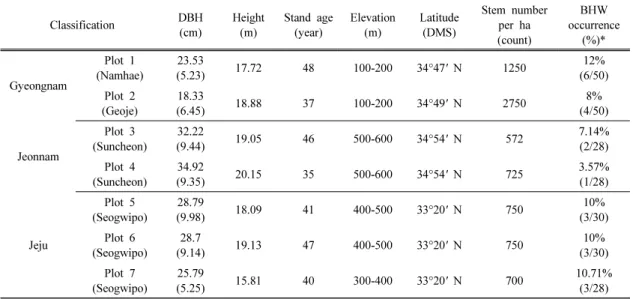
Korea were used (Table 1). The sample tree selections for black-colored heartwood (BHW) red-colored heartwood tree (RHW) were con- ducted by examining color of cores obtained by increment borer in advance of felling trees.
The heartwoods (HW) were grouped into two types by naked eye; BHW and RHW (Fig. 1).
The total number of selected sample trees both for RHW and BHW were eight, respectively.
Each RHW and BHW was felled within the same plot. The sample trees were felled one or two trees from seven plots. The trees dried in a natural room temperature condition were used later. The occurrence ratio of BHW in Japanese cedar stands was measured by incre- ment cores and the occurrence ratio was ran- domly estimated per fixed area.
2.2. Physical Properties Measurement
Shrinkage test (Air-dried shrinkage and oven dry shrinkage) was conducted in a constant temperature and humidity room (temperature 20
± 2 ℃, relative humidity 65 ± 3%) according to the KS F 2203 in KS. The sample size was 20
× 20 × 20 mm. The number of samples of sap- wood (SW) and heartwood (HW) were 10 per each tree, respectively. Specific gravity, annual
Classification DBH (cm)
Height (m)
Stand age (year)
Elevation (m)
Latitude (DMS)
Stem number per ha (count)
BHW occurrence
(%)*
Gyeongnam
Plot 1 (Namhae)
23.53
(5.23) 17.72 48 100-200 34°47' N 1250 12%
(6/50) Plot 2
(Geoje)
18.33
(6.45) 18.88 37 100-200 34°49' N 2750 8%
(4/50)
Jeonnam
Plot 3 (Suncheon)
32.22
(9.44) 19.05 46 500-600 34°54' N 572 7.14%
(2/28) Plot 4
(Suncheon)
34.92
(9.35) 20.15 35 500-600 34°54' N 725 3.57%
(1/28)
Jeju
Plot 5 (Seogwipo)
28.79
(9.98) 18.09 41 400-500 33°20' N 750 10%
(3/30) Plot 6
(Seogwipo)
28.7
(9.14) 19.13 47 400-500 33°20' N 750 10%
(3/30) Plot 7
(Seogwipo)
25.79
(5.25) 15.81 40 300-400 33°20' N 700 10.71%
(3/28) DBH = diameter at breast height; BHW = black-colored heartwood tree; and *means the number of black-colored heartwood trees / the total
number of Japanese cedar trees per fixed area.
Table 1. Plot data of Japanese cedar obtained by stand survey
RHW BHW
Fig. 1. Classification of RHW and BHW.
ring width, and latewood ratio were measured using by the specimens of strength test accord- ing to KS F 2198 and KS F 2202.
2.3. Mechanical Properties Measurement
Bending test was performed on the samples using a universal testing machine (UTM) (TSU-2, Taeshin Accuracy Machine, Korea) with a center point loading method (concentrated load at mid span and supported at the ends). The size of sample was 20 × 20 × 320 mm and the span was 280 mm and the crosshead speed was set at 2.5 mm/min. The number of samples of SW and HW were 10 per each tree, respectively. Both bending modulus of elasticity (MOEb) and bend- ing modulus of rupture (MORb) were calculated from load-deflection curves.
A compressive and shear strength tests were carried out according to the procedure of a Korean standard (KS F2206, 2004., KS F2209, 2004) using a hydraulic testing machine (EHF-ED10-20L, Shimazu, Japan). The loading speed was set at 1 mm/min. The load-deforma- tion data were analyzed to determine the com- pressive modulus of elasticity (MOEc), com- pressive modulus of rupture (MORc), and shear modulus of rupture (MORs).
2.4. Decay Resistance Test
Decay resistance test was conducted in ac- cordance with the KS F 2213. The white rot fungi, Fomitopsis palustris was used to exam- ine the decay resistance. The medium was
sterilized for 30 min at 121 ℃ and cooled down before inoculation. The testing fungi were inoculated on the potato dextrose agar medium (Becton, Dickinson and Company sparks, MD 21152).
The observation of decay resistance was con- ducted and a photograph was taken every week after inoculation. After the decay resistance test, weight loss was measured in SW and HW both of RHW and BHW. The tests were con- ducted from 18 experiment replications for each sample divided by SW of RHW, HW of RHW, SW of BHW, and HW of BHW.
Weight loss ratio (P
w) was calculated according to the equation (1):
P
w =
× (%) ··· (1)
Where, W
1is the weight of specimen before decay operation, W
2is the weight of specimen after decay operation.
2.5. Analysis of Chemical Components
The contents of inorganic elements were ana-
lyzed with a pretreated acid specimen using an
inductively coupled plasma optical emission
spectrometer (ICP-OES, PerkinElmer Optima
5300DV) in the research center at Gyeongsang
national university. The tests were conducted
from 6 experiment replications for each sample
divided by SW of RHW, HW of RHW, SW of
BHW, and HW of BHW.
3. RESULTS and DISCUSSION 3.1. Occurrence of BHW
The occurrence frequency of BHW trees in Japanese cedar stands of Gyeongnam, Jeonnam, and Jeju area were 10%, 5.36%, and 10.11%, respectively (Table 1). Site elevation order was Jeonnam > Gyeongnam > Jeju. This result indicates that the ratio of BHW occurrence appeared conversely to site elevation. Kubo and Ataka (1998) also reported that the BHW of Japanese cedar occurred frequently in trees from the lower site of a sloped plantation near a mountain stream.
3.2. Physical Properties due to RHW and BHW
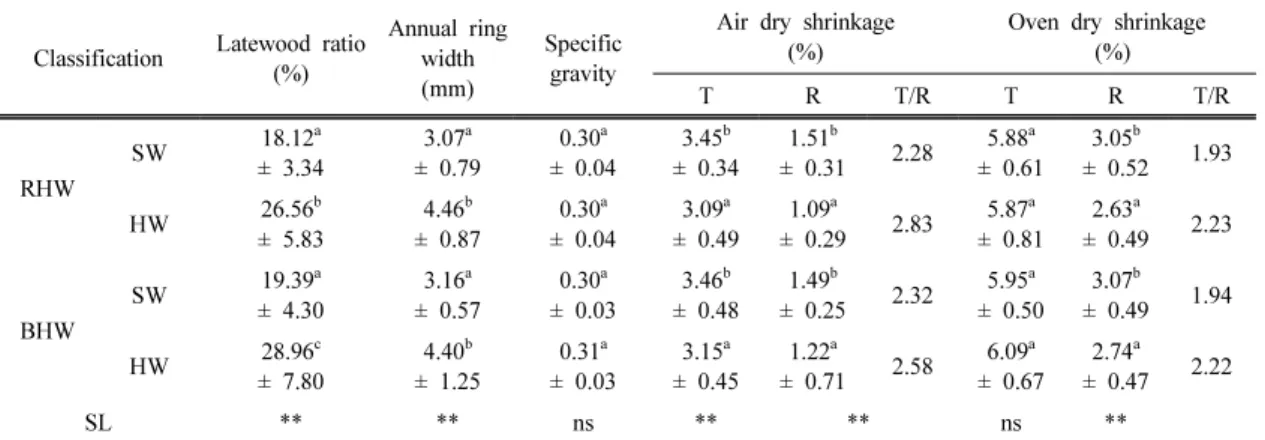
Table 2 shows the average values of physical properties of Japanese cedar. Latewood ratios in the SW and HW of RHW, SW and HW of BHW were 18.12%, 26.56%, 19.39%, and
28.96%, respectively. The results indicated that latewood ratio was higher in HW than in SW for both RHW and BHW. There was no sig- nificant difference in latewood ratio between RHW and BHW.
Annual ring widths in SW and HW of RHW were 3.07 and 4.45 mm, respectively. Annual ring widths in SW and HW of BHW were 3.16 and 4.40 mm, respectively. The result indicated that annual ling width was wider in HW than in SW in both of RHW and BHW, and there was no significant difference between RHW and BHW. Specific gravity was not sig- nificantly different between SW and HW of both RHW and BHW. For air dry shrinkage both in tangential and radial directions, the shrinkage of SW appeared to be higher than that in the HW for both of RHW and BHW.
There was a significant difference between the SW and HW for both of RHW and BHW. But there was no significant difference between RHW and BHW. For oven dry shrinkage in
Classification Latewood ratio (%)
Annual ring width (mm)
Specific gravity
Air dry shrinkage (%)
Oven dry shrinkage (%)
T R T/R T R T/R
RHW
SW 18.12a
± 3.34
3.07a
± 0.79
0.30a
± 0.04
3.45b
± 0.34 1.51b
± 0.31 2.28 5.88a
± 0.61 3.05b
± 0.52 1.93
HW 26.56b
± 5.83
4.46b
± 0.87
0.30a
± 0.04
3.09a
± 0.49 1.09a
± 0.29 2.83 5.87a
± 0.81 2.63a
± 0.49 2.23
BHW
SW 19.39a
± 4.30
3.16a
± 0.57
0.30a
± 0.03
3.46b
± 0.48 1.49b
± 0.25 2.32 5.95a
± 0.50 3.07b
± 0.49 1.94
HW 28.96c
± 7.80
4.40b
± 1.25
0.31a
± 0.03
3.15a
± 0.45 1.22a
± 0.71 2.58 6.09a
± 0.67 2.74a
± 0.47 2.22
SL ** ** ns ** ** ns **
Values are presented as mean; ± standard deviation; a, b and c mean that the same letters are not significantly different at a p-value of 0.05 according to Duncan’s new multiple range test; ** = p < 0.05; SL = significance level; ns = non significant; RHW = red-colored heartwood tree; BHW = black-colored heartwood tree; SW = sapwood; HW = heartwood; T = tangential direction; and R = radial direction.
Table 2. Physical properties of Japanese cedar due to RHW and BHW
tangential direction, there were no significant differences among SW and HW of RHW, SW and HW of BHW. But there were significant differences between SW and HW of both RHW and BHW for oven dry shrinkage in radial direction. There were significant differences of physical properties in many factors between SW and HW of both RHW and BHW. There was no significant difference in physical properties between RHW and BHW. However, Yamashita et al. (2009) reported that Japanese cedar culti- vars showed significant differences in tangential shrinkage, radial shrinkage, and tangential/radial shrinkage ratio within a stem and tangen- tial/radial shrinkage ratio decreased with radius and height in the stems of most cultivars.
3.3. Mechanical Properties due to RHW and BHW
Table 3 shows the average values of me-
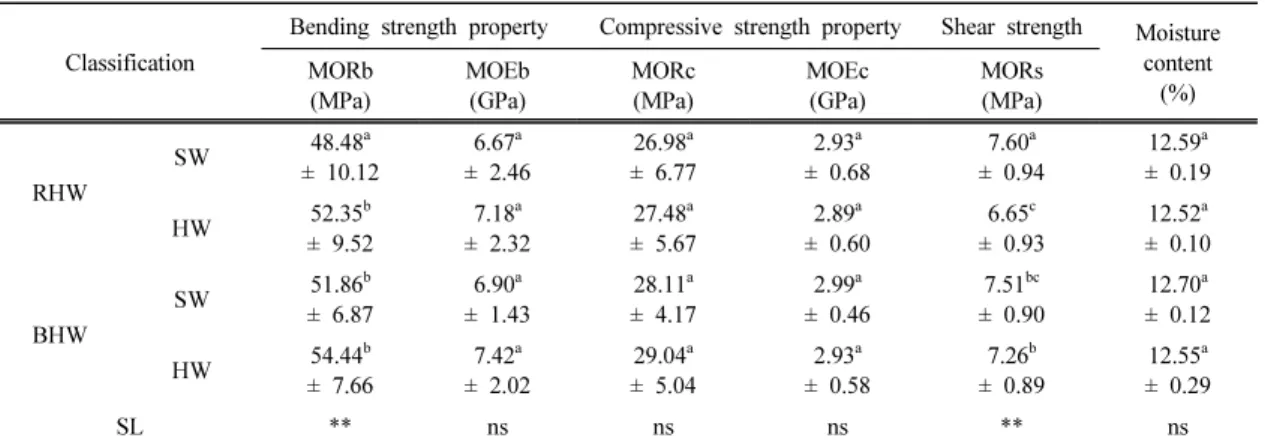
chanical properties. Bending MOR (MORb) in the SW and HW of RHW, SW and HW of BHW were 45.48, 52.35, 51.86, and 54.44 MPa, respectively. Bending MOE (MOEb) in the SW and HW of RHW, SW and HW of BHW were 6.67, 7.18, 6.90, and 7.42 GPa, respectively.
Compressive MOR (MORc) in SW and HW of RHW, SW and HW of BHW were 26.98, 27.48, 28.11, and 29.04 MPa, respectively.
Compressive MOE (MOEc) were 2.93, 2.89, 2.99, and 2.93 GPa, respectively. Shear MOR (MORs) in were 7.60, 6.65, 7.51, and 7.26 MPa, respectively. In mechanical properties, there were no significant differences in MORb, MORc, and MOEc in SW of RHW, HW of RHW, SW of BHW, and HW of BHW. Also Matsunaga et al. (2006) reported that the strength properties of RHW were not sig- nificantly different from BHW.
Classification
Bending strength property Compressive strength property Shear strength Moisture content
(%) MORb
(MPa)
MOEb (GPa)
MORc (MPa)
MOEc (GPa)
MORs (MPa)
RHW
SW 48.48a
± 10.12
6.67a
± 2.46
26.98a
± 6.77
2.93a
± 0.68
7.60a
± 0.94
12.59a
± 0.19
HW 52.35b
± 9.52
7.18a
± 2.32
27.48a
± 5.67
2.89a
± 0.60
6.65c
± 0.93
12.52a
± 0.10
BHW
SW 51.86b
± 6.87
6.90a
± 1.43
28.11a
± 4.17
2.99a
± 0.46
7.51bc
± 0.90
12.70a
± 0.12
HW 54.44b
± 7.66
7.42a
± 2.02
29.04a
± 5.04
2.93a
± 0.58
7.26b
± 0.89
12.55a
± 0.29
SL ** ns ns ns ** ns
Values are presented as mean; ± standard deviation; a, b and c mean that the same letters are not significantly different at a p value of 0.05 according to Duncan’s new multiple range test; ** = p < 0.05; SL = significance level; ns = non significant; RHW = red-colored heartwood tree; BHW = black-colored heartwood tree; SW = sapwood; HW = heartwood; MORb = bending modulus of rupture; MOEb = bending mod- ulus of elasticity; MORc = compressive modulus of rupture; MOEc = compressive modulus of elasticity; and MORs = shear modulus of rupture.
Table 3. Mechanical properties of Japanese cedar due to RHW and BHW
3.4. Decay Resistance
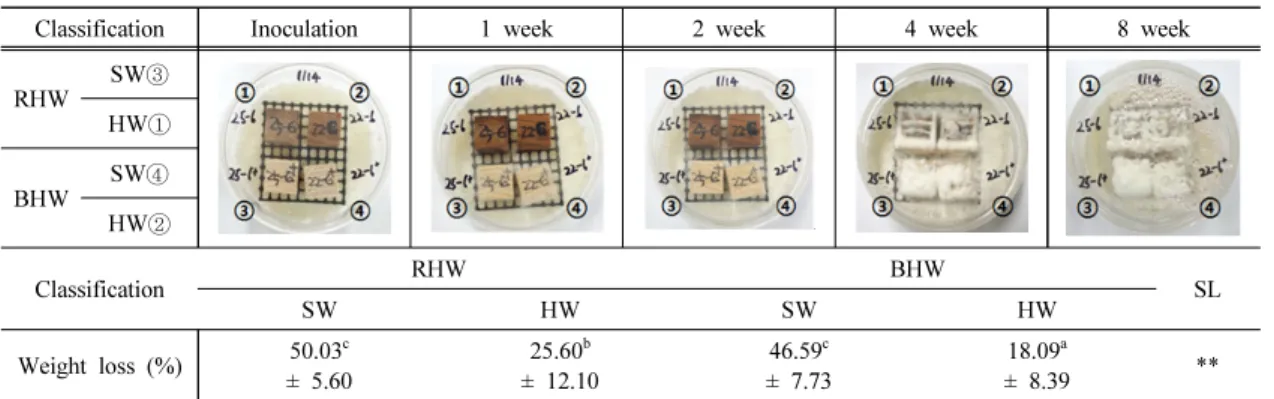
Table 4 shows the decay resistance character- istics of Japanese cedar. From the results of naked-eye observation, the decay resistance were in order of HW of BHW > HW of RHW
> SW of RHW = SW of BHW. The decay re- sistance indicated to be higher in HW than in SW for both of RHW and BHW.
Weight loss of SW and HW of RHW, SW and HW of BHW were 46.74%, 21.51%, 46.82%, and 16.57%, respectively. There were significant differences of weight loss between SW and HW both for RHW and BHW.
Furthermore, there was a significant difference between HW of RHW and HW of BHW. From the results of decay resistance, decay resistance was significantly different in SW of RHW, HW of RHW, SW of BHW, and HW of BHW. The resistance to hyphae of BHW was higher than that of RHW. In addition to the resistance to fungi, Kurimoto (1998) reported that the results
of the termite feeding tests showed resistance characteristics to be higher in HW than in SW of Japanese cedar.
3.5. Inorganic Element Properties
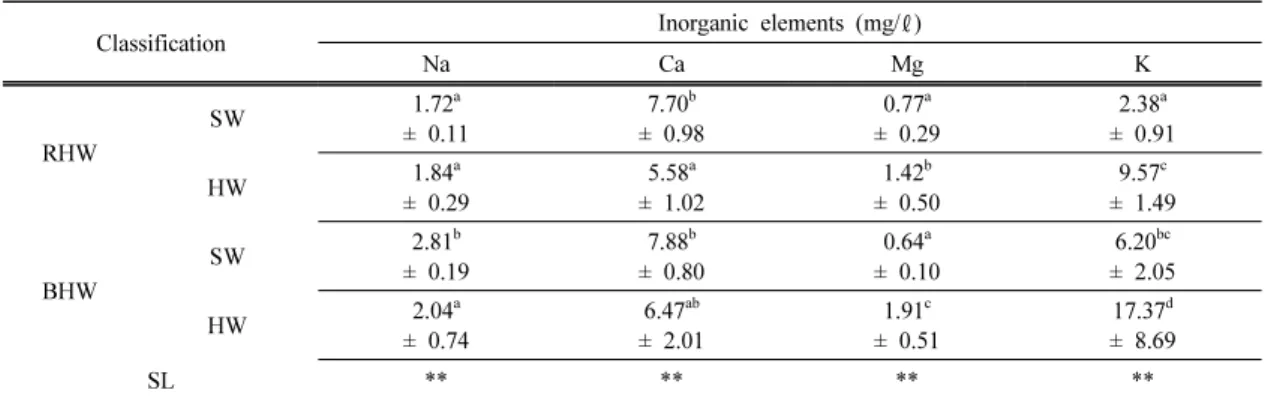
Table 5 shows inorganic elemental analytic results by ICP-OES of SW and HW of RHW, SW and HW of BHW. The contents of sodium (Na), calcium (Ca), magnesium (Mg), and po- tassium (K) in SW of RHW were 1.72, 7.70, 0.77, and 2.38 mg, respectively and 1.84, 5.58, 1.42, and 9.57 mg, respectively in HW of RHW. The contents of Na, Ca, Mg, and K showed 2.81, 7.88, 0.64, and 6.20 mg, re- spectively in SW of BHW and 2.04, 6.47, 1.91, and 17.37 mg in HW of BHW, respectively.
The contents of Na, Ca, K, and Mg had stat- istically significant differences. The content of Ca had a tendency to be higher in SW than in HW for both of RHW and BHW. Mg and K contents had significant differences between SW
Classification Inoculation 1 week 2 week 4 week 8 week
RHW SW③ HW① BHW
SW④ HW②
Classification RHW BHW
SW HW SW HW SL
Weight loss (%) 50.03c
± 5.60
25.60b
± 12.10
46.59c
± 7.73
18.09a
± 8.39 **
Values are presented as mean; ± standard deviation; a, b and c mean that the same letters are not significantly different at a p value of 0.05 ac- cording to Duncan’s new multiple range test; ** = p < 0.05; SL = significance level; RHW = red-colored heartwood tree; BHW = black-col- ored heartwood tree; SW = sapwood; HW = heartwood. ① = heartwood of RHW; ② = heartwood of BHW; ③ = SW of RHW; and ④ = SW of BHW.
Table 4. Decay properties of Japanese cedar due to RHW and BHW
and HW both in RHW and BHW, and also had significant differences between RHW and BHW. The contents of Mg and K were greater in BHW than in RHW.
This fact that the total content of Ca, Mg, Na, and K was generally greater in BHW than in RHW was previously reported by many other researchers (Morikawaet et al., 1996; Takahashi, 1996; Matsunaga et al., 2006). However, Kubo et al. (1998) reported that high content for K only indicated among inorganic elements in BHW of Japanese cedar and the other inorganic elements had low value.
The location of inorganic components in BHW of Japanese cedar was previously reported by the other researchers. Park et al. (2010) re- ported that the amounts of Mg and Kwere high in BHW of Japanese cedar, and inorganic elements of K
2O and CaO in the ray cells were thought to be one of the important factors for BHW formation of Japanese cedar.
Additionally, Matsunaga et al. (2006) reported that K generally exists in tracheids, ray, and
axial parenchyma cells in BHW. But the con- tent of K in BHW of Japanese cedar is extra- ordinarily abundant in the axial parenchyma cells.
4. CONCLUSIONS
Most physical and mechanical properties of Japanese cedar mostly distributed in the south- ern area of korea showed no statistically sig- nificant differences between red-colored heart- wood and black-colored heartwood of Japanese cedar trees distributed in Korea. The decay re- sistance and contents of magnesium and potas- sium were greater in black-colored heartwood tree than in red-colored heartwood tree. From our findings, with the lack of disadvantages in physical and mechanical properties, Japanese cedar with black-colored heartwood could be used as a more specific purpose and place even with an advantage of high resistant property to decay.
Classification Inorganic elements (mg/ℓ)
Na Ca Mg K
RHW
SW 1.72a
± 0.11
7.70b
± 0.98
0.77a
± 0.29
2.38a
± 0.91
HW 1.84a
± 0.29
5.58a
± 1.02
1.42b
± 0.50
9.57c
± 1.49
BHW
SW 2.81b
± 0.19
7.88b
± 0.80
0.64a
± 0.10
6.20bc
± 2.05
HW 2.04a
± 0.74
6.47ab
± 2.01
1.91c
± 0.51
17.37d
± 8.69
SL ** ** ** **
Values are presented as mean ± standard deviation; a, b, c means that the same letters are not significantly different at a p value of 0.05 ac- cording to Duncan’s new multiple range test; ** = p < 0.05; SL = significance level; RHW = red-colored heartwood tree; BHW = black-col- ored heartwood tree; SW = sapwood; and HW = heartwood.
Table 5. Inorganic element properties of Japanese cedar due to RHW and BHW
ACKNOWLEDGEMENT
This study was carried out with the support of
‘Southern Forest Resources Research Center, National Institute of Forest Science’ (Project No.
SC0500-2012-01) provided by Korea forest service.
REFERENCES
Sampson, R.N. 1992. Forestry opportunities in the United States to mitigate the effects of global warming. Water, Air, and Soil Pollution. 64:
157∼180.
Jung, S.Y., Lee, K.S., Yoo, B.O., Park, Y.B. Ju, N.G., Kim, H.H., Park, J.H. 2014. Freezing in- jury characteristics of evergreen broad-leaved trees in southern urban area, Korea. Journal of Korean Forest Society 103(4): 528∼536.
Sakagami, H., Hatae, F., Yamamoto, H., Kijidani, Y., Matsumura J. 2013. Microcrack propagation in red and black heartwoods of Cryptomeria japonica during drying. BioResources 8(4):
5983∼5994.
Kubo, T., Ataka S. 1998. Blackening of sugi (Cryptomeria japonica D. Don) heartwood in re- lation to metal content and moisture content.
Journal of Wood Science 44: 137∼141.
Kim, K.M., Park, J.H., Park, B.S., Son, D.W., Park, J.S. Kim, W.S., Kim, B.N., Shim, S.R. 2009.
Physical and mechanical properties of heat-treat- ed domestic cedar. Journal of the Korean Wood Science & Technology 37(3): 330∼339.
Matsunaga, H., Shiotari, R., Matsumura, J., Oda, K., Utsumi, Y., Yamamoto, K. 2006. Potassium dis- tribution in black heartwood of sugi (Cryptomeria japonica) I: localization in axial
parenchyma cells. Journal of Wood Science 52:
95∼100.
Takahashi, K. 1996. Relationships between the blacking phenomenon and norlignans of sugi (Cryptomeria japonica D. Don) heartwood I.A case of partially black heartwood. MokuzaiGakkaishi 42: 998∼ 1005.
Park, B.S., Hwang, K.H., Chong S.H. 2010. Wood properties of Japanese cedar (Cryptomeria japon- ica) planted as a windbreak forest of mandarin orange field in Jeju island. KFS Journal. 21(6):
479∼485.
KS F 2203, 2206, 2209, 2011. Methods of shrinkage test, compression test, shear test for wood (in Korean). Korea Standards Association, Seoul Korea.
Doi, S., Kurimoto, Y. 1998. Durability of sugi (Cryptomeria japonica D. Don) bark against wood decay fungi and a subterranean termite.
HolzalsRoh- und Werkstoff. 56: 168∼178.
Kim, S.H., Lee, S.Y., Gwak, K.S. Lee, J.J., Choi, I.G. 2010. Decay resistance evaluation to the wood rot fungi for Cryptomeria japonica.
Journal of the Korean Wood Science &
Technology (proceeding) 2010(0): 253∼254.
Morikawa, T., Oda, K., Matsumura, J., Tsutsumi, J.
1996. Black-heartwood formation and ash con- tent in the stem of sugi (Cryptomeria japonica D. Don) II. heartwood properties of three sugi cultivars (in Japanese). Bull Kyushu University For. 74: 41∼49.
Takahashi, K., Mori, K. 2006. Relationships between blacking phenomenon and norlignans of sugi (Cryptomeria japonica) heartwood III: coloration of norlignans with alkaline treatment. Journal of Wood Science 52: 134∼139.