Received Jun 15, 2009; Revised Jul 10, 2009; Accepted Jul 15, 2009
Corresponding author: Yeonghye Kim
Tel: +82 (51) 720-2297 e-mail: [email protected] 1225-3480/25207
우리나라 남해안에 분포하는 참문어 (
Octopus vulgaris
) 의 성숙과 산란강현정, 김영혜, 김성연1, 이동우2, 최영민, 장대수, 곽우석3
국립수산과학원 자원연구과, 1국립수산과학원 양식환경연구센터, 2국립수산과학원 독도수산연구센터,
3경상대학교 해양생명과학과
Maturity and Spawning Period of the Common Octopus, Octopus vulgaris in the South Sea of Korea
Hyunjung Kang, Yeonghye Kim, Sungyeon Kim1, Dongwoo Lee2, Youngmin Choi, Daesoo Chang and Woo-Seok Gwak3
Fisheries Resource Research Department, National Fisheries Research and Development Institute, Busan 619-902, Korea
1Aquaculture Environment Institute, NFRDI, Tongyeong, Gyeongsangnam-do, 650-943, Korea
2Dokdo Fisheries Research Center, NFRDI, Pohang 791-802, Korea
3Gyeongsang National University, Department of Marine Biology and Aquaculture, Tongyeong, 650-160, Korea
ABSTRACT
The common octopus, Octopus vulgaris is commercially important species in Korea. Korean fishing vessels have actively caught it. However, the study of this species has been poorly known. Therefore, the purpose of this study is to provide information about maturation and spawning period of this species. Samplings have been monthly collected in Tongyoung and Sacheon of Gyeongsangnam-do, using traps. A total of 748 individuals were sampled from February 2007 to January 2008. We analyzed monthly changes in maturity stages, gonadosomatic index, total weight at 50% group maturity. The octopus total weight was between 128.6 and 3381.4 g. Females were distributed between 129.8 and 3381.4 g and males between 128.6 and 2378.4 g. The spawning periods were May to June and September. The total weight at 50% group maturity was estimated to be 919.6 g.
Key words: common octopus, octopus vulgaris, maturity spawning period, maturation size.
서 론
참문어 (Octopus vulgaris)는 문어목 문어과에 속하는 종 으로 우리나라 서․남해안, 일본 혼슈 이남의 전 연안, 지중해 등을 포함한 전 세계의 온․열대해역에 분포하는 것으로 알려져 있다. 참문어는 가까운 연안에서부터 수심 200 m까지 서식하 는 연안저서종으로 야행성이다. 주로 이미패류, 갑각류, 작은 어류 등을 먹으며 체색은 환경에 따라 상당한 변이를 보인다 (Roper and Sweeny, 1984). 몸통의 외형은 타원형으로 외 피는 근육질이며 체색은 자갈색, 암갈색에 갈색, 황색, 청색의 작은 반점이 있고, 머리의 폭은 몸통의 폭보다 다소 좁다. 팔
길이식은 3 > 2 > 4 > 1이고 수컷의 세 번째 팔의 끝부분은 교접시 난을 암컷의 생식소로 이동시키기 위해 구두주걱 모양 으로 교접기화되어있다 (Okutani et al. 1987).
참문어는 우리나라, 일본, 스페인, 이탈리아 등에서 수산자 원으로 매우 중요한 위치에 있다. 참문어의 세계 총 어획량 50,577 톤 중 대부분이 일본과 스페인에서 어획되며 우리나라 와 이탈리아에서도 많이 어획된다. 수산자원보호령에서는 2006년 7월 14일 개정 전 문어류의 포획금지 체중을 300 g 으로 설정하였으나 개정 후 문어류가 아닌 대문어에 한한다고 명시하였다. 하지만 대문어는 동해안에만 분포하는 동해 특산 종인 반면 참문어는 우리나라 전 연안에 분포하는 중요한 자원 이기 때문에 참문어에 관한 포획금지 체중의 설정과 같은 효과 적인 자원관리 방안이 필요하다. 또 FAO의 어업통계자료에 따르면 최근 10년간 세계에서는 물론 우리나라에서의 참문어 어획량이 감소하는 추세이므로 참문어의 자원관리는 더욱더 필요하다고 판단된다.
참문어에 대한 국외의 연구로는 Smale and Buchan
Year Month Number
Male Female
2007 Feb 13 20
Mar. 41 27
Apr. 45 23
May 33 31
Jun. 28 30
Jul. 32 39
Aug. 33 37
Sep. 37 39
Oct. 35 25
Nov. 31 29
Dec. 26 34
2008 Jan. 34 26
Total 388 360
Table 1. Number of specimen of common octopus, Octopus vulgaris sampled from the South Sea of Korea.
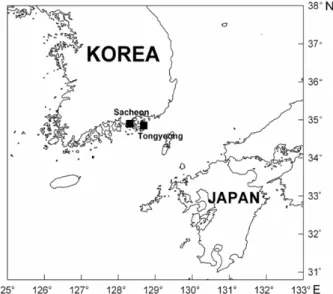
Fig. 1. Sampling area of common octopus, Octopus vulgaris.
(1981) 의 아프리카 남쪽해안에 서식하는 참문어의 생물학적 특성, Andrews and Tansey (1983) 의 참문어 소화관 발달 에 관한 보고가 있다. 이 외에 Canary 제도 해역에서 참문어 의 어획현황 (Hernandez-Garcia et al., 1998), Mallorca 지방에서의 참문어 어획과 생태 (Quetglas et al., 1998), 참 문어 유생사육 (Villaneva et al., 2002; Paulo et al., 2004), 스페인 Asturias 지역에서 참문어 어업관리의 효과 (Fernandez-Rueda and Garcia-Florez, 2007) 에 관한보 고 등 이 있다. 국내에서는 Chu and Kim (1990) 의 참문어 종묘생산기술에 관한보고와 Kim et al. (2008) 의 참문어의
생식생물학적 연구가 있다.
수산자원생물의 성숙과 산란기에 관한 연구는 자원의 효율 적 관리에 중요한 기초 자료를 제공한다. 이 논문은 참문어의 산란기를 규명하기 위해 생식소의 조직학적 분석을 통하여 생 식소 발달단계를 파악하고 생식소중량지수 (Gonadosomatic Index, GSI) 를 분석하였으며, 개체군의 50%가 성숙하는 성 숙체중 등의 생식생물학적 연구를 수행하여 참문어의 자원관 리를 위한 과학적인 기초 자료를 제공하고자한다.
재료 및 방법
참문어의 시료는 2007년 2월부터 2008년 1월까지 매월 1 회씩 경남 통영과 사천 연안에서 연안통발어업에 의해 어획된 것을 채집하였다 (Fig. 1). 채집된 시료는 총 748 개체로 암컷 은 360 개체, 수컷은 388 개체가 채집되었다. 암컷은 전중량 129.8-3381.4 g의 개체가 채집되었고 수컷은 전중량 128.6-2378.4 g의 개체가 채집되었다 (Table 1). 채집된 시 료의 외투장은 0.1 cm, 전중은 0.1 g, 생식소중량은 0.01 g까 지 측정하였다.
참문어의 산란기 판별을 위하여 생식소의 월별 발달단계와 생식소중량지수 (GSI) 를 조사하였다.
생식소의 발달단계는 조직학적 분석을 통하여 관찰하였다. 먼 저 생식소를 Bouin's solution에 24시간 고정 후 수세하였으 며 탈수과정과 xylene 연속과정을 거쳐 paraffin으로 포매한 후 5-6 μm두께로 절편을 만들어 haematoxyline-eosin으로 이중염색을 한 후 광학현미경을 이용하여 40 배율로 관찰하고 미숙 (immature stage), 중숙 (maturing stage), 성숙 (mature stage), 완숙 (ripe stage) 의 4 단계로 구분하였다.
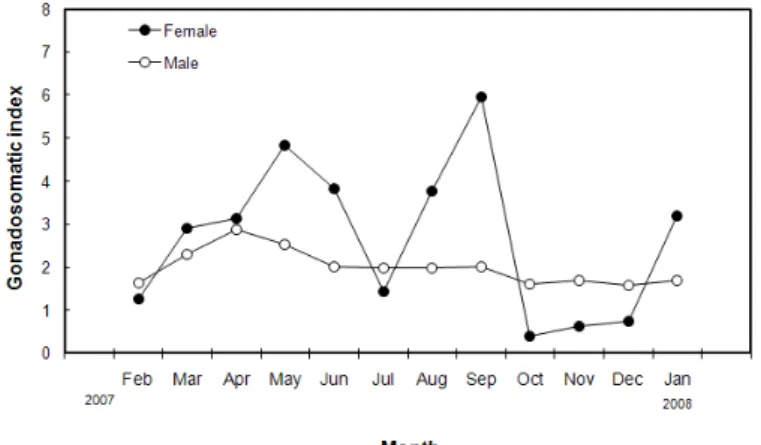
Fig. 2. Monthly changes of gonadosomatic index for common octopus, Octopus vulgaris in the South Sea of Korea.
생식소중량지수 (GSI)는 다음과 같은 식에 의하여 구하였 다.
생식소중량지수 (GSI) = GW/TW × 100
여기서 GW (gonad weight) 는 생식소중량, TW (total wet weight) 는 체중이다.
성숙체중은 산란기중 전체 암컷 중 생식소가 성숙 이상의 숙도를 가지는 개체의 비율을 구한 후, 다음의 logistic equation에 적용시켜 성숙체중을 추정하였다.
Pi = 1/(1-e-bo-biTW)
여기서 Pi 는 i체중계급에서의 군 성숙비율을 나타낸다.
결 과 1. 생식소 중량지수 (GSI) 의 월별 변화
참문어의 산란기를 추정하기 위하여 생식소중량지수의 월별 변화를 알아본 결과는 Fig. 2와 같다. 암컷의 경우 2월의 1.26 에서 5월에는 4.84로 증가하는 경향을 보였고, 7월에는 1.44 의 낮은 값으로 감소하였으며 8, 9월에 다시 상승하였다. 10 월에는 0.38의 낮은 값으로 급격히 감소하였으며 2008년 1월 3.18의 값으로 증가하였다. 수컷의 경우는 연중 1.5 이상의 높 은 값을 나타냈다. 이러한 생식소중량지수의 월 변화의 결과를 토대로 참문어의 산란기를 추정해본 결과 참문어의 산란기는 5-6월과 9월로 판단된다.
2. 생식소 발달의 조직학적 관찰
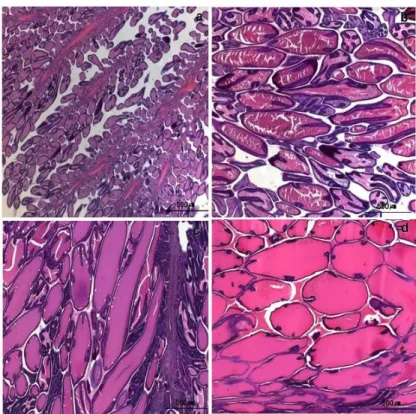
참문어의 암컷과 수컷의 생식소를 조직학적으로 관찰하여 성숙도를 미숙, 중숙, 성숙, 완숙의 4 단계로 구분하였다. 암컷 의 관찰결과는 다음과 같다 (Fig. 3).
미숙 (immature stage): 난소에서는 난소소엽 상피세포 층을 따라 초기 성장 중인 난모세포들이 소엽간의 내강 쪽으로 성장 해 갔다. 장경 200 μm까지의 난모세포들은 비교적 구형의
형태를 보였으나, 점차 타원형으로 성장 발달되면서 장경 400-700 μm, 단경 80-150 μm까지 발달하였으며 이 시기 까지는 난모세포의 세포질 내에 핵이 관찰되었다.
중숙 (maturing stage): 난소에서는 난모세포들이 성장, 발달 하여 장경 1,000 μm, 단경 200 μm 이상이 되면서 난모세포 의 세포질 내 난황구들이 관찰되기 시작하였고, 이후에도 난황 물질의 축적과 함께 계속 성장 발달해 갔다.
성숙 (mature stage): 난소에서는 난모세포들이 장경 1,400-1,800 μm, 단경 400-600 μm 까지 성장 발달하였고, 난모세포 세포질 내 난황구들은 계속적인 축적과 함께 균질화 가 진행되기 시작하였다.
완숙 (ripe stage): 난소 내에는 장경 2,000-2,500 μm, 단경 900-1,100 μm 전후인 긴 타원형의 완숙된 난모세포들이 가 득 차게 되는데, 이 시기에는 난모세포 세포질 내 축적되었던 난황구들이 서로 융합되며 완전히 균질화되었다.
참문어 수컷의 생식소의 관찰결과는 다음과 같다 (Fig. 4).
미숙 (immature stage): 정소에서는 정소소엽 상피를 따라 정모세포가 다수 관찰되었고 내강 쪽으로는 정세포와 일부 변 태 중인 정자들이 관찰되었다.
중숙 (maturing stage): 정소에서는 소엽 내강에 성숙 변태 를 마친 정자들이 계속적으로 축적되는 것이 관찰되었다.
성숙 (mature stage): 정소에서는 소엽 내강에 성숙 변태를 마친 정자들이 계속적으로 축적되면서 중앙 내강에는 정자괴 가 뚜렷이 구분 관찰되었다.
완숙 (ripe stage): 정소의 소엽내강에는 성숙한 정자들의 수 가 더욱 늘어나 소엽내강을 거의 채우면서 수정관 쪽으로 이동 밀집되어 가는 것이 관찰되었다.
3. 생식소의 월별 발달 과정
Fig. 3. Developmental stages of common octopus egg in the ovary.
a: immature stage, b: maturing stage, c: mature stage, d: ripe stage (scale bar = 500 μm)
Fig. 4. Developmental stages of Common octopus sperm in the testis.
a: Immature stage, b: Maturing stage, c: Mature stage, d: Ripe stage (Scale bar = 500 μm)
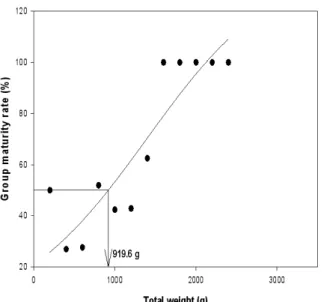
Fig. 6. Relationship between total weight and group maturity of common octopus, Octopus vulgaris in the South Sea of Korea.
Fig. 5. Monthly changes in maturity stages of common octopus, Octopus vulgaris in the South Sea of Korea.
조직학적 관찰을 통하여 생식소의 월별 발달과정을 분석한 결과, 암컷의 경우 성숙단계를 지난 개체는 5-6월에 출현비율 이 높았고, 7월에 급격히 감소하였으며 다시 9월에 가장 높은 비율은 나타내다가 10월에 급격히 감소하는 경향을 나타냈다 (Fig. 5). 수컷의 경우, 조사기간 중 미숙, 중숙, 성숙, 완숙기 의 개체들이 혼재하여 출현하였으며 생식소의 숙도가 방정이 가능한 성숙단계 이상의 개체는 전 기간에 걸쳐 관찰되었다.
4. 성숙체중
성숙체중은 수산자원생물을 자원진단 할 때 그 생물의 어획 금지 체중 (또는 체장) 이 적합한지 여부를 판단할 수 있는 과
학적 근거자료가 되므로 자원관리에 있어서 매우 중요한 자료 가 된다. 이 연구에서 암컷의 50%이상이 성숙하는 성숙체중 을 구한 결과는 Fig. 6과 같다. 참문어 최소 성숙체중은 187.8 g로 나타났으며 체중 1,600 g 이상의 개체는 100% 성숙하는 것으로 나타났고, logistic equation에 적용시켜 성숙체중을 알아본 결과 성숙체중은 919.6 g로 추정되었다 (Fig. 6).
고 찰
참문어의 산란기를 규명하기위에 생식소 중량지수의 월 변 화와 생식소의 조직학적 분석을 통한 생식소의 월별 발달과정 을 알아보았으며, 개체군의 50%가 성숙하는 성숙체중을 조사 하였다.
Rodriguez-Rua et al. (2005) 은 참문어의 생식소 발달과 정을 육안적 관찰과 조직학적 관찰을 병행하여 분석하였고 암 컷과 수컷의 생식소의 성숙도를 방후를 포함한 미숙, 중숙, 성 숙, 방후의 4단계로 구분하였으며 성숙과 완숙의 단계를 구분 하지 않았다. Kim et al. (2008) 은 참문어의 생식소 발달과 정을 육안적 관찰로서 미숙, 중숙, 성숙, 완숙의 4 단계로 구분 한 결과를 보고하였고 이 연구에서는 그 결과를 명확히 뒷받침 하기위해 조직학적 분석을 시행하였으며 육안관찰과 마찬가지 로 방란 전 단계까지인 미숙, 중숙, 성숙, 완숙의 4단계로 구분 할 수 있었다. 이러한 방법으로 참문어 생식소의 월별 발달 과 정을 조사한 결과, 암컷의 경우 성숙단계를 지난 개체는 5-6월 에 출현비율이 높았고, 7월에 급격히 감소하였으며 다시 9월 에 가장 높은 비율은 나타내다 10월에 급격히 감소하는 경향 을 나타냈다. 생식소 중량지수 (GSI) 는 5월과 6월에 높은 값 은 나타내다 7월에 급격히 감소하였으며, 9월에 가장 높은 값 을 보이다 10월에는 가장 낮은 값을 나타냈다. 이러한 생식소 중량지수 (GSI) 의 월별 변화, 생식소의 월별 발달과정에 대
한 분석을 통하여 알아본 참문어의 산란기는 이전의 Kim et al. (2008) 의 결과와 같이, 5-6월과 9월 (주 산란기) 로 1년 에 2 회의 산란 성기가 있고 2 개의 cohort가 있다고 분석되 어졌다. 참문어의 산란기가 1년에 2회의 산란성기가 있다는 결과는 일본 Chiba현에 서식하는 참문어가 5-6월과 9-11월 2 회 산란한다는 보고 (Tanaka, 1958), 스페인 Canary제도에 서식하는 참문어가 1-6월 (주 산란기는 4월) 과 10-11월에 산 란한다는 보고 (Hernandez-Garcia et al., 2002), 지중해연 안과 일본해역에 서식하는 참문어는 4-5월과 10월, 서 아프리 카 해역의 참문어는 5-6월과 9월 (주 산란기) 에 2회 산란한 다는 연구 결과 (FAO Species Fact, 2008) 와 유사하게 나 타났다.
성숙체중은 수산자원생물을 자원진단 할 때 그 생물의 어획 금지체중 (또는 체장) 이 적합한지 여부를 판단할 수 있는 과 학적 근거자료가 되므로 자원관리에 있어서 매우 중요한 자료 가 된다. 이 연구에서 참문어의 성숙체중은 919.6 g이었고, 1,600 g 이상에서는 모든 개체가 성숙하는 것으로 나타났다.
919.6 g 이하의 개체들을 번식시기에 무분별하게 어획한다면 참문어의 가입량이 감소되어 자원량이 급격히 감소할 수 있을 것으로 판단된다. 참문어 자원량 증가를 위한 성숙체중의 조사 는 여러 논문에서 보고되어지고 있다. Hernandez-Garcia et al. (2002) 은 참문어의 성숙체중을 1200-1300 g이라 보고한 바 있고, Otero et al. (2007) 은 1858.6 g, Rodriguez-Rua et al. (2005) 은 1250 g이라 보고한 바 있다. 특히 스페인 Asturias 해역의 경우 2001년 참문어의 어획금지체중을 기초 적 연구수행 없이 500 g로 설정하였으나 자원관리 효과가 없 어 어획금지체중을 1000 g로 설정하고 어획금지기간을 설정 하여 참문어의 자원관리를 효과적으로 시행하고 있다 (Fernandez-Rueda et al., 2007). 우리나라에서도 아직 참 문어의 구체적 자원관리가 행해지고 있지 않기 때문에 본 연구 는 매우 귀중한 자료가 될 것이라 사료된다.
이 연구에서 조사한 참문어의 산란기는 자원관리에 있어서 포획금지기간을 제시할 수 있고 성숙체중은 포획금지체중을 제시할 수 있기 때문에 이 연구의 결과는 참문어 자원관리 방 안에 있어 중요한 기초 자료를 제공할 것이라 판단된다. 본 연 구의 결과, 참문어의 주 산란기는 9월이었고 참문어의 성숙체 중은 919.6 g로 나타났으므로 이러한 연구결과를 바탕으로 포 획금지기간과 포획금지체중을 설정한다면, 참문어의 자원관리 를 효율적으로 할 수 있을 것이라 판단된다.
요 약
이 연구는 경남 통영과 사천지역의 연안에서 2007년 2월부 터 2008년 1월까지 연안통발어업에 의해 어획된 참문어를 매 월 1회 채집하여 성숙과 산란에 관한 연구를 수행하였다. 조
직학적 검경을 통한 생식소 성숙도의 월별 발달과정을 분석한 결과 암컷의 경우, 조사 기간 중 미숙, 중숙, 성숙, 완숙기의 개체들이 혼재하여 출현하였으며 산란이 가능한 완숙 개체는 10월과 12월을 제외하고 연중 관찰되었다. 수컷의 경우도 조 사기간 중 미숙, 중숙, 성숙, 완숙기의 개체들이 혼재하여 출현 하였으며 방정이 가능한 성숙 이상의 개체는 전 기간에 걸쳐 관찰되었다. 생식소 중량지수의 월 변화는 암컷의 경우, 2월 1.26에서 5월 4.84로 증가하다 이후 감소하였으며 8,9월에 다 시 상승하였다가 10월에 0.38의 낮은 값으로 감소하였다. 이 러한 생식소 성숙도의 월별발달과정과 생식소 중량지수의 월 변화를 바탕으로 참문어의 산란기를 추정한 결과 주 산란기는 9월로 나타났다. 수컷의 경우는 연중 1.5이상의 높은 값을 나 타냈다. 참문어의 50% 군 성숙체중은 919.6 g로 추정되었다.
ACKNOWLEDGEMENTS
본 연구는 국립수산과학원 연근해어업자원조사에 의하 여 수행되었으며 (RP-2009-FR-027), 익명의 심사위원들의 고견에 대해 감사드립니다.
REFERENCES
Andrews, P.L.R. and Tansey, E.M. (1983) The digestive tract of Octopus vulgaris: The anatomy, physiology and pharmacology of the upper tract. Marine Biology, 63(1): 109-134.
Antoni, Q., Francesc, A., Aina, C., Paolo, M. and Pilar, S. (1998) Biology and fishery of Octopus vulgaris Cuvier, 1797, caught by trawlers in Mallorca (Balearic Sea, Western Mediterranean). Fishery Research, 36: 237-249.
Aronson, R.B. (1991) Ecology paleobiology and evolutionary constraint in the Octopus. Bulletin of Marine Science, 49(1-2): 245-255.
Chung, E.Y., Kim, B.G., Kim, S.W. and Ko, T.S. (1999) Reproductive ecology of Octopus ocellatus on the west coast of Korea. Yellow Sea, 5: 33-45. [in Korean]
Chu, C. and Kim, S.G. (1990) Studies on the development of Techniques on seedling production of Octopus vulgaris. National Fisheries Research Development Institute, 86: 92-97. [in Korean]
Cortez, T., Castro, B.G. and Guerra, A. (1995) Reproduction and condition of female Octopus mimus (Mollusca: cephalopoda). Marine Biology, 123(3): 505-510.
Cristo, C. and Cosmo, A. (2007) Neuropeptidergic control of Octopus oviducal gland. Peptides, 28:
163-168.
FAO Species Fact. (2008) http://www.fao.org/fishery/
species/3571
Fernandez-Rueda, P. and Garcia-Florez, L. (2007) Octopus vulgaris (Mollusca: Cephalopoda) fishery
management assessment in Asturias (north-west Spain). Fishery Research, 83: 351-354.
Forsythe, J.W. and Halon, R.T. (1988) Effect of temperature on laboratory growth, reproduction and life span of Octopus bimaculodes. Marine Biology, 98(3): 369-379.
Guerra, A. (1992) Mollusca Cephalopoda. Fauna Iberica, Vol. 1. Museo Nacional de Cientificas, Madrid, 327 pp.
Hatanaka, H. (1979) Spawning season of common octopus, Octopus vulgaris CUVIER, off the northwestern coast of Africa. Rapport du Groupe de Travail Ad Hoc sur l'Evaluation des Stocks de Cephalopodes. Appendix 11.
Hernandez-Garcia V., Hernandez-Lopez, J.L. and Castro-Hernandez J.J. (1998) The octopus (Octopus vulgaris) in the small-scale trap fishery off the Canary Islands (Central-East Atlantic). Fishery Research, 35: 183-189.
Hernandez-Garcia V., Hernandez-Lopez, J.L. and Castro-Hernandez J.J. (2002) On the reproduction of Octopus vulgaris off the coast of the Canary Islands. Fishery Research, 57: 197-203.
Katsanevakis, S., Protopapas, N. and Miliou, H. (2005) Effect of temperature on specific dynamic action in the common octopus, Octopus vulgaris (Cephalopoda). Marine Biology, 146: 733-738.
Kim, Y.H., Kang, H.J., Lee, E.H., Lee, D.W., Chang, D.S. and Gwak. W.S. (2008) Reproductive biology of common octopus, Octopus vulgaris in the South Sea of Korea. Korean Journal of Malacology, 24(3):
161-166. [in Korean]
Mangold, K. and Von Boletzky, S. (1973) New data on reproductive biology and growth of Octopus vulgaris. Marine Biology, 19: 7-12.
Okutani, T., Tagawa, M. and Horikawa, H. (1987) Cephalopods from Continental Shelf and Slope around Japan. pp. 156-157. Japan Fisheries Resource Conservation Association, Tokyo. [in Japanese]
Otero, J., Gonzalez, A.F., Sieiro, M.P. and Guerra, A.
(2007) Reproductive cycle and energy allocation of
Octopus vulgaris in Galician waters, NE Atlantic.
Fishery Research, 85: 122-129.
Paulo, V.P., Pedro, S. and Alexandra, B. (2004) Aquaculture potential of the Common octopus (Octopus vulgaris Cuvier, 1797): a review.
Aquaculture, 238: 221-238.
Quetglas, A., Alemany, F., Carbonell, A., Merella, P. and Sanchez, P. (1998) Biology and fishery of Octopus vulgaris Cuvier, 1797, caught by trawlers in Mallorca (Balearic Sea, Western Mediterranean).
Fishery Research, 36: 237-249.
Rodriguez, C., Carrasco, J.F., Arronte, J.C. and Rodriguez, M. (2006) Common octopus (Octopus vulgaris Cuvier, 1797) juvenile ongrowing in floating cages. Aquaculture, 254: 293-300.
Rodriguez-Rua, A., Pozuelo I., Prado, M.A., Gomez, M.J.
and Bruzon, M.A. (2005) The gametogenic cycle of Octopus vulgaris (Mollusca: Cephalopoda) as observed on the Atlantic coast of Andalusia (South of Spain). Marine Biology, 147: 927-933.
Roper, C.F.E. and Sweeney, M.J. (1984) FAO Species Catalogue Vol. 3 Cephalopods of The World, 211 pp.
Rosa, R., Costa, P.R. and Nunes, M.L. (2004) Effect of sexual maturation on the tissue biochemical composition of Octopus vulgaris and O. defilippi (Mollusca: Cephalopoda). Marine Biology, 145:
563-574.
Smale, M.J. and Buchan, P.R. (1981) Biology of Octopus vulgaris off the Coast of South Africa. Marine Biology, 65: 1-12.
Tanaka, J. (1958) On the stock of octopus, Octpus vulgaris Lamarck, on the East Coast of Boso Peninsula, Japan. Bulletin of Japanese Society of Scientific Fisheries, 24(8): 601-607.
Villanueva, R., Koueta, N., Riba J. and Boucaud-Camou, E. (2002) Growth and proteolytic activity of Octopus vulgaris paralarvae with different food rations during first feeding, using Artemia nauplii and compound diets. Aquaculture, 205: 269-286.
Wodinsky, J. (1972) Breeding season of Octopus vulgaris. Marine Biology, 16: 59-63.