J Kor Soc Fish Technol, 51 (1), 1―8, 2015 http://dx.doi.org/10.3796/KSFT.2015.51.1.001
<Original Article>
Growth and mortality of the juvenile common octopus (Octopus vulgaris) in pipe- and tire-type shelters placed in flow-through seawater tanks
Inyeong KWON1, Taeho KIM2*
1Department of Fisheries Science, Graduate School, Chonnam National University, Yeosu 550-749, Republic of Korea
2Division of Marine Technology, Chonnam National University, Yeosu 550-749, Republic of Korea
The common octopus, which has a high growth rate and high market price, is a prime candidate for commercial marine aquaculture operations. We evaluated the effectiveness of two types of shelters (pipe and tire types) for juvenile common octopus growing out in flow-through seawater tanks. Growth rates were evaluated in two experiments. The first experiment (Experiment 1) ran for 72 days, and the second (Experiment 2; replicated) ran for 46 days. Each trial included 40 octopuses fed a diet of frozen sardine (Sardinops melanostictus) and swimming crab (Portunustri tuberculatus) at 3–8% of body weight once every 3 days. In the two experiments, the respective specific growth rates were 0.3 and 0.04%/day in pipe-type shelters and 0.00 and 0.88%/day in tire-type shelters, while the respective percentage survivals were 80 and 80% in pipe-type shelters and 70 and 90% in tire-type shelters. Shelter type had little influence on the growth rate (P < 0.05).
Keywords: Octopus, Pipe shelter, Tire shelter, Rearing system, Flow-through seawater tank
*Corresponding author: [email protected], Tel: +82-61-659-7121, fax: +82-61-659-7129
Introduction
As the global demand for aquatic food increases, aqua- culture techniques are developing and expanding worldwide, with many finfish and shellfish currently under aquaculture.
Moreover, although they are valuable potential candidates for marine aquaculture operations, benthic cephalopods have received relatively little study. In particular, the rapid growth rate and high market price of the common octopus (Octopus vulgaris) makes it a highly valuable animal (Semmens et al., 2004; Vaz-Pires et al., 2004; Estefanell et al., 2012a).
The common octopus occurs worldwide in benthic envi- ronments extending from coastlines to depths of 200 m at the outer edges of continental shelves. Globally, octopus capture peaked at 110,000 MT in 1975, with recent octopus yields decreasing from 50,000 MT in 2004 to 42,000 MT
in 2010 (FAO, 2012). In a commercial South Korean fishery, the harvest decreased from 15,000 MT in 2009 to 10,000 MT in 2012 (KOSIS, 2013).
The juvenile common octopus can be cultured in floating cages with internal shelters (Rodriguez et al., 2006). Pascual et al. (2006), García García et al. (2009), and Chapela et al. (2006) described grow-out techniques for the common octopus, with the animals growing in shelters suspended from mussel rafts. Estefanell et al. (2012a) showed that mor- tality was higher when octopuses were reared in groups without individual shelters. Such mortality was associated with cannibalism, and adverse hierarchical and reproductive behaviors (García García et al., 2009; Estefanell et al., 2012a; Estefanell et al., 2012b).
The influence of initial stocking density on growth has
been studied (Rodriguez et al., 2006). Initial stocking den- sities of 24.5 and 10.7 kg/m3 were associated with specific growth rates (SGRs) of 0.5% and 1.5%, and mortalities of 41% and 17%, respectively. In another study, survival rates in tanks were higher at a stocking density of 8.0 kg/m3 com- pared to those at 15 kg/m3 (Domingues et al., 2010). The ef- fects of water temperature were investigated in flow-through seawater tanks in Spain (Delgado et al., 2011), with high mortalities (47–88%) evident in summer (when the water temperature was >28°C) and winter (when the water temper- ature was <10°C).
Several studies have sought to reduce cannibalism by varying rearing conditions, food levels (Hanlon and Messenger, 1996), size disparities (Hanlon and Messenger, 1996; Chapela et al., 2006), and shelters (Katsanevakis and Verriopoulos, 2003; Chapela et al., 2006). In particular, shel- ters were thought to decrease cannibalism (Chapela et al., 2006).
Optimized grow-out shelters that reduce cannibalism are clearly required if benthic cephalopod aquaculture is to expand. Seclusion and protection are the major criteria used by an octopus when choosing a shelter. In addition to natural caves and holes beneath rock formations, individuals are of- ten found in anthropogenic debris, including barrels, jugs, cans, tires, and bottles on the ocean floor (High, 1976).
In the present study, two shelter types for octopus grow-out were evaluated. One shelter type used in previous studies (Chapela et al., 2006; Rodriguez et al., 2006; García García et al., 2009; Estefanell et al., 2012a; Estefanell et al., 2012b) was made from inexpensive polyvinyl chloride (PVC) pipe, while the second shelter type consisted of scrap tires, often used in breakwaters and retaining walls of har- bors and estuaries. Tires, which have found many applica- tions in marine construction, serve as artificial reefs when seeking to enhance fishery yields (Collins et al., 2002).
Notably, in Alaska, scrap tires are used to catch the giant Pacific octopus (Enteroctopus dofleini) (Conners et al., 2012). Pots made of scrap tires were found to be better than plastic pots as the tires were easier to handle, cheaper, and more quickly assembled. In many regions, waste tires are readily available at little cost; they are durable and contain large empty spaces (Collins et al., 2002). In addition, many octopus species prefer dark environments (Okamoto et al.,
2001; Conners et al., 2012). Therefore, in addition to PVC pipe, we tested tire-type shelters, considering the biological features of the octopus and the economic viability of such shelters.
Thus, we explored whether PVC and tire-type shelters re- duced cannibalism in the common octopus bearing in mind shelter quality, durability, and habitat. Two sets of experi- ments were performed to quantify juvenile grow-out in four, controlled, flow-through seawater tanks.
Materials and Methods Experimental shelters
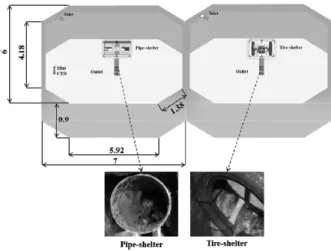
We evaluated pipe- and tire-type shelters (Fig. 1a, b). The PVC pipe-type shelter was described by Oh and Kim (2014).
The outer frames were made of polypropylene pipe (dia- meter 3.2 cm) covered with net (Nylon Td 210 × 12, mesh size: 0.5 cm). The nominal dimensions of the pipe-shelter frame were 1 m × 0.5 m × 0.5 m. Internal to the frame, additional PVC pipe sections served as hiding places (12 pieces each 0.31 m in length; total volume 0.25 m3).
(a)
(b)
Fig. 1. (a) A pipe-type shelter and (b) a tire-type shelter (unit: m).
The nominal dimensions of the tire-shelter frame were 1.07 m × 0.52 m × 0.79 m (total volume 0.41 m3), and three scrap tires (0.51 m outer and 0.31 m inner diameter) were placed internally. For comparative growth rate studies, the shelters were placed in separate, flow-through seawater tanks; flow, dissolved oxygen level, and animal growth were all evaluated under controlled conditions.
Source of animals and acclimatization Study area
All studies were performed in four flow-through seawater tanks located at the Aquaculture Research Center (ARC) of Chonnam National University in Gamak Bay, Korea. Gamak Bay lies in the Jeollanamdo region of the south coast of Korea. The bay is oval in shape and has a surface area of approximately 112 km2.
We used 40 juvenile common octopuses caught by local fishermen in octopus traps. Each specimen was acclimatized in a separate shelter for 7 days to minimize biological inter- action prior to the experiment. At the commencement of ex- periments, the respective average weights were 452 ± 119 and 430 ± 100 g in the pipe-shelter tanks and replicate tanks, and 546 ± 104 and 285 ± 90 g in the tire-shelter tanks and replicate tanks.
Males and females were reared together (Rodriguez et al., 2006; García García et al., 2009).
Experimental design
Replicate tests were conducted in octagonal, flow-through, concrete seawater tanks (each 47.33 m3 in volume; Fig. 2);
the tanks were sufficiently large to ensure relatively uniform flow patterns and each tank was covered with a sun-pro- tective net. The first test (Experiment 1) ran for 72 days (from 2 April to 13 June 2013) and the second test (Experiment 2, replicated) ran for 46 days (from 29 April 2013 to 13 June 2013). Growth and survival were compared.
Ten individuals were placed in each tank. The pipe shelter had smaller hiding places than the tire shelter. Accordingly, the respective initial stocking densities were 11.46 and 17.64 kg/m3 in the pipe-shelter tests and 8 and 10.85 kg/m3 in the tire-shelter tests. The octopuses were fed frozen sardine (Sardinops melanostictus) and swimming crab (Portunustri
tuberculatus) at 3–8% body weight once every 3 days (Rodriguez et al., 2006). Uneaten food was removed at the end of each 3-day period.
Fig. 2. Experimental setup in flow-through seawater tanks (unit: m).
Rearing conditions
Each structure was placed in a 36-tonne, octagon-shaped flow-through tank receiving sand-filtered seawater that was turned over twice daily. The water inlet lay tangential to the wall, with the water outlet at the center of the floor (Fig.
2). The diameter of the water inlet pipe was 0.06 m, and the tank water outlet was a vertically slotted 0.2 m length of PVC pipe. Water leaving the tank was discharged by gravity into the sea. The water depth in each tank was main- tained at approximately 0.82 m. Seawater temperature and salinity were continuously measured using a logger-type CTD-Diver (Eijkelkamp, Giesbeek, The Netherlands), and dissolved oxygen and pH levels were measured once every 3 days using a handheld multi-probe instrument (YSI 556 MPS-20M; YSI Instrumental, Yellow Springs, OH, USA).
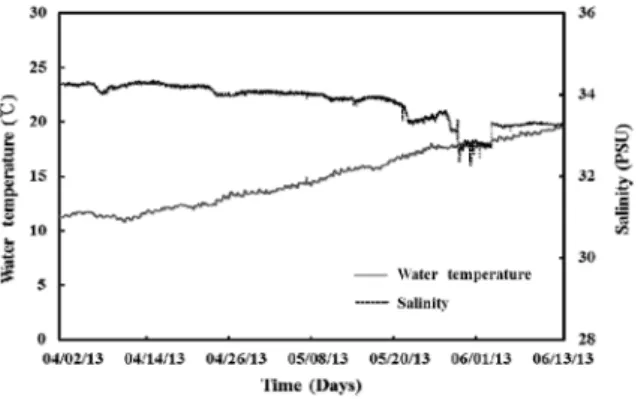
During the experiments, the inlet seawater temperature ranged from 10.88 to 19.71°C, and the salinity ranged from 32.26 to 34.34 psu (Fig. 3).
The dissolved oxygen level was maintained above 7 mg L–1, and the pH was held between 7.87 and 8.0. Water quality parameters were similar in all test tanks; the water sources were identical. Water velocities were measured using an Aquadopp Acoustic Doppler Velocimeter (Nortek AS, Rud, Norway). The instrument was configured to measure veloc- ities in the X and Y directions at every 1 m of depth on
a diametric axis. Measurements were obtained at the mid-water depth of each point at 23 Hz for 2 min (n = 2760).
The average water velocity ranged from 0.01 to 0.1 m/s.
Fig. 3. Water temperature and salinity over time in the experimental tanks.
Data processing
Every 15 days, the wet body weights of all octopuses were measured to the nearest 0.01 kg using an electronic balance.
During sampling, fouling organisms and dead octopuses were removed from the shelters. Juvenile SGRs were calcu- lated as
(1)where Wf is the final mean weight, Wi is the initial mean weight, and t is the time in days. Survival (S) was de- termined by censusing numbers from each replicate and was expressed as
(2)
where Nf is the final and Ni is the initial number of octopuses. The effects of shelter type on growth and survival were analyzed using the Mann–Whitney U-test (Ruxton, 2006) of the statistical package SPSS version 21 (SPSS Inc., Chicago, IL, USA). A P value <0.05 was considered significant.
Results Growth and survival
SGRs and survival levels were calculated using Equations
(1) and (2), respectively. The respective initial average body weights were 452 ± 119 and 430 ± 100 g in the pipe-shelter tests, and 546 ± 104 and 285 ± 90 g in the tire-shelter tests.
At the end of the experiments, body weights increased to 562 ± 149 and 438 ± 80 g, and 548 ± 75 and 427 ± 90 g, in the pipe- and tire-shelter tests, respectively. The SGRs (%) and weight data are shown in Table 1.
Table 1. Growth rates of the common octopus in pipe and tire shelters of flow-through seawater tanks
Shelter Initial body weight
(g)
Intermediate body weight3(g)
Final body weight
(g)
SGR (%/day) Pipe1 452 ± 119 621 ± 144 562 ± 149 0.30 Tire1 546 ± 104 593 ± 163 548 ± 75 0.00 Pipe2 430 ± 100 488 ± 90 438 ± 80 0.04 Tire2 285 ± 90 432 ± 90 427 ± 90 0.88
1: Experiment 1: 72 days (2 April to 13 June 2013).
2: Experiment 2: 46 days (29 April to 13 June 2013).
3: Intermediate body weight (body weight in mid-May).
(a)
(b)
Fig. 4. Survival rates (%) of the common octopus in the pipe-and tire-shelter tests. (a) Experiment 1 and (b) Experiment 2.
The SGR was 0.3–0.04%/day in the pipe-shelter tests and 0.00–0.88%/day in the tire-shelter tests. The average survival percentages in both pipe-shelter tests were 80%, while they were 70 and 90% in the type-shelter tests (Fig. 4).
Statistical analysis
The outcomes of Mann–Whitney U-test analyses of the survival and growth data sets are shown in Table 2 for each shelter type. No significant between-shelter difference in survival was noted (P > 0.05). The SGRs of Experiment 1 differed significantly between the two groups (P < 0.05).
Table 2. Mann–Whitney U-testa comparisons of survival rates and SGRs of the common octopus growing in pipe and tire shelters in flow-through seawater tanks (P < 0.05)
Survival1 Survival2 SGR1 SGR2
Mann–Whitney U 28.00 15.50 3.50 2.50
Wilcoxon W 64.00 36.50 24.50 8.50
Z –0.49 –0.53 –2.36 –0.89
Asymptotic Sig.
(two-tailed) 0.63 0.60 0.02 0.38
Exact Sig.
[2*(one-tailed)] 0.72b 0.70b 0.02b 0.40b
a: Grouped data, b: Not corrected for ties.
1: Experiment 1, 2: Experiment 2.
Discussion
Juvenile common octopuses exhibited similar biological
performance when growing in pipe and tire shelters in flow-through seawater tanks. Compared to other studies, our observed growth rates were low, but the survival rates were relatively high (Table 3).
Compared to the data of other indoor tank experiments, our survival rates were higher than those of Delgado et al.
(2011), possibly because our water temperatures were warmer. However, the survival rates of the present study were lower than those of Domingues et al. (2010), probably because our stocking densities were higher. Table 3 shows the results of sea cage experiments described in Estefanell et al. (2012b); survival was only 72% under group con- ditions, being compromised by weight dispersion, cannibal- ism, and abnormal reproductive behavior.
In general, the growth rates noted in the present study were lower than those of the other studies summarized in Table 3. Several factors, including initial stocking density (Garcia Garcia et al., 2009), influence octopus growth rate.
In the present study, initial culture densities in the pipe-shel- ter tests were higher (11.46 and 17.64 kg/m3) than the pre- viously reported optimal density of 10 kg/m3 (Garcia Garcia et al., 2009). Therefore, the survival rates of the tire-shelter tests (with culture densities of 8 and 10.85 kg/m3) were slightly higher than those of the pipe-shelter tests. Water temperature significantly affects growth and food intake of the common octopus (Mangold, 1983; Delgado et al., 2011).
Table 3. Survival rates and SGRs of the common octopus in the field and indoors Culture methd Shelter type(Culture type) Period (days) Survival rate
(%) Initial body
weight (g) Final body weight (g) SGR
(%/day) Initial density
(kg/m3) Source
Indoor tank Den
(Grouped) 70 90 1174 2660 1.17 4 Domingues et al. (2010)
Indoor tank Scrap tire
(Grouped) 72 80 445 476 0.00 10.85 This study1
Indoor tank PVC pipe
(Grouped) 72 70 441 500 0.30 17.64 This study1
Indoor tank Den
(Grouped) 84 22 731 2200 1.31 4.9 Delgado et al. (2011)2
Suspended sea
cage Tube
(Individual) 60 100 1502 3350 1.3 10 Estefanell et al. (2012a)
Subsurface sea
cage No shelter
(Grouped) 60 72 873 2615 1.8 10 Estefanell et al. (2012a)
Suspended
from rafts Den (Grouped)
1–75 98.10 2440 2440 0.93
(Female) 13.1
Chapela et al. (2006)3
>75 98 2440 2210 –0.66
(Female) 13.1 Suspended sea
cage Den
(Grouped)
91 81.3 996 3982 1.54 10.7 Rodríguez et al. (2006)4
86 58.9 1090 1694 0.5 24.5 Rodríguez et al. (2006)4
1: Experiment 1, 2: Trial 1, 3: Trial 2, 4: Experiment 4.
A temperature of about 16°C was associated with good octopus growth rates in suspended mussel rafts (Chapela et al., 2006). Iglesias et al. (2000) reported SGRs of 0.77–
0.95%/day at water temperatures from 13 to 16°C. The opti- mum water temperature for octopus growth has been de- scribed as being 18.5°C (García García et al., 2009). In the present study, juvenile octopuses were only mildly affected by water temperatures of 10.88–19.71°C. Higher rates of ear- ly growth (from the initial to the intermediate stage) (pipe shelter: 0.63 and 0.54%/day; tire shelter: 0.54 and 1.8%/day) were observed as the water temperature increased. Holding the water temperature at 16°C appeared to positively influ- ence octopus growth (Chapela et al., 2006). Our average in- termediate-stage water temperature was 16.6°C (at about mid-May). When the water temperature was above 18°C (at about the end of May), some weight loss was evident (pipe shelter: –0.50 and –0.53; tire shelter: –0.40 and –0.02%/day) from the intermediate to the final stage of growth. However, the common octopuses we used were smaller and younger than those of other studies (Chapela et al., 2006; Estefanell et al., 2010; Delgado et al., 2011; Estefanell et al., 2012a), and most weight loss occurred after mid-May. Smaller in- dividuals are more sensitive to both water temperature per se (Aguado Giménez and García García, 2002) and increases in water temperature (Miliou et al., 2005).
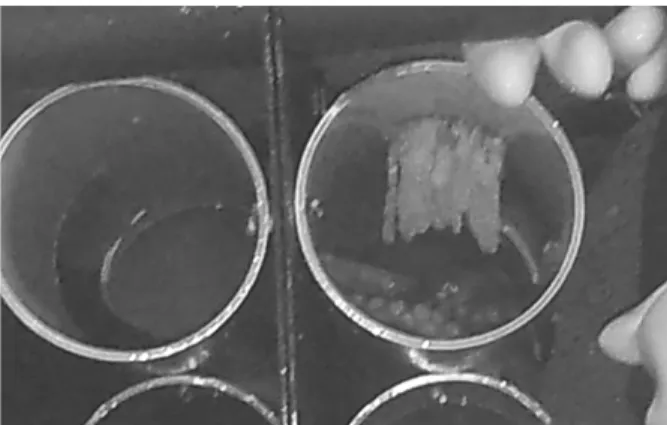
Mating and spawning, which occur throughout the year in many octopus species, may also affect growth. Octopuses of the Gran Canarian waters of Spain exhibit peak re- productive activity in April off the western coast of Africa (Hernández-García et al., 2002). On the southern coast of Korea, the spawning periods occur from May to June, and again in September (Kang et al., 2009). Female octopuses with attached egg masses exhibited low growth rates (Kang et al., 2009). Chapela et al. (2006) reported that the growth rate of female octopuses decreased from 0.93% to 0.66%
in summer, probably caused by spawning. In the present study, reproductive behavior was evident after mid-May; the SGRs fell from 0.63 and 0.54%/day in pipe shelters and 0.54 and 1.8%/day in tire shelters to –0.50 and –0.53%/day in pipe shelters and –0.40 and –0.02%/day in tire shelters (Fig.
5). These low values may reflect the fact that energy was expended on reproductive processes.
Fig. 5. Reproduction of the common octopus in pipe-type shelters.
Cannibalism is practiced principally by large (>1 kg) octo- puses (Salia et al., 1980; Chapela et al., 2006) and was not a significant problem in the present study.
Finally, octopuses are highly mobile, sensory animals and are likely to select shelters carefully (Anderson, 1997).
Although the common octopus continues to grow at rela- tively high densities in captivity, the species is inherently territorial and requires a minimum amount of space for de- velopment and growth (Rodriguez et al., 2006). In the natu- ral environment, introduction of artificial dens may allow an octopus population to increase in numbers (Katsanevakis and Verriopoulos, 2003), and shelter is therefore extremely important. Estefanell et al. (2012a) showed that mortality was higher when octopuses were reared as a group, without shelters, rather than individually, with shelters. Octopuses were reared as a group in a floating cage (5 m3) containing 90 PVC T-shaped pipes as shelters (Estefanell et al., 2012a).
Four types of artificial dens were investigated via SCUBA diving surveys: these included wells (vertical holes in the sediment), rocks/stones, empty shells, and structures of hu- man origin (bottles, tires, and pipes) (Katsanevakis and Verriopoulos, 2003). In total, 38.7% of all octopuses were found to be sheltered in structures of human origin.
Thus, the lower growth rates in each shelter type studied here were attributable not only to initial culture densities but also to water temperature, reproductive requirements, and differences in growth habitat, as described above.
Even if waste tires seem suitable for use as octopus shel- ters, heavy metal levels in cultured octopuses must be monitored. The principal heavy metal leached from tires is zinc (Collins et al., 1994), which was found to be accumu-
lated by hydroids growing on tire surfaces (Collins et al., 2002). Heavy metals are accumulated by caged animals (Collins et al., 2002) and the levels peak in the highest pred- ators of the food chain (Kim et al., 2008). Therefore, the heavy metal levels of octopuses grown in tire-type shelters must be monitored.
In conclusion, we conducted two replicate experiments to evaluate the survival and growth rates of the common octo- pus in tanks fitted with two types of shelter made of PVC pipe and waste tires. The survival rates were 80%
(Experiment 1) and 80% (Experiment 2) in pipe shelters and 70% (Experiment 1) and 90% (Experiment 2) in tire shelters.
The SGRs were 0.3 (Experiment 1) and 0.04%/day (Experiment 2) in pipe shelters and 0.00 (Experiment 1) and 0.88%/day (Experiment 2) in tire shelters. No significant be- tween-shelter difference in growth or survival was evident.
The observed low growth rates may be attributable to effects of water temperature and reproductive demands. Tire shel- ters are cost-effective, but tires are often viewed as examples of environmental pollution. In situ follow-up work is needed to explore whether pipe and tire shelters can be effectively incorporated into existing octopus aquaculture operations.
Acknowledgements
This research was supported by Basic Science Research Program through the National Research Foundation of Korea (NRF) funded by the Ministry of Education, Science and Technology (NRF-2013R1A1A2004481). The authors would like to thank Hyoyeong Lee and Sunju Moon of the Department of Fisheries Science, Chonnam National University for their assistance in measuring and maintaining the experimental animals.
References
Aguado Giménez F and García García B. 2002. Growth and food intake models in Octopus vulgaris Cuvier (1797) influence of body weight, temperature, sex and diet. Aquacult Int 10, 361–377. (doi: 10.1023/A:1023335024053)
Anderson T. 1997. Habitat selection and shelter use by Octopus tetricus. Mar Ecol Prog Ser 150, 137–148.
Baldrati G. 1989. Handling, marketing and processing of cephalo- pods in Italy. Ind Conserve 64, 353–355.
Chapela A, Gonzalez AF, Dawe EG, Rocha F and Guerra A. 2006.
Growth of common octopus (Octopus vulgaris) in cages sus- pended from rafts. Sci Mar 70, 121–129. (doi:10.3989/
scimar.2006.70n1121)
Collins KJ, Jensen AC, Lockwood PM and Lockwood SJ. 1994.
Coastal structures, waste materials and fishery enhancement.
Bull of Mar Sci 55, 1240–1250.
Collins KJ, Jensen AC, Mallinson JJ, Roenelle V and Smith IP.
2002. Environmental impact assessment of a scarp tyre artifi- cial reef. ICES J Mar Sci 59, S243–S249. (doi: 10.1006/
jmsc.2002.1297)
Conners ME, Conrath C and Brewer R. 2012. Field studies in sup- port of stock assessment for the giant Pacific octopus Enteroctopus dofleini. North Pacific Research Board Final Report 906, 32.
Delgado M, Ignasi GJ, Carbó R and Aguilera C. 2011. Growth of Octopus vulgaris (Cuvier, 1797) in tanks in the Ebro Delta (NE Spain): effects of temperature, salinity and culture density. Sci Mar 75, 53-59. (doi:10.3989/scimar.2011.75n1053) Domingues P, Garcia S and Garrido D. 2010. Effects of three cul- ture densities on growth and survival of Octopus vulgaris (Cuvier, 1797). Aquacult Int 18, 165–174. (doi: 10.1007/
s10499-008-9233-3)
Estefanell J, Roo J, Fernández-Palacios HR, Izquierdo M, Socorro J and Guirao R. 2012a. Comparison between individual and group rearing systems in Octopus vulgaris (Cuvier, 1797). J World Aquacult Soc 43, 63–72. (doi: 10.1111/j.1749-7345.2011.00540) Estefanell J, Roo J, Fernández-Palacios HR, Izquierdo M and
Socorro J. 2012b. Benthic cages versus floating cages in Octopus vulgaris Biological performance and biochemical composition feeding on Boops boops discarded from fish farms. Aquacult Eng 49, 46–52. (doi: 10.1016/j.aquaeng.2012.02.001) Estefanell J, Socorro J, Roo FJ, Fernández-Palacios H and
Izquierdo M. 2010. Gonad maturation in Octopus vulgaris during ongrowing, under different conditions of sex ratio.
ICES J Mar Sci 67,1487–1493. (doi: 10.1093/icesjms/fsq111) FAO. 2012. Total fishery production. http://faostat.fao.org.
García García B, Cerezo VJ, Aguado-Giménez F, García GJ and Hernández MD. 2009. Growth and mortality of common octo- pus Octopus vulgaris reared at different stocking densities in Mediterranean offshore cages. Aquac Res 40, 1202–1212.
(doi: 10.1111/j.1365-2109.2009.02222)
Guerra A. 1992. Mollusca, Cephalopoda. in M. A. Ramos, J.
A.Tercedor, X. Belles, J. G. Gonsalbez, A. Guerra, E.
Macpherson, F. Martin, Fauna Iberica, 1st edition. Museo Nacional de Ciencias Naturales, CSIC, Madrid 327.
Hanlon RT and Messenger JB. 1996. Cephalapod Behaviour.
Cambridge: Cambridge University Press.
Hernández-García V, Hernádez-López JL and Castro-Hernández JJ.
2002. On the reproduction of Octopus vulgaris off the coast
of the Canary Islands. Fish Res 57, 197–203. (doi:
10.1016/S0165-7836(01)00341-1)
High WL. 1976. The giant Pacific octopus. US National Marine Fisheries Service, Mar Fish Rev 38, 17–22.
Iglesias J, Sánchez FJ, Otero JJ and Moxica C. 2000. Culture of octopus (Octopus vulgaris, Cuvier). Present knowledge, prob- lems and perspectives. Cahiers Options Méditerrané 47, 313–
321. (doi: 10.1016/j.aquaculture.2007.02.019)
Kang HY, Kim YH, Kim SY, Lee DW, Choi YM, Chang DS and Gwak WS. 2009. Maturity and spawning period of the com- mon octopus, Octopus vulgaris in the south sea of Korea.
Korean J of Malacol 25, 127–133.
Katsanevakis S and Verriopoulos G. 2003. Den ecology of Octopus vulgaris, Cuvier 1797, on soft sediment: Availability and types of shelter. Sci Mar 68, 147–157. (doi:10.3989/scimar.
2004.68n1147)
Kim GB, Kang MR and Kim JW. 2008. Specific accumulation of heavy metals in squid collected from offshore Korean waters:
preliminary results for offshore biomonitoring and food safety assessment. Fish Sci 74, 882–888. (doi: 10.1111/j.1444-2906.
2008.01603)
KOSIS. 2013. Total fishery production. www.kosata.go.kr.
Mangold K. 1983. Food, feeding and growth in cephalopods.
Memoirs of the National Museum of Victoria 44, 81–93.
Miliou H, Fintikaki M, Kountouris T and Verriopoulos G. 2005.
Combined effects of temperature and body weight on growth utilization of the common octopus, Octopus vulgaris.
Aquaculture 249, 245–256. (doi: 10.1016/j.aquaculture.2005.03.038) Oh MH and Kim TH. 2014. Subsurface cage system for octopus
grow-out. Korea Patent 10-1355164. Jan. 17, 2014.
Okamoto M, Anraku K, Kawamura G and Tanaka Y. 2001.
Selectivity of color of shelter by Octopus vulgaris and O.
aegina under different background colors. Nippon Suisan Gakkaishi 67, 672–677.
Pascual S, González AF and Guerra A. 2006. Unusual sites of Aggregata octopiana infection in octopus cultured in floating cages. Aquaculture 254, 21–23. (doi: 10.1016/j.aquaculture.
2005.10.014)
Rodríguez C, Carrasco JF, Arronte JC and Rodríguez M. 2006.
Common octopus (Octopus vulgaris Cuvier, 1797) juvenile ongrowing in floating cages. Aquaculture 254, 293–300. (doi:
10.1016/j.aquaculture.2005.10.053)
Ruxton GD. 2006. The unequal variance t-test is an underused alter- native to student's t-test and the Mann-Whitney U-test. Behav Ecol 17, 688–690. (doi:10.1093/beheco/ark016)
Saila SB, Wigbout M and Lermit RJ. 1980. Comparison of some time series models for the analysis of fisheries data. ICES J Mar Sci 39, 44–52. (doi: 10.1093/icesjms/39.1.44) Semmens JM, Pecl GT, Villanueva R, Jouffre D, Sobrino I, Wood
JB and Rigby PR. 2004. Understanding octopus growth: pat- terns, variability and physiology. Mar Freshwater Res 55, 367–377. (doi:.org/10.1071/MF03155)
Vaz-Pires P, Seixas P and Barbosa A. 2004. Aquaculture potential of the common octopus (Octopus vulgaris Cuvier, 1797): a review. Aquaculture 238, 221–238. (doi: 10.1016/j.aquaculture.
2004.05.018)
2015. 1.14 Received 2015. 2. 8 Revised 2015. 2.23. Accepted