한국표면공학회지 J. Korean Inst. Surf. Eng.
Vol. 50, No. 4, 2017.
https://doi.org/10.5695/JKISE.2017.50.4.277
<연구논문>
ISSN 1225-8024(Print) ISSN 2288-8403(Online)
강유전체(K
0.5
Na0.5
)NbO3
의 제조 및 전기적 특성 분석현준원*, 변재덕
단국대학교 물리학과
Fabrication and Electrical Propertie of the Ferroelectric (K 0.5 Na 0.5 )NbO 3
June Won Hyun* and Jaeduk Byun
Department of Physics, Dankook University, Dandae-ro, Dongnam-gu, Cheonan-si, Chungnam, 31116, Korea
(Received August 7, 2017 ; revised August 25, 2017 ; accepted August 25, 2017)
Abstract
Ferroelectric ceramics are broadly used for various industrial applications. In this research, the lead-free ferroelectric ceramics of (K
0.5Na
0.5)NbO
3was fabricated by using the solid state synthesis. The (K
0.5Na
0.5)NbO
3pellets were sintered at 1200, 1150 and 1100
oC for 4 hours in air atmosphere. Field-emission scanning electron microscopy (FE-SEM) characterization of the sintered KNN ceramics revealed surface morphology and grain size. And we used the X-ray diffraction (XRD) for measuring the sample crystal phase. Temperature depen- dence of the dielectric constant was measured by using an LCR meter. The sintered at 1150
oC for 4 hours sample has a highest dielectric constant 6011 at Curie temperature (T
C) and dense structure with 2.33
μm grain size.
Keywords : KNN, Ferroelectric, Ceramic, Dielectric constant, Perovskite
1. 서 론
강유전성 세라믹들은 산업 분야에서 널리 응용되 고 있다. 예를 들어 압전성 엑추에이터, 초전성 센 서, 강유전성 기억장치(Ferroelectric Random Access Memory), 다층세라믹콘덴서(Multi-Layer Ceramic Capacitor), 일렉트릭 옵틱 디바이스 등에 쓰인다[1- 6]. 특히, Pb(Zr,Ti)O3(PZT), Pb(Mg1/3Nb2/3)O3(PMN) 기반 페로브스카이트(Perovskite) 세라믹 구조를 가 진 납을 포함하는 물질들은 우수한 강유전성과 압 전성을 갖추고 있다[7-10]. 그러나 납을 포함한 물 질들은 독성을 가지고 있다. 이러한 납 물질들은 제 조과정과 폐기시 환경 문제를 야기한다. 따라서 오
늘날에는 비(非)납 물질이면서 높은 강유전성과 압 전성을 띄는 물질을 찾는 방향으로 연구가 진행 중 이다[11].
(K0.5Na0.5)NbO3(KNN) 기반의 비(非)납 물질은 1950년대에 고안되었다[12]. KNN 세라믹은 강유전 성 특징을 가지고 있고, 우수한 전기적 특성(잔류 분극 Pr=33μC/cm2, 압전계수 d33=160 pC/N)과 높 은 큐리온도(Tc=420oC)를 가지고 있다. 그리고 Li, Ta 그리고 Sb가 첨가된 KNN 물질 또한 좋은 압전 성과 전기적-기계적인 특성을 가지는 것으로 보고 되어 있다[13-16]. KNN 세라믹은 유전체로서 넓은 범위의 열적 안정 온도를 가진다. 강유전성 세라믹 들은 고체 상태의 합성 방법으로 각기 다른 특징들 을 얻을 수 있다. 고체 상태의 합성은 비용이 적게 들면서도 제작하기에 간단하다. 일반적으로 KNN 세라믹 합성은 A-site와 B-site의 구조를 가지는 ABO3 페로브스카이트 세라믹 제조 방식으로 설명 할 수 있다[17-18]. 하지만 KNN 세라믹의 경우 고
*
Corresponding Author: June Won Hyun
Department of physics, Dankook University
Tel: +82-41-550-3496 ; Fax: +82-41-559-7858
E-mail: [email protected]
온 소결 중 Na와 K의 기화로 인해 낮은 밀도와 유 전성을 가지게 된다. 그러므로 KNN 세라믹 제조 를 위해 소결 조건을 찾는 연구가 필요 하다.
본 연구에서는 페로브스카이트의 복합구조를 갖 는 KNN 강유전 세라믹을 고상반응법을 이용하여 제조하였다. 최적의 소결 조건을 찾기 위해 1100, 1150, 1200oC에서 4시간동안 소결한 후 결정 구조 및 표면 형상, 전기적 특성을 분석 하였다.
2. 실험방법
KNN 고용체를 제작 하기 위해 출발 물질로는 파 우더 형태의 K2CO3 (Potassium Carbonate, Shinyo Pure Chemicals Co., Powder, 99.5 %), Na2CO3 (Sodium Carbonate, Powder, Shinyo Pure Chemicals Co., 99.0 %) Nb2O5 (Niobium (V) Oxide, High Purity Chemicals Co., Powder, 99.9 %)을 사용 하였다.
각각의 출발 물질을 조성에 맞게 칭량 후 250 ml 의 폴리프로필렌 병에 지르코니아 볼과 함께 넣고, 분산매로 에틸 알콜(99.9 %)을 사용하여 12시간동 안 혼합하였다. 혼합한 슬러리를 100oC 건조기에 서 24시간 이상 건조하였다. 혼합, 건조된 분말을 하소하기 위해 800oC까지 가열하고 3시간 동안 유 지하였다. 이때의 승온 및 냉각속도는 5oC/min이다.
하소한 분체를 KNN_P라 한다. KNN_P를 내경이 10 mm인 몰드를 사용하여 디스크 형태로 성형 하 였다. 이때 시료에 가한 압력은 약 800 MPa 이다.
바인더는 PVA(Polyvinyl alcohol)를 사용하였다. 성 형된 샘플의 바인더 제거를 위해 소결과정 중 550oC 에서 30분 유지하였고, 계속 온도를 상승하여 각각 1200oC, 1150oC, 1100oC에서 4시간 동안 소결 하
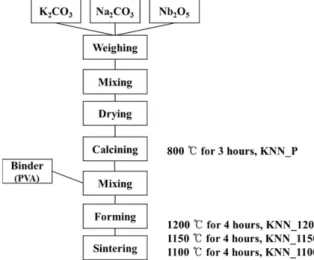
였다. 이 실험에서 사용한 제조 방법의 흐름도를 그 림 1에 나타냈다. 각각의 소결 온도에 따라 KNN_1200, KNN_1150, KNN_1100로 표시한다. 전 기적 특성을 측정하기 위하여 소결체의 두께를 약 1 mm로 연마한 다음 시편 양면에 Ion sputter (HITACHI, E-1045 ION Sputter)를 이용하여 Pt 전 극을 부착 하였다. 온도에 따른 유전특성을 분석하 기 위해 LCR meter (HP, 2484A)를 사용하여 측정 하였다. 시편 단면 형상을 분석하기위해 제조된 샘 플을 파쇄 후 파쇄된 단면을 Field emission scanning electron microscopy (FE-SEM, HITACHI, S-4300)을 이용하여 분석하였다. 또한 시편의 결정 성을 살펴 보기위해 시료를 분쇄 후 X-ray 회절장 치(XRD, Rigaku)을 이용하여 결정성을 확인 하였 다. 이때 측정 조건은 λ = 1.542 Å인 CuKα를 이용 하여 step size는 0.02o, 스캔 속도는 2o/min, 회절각 (2θ) 10~80o사이를 측정하였다.
3. 결과 및 고찰
그림 2는 KNN 샘플의 XRD 측정결과이다. 페로 브스카이트 구조를 가진 KNN이 제조되었음을 확 인 할 수 있었다(JCPDS card No.77-0038). 순수한 KNN 세라믹의 결정상은 상온에서 사방정계를 보 이며, 200oC 부근에서 사방정계에서 정방정계로 상 전이(TO-T)하고, 400oC 부근에 Tc가 있다고 알려져 있다. 그림 3은 KNN 샘플의 소결 온도에 따른 미 세구조 표면 형상이다. KNN_1200 샘플의 평균 결 정립 크기는 8.87 μm, KNN_1150의 경우 2.33 μm, KNN_1100의 경우 1.34 μm로 측정 되었다. 결정립 의 크기는 선형분석법(Linear intercept method)을 사 용하여 측정 하였다. 소결 온도가 증가 할수록 평 균 결정립의 크기는 증가하는 것을 확인 할 수 있
Fig. 1. Flow chart showing the process for manufacturing KNN ceramics.
Fig. 2 XRD patterns of KNN ceramics and calcining
powder.
Fig. 3 FE-SEM images of KNN ceramics. (a) KNN_1200, (b) KNN_1150 and (c) KNN_1100.
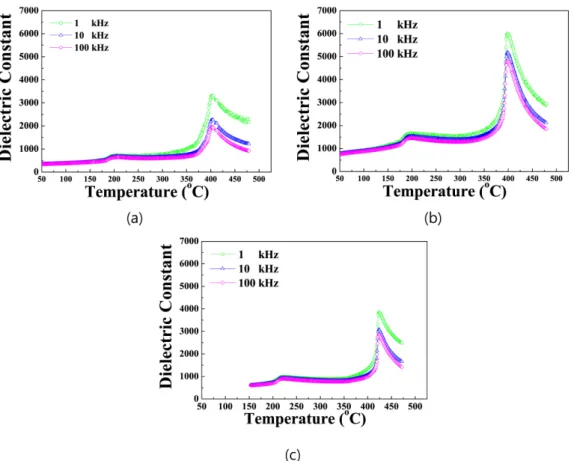
Fig. 4 Temperature dependence of the dielectric constant for KNN ceramics. (a) KNN_1200, (b) KNN_1150 and (c)
KNN_1100.
었고, KNN_1200의 경우 결정립 주변의 기공도 같 이 증가한 것을 확인 할 수 있었다. 완성된 시편 내 부의 기공은 유전율을 감소시키는 결점으로 작용한 다. KNN_1150와 KNN_1100의 경우 치밀한 구조와 균일한 형태의 결정립을 가지는 것을 확인 할 수 있었다.
그림 4는 소결된 KNN 세라믹의 온도와 측정 주 파수에 따른 유전상수를 나타낸다. 측정시 가열 속 도는 2oC/min으로 하였고, DC-bias를 제거한 상태 에서 전기용량을 측정 하였다. 측정 온도 단위는 1oC로 하였고, 각각의 주파수 1, 10, 100 kHz에서 전기용량을 측정 하였다. 가열시 KNN_1200의 Tc는 1 kHz에서 402.9oC, KNN_1150은 398oC, KNN_1100 는 424.1oC로 측정 되었다. 또한 TC에서의 유전상수 는 1 kHz에서 KNN_1200의 경우 3317, KNN_1150 의 경우 6011, KNN_1100의 경우 3850로 측정 되 었다. 일반적으로 유전체 세라믹에서 유전율은 결 정립의 크기와 밀도에 영향을 받는 것으로 알려져 있다. 특히 충분히 작은 1 ~ 10 μm의 결정립의 경 우 결정립 크기와 전기적 특성은 비례관계에 있다 고 알려져 있다[19-20]. KNN_1200의 경우 KNN_1100와 KNN_1150에 비해 큰 결정립의 가지 고 있지만 치밀하지 못한 구조와 불균일한 결정립 크기, 형태의 영향으로 비교적 낮은 유전 상수를 가 지는 것으로 생각 된다. KNN_1150의 경우 가장 높 은 유전 상수를 가지는 것으로 측정 되었는데 이는 치밀한 구조와 결정립의 크기가 균일하며 KNN_1100 보다 큰 결정립2.33 μm을 가지고 있기 때문으로 사 료된다. 상전이 온도 TO-T는 KNN_1200에서 201oC, KNN_1150에서 191oC, KNN_1100에서 224oC로 측정 되었다. 이때의 유전상수는 각각 790.3, 1717.1, 1063.4으로 측정 되었다. 소결된 KNN 샘플의 경우 Tc 이전에는 온도가 증가함에 따라 유전상수가 증 가하는 경향을 보이고, Tc 이후에는 유전상수가 감 소하는 경향을 보인다. 이는 강유전체의 전형적인 특성이다. KNN 시료의 표면 형상과 유전상수를 측 정한 결과 가장 시료를 제작하기 적당한 온도는 1150oC 부근으로 사료된다.
4. 결 론
본 연구에서는 (K0.5Na0.5)NbO3 형태의 세라믹 강 유전체를 고상반응법을 이용하여 제조하고 특성을 살폈다. XRD분석 결과 페로브스카이트 구조를 가 지는 KNN 세라믹이 형성되었음을 확인 할 수 있 었고, SEM 측정 결과 각각의 소결 조건에 따른 KNN_1200, KNN_1150, KNN_1100 샘플의 평균
결정립 크기는 8.87 μm, 2.33 μm, 1.34 μm로 측정 되었다. 1150, 1100oC에서 4시간 동안 소결 처리한 KNN_1150, KNN_1100의 경우 치밀하고 균일한 구 조를 가지는 것을 확인 할 수 있었다.
소결된 KNN_1200, KNN_1150, KNN_1100 샘플 의 Tc에서의 각각의 유전상수는 1 kHz에서 3317, 6011, 3850으로 측정 되었고, 이때의 Tc는 402.9oC, 398oC, 424.1oC로 측정되었다. 가장 높은 유전적 특성을 가지는 소결체는 KNN_1150으로 1150oC에 서 4시간동안 소결한 샘플로 확인 할 수 있었다.
위의 결과로부터 1150oC에서 4시간 동안 소결 처 리한 샘플의 경우 가장 우수한 유전적 특성과 균일 하며 치밀한 구조를 가지는 것을 확인 할 수 있었 고, 소결 조건을 변화시켜 본다면 더 좋은 특성을 가지는 KNN 세라믹 강유전체를 제조 할 수 있을 것으로 사료된다.
References