• 검색 결과가 없습니다.

Influence of Rapid Thermal Annealing on the Opto-Electrical Performance of Ti-doped Indium Oxide Thin Films

N/A
N/A
Protected

Academic year: 2021

Share "Influence of Rapid Thermal Annealing on the Opto-Electrical Performance of Ti-doped Indium Oxide Thin Films"

Copied!
4
0
0

로드 중.... (전체 텍스트 보기)

전체 글

(1)

306

한국표면공학회지 J. Korean Inst. Surf. Eng.

Vol. 52, No. 6, 2019.

https://doi.org/10.5695/JKISE.2019.52.6.306

<연구논문>

ISSN 1225-8024(Print) ISSN 2288-8403(Online)

Influence of Rapid Thermal Annealing on the Opto-Electrical Performance of Ti-doped Indium Oxide Thin Films

Su-Hyeon Choe and Daeil Kim

*

School of Materials Science and Engineering, University of Ulsan, Ulsan 44610, Korea (Received 15 October, 2019 ; revised 18 November, 2019 ; accepted 25 November, 2019)

Abstract

Titanium (Ti) doped indium oxide (In

2

O

3

) films were deposited on glass substrates by RF magnetron sput- tering and the films were rapid thermal annealed at 100, 200, and 300

o

C, respectively to investigate the influence of the rapid annealing on the opto-electrical performance of the films. The grain size of In

2

O

3

(222) plane increased with annealing temperatures and their electrical resistivity decreased to as low as 8.86×10

-4

Ω cm at 300

o

C. The visible transmittance also improved from 77.1 to 79.5% when the annealing temperature increased. The optical band gap of the TIO films shifted from 4.010 to 4.087 eV with increases in annealing temperature from room temperature to 300

o

C. The figure of merit shows that the TIO films annealed at 300

o

C had better optical and electrical performance than the other films prepared using lower-temperature or no annealing.

Keywords: TIO, Magnetron sputtering, XRD, AFM, Figure of merit,

1. Introduction

Recently, Ti doped In

2

O

3

(TIO) films [1] have attracted much attention for their potential application in various opto-electronic devices such as transparent thin film transistors due to their higher electrical mobility than conventional Sn-doped In

2

O

3

(ITO) [2].

Various deposition methods have been applied to deposit high quality TIO films, including magnetron sputtering [3] and pulsed laser deposition [4]. Among the various deposition methods, RF magnetron sputtering is the most widely used due to its ability to assure uniformity of the composition and thickness over a relatively large area.

However, it is known that transparent conductive oxide films prepared at room temperature by RF magnetron sputtering have relatively low visible transmittance and high electrical resistivity [5,6].

Thus, the optical and electrical properties of conventional TIO films deposited at room temperature do not meet the typical opto-electrical demands of various display applications. In a previous study, D. Kim investigated the effect of substrate temperatures on the properties of 480 nm thick TIO films deposited on glass substrates [3].

In this study, TIO thin films deposited by RF magnetron sputtering were rapid thermal annealed and the influence of annealing temperature on the films’

structural, electrical, and optical properties were investigated by means of X-ray diffraction (XRD), UV- visible spectrometer, Hall measurements, and atomic force microscope (AFM), respectively.

2. Experimental Part

100 nm thick TIO films were deposited at room temperature on glass substrates (Corning 1797, 30×30 mm

2

) by RF magnetron sputtering with a TIO target (Ti:In

2

O

3

= 5:95 At%; 99.99% purity). Prior to each deposition, the chamber was evacuated to 5×10

-7

Torr. Table 1 shows the experimental conditions used

* Corresponding Author: Daeil Kim

School of Materials Science and Engineering, University of Ulsan, Ulsan 44610, Korea

Tel: +82-52-712-8066 ; Fax: +82-52-712-8045

E-mail: [email protected]

(2)

Su-Hyeon Choe et al./J. Korean Inst. Surf. Eng. 52 (2019) 306-309 307

for this study.

After deposition, the films were rapid thermal annealed at 1×10

-3

Torr for five minutes at 100, 200, and 300

o

C, respectively. To prevent thermal deformation of the glass substrates, the maximum annealing temperature was calibrated at 300

o

C. The film thickness was confirmed using a surface profilometer (Detak 500, Veeco) and the root mean square (RMS) roughness of the films was analyzed by means of AFM (XE-100, Park Systems). The crystallization of the films was observed with high- resolution XRD (X’Pert Pro MRD, Philips) using Cu-Kα (0.154 nm) radiation at the Korea Basic Science Institute (KBSI), Daegu center. The visible transmittance and electrical properties of the films rapid annealed at different temperatures were observed with a UV-visible spectrometer (Cary100 Cone, Varian) and Hall measurement system (HMS-3000 Ecopia), respectively. The opto-electrical performance of the films as transparent conducting films was evaluated using the figure of merit (FOM) [7].

3. Results and Discussion

Fig. 1 shows the XRD patterns obtained from the as-deposited TIO films, and from the TIO films that were subjected to rapid annealing at 100, 200, and 300

o

C. In Fig. 1, the films show some diffraction peaks corresponding to the (222), (400), (431), (440), (444) planes of In

2

O

3

films and (004), (111), (211) planes of TiO

2

, respectively. The full width at half maximum of the In

2

O

3

(222) peak decreased with increasing annealing temperature, meaning that increasing the temperature enhanced the films’

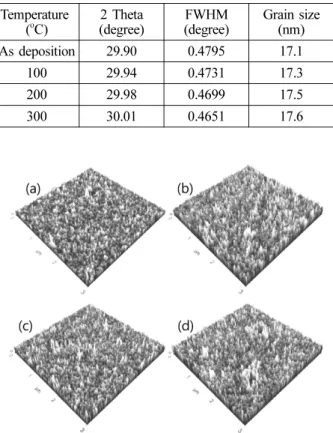
crystallization. Table 2 lists the grain sizes of the films as evaluated using Scherer’s formula [8]. The films annealed at 300

o

C show the largest grain size of 17.6 nm as measured on the In

2

O

3

(222) plane.

In Fig. 2, AFM images of the as-deposited and annealed TIO films show that the surface roughness Table 1. Experimental condition of TIO thin film

deposition.

Base pressure (Torr) 5.0 × 10

-7

Deposition pressure (Torr) 1.0 × 10

-3

RF Power (W/cm²) 2.5

Ar gas flow rate (sccm) 10 Deposition rate (nm/minute) 30

Film thickness (nm) 100

Annealing pressure (Torr) 1.0 × 10

-3

Annealing time (minute) 5

Temperature (

o

C) 100, 200, 300

Fig. 1. The XRD pattern of the TIO films annealed at different temperatures. (a) As deposition, (b) Annealed films at 100

o

C, (c) Annealed films at 200

o

C, (d) Annealed films at 300

o

C.

Table 2. Variation of grain size of In

2

O

3

(222) plane as a function of annealing temperature.

Temperature (

o

C)

2 Theta (degree)

FWHM (degree)

Grain size (nm) As deposition 29.90 0.4795 17.1

100 29.94 0.4731 17.3

200 29.98 0.4699 17.5

300 30.01 0.4651 17.6

Fig. 2. Surface morphology (scan area; 3×3 μm

2

) and RMS roughness of the TIO films annealed at different temperatures. (a) As deposition, RMS roughness;

0.63 nm, (b) Annealed films at 100

o

C, RMS

roughness; 0.66 nm, (c) Annealed films at 200

o

C,

RMS roughness; 0.72 nm, (d) Annealed films at

300

o

C, RMS roughness; 0.74 nm.

(3)

308 Su-Hyeon Choe et al./J. Korean Inst. Surf. Eng. 52 (2019) 306-309

increased with annealing temperature. As deposited films show the RMS roughness of 0.63 nm, while the films annealed at 300

o

C show a higher RMS roughness of 0.74 nm. This increasing surface roughness is attributed to the grain growth of the films, already observed from the XRD patterns.

Fig. 3 shows the visible regions of the optical transmittance spectra collected for the as-deposited and the annealed TIO films. The bare glass substrates show 92% of optical transmittance. The average transmittance of the as-deposited films was approximately 77.1% and the film annealed at 300

o

C had optical transmittance of 79.5%. This means that annealing increased the visible transmittance of the films.

Table 3 shows the dependence of the electrical properties upon the annealing temperature. As the annealing temperature increased from room temperature to 300

o

C, resistivity decreased from 2.95×10

-3

to 8.86×10

-4

Ω cm due to increases in mobility and carrier density.

Based on the XRD patterns and the results presented in Table 2, it is supposed that the observed

decreases in resistivity with increasing annealing temperatures occurred because of grain growth, because grain growth reduces the density of grain boundary, which acts as a trap for the charge carrier and as a barrier to carrier movement.

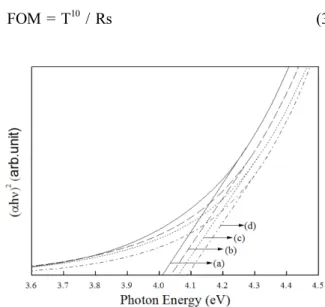
Fig. 4 shows plots of (αhν)

2

versus photon energy for the TIO films [9]. The optical absorption coefficient (α) can be calculated from the following relation [10]:

α = (1/d) ln (1/T) (1)

wherein d is the film thickness and T is the visible transmittance. The relation between the optical absorption coefficient and the optical band gap (E

g

) is given by the Tauc formula [11]:

(αhν)

2

= A(hν-E

g

) (2)

wherein hν is the energy of the incident photons and A is the absorption edge width parameter. Table 4 lists the optical band gaps of the TIO films annealed at various temperatures. All annealed films had wider optical band gaps than the as-deposited films. The optical band gap of the TIO films shifted from 4.010 to 4.087 eV with increases in annealing temperature from room temperature to 300

o

C.

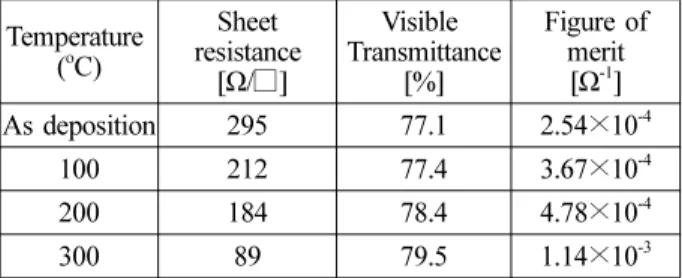
The FOM is an valuable index used to evaluate the performance of transparent conductive oxide films [7]. The FOM is defined as

FOM = T

10

/ Rs (3)

Fig. 3. The visible transmittance spectra for the as- deposited and the annealed TIO films. (a) As deposition, (b) Annealed films at 100

o

C, (c) Annealed films at 200

o

C, (d) Annealed films at 300

o

C.

Table 3. Electrical properties of the TIO films as a function of annealing temperature.

Temperature (

o

C)

Carrier density (cm

-3

)

Mobility (cm

2

/Vs)

Resistivity (Ω cm) As deposition 9.82×10

19

21.58 2.95×10

-3

100 1.31 ×10

20

23.59 2.12 ×10

-3

200 1.44 ×10

20

23.98 1.84 ×10

-3

300 2.52×10

20

26.87 8.86×10

-4

Fig. 4. Plots of (αhν)

2

as a function of hν for TIO films

annealed at different temperatures. The extrapolation

of the linear region to hν = 0 to determine optical band

gap (E

g

) values is as indicated with lines. (a) As

deposition, (b) Annealed films at 100

o

C, (c) Annealed

films at 200

o

C, (d) Annealed films at 300

o

C.

(4)

Su-Hyeon Choe et al./J. Korean Inst. Surf. Eng. 52 (2019) 306-309 309

wherein T is the film’s optical transmittance in the visible region, and Rs is the film’s sheet resistance.

Table 5 lists the FOMs of the TIO films annealed at various temperatures. The maximum FOM of 1.14×10

-3

-1

was observed for the films annealed at 300

o

C. Since a higher FOM indicates better optical and electrical performance of the transparent conductive oxide film, TIO films rapid annealed at 300

o

C would perform better than the films annealed at lower temperatures in this study.

4. Conclusion

TIO thin films were deposited onto unheated glass substrates by RF magnetron sputtering and then rapid thermal annealed at 100, 200, and 300

o

C. The full width at half maximum of the In

2

O

3

(222) peak

decreased with increasing annealing temperature, indicating that hotter annealing enhanced the films’

crystallization. The films annealed at 300

o

C showed a lower resistivity of 8.86×10

-4

Ω cm and a higher visible transmittance of 79.5%, respectively. Based on the observed results, it can be concluded that post-deposition rapid thermal annealing at optimized temperature enhances the optical and electrical properties of the as-deposited TIO films.

References

[1] R. K. Gupta, K. Ghosh, S. R. Mishra, P. K. Kahol, Mater. Lett., 62 (2008) 1033.

[2] A. Ali, Z. Hassan, A. Shuhaimi, Appl. Surf. Sci., 443 (2018) 544.

[3] D. J Kim, B. Kim, H. K. Kim, Thin solid films, 547 (2013) 225.

[4] R. K. Gupta, K. Ghosh, S. R. Mishra, P. K. Kahol, Appl. Surf. Sci., 253 (2007) 9422.

[5] Y. M. Kong, M. K. Kim, D. Kim, Korean J. Met.

Mater., 52 (2014) 233.

[6] P. Prepelita, V. Craciun, F. Garoi, and A. Staicu, Appl. Surf. Sci., 352 (2015) 23.

[7] G. Haacke, New figure of merit for transparent conductors, J. Appl. Phys., 47 (1976) 4086.

[8] Y. S. Kim, J. Y. Choi, Y. J. Park, S. H. Choe, Y. M. Kong, D. Kim, Korean J. Met. Mater., 57 (2019) 324.

[9] Y. Wang, W. Tang, L. Zhang, and J. Zhao, Thin Solid Films, 563 (2014) 62.

[10] X. Yin, W. Tang, X. Weng, and L. Deng, J. Phys.

D: Appl. Phys., 42 (2009) 025104.

[11] J. Tauc, Amorphous and liquid semiconductors, Plenum, New York (1974).

Table 4. The optical band gap of TIO films as a function of annealing temperature.

Temperature (

o

C) Optical band gap energy (eV)

As deposition 4.013

100 4.034

200 4.057

300 4.087

Table 5. The FOM values for TIO films annealed at different temperatures.

Temperature (

o

C)

Sheet resistance

[Ω/ □]

Visible Transmittance

[%]

Figure of merit

[Ω

-1

] As deposition 295 77.1 2.54 ×10

-4

100 212 77.4 3.67×10

-4

200 184 78.4 4.78×10

-4

300 89 79.5 1.14 ×10

-3

수치

Table 2. Variation of grain size of In 2 O 3  (222) plane as a function of annealing temperature
Table 3 shows the dependence of the electrical properties upon the annealing temperature
Table 4. The optical band gap of TIO films as a function of annealing temperature.

참조

관련 문서

at the Specific Conditions of Sputtering Power in the Preparation of CoSi 2 Thin Films by Using the Sputtering Method ……… 88 Fig.. 44 Carrier Concentration and Mobility of the

international exchange of South Korean films, korean films in the 2000s, korean domestic international film festivals, korean films in overseas film

This research further enriches the previous research on the influencing factors of employee organizational commitment and OCB, which help Chinese companies

Lee, “Effective Ag Doping by He-Ne Laser Exposure to Improve the Electrical and the Optical Properties of CdTe Thin Films for Heterostructured Thin Film

Improvement of the Performance and Stability of Oxide Semiconductor Thin-Film Transistors Using Double-Stacked Active Layers.. Metal oxide semiconductor

Laser-induced doping of amorphous copper diselenide (α-CuSe 2 ) thin film with gallium (Ga) and indium (In) was performed to control/improve their electrical

1 John Owen, Justification by Faith Alone, in The Works of John Owen, ed. John Bolt, trans. Scott Clark, &#34;Do This and Live: Christ's Active Obedience as the

Surface characteristics and structure of anodic oxide films containing Ca and P on a titanium implant material.. Preperation of bioactive metal via anodic