1. Introduction
In English, prosodic prominence (or pitch accents) is associated with several acoustic cues, such as duration, F0, intensity, and spectral emphasis (Beckman, 1986; Breen et al., 2010; Cole et al., 2010, among others). Prominence is assigned to words deliver- ing the semantic or pragmatic meaning of a word in discourse context (Pierrehumbert & Hirschberg, 1990). It tends to occur on content words since they often convey information about what and who are being discussed in discourse. Function words can also be landing locations of prominence if they are under contras-
tive focus. In Autosegmental-Metrical Theory (Liberman, 1975;
Pierrehumbert, 1980), the rightmost content word in a prosodic phrase (i.e., intermediate phrase) carries the nuclear pitch accent.
In other words, only one pitch accent is obligatory in an inter- mediate phrase. More than one pitch accent is optional and can occur depending on rhythm, information status, or focus in dis- course context. Hirschberg (1993) examined the distribution of pitch accents in relation to word classes, information status, and focus in various English corpora. She found that pitch accent assignment is most predicted by the parts-of-speech of a word.
Information status is not a strong factor for predicting the
* [email protected], Corresponding author
Received 30 July 2019; Revised 15 November 2019; Accepted 11 December 2019
ⓒ Copyright 2019 Korean Society of Speech Sciences. This is an Open-Access article distributed under the terms of the Creative Commons Attribution Non- Commercial License (http://creativecommons.org/licenses/by-nc/4.0) which permits unrestricted non-commercial use, distribution, and reproduction in any medium, provided the original work is properly cited.
pISSN 2005-8063 eISSN 2586-5854 2019. 12. 31.
Vol.11 No.4 pp. 1-8
말소리와 음성과학
https://doi.org/10.13064/KSSS.2019.11.4.001
Word class information in perception of prosodic prominence by Korean learners of English
Suyeon Im
*Department of Chinese and Bilingual Studies, The Hong Kong Polytechnic University, Hong Kong SAR
Abstract
This study aims to investigate how prosodic prominence is perceived in relation to word class information (or parts- of-speech) by Korean learners of English compared with native English speakers in public speech. Two groups, Korean learners of English and native English speakers, were asked to judge words perceived as prominent simultaneously while listening to a speech. Parts-of-speech and three acoustic cues (i.e., max F0, mean phone duration, and mean intensity) were analyzed for each word in the speech. The results showed that content words tended to be higher in pitch and longer in duration than function words. Both groups of listeners rated prominence on content words more frequently than on function words. This tendency, however, was significantly greater for Korean learners of English than for native English speakers.
Among the parts-of-speech of the content words, Korean learners of English were more likely than native English speakers to judge nouns and verbs as prominent. This study presents evidence that Korean learners of English consider most, if not all, content words as landing locations of prosodic prominence, in alignment with the previous study on the production of prominence.
Keywords: Korean learners of English, parts-of-speech, prosodic prominence, word classes
distribution of pitch accents. Although the parts-of-speech are the strongest factor accounting for pitch accent assignment in the corpora, this does not imply that content words are one- to-one mapped with pitch accents. In the same study, Hirschberg stated that direct mapping between pitch accents and content words is not felicitous and would result in unnatural sounding utterances.
The complex relation between prominence and linguistic factors (e.g., parts-of-speech, rhythm, discourse meaning) may raise difficulties in learning prosody for Korean learners of English (Im, 2019; Lee et al., 2017; Um et al., 2001, among others). Im (2019) investigated the perception of prominence by Korean learners of English and native English speakers.
Participants were asked to rate prominence while listening to a speech in real time. Results showed that Korean learners of English rated prominence similarly with native English speakers in relation to the referential, lexical, and contrastive meanings of a word in the speech, but the two groups of speakers differed in that Korean learners of English were more likely to mark prominence on lexically given words. This tendency seems to be related to the parts-of-speech of the lexically given words.
All the lexically given words were content words in the speech.
Um & her colleagues (2001) examined the production of pitch accents by Korean learners of English compared with native English speakers. Both groups of speakers were asked to read aloud question-answer pairs of sentences. Results showed that native English speakers produced prominence on few content words carrying new information or focus. Native English speakers tended not to assign prominence on repeated expressions or on new expressions where the preceding expressions were accented (i.e., prominence clash condition). Korean learners of English, however, were found to differ from native English speakers.
Korean learners of English assigned prominence on every content word and some function words (e.g., I, you, they), regardless of the givenness or rhythm in utterances.
The previous study above suggests that Korean learners of English privilege content words as landing locations of pro- minence, especially in their production, but it is still unclear how Korean learners of English have established such a relationship between prominence and content words. It is possible that Korean learners of English perceive all the content words as prominent, which leads to the one-to-one association between prominence and content words in their production. Or, it is possible that Korean learners of English perceive prominence on few content words, similarly with native English speakers, but they produce prominence on all the content words, differently from native English speakers. These questions cannot be add- ressed sufficiently by the production data only and lead us to consider perception data for a better understanding of the mapping between prominence and content words among Korean learners of English.
The current study investigates the perception of prosodic prominence by Korean learners of English compared with native English speakers in relation to word class information in a speech.
Both groups of speakers judged prosodic prominence while listening to the speech in real time. Parts-of-speech and three acoustic cues (max F0, mean phone duration, and mean intensity) were obtained for each word in the speech. The three acoustic cues were included in the analysis to control their potential influ-
ence on perceived prominence. The current study asks whether Korean learners of English perceive prominence as a function of word classes similarly with native English speakers and attempts to provide an explanation for the association between prominence and content words in the productions of Korean learners of English observed in the previous study.
2. Method
2.1. Speech Material
The speech material was a TED talk entitled “Try something new for thirty days” (Cutts, 2011) delivered by a male speaker of American English in a clear and engaging manner (361 words, t=2’ 25”). The speech material was selected because it is a clear speech covering a non-technical topic. Korean learners of English might have difficulties in understanding a conver- sational (reduced) speech or a speech with technical topics (e.g., lectures, political speeches), which might influence their per- ceptual judgments of prominence. For these reasons, a clear speech with a non-technical topic was considered as the ideal speech material for perception experiments.
2.2. Perception Experiment
In perception experiments, thirty-five native English speakers (23 females and 12 males, mean age 24.3) and thirty native Korean speakers (26 females and 4 males, mean age 20.6) were asked to select words perceived as prominent while listen- ing to the speech online (Rapid Prosody Transcription; Cole et al., 2010). The native English speakers were undergraduate or graduate students at a midwestern university in the U.S. The native Korean speakers were undergraduate students majoring in English at a university in Seoul in Korea and advanced learners of English (average TEPS scores 820 over 990).
Advanced learners of English were considered because they were expected to show few difficulties in understanding the meanings of utterances, which might influence their perceptual judgments of prominence.
In the experiments, prominent words were described as the
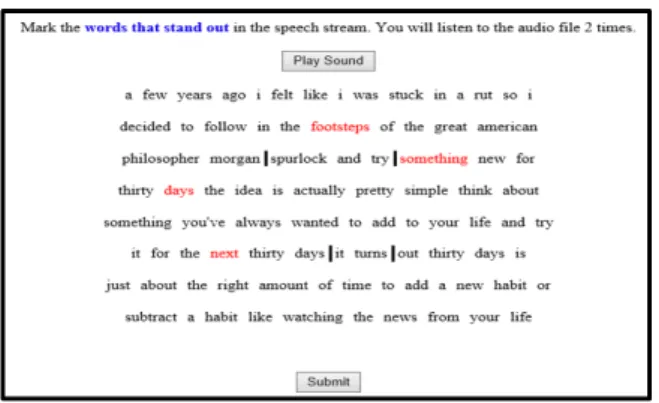
“words that stand out in the speech stream by virtue of being louder, longer, more extreme in pitch, or more crisply articulated than other words in the same utterance.” Participants were able to listen to the speech twice. They were provided with a transcript of the speech presented without punctuation and capitalization on an online interface (Language Markup and Experimental Design Software; Mahrt, 2013), as shown in Figure 1. Punctu- ation and capitalization were removed because they indicate the syntactic boundaries of utterances and might influence listeners’
judgments of prominence.
Figure 1. Screen capture of the perception experiments on the online interface. Listeners were able to select words perceived as prominent (shown in red) or click spaces between words considered as being prosodic
boundaries (shown in black bars). The results on the perceived prosodic boundaries are not discussed in the current study.
2.3. Parts-of-speech
Parts-of-speech were annotated for each word using Penn Treebank P.O.S. tags (Taylor et al., 2003). Adjectives, adverbs, conjunctions, determiners, interjections, modals, nouns, numbers, prepositions, pronouns, and verbs were obtained from the speech.
They were categorized into content words (adjectives, adverbs, nouns, numbers, and verbs) versus function words (conjunctions, determiners, interjections, modals, prepositions, and pronouns).
2.4. Acoustic Cues
Three acoustic cues, max F0 (Hz), duration (ms), and mean intensity (dB), were obtained for each word using ProsodyPro (Xu, 2013). Mean phone duration was calculated by dividing the entire duration of a word by the number of phones consisting of the word. The three acoustic cues of each word were z- normalized (centered and scaled) using the mean and standard deviation of the words in the entire speech. Max F0, mean phone duration, and mean intensity will be referred to as F0, duration and intensity, respectively.
2.5. Analyses
A generalized linear mixed-effects model was run using the lme4 package (Bates et al., 2015) in R (R Core Team, 2019).
The listeners’ binary judgment of perceived prominence (1 for the words perceived as prominent and 0 for the words per- ceived as non-prominent) was modeled in relation to L1 groups (native English speakers and Korean learners of English), word classes (function words and content words), three acoustic cues (F0, duration, and intensity), the interaction between L1 groups and word classes, the interactions between L1 groups and three acoustic cues, and the interactions between word classes and three acoustic cues. Participants were submitted as random effects.
Note that the three acoustic cues and their interactions with L1 groups or word classes were included as control variables to tease apart the effects of the acoustic cues from those of the L1 groups or word classes on the perceived prominence in the statistical analysis.
For further analysis, prominence (p-) scores (Cole et al., 2010) were obtained to visualize the perceived prominence of each word by the two L1 groups. The p-scores were calculated by dividing the sum of prominence responses for a word by the
total number of participants in each L1 group. It ranges from 0 to 1, where 1 indicates that all the listeners have rated the word as salient, while 0 means that none of the listeners have done so. The p-scores will be discussed informally only.
2.6. Predictions
It is expected that Korean learners of English judge promi- nence on content words more frequently than do native English speakers. Korean learners of English, however, would not differ from native English speakers in rating prominence on function words. The reasoning is that in the previous study (Um et al., 2001), Korean learners of English were found to be more likely to produce prominence on content words than native English speakers. The difference in assigning prominence on function words was small between the two groups of speakers. Considering these findings from the previous production study, similar pre- dictions were made in the current perception study.
3. Results
In Section 3.1., the current study examines how word class information is phonetically encoded by the speaker in this speech.
In section 3.2., the present study describes the results from the perception experiments on how word class information influences the judgments of prominence by Korean learners of English com- pared with native English speakers.
3.1. Phonetic Encoding of Word Classes
In this speech, word class information is found to be weakly associated with phonetic cues. Word classes are presented in relation to F0 of a word in Figure 2, duration in Figure 3, and intensity in Figure 4. Across Figures 2–4, there are overlaps of phonetic values between content words (left boxplot) and function words (right boxplot), although F0 and duration tend to be higher for content words than function words in Figures 2 and 3, respectively. Put differently, in this TED talk, content words are produced with higher pitch and longer duration, but not stronger intensity, than function words, although the differ- ences in pitch and duration are small between content versus function words.
Figure 2. Relation between word classes and F0 of a word in this speech. The F0 of content words are shown on the left, and that of function words are on
the right.
Figure 3. Relation between word classes and duration.
Figure 4. Relation between word classes and intensity.
3.2. Perceived Prominence
The results from the perception experiments show that Korean learners of English differ from native English speakers in judging prominence in relation to word classes. Figure 5 describes promi- nence scores by native English speakers (red) and Korean learners of English (blue) for one of the utterances analyzed in this study, “so, I decided to follow in the footsteps of great American philosopher, Morgan Spurlock, and try something new for thirty days.”
Figure 5. Prominence scores for one of the utterances analyzed in this study by native English speakers (red) and Korean learners of English (blue).
In Figure 5, both groups of speakers rate prominence infre- quently on function words such as “so,” “I,” “to,” “in,” “the,”
“of,” “and,” and “for” in the utterance. However, Korean learners of English tend to judge prominence more frequently than native English speakers on most content words, for example, “decided,”
“follow,” “footsteps,” “philosopher,” “try,” “thirty,” and “days.”
This suggests that there are differences between the two L1 groups in rating prominence on content words in this speech.
Table 1 presents the results from the generalized linear mixed- effects model, where listeners’ prominence judgment was modeled in relation to L1s, word classes, acoustic cues, and their interac- tions.
Table 1. Estimated effects of L1 groups, word classes, acoustic cues, and interactions on perceived prominence
Variable est. SE z p-value
(intercept) –2.63 0.10 –25.46 <0.01**
L1 groups
Korean 0.15 0.15 0.99 0.32
word classes
content word 1.29 0.06 20.38 <0.01**
acoustic cues
F0 0.39 0.04 9.30 <0.01**
duration 0.84 0.04 20.12 <0.01**
intensity 0.11 0.05 2.43 <0.05*
L1 groups: word classes
Korean: content word 0.62 0.09 7.15 <0.01**
word classes: acoustic cues
content word: F0 0.15 0.04 3.38 <0.01**
content word: duration –0.19 0.04 –4.36 <0.01**
content word: intensity –0.22 0.05 –4.59 <0.01**
L1 groups: acoustic cues
Korean: F0 0.11 0.04 2.66 <0.01**
Korean: duration –0.11 0.04 –2.85 <0.01**
Korean: intensity –0.14 0.04 –3.08 <0.01**
In Table 1, L1 groups are not a significant factor in esti- mating perceived prominence. This means that the two groups of speakers do not significantly differ in making overall judg- ments of prominence. Word classes and the three acoustic cues are significant factors in estimating prominence judgment, which suggests that these are important factors for listeners in rating prominence in this speech. There is a significant interaction between L1 groups and word classes in the model. This means that Korean learners of English significantly differ from native English speakers in rating prominence between content versus function words. Also, the interactions between word class infor- mation and acoustic cues are significant, suggesting that acoustic cues influence listeners’ prominence judgments differently between content words versus function words. Finally, the interactions between L1 groups and acoustic cues are significant in the model, which means that the L1 groups differ in relying on acoustic cues while making prominence judgments.
Figure 6 is a visualization of the estimated effects of the
interaction between L1 groups and word classes on perceived pro-
minence. The x-axis is word classes, and the y-axis is estimated
effects of word classes on prominence judgments by native
English speakers (left panel) and Korean learners of English
(right panel).
Figure 6. Estimated effects of word classes on prominence ratings by native English speakers (left panel) and Korean learners of English (right panel).
In Figure 6, the estimated effects of content words are higher than those of function words for both groups of speakers, but there are greater differences between content words versus function words for Korean learners of English than for native English speakers. This suggests that Korean learners of English are more likely to mark prominence on content words than function words compared with native English speakers, although both L1 groups favor content words as locations of perceived prominence.
Figures 7–9 show the estimated effects of F0, duration, and intensity of a word, respectively, on prominence ratings by native English speakers (left panel) and Korean learners of English (right panel). The x-axis is z-normalized acoustic values, and the y-axis is the estimated effects of acoustic values on perceived prominence.
Figure 7. Estimated influences of F0 on prominence judgment by native English speakers (left panel) and Korean learners of English (right panel).
Figure 8. Estimated effects of duration on prominence ratings by native English speakers and Korean learners of English.
Figure 9. Estimated influences of intensity on prominence judgments by native English speakers and Korean learners of English.
In Figure 7, the slope is greater for Korean learners of English than for native English speakers, suggesting that Korean learners of English are more likely than native English speakers to rate prominence if the F0 of a word increases. In other words, Korean learners of English tend to be more sensitive to changes in pitch than are native English speakers while judging promi- nence.
In Figure 8, the slope is greater for native English speakers than Korean learners of English, meaning that native English speakers are more likely to rely on duration than Korean learners of English in judgments of prominence.
In Figure 9, the slope is negative for both L1 groups. If the
intensity of a word increases, both L1 groups are less likely
to rate prominence. This is surprising because the increase of
intensity is expected to be associated with a greater likelihood
of perceived prominence. The results seem to be related to the
speech style of the speaker. The speaker tends to speak loudly
throughout the speech to address a large audience. Instead of
speaking more loudly, the speaker softens his voice to draw
the attention of the audience. Due to this speech style, both
L1 groups tend to rate prominence if the intensity of a word
decreases. In Figure 9, the slope is steeper for Korean learners
of English than for native English speakers, suggesting that
Korean learners of English are more sensitive to the changes
in intensity of a word than are native English speakers while rating prominence.
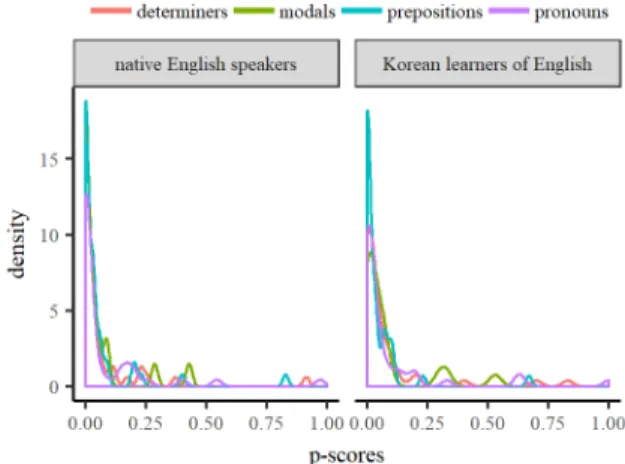
For further analysis, the relation between the parts-of-speech of a word and prominence scores is examined. Figure 10 shows the parts-of-speech of the content words while Figures 11–12 describe those of the function words. The distinction between Figure 11 and Figure 12 is made for display purposes only. Across Figures 10–12, the x-axis is prominence scores obtained from native English speakers (left panel) and Korean learners of English (right panel). The y-axis is the distribution of the data.
Color-coded lines represent different parts-of-speech.
Figure 10. Prominence scores in relation to parts-of-speech of content words, adjectives (red), adverbs (green), nouns (blue), and verbs (purple). The scores for native English speakers are shown in the left panel, and those for
Korean learners of English are in the right panel.
Figure 11. Prominence scores regarding parts-of-speech of function words, determiners (red), modals (green), prepositions (blue), and pronouns
(purple).
Figure 12. Prominence scores for other parts-of-speech of function words, conjunctions (red) and interjections (blue).