파지 예비형상과 물체원형 정보를 활용한 세손가락 로봇손의 파지경로계획
Grasp Planning for Three-Fingered Robot Hands using Taxonomy-Based Preformed Grasp and Object Primitives
정 현 환1, 박 종 우1, 정 주 노2, 박 종 우3
Hyunhwan Jeong1, Jongwoo Park1, Joono Cheong2, Frank Chongwoo Park3
Abstract In this paper, we present a grasp planning method using grasp taxonomy and object primitives. Our grasp taxonomy includes newly defined grasp methods such as thumb supported pinch and palm supported pinch, to enhance grasp robustness. On the target surface, locations of finger-print that will be contacted by the robot fingers are sampled. The sampling is made to be consistent to the grasp taxonomy, called preformed grasps, matched to the target object. We perform simulations to examine the validity and the efficacy of the proposed grasp planning method.
Keywords : Grasp planning, Grasp taxonomy, Object primitive, Preformed grasps.
1. Introduction
Most robots in industry are using conventional jaw- grippers or specialized tools to handle objects without much consideration of grasp manipulation. These end- effector tools and simple on-off grippers farily limit the operations that prevent complicated and dexterous tasks.
To overcome such problems, multi-fingered robot hands like human being’s must be needed. The multi-fingered hands, however, leave us many difficulties such as how to find stable grasps quickly, what to be the optimal among them, or how to apply finger forces to achieve firm grasps without grasped objects being slipped off. These difficulties are mostly due to the fact that robot hands have many degrees of freedoms. For the analysis of grasp study, the concept of force-closure using wrench space and friction cone well-known. The condition of force- closure (i.e., contact forces must positively span the
external wrench [1]-[4]) was addressed by Salisbury and Roth [5].. Ferrari and Canny [6] proposed a computing algorithm for optimal grasp. Ponce and Faverjon [7]
developed the condition of force-closure for a three- fingered grasp to 2D objects and made an algorithm using Gaussian elimination. Ji and Roth [8] presented a method to analytically compute the optimized grasp using contact forces, and Li et al. [9] developed an efficient algorithm for obtaining force-closure conditions, and demonstrated three-fingered force-closure grasp on 2D and 3D examples. Contrary to the analytic approach, grasp study based on human grasp behaviors also has been attempted as well. And results from such experimental researches were applied to motion control of robotic hands.
Cutkosky and Wright [10] presented a taxonomy-based grasp classification and extended the result on geometric environment. A very nice tutorial on grasp taxonomies can be found in [11]. Another research topic on the study of multi-fingered grasp is to use objects and grasp primitives. Milleret al. [12] presented a method of automatic grasp planning based on shape primitives of grasped objects. Jorda[13] addressed taxonomy grasps which are learned from human’s grasp configurations using teleoperation.
※ 본 연구는 산업자원부 21 세기 프론티어 사업단 인간기능 생활 지원 지능로봇 기술개발사업 과제 지원으로 수행되었음.
1 고려대학교 제어계측공학과
([email protected], [email protected])
2 고려대학교 제어계측공학과 ([email protected]) -책임저자
3 서울대학교 기계항공공학부 ([email protected])
In this paper, we suggest a grasp method like what human beings are doing with extended grasp features to improve grasp stability. We classify types of human grasps on several shapes of objects often found in our daily lives. We prepare a database that contains a mapping of grasp taxonomy to object shape primitives.
Based on the mapping, when a target object is given, preferred grasp types are invoked, and we randomly select samples of finger-prints on the surface of the target object on which the fingers of the robot hand will make contact. While the sampling is generated on the object surface, the samples are always chosen to satisfy the matched grasp types. This will significantly reduce the computation time in finding the grasp configurations.
Also, we use the ray-shooting technique to analyze force-closure grasp and offer a quality measure for grasp stability.
The rest of the paper is organized as follows. In Section 2, we address a basic grasp theory. In addition, we introduce a grasp quality measure using ray-shooting.
And then, we present our grasp taxonomy on object shape primitive and finger-print sampling method in Section 3. Section 4 is devoted to simulation study, and Section 5 makes conclusion. We assume in this paper that the robot hand has three fingers similar to Barrett hands, and every related kinematic parameter is known.
2. Force-closure grasp and grasp measure
2.1 Force-closure
A contact between fingers and an object can be described as a mapping from fingers’ contact forces to object wrenches. Generally, there are three contact models: frictionless point contact, point contact with friction, and soft contact [1]. A frictionless point contact is used when there is no friction between the finger and the object at contact points. In this case, contact force is applied only to the normal direction to surface. A point contact with friction model is used when there exists a friction between the finger and the object surface. So contact forces can be applied to directions in 3D space starting at the contact point. A soft-finger model is more realistic contact model which gives not only the force on surface but also the torque to the normal direction.
However, because of difficulty in analysis and synthesis, often the point contact with friction model is preferred.
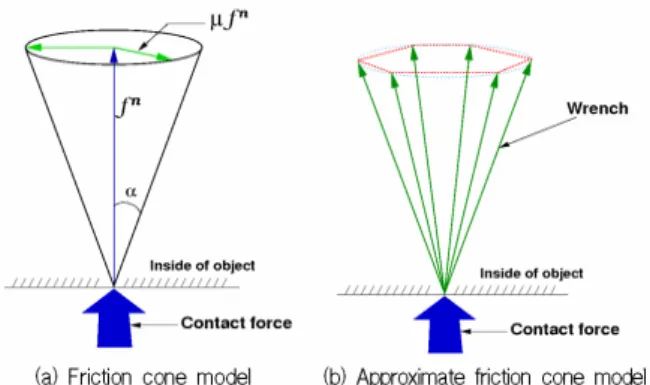
In the point contact with friction model, when a contact occurs between a finger and an object surface, friction cone is generated inwards of the surface at the contact point. The shape of friction cone is determined by
Fig. 1. 3D Model of friction cone
the amount of normal force at the contact point and contact materials. If we let fn be the normal force at the contact point, and ftis tangential force, we know that slipping is started when
n
t f
f >μ (1)
where μ >0 is the coefficient of friction, otherwise has the condition of non-slipping. Equation (1) can be represented geometrically, as shown in Fig.1(a), where the angle of friction cone is determined friction coefficientμ , such that
μ
α=tan−1 (2) Also, friction cone in 3D grasp are usually approximated as polyhedral cones with a finite number of sides, whose edges become wrench vectors as shown in Fig.1(b).
In a grasp with a multi-fingered hand, force equilibrium between contact forces and an arbitrary external force is described by
e
c F
Gf =− (Fe : external wrench) (3)
where G∈ℜp×m is the grasp map, fc∈FC(friction cone)⊂ℜm is the force from fingers and Fe∈ℜP is the external wrench. In order for this grasp to be a force- closure, column space of G must span the external wrench, and there is no force-closure otherwise. For the case of three-finger force-closure grasp, [9] proposed an efficient method of computing 3D force-closure.
According the work, a 3D force-closure exists whenever (i) contact plane S and all the three friction cones have
Fig. 2. 2D and 3D force-closure model
Fig. 3. 2D and 3D force-closure model
intersections, and (ii) in the plane S there is a 2D force- closure grasp. (Please refer to Fig.2.) In this 2D grasp, the grasp achieves a force-closure when the grasp has a non- marginal equilibrium. In the case of non-marginal equilibrium, there should be an area of intersection made by three rays starting inside the projected friction cones in plane S, and the area of intersection should be inside the intersection of the three projected friction cones shown in Fig.2(b). However, since the algorithm is based on geometric relations, it is hard to generalize the result for other types of robotic hands.
2.2 Grasp measure
As an alternative to analyze force-closure grasps, ray- shooting based technique can offer a numerically fast
algorithm, working for generic 3D grasps independent of robotic hands. Ray shooting technique, which was adapted by Liu et al. [14] for grasp analysis, can readily offer us an effective qualitative measure of force-closure grasps. Because of its simplicity and intuitiveness, this technique can be useful in searching for a force-closure grasps during grasp planning.
It is well-known in computer geometry [15] that convex hulls can be dually transformed into convex polytopes that are defined as
m
Tx a M M R
a ≤1, ∀ ∈ , ⊂ , (4)
where Rm represents space of convex hull. And by a duality transform, a point aT =(a1,a2,L,am) in R to m the hyperplane is
2 1
2 1
1x +a x + +amxm=
a L . (5)
By this transformation, a vertex of convex hull is transformed to a facet of the convex polytope. As shown in Fig.3, we define a vector PO from the center of
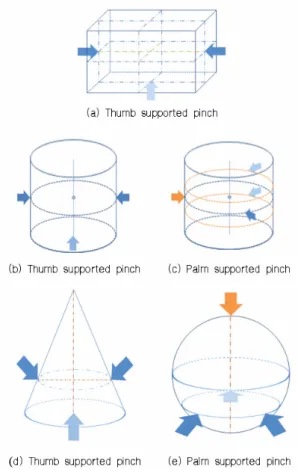
Fig. 4. Newly defined 3D grasp methods
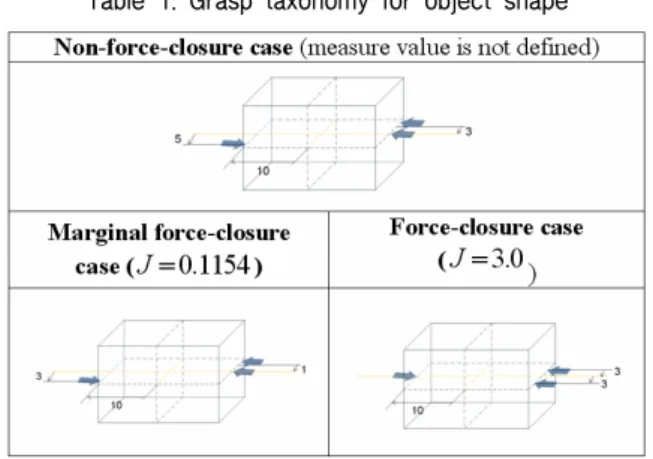
Table 1. Grasp taxonomy for object shape
convex hull, P, to the origin, O. Then we calculate a point Q that is on the intersection of a hyper-plane of convex hull and PO vector. When the following is true
PO
PQ> , (6)
the corresponding grasp is a force-closure. Otherwise it is not a force-closure. Furthermore, we develop a qualitative grasp measure such that
PO PQ J
PO
= − (J : measure function). (7)
The more Jvalue is big, the grasp is more stable. In (7), the reason we divide the term in the right side by the length of PO is that we want to remove effects of geometric scales of objects. For illustration, in Table 1, we compare measure values of three pinch grasps with the corresponding grasp measures. The first one is not force-closure since the fingers on opposite sides are crisscrossed. The next two are force-closures, where the last case shows the most balanced grasp.
3. Grasp taxonomy and grasp planning
This section addresses grasp taxonomy and planning for grasping simplified object primitives. Because there are too many shapes of objects, it is difficult for us to make a unified taxonomy of grasps. To cope with practical situations, we need to simplify the object shapes into several primitives. In this paper, we propose to classify object primitives as box, sphere, cylinder, and cone, which are the typical shapes we often encounter in everyday lives. Corresponding to these shape primitives, we can group possible grasp methods to be discussed. If
an object is arbitrary in shape, we can reconstruct it by the combination of these four object primitives.
3.1 Taxonomy and shape primitives
Taxonomy table makes a selection of grasp method easier, compared to arbitrary selection without pre- defined taxonomy, because of a huge number of possible grasp configurations. Since we already classified objects into shape primitives, the grasp taxonomy is defined base on the object primitives. We propose four grasp methods (Pinch, Spherical, Thumb supported pinch, and Palm supported pinch) matched to object primitives as shown Table 2.
Table 2. Grasp taxonomy for object primitives Object Grasp Types Box Pinch, Thumb supported pinch Sphere Spherical, Palm supported pinch Cylinder Pinch, Thumb supported pinch, Spherical, Palm supported pinch Cone Spherical, Palm supported pinch
Box - This object primitive has two types of grasps. One of the possible grasp methods is pinch grasp. Thumb supported pinch grasp which is new type is presented Fig.4(a).
Sphere – This object primitive has two types of grasps.
One is spherical grasp. The other is palm supported pinch grasp which is using the palm of the robot hand as shown in Fig.4(e).
Cylinder – This object primitive allows all types of grasps. Pinch grasp is the same as that of the box primitive. Thumb supported pinch grasp becomes a useful grasp when a cylinder lies on a desk. Spherical grasp is the most general method in grasping a cylinder.
Palm supported pinch grasp is used to grasp a circular bar more firmly. Fig.4 (b) and (c) show thumb supported pinch grasp and palm supported pinch grasp.
Cone - It has two types of grasps: palm supported pinch grasp and spherical grasp. In the case of palm supported pinch grasp, the bottom face is supported by the thumb and the upper face has contacts with the two fingers as shown in Fig. 4 (d). This grasp is the same as that of the cylinder primitive and can be used when the cone lies on a desk.
3.2 Schematic of grasp planning using preformed grasp
Now we need to sample locations where the robot
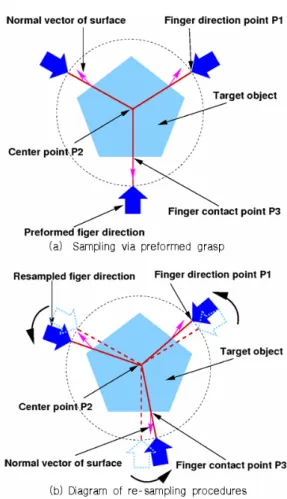
Fig. 5. Diagram of sampling finger prints
fingers will contact. We sample the contact points by incorporating the geometry of preformed grasps. The following is a illustration of our sampling method using spherical preformed grasp with the cylinder primitive.
Step 1 - We make a virtual cylinder that can contain the arbitrarily cylinder-like target object.
Step 2 - On the surface of the virtual cylinder, place three points to locate fingers based on preformed spherical grasp. Two required parameters are the angle of fingers with equal distribution and depth of spherical grasp.
Depth means the length from top of object to contact point. The angle and the depth are selected randomly to satisfy the pre-formed grasp.
Step 3 – Three points which have the same depth determined in step 2 generate rays toward the origin of the object. The actual contact points are the intersections of rays and target object surface. These are the prospective finger contact points.
Step 4 – We check force-closure condition from wrenches which are made from the friction cones associated with normal vectors on contact locations.
Step 5 – If these contact points do not satisfy the force-
Fig. 6. Simulator and user-interface controller
closure condition or grasp condition is too marginal, then repeat procedures from step 2 to step 4, by slightly perturbing the angle and depth parameters.
Step 6 – Even after N number of trials, if a force-closure grasp is not found, repeat procedures from step 2 to step 5 using other possible grasps from the taxonomy table.
Fig.5 illustrates how to sample and re-sample over the spherical grasp. For the cylindrical type of objects, the preformed grasp should be made on a surface of virtual cylinder with an appropriate radius. This sampling method is called ‘sampling via preformed grasps.’ This method is very efficient and intuitive to select locations of finger-print without performing a large amount of samplings. Based on the global similarity of target object, we can define a virtual object primitive with appropriate dimension. And finger locations are to be sampled on the surface of the virtual object using a possible grasp method from the taxonomy table. Grasp stability at the actual finger locations is computed using the information of normal vector. If needed, re-sampling is to be performed.
4. Simulation
4.1 Simulation setup
To verify the efficacy of the method addressed in this paper, we developed a simulator using Visual C++ and OpenGL. This simulator consists of two parts. One is robotic arm control part and the other is hand control part.
The robot arm has human-like 7 degree of freedom, and at the end it carries a three-fingered robotic hand. Each finger allows three degrees of freedoms, except the thumb whose base is fixed on the palm. The hand has totally eight degrees of freedoms. Fig.6 shows a snapshot of the simulator and the user-interface.
(a) Pinch grasp (b) Thumb supported pinch grasp Fig. 7. Possible grasp methods for grasping a box
(a) Pinch grasp (b) Thumb supported pinch grasp
(c) Spherical grasp (d) Palm supported pinch grasp Fig. 8. Possible grasp methods for grasping a cup
4.2 Result
We have tested various types of grasps with several different objects. The first set is the grasp over box type object primitive as shown in Fig.7. As mentioned before, this grasp has two types of grasps: pinch grasp and thumb supported pinch grasp. Thumb supported pinch grasp is better for holding the object when it lies on the desk as shown. The second test is for grasping a cup which can be seen everywhere and is approximately modeled as a cylinder primitive. So this primitive allows all types of grasps in taxonomy as shown in Fig.8. We can see that every grasp makes force-closure but the spherical grasp and palm supported grasp are more robust in holding.
Last test is on a flask object which has the shape of a cone as shown in Fig.9. This case allows thumb supported pinch and spherical grasps. In Fig.10, we
(a) Spherical grasp (b) Thumb supported pinch grasp Fig. 9. Possible grasp methods for grasping a flask
(a) Non-force-closure sampling (b) Force-closure after re-sample Fig. 10. Sampling result over and arbitrary object
present grasp planning results over arbitrary shapes of objects. We use the spherical preformed grasp since the object shapes are classified to the cylinder primitive. The first case of planning result shown in Fig.10(a) is not force-closure since one finger location is directed to make a rotating moment, resulting in an unstable grasp.
To make a stable grasp, we re-sample the finger locations by slightly perturbing the distribution angles of fingers and depth. In Fig.10(b), the final re-sampled finger locations are presented after three consecutive re- samplings. The arrows indicate the directions of re- sample made from the initial sample. The new locations satisfy the force-closure condition with grasp measure J=1.435.
In the above simulations, we applied object primitives and preformed grasps based on grasp taxonomy. Thus, the finger-print locations are computed instantly, and so the grasp planning can be done in real-time, though the mesh data of the object must be available in advance.
5. Conclusion and future work
We have developed a taxonomy database that has the mapping between object primitives and grasp methods.
Over the various previous methods of grasps, we have
added new grasps like thumb supported pinch and palm supported pinch to improve robustness of grasp capability.
The grasp locations are sampled using preformed grasps defined on a virtual object primitive which can sufficiently enclose target object. Sampling is made to be repeated until a desired grasp is found. If the finger- printing is done, inverse kinematics of arm and fingers are solved to simulate the grasp motions. We believe that still there are many works that should be done in the future: the automatic determination of object primitives for arbitrarily given objects, reliable contact detection and realization of firm grasp in real time, and/or sensor based slip detection. In addition, we need to develop an algorithm to simplify complex objects in real world into suitable plain object primitives.
[1] R. M. Murray, Z. Li and S. S. Sastry, A Mathematical introduction to robotic manipulation, CRC Press, 1993.
[2] B. Mishra, J. T. Schwartz, and M. Sharir, “On the existence and synthesis of multifinger positive grasp.” Algorithmica, vol. 2, no. 4, pp. 541-558, 1987.
[3] J. Hong, G. Lafferiere, B. Mishra, and X. Tan, “Fine manipulation with multifinger hands.” In Proc.
IEEE Int. Conf. Robotics and Automation, pp. 1568- 1573, 1990.
[4] X. Markenscoff, L Ni, and C. H. Papadimitriou,
“The geometry of grasping,” Int. J. Robot. Res., vol.
9, no. 1, pp. 61-74, 1990.
[5] J. K. Salisbury and B. Roth, “Kinematic and force analysis of articulated hands,” ASME J.
Mechanisms, Transmissions, Autiomat. Des., vol.
105, pp. 33-41, 1982.
[6] C. Ferrari and J. F. Canny, “Planning optimal grasps,” in Proc. IEEE Int. Conf. Robotics and Automation, pp. 2290-2295, 1992.
[7] J. Ponce and V. Faverjon, “On computing three- finger force-closure grasps of polygonal objects,”
IEEE trans. Robot. Automat., vol. 11, pp. 868-881, 1995.
[8] Z. Ji and B. Roth, “Contact force in grasping and kinematic constraints,” in Proc. 7th IFToMM World Congr., pp 1219-1222 1987.
[9] J. Li, H. Liu and H.Cai, “On computing three-finger force-closure grasps of 2-D and 3-D objects,” IEEE trans. Robot. Automat., vol. 19, pp. 155-161, 2003.
[10] M. R. Cutkosky and P. K. Wright, “Modeling manufacturing grips and correlation with the design of robotics hands,” in Proc. IEEE Int. Conf.
Robotics and Automation, pp. 1533-1539, 1986.
[11] T. Iberall, “Human prehension and dexterous robot hands,” The international Journal of Robotics Research, 16(3), pp. 285-299. 1997.
[12] T. Miller, S. Knoop, H. I. Christensen and P.K.
Allen, “Automatic grasp planning using shape primitives,” in Proc. IEEE Int. Conf. Robotics and Automation, vol. 2, pp 1824-1829, 2003.
[13] J. M. C. Jorda, Intelligent Task Level Grasp Mapping for Robot Control, Master of Science Thesis, Royal Institute of Technology, 2006.
[14] Y. H. Liu, D. Ding and M. L. Lam, “3-D Grasp Analysis and synthesis using the ray-shooting technique”, Robotics Welding, Intelligence and Automation, LNCIS 299, pp. 80-109, 2004.
[15] K. Mulmuley, Computational Geometry: and Introduction through Randomized Algorithms, Englewood Cliffs, NJ:Prentice Hall, 1994.
박 종 우
2007 고려대학교 컴퓨터정보 학과(공학사)
2007~현재 고려대학교 제어 계측공학과 석사과정 관심분야 : 이동로봇
정 현 환
2007 고려대학교 제어계측공 학과(공학사)
2007~현재 고려대학교 제어 계측공학과 석박사 통 합과정
관심분야 : 로봇 조작 및 경로계획 참 고 문 헌
박 종 우 1985 MIT EECS학사 1991 Harvard 응용수학 석사,
박사
1991~1994 Univ. of California, Irvine 기계항공공학과 조교수
1994~현재 서울대학교 기계항공공학부 교수 관심분야 : Robot mechanics and planning
정 주 노 1995 포항공대 기계공학사 1997 동 대학원 석사 2003 동 대학원 박사 2003 서울대학교 정밀기계설
계연구소 박사후 연구원
2003~2005 MIT 전자통신 연구소 박사후 연구원 2005~현재 고려대학교 서창캠퍼스 제어계측공학과
조교수
관심분야 : 로봇 조작 및 경로계획, 네트워크 기반로봇 시스템, 햅틱 시뮬레이션