• 검색 결과가 없습니다.

The Occupational Stress According to the Gender, Employee Type, Medical Facility, and the Treatment Field in Physical Therapists

N/A
N/A
Protected

Academic year: 2021

Share "The Occupational Stress According to the Gender, Employee Type, Medical Facility, and the Treatment Field in Physical Therapists"

Copied!
5
0
0

로드 중.... (전체 텍스트 보기)

전체 글

(1)

JKSCI

The Occupational Stress According to the Gender, Employee Type, Medical Facility, and the Treatment Field in Physical Therapists

1)

Gyoung-Mo Kim*, In-Seop Kim*, Jae-Cheong Choi*

*Professor, Dept. of Physical Therapy, Daejeon Health Institute of Technology, Daejeon, Korea

*Professor, Dept. of Physical Therapy, Daejeon Health Institute of Technology, Daejeon, Korea

*Professor, Dept. of Physical Therapy, Daejeon Health Institute of Technology, Daejeon, Korea

[Abstract]

The purpose of this study is to investigate the occupational stress of physical therapists. A total of 302 physical therapists participated in this study. All participants were responded to a Korean Occupational Stress Scale-short form to investigate occupational stress. We compared the occupational stress of physical therapists according to the gender, employee type, medical facility, and the department. Occupational stress showed a significant difference only in gender. Overall, the physical therapist showed low occupational stress in this study. However, among the 7 items on the Korean Occupational Stress Scale-short form, the ‘Job demand’ item score was higher than other items. This study suggests that the hospital administrator needs to provide proper job demand and environment considering the level of the physical therapists in order to effective occupational stress management.

▸Key words: Occupational stress, Physical therapist, Employee type, Medical agency, Treatment field

[요 약]

본 연구는 물리치료사의 성별 , 고용형태, 의료기관 및 치료분야에 따른 직무스트레스의 차이를 조사하고 비교하고자 실시하였다. 한국인 직무스트레스 측정도구 단축형을 활용하여 직무스트레 스를 비교한 결과 직무스트레스는 오직 성별에서만 유의한 차이가 있었고 고용형태 , 의료기관 및 치료분야에 따른 직무스트레스는 유의한 차이가 없었다 . 한국인 직무스트레스 측정도구 7항목 중 에서 직무요구에 대한 점수가 다른 항목에 비해 상대적으로 높게 나타났지만 전체적으로 물리치 료사의 직무스트레스는 참고치에 비해 낮은 것으로 조사되었다 . 물리치료사들의 적절한 직무스트 레스 관리를 위해 적절한 직무요구와 직무환경을 제공하는 것은 직무스트레스를 효과적으로 조절 할 수 있는 하나의 방법이 될 수 있다.

▸주제어: 직무스트레스, 물리치료사, 고용형태, 의료기관, 치료분야

∙First Author: Gyoung-Mo Kim, In-Seop Kim, Corresponding Author: Gyoung-Mo Kim

*Gyoung-Mo Kim ([email protected]), Dept. of Physical Therapy, Daejeon Health Institute of Technology *In-Seop Kim ([email protected]), Dept. of Physical Therapy, Daejeon Health Institute of Technology *Jae-Cheong Choi ([email protected]), Dept. of Physical Therapy, Daejeon Health Institute of Technology

∙Received: 2020. 05. 13, Revised: 2020. 06. 03, Accepted: 2020. 06. 04.

Copyright ⓒ 2020 The Korea Society of Computer and Information http://www.ksci.re.kr pISSN:1598-849X | eISSN:2383-9945
(2)

I. Introduction

직무 스트레스는 개인에게 발생되는 외부상황으로 인해 나타나는 일종의 적응반응(adaption response)으로 직무 와 관련하여 조직에서 상호작용하는 과정에서 조직목표와 개인 욕구간의 불균형으로 발생한다[1]. 직무 스트레스는 개인의 심리적, 성격적 특성에 따라 영향을 받게 되고 스 트레스를 어느 정도 지각하는지, 주위의 적절한 도움을 받 을 수 있는지, 그리고 얼마나 합리적으로 대처하는지 등의 여러 변인들에 따라 스트레스를 경험하는 정도가 달라진 다[2]. 이러한 스트레스는 스트레스를 발생시키는 환경적 요인과 개인과의 상호작용 결과로 나타나기 때문에 개인 의 특성에 따라 스트레스의 결과는 달리 나타나게 된다.

환자를 대상으로 의료 서비스를 제공하는 의료관련 종 사자들은 다양한 직종들이 각 분야의 전문성에 맞게 유기 적으로 업무를 진행해 나가야 하는 특성으로 인해 다른 직 종에 비해 직무 스트레스가 높은 경향이 있다[3]. 특히, 환 자와 직접 대면하는 시간이 많은 물리치료사와 같은 직종 은 직무 스트레스가 증가할 가능성이 높다[4]. 직무 스트레 스의 상승은 의료 종사자들의 직무만족 및 업무수행 등을 감소시켜 환자 치료의 질적 저하를 초래하여 의료서비스 의 질을 낮추는 요인이 된다[5].

물리치료사의 직무 스트레스에 대한 몇몇 연구를 살펴 보면 직무 스트레스는 일 평균 환자 수, 근무시간, 근골격 계 통증 등과 상관관계가 있었고[6], RO[7]의 연구에서는 신체적인 직무 스트레스 증상을 높게 느끼는 것으로 보고 되었고, 직무 스트레스 항목 중에서 직무자율성에 대한 직 무 스트레스가 높다고 하였다[8]. 물리치료사는 의료기사 등에 관한 법률과 시행령에 따라 업무범위를 명시하고 있 고 의원급 의료기관은 전문 진료 분야에 따른 치료실 운영 을 하고 있으며 병원급 이상의 의료기관에서는 진료 분야 와 그에 따른 전문적 치료부서를 두고 운영하고 있다. 이 와 같이 물리치료 분야가 전문적으로 시행되고 있는 만큼 물리치료사들은 고도의 전문성과 긴장성을 요구하는 업무 로 인해 많은 신체적인 소모와 정신적인 집중이 요구되고 그에 따른 직무스트레스가 증가하는 양상을 보이고 있다.

또한 직무스트레스는 개인적 노력에 의해 관리될 수 있지 만 병원 또는 해당 기관에서의 조직적인 지원이 병행된다 면 더욱 효과적인 스트레스 관리가 될 수 있다[9].

그러므로 기존 연구에서 언급하고 있는 물리치료사의 직무스트레스의 변인들 외에 근무기관이나 치료분야에 따 른 직무스트레스를 추가로 파악하여 물리치료사의 적절한 전문 인력 관리 및 직무관리를 위한 자료로 활용할 필요가 있다. 따라서 본 연구는 물리치료사들이 근무하는 근무기

관과 치료부서에 따른 직무 스트레스를 비교 확인하고자 실시하였다.

II. Preliminaries

국내 의료 종사자들의 직무 스트레스에 관한 연구를 살 펴보면 여성, 나이가 적을수록, 미혼자, 음주자, 규칙적인 운동을 하지 않는 군, 비정규직, 낮은 연봉 및 근무기간 5년 이하인 군에서 직무 스트레스가 높은 결과를 보였다[10].

직무 스트레스의 상승은 근육의 긴장과 같은 신체적 변화 를 야기하고[11], 직무만족, 동기부여 및 감정변화 등과 같 은 정신적 문제에 부정적인 영향을 미친다[12]. 직무 스트 레스의 적절한 관리조절은 조직몰입을 높이고 구성원에게 순기능 작용을 통해 개인성과를 높이는데 기여할 수 있다 [13]. 그러므로 직무 스트레스와 다양한 변인들과의 관계에 대한 연구를 통해 개인차원에서 관리뿐만 아니라 직장에서 체계적인 스트레스 관리 방안이 모색되어야 한다.

III. Research design

1. Research subject and Data collection

본 연구는 2017년 11월 1일부터 2018년 1월 30일까지 물리치료사 면허 소지자로 대전지역 의원급 이상 의료기 관에서 근무하고 있는 물리치료사 302명(남자 129명, 여 자 173명)을 대상으로 실시하였다. 모든 대상자들에게 설 문 전에 연구의 목적과 절차에 대한 설명을 충분히 진행하 였으며 연구에 동의한 자에 한하여 자발적으로 설문조사 를 진행하였다. 본 연구 대상자의 제외 기준은 응답에 누 락이 있거나 설문 응답이후 연구에서 자발적으로 철회의 사를 밝힌 경우는 제외하였다.

2. Research Tool

1) Korean Occupational Stress Scale-short form

본 연구에서 직무 스트레스 측정은 Chang[14]등이 현

장 진단이 용이하도록 24문항으로 구성된 한국인 직무 스

트레스 측정도구 단축형을 사용하였다. 단축형은 기본형 8

개 직무 스트레스 영역 43문항 중에서 물리환경 영역을 제

외하고 직무요구(4문항), 직무자율성 결여(4문항), 직무불

안정(3문항), 관계갈등(2문항), 조직체계(4문항), 보상부적

절(3문항), 직장문화(4문항)으로 총 7개 영역 24개 문항으

로 구성되어 있다. 한국인 직무스트레스 단축형 점수 산출

방법은 다음과 같은 공식에 의해서 산출할 수 있다.

(3)

• 각 영역별 환산점수

= (실제점수-문항수)×100/(예상 가능한 최고점수-문항수)

• 직무스트레스 총 점수

= (각 7개 영역의 환산점수의 총합)/7

공식에 의해 계산된 점수는 한국인 직무스트레스 단축형 참고치를 기준으로 해석할 수 있다. 참고치는 한국인 직무 스트레스 평가표를 기준으로 해석하는데 대상 근로자의 실 제점수와 회사(또는 부서) 평균점수 및 전국 근로자의 4분 위수를 제시한 것으로 대상 근로자의 직무 스트레스 점수 가 어떤 범위에 포함되는가를 비교할 수 있다. 예를 들어 남성의 경우 직무요구 항목 상위 25%는 직무요구 항목에 서 58.4점 이상을 획득한 경우에 해당되는 것으로 이는 직 무요구 항목에서 직무스트레스 점수가 전국 근로자 중 직 무스트레스가 높은 상위 25%에 해당한다는 걸 의미한다.

3. Data analysis method

연구대상자의 일반적 특성, 부서와 성별에 따른 직무스 트레스의 차이 비교를 위해 SPSS ver. 18.0(SPSS Inc., Chicago, IL, USA)을 이용하여 분석하였다. 일반적 특성 정보는 빈도수와 백분율로 분석하였고, 성별과 고용형태에 따른 직무스트레스 차이를 비교하기 위하여 독립표본 t-검 정(independent t-test)을 사용하였고, 근무기관과 치료 분야에 따른 직무스트레스 차이를 비교하기 위하여 일원 배치분산분석(ANOVA)을 사용하였으며 유의수준은 0.05 로 설정하였다.

IV. Result

1. General Characteristics

본 연구 대상자 302명 중 남성은 129명(42.7%), 여성은 173명(57.4%)이었고, 평균연령은 28.3세 이었다. 고용형 태는 정규직이 261명(86.4%), 비정규직이 41명(13.6%)이 었고 평균 근무기간은 73.9개월 이었다(Table 1).

Parameters Male

(n=129)

Female (n=173)

Total (n=302)

Age 30.8±6.7 26.4±4.9 28.3±6.1

Clinical career

(months) 73.9±77.5 55.1±56.2 63.2±66.7

Employ Regular 112

(86.7%) 149

(86.1%) 261

(86.4%) Irregular 17

(13.3%) 24

(13.9%) 41

(13.6%) Table 1. Demographic characteristics of the participants

(N=302)

2. A comparison of occupational stress in gender 성별에 따른 직무스트레스의 차이를 비교해 본 결과 7 개 항목 중에서 보상부적절과 직장문화 항목들에서 유의 한 차이를 보였고, 전체 직무스트레스 점수에서도 성별에 따른 유의한 차이를 보였다(Table 2).

Parameters Male

(n=78) Female

(n=27) p value

Job demand 50.1±16.9 52.5±14.9 .205

Insufficient job

control 45.0±15.5 47.5±13.8 .146

Interpersonal

conflict 36.0±15.9 34.6±12.7 .417

Job insecurity 46.9±15.3 46.6±12.4 .869 Organizational

system 46.4±11.1 48.8±11.4 .061

Lack of reward * 41.9±13.8 46.1±14.6 .012 Occupational

climate * 38.4±21.0 43.4±16.9 .027

Total score * 43.5±8.0 45.7±6.6 .015

* p<0.05

Table 2. Comparison of occupational stress between male and female

(N=302)

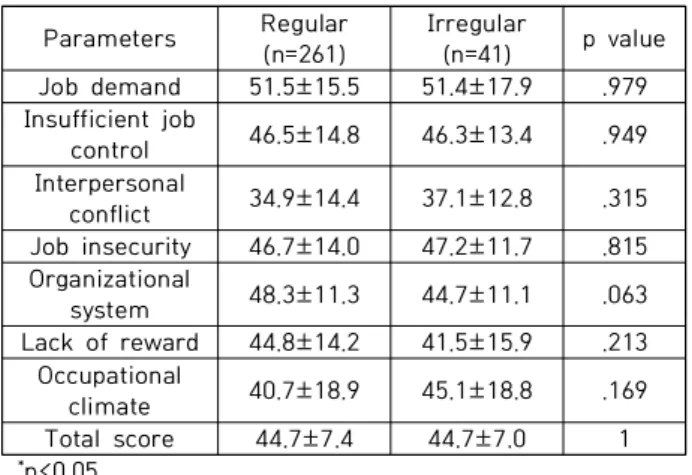
3. A comparison of occupational stress between regular and irregular employees

고용형태에 따른 직무스트레스의 차이를 비교해 본 결과 모든 항목들에서 유의한 차이를 보이지 않았다(Table 3).

Parameters Regular

(n=261)

Irregular

(n=41) p value

Job demand 51.5±15.5 51.4±17.9 .979

Insufficient job

control 46.5±14.8 46.3±13.4 .949

Interpersonal

conflict 34.9±14.4 37.1±12.8 .315

Job insecurity 46.7±14.0 47.2±11.7 .815 Organizational

system 48.3±11.3 44.7±11.1 .063

Lack of reward 44.8±14.2 41.5±15.9 .213 Occupational

climate 40.7±18.9 45.1±18.8 .169

Total score 44.7±7.4 44.7±7.0 1

* p<0.05

Table 3. Comparison of occupational stress between regular and irregular employee

(N=302)

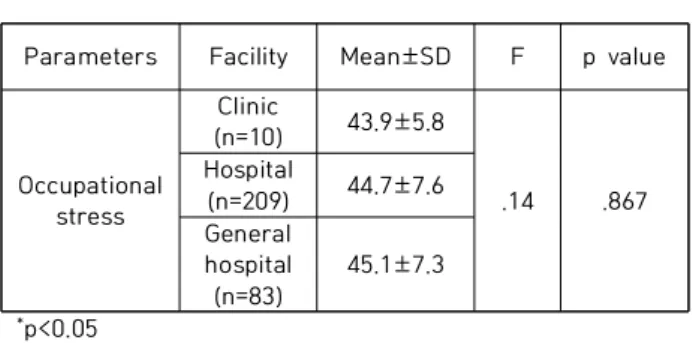
4. A comparison of occupational stress according to the medical facility

의료기관에 따른 직무스트레스의 차이를 비교해 본 결과

의료기관에 따른 유의한 차이를 보이지 않았다(Table 4).

(4)

Parameters Facility Mean±SD F p value

Occupational stress

Clinic

(n=10) 43.9±5.8

.14 .867

Hospital

(n=209) 44.7±7.6 General

hospital (n=83)

45.1±7.3

* p<0.05

Table 4. Comparison of occupational stress according to medical agency type

(N=302)

5. A comparison of occupational stress according to the treatment field

치료분야에 따른 직무스트레스의 차이를 비교해 본 결 과 각 치료분야별 유의한 차이를 보이지 않았다(Table 5).

Parameters Field Mean±SD F p value

Occupational stress

Neuro-adult

(n=186) 44.8±7.3

.15 .932

Pain control

(n=47) 45.1±7.8 Musculoske

letal (n=32)

44.6±6.7 Neuro-child

(n=37) 44.1±7.6

* p<0.05

Table 5. Comparison of occupational stress according to the field of therapy

(N=302)

V. Conclusions

본 연구는 의료기관에서 근무하고 있는 물리치료사를 대 상으로 성별, 고용형태, 근무기관 및 치료분야에 따른 직무 스트레스 차이를 알아보고자 실시하였다. 본 연구 결과 고 용형태, 근무기관 및 치료분야에 따른 직무스트레스의 점수 는 유의한 차이를 보이지 않았지만, 성별에 따른 직무스트 레스는 유의한 차이를 보였다. 본 연구에서 물리치료사들의 스트레스 총점은 남자 물리치료사는 43.5, 여자 물리치료사 는 45.7로 한국인 직무스트레스 단축형 참고치 기준 하위 50%이하(남성기준 42.5~48.4, 여성기준 44.5~50.0) 점수 를 획득하여 전체적으로 직무스트레스는 높지 않음을 알 수 있었다. 항목별 점수를 살펴보면 직무요구, 조직체계, 보상 부적절, 직장문화 항목에서는 여자 물리치료사들이 남자 물

리치료사들보다 상대적으로 높은 점수를 보였다. 특히 보상 부적절과 직장문화 항목에서는 통계학적으로 유의미한 차 이를 보였다. 특히, 7가지 항목 중에서 전체 대상자들에서 직무요구 항목이 다른 항목보다 높은 점수를 보이면서 물리 치료사들에게 직무요구도가 다른 항목에 비해 상대적으로 높음을 알 수 있었다. 직무요구는 시간적 압박, 업무량 증 가, 책임감 등을 평가하는 항목으로 이는 물리치료사들이 환자의 신체를 직접 대하면서 다양한 치료 서비스를 제공해 야 하는 직무의 특성을 반영한 결과라고 할 수 있다. 고용형 태, 의료기간의 종류와 치료부서에 따른 직무스트레스의 차 이에서는 모두 통계학적으로 유의미한 차이를 보이지 않았 으며 전체적으로 직무스트레스는 낮은 것으로 나타났다. 이 러한 결과를 종합하여 볼 때 병원 경영자 또는 치료 관리자 들은 물리치료사들에게 성별에 따라 차이를 보이는 직무스 트레스 항목을 고려하여 직무스트레스 관리 프로그램을 제 공할 필요가 있으며 적합한 직무범위와 직무한계를 제공하 여 직무스트레스를 관리할 것을 조언한다.

본 연구는 몇 가지 제한점을 가지고 있다. 첫째, 특정지역 을 대상으로 설문이 진행되었고 연구 대상자의 평균연령 28.3세와 평균 근무기간 73.9개월로 다양한 연령군과 근무 기간을 고려한 대상자를 확보하지 못하여 결과를 일반화하 기에는 어려움이 있다. 추후에는 폭넓은 지역에서 다양한 연 령군과 근무기간을 고려한 대상자 선정을 통해 결과를 얻게 된다면 통계적으로 더욱 의미 있는 결과를 얻을 수 있을 것으 로 생각된다. 둘째, 직무스트레스에 영향을 줄 수 있는 개인 의 성격유형, 신체적 및 심리적 건강상태와 자아존중감과 같 은 내부적 요인과 사회적 지지나 근무환경과 같은 외부적 요인의 다양한 변인을 고려하지 못하였다. 추후 연구에서는 이러한 변인을 고려하여 직무스트레스에 영향을 주는 요인 들에 대해서 지속적인 연구가 필요할 것으로 생각된다.

ACKNOWLEDGEMENT

This work was supported by Daejeon Health Institute of Technology Research Grant.

REFERENCES

[1] Abbas SG, Farah A, Apkinar-Sposito C. Measuring the

immeasurable: An overview of stress and strain measuring

(5)

instruments. Meditgerranean Jouranl of Social Sciences, Vol. 4, No. 10, pp. 480-489, 2013. DOI: http://dx.doi.org/10.5901/mjs s.2013.v4n10p480.

[2] Folkman S, Lazarus RS. If it changes, it must be a process:Study of emotion and coping during three stages of a college examination.

J Pers Soc Psychol, Vol. 48, No. 1, pp. 150-170, 1985.

[3] Shim JH, Yoon TH. Analysis of factors that influence the job satisfaction of physical therapists. J Kor Soc Phys Ther, Vol. 23, No. 1, pp. 67-75, 2011.

[4] Shin SG. The association of fatigue and psychosocial stress with physical therapist in several rehabilitation hospitals. Catholic University of Korea. Dissertation of Master's Degree, 2007.

[5] Park JS. The relationship of organizational and job characteristics, empowerment, job satisfaction and organizational commitment perceived by hospital administrative staffs. Korean Journal of Health Policy & Adminstration, Vol. 14, No. 1, pp. 65-88, 2004.

[6] Kim GM. Musculoskeletal pain and job stress of physical therapists. Graduate school of Yonsei University, Republic of Korea, Master's thesis, 2005.

[7] Ro HL. Relationship between job stress and self-esteem of physical therapists. The Journal Korean Society of Physical Therapy, Vol.

22, No. 1, pp. 83-90, 2010.

[8] Wang JS, Kim YR. Analysis of relationship between job stress and turnover intention of physical therapist. Journal of the Korea Academia-Industrial cooperation society, Vol. 16, No. 9, pp.

6112-6119, 2015

[9] Min MS, Cho WL. A grounded theory study on burnout of physical therapists at the university hospital. Korean Journal of Physical, Multiple, & Health Disabilities, Vol. 52, No. 3, pp. 47-68, 2009 [10] Noh SM. Factors impacting on the psychosocial health status

among hospital workers. Injae University. Dissertation of Master's Degree, 2001.

[11] B. Shahidi, A. Haight, K. Maluf. Differential effects of mental concentration and acute psychosocial stress on cervical muscle activity and posture. J Electromyogr Kinesiol, Vol. 23, No. 5, pp. 1082-1089, 2013. DOI: http://dx.doi.org/10.1016/j.jelekin.20 13.05.009

[12] Q. H. Lin, C. Q. Jiang, T. H. Lam. The relationship between occupational stress, burnout, and turnover intention among managerial staff from a sino-japanese joint venture in guangzhou, china. J Occup Health, Vol. 55, No. 6, pp. 458–467, 2013. DOI:

http://dx.doi.org/10.1539/joh.12-0287-OA

[13] Han YS, Lee SH. The analysis about duty attitude followed by duty stress and psychological variable of Taekwondo coach.

Korean Journal of Sport Science, Vol. 13, No. 2, pp. 59-69, 2007.

[14] Chang SJ, Koh SB, Kang DM, Kim SA, Kang MG. Developing an occupational stress scale for Korean employees. Korean J Occup Environ Med, Vol. 17, No. 4, pp. 297-317, 2005.

Authors

Gyoung-Mo Kim received the B.S., M.S.

and Ph.D. degrees in Physical Therapy from Yonsei University, Korea, in 2000, 2005 and 2015, respectively. Dr. Kim joined the faculty of the Department of Physical Therapy at Daejeon Health Institute of Technology, Daejeon, Korea, in 2017. He is currently a Professor in the Department of Physical Therpay, Daejeon Health Institute of Technology. He is interested in neuroscience, neurorehabilitation, therapeutic exercise, and balance recovery therapy.

In-Seop Kim received the M.S, and Ph D.

degrees in Health Science from Daegu University, Korea, in 2002, 2015, repectivelyt. Dr Kim joined the faculty of Korean Society of Integrative Medicine,

in 2010, He is currently a Professor in the Department of Physical Therapy, Daejeon Health Institute of Technology.

He is interested in musculo-skeletal physical therapy.

Jae-Cheong Choi received the Ph D. degrees in Exercise Physiology from Hanyang University, Korea, in 1997. Dr. Choi joined the faculty of the Department of Physical Therapy at Daejeon Health Institute of

Technology, Daejeon, Korea, in 1992. He is currently a

Professor in the Department of Physical Therpay, Daejeon

Health Institute of Technology. He is interested in

neuro-therapeutic exercise and kinesiology.

수치

Table  3.  Comparison  of  occupational  stress  between  regular  and  irregular  employee
Table 4. Comparison of occupational stress according  to  medical  agency  type

참조

관련 문서

The “Asset Allocation” portfolio assumes the following weights: 25% in the S&amp;P 500, 10% in the Russell 2000, 15% in the MSCI EAFE, 5% in the MSCI EME, 25% in the

Fifth, in the relationship between the parents' communication types and the intimacy according to the grades, the parents have more open communication type

3) There was a significant difference in the strategy children had utilized to reduce parents' anger according to the gender. In anger situation with

3-13 The arc-induction-type DC circuit breaker modelling according to existence and nonexistence of the induction needle ··· 30 Fig.. 3-14 The flowing a magnetic field

  Investigation of turnover comes from the job itself and in this study worked in a care facility for the elderly, Caregiver Stress, Burnout comes from

First, in the difference in Taekwondo image, Taekwondo loyalty, and memorial intention according to the general characteristics (gender, nationality,

There was statistically significant difference in physical competence information according to gender, exercise performance, and participation persistence

The Eschar Distribution According to Gender and Orientia tsutsugamushi Genotypes of