• 검색 결과가 없습니다.

Different Clinical Courses for Poisoning with WHO Hazard Class Ia Organophosphates EPN, Phosphamidon, and Terbufos in Humans

N/A
N/A
Protected

Academic year: 2021

Share "Different Clinical Courses for Poisoning with WHO Hazard Class Ia Organophosphates EPN, Phosphamidon, and Terbufos in Humans"

Copied!
8
0
0

로드 중.... (전체 텍스트 보기)

전체 글

(1)

저저

INTRODUCTION

The World Health Organization (WHO) system of classification defines highly toxic OP formulations based on rat LD50 values for only the active ingredi- ent in the formulation (i.e., the organophosphate (OP))

1)

. A linear relationship has been demonstrated between the WHO hazard class and mortality from

WHO 분류 1 등급 EPN, Phosphamidone, Terbufos 유기인계 중독환자의 임상 양상

전남대학교병원 응급의학과1, 경북대학교병원 응급의학과2

문종구

1

∙문정미

1

∙이미진

2

∙전병조

1

Different Clinical Courses for Poisoning with WHO Hazard Class Ia Organophosphates EPN, Phosphamidon, and Terbufos in Humans

Jong Gu Mun, M.D.

1

, Jeong Mi Moon, M.D.

1

, Mi Jin Lee, M.D.

2

, Byeong Jo Chun, M.D.

1

Department of Emergency Medicine, Chonnam National University Medical School, Gwangju

1

, Department of Emergency Medicine, Kyungpook National University Medical School, Daegu

2

, Korea

Purpose: Extremely hazardous pesticides are classified as World Health Organization (WHO) hazard class Ia.

However, data describing the clinical course of WHO class Ia OP (organophosphate) poisonings in humans are very scarce. Here, we compare the clinical features of patients who ingested hazard class Ia OPs.

Methods: This retrospective observational case study included 75 patients with a history of ingesting ethyl p-nitro- phenol thio-benzene phosphonate (EPN), phosphamidon, or terbufos. The patients were divided according to the chemical formulation of the ingested OP. Data regarding mortality and the development of complications were col- lected and compared among groups.

Results: There were no differences in the baseline characteristics and severity scores at presentation between the three groups. No fatalities were observed in the terbufos group. The fatality rates in the EPN and phosphamidon groups were 11.8% and 28.6%, respectively. Patients poisoned with EPN developed respiratory failure later than those poisoned with phosphamidon and also tended to require longer mechanical ventilatory support than phos- phamidon patients. The main cause of death was pneumonia in the EPN group and hypotensive shock in the phos- phamidon group. Death occurred later in the EPN group than in the phosphamidon group.

Conclusion: Even though all three drugs are classified as WHO class Ia OPs (extremely hazardous pesticides), their clinical courses and the related causes of death in humans varied. Their treatment protocols and predicted out- comes should therefore also be different based on the chemical formulation of the OP.

Key Words: Organophosphates, World health organization, Classification

책임저자: 문 정 미

광주광역시 동구 제봉로 42 전남대학교병원 응급의학과

Tel: 062) 220-6796 Fax: 062) 228-7417 E-mail: [email protected]

투고일: 2018년 5월 18일 1차 심사일: 2018년 5월 18일 게재 승인일: 2018년 6월 15일

* 이 논문은 특정단체의 재정적 지원이나 관련된 이해관계가 없습니다.

(2)

OP poisoning

2)

. In contrast, other studies have shown that there is a mismatch between the toxicity of dif- ferent OP formulations in humans and their WHO classifications

1,3)

. There is substantial variety in the clinical courses and outcomes in humans who were poisoned with the same WHO class II or III OP

1,3)

.

However, no study has reported the clinical fea- tures that are observed after poisoning with WHO class Ia OPs (extremely hazardous), including ethyl p-nitrophenol thio-benzene phosphonate (EPN) and terbufos. This is likely because it is difficult to enroll a sufficient number of patients as these WHO Class Ia OPs are banned in several countries. Recently, we treated several patients who were intentionally poi- soned with terbufos, which is classified as a WHO hazard class Ia OP. In contrast to the fact that a poor outcome was predicted for these patients based on the clinical features they presented on admission, they experienced a full recovery.

Gaining further insight into the clinical courses that are associated with OP poisoning, especially for OPs that are expected to be fatal based on their hazard classification (e.g., WHO class Ia poisons), may pro- vide guidance to physicians during the selection of treatments and assist them in predicting outcomes.

We have therefore described and compared the clinical features that were observed in a number of patients who ingested terbufos, EPN or phosphami- don, all of which are WHO class Ia OPs. In addition,

we have discussed which factors, including the state of the chemical formulation or their additives, influ- enced the toxicity of these WHO hazard class Ia OP poisons in humans.

MATERIALS AND METHODS 1. Study design

This investigation was a two-institution, retrospec- tive, observational case series study that was per- formed using chart reviews. The study design was approved by the Institutional Review Board at Chonnam National University Hospital (IRB No CNUH-2016-270).

2. Subjects

The inclusion criteria were the following: patients 18 years old or older who presented to the Chonnam National University hospital emergency department (ED) or Kyungpook National University hospital ED within 24 hours of intentionally ingesting EPN, phos- phamidon, or terbufos between 2004 and 2014.

Because EPN and phosphamidon accounted for 67.1% of the cases of WHO Class Ia OP poisoning in the 00 National University hospital ED, we limited our study to patients who were poisoned with these two class Ia OP insecticides and terbufos. The char-

Table 1. Characteristics of three World Health Organization (WHO) hazard class Ia organophosphates (OPs).

EPN Phosphamidon Terbufos

Formulation state Emulsifiable concentrate Soluble concentrate Granule

(Liquid) (Liquid) (Solid)

Active ingredient, OP

Leaving group O(C

6

H

5

)-4-NO

2

(CH

3

)

2

NCOCClCOCH

3

SCH

2

SC(CH

3

)

3

Bind with phosphoric acid P=S P=O P=S

Alkyl groups (R

1

, R

2

) Ethoxy, Phenyl Methoxy, Methoxy Ethoxy, Ethoxy

Log Kow* 0004.78 00.8 0004.71

Molecular weight 323.3 299.70 288.4

WHO Oral LD

50

in rat

(mg/kg) 14 7 C2

Concentration of OP 46% 50% 3%

(3)

acteristics of these OPs are described in Table 1. A diagnosis of OP poisoning was made based on the following criteria: a history of OP ingestion was pro- vided by the patient or a witness, and decreased butyrylcholinesterase (BChE) activity was observed.

The chemical formulations of the OPs were deter- mined based on medical records that indicated the chemical name or the brand name that was listed on the bottle that the patient or witness brought to the ED. To reduce bias from prehospital deaths as much as possible, we included patients who were dead on arrival at the ED. The record review identified 128 patients who met these criteria. The exclusion criteria included co-ingestion with another drug (n=20), unknown time of OP ingestion (n=5), patients who were transferred before establishing a final outcome (n=11) or discharged against medical advice (n=3), a treatment based on a different protocol using prali- doxime (PAM) and atropine (n=9), a history of lung disease (n=3) or a history of other preexisting co- morbid conditions (n=2). After applying the exclu- sion criteria, the 75 remaining patients were included in the subsequent analyses.

The patients were stratified based on the chemical formulation of the OP they ingested. The observed OPs included terbufos (terbufos group), EPN (EPN group), or phosphamidon (phosphamidon group).

All of the patients in the two hospitals were admin- istered atropine and PAM and treated with general supportive measures, including mechanical ventila- tion support. Atropine was administered either as a continuous infusion or as a bolus injection every 15 minutes according to the severity of the OP poison- ing, and the dosage was titrated to achieve adequate atropinization, the symptoms of which included dry bronchial secretions. In addition, a bolus of 1 g of PAM was administered, followed by 0.5 g/hour of PAM for 2-3 days. If an intermediate syndrome was clinically diagnosed, additional PAM was adminis- tered. The need for intubation and mechanical venti- lation support was assessed by the on-call emergency physician. The patients were weaned from the mechanical ventilator if they satisfied the hospital’s criteria for weaning.

3. Data collection

The following information was collected during the medical chart review: age, gender, OP formulation ingested, time interval from ingestion to arrival at the ED, the amount of ingested OP, score on the Glasgow Coma Scale (GCS) at presentation, Acute Physiology and Chronic Health Evaluation (APACHE) II score at presentation, poisoning severity score (PSS) at pre- sentation, BChE and red blood cell (RBC) AChE lev- els at presentation, laboratory results, the time inter- val from ingestion to administration of gastric lavage and activated charcoal, the development of respirato- ry failure, the duration of mechanical ventilation sup- port, the development of seizures, hypotension or metabolic acidosis, and the survival outcome. We did not collect the ingested amount because the ingested amount does not reflect the real absorbed amount because the patient may have vomited and, in the case of terbufos, because it is sold as a granule for- mulation, whereas the other two OPs are sold as a liquid formulation. The severity of OP poisoning at presentation was assessed using the GCS, PSS, and APACHE II scores that were determined at presenta- tion. These scores can be used to predict the mortali- ty of an OP

4)

. Respiratory failure was defined as acute respiratory insufficiency that required mechanical ventilation (MV) support. Hypotension was defined as the need for intravenous vasopressor infusion to maintain blood pressure after admission. Vasopressor support was defined as the use of dopamine at greater than or equal to 10 μg/kg/min or the use of norepinephrine at greater than or equal to 0.1 μg/

kg/min. Metabolic acidosis was defined as an arterial pH <7.2, a bicarbonate level <22 mmol/L, a base excess of ≤5 mmol/L, and an expected partial pres- sure of carbon dioxide = bicarbonatemia x 1.5+8±2 mmHg

5)

.

4. Statistical analyses

The baseline patient characteristics are presented

as frequencies for categorical variables and as medi-

ans and interquartile ranges for continuous variables.

(4)

Continuous variables were compared using the Kruskal-Wallis H test. The post hoc comparisons were conducted using the Mann-Whitney test with a Bonferroni adjustment. Either a Fisher’s exact test or a Chi-square test was performed to compare categori- cal variables.

p-values ≤0.05 were considered statistically signifi- cant. All of the statistical analyses were performed using the Statistical Package for the Social Sciences software version 21.0.

RESULTS

Table 2 shows the baseline and clinical characteris- tics of 75 patients who were poisoned with either EPN, phosphamidon, or terbufos.

There was no significant difference in age, gender, or severity scores, including GCS, PSS, and APACHE II scores at presentation and in the initial decontami- nation between the three groups, except for the time interval from ingestion to ED presentation. The EPN group presented to the ED later than the terbufos group (3.0 (range, 2.6-5.0) hours in the EPN group vs.2.0 (1.0-2.0) in the terbufos group; p=0.015).

The EPN group showed a significantly slower onset of respiratory failure after ingestion (6.0 (3.6-14.0) hours in the EPN group vs. 3.0 (1.6-6.5) hours in the phosphamidon group; p=0.024) and a longer admission in the ICU (17.0 (5.0-33.0) days in the EPN group vs.

3.0 (2.0-14.8) days in the phosphamidon group;

p=0.015) than was observed in the phosphamidon group. EPN patients also tended to require longer

Table 2. The baseline characteristics and clinical courses that were observed in patients who were poisoned with one of three Organophosphates (OPs)

EPN (n=34) Phosphamidon (n=21) Terbufos (n=20) p value

Age (yrs) 65.0 (53.8-70.5) 58.0 (46.5-64.0) 62.0 (47.0-83.0) 0.070

Male 24 (70.6) 18 (85.7) 11 (55.0) 0.097

Diabetes mellitus 0 (0.0) 01 (04.8) 03 (15.0) 0.060

Time to presentation (hr)* 3.0 (2.6-5.0) 2.5 (1.0-4.0) 2.0 (1.0-2.0) 0.034

At presentation

Glasgow Coma scale 10.0 (5.8-13.0) 8.0 (3.0-13.0) 10.0 (4.5-15.0) 0.460

Poisoning severity score 2.0 (1.0-3.0) 3.0 (2.0-3.0) 2.0 (2.0-3.0) 0.631

APACHE II

15.0 (12.0-24.0) 17.0 (9.0-26.0) 15.0 (9.8-23.0) 0.957

BChE activities (U/L)

546.0 (158.8-1355.5) 228.0 (86.8-925.5) 339.0 (115.8-735.0) 0.321 RBC AChE activities (U/L)

6270.0 (3639.5-10009.8) 1987.0 (1045.0-4533.5) 8410.0 (720.8-10253.0) 0.066

Death at arrival 01 (02.9) 00 (00.0) 00 (00.0) 0.543

Treatment

Gastric lavage within 1 hr 16 (47.1) 12 (57.1) 09 (45.0) 0.693

Activated charcoal within 1 hr 01 (02.9) 02 (09.5) 04 (20.0) 0.115

Outcome

Mortality 04 (11.8) 06 (28.6) 00 (00.0) 0.025

Respiratory failure 31 (91.2) 15 (71.4) 14 (70.0) 0.088

Onset of MV after ingestion (hr) 6.0 (3.6-14.0) 3.0 (1.6-6.5) 2.0 (2.0-8.0) 0.011 Duration of MV support (day)

§

19.0 (7.0-31.0) 8.0 (2.5-10.5) 7.0 (5.0-14.0) 0.022

Seizure 02 (05.9) 02 (09.5) 02 (10.0) 0.826

Hypotension 13 (38.2) 10 (47.6) 00 (00.0) 0.002

Metabolic acidosis 05 (14.7) 08 (38.1) 04 (20.0) 0.125

Cardiac arrest 01 (02.9) 04 (26.7) 00 (00.0) 0.089

Duration of ICU (days) 17.0 (5.0-33.0) 3.0 (2.0-14.8) 8.0 (3.3-18.0) 0.008

(5)

MV support than phosphamidon patients (19.0 (7.0- 31.0) days in the EPN group vs. 8.0 (2.5-10.5) days in the phosphamidon group; p=0.057).

Although there was no statistical difference in the fatality rate between the terbufos group and the ENP group, none of the patients in the terbufos group died. The terbufos group had a lower frequency of respiratory failure (91.2% in the EPN group vs. 70.0%

in the terbufos group; p=0.044) and hypotension (38.2% in the EPN group vs. 0.0% in the terbufos group; p=0.002) than the EPN group. The terbufos group also had a lower fatality and incidence of hypotension than the phosphamidon group (for fatal- ity, 28.6% in the phosphamidon group vs. 0.0% in the terbufos group; p=0.021, for incidence of hypoten- sion, 47.6% in the phosphamidon group vs. 0.0% in the terbufos group; p<0.001).

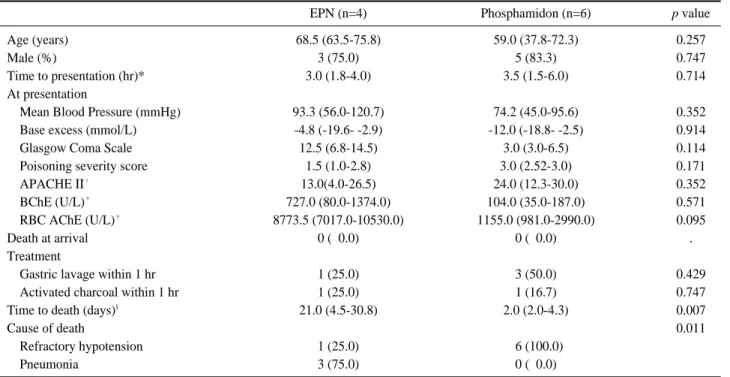
When the characteristics of deceased patients were compared according to the ingested OP, 4 EPN patients and 6 phosphamidon patients were included (Table 3).

None of terbufos patients were included because there

were zero fatalities in the terbufos group. The EPN group tended to have higher GCS scores, BChE levels and RBC AChE levels and lower APACHE II and PSS scores at presentation than the phosphamidon group.

Deaths resulting from ingesting EPN occurred signifi- cantly later than deaths resulting from ingesting phosphamidon (21.0 (45-30.8) days in the EPN group vs. 2.0 (2.0-4.3) days in the phosphamidon group;

p=0.007). The main cause of death in the phosphami- don group was refractory hypotension, whereas pneumonia-related complications were the main cause of death in the EPN group.

DISCUSSION

This study describes the various clinical courses that were observed in patients who were poisoned by one of three WHO hazard class Ia OPs. In particu- lar, we showed the various initial characteristics that were observed in patients who were poisoned with three WHO hazard class Ia OPs and died. However,

Table 3. The initial characteristics of and causes of death in deceased patients.

EPN (n=4) Phosphamidon (n=6) p value

Age (years) 68.5 (63.5-75.8) 59.0 (37.8-72.3) 0.257

Male (%) 3 (75.0) 5 (83.3) 0.747

Time to presentation (hr)* 3.0 (1.8-4.0) 3.5 (1.5-6.0) 0.714

At presentation

Mean Blood Pressure (mmHg) 93.3 (56.0-120.7) 74.2 (45.0-95.6) 0.352

Base excess (mmol/L) -4.8 (-19.6- -2.9) -12.0 (-18.8- -2.5) 0.914

Glasgow Coma Scale 12.5 (6.8-14.5) 3.0 (3.0-6.5) 0.114

Poisoning severity score 1.5 (1.0-2.8) 3.0 (2.52-3.0) 0.171

APACHE II

13.0(4.0-26.5) 24.0 (12.3-30.0) 0.352

BChE (U/L)

727.0 (80.0-1374.0) 104.0 (35.0-187.0) 0.571

RBC AChE (U/L)

8773.5 (7017.0-10530.0) 1155.0 (981.0-2990.0) 0.095

Death at arrival 0 (00.0) 0 (00.0) .

Treatment

Gastric lavage within 1 hr 1 (25.0) 3 (50.0) 0.429

Activated charcoal within 1 hr 1 (25.0) 1 (16.7) 0.747

Time to death (days)

§

21.0 (4.5-30.8) 2.0 (2.0-4.3) 0.007

Cause of death 0.011

Refractory hypotension 1 (25.0) 06 (100.0)

Pneumonia 3 (75.0) 0 (00.0)

Time to presentation (hr)*: Time interval from ingestion to presentation at the emergency department (ED).

APACHE II

: Acute Physiology and Chronic Health Evaluation II.

BChE activities

and RBC AChE activities

: The normal ranges of butylcholinesterase (BChE) and red blood cell acetylcholinesterase (RBC AChE) activity are 4,260-11,250 U/L and 11,188-16,698 U/L, respectively.

Time to death (days)

§

: Time interval from presentation at ED to death.

(6)

the variability that was observed in the clinical cours- es between OPs in this study was unlikely to be the result of patient-related factors because the groups were similar. The initially markedly lower cholinesterase (ChE) activity that was observed in the phosphami- don group can be explained by differences in selec- tive inhibition and variation in the rate of inhibition by each OP rather than more severe intoxication in the phosphamidon group

6)

. Consistent with this find- ing, BChE levels at presentation did not predict out- comes in patients poisoned with OPs in a study that did not account for the chemical formulation of the OP

7)

.

1. Phosphamidon

In this study, the fatality rate in the phosphamidon group appeared to be higher than the rate in the EPN group (28.6% in phosphamidon group vs. 11.8% in EPN group; p=0.116). The lack of a statistical differ- ence in fatality rates in this study may be because of its small sample size. In a similar, national level study performed in South Korea, a 6.7% fatality rate was reported for EPN poisoning, and a 31.8% fatality rate was reported for phosphamidon poisoning

8)

. The phosphamidon group also had a more rapid onset of respiratory failure than the EPN group. This may have been partially caused by the phosphoric acid bonds in phosphamidon. Phosphoric acid bonds (P=O) can lead to a more rapid onset of reactivity with AChE than is observed in an OP with phospho- rothioic bonds (P=S), such as those in EPN, because these bonds require desulfuration to be bioactivated

9,10)

. The lower level of activity of both ChEs in the phos- phamidon group, despite the similar time interval from ingestion to presentation and the similar ingest- ed amount (100 (30.0-275.0) ml in EPN vs. 60.0 (27.5- 275.0) ml in phosphamidon) between the two groups, might reflect the rapid onset of inhibition of AChE by phosphamidon. Death occurred earlier in the phos- phamidon group than in the EPN group, and the cause

part, by a high plasma concentration of phosphami- don that resulted from its low fat solubility. The lower fat solubility of this poison causes it to have a lower volume of distribution and a very high blood concentration in an acute state

3)

. Similarly, dimethoate (log Kow 0.76) caused refractory shock and death within 12-48 hours after ingestion

11)

. Severe isopropyl alcohol poisoning results in CNS disturbance, respira- tory depression, and circulatory collapse

12,13)

. Isopropyl alcohol, an additive of phosphamidon, may have con- tributed to the development of refractory hypotension in deceased patients. However, the osmol gap was less than 20 m Osm/kg H 2 O in 4 of the 6 deceased patients who presented at an ED within a median of 3.5 hours of ingesting phosphamidon. Although the pathophysiology of hypotension in patients with phosphamidon poisoning remains unclear, a physician should focus on reversing hypotension in patients with phosphamidon poisoning by measuring charac- teristics such as the patient’s cardiac output and sys- temic vascular resistance

14,15)

.

2. EPN

The onset of respiratory failure occurred later in the EPN group than in the phosphamidon group, and this may have resulted in part from the presence of phosphorothioic bonds (P=S) in EPN. EPN, which has a higher log Kow than phosphamidon, can rapidly distribute from circulation and then slowly redistrib- ute back into the circulation

9,10)

. This slow redistribu- tion may have been what caused the longer MV sup- port durations that were observed in the EPN group.

Hence, before declaring that a patient who has

ingested EPN is not suffering from severe poisoning,

a physician should observe the patent for a longer

period of time. The patients who died in the EPN group

tended to show milder symptoms than the patients who

died in the phosphamidon group according to GCS,

and APACHE II and PSS scores at presentation. These

findings support the notion that the predictors used

(7)

nia-related complications. Pulmonary toxicity has been reported in patients poisoned with xylene, which is used as an additive in EPN formulations

17)

. Xylene might facilitate the development of pulmonary com- plications, but none of the deceased patients in the EPN showed chest X-ray abnormalities within the first 24 hours after ingestion. The physician should therefore pay more attention to preventing the devel- opment of ventilatory-associated pneumonia (VAP) in EPN patients once cholinergic symptoms have been controlled. The VAP prevention strategies that have been suggested are followings; infection con- trol, semi-recumbent position, regular oral care, aseptic technique during intubation and tracheosto- my, and regular maintence of cut pressure of 20-30 mmH

2

O

18)

.

3. Terbufos

Terbufos is, like EPN, a phosphorodithioate insecti- cide (P=S), and terbufos has a log Kow value similar to that of EPN. However, the terbufos group had a zero fatality rate and a lower frequency of hypoten- sion and respiratory failure than was observed in the EPN group. The zero fatality rate in the terbufos group in this study is in accord with the findings of a previous study

8)

. The lower toxicity that was observed in the terbufos group may have resulted in part from the shorter time interval between ingestion and pre- sentation in the ED, its granular formulation, and its two bonded ethyl groups. Terbufos is sold in a gran- ule formulation. The granule formulation of carbofu- ran, which has an oral LD 50 of 8 mg/kg in rats, was found to have a fatality rate of 1.0%, which is lower than the rate for carbosulfan (10.7%), which has an LD50 of 250 mg/kg when orally administered in rats and is obtained as a liquid

1)

. The speed at which AChE is aged by an OP determines its therapeutic time win- dow. In EPN poisoning, this aging process has been shown to be completed within 4 hour of ingestion, whereas terbufos, a diethyl OP, had a half-life of 33 hours

6)

. We also noted that one patient who was inten- tionally poisoned with terbufos and presented with a GCS score of 3 and an APACHE II score of 30 sur-

vived. However, another patient who ingested EPN and presented with a GCS score of 13 and an APACHE II score of 10 died. These finding suggest that physi- cians should aggressively treat patients poisoned with terbufos, even when a poor outcome is predict- ed based on the initial parameters at presentation in the ED. Diethylene glycol (5%) is added to terbufos granular formulations by the manufacturer to stabilize it. Diethylene glycol can cause serious complications, such as metabolic acidosis, renal failure or delayed neuropathy

19)

. However, renal failure, a hallmark of diethylene glycol poisoning, was not observed in the terbufos group. The granular formation is less readily absorbed from dermal exposure

20)

, however, fatality was reported after continuous inhalational and dermal exposure to large amount of terbufos for 3 hours

21)

. High temperature and humidity, and continuous expo- sure were suggested to increase the absorption of ter- bufos, and finally lead to fatality

21)

. Therefore, physi- cians should keep in mind that the presence of factor which increases the absorption of terbufos can lead to severe symptoms or fatality after terbufos poisoning.

This study has several limitations. The first limitation of our study is that the number of enrolled patients was too small to draw definitive conclusions. Prospective studies involving a larger number of patients are need- ed. However, the fatality rates for the three OPs exam- ined in this study was similar to those in a previous national level study performed in South Korea

8)

. Second, because of the retrospective design of this study, the treatments were not standardized between the two included hospitals. Managing OP poisoning consists of antidote therapy and intensive care support.

Intensive care support might not differ between the

two hospitals. The protocol for antidote therapies

(atropine and PAM) changed in 2012 at Kyungpook

National University Hospital to correspond to the

protocol that is used at Chonnam National University

Hospital. We therefore excluded the patients who

presented at Kyungpook National University Hospital

before 2012. When the six originally included patients

(2 in the EPN group and 4 in the phosphamidon group)

who presented at the Kyungpook National University

after 2012 were excluded, the results were the same

(8)

as the original results that were obtained by including these six patents. Importantly, no patient who present- ed to the Kyungpook National University ED who was poisoned with terbufos was not included.

In conclusion, the clinical courses and causes of death following poisoning with EPN, phosphamidon, or terbufos are diverse in human, even though all three are classified as WHO hazard class Ia OP formulations.

Thus, the treatment protocol, including intensive supportive care and the prediction of outcomes for EPN, phosphamidone or terbufos poisoning, should differ based on the chemical formulation of the OP.

ORCID

Jonggu Mun (https://orcid.org/0000-0001-5108-9509) Jeongmi Moon (https://orcide.org/000-0002-9182-5475)

REFERENCES

01. Dawson AH, Eddleston M, Senarathna L, Mohamed F, Gawarammana I, Bowe SJ, et al. Acute human lethal toxi- city of agricultural pesticides: a prospective cohort study.

PLoS Med 2010;7(10):e1000357.

02. Peter JV, Jerobin J, Nair A, Bennett A. Is there a relationship between the WHO hazard classification of organophos- phate pesticide and outcomes in suicidal human poisoning with commercial organophosphate formulations? Regul Toxicol Pharmacol 2010;57(1):99-102.

03. Eddleston M, Eyer P, Worek F, Mohamed F, Mohamed F, Senarathna L, von Meyer L, et al. Differences between organophosphorus insecticides in human self-poisoning: a prospective cohort study. Lancet 2005;366(9495):1452-59.

04. Sam KG, Kondabolu K, Pati D, Kamath A, Pradeep Kumar G, Rao PG. Poisoning severity score, APACHE II and GCS:

effective clinical indices for estimating severity and pre- dicting outcome of acute organophosphorus and carbamate poisoning. J Forensic Leg Med 2009;16(5):239-47.

05. Jung B, Rimmele T, Le Goff C, Chanques G, Corne P, Jonquet O, et al. Severe metabolic or mixed acidemia on intensive care unit admission: incidence, prognosis and administration of buffer therapy. A prospective, multiple- center study. Crit Care 2011;15(5):R238.

07. Cander B, Dur A, Yildiz M, Koyuncu F, Girisgin AS, Gul M, et al. The prognostic value of the Glasgow coma scale, serum acetylcholinesterase and leukocyte levels in acute organophosphorus poisoning. Ann Saudi Med 2011; 31:

163-6.

08. Moon JM, Chun BJ, Cho YS. The characteristics of emer- gency department presentations related to acute herbicide or insecticide poisoning in South Korea between 2011 and 2014. J Toxicol Environ Health A 2016;79(11):466-76.

09. Hoffman RS, Howland MA, Lewin NA, Nelson LS, Goldfrank LR. Goldfrank’s Toxicologic Emergencies, tenth edition. San Francisco: Mc Graw Hill; 2015.

10. Ballantyne B, Marrs TC. Clinical and experimental toxi- cology of Organophosphates and carbamates. London:

The bath Press;1992.

11. Davies J, Roberts D, Eyer P, Buckley N, Eddleston M.

Hypotension in severe dimethoate self poisoning. Clin Toxicol 2008;46:880-4.

12. Slaughter RJ, Mason RW, Beasley DM, Vale JA. Isopropanol poisoning. Clin Toxicol 2014;52:470-8.

13. Meng X, Paul S, Federman DJ. Metabolic acidosis in a patient with isopropyl alcohol intoxication: a case report.

Ann Intern Med 2014;162:322-3.

14. Buckley NA, Dawson AH, Whyte IM. Organophosphate poisoning. peripheral vascular resistance - a measure of ade- quate atropinization. J Toxicol Clin Toxico 1994; 32:61-8.

15. Marosi G, Iván J, Nagymajtényi L, Csatlós I, Tószegi A.

Dimethoate-induced toxic cardiac failure in the guinea pig.

Arch Toxicol 1985; 57:142-3.

16. Davies JO, Eddleston M, Buckley NA. Predicting outcome in acute organophosphate poisoning with a poison severity score or the Glasgow coma scale. QJM 2008;101:371-9.

17. Morley R, Eccleston DW, Douglas CP, Greville WE, Scott DJ, Anderson J. Xylene poisoning-a report on one fatal case and two cases of recovery after prolonged unconscious- ness. Br Med J 1970;3:442-3.

18. Lau AC, So HM, Tang SL, Yeung A, Lam SM, Yan WW, et al. Prevention of ventilator-associated pneumonia. Hong Kong Med J 2015;21(1):61-8.

19. Schep LJ, Slaughter RJ, Temple WA, Beasley DM.

Diethylene glycol poisoning. Clin Toxicol 2009;47:525-35.

20. Macfarlane E, Carey R, Keegel T, El-Zaemay S, Fritschi L. Dermal exposure associated with occupational end use of pesticides and the role of protective measures. Saf Health Work 2013;4(3):136-41.

21. Liang Y, Tong F, Zhang L, Li W, Huang W, Zhou Y.

Fatal poisoning by terbufos following occupational expo-

수치

Table 1. Characteristics of three World Health Organization (WHO) hazard class Ia organophosphates (OPs).
Table 2 shows the baseline and clinical characteris- characteris-tics  of  75  patients  who  were  poisoned  with  either EPN, phosphamidon, or terbufos.
Table 3. The initial characteristics of and causes of death in deceased patients.

참조

관련 문서

with the experimental C versus t data. If the fit is unsatisfactory, another rate equation is guessed and tested. Integral method is especially useful for fitting simple

In 2009 Lakhvir Singh of Feltham, west London, used aconitine to poison the food of her ex-lover (who died as a result of the poisoning) and his current fiancée?. Singh received

In this study, the dislocation group had a wider width of AEB (p&lt;0.05), and the posterior slope (TR angle) of the AER and the average of AEB were smoother (p&lt;0.05) compared

As a result of performing a compound exercise of spinning and Zumba for 8 weeks, the change in α-amylase showed a significant difference in the exercise group (p&lt;.01), and

Subjects with a smoking period of 1 to 3 years had a high smoking cessation success rate (p=0.024), and the lower the average daily smoking amount, the higher the

Article 14 (Allowances, etc,) The members who attend a meeting of the Deliberative Committee and a person who is required to attend the meeting to make

Transformed –log 10 p of SNPs from the logistic regression model of association with dementia based on the additive model in male subjects.. P-value on the left Y-axis is

- Example) Suppose that a new product or facility is proposed and that the criterion for success is a 10 percent rate of return on the investment for a 5-year life of the