• 검색 결과가 없습니다.

Processing, structure, and properties of lead-free piezoelectric NBT-BT

N/A
N/A
Protected

Academic year: 2021

Share "Processing, structure, and properties of lead-free piezoelectric NBT-BT"

Copied!
6
0
0

로드 중.... (전체 텍스트 보기)

전체 글

(1)

Vol. 25, No. 4 (2015) 160-165

http://dx.doi.org/10.6111/JKCGCT.2015.25.4.160

e-ISSN 2234-5078

Processing, structure, and properties of lead-free piezoelectric NBT-BT

Sungwook Mhin, Jung-Il Lee* and Jeong Ho Ryu*

,†

Heat Treatment R&D Group, Korea Institute of Industrial Technology, Cheonan 429-846, Korea

*Department of Materials Science and Engineering, Korea National University of Transportation, Chungju 380-702, Korea (Received July 30, 2015)

(Revised August 12, 2015) (Accepted August 17, 2015)

Abstract Lead-free piezoelectric materials have been actively studied to substitute for conventional PZT based solid solution, Pb(Zr

x

Ti

1 − x

O

3

), which occurs unavoidable PbO during the sintering process. Among them, Bismuth Sodium Titanate, Na

0.5

Bi

0.5

TiO

3

(abbreviated as NBT) based solid solution is attracted for the one of excellent candidates which shows the strong ferroelectricity, Curie temperature (Tc), remnant polarization (Pr) and coercive field (Ec). Especially, the solid solution of rhombohedral phase NBT with tetragonal perovskite phase has a rhombohedral - tetragonal morphotropic phase boundary. Modified NBT with tetragonal perovskite at the region of MPB can be applied for high frequency ultrasonic application because of not only its low permittivity, high electrocoupling factor and high mechanical strength, but also effective piezoelectric activity by poling. In this study, solid state ceramic processing of NBT and modified NBT, (Na

0.5

Bi

0.5

)

0.93

Ba

0.7

TiO

3

(abbreviated as NBT-7BT), at the region of MPB using 7 % BaTiO

3

as a tetragonal perovskite was introduced and the structure between NBT and NBT-7BT were analyzed using rietveld refinement. Also, the ferroelectric and piezoelectric properties of NBT-7BT such as permittivity, piezoelectric constant, polarization hysteresis and strain hysteresis loop were compared with those of pure NBT.

Key words NBT-7BT, Ferroelectric properties, Piezoelectric properties

1. Introduction

To date, the dominant piezoceramic has been lead zir- conate titanate (Pb(Zr

1 − x

Ti

x

)O

3

or PZT), because it shows excellent piezoelectric properties [1]. However, as its applications have expanded, environmental concern is also increasing due to the volatilization of PbO during processing, as well as recycling and waste disposal issues [2]. This has resulted in the exploration of Pb-free mate- rials to substitute for PZT in current and developing piezoelectric applications [3-8].

Amongst the candidates to substitute for the conven- tional PZT, (Na

x

Bi

1 − x

)

y

Ba

1 − y

TiO

3

(NBT-BT) is one of the most promising. [9] However, (Na

x

Bi

1 − x

)

y

Ba

1 − y

TiO

3

(NBT) in the undoped form shows a high coercive field, which makes poling difficult. Also, its ferroelectric properties are not competitive with PZT. When NBT is modified using dopants such as BaTiO

3

, and is near the MPB ((Na

0.5

Bi

0.5

)

0.93

Ba

0.7

TiO

3

), it has the potential for improved properties: higher mechanical strength, higher electro-mechanical coupling factor and effective piezo- electric activity by poling [10].

In this study, (Na

0.5

Bi

0.5

)

0.93

Ba

0.7

TiO

3

(NBT-7BT) was prepared via solid state processing. The properties of the NBT-7BT were compared with those of undoped Na

0.5

Bi

0.5

TiO

3

(NBT).

2. Experimental Procedure 2.1. Sample preparation

NBT was fabricated using the raw powders: sodium carbonate, titanium dioxide, bismuth oxide. The infor- mation about the raw powders is provided in Table 1.

The NBT-7BT was synthesized using following method;

raw powders of sodium carbonate, titanium dioxide, bis- muth oxide, and barium carbonate were used to synthe- size NBT-7BT. Details of the starting powders are provided in Table 2.

Before weighing the raw powders, the sodium carbon- ate and barium carbonate were dried at 150

o

C for 1 h.

The starting powders were weighed in stoichiometric amounts and placed in a 16 ounce Nalgene bottle con- taining 300 gm of 5 mm diameter, spherical zirconia milling media and 100 ml of ethanol and ball milled for 48 h. The powders were then dried for 24 h in an oven at 100

o

C. The dried powders were ground in a mortar

Corresponding author

Tel: +82-43-841-5384

Fax: +82-43-841-5380

E-mail: [email protected]

(2)

and pestle and were passed through 200 μm STM sieve.

The powders were calcined in a closed alumina cruci- ble using a heating rate of 5

o

C/min up to 900

o

C, held for 3 h at 900

o

C and cooled at a rate of 4

o

C/min. The calcined powders were placed in a 16 ounce Nalgene bottle containing 300 gm of 5 mm spherical zirconia milling media, and 100 ml of ethanol and ball milled for 24 h. The powders were then dried for 24 h in an oven at 100

o

C and ground in a mortar and pestle with 1 gm of PVA binder.

0.4 g of the powder and binder mixture was loaded into a 10 mm diameter die and pressed into pellets using a uniaxial stress of 35 MPa. The pellets were then loaded into balloons, the balloons were evacuated of air, the ends tied, and the balloons were placed in the isostatic press under a 200 MPa stress for 2 min. Following this, the pellets were placed in a covered alumina crucible and sintered at 1150

o

C for 3 h after holding at 400

o

C for 1 h. The heating rate up to sintering temperature was 5

o

C/min and the cooling rate down to room tempera- ture was 5

o

C/min. Both undoped NBT and NBT-7BT were made using this process.

2.2. Characterization

The density of the sintered pellets was measured using the Archimedes principle. The fluid used for the experi- ments was water and the measurements were per- formed at an ambient temperature of 25.1

o

C. Powder X- ray diffraction patterns of the pellets were recorded using a laboratory X-ray diffractometer equipped with a curved position sensitive detector (CPS 120, Inel), CuK α1 radiation, and multi-layer mirror optics for increased intensity. The surface of each pellet was investigated using SEM. Before the SEM observation, the samples

were polished using diamond paste on the glass plate for improving the effect of thermal etching and then, thermal etching was performed, so that a reliable quanti- tative estimate of grain size could be achieved. Thermal etching was performed at the different conditions. The conditions were 1000

o

C for 10 min, 1000

o

C for 30 min, 1050

o

C for 10 min and 1050

o

C for 30 min and the opti- mal conditions for thermal etching were 1000

o

C for 10 min. With the other conditions, grain growth was observed after thermal etching. For electrical poling of the samples, the surfaces of pellets were cleaned with acetone and ethanol. Gold electrodes were deposited on the top and bottom surfaces using Gold sputter. The electrodes were of the same planar dimensions as the samples. Electrical poling was performed on pellets in an oil bath heated to 60

o

C. The samples were poled using the conditions listed in Table 3.

The direct, longitudinal piezoelectric coefficient (d

33

) was measured using a wide-range Berlincourt d

33

meter (model 90-2030, APC Ceramics) both immediately after poling and 10 days after poling. Also, the perpendicular piezoelectric coefficient (d

31

) to the polarization direc- tion was measured using a Berlincourt d

31

meter imme- diately after poling. Polarization and strain hysteresis of a poled sample from undoped NBT and NBT-7BT were measured at a frequency of ~1 Hz under 8 kV/mm. Also, impedance and series resonance frequency of the pel- lets was measured using an Agilent 4294A Precision Table 1

Starting powders, companies, purities, molar fraction, molar weight, and weight used in synthesis of NBT

Composition Company Purity Molar fraction Molar weight (g/mol) Weight used (g)

Na

2

CO

3

Alfa aesar 99.5 % 0.25 105.99 1.2634

TiO

2

Fisher scientific 99.85 % 1 79.87 3.7785

Bi

2

O

3

Alfa aesar 99.975 % 0.25 465.9 5.5108

Table 2

Starting powders, companies, purities, molar fraction, molar weight, and weight used in synthesis of NBT-7BT

Composition Company Purity Molar fraction Molar weight (g/mol) Weight used (g)

Na

2

CO

3

Alfa aesar 99.5 % 0.2325 105.99 1.1609

TiO

2

Fisher scientific 99.85 % 1 79.87 3.8994

Bi

2

O

3

Alfa aesar 99.975 % 0.2325 465.9 5.0792

BaCO

3

Alfa aesar 99.8 % 0.07 197.35 0.6474

Table 3

The conditions in undoped NBT and NBT-7BT pellets Thickness

(mm)

Voltage (kV)

Field (kV/mm)

Time (min)

NBT 1.19 7.2 6.05 10

NBT-7BT 1.33 8 6.01 10

(3)

Impedance Analyzer. Dielectric permittivity of pellets was calculated using capacitance measured from pellets using an Agilent 4284A Precision LCR meter.

3. Results and Discussion

Relative densities of the undoped NBT and NBT-7BT were shown in Table 4. The relative density calculations were based on the theoretical density of undoped NBT and NBT-7BT, 5.99 g/cm

3

and 5.92 gm/cm

3

, respectively.

The equation used to calculate absolute density is:

p = w a ( ) * p fl ( ) 0.99983G

--- + 0.0012

Table 4

Sample weight and density calculations of NBT and NBT-7BT Weight

in air (g)

Weight in water (g)

Calculated absolute density (g/cm

3

)

Relative density (%)

NBT 0.3676 0.3048 5.84098 97.51

NBT-7BT 0.392 0.3233 5.6914 96.05

Fig. 1. (a) XRD patterns of sintered NBT and NBT-7BT pellets and (b) Rietveld refinement of NBT-7BT.

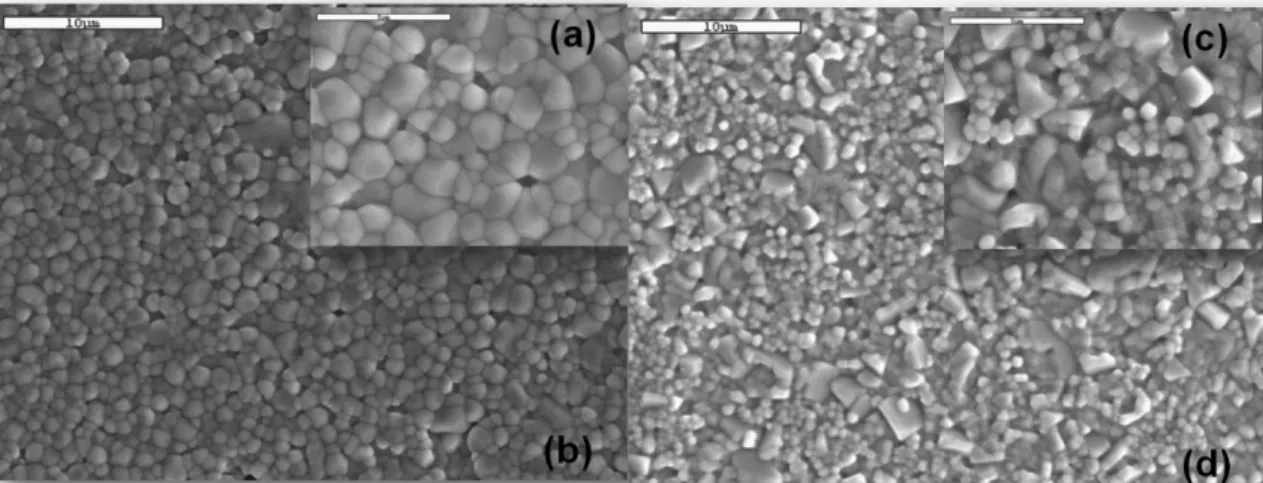
Fig. 2. Scanning electron micrographs of (a), (b) NBT and (c), (d) NBT-7BT.

where w(a) - the weighed mass of pellet in air p(fl) - density of fluid (H

2

O at 25.1

o

C, p(fl) is 0.99707.) G = w(a) − w(fl)

The densities of undoped NBT and NBT-7BT were 97.51 % and 96.05 %, respectively.

Diffraction patterns of the powders were obtained from the surface of sintered pellets of undoped NBT and NBT-7BT. Selected diffraction patterns of sintered pellets are shown in Fig. 1(a). Both the upper and lower surfaces of each pellet were measured and the diffrac- tion patterns obtained were very similar.

The diffraction patterns of NBT-7BT were analyzed using the Rietveld refinement program RIETICA. The space group R3m was used in the calculated patterns, and the difference of patterns below shows that this matches the experimental data closely (see Fig. 1(b)).

Other space groups were attempted, each with a worse

fit to the experimental pattern. The lattice parameters

obtained from the refinement are a = 5.537675 Å and

c = 6.7929 Å (in the hexagonal setting). This converts to

a = 3.91779 Å and α = 89.9399

o

in the rhombohedral

(4)

setting. NBT-7BT powders show no second phases observed by XRD, indicating the samples are phase- pure. The sintered pellets have a homogeneous crystal structure throughout, which is shown by comparing the diffraction patterns of top and bottom surface of pellets.

Representative secondary electron micrographs of samples after thermal etching at the optimal conditions are shown in Fig. 2. The micrographs of undoped NBT (Fig. 2 (a), (b)) show homogeneous size distribution of grains which range from 500 nm to 3 μm, while less homogeneous size distribution of grains in the NBT- 7BT (Fig. 2 (c), (d)) is shown.

The measured d

31

and d

33

values for NBT and NBT- 7BT are shown in Table 5. The value of d

33

in NBT- 7BT pellet was almost twice higher than the undoped NBT. Also, d

31

of the NBT-7BT was higher than the undoped NBT. However, decrease of the d

33

and d

31

was observed in the NBT-7BT, while no change of piezo- electric coefficient was observed in undoped NBT after 10 days.

The capacitance, dielectric permittivity and piezoelec-

Table 5

The value of d

33

and d

31

in undoped NBT and NBT-7BT pellets

d

33

after poling (pC/N) d

33

after 10 days (pC/N) d

31

after poling (pC/N) d

31

after 10 days (pC/N)

NBT 72/−70 71/−69 −34 −31

NBT-7BT 143/−138 130/−128 −43 −39

Table 6

The conditions and value of dielectric permittivity and g

33

/g

31

of NBT and NBT-7BT pellets

Thickness (m) The area of sample electrode (m

2

) Capacitance (F) Dielectric permittivity g

33

(Vm/N) g

31

(Vm/N)

NBT 0.001 0.00001592 170 384.266866 0.02143 0.01039

NBT-7BT 0.0013 0.00005338 248.27 683.2 0.02074 0.00612

Fig. 3. (a) Polarization, (b) strain loops for NBT and NBT-7BT and (c) piezoelectric properties of undoped NBT and NBT-7BT pellets.

tric voltage constants of samples are shown in Fig. 3.

The equation used to calculate dielectric permittivity is:

where t - thickness (m)

where S - Area of covered electrodes (m

2

) where C - Capacitance

where ε

0

- dielectric permittivity in air (8.85*10-12 F/m) Also, piezoelectric voltage constants (g

31

, g

33

) were cal- culated using the equation:

As shown in Table 6, the values of the capacitance and dielectric permittivity of the NBT-7BT were larger than those of undoped NBT.

The strain and the hysteresis loop from each sample ε r, 33 T = t * C

S * ε 0 ---

g 33 = d 33 ε 0 * ε r, 33 T ---

g 31 = d 31

ε 0 * ε r, 33 T

---

(5)

were shown in Fig. 3. The coercive field from the hys- teresis loop (Fig. 3(a)) shows the NBT-7BT has lower coercive field than undoped NBT. In the strain hystere- sis measurements (Fig. 3(b)), the NBT-7BT shows larger strain than pure NBT under electrical field. Piezoelec- tric properties of both pellets are summarized in Fig.

3(c).

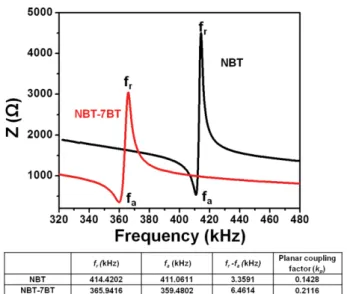
Fig. 4 shows the impedance from each sample as a function of frequency. Also, it shows details of reso- nance and anti-resonance frequencies of impedance of samples. The planar coupling (k

p

) factors of the sam- ples in the table below were calculated using the follow- ing approximation:

The results show that the planar coupling (k

p

) of NBT- 7BT is higher than that of undoped NBT. Also, the value of the planar coupling factor of each sample is comparable to reported values [1].

Table 7 shows the resonance frequency and fre- quency constant of both NBT and NBT-7BT. The fre- quency constant (N

p

) of each samples was calculated using the following equation:

N

p

= f

r

· D

where D : diameter of ceramic element where f

r

: resonant frequency

4. Summary

NBT and NBT-7BT pellets were prepared using solid solution processing. NBT-7BT shows lower coercive field, higher piezoelectric coefficient, higher dielectric permittivity and higher planar coupling factor than undoped NBT. This work confirms that the use of the materials with compositions close to morphotropic phase boundaries can be advantageous to the improve- ment of piezoelectric properties.

Acknowledgement

This research was supported by a grant from the School of Convergence Program of Ministry of Education.

References

[ 1 ] V.T. Tung, N.T. Tinh, T.V. Chuong, N.T.M. Huong, D.A. Tuan and L.V. Truyen, “Investigation the dimen- sional ratio effect on the resonant properties of piezo- electric ceramic disk”, J. Modern Phys. 4 (2013) 1627.

[ 2 ] D. Akai, R. Yoshita and M. Ishida, “(Na, Bi)TiO

3

based lead-free ferroelectric thin films on Si substrate for pyroelectric infrared sensors”, J. Phys.: Conference Series 433 (2013) 012017-1-6.

[ 3 ] M. Cernea, B.S. Vasile, C. Capiani, A. Ioncea and C.

Galassi, “Dielectric and piezoelectric behaviors of NBT- BT

0.05

processed by sol–gel method”, J. Eur. Ceram.

Soc. 32 (2012) 133.

[ 4 ] M. Chen, Q. Xu, B.H. Kim, B.K. Ahn and W. Chen,

“Effect of CeO

2

addition on structure and electrical properties of (Na

0.5

Bi

0.5

)

0.93

Ba

0.07

TiO

3

ceramics prepared by citric method”, Mater. Res. Bull. 43 (2008) 1420.

[ 5 ] H. Wang, R. Zuo, X. Ji and Z. Xu, “Effects of ball mill- ing on microstructure and electrical properties of sol-gel derived (Na

0.5

Bi

0.5

)

0.94

Ba

0.06

TiO

3

piezoelectric ceramics”, Mater. Des. 31 (2010) 4403.

[ 6 ] A. Ullah, C.W. Ahn, A. Hussain and I.W. Kim, “The effects of sintering temperatures on dielectric, ferro- electric and electric field-induced strain of lead-free Bi

0.5

(Na

0.78

K

0.22

)

0.5

TiO

3

piezoelectric ceramics synthe- sized by the sol gel technique”, Curr. Appl. Phys. 10 (2010) 1367.

[ 7 ] H. Takahashi, Y. Numamoto, J. Tani, K. Matsuta, J.

Qiu and S. Tsurekawa, “Lead-free barium titanate ceramics with large piezoelectric constant fabricated by microwave sintering”, Jpn. J. Appl. Phys. 45 (2006) L30-2.

[ 8 ] H.D. Li, C. Feng and W.L. Yao, “Some effects of differ- k p = 2.51 f a − f r

f a ---

⎝ ⎠

⎛ ⎞ − f a − f r f a ---

⎝ ⎠

⎛ ⎞ 2

Fig. 4. Impedence value and planar coupling factor of NBT and NBT-7BT as a function of frequency.

Table 7

Frequency constant of undoped NBT and NBT-7BT pellets Diameter (m) f

r

(kHz) N

p

(m/s)

NBT 0.007909 411.0612 3251.283

NBT-7BT 0.00806 359.4802 2897.33

(6)

ent additives on dielectric and piezoelectric properties of (Na

1/2

Bi

1/2

)TiO

3

-BaTiO

3

morphotropic-phase-boundary composition”, Mater. Lett. 58 (2004) 1194.

[ 9 ] J. Rodel, W. Jo, K.T.P. Seifert, E. Anton and T. Gran- zow, “Perspective on the development of lead-free

piezoceramics”, J. Amer. Ceram. Soc. 92 (2009) 1153.

[10] T. Tanaka, K. Maruyama and K. Sakata, “(Bi

0.5

Na

0.5

)TiO

3

-

BaTiO

3

system for lead-free piezoelectric ceramics”,

Jpn. J. Appl. Phys. 30 (1991) 2236.

수치

Fig. 2. Scanning electron micrographs of (a), (b) NBT and (c), (d) NBT-7BT.
Fig. 4 shows the impedance from each sample as a function of frequency. Also, it shows details of  reso-nance and anti-resoreso-nance frequencies of impedance of samples

참조

관련 문서

Temperature distribution of cold region between thermoelectric cooling system and piezoelectric actuator was visualized without and with the piezoelectric

Our results also showed that pigment epithelium-derived factor concentration in vitreous was higher than that in serum, suggesting that it is mainly derived from

Forth, as higher Internet addiction degree is, higher Internet-use-con fidence, Internet-learning-efficacy, and Connection-frmation-efficacy of Internet are,

In this study, it can be interpreted that the combined increase of the trust and the alternative attraction makes the intention of conversion higher rather

같이 크게 열전 소자 (thermoelectric module), 열전 소자의 발열부에서 발생하는 열을 냉각하기 위한 방열판 (heat sink)과 냉각 팬 (cooling fan)으로 구성된 열전냉

GH, cortisol, epinephrine and norepinephrine of metabolic hormone show higher from Taekwondo training group who undergo regular training, which shows

 Since the output impedance of bipolar cascode is higher than that of the CE stage, we would expect its voltage gain to be higher as well.... Alternate View

For class flow, autotelic experience of the first and second graders was higher than that of the third graders, and matching of behavior with consciousness