Introduction
Abalone is a gastropod shellfish belongs to the family Haliotidae.
It is distributed worldwide along coastal waters of the tropical and temperate areas (Gordon and Cook, 2004). In the coasts of North-west Pacific Ocean, it is generally distributed in Korean Peninsula, Shandong and Liaodong Peninsula of China, Japan and Far East water of Russia (Lv, 1978; Gordon and Cook, 2004; Hara and Sekino, 2005). Among the abalone species, Pacific abalone (Haliotis discus hannai) is the most important invertebrate species in Korea as well as in the south-east Asian countries. It is widely used in commercial aquaculture because of its food value and high price (Park and Kim, 2013). Large-scale farming in sea cages has spread along small bays and islands of the south-west coast of Korea (Choi et al., 2015). The growth and development of abalone is influenced by various environmental factors, such as tempera- ture, oxygen, CO2 and salinity. Among these factors, water tem- perature is the most important, having higher effect on growth as well as increase of summer mortality (Kang et al., 2019). Water
temperature changes causes various effect on aquatic organisms, such as, increase in temperature reflected in the decreased oxygen solubility in coastal waters, which creates hypoxic conditions, thus causing internal energy imbalance (Mateus et al., 2017). This stress condition makes them highly susceptible to pathogens, and in- crease the mortality. The optimum temperature tolerance of Pacific abalone is 20℃. The deviations from the optimal temperature resulted in suppressed lysozyme activity, reducing immune activity against bacterial infection and leading to high mortality (Ding et al., 2016).
The Heat shock proteins (HSPs) are one of the highly conserved groups of proteins, found in nearly every species from bacteria to humans. HSPs mediate the homeostatic cellular response to stress (Breitburg et al., 2018). HSPs are molecular chaperones, in that they interact with other proteins and facilitating protein synthesis, promoting productive folding pathways and ultimately stabilizing cellular proteins and membranes. Other than cellular stress; HSPs are present in cells constitutively, such that under normal growth conditions HSPs help to guide protein folding and movement
JMLS
http://jmls.or.krExpression Profile of Heat Shock Protein Gene Transcripts (HSP70 and HSP90) in the Nerve Ganglia of Pacific abalone, Haliotis discus hannai Exposed to Thermal Stress
Zahid Parvez Sukhan, Kang Hee Kho*
Department of Fisheries Sciences, Faculty of Aquatic Biology, Chonnam National University, Jeonnam 59626, Korea
Corresponding Author Kang Hee Kho
Department of Fisheries Sciences, Faculty of Aquatic Biology, Chonnam National University, Jeonnam 59626, Korea E-mail : [email protected]
Received : November 24, 2020 Revised : November 25, 2020 Accepted : December 14, 2020
Heat shock proteins (HSPs) are highly conserved cellular proteins that contribute to adaptive responses of organisms to a variety of stressors. In response to stressors, cellular levels of HSPs are increased and play critical roles in protein stability, folding and molecular trafficking. The mRNA expression pattern of two well-known heat shock protein transcripts, HSP70 and HSP90 were studied in two tissues of nerve ganglia, cerebral ganglion and pleuropedal ganglion of Pacific abalone (Haliotis discus hannai). It was observed that both HSP70 and HSP90 transcripts were upregulated under heat stress in both ganglion tissues. Expression level of HSP70 was found higher than HSP90 in both ganglia whereas cerebral ganglion showed higher expression than pleuropedal ganglion. The HSP70 and HSP90 showed higher expression at Day-1 after exposed to heat stress, later decreased at Day-3 and Day-7 onwards. The present result suggested that HSP70 and HSP90 synthesize in nerve ganglion tissues and may provide efficient protection from stress.
Keywords: Heat shock protein, HSP70, HSP90, Heat stress, Pacific abalone, Haliotis discus hannai
throughout the life of the cell, performing important housekeeping functions associated with protein synthesis and maturation (Nam et al., 2017; Wang et al., 2011). Although thermal stress plays important role to stimulate the expression of HSPs, other environ- mental stressors such as hypoxia, osmotic stress, heavy metals and ultraviolet damage and physical trauma (such as infection, oncogenesis, inflammation, ischemia and reperfusion) can stimulate the expression of HSPs (Craig, 1994; Jolly and Morimoto, 2000).
The HSPs are categorized into 6 major families based on their molecular weight, such as HSP100, HSP90, HSP70, HSP60, HSP40 and small HSPs (Jolly et al., 2018). Among them, HSP70 and HSP- 90 are the most well characterized HSP and have diverse roles that are still being identified. These proteins have been reported to function to protect trigeminal ganglion neurons from thermal stress and to play role in neuronal polarization, as well as a role in neuronal disease (Turturici et al., 2011). HSP90 is the most abun- dant among the heat shock proteins. HSP90 functions as molecular chaperone in maturation and activation of the proteins that are important for growth and development (Pratt, 1997; Keppler et al., 2006). The HSP70 family represents one of the largest family of HSP distributed across organisms. HSP70 prevents proteins from aggregating by binding tightly to partially synthesized poly- peptides, assists in the transmembrane transport of proteins and participates in the removal of damaged or defective proteins (Mayer and Bukau, 2005; Wegele et al., 2004).
Both HSP70 and HSP90 play a role in neuronal development and cellular maintenance, however these HSPs can also promote disease pathology (Walsh et al., 1997; Sidera et al., 2004). HSP70 acts to protect the nervous system from toxic effects that develop from neurodegenerative disease in mammals (Magrane et al., 2004).
On the other hand, HSP90 is thought to repair disease conditions of several neurodegenerative disorders characterized by the de- position of abnormal tau protein in the brain (Bohush et al., 2019).
HSP90 can also act to repress HSP70 and other heat shock pro- teins. Thus heat shock protein plays important role to protect the central nervous system (CNS) and other tissues by both positive and negative transcriptional regulations. Several researches have been conducted on the expression and role of HSP70 and HSP90 in central nervous system so far. In the central nervous system, these proteins may be required for axonal regeneration after molting in lobster (Spees et al., 2002), and it also helps to recover the damaged nervous tissue of crustaceans (Rochelle et al., 1991;
Bittner, 1988; Bittner, 1991). A gastropod species, Lymnae stagnalis, showed higher expression of HSP70 in the central nervous system when exposed to thermal stress (Foster et al., 2015). In Pacific
abalone, both HSP 90 and HSP 70 have been reported and observed their expression in different tissues other than nerve ganglia (Zhang et al., 2011; Cheng et al., 2007). With the above discussion, using quantitative real-time polymerase chain reaction (qRT-PCR), we analyze the mRNA expression of HSP70 and HSP90 in the two tissues of nerve ganglia, cerebral ganglion (CG) and pleuropedal ganglion (PPG) of Pacific abalone after exposed to temperature stress.
Materials and Methods 1. Abalone collection and rearing
Pacific abalone, H. discus hannai were collected from cages of abalone sea cage aquaculture of East sea of Wando-gun, Jeollanam-do, South Korea in June. The water temperature of sampling site was 20℃. Collected abalones were transported to the Tou-Jeong Soosan abalone hatchery in Dolsan-eup, Yeosu-si, Jeollanam-do, and reared in indoor tank with recirculating sea water for conditioning under natural photoperiod for two weeks.
The water temperature during conditioning period was similar to that in sampling site.
2. Experimental design
Experiments under different temperature condition were con- ducted in June 2020. Pacific abalones were exposed to low (15℃), ambient or normal (20℃) and high (25℃) water temperature. To acclimatize the Pacific abalone to low and high temperature, temperature was gradually decreased or increased (Δ1℃ per 24 h) from normal water temperature to target temperature conditions.
After reaching at target water temperature, abalone samples were exposed to the target temperature. After exposed to target tem- perature, abalones were sampled at 1, 3, and 7 days, which served as day-1, day-3, and day-7 groups, respectively (n = 5 for each group). In addition, a set of abalone was sampled just before start of the experiment in changing water temperature condition and this group was served as initial control (IC).
3. Abalone husbandry and monitoring
Water temperature of experimental tank was maintained using electric cooling and heating system unit using electronic thermo- stat (DHE, South Korea) with a water flow rate at 1.5 ℓ min-1. Water quality parameters such as dissolved oxygen, salinity, tem-
perature and pH were measured daily with YSI professional plus digital water quality meter (Pro 10102030; Xylem Inc., USA).
Abalones were fed daily to satiation with sea weed, Laminaria religosa.
4. Ethics statement
Animal experiments were conducted in accordance with the guidelines of the Institutional Animal Care and Use Committee of Chonnam National University (CNU IACUC) with a permission number of CNU IACUC-YS-2020-5 and according to Article 14th of the Korean Animal Protection Law of the Korean government, and the animals were cared for in accordance with the Guidelines for Animal Experiments of Chonnam National University.
5. Sample collection
After each water temperature exposer, abalones were collected and anesthetized and sacrificed before sample collection. The total length and width were measured using digimatic caliper and weight was taken using electric balance in nearest mm and g respectively. From each abalone of each set of samples, cerebral ganglion (CG), pleuropedal ganglion (PPG), were collected; snap frozen in liquid nitrogen and stored at -80℃ until total RNA extraction.
6. Total RNA extraction and cDNA synthesis
Total cellular RNA from all sampled tissues of Pacific abalone were extracted using a RNeasy mini kit (Qiagen, Hilden, Germany), then any possible contamination of genomic DNA was eliminated by treating with RNase-free DNase (Promega, Madison, WI, USA).
Quality and quantity of total RNA was evaluated by electro- phoresis and spectrophotometry (NanoDrop® NP1000). First-strand cDNA was synthesized from total RNA using Oligo (dT) primer (OdT) (Sigma) and Superscript® III First-Strand cDNA synthesis kit (Invitrogen, USA). All steps of the RNA extraction and cDNA synthesis were conducted as per the manufacturer's instructions.
7. Quantitative real time PCR (qRT-PCR) analysis of abalone heat shock protein gene transcript, HSP- 70 and HSP90
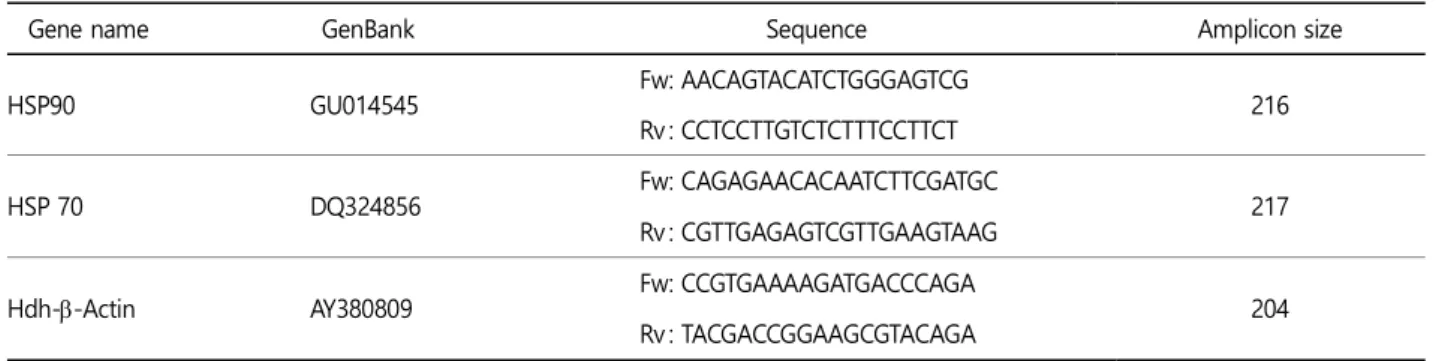
The quantitative real-time PCR (qPCR) assay was carried out using 2x qPCRBIO SyGreen Mix Lo-Rox kit (PCR Biosystems Ltd., UK) as describe previously (Sukhan et al., 2020). Briefly, the qPCR reaction mixture was prepared with 1 μl of cDNA template, 1 μl (10 pmol) of forward and reverse primer (Table 1), 10 μl of SYBR Green Mix, and dH2O with a final volume of 20 μl. Triplicate reactions were performed for each tissue sample of the target and reference genes. The PCR amplification conditions were pre- incubation at 95℃ for 3 min, followed by 40 cycles of a three-step amplification at 95℃ for 30 sec, 60℃ for 30 sec, and 72℃ for 30 sec. The melting temperature was used as prescribed default setting. At the end of each cycle, a fluorescence reading was recorded for quantification. A LightCycler® 96 System (Roche, Germany) was used for amplification and data analysis. Specific amplification of each subtype cDNA was verified by melting curve analysis and gel electrophoresis of the product. The relative gene expression was quantified on the basis of the cycle threshold 2-ΔΔct method with β-actin gene (GenBank accession no. AY380809) as an internal reference gene (Livak and Schmittgen, 2001).
Table 1. Lists of Haliotis discus hannai gene specific primers for heat shock protein gene transcripts (HSP70 and HSP90) and housekeeping gene Hdh-β-Actin used in qRT-PCR
Gene name GenBank Sequence Amplicon size
HSP90 GU014545 Fw : AACAGTACATCTGGGAGTCG
Rv : CCTCCTTGTCTCTTTCCTTCT 216
HSP 70 DQ324856 Fw : CAGAGAACACAATCTTCGATGC
Rv : CGTTGAGAGTCGTTGAAGTAAG 217
Hdh--Actin AY380809 Fw : CCGTGAAAAGATGACCCAGA
Rv : TACGACCGGAAGCGTACAGA 204
8. Statistical analysis
The mRNA values were analyzed statistically and expressed as mean ± SD. The changes in relative mRNA expression in different tissues were analyzed by one-way analysis of variance (ANOVA) followed by Tukey's post hoc test to assess statistically significant differences among the different temperature-days conditions. Sta- tistical significance was set at p < 0.05, different letters in figures show significant differences between different temperature. All data were analyzed and graphs were generated with GraphPad Prism 5.1 software (GraphPad Software, San Diego, CA, USA).
Results and Discussions
In the present study, mRNA expression pattern of two shock protein transcripts, HSP70 and HSP90 were analyzed in cerebral ganglion and pleuropedal ganglion of H. discus hannai. The mRNA expression of HSP70 was rapidly increased and showed higher expression in the cerebral ganglion at the first day when exposed to high water temperature (25℃, 5 degrees higher than normal water temperature), on the other hand, it was also showed increased expression when exposed to lower water temperature stress (15℃, 5 degrees higher than normal water temperature).
The elevation of HSP70 was lower in low water temperature than high water temperature stress. However, the changes of expres- sion between low and high water temperature was not statistically
significant. On the Day-3 and Day-7, the level of mRNA expres- sion of HSP70 was decreased significantly than Day-1 sample (Fig. 1). The mRNA expression of HSP70 in the pleuropedal ganglion was also showed elevated expression when exposed to both low and high water temperature stress compared to normal water temperature (Fig. 2). In both ganglion, expression of HSP70 showed unchanged expression at normal water temperature (20℃) during the experimental period.
The expression of HSP90 mRNA showed higher expression at the first day when exposed to high water temperature (25℃, 5 degrees higher than normal water temperature) in the cerebral ganglion. At low water temperature (15℃, 5 degrees higher than water normal temperature) stress, the expression of HSP90 was also showed elevated expression (Fig. 3). The changes of expression between low and high water temperature was not significant. On the day-3 and day-7, the level of mRNA expression of HSP90 was decreased moderately, however it was not statistically significant.
The mRNA expression of HSP90 in the pleuropedal ganglion was also showed elevated expression when exposed to both low and high water temperature compared to normal water temperature (Fig. 4). The changes of expression of HSP90 in pleuropedal ganglion among Day-1, Day-3 and Day-7 was not significant. The expression level was observed lower in the pleuropedal ganglion than cerebral ganglion. In both ganglion, expression of HSP90 showed similar expression pattern at normal water temperature (20℃) during the experimental period.
The central nervous system is sensitive to thermal stress and heat shock response in many forms of neurons may contribute in this process. In the present study, it was observed that both HSP70 and HSP90 level was significantly elevated in the nerve ganglia after exposed to thermal stress. In Lymnae stagnalis, HSP70 was rapidly increased in the central nervous system within 30 min of the end of the thermal stress, later it was decreased gradually (Foster et al., 2015). In cray fish, Procambarus clarkia, it was reported that both HSP70 and HSP90 showed increased expression in the nervous system when exposed to heat stress (Jolly et al., 2018; Liang et al., 2013). Several studies showed that motor neurons have high efficiency to induce heat shock response that accredited to active heat shock transcription factor 1 (Manzerra and Brown, 1992; 1996). Other studies showed that the protection of motor neurons partly depended extracellular HSPs, suggesting that HSP70 and HSP90 could contribute to the thermal stress response in the nervous system (Sarge et al., 1993; Batulan et al., 2006). They also hypothesized that motor neurons synthesize HSP70 and HSP90 to that extent which is necessary for main- tenance of cell function and survival, but do not increase the amount in response to the demands of environmental stress. In this study, it was observed that the expression of HSP70 and HSP90 in nerve ganglia increased at Day-1 after exposed to heat stress, later at Day-3 and Day-7 the expression level was decreased gradually when the abalones are acclimatized to thermal stress.
These results of present study coincide with above hypothesis on
synthesis of HSP in motor neurons and HSPs in motor neurons may provide efficient protection from stress.
Declaration of competing interest
The authors declare that they have no conflicts of interest.
Acknowledgement
This research was a component of a project titled 'Development of technology for abalone aquaculture using sperm cryopreser- vation (Grant No. 2018-2129)' funded by the Ministry of Oceans and Fisheries, Republic of Korea.
References
Batulan Z, Taylor DM, Aarons RJ, Minotti S, Doroudchi MM, Nalbantoglu J, Durham HD. 2006. Induction of multiple heat shock proteins and neuroprotection in a primary culture model of familial amyotrophic lateral sclerosis. Neurobiol Dis 24: 213-225.
Bittner GD. 1988. Long term survival of severed distal axonal stumps in vertebrates and invertebrates. Am Zool 28: 1165 -1179.
Bittner GD. 1991. Long-term survival of anucleate axons and its implications for nerve regeneration. Trends Neurosci 14: 188
-193.
Bohush A, Bieganowski P, Filipek A. 2019. HSP90 and Its Co- Chaperones in Neurodegenerative Diseases. Int J Mol Sci 20: 4976.
Breitburg D, Levin LA, Oschlies A, Grégoire M, Chavez FP, Conley DJ, Jacinto GS. 2018. Declining oxygen in the global ocean and coastal waters. Science 359: 6371.
Cheng P, Liu X, Guofan Zhang G, Jianguo He J. 2007. Cloning and expression analysis of a HSP70 gene from Pacific abalone (Haliotis discus hannai). Fish Shellfish Immu 22: 77-87.
Choi KS, Kim BH, Lim HK. 2015. Current status of abalone aqua- culture in Korea. In: World Aquaculture 2015 - Meeting Ab- stract. [online] https://www.was.org/meetings/ShowAbstract.
aspx?Id=35639
Craig EA, Weissman JS, Horwich AL. 1994. Heat shock proteins and molecular chaperones: mediators of protein conformation and turnover in the cell. Cell 78: 365-372.
Ding J, Li L, Wu F, Zhang G. 2016. Effect of chronic temperature exposure on the immunity of abalone, Haliotis discushannai. Aquac Res 47: 2861-2873.
Foster NL, Lukowiak K, Henry TB. 2015. Time-related expression profiles for heat shock protein gene transcripts (HSP40, HSP70) in the central nervous system of Lymnaea stagnalis exposed to thermal stress. Commun Integr Biol 8: e1040954.
Gordon H, Cook P. 2004. World abalone fisheries and aquaculture update: supply and market dynamics. J Shellfish Res 23: 935 -939.
Hara M, Sekino M. 2005. Genetic difference between Ezo-awabi Haliotis discus hannai and Kuro-awabi H. discus discus popu- lations: microsatellite-based population analysis in Japanese abalone. Fish Sci 71: 754-766.
Jolly C, Morimoto RI. 2000. Role of the heat shock response and molecular chaperones in oncogenesis and cell death. J Natl Cancer Inst 92: 1564-1572.
Jolly ER, Liang S, Yu X, Wood D. 2018. HSP70, HSP90A, and HSP90B are differentially regulated in response to thermal, osmotic and hypoxic stressors. Ann Exp Mol Biol 1: 000101.
Kang HY, Lee YJ, Song WY, Kim TI, Lee WC, Kim TY, Kang CK.
2019. Physiological responses of the abalone Haliotis discus hannai to daily and seasonal temperature variations. Sci Rep 9: 1-13.
Keppler BR, Grady AT, Jarstfer MB. 2006. The biochemical role of the heat shock protein 90 chaperone complex in establishing human telomerase activity. J Biol Chem 281: 19840-19848.
Liang S, Yu X, Wood D, Jolly ER. 2013. Hsp70 and HSP90 are
differentially expressed in crayfish muscle and neurons after heat stress. Res Rep Bio 4: 41-51
Livak KJ, Schmittgen TD. 2001. Analysis of relative gene expression data using real-time quantitative PCR and the 2-ΔΔCT method.
Methods 25: 402-408.
Lv DH. 1978. A study on the Haliotidae from the coast of China.
Studia Marina Sinic 14: 89-100.
Magrane J, Smith RC, Walsh K, Querfurth HW. 2004. Heat shock protein 70 participates in the neuroprotective response to intracellularly expressed beta-amyloid in neurons. J Neurosci 24: 1700-1706.
Manzerra P, Brown IR. 1992. Expression of heat shock genes (HSP70) in the rabbit spinal cord: localization of constitutive and hyperthermia-inducible mRNA species. J Neurosci Res 31: 606-615.
Manzerra P, Brown IR. 1996. The neuronal stress response: nuclear translocation of heat shock proteins as an indicator of hyper- thermic stress. Exp Cell Res 229: 35-47.
Mateus AP, Power DM, Canário AVM. 2017. Chapter 8-Stress and Disease in Fish. In Fish Diseases, Jeney G, Ed., Academic Press: London, UK, pp 187-220.
Mayer MP, Bukau B. 2005. HSP70 chaperones: cellular functions and molecular mechanism. Cell Mol Life Sci 62: 670-684.
Nam BH, An, CM, Kim DG, Kong HJ, Kang JH, Moon JY, Park JY, Kim WJ, Kim YO, Yoon J, Park CJ. 2017. Genome sequence of pacific abalone (Haliotis discus hannai): The first draft genome in family Haliotidae. GigaScience 6: gix014.
Park CJ, Kim SY. 2013. Abalone Aquaculture in Korea. J Shellfish Res 32: 17-19.
Pratt WB. 1997. The role of the HSP90-based chaperone system in signal transduction by nuclear receptors and receptors signaling via MAP kinase. Annu Rev Pharmacol Toxicol 37:
297-326.
Rochelle JM, Grossfeld RM, Bunting DL, Tytell M, Dwyer BE, Xue ZY. 1991. Stress protein synthesis by crayfish CNS tissue in vitro. Neurochem Res 16: 533-542.
Sarge KD, Murphy SP, Morimoto RI. 1993. Activation of heat shock gene transcription by heat shock factor 1 involves oligomerization, acquisition of DNA-binding activity, and nuclear localization and can occur in the absence of stress.
Mol Cell Bio l13: 1392-1407.
Sidera K, Samiotaki M, Yfanti E, Panayotou G, Patsavoudi E. 2004.
Involvement of cell surface HSP90 in cell migration reveals a novel role in the developing nervous system. J Biol Chem 279: 45379-45388.
Spees JL, Chang SA, Snyder MJ, Chang ES. 2002. Thermal acclima- tion and stress in the American lobster, Homarus americanus: equivalent temperature shifts elicit unique gene expression patterns for molecular chaperones and polyubiquitin. Cell Stress Chaperones 7: 97-106.
Sukhan ZP, Sharker MR, Kho KH. 2020. Molecular cloning, in silico characterization and expression analysis of axonemal protein 66.0 in Pacific abalone, Haliotis discus hannai. Eur Zool J 87:
648-658.
Turturici G, Sconzo G, Geraci F. 2011. HSP70 and its molecular role in nervous system diseases. Biochem Res Int 2011: 618127.
Walsh D, Li Z, Wu Y, Nagata K. 1997. Heat shock and the role of the heat shock proteins during neural plate induction in early mammalian CNS and brain development. Cell Mol Life
Sci 53: 198-211.
Wang N, Whang I, Lee JS, Lee J. 2011. Molecular characterization and expression analysis of a heat shock protein 90 gene from disk abalone (Haliotis discus). Mol Biol Rep 38: 3055 -3060.
Wegele H, Muller L, Buchner J. 2004. HSP70 and HSP90- a relay team for protein folding. Rev Physiol Biochem Pharmacol 151: 1-44.
Zhang W, Wu C, Mai K, Chen Q, Xu W. 2011. Molecular cloning, characterization and expression analysis of heat shock pro- tein 90 from Pacific abalone, Haliotis discus hannai Ino in response to dietary selenium. Fish Shelfish Immun 30: 280 -286.