• 검색 결과가 없습니다.

A Case of Valsalva Retinopathy Associated with Straining at Stool

N/A
N/A
Protected

Academic year: 2021

Share "A Case of Valsalva Retinopathy Associated with Straining at Stool"

Copied!
5
0
0

로드 중.... (전체 텍스트 보기)

전체 글

(1)

Vol.23 No.2 p227-231, Dec. 2006

Introduction

The Valsalva maneuver is an expiratory effort against a closed glottis or airway.

1)

It is a circulatory response to increasing airway pressure up to 40 mmHg for about 30 seconds with changes in heart rate and beat-to-beat blood pressure. Initially, the raised intrathoracic pressure alters the baseline circulatory

pressures, and the arterial pressure is consequently increased. At the same time, ventricular filling and cardiac output decrease.

Then tachycardia, increased systemic vascular resistance and increase in peripheral venous pressure, which tends to restore the venous return, cause the consequent decline in arterial pressure to the level before starting the Valsalva maneuver. As a result of

책임저자:장우혁, 대구광역시 남구 대명동 317-1, 영남대학교 의과대학 안과학교실 Tel: (053) 620-3443, Fax: (053) 626-5936, E-mail: [email protected]

1)
A Case of Valsalva Retinopathy Associated with Straining at Stool

Tae Yoon Lee, Woo Hyok Chang

Department of Ophthalmology,

College of Medicine, Yeungnam University, Daegu, Korea

-Abstract-

The Valsalva maneuver is described as an expiratory effort against a closed glottis or airway. It leads to elevation of retinal venous pressure and may result in retinal hemorrhage.

A fifty two- year-old man presented with an acute reduction of central visual acuity in his right eye which occurred after considerable straining at stool. Detailed past medical history revealed that he suffered from chronic constipation and hypertension. There were one disc sized subhyaloid hemorrhage and three small intraretinal hemorrhages around the fovea at the dilated fundus examination. After three months of follow-up without any treatment, the retinal hemorrhages resolved without any sequelae. Here we report a patient with sudden visual loss and retinal hemorrhage.

Key Words: Constipation, Preretinal hemorrhage, Valsalva maneuver, Valsalva retinopathy

(2)

compensation the intrathoracic pressure is restored to normal, venous return improves and cardiac output increases. However, persistent peripheral arteriolar resistance results in the temporary blood pressure overshoot and bradycardia.

2, 3)

The Valsalva maneuver may accompany strenuous exertion, emesis, violent coughing, tenesmus, end-stage labor, blowing into musical instruments and crush or compression injuries. Sudden elevation of venous pressure may give rise to a variety of signs involving the head and upper body including:

subconjunctival hemorrhages, skin petechiae and cyanosis.

4)

The increase in retinal venous pressure may cause local rupture of superficial capillaries. This leads to retinal hemorrhage. We report a patient with sudden visual loss and retinal hemorrhage following heavy straining at stool.

Case report

A fifty two-year-old man presented with an acute reduction of central visual acuity in his right eye; this occurred while considerable straining at stool two days previously. A detailed past medical history revealed that the patient suffered from chronic constipation for three years without medication. Eight years ago, he was diagnosed with hypertension and had been on oral hypertensive medication.

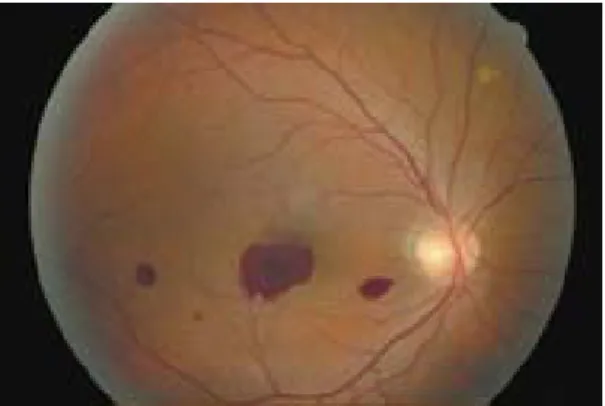
On presentation, the corrected vision was 5/200 OD and 20/20 OS. There was no afferent pupillary defect and examination of Fig. 1. Multiple retinal hemorrhages in the right

eye following a Valsalva maneuver associated with staining at stool.

Fig. 2. Fluorescein angiography of the right eye showing blocking of background choroidal fluorescence by

the hemorrhages without any vascular leakage in early phase and late phase.

(3)

the anterior segment was unremarkable. The dilated fundus examination revealed one disc sized subhyaloid hemorrhage at the fovea on the right, accompanied by three small scattered intraretinal hemorrhages around fovea (Fig.

1). Fluorescein angiography of the right eye demonstrated blocking of the background choroidal fluorescence by the hemorrhages without any vascular leakage from the early phase to late phase (Fig. 2). There was no evidence of underlying vascular pathology.

The appearance of the fundus combined with an associated history of physical exertion was consistent with the diagnosis of Valsalva retinopathy. Five months later at follow-up without any treatment, fundal examination revealed total resolution of the hemorrhages and the patient's vision returned to normal (Fig. 3).

Discussion

Valsalva retinopathy was initially described by Duane in 1972. He reported three cases

involving retinal hemorrhages in the macular region presumably secondary to a sudden increase of intrathoracic pressure.

5)

Since then, Valsalva retinopathy has been reported following weight-lifting sports,

4)

aerobic exercise,

6)

pregnancy,

7)

labor,

8)

riding a motorcycle,

9)

blowing up balloons,

10)

transrectal biopsy of the prostate and as a complication of colonoscopy.

11, 12)

de Crecchio and colleagues

13)

reported that Valsalva retinopathy is associated with a congenital retinal macrovessel. However, the presence of a congenital retinal macrovessel in the macular area is a rare occurrence, and Valsalva retinopathy has rarely occurred after the Valsalva maneuver.

When Valsalva retinopathy occurs, patients have blurred vision or central scotoma.

Presenting visual acuity usually ranges from 6/6 to 6/12, although on rare occasions it may be reduced to 6/60 or counting fingers.

4)

The hemorrhage is invariably located at or near the fovea and is secondary to a spontaneous rupture of the perifoveal capillary plexus following the Valsalva maneuver.

Valsalva retinopathy is typically a preretinal hemorrhage which is well-circumscribed and round or dumb-bell shaped. However, subretinal, intraretinal, subhyaloid and vitreous hemorrhages can be observed with Valsalva retinopathy.

14)

Shukla et al

15)

evaluated Valsalva retinopathy by optical coherence tomography and showed that the exact site of the retinal hemorrhage was the subinternal limiting membrane. Most cases Fig. 3. Multiple retinal hemorrhages resolved without

any treatment after 5 months follow-up.

(4)

of Valsalva retinopathy resolve spontaneously within weeks to months, and have a good visual prognosis. Nd:YAG laser membranotomy seems to be helpful for the rapid clearance of a large premacular hemorrhage by causing disruption of the internal limiting membrane, allowing the blood to gravitate into the inferior vitreous cavity and allowing absorption of blood. However, complications such as retinal or choroidal hemorrhage, retinal hole and vitreous hemorrhage have been reported after this procedure.

16)

This is the first reported case occurring associated with straining at stool in Korea.

When patient with chronic constipation complain about visual disturbance, Valsalva retinopathy should be considered in the differential diagnosis through detailed history taking. In the case presented here,

Valsalva retinopathy developed in a hypertensive patient but the relationship between Valsalva retinopathy and hypertension is not clear. The effect of hypertension on Valsalva retinopathy requires further investigation.

요 약

기도가 닫힌 상태에서 강하게 숨을 뿜어내 는 발살바법은 망막의 정맥압을 상승시키고 이 에 따라 망막 출혈을 유발시킬 수 있다. 힘든 배변을 경험한 55세 남자가 우안의 중심시력 감소로 인해 본원을 방문하였다. 전신적인 질 환으로 고혈압, 만성 변비를 앓고 있었고 동공

을 산대하여 정밀 안저검사를 한 결과 유두 한 개 정도 크기의 망막전 출혈과 황반와주위로 작은 크기의 망막내 출혈이 관찰되었다. 특별 한 치료없이 망막 출혈은 자연 흡수되어 시력 은 정상으로 회복되었다. 배변으로 인해 급작 스런 시력감퇴를 나타낸 발살바 망막증을 경험 하였기에 보고하는 바이다.

Reference

1. Slonim NB, Hamilton LH. Respiratory physiology, 5th ed. St Louis: Mosby; 1981.

2. Lumb AB, editor. Nunn’s Applied Respiratory Physiology, 5th ed. Great Britain; Elsevier Science; 2003.

3. Kasper DL, Braunwald E, Fauci AS, Hauser SL, Longo DL, Jameson JL. Harrison’s principles of internal medicine. In: Low PA, Engstrom JW editors. Disorders of the autonomic nervous system. 16th ed. New York: McGraw -Hill; 2005. p. 2431.

4. Chapman-Davies A, Lazarevic A. Valsalva maculopathy. Clin Exp Optom 2002 Jan;85(1):

42-5.

5. Duane TD. Valsalva hemorrhagic retinopathy.

Trans Am Ophthalmol Soc 1972;70:298-313.

6. Roberts KD, Mackay AK. Microhemorrhagic maculopathy associated with aerobic exercise.

J Am Optom Assoc 1987 May;58(5):415-8.

7. Deane JS, Ziakas N. Valsalva retinopathy in pregnancy. Eye 1997;11:137-8.

8. Ladjimi A, Zaouali S, Messaoud R, Ben Yahia S, Attia S, Jenzri S, Khairallah M. Valsalva retinopathy induced by labour. Eur J Ophthalmol 2002 Jul-Aug;12(4):336-8.

9. Ioannidis AS, Tranos PG, Harris M. Valsalva retinopathy associated with riding a motorcycle.

Eye 2004 Mar;18(3):329-31.

(5)

10. Georgiou T, Pearce IA, Taylor RH. Valsalva retinopathy associated with blowing balloons.

Eye 1999 Oct;13:686-7.

11. Fanin LA, Thrasher JB, Mader TH, Truxal AR. Valsalva retinopathy associated with transrectal prostate biopsy. Br J Urol 1994 Sep;74(3):391-2.

12. Oboh AM, Weilke F, Sheindlin J. Valsalva retinopathy as a complication of colonoscopy.

J Clin Gastroenterol 2004 Oct;38(9):793-4.

13. de Crecchio G, Pacente L, Alfieri MC, Greco

GM. Valsalva retinopathy associated with a congenital retinal macrovessel. Arch Ophthalmol 2000 Jan;118(1):146-7.

14. Gass JD. A stereoscopic Atals of Macular Disorders, 3rd ed. St. Louis: Mosby; 1987.

15. Shukla D, Naresh KB, Kim R. Optical coherence tomography findings in valsalva retinopathy.

Am J Ophthalmol 2005 Jul;140(1):134-6.

16. Zaman F, Irwin R, Godley BF. Nd:YAG laser treatment for macular preretinal hemorrhage.

Arch Ophthalmol 1999 May;117(5):694-5.

수치

Fig. 2. Fluorescein  angiography  of  the  right  eye  showing  blocking  of  background  choroidal  fluorescence  by  the  hemorrhages  without  any  vascular  leakage  in  early  phase  and  late  phase.

참조

관련 문서

“Every unobstructed point of a wavefront, at a given instant in time, serves as a source of secondary wavelets (with the same frequency as that of the primary wave).. The

– the decrease in systolic arterial pressure frequently exceeds the normal decrease of 10 mmHg and the peripheral pulse may disappear completely during

The results showed that male bladder cancer patients with urinary diversion experienced various symptoms at the same time, and the identified symptom clusters affected

And then, he makes his characters who live death-in-life in Dublin experience some severe paralysis and he, at the same time, emphasizes a spiritual

The government strives to create venture ecosystem for realizing creative economy, at the same time, the Mistry of Education is spending huge resources

The cucumber sprouts pre-treated with all seven rhizobacterial strains at concentration of 5.0×10 6 cfu/ml were significantly increased plant height and

Time series of vertical cross section of potential vorticity and wind vector calculated by Case 1 along the A-A' line indicated at Fig.. Same

(Saturated zone is the zone in which the voids in the soil and rocks are filled with water at a pressure greater than atmospheric pressure).. (Unsaturated zone is the zone