DOI 10.17480/psk.2017.61.6.286
Giffonin A와 D의 전합성 연구
정명교 · 최현진 · 김승태 · 윤화영*
부산대학교 약학대학
(Received October 18, 2017; Revised November 15, 2017; Accepted November 28, 2017)
Studies on Total Synthesis of Giffonins A and D
Myeonggyo Jeong, Hyeonjin Choi, Seung Tae Kim, and Hwayoung Yun*
College of Pharmacy, Pusan National University, Busan 46241, Korea
Abstract — A synthetic study toward the total synthesis of giffonins A and D, cyclized diarylheptanoids, is described. The key feature of our synthesis involves efficient formation of the advanced precursors, which consist of entire skeleton of the diarylheptanoids, utilizing regioselective formylation and iodination.
Keywords giffonin A, giffonin D, diaryl ether heptanoid, antioxidant, regioselective reaction
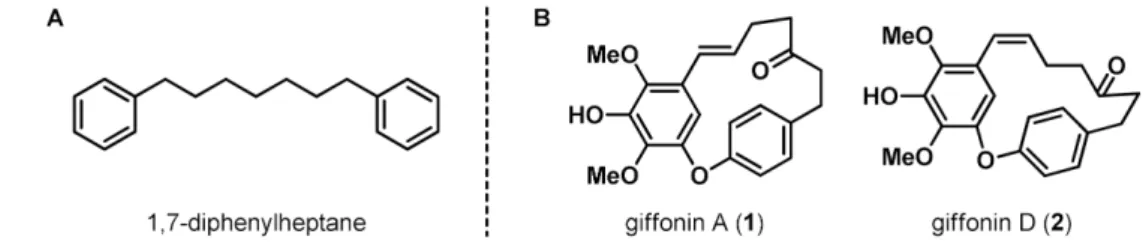
1,7-Diphenylheptane 골격을 가지는 천연물을 diarylheptanoid 라 일컬으며, 주로 Zingiber, Curcuma, Alpinia, Alnus 등의 식물 속으로부터 추출되었다(Figure 1A).1-3) 1815년 curcumin이 분리 된 이래로 현재까지 400종 이상이 보고되었으며, 항산화, 항균, 항염, 항암 등 다양한 생리활성을 나타내므로 신약 후보물질로 서 많은 관심을 받고 있다.1-8)이들은 구조적으로 크게 linear- diarylheptanoid와 cyclic-diarylheptanoid로 분류되는데, 후자 의 경우 1,7-diphenylheptane 골격의 2개의 환이 biaryl 또는 diaryl ether 형태로 결합되어 macrocyclic 환을 이루는 것이 특징이다.1-3) 이러한 구조는 큰 ring strain을 유발하기 때문에 환 구조를 확립하는 것이 이들 천연물의 합성 연구에서 핵심이 라고 할 수 있다. 따라서, diarylheptanoid 계열 천연물의 다양한 생리활성과 구조적 특이성 때문에 이들을 효과적으로 합성하기 위한 연구가 지속적으로 이루어졌다.9,10)
Giffonin A (1)와 D (2)는 2015년에 Piacente 등에 의해 보고 된 천연물로 Batulaceae과에 속하는 Corylus avellana의 나뭇잎
에서 추출되었다(Figure 1B).11)이 잎은 전통적으로 민간에서 정 맥류와 치질 증상의 개선 목적으로 사용되었고, 항균 효과가 있 는 것으로 보고되었다. 천연물 giffonin A와 D는 특히 H2O2에 의해 유도된 lipid peroxidation을 저해하는 활성이 있다. 이들은 15원환의 macrocyclic diaryl ether heptanoid(MDEH)를 기본 골격으로 하는 매우 독특한 구조로 이루어져 있고, internal olefin 이 trans인 것이 giffonin A, cis인 것이 giffonin D이다.
MDEH 계열 천연물인 giffonin A (1)와 D (2)의 역합성 전략은 Figure 2와 같다. 이들 천연물의 전합성을 위해서는 macrocyclic 환을 효과적으로 확립하는 것이 핵심이라고 할 수 있다. Giffonin A와 D의 macrocyclic 환은 cross metathesis 등의 방법으로 1,7- diphenylheptane 구조를 먼저 확립한 후 Ullmann coupling 등을 통해서 합성할 수 있다.12) Diaryl ether는 핵심 전구체인 aryl iodide 3과 phenol 4로부터 합성할 수 있다. 전구체 aryl iodide 3은 상업적으로 구매 가능한 2,6-dimethoxyphenol (6)로부터 위 치선택적인 formylation과 iodination의 방법으로 합성할 수 있고, 또 다른 전구체 phenol 4는 상업적으로 구매 가능한 3-(4- hydroxyphenyl)propionic acid (10)로부터 합성할 수 있다.
실험방법 (Experimental Methods)
Reaction flask는 100oC에서 수분을 제거한 후 사용하였으며
#
Corresponding Author Hwayoung Yun
College of Pharmacy, Pusan National University, Busan 46241, Korea
Tel.: 051-510-2810 Fax.: 051-513-6754 E-mail: [email protected]
Short Report
종설공기와 수분에 민감한 반응은 아르곤 대기 하에서 수행하였다.
본 실험에서 사용한 용매 및 언급하지 않은 시약은 별도의 정제과 정을 거치지 않은 시판품을 사용하였다. Column chromatography 용 silica gel 60(230-400 mesh, Merck)를 사용하였고 thin layer chromatography(TLC)는 Kieselgel 60 F254 plate(Merck)를 사 용하였다. IR 스펙트럼은 JASCO FT-IR-4200 spectrometer를 사 용하여 얻었다. 1H NMR 및 13C NMR은 Varian Unity 400와 Agilent 300로 측정하였으며 chemical shift는 parts per million (ppm, δ)으로 coupling constant는 Hertz(Hz)로 나타내었다.
Low resolution mass spectra는 VG Trio-2 GC-MS를, high resolution mass spectra는 JEOL JMS-AX 505WA와 Agilent Q TOF 6530를 사용하여 m/z로 나타내었다.
2,6-Dimethoxyphenyl pivalate (7)
2,6-Dimethoxyphenol(4.03 g, 26.1 mmol)의 CH2Cl2(50 ml) 용액에 triethylamine(7.21 ml, 52.0 mmol)을 가한 후 pivaloyl chloride(3.84 ml, 31.2 mmol)를 천천히 적가하였다. 상온에서 2 시간 교반 후, 물과 CH2Cl2로 희석하였다. 층분리하여 유기층을 얻은 후, 수층을 CH2Cl2로 2번 재추출하였다. 추출한 유기층을 MgSO4로 처리하여 수분을 제거한 뒤 감압 농축하였다. 농축한
잔사를 컬럼 크로마토그래피(EtOAc : n-hexane=1 : 10)로 정제 하여 투명한 액체의 2,6-dimethoxyphenyl pivalate(5.96 g, 96%) 를 얻었다.
FT-IR(thin film, neat) νmax 2972, 2941, 2906, 2873, 2840, 2349, 2309, 1754, 1605, 1589, 1499, 1482, 1462, 1444, 1396, 1366, 1305 cm-1; 1H NMR(CDCl3, 400 MHz) δ 7.10(t, 1H, J=8.4 Hz), 6.59(d, 2H, J=8.4 Hz), 3.79(s, 6H), 1.38(s, 9H);
13C NMR(CDCl3, 100 MHz) δ 176.5, 152.6, 129.2, 126.0, 105.1, 56.3, 39.2, 27.4; LR-MS(ESI+) m/z 239(M+H+); HR- MS(ESI+) calcd for C13H19O4(M+H+) 239.1278; found 239.
1270.
3-Formyl-2,6-dimethoxyphenyl pivalate (5)
2,6-Dimethoxyphenyl pivalate(7.01 g, 29.4 mmol)의 CH2Cl2 (100 ml) 용액을 −78oC로 냉각한 후 silver trifluoromethanesulfonate (15.1 g, 58.8 mmol)를 가하였다. 20분 동안 교반 후, dichloromethyl methyl ether(4.52 ml, 50.0 mmol)를 천천히 적가하였다. 동일 온 도에서 24시간 동안 교반한 후, 상온에서 NaHCO3 수용액으로 반응을 종결하였다. 층분리하여 유기층을 얻은 후, 수층을 CH2Cl2 로 2번 재추출하였다. 추출한 유기층을 MgSO4로 처리하여 수분
Fig. 1 − (A) Structure of 1,7-diphenylheptane (B) Structures of giffonins A (1) and D (2).
Fig. 2 − Retrosynthetic analysis of giffonins A (1) and D (2).
을 제거한 뒤 감압 농축하였다. 농축한 잔사를 컬럼 크로마토그 래피(EtOAc : n-hexane=1 : 6)로 정제하여 노란색 액체의 3- formyl-2,6-dimethoxyphenyl pivalate(7.51 g, 96%)를 얻었다.
FT-IR(thin film, neat) νmax 2975, 2908, 2872, 2845, 1759, 1685, 1599, 1498, 1469, 1443, 1427, 1390, 1367 cm-1; 1H NMR(CDCl3, 400 MHz) δ 10.21(s, 1H), 7.73(d, 1H, J=8.8 Hz), 6.79(d, 1H, J=8.8 Hz), 3.92(s, 3H), 3.86(s, 3H), 1.40(s, 9H); 13C NMR(CDCl3, 100 MHz) δ 188.3, 176.1, 157.9, 156.2, 133.0, 127.0, 123.3, 107.6, 63.2, 56.5, 39.3, 27.3; LR- MS(FAB+) m/z 267(M+H+); HR-MS(FAB+) calcd for C14H19O5(M+H+) 267.1232; found 267.1224.
3-Formyl-5-iodo-2,6-dimethoxyphenyl pivalate (8) 3-Formyl-2,6-dimethoxyphenyl pivalate(4.9 g, 18.4 mmol)의 CH2Cl2(90 ml) 용액에 I2(5.6 g, 22.1 mmol)를 가한 후, CF3CO2Ag (4.88 g, 22.1 mmol)를 적가하여 상온에서 교반하였다. 4시간 후, 물과 CH2Cl2로 희석하여 Na2S2O3를 가하여 30분 동안 교반하 였다. 층분리하여 유기층을 얻은 후, 수층을 CH2Cl2로 2번 재추 출하였다. 추출한 유기층을 MgSO4로 처리하여 수분을 제거한 뒤 감압 농축하였다. 농축한 잔사를 컬럼 크로마토그래피(EtOAc:
n-hexane=1 : 20 to 1 : 6)로 정제하여 하얀색 고체의 3-formyl- 5-iodo-2,6-dimethoxyphenyl pivalate(5.05 g, 70%)를 얻었다.
FT-IR(thin film, neat) νmax 2977, 2349, 1766, 1690, 1578, 1461, 1416 cm-1; 1H NMR(CDCl3, 400 MHz) δ 10.17(s, 1H), 8.16(s, 1H), 3.92(s, 3H), 3.87(s, 3H), 1.43(s, 9H); 13C NMR (CDCl3, 100 MHz) δ 187.1, 175.7, 158.2, 156.9, 138.1, 135.8, 127.4, 86.1, 63.9, 61.6, 39.3, 27.2; LR-MS(FAB+) m/z 393 (M+H+); HR-MS(FAB+) calcd for C14H18IO5(M+H+) 393.
0199; found 393.0190.
3-Iodo-2,6-dimethoxy-5-vinylphenyl pivalate (9) CH3PPh3Br(7.11 g, 19.9 mmol)의 THF(50 ml) 용액을 0oC로 냉각한 후 n-BuLi(15.6 ml, 24.9 mmol, 1.6 M in hexane)을 천천히 가하였다. 동일 온도에서 30분 동안 교반한 후, 3- for my l - 5- i od o-2, 6-di m et h ox y ph e n yl p i v al a t e (4 .88 g, 12.4 mmol)의 THF(30 ml) 용액을 가하였다. 3시간 후, 상온에 서 물과 EtOAc로 희석하였다. 층분리하여 유기층을 얻은 후, 수 층을 EtOAc로 2번 재추출하였다. 추출한 유기층을 MgSO4로 처 리하여 수분을 제거한 뒤 감압 농축하였다. 농축한 잔사를 컬럼 크로마토그래피(EtOAc : n-hexane=1 : 30)로 정제하여 하얀색 고 체의 3-iodo-2,6-dimethoxy-5-vinylphenyl pivalate(3.76 g, 99%)를 얻었다.
FT-IR(thin film, neat) νmax 2975, 1760, 1626, 1581, 1471, 1456, 1404, 1367 cm-1; 1H NMR(CDCl3, 300 MHz) δ 7.77(s,
1H), 6.81(dd, 1H, J=17.6, 11.1 Hz), 5.71(d, 1H, J=17.6 Hz), 5.32(d, 1H, J=11.1 Hz), 3.79(s, 3H), 3.72(s, 3H), 1.42(s, 9H);
13C NMR(CDCl3, 100 MHz) δ 175.9, 152.4, 151.2, 138.2, 132.7, 130.2, 129.5, 116.2, 85.9, 61.8, 61.5, 39.2, 27.2; LR- MS(FAB+) m/z 391(M+H+); HR-MS(FAB+) calcd for C15H19IO4(M+) 390.0328; found 390.0321.
3-Iodo-2,6-dimethoxy-5-vinylphenol (3)
3-Iodo-2,6-dimethoxy-5-vinylphenyl pivalate(961 mg, 2.80 mmol) 의 THF/H2O(30 ml/15 ml) 용액에 LiOH·H2O(235 mg, 5.60 mmol) 의 H2O(5 ml) 수용액을 가한 후, 70oC에서 가열환류 하였다. 20 시간 후 물과 EtOAc로 희석하고 1N HCl을 가하여 반응 혼합물 을 pH 3~4로 만들었다. 층분리하여 유기층을 얻은 후, 수층을 EtOAc로 2번 재추출하였다. 추출한 유기층을 MgSO4로 처리하 여 수분을 제거한 뒤 감압 농축하였다. 농축한 잔사를 컬럼 크로 마토그래피(EtOAc : n-hexane = 1 : 7)로 정제하여 하얀색 고체 의 3-iodo-2,6-dimethoxy-5-vinylphenol(515 mg, 71%)을 얻었다.
FT-IR(thin film, neat) νmax 3343, 3091, 3009, 2968, 2936, 2880, 2829, 2359, 2308, 1978, 1896, 1823, 1693, 1624, 1565, 1517, 1459, 1417, 1400, 1319 cm-1; 1H NMR(CDCl3, 400 MHz) δ 7.44(s, 1H), 6.80(dd, 1H, J=17.7, 11.1 Hz), 5.71(s, 1H), 5.70(dd, 1H, J=17.6, 1.1 Hz), 5.31(dd, 1H, J=11.1, 1.1 Hz), 3.89(s, 3H), 3.82(s, 3H); 13C NMR(CDCl3, 100 MHz) δ 147.1, 146.1, 142.5, 129.8, 129.1, 126.1, 116.0, 85.3, 61.5, 61.0; LR-MS(FAB+) m/z 306(M+H+); HR-MS(FAB+) calcd for C10H11IO3(M+) 305.9753; found 305.9756.
3-(4-((tert-Butyldimethylsilyl)oxy)phenyl)propanoic acid (11)
3-(4-Hydroxyphenyl)propionic acid(10 g, 60.2 mmol)의 DMF (80 ml) 용액에 Imidazole(12.3 g, 181 mmol)을 가하고 tert- butyldimethylsilyl chloride(13.6 g, 90.3 mmol)를 적가하여 상온 에서 3시간 교반하였다. 물과 EtOAc로 희석한 후, 유기층을 물 로 3회 씻어주었다. MgSO4로 처리하여 수분을 제거한 뒤 감압 농축 하였다. 농축한 잔사를 컬럼 크로마토그래피(EtOAc: n-hexane=1:3) 로 정제하여 흰색 고체의 3-(4-((tert-butyldimethylsilyl)oxy)phenyl) propanoic acid(16.8 g, 99%)을 얻었다.
1H NMR(CDCl3, 400 MHz) δ 7.02(d, 2H, J=7.3 Hz), 6.73 (d, 2H, J=7.7 Hz), 2.85(t, 2H, J=7.6 Hz), 2.62(t, 2H, J=7.5 Hz), 0.91(s, 9H), 0.24(s, 6H); 13C NMR(CDCl3, 100 MHz) δ 179.5, 154.2, 132.9, 129.3, 120.2, 36.1, 30.0, 25.8, 18.3, -4.3.
1-(4-((tert-Butyldimethylsilyl)oxy)phenyl)hept-6-en-3- one (12)
3-(4-((tert-Butyldimethylsilyl)oxy)phenyl)propanoic acid(3.42 g, 12.2 mmol)의 CH2Cl2(60 ml) 용액에(COCl)2(2.92 ml, 36.6 mmol)를 가한 후 상온에서 1시간 동안 교반하였다. 감압 농축 후 반응 혼 합물을 CH2Cl2(60 ml)로 희석하였다. 3-Butenylmagnesium bromide (24.4 ml, 12.2 mmol, 0.5 M in THF)를 0oC에서 천천히 적가하였 다. 상온에서 2시간 교반 후, 물을 가하여 반응을 종결시켰다. 층 분리하여 유기층을 얻은 후, 수층을 CH2Cl2로 2번 재추출하였다.
추출한 유기층을 MgSO4로 처리하여 수분을 제거한 뒤 감압 농축 하였다. 농축한 잔사를 컬럼 크로마토그래피(EtOAc : n-hexane
=1 : 30)로 정제하여 노란색 액체의 1-(4-((tert-butyldimethylsilyl) oxy)phenyl)hept-6-en-3-one (2.26 g, 58%)을 얻었다.
1H NMR(CDCl3, 400 MHz) δ 7.02(d, 2H, J=8.4 Hz), 6.74 (d, 2H, J=8.4 Hz), 5.78(m, 1H), 5.49(m, 2H), 2.82(t, 2H, J=7.5 Hz), 2.69(t, 2H, J=7.5 Hz), 2.47(t, 2H, J=7.4 Hz), 2.30 (m, 2H), 0.97(s, 9H), 0.17(s, 6H); 13C NMR(CDCl3, 100 MHz) δ 209.6, 154.0, 137.2. 133.8, 129.3, 120.1, 115.3, 44.7, 42.2, 29.1, 27.8, 25.8, 18.3, -4.3.
1-(4-Hydroxyphenyl)hept-6-en-3-one (4)
1-(4-((tert-Butyldimethylsilyl)oxy)phenyl)hept-6-en-3-one (5.19 g, 16.3 mmol)의 THF(60 ml) 용액을 0oC로 냉각한 후 tetrabutylammonium fluoride(17.9 ml, 17.9 mmol, 1.0 M in THF)를 천천히 가하였다. 상온에서 2시간 교반 후, 물과 EtOAc 로 희석하였다. 층분리하여 유기층을 얻은 후, 수층을 EtOAc로 2번 재추출하였다. 추출한 유기층을 MgSO4로 처리하여 수분을 제거한 뒤 감압 농축하였다. 농축한 잔사를 컬럼 크로마토그래 피(EtOAc : n-hexane=1 : 5)로 정제하여 투명한 액체의 1-(4- hydroxyphenyl)hept-6-en-3-one(3.19 g, 96%)을 얻었다.
1H NMR(CDCl3, 400 MHz) δ 7.02(d, 2H, J=8.5 Hz), 6.72 (d, 2H, J=8.4 Hz), 5.76(m, 1H), 4.97(m, 2H), 2.82(t, 2H,
J=7.5 Hz), 2.69(t, 2H, J=7.5 Hz), 2.47(t, 2H, J=7.4 Hz), 2.30 (m, 2H); 13C NMR(CDCl3, 100 MHz) δ 211.3, 154.3, 136.9, 132.6, 129.4, 115.5, 44.8, 42.1, 29.0, 27.8, 23.8.
결과 및 고찰 (Results and Discussion)
Giffonin A (1)와 D (2)의 전합성을 위한 핵심 전구체인 aryl iodide 3의 합성 과정은 Scheme 1과 같다. Aryl iodide 3은 benzene 환에 5개의 치환기가 연결된 구조로서 치환기 각각의 위치선택적인 도입이 핵심이다. 전구체 3의 합성은 상업적으로 구매 가능한 2,6-dimethoxyphenol (6)의 pivaloylation으로부터 시 작되었다. 6의 phenol 기를 보호하기 위해서 pivaloyl 기를 선택 하였고 96%의 수득률로 7을 얻었다. 보호기로서 MOM 기를 도 입하였을 때는 formylation 단계에서 탈보호화 반응이 일어났고, acetyl 기를 도입하였을 때는 Wittig 반응 단계에서 부산물이 생 성되었다. Pivaloyl 보호기가 도입된 화합물 7에 위치선택적으로 aldehyde 기를 도입하기 위해서 Doi 등이 보고한 Cl2CHOMe/
AgOTf 조건을 이용하여 benzaldehyde 5를 효과적으로 얻었다.13) 가장 널리 알려진 방법인 Vilsmeier-Haack formylation 조건에 서는 목적하는 생성물을 얻을 수 없었다. I2/CF3CO2Ag 조건에 서 aldehyde 기의 meta 위치에 위치선택적으로 iodination하여 aryl iodide 8을 얻었다.14) Benzaldehyde 8의 Wittig 반응을 통 해서 styrene 9를 얻은 후에 가수분해하여 핵심 전구체인 aryl iodide 3을 얻었다.
또 다른 핵심 전구체인 phenol 4의 합성은 Scheme 2와 같다.
상업적으로 구매 가능한 3-(4-hydroxyphenyl)propionic acid (10) 의 phenol 기를 TBS 기로 선택적으로 보호화하여 acid 11을 얻 었다. 화합물 11의 carboxylic acid 기를 butenyl ketone 기로 변 환시키기 위해서 oxalyl chloride를 사용하여 acid halide 기를 도 입하였다. 정제 과정 없이 3-butenylmagnesium bromide를 in
Scheme 1. Regioselective synthesis of aryl iodide 3
situ로 부가하여 ketone 12를 효과적으로 얻었다. 최종적으로 TBAF를 사용하여 TBS 탈보호화 반응을 수행하여 핵심 전구체 인 phenol 4를 얻었다. 합성된 핵심 전구체 aryl iodide 3과 phenol 4의 cross metathesis로 1,7-diphenylheptane 구조를 확 립한 후, Ullmann coupling 반응을 성공적으로 수행하면 giffonin A(1)와 D(2)의 전합성을 완료할 수 있다.12)
결 론 (Conclusion)
천연물 giffonin A (1)와 D (2)의 전합성 연구 과정에서 MDEH 골격을 이루는 핵심 전구체 3과 4의 합성을 완료하였다. 목적하 는 전구체를 효과적으로 합성하기 위해서 위치선택적인 formylation 과 iodination이 사용되었다. 본 giffonin A와 D의 합성 연구는 다 른 MDEH 계열 천연물의 합성 연구에 적용될 수 있고, 나아가 신규 생리활성 유도체의 합성에도 활용될 수 있을 것이라 사료된다.
감사의 말씀 (Acknowledgment)
이 논문은 부산대학교 기본연구지원사업(2년)에 의하여 연구 되었음.
References
1) Lv, H. and She, G. : Naturally Occurring Diarylheptanoids. Nat.
Prod. Commun. 5, 1687 (2010).
2) Lv, H. and She, G. : Naturally Occurring Diarylheptanoids – A Supplementary Version. Rec. Nat. Prod. 6, 321 (2012).
3) Zhu, J., Islas-Gonzalez, G. and Bois-Choussy, M. : Recent progress in isolation, bioactivity evaluation and total synthesis of diarylheptanoids. Org. Prep. Proc. Int. 32, 505 (2000).
4) Ishida, J., Kozuka, M., Tokuda, H., Nishino, H., Nagumo, S., Lee, K.-H. and Nagai, M. : Chemopreventive potential of cyclic diarylheptanoids. Bioorg. Med. Chem. 10, 3361 (2002).
5) Suksamrarn, A., Ponglikitmongkol, M., Wongkrajang, K., Chindaduang, A., Kittidanairak, S., Jankam, A., Yingyongnarongkul, B.-e., Kittipanumat, N., Chokchaisiri, R., Khetkam, P. and Piyachaturawat, P. : Diarylheptanoids, new phytoestrogens from the rhizomes of Curcuma comosa : Isolation, chemical modification and estrogenic activity evaluation. Bioorg. Med.
Chem. 16, 6891 (2008).
6) Anand, P., Thomas, S. G., Kunnumakkara, A. B., Sundaram, C., Harikumar, K. B., Sung, B., Tharakan, S. T., Misra, K., Priyadarsini, I. K., Rajasekharan, K. N. and Aggarwal, B. B. : Biological activities of curcumin and its analogues (Congeners) made by man and Mother Nature. Biochem. Pharmacol. 76, 1590 (2008).
7) Bryant, V. C., Kishore Kumar, G. D., Nyong, A. M. and Natarajan, A. : Synthesis and evaluation of macrocyclic diarylether heptanoid natural products and their analogs. Bioorg. Med. Chem.
Lett. 22, 245 (2012).
8) Novakovic, M., Pesic, M., Trifunovic, S., Vuckovic, I., Todorovic, N., Podolski-Renic, A., Dinic, J., Stojkovic, S., Tesevic, V., Vajs, V. and Milosavljevic, S. : Diarylheptanoids from the bark of black alder inhibit the growth of sensitive and multi-drug resistant non-small cell lung carcinoma cells.
Phytochemistry. 97, 46 (2014).
9) Pitsinos, E. N., Vidali, V. P. and Couladouros, E. A. : Diaryl Ether Formation in the Synthesis of Natural Products. Eur. J.
Org. Chem. 7, 1207 (2011).
10) Gulder, T. and Baran, P. S. : Strained cyclophane natural products: Macrocyclization at its limits. Nat. Prod. Rep. 29, 899 (2012).
11) Masullo, M., Cerulli, A., Olas, B., Pizza, C. and Piacente, S. :
Scheme 2. Synthesis of phenol 4.
Giffonins A−I, Antioxidant Cyclized Diarylheptanoids from the Leaves of the Hazelnut Tree (Corylus avellana), Source of the Italian PGI Product “Nocciola di Giffoni”. J. Nat. Prod. 78, 17 (2015).
12) Kumar, G. D. K. and Natarajan, A. : Total synthesis of ovalifoliolatin B, acerogenins A and C. Tetrahedron. Lett. 49, 2103 (2008).
13) Ohsawa, K., Yoshida, M. and Doi, T. : A Direct and Mild
Formylation Method for Substituted Benzenes Utilizing Dichloromethyl Methyl Ether−Silver Trifluoromethanesulfonate.
J. Org. Chem. 78, 3438 (2013).
14) Lee, C.-L., Huang, C.-H., Wang, H.-C., Chuang, D.-W., Wu, M.- J., Wang, S.-Y., Hwang, T.-L., Wu, C.-C., Chen, Y.-L., Chang, F.- R. and Wu, Y.-C. : First total synthesis of antrocamphin A and its analogs as anti-inflammatory and anti-platelet aggregation agents. Org. Biomol. Chem. 9, 70 (2011).