Autonomous Navigation System for Power Wheelchair System
Moon-Shu Jung
*․ Seong-Soo Ahn
**ABSTRACT
The power wheelchair is an important and convenient mobility device. The demand of power wheelchair is increasing for assistance in mobility. In this paper we proposed a robotic wheelchair for mobility aid to reduce the burden from the disabled. The main issue in an autonomous wheelchair is the automatic detection and avoidance of obstacles and going to the pre-designated place. The proposed algorithm detects the obstacles and avoids them to drive the wheelchair to the desired place safely with panning scan from sensors of distance measurement and fuzzy control. By this way, the disabled will not always have to worry about paying deep attention to the surroundings and his path.
keywords
Power wheelchai, Robotic wheelchai, Sensors of distance measurement, Fuzzy control
* Dept. of Computer Engineering, Chosun University ** Dongshin University
Ⅰ. Introduction
Nowadays with advancement in technology and aging society, the number of disabled citizens is increasing. The disabled citizens always need a caretaker for daily life routines especially for mobility. In future, the need is considered to increase more. To reduce the burden from the disabled, various devices for healthcare are introduced using computer technology. The power wheelchair is an important and convenient mobility device. The demand of power wheelchair is increasing for assistance in mobility. Generally, a joystick is used at the arm of the unaffected side to mobilize the wheelchair, however, if both arms are affected, the leg of unaffected side is used. The use of power wheelchair is convenient. However, the driving of conventional wheelchair may cause a burden to the disabled due to continuous use of
joystick and always paying deep attention to the surroundings and to the obstacles on the drive-way. Then the capacity to recognize path condition and to avoid obstacles is required.
Moreover, the user has to be proficient in driving the wheelchair.
In this paper we proposed a robotic wheelchair for mobility aid to reduce the burden from the disabled. The main issue in an autonomous wheelchair is the automatic detection and avoidance of obstacles and going to the pre-designated place. The proposed algorithm detects the obstacles and avoids them to drive the wheelchair to the desired place safely. By this way, the disabled will not always have to worry about paying deep attention to the surroundings and his path. For the obstacle detection, we have used two infrared sensors mounted on step motors. The infrared sensors scan the area for obstacles, detect the obstacles
and inform the control system. The infrared sensors are connected to the control system.
The step motors and sensors are controlled by ATMEGA 128 Processor. The joystick is connected to the system. The proposed algorithm is for office like environment where the user can mobilize easily avoiding hazardous areas. The sensors will scan the area while driving the wheelchair, and signal the control system. The control system, on finding an obstacle, will consider it as hazardous and will stop the motion by controlling the joystick.
After stopping the motion, it decides which direction to move. The purpose of the system is to avoid the obstacle and keep on moving in the same direction to go to the desired place.
The key issue in this system is to keep the motion of the wheelchair in the same direction after avoiding the obstacle as it was before stopping.
Ⅱ. Panning scan of Distance measurement sensors
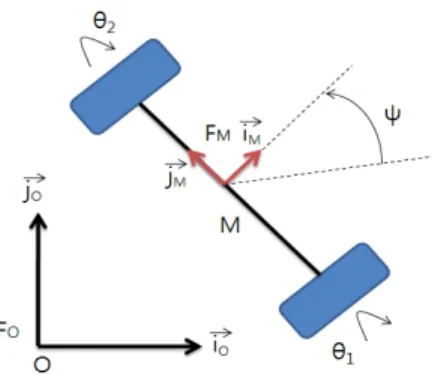
In this paper, we have shown the setting up of the model theory of the autonomous navigation mechanism of power wheelchair for controller design. Figure 1 shows the model theory of mechanism for designing the best suited controller [1].
Figure 1 shows the model theory of mechanism expression of autonomous navigation power wheelchair in two wheel drive for modeling.
M M
x r(
θ θ
)cosψ
2 1− 2= (1)
Figure 1: Kinematic model of an ARV
M M
y r(
θ θ
)sinψ
2 1− 2= (2)
) 2(
θ
1θ
2ψ
= r −M (3)
This expression is restricted to equation 2, in other words it satisfies the complete condition of the surface of the path, i.e., it does not slide on a slide surface [2].
0 sin
M−
MΨ
M=
M
c y
x ψ
(4)This drive method is steering method based on the difference between the speeds of both wheels. Equation 1 is not for control; however, it is the best generation theory of mechanism of the two wheel drive of power wheelchair.
Because Equation 2 is not a completed integral calculus; is has the non-holonomic feature [3].
In this paper we have proposed to follow the two wheel drive method basically, using two assistance drive-wheels and two drive wheels to control the non-holonomic feature [4].
2-1. Sensor panning scan algorithm for course driving:
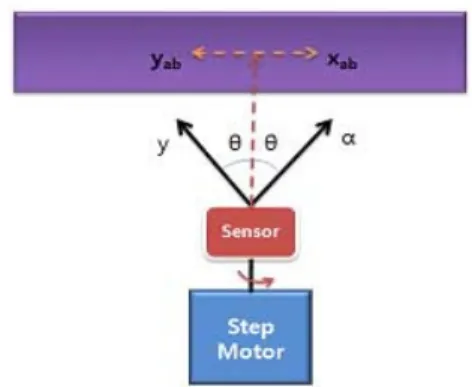
This makes our algorithm to decide for position and posture of autonomous navigation power wheelchair by defining the course form. Figure 2 shows the relation between coordinates of sensors and obstacle or Wall.
Figure 2: Coordinates of sensors and Obstacle or Wall
In case of movement towards the obstacle, the new coordinates can show 4x4 determinate of standard coordinates. That is, to express the direction of obstacle coordinate axis, and toexpress the vector translation of moving obstacle coordinates origin, the composition of three vectors can be used to create a matrix.
The point p1 = [x, y] T is used to create a 2x2 matrix, that the random point p shows [x, y] T on 2 dimension system.
⎟⎟⎠
⎜⎜ ⎞
⎝
⎛ +
⎟⎟ +
⎠
⎜⎜ ⎞
⎝
⎟⎟⎛
⎠
⎜⎜ ⎞
⎝
=⎛
⎟⎟⎠
⎜⎜ ⎞
⎝
⎛
dy bx
cy ax y x d c b a y x 1 1
(5)
Obstacle recognition is done by panning scan of x coordinates of course form. Next shows geometrical relation.
) ( ) ( α β θ α θ
θ = + −
(6)) ( ) ( α β l α l
l = + −
(7)Following is the distance measurement process by panning scan.
① Distance sensor detects obstacle in a range of 50cm, and stops.
② Then starts panning scan on right hand side in a range of 50cm
③ At the first time step motor scans 5 rounds of 45° with a span of 9° panning.
④ After completing steps, ①②③, the step motor comes back to the center position.
⑤ Starting panning scan at the left side, with a distance of 50 cm from the obstacle.
⑥ At the first time step motor scans 10 rounds of 90° with a span of 9° panning.
⑦ After completing steps, ⑤⑥, the step motor comes back to the center position.
This algorithm detects obstacles on the path of autonomous wheelchair.
Figure 3: Coordinates of sensors and obstacle
It is done by panning scan in front of the wheelchair. Figure 3 shows the coordinates of the sensors and the obstacle. The following equation (8) is used to find the size of the obstacle.
2
2 ( ( ) )
) ) (
(x b x b x b x b
O = α+β − α + azα+β − azα (8)
This equation is used for the detection of the obstacle size.
Ⅲ. Autonomous navigation system of fuzzy control
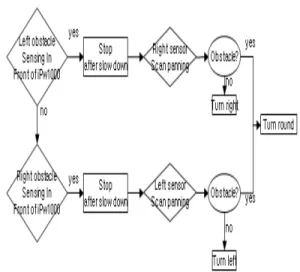
We propose fuzzy control algorithm for autonomous navigation power wheelchair system that has learning ability. This algorithm is used to avoid the obstacle after recognizing it while the autonomous navigation power wheelchair system is driving. Furthermore, this system learns the position and shape of obstacles by getting data from sensors every time. Figure 4 and 5 is navigation of drive path and the obstacle avoidance algorithm.
Figure 4: Both Left and Right Autonomous Navigation and Obstacle avoidance of iPw1000 algorithm.
This paper has eight assumptions for autonomous navigation power wheelchair.
Assumption1. Detect left, right of front obstacle and left obstacle
Assumption2. Detect left, right of front
obstacle and right obstacle
Assumption3. Assumption1. Detect left, right of front obstacle and left obstacle isn't
Assumption4. Only detect left of front obstacle.
Assumption5. Only detect right of front obstacle.
Assumption6. Right sensor don't detect obstacle while left, forward movement
Assumption7. Left sensor don't detect obstacle while right, forward movement
Assumption8. Detect back obstacle while back drive.
Figure 5: Either Left or Right Autonomous Navigation and Obstacle avoidance of iPw1000 algorithm
The Power wheelchair decides navigation course by these eight assumptions. Assumption 1 is moving after turn right. Assumption 2 is moving as opposition direction after turn left.
Assumption 3 is moving with standard position is left when don't have any learning data.
Assumption 4 is void obstacle after turn right and turn left and forward movement.
Assumption 5 is opposite to assumption 4.
Assumption 6 is forward movement. Assumption 7 is forward movement after turn left. Finally,
Assumption 8 is stop.
3-1. Autonomous navigation learning algorithm
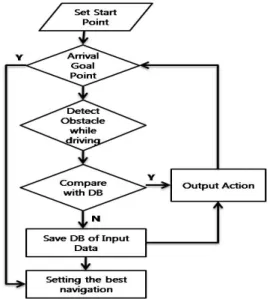
In this paper, the algorithm needs some learning for autonomous navigation power wheelchair using distance sensors. That is, learning to move obstacle area anywhere.
Figure 6 shows the learning algorithm.
Figure 6: learning algorithm of autonomous navigation
This algorithm learns navigation course to change start point for the best navigation course when initially wheelchair starts. Power Wheelchair can detect obstacle, total driving distance, and learns the best navigation course.
3-2. Fuzzy control for avoid obstacle.
The Power Wheelchair when sometimes meet unexpected obstacles, it sets the best navigation course for driving. It should be control speed of power wheelchair for can avoid obstacle according as distances. The
speed of the Power Wheelchair should be controlled so that it can avoid obstacles according to appropriate distance. In this paper we used fuzzy controller to control the speed of the Power wheelchair system.
3.2.1 Definition of Input and Output
There are Input, Output variable data, and functions in this paper.
- Input Variable: Distance(d), axis(Θ) - Output Variable: Left, Right wheel speed (vl, vr)
Distance of Input data is the detected distance between power wheelchair and obstacle, angle is the angle between setting navigation course data of power wheelchair and driving navigation course data of power wheelchair.
Table 1 is fuzzy function.
Distance Error Angle
NE : Near
NB : Negative Big NS : Negative Short ZZ : Zero
FA : Far
PS : Positive Short PB : Positive Big Table 1: Fuzzy Function
3.2.2 The Control rule and Fuzzy function
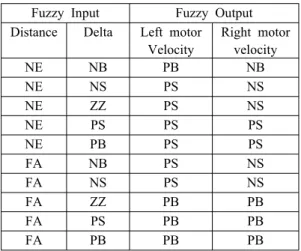
Table 2 shows the left and right control of wheel using input and output variable data.
There are 20 control rules to apply on the left and right speed of wheel when select each 2 and 5 fuzzy control variables as table 2 input variable dconditionally.
Figure 7: Function by distance
Table 2: Fuzzy Control Rule of Left Wheel
Fuzzy Input Fuzzy Output
Distance Delta Left motor Velocity
Right motor velocity
NE NB PB NB
NE NS PS NS
NE ZZ PS NS
NE PS PS PS
NE PB PS PS
FA NB PS NS
FA NS PS NS
FA ZZ PB PB
FA PS PB PB
FA PB PB PB
3.2.3 Non-fuzzy
Fuzzy inference result of Fuzzy control is output fuzzy set to define total set of control input.
Inference output value should be changed to deterministic value for input value of processor.
This process of changing needs fuzzy value to change into non-fuzzy. In this paper we used a good method, i.e., using center of gravity which is the best method and intuition [5].
Ⅳ. The Result of Test and Implementation
We have set up ARM System for iPw1000 system (Intelligent Power Wheelchair System) test and implementation, sensor platforms, and Control systems. This is Auto Control and
driving using joystick signal without change in the basic system of P110 power wheelchair.
Following Figure 9 shows Intel Pxa270 ARM System for test. Figure 10 is the architecture of iPw1000 System.
Figure 8: Power Wheelchair
Figure 9: iPw1000 Main Control Embedded System
Figure10: iPw1000 system
4.1 Panning scan System of Sensors
We produce a sensor system for test, using sensor panning scanning. Distance measurement sensor is Sharp GP2Y0A2YKOF and distance measurement is from 10 to 150cm. Step motor is NK243-01AT 1.8 degree. Data measurement gets distance data to move step motor at steps of 1.8 degrees from distance measurement sensor.
Sensor system scans left and right by panning scan using step motor. The obtained data is transmitted to ATmega128 system of sensor system by ADC Convertor to calculate 10bit sampling signal data. This data use learning data for autonomous navigation system.
Figure 11: Panning scan of sensor
Figure 12: Obstacle detection system by distance measurement sensors and panning scan
Figure 11and 12 shows system architecture of Obstacle detection using distance measurement sensor panning.
4.2 Implementation of Autonomous Navigation System using fuzzy control
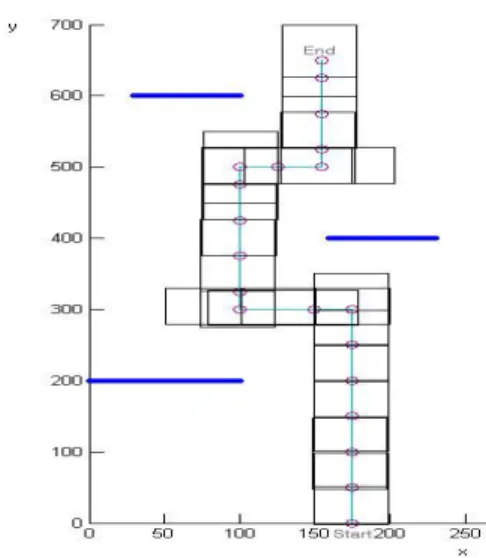
The map environment has 255cm width and 700cm height for test. This test sets up Obstacles, 200cm on left of y-axis, 100cm width and 30cm height near 600cm, 400cm on right of y-axis. Driving course goal figure out the best driving courses from 0 to 650 coordinate of y-axis. The power wheelchair size is 50cm in width and 100cm in height. Figure 13 is the environment map for test.
While testing of the power wheelchair, it drives on course after setting up the start point to A(75, 0), B(128, 0) and C(175, 0) of center-axis of the wheelchair. Figure 14, 15, and 16 show result of the simulation test of autonomous navigation driving.
This increases the moving distance. The Power Wheelchair detects obstacle in arange of 50cm ahead, assumes that power wheelchair speed is regular. Power wheelchair keeps up 30cm of each side to get the point values of Obstacle while driving on a side of obstacle. At first start of Power wheelchair, it detected obstacles three times at A(75,0) point. Total distance moved by the power wheelchair was 740cm. At the second start, while driving straight line at B(128,0) point, Power Wheelchair didn't detect obstacle.
Total distance moved by the power wheelchair was 650cm. At the third start, Power wheelchair detected obstacle two times and turned 4 times at C(175,0) point. Total distance moved by the power wheelchair was 680cm. Finally, the Power wheelchair decides that the best course is start point of B because the moving distance was the shortest.
Figure 13: Testing map for autonomous navigation
Figure 14: Testing result of starting left at A(75, 0)
Figure 15: Testing result of Starting center at B(128, 0)
Figure 16: Testing result of starting right at C(155, 0)
5. Conclusions
The important point of autonomous power wheelchair system is to go to goal, and do it very safely. The purpose of system developed is to make a very safe Power Wheelchair
System without any discomfort for the user.
In this paper, we have proposed the autonomous navigation driving algorithms for autonomous driving and that can avoid obstacle using fuzzy control for the instant situations. This system can figure out the best navigation course and can set up start point by learning data. This system is not yet completed, and can get better data from ultra sensor and laser sensor for measurement of distance from obstacles. This system will be further developed to Smart Power Wheelchair having camera system which is going to make 3-D shape matching sensor data to avoid obstacles and measure the distance from obstacles.
[Acknowledgement]
This research was supported by the Program for the Training of Graduate Students in Regional Innovation which was conducted by the Ministry of Commerce Industry and Energy of the Korean Government
References
[1] Rory A. Cooper, Lana M. Widman et al.
“Force Sensing Control for Electric Power Wheelchairs”, IEEE Transaction on control system technology, Vol.8:112-17, 2000, Jan [2] Takanori Fukao, Hiroshi Nakagawa and
Norihicko Adchi, "Adaptive Tracking Control of a Nonholonomic Mobile Robot", IEEE Transaction on Robotics and Automation, Vol. 16, No. 5, Oct. 2000.
[3] Gisbert Lawitzky, "A Navigation System for Cleaning Robots", Autonomous Robots, Vol. 9, No.3, pp 255-260, 2000.
[4] X. Yun and Nilanjan Sarkar, "Dynamic Feedback Control of Vehicle with Two Steerable Wheels",
IEEE International Conference on Robotics and Automation, pp.3105-3110, April 1996.
[5] Kim, S. C., "A Study on Collision Avoidance system of Vehicle using Fuzzy Control Algorithms," Dong-a University, pp. 28-47, 2002.
저 자 소 개
정 문 수(Moon-Shu Jung) 2009년 3월 현재 조선대학교 대학원 컴퓨터공학과 석사과정,
안성수(Ahn Seong-Soo) 1986년 조선대학교 자연과학대 학 수학과 졸업 (이학사)
1988년 조선대학교 대학원 수 학과 졸업 (이학석사)
1993년 조선대학교 대학원 수 학과 졸업 (이학박사)
2009년 3월 현재 동신대학교 전기공학과 교수
※관심분야 : 분산시스템, 유비쿼터스