논문 2011-6-22
Ad Hoc 네트워크에서 이동 IP Router
Mobile IP Router in Ad Hoc Network
박천관*
Chun-Kwan Park
요 약 본 논문은
Ad Hoc
네트워크 내의 노드간 통신뿐만 아니라 외부의 인터넷 접속을 제공하는 이동용IP
라우터 설계에 관한 것이다. Ad Hoc
네트워크는 유선 인프라스트럭쳐 도움 없이 노드간 서로 협력하여 정보를 교환할 수 있 는 네트워크이고,
이동IP
라우터는 네트워크를 하나의 이동 단위로 간주하여,
이동하는 공간에서도 정지된 공간에서 와 같은 인터넷 접속을 지원한다. Ad Hoc
네트워크 의 라우팅을 수용하면서 원활한 인터넷 접속을 제공하고자 한다.
이를 통하여 이동용IP
라우터는Ad Hoc
단말에게 인터넷 접속 서비스,
라우팅,
및 이동성을 등과 같은 다양한 무선 통신 서비스를 제공해 줄 수 있다.
Abstract This paper addresses mobile IP router which communicate between nodes in Ad Hoc network as well as supply attachment to outer Internet. Ad Hoc network is one which exchanges information through cooperations among nodes without wire infrastructure. mobile IP router considers the network as one mobile unit, and supports Internet connection in mobile as well as fixed spaces. Therefore, this router can accommodate the routing of Ad Hoc network, and provide nodes in Ad Hoc network with Internet connection. So mobile IP router can provide Ad-Hoc terminals with the diverse wireless services, such as Internet connection service, routing, mobility, and so on.
Key Words : Ad Hoc, Router, Mobile Network, multihoming, NEMO
*종신회원, 국립목포해양대학교 접수일자 2011.11.22, 수정완료 2011.12.5 게재확정일자 2011.12.16
Ⅰ. Introduction
These days the demand are increasing to use Internet at anytime, anywhere in the fixed location, such as home, office, and building as well as the vehicles, such as bus, train, and airplane
.IP mobility support of Internet protocols has had been one of important problems. So mobile IP working Group of IETF(Internet Engineering Task Force) has proposed Mobile IP as the solution for it. This Group
considered Host mobility. But IETF Nemo working Group considered the network mobility and then a network as mobility unit. In the case of installing Internet in vehicles, such as air plane, train, car, and ship, IETF NEMO WG solves the problems caused by moving the entire network, and then determined the network operation standard for the entire network mobility.
In mobile Ad Hoc Network, there are mobile nodes,
and they try to communicate with each other through
a multi-hop way without a fixed infrastructure. In this
environment, the Internet access functions like mobile
IP routing is needed for the nodes to receive the
Internet service.
In Ad Hoc network, mobile IP router has to have both Ad Hoc routing protocol and the function that has all nodes in Ad Hoc network connect to the infrastructure, such as Internet. mobile IP router offers the connection to the infrastructure of the mobile nodes in the mobile network. Mobile network is an IP subnet that is configured of several fixed or mobile terminals connected to the infrastructure.
This paper addresses mobile IP router which communicate between nodes in Ad Hoc network as well as supply attachment to outer Internet. Ad Hoc network is one which exchanges information through cooperations among nodes without wire infrastructure.
mobile IP router considers the network as one mobile unit, and supports Internet connection in mobile as well as fixed spaces. Therefore, this router can accommodate the routing of Ad Hoc network, and provide nodes in Ad Hoc network with Internet connection.
The configuration of this paper are following:
Chapter Ⅱ addresses mobile router services, such as wireless Internet service, multihoming service and network mobility. Chapter Ⅲ addresses Ad Hoc network characteristics, such as network configuration, and routing protocols. Chapter Ⅳ addresses mobile IP router design for Ad Hoc network. And chapter Ⅴ addresses conclusion and future research fields.
Ⅱ. Mobile Router Operation
As wireless connection technologies for Internet are being developed and is being used extensively, IP mobility support is being magnified as the important issue. As the solution about this, mobile IP WG(Working Group) of ETF proposed Mobile IP. This is based on the terminal mobility. But IETF Nemo WG considers the network instead of the terminal as mobility unit.
1. Wireless Internet Service
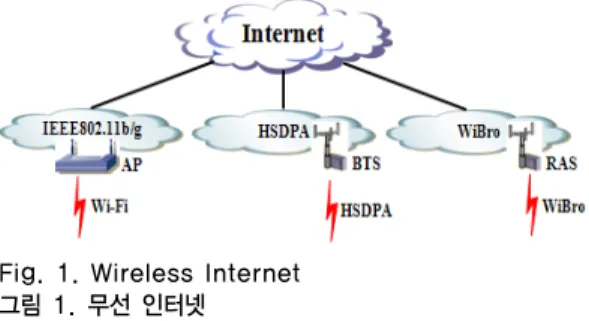
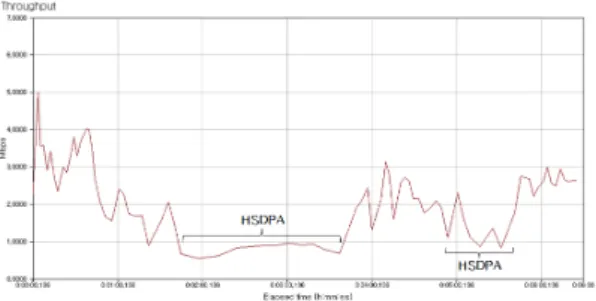
Figure 1 shows wireless Internet service. This is Internet access services which mobile WiMAX(WiBro), HSDPA(High Speed Downlink Packet Access), and Wi-Fi can be used commercially. Wi-Fi rate is 54Mbps, but actually it is 2Mbps. Maximum speed of HSDPA is 14Mbps in downstream and 2Mbps in upstream, but actually it is 1Mbps in downstream and 0.3Mbps in upstream. WiBro can be used only in the metropolitan area. it's rete is 18Mbps in downstream and 4Mbps in upstream, but actually it is 3Mbps in downstream and 1.2Mbps in upstream. HSDPA and WiBro provide layer 2 mobility, but doesn't provide IP mobility. Layer 2 mobility has to provide IP mobility for the seamless IP services. Mobile terminal uses the same IP address through IP mobility.
Fig. 1. Wireless Internet 그림 1. 무선 인터넷
2. Multihoming Service
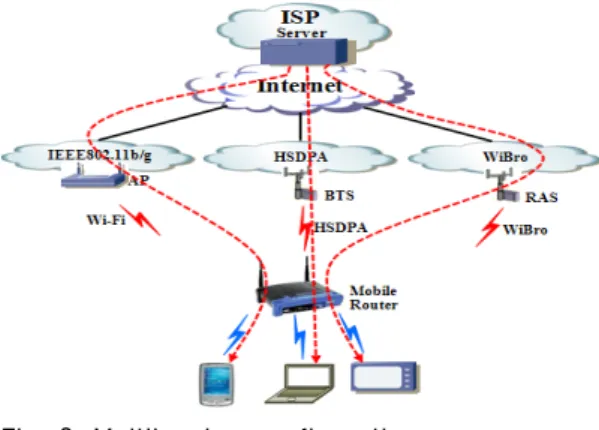
Figure 2 shows multihoming concepts. This is the technology that maintains the multiple connection to homogeneous or heterogeneous links. For this, node, site, and network in Internet uses multiple IP addresses.
Multihoming function distributes the traffics to the multiple interfaces. So if any of the links is out of order, the traffics on the failure link can be moved to the another active link for the seamless service.
Multihoming technology can provide higher bandwidth
than the used one interface, and also the reliable
connection between terminal and network. if user uses
the policy based on the link selection mechanism, they
can select the cost efficient link. This can be
accomplished by assigning the address to each multiple
IP prefix, or setting up multiple interfaces, through multihoming technology.
Fig. 2. Multihoming configuration 그림 2. 멀티호밍 구성
Figure 3 shows multi link configuration using BID(Binding IDentifier) during multihoming operation.
if mobile router sends binding update message to each interface, HA(Home Agent) finds out which interface can be used, and then stores their information in the binding cache. After this operation, HA sends the traffics to the available interface according to the load balancing policy.
Fig. 3. Multihoming operation 그림 3. 멀티호밍 동작
3. NEMO(Network Mobility)
In NEMO, instead of mobile terminal, mobile router is mobile unit. In subnet of mobile router, there can be multiple terminals. if the existing mobile IP applies to
the mobile network, The packet can be sent from CN(Correspondent Node) to mobile router, but the path to transfer the date to the lower terminals in the mobile network can't be found out. That is why the location information updated in binding cache is information for only mobile router, not for the lower terminals. So, for mobile IP to support the network mobility, the binding cache can have the mobile network prefix (NEMO prefix) item by improving binding cache and binding update message.
Figure 4. shows network mobility configuration.
NEMO aims at maintaining the connection of transport or application layer to Internet even if the terminals continues to move. HA(Home Agent) has the binding cache which maintains the current location information of mobile terminal, and the CN(Correspondent Node) also has the binding cache for route optimization.
Fig. 4. NEMO mobility configuration 그림 4. NEMO 구성
NEMO is the technology that can provide the
network mobility by connecting to Internet directly
instead of the network having the different
characteristics. Even if any network moves and then
it's Internet attachment point is changed, the terminals
within the network can connect to Internet with no
changing it's own address using network mobility
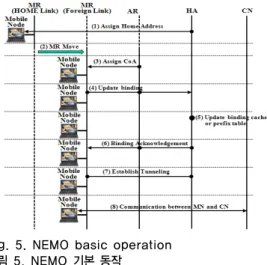
technology regardless of the changed location. Figure 5
shows the basic operation of NEMO. To transfer the
packet through the tunnel, MR has to send the prefix
information within the mobile network to HA. But this
information can't be transferred to the access router.
Fig. 5. NEMO basic operation 그림 5. NEMO 기본 동작
Ⅲ. Ad Hoc network characteristics
Wireless Ad Hoc aims at allowing a group of communication nodes to install and maintain a network by themselves without the existing infrastructure.
Therefore, Ad Hoc network has autonomous architecture which can communicate among the scattered nodes of wireless communication ability without AP(Access Point). Figure 6 shows Ad-hoc networking. Basically, Ad-hoc network uses the existing Internet, but can establish the network among the wireless equipments.
As this network has no arbitration node, each node has to communicate with each other by using it's own information, and can communicate with the remote nodes through other nodes. So this needs the routing protocols which finds out the path of lowest communication cost, such as the number of hops, power, and so on.
Fig. 6. Ad-Hoc networking 그림 6. Ad-Hoc 네트워킹
Ad-hoc network based on mobility is called MANET(Mobile Ad-hoc Network). MANET routing protocol is classified into proactive(table-driven) and reactive(on-demand). Figure 7 shows Ad Hoc routing protocol.
Fig. 7. Ad Hoc routing Protocol 그림 7. Ad Hoc 라우팅 프로토콜
In a), All nodes in the network maintain the routing formation for the rest nodes except of his own one. All nodes build their own routing tables continuously by broadcasting the routing information periodically to other nodes. The route gaining procedure is not needed when setting up the route by maintaining the routing information for all nodes. So, this is suitable for Ad-hoc network of small size which has the short delay and a few nodes. But this has the disadvantage which the overhead is increased due to the message to maintain the routing information. if node_4 moves to left, it is possible to communicate after the overall routing table is updated.
In b), the route setting procedure is done on demand.
this is suitable for Ad-hoc network which the location
is changed frequently. But it needs the search for the
overall network when the route setting is required. So,
it is not suitable for the real-time communication
because of long delay, and can generate also much
control traffics. if node moves to below, this method
confirms new routing path through request/reply.
Ⅳ. Mobile IP Router Design for Ad Hoc network
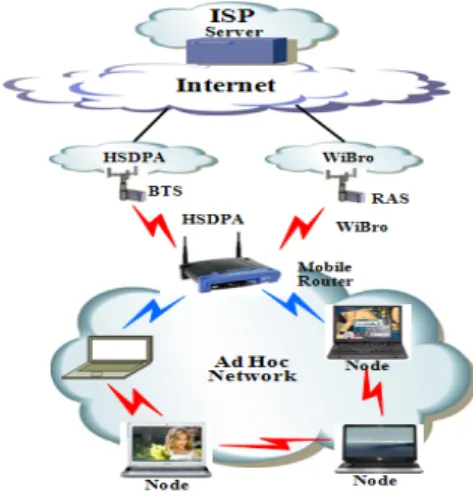
Figure 8 shows network configuration. MANET is network which exchanges information through cooperation among nodes without infrastructure.
Fig. 8. Network Configuration 그림 8. 네트워크 구성
MANET can be considered as one subnet. So the same subnet address is assigned to all hosts in MANET. For this, all source nodes in MANET confirm whether destination nodes is in same MANET through subnet masking procedure. At this time, though source and destination node is in the same MANET, if destination node is not in the propagation coverage of source node, source has to communicate with destination node in multi-hop through neighbor node's help. Therefore, source and destination nodes have the same subnet, but it is the architecture of multilink subnet because it has to pass through many links.
Figure 9 shows protocol stack for mobile router in Ad Hoc Network. In this stack, there are protocols for mobility functions, such as multihoming, network mobility, and policy routing. Power awareness is required in every layer for efficient power management.
So the routing protocol including power awareness is needed for routing cost computation and path selection.
IP core supports neighbor discovery for IPv6
(RFC2461), IPv6 stateless address auto-configuration (RFC2462), and IPv6 gloobal unicast address format (RFC3587) as basic functions. And it supports OSPF (Open Shortest Path First) for IPv6 (RFC2740).
Fig. 9. Protocol stack 그림 9. 프로토콜 스택
Figure 10 shows the relationship between RSSI (Received signal strength indicator), CINR(Carrier to Interference-plus-Noise Ratio) and bandwidth for upstream and downstream in mobile router.
Fig. 10. RSSI, CINR, and bandwidth 그림 10. RSSI, CINR, 그리고 대역폭
This is measured through network configuration in
Figure 8. if the average values of CINR and RSSI are
20 and 50 respectively, Average bandwidth is 4Mbps,
where is not always constant. The higher CINR value
and the lower RSSI, The more good. In this figure, if
CINR value is changed from 50 to 5 and RSSI value is
changed from 50 to 55, bandwidth is changed from
2.5Mbps to 0.5Mbps. Even if there are no much
variations in CINR and RSSI values, bandwidth can be unstable temporally. Therefore bandwidth is proportional to CINR and inversely proportional to RSSI.
Fig. 11. Handover characteristics 그림 11. 핸드오버 특성