Impact of Trans-Asian-Railway Network on Korean Economy
이태식* 란잔**
Lee, Tai Sik Saumya R Swain
--- ABSTRACT
There is a growing acceptance that rail has an important role to play in the national and international movements of goods and people. By making transportation between countries more efficient, the Trans-Asian-Railway Network is an important infrastructural and logistical component of Asian’s goal of achieving closer economic and social integration, This paper discuses about Trans-Asian-Railway Network and its impact on Asia and Korean economy.
--- 1. Introduction
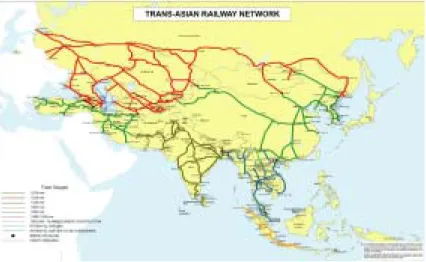
The Trans-Asian Railway (TAR) was initiated in the 1960s with the objective of providing a continuous 14,000-km rail link between Singapore and Istanbul (Turkey), with possible onward connections to Europe and Africa. project to create an integrated freight railway network across Europe and Asia. The TAR is a project of the United Nations Economic and Social Commission for Asia and the Pacific (UNESCAP). At the time shipping and air travel were not as well developed, and the project promised to significantly reduce shipping times and costs between Europe and Asia. Progress in developing the TAR was hindered by political and economic obstacles throughout the 1960s, 1970s and early 1980s. By the 1990's, the end of the cold war and normalisation of relations between some countries improved the prospects for creating a rail network across the Asian continent.
The link offered the potential to greatly shorten the distances and reduce transit times between countries and regions, while being a catalyst for the notion of international transport as a tool for trade expansion, economic growth and cultural exchanges.
The international events that punctuated the 1960s, 1970s and early 1980s influenced the momentum of the concept during these three decades. However, with the political and economic changes that took place in the region in the 1980s and early 1990s, the development of the TAR concept was revived.
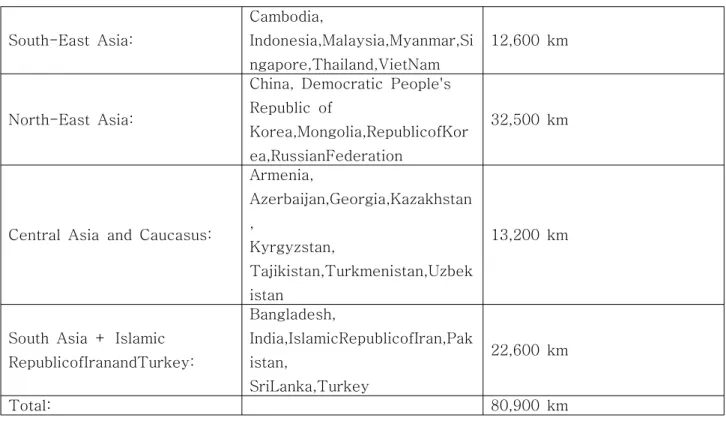
Given the extent of the territory covered, the differences in standards, and differences in the levels of technical development between railways in the region, ESCAP adopted a step-by-step approach to define the TAR network. The network was initially divided into four major components which were studied separately. The TAR was seen as a way to accommodate the huge increases in international trade between Eurasian nations and facilitate the increased
---
* 정회원, 한양대학교 건설환경시스템공학과 교수 E-mail : [email protected]
TEL : (031)400-4108 FAX : (031)418-2974
** 한양대학교 토목공학과 석사과정