• 검색 결과가 없습니다.

Investigations of the Boron Diffusion Process for n-type Mono-Crystalline Silicon Substrates and Ni/Cu Plated Solar Cell Fabrication

N/A
N/A
Protected

Academic year: 2021

Share "Investigations of the Boron Diffusion Process for n-type Mono-Crystalline Silicon Substrates and Ni/Cu Plated Solar Cell Fabrication"

Copied!
5
0
0

로드 중.... (전체 텍스트 보기)

전체 글

(1)

Investigations of the Boron Diffusion Process for n-type Mono-Crystalline Silicon Substrates and Ni/Cu Plated

Solar Cell Fabrication

Sunyong Lee ․ Atteq ur Rehman ․ Eun Gu Shin ․ Soo Hong Lee*

Green Strategic Energy Research Institute, Department of Electronic Engineering, Sejong University, 98 Gunja-dong, Gwangjin-gu, Seoul, Korea 143-747

ABSTRACT: A boron doping process using a boron tri-bromide (BBr

3

) as a boron source was applied to form a p

+

emitter layer on an n-type mono-crystalline CZ substrate. Nitrogen (N

2

) gas as an additive of the diffusion process was varied in order to study the variations in sheet resistance and the uniformity of doped layer. The flow rate of N

2

gas flow was changed in the range 3 slm~10 slm. The sheet resistance uniformity however was found to be variable with the variation of the N

2

flow rate. The optimal flow rate for N

2

gas was found to be 4 slm, resulting in a sheet resistance value of 50 Ω/sq and having a uniformity of less than 10%. The process temperature was also varied in order to study its influence on the sheet resistance and minority carrier lifetimes. A higher lifetime value of 1727.72 s was achieved for the emitter having 51.74 Ω/sq sheet resistances. The thickness of the boron rich layer (BRL) was found to increase with the increase in the process temperature and a decrease in the sheet resistance was observed with the increase in the process temperature.

Furthermore, a passivated emitter solar cell (PESC) type solar cell structure comprised of a boron doped emitter and phosphorus doped back surface field (BSF) having Ni/Cu contacts yielding 15.32% efficiency is fabricated.

Key words: BBr

3

, BRL, PESC, Ni/Cu plating, BSF, Solar cell

*Corresponding author: [email protected]

Received October 18, 2014; Revised November 6, 2014;

Accepted November 6, 2014

ⓒ 2014 by Korea Photovoltaic Society

This is an Open Access article distributed under the terms of the Creative Commons Attribution Non-Commercial License (http://creativecommons.org/licenses/by-nc/3.0)

which permits unrestricted non-commercial use, distribution, and reproduction in any medium, provided the original work is properly cited.

1. Introduction

Boron and oxygen combines to form B-O complex during the implantation of boron for the processing of p-type silicon sub- strates

1)

. The B-O defect introduces the light induced degradation (LID) phenomenon, which adversely disturbs the cell efficiency

2)

. This B-O complex acts as a trap for an EHP (electron hole pair), which affects the efficiency of solar cell by lowering the lifetime of carriers

3)

. In recent times, phosphorus doped n-type silicon has received a great amount of attention for solar cells

4)

. This is mainly because of its capacity to have inferior sensitivity to contamination from common interstitial impurities (e.g. Fe) and invulnerability to light-induced boron-oxygen defects

1,2)

. That is why the n-type offers higher minority carrier diffusion lengths in comparison to p-type c-Si substrates with a similar impurity concentrations. The carrier lifetime for n-type substrates is up to five times higher than p-type substrates

5,6,7)

. This is because of the high efficiency potential of n-type substrates yields cells with higher efficiencies than cell comprised of p-type c-Si substrates

5,6,7)

.

Although, the n-type silicon has the potential to offer higher efficiencies, cell processing is challenging

8,9)

. The formation of a boron doped emitter requires a higher temperature process

9,10)

. The junction depth and the series resistance of the emitter formed can influence the efficiency of the cell

10)

. The formation of a heavily doped emitter can decrease the mobility of the minority carriers, which can increase the recombination rates

5,6,9,12)

. On the other hand shallow doping results in increase in the series resistance and hence will lower down the fill factor of the cell

5,6,9,12)

. In order to achieve optimized cell efficiency a uniform emitter formation (appropriate sheet resistance) with a precise control of the dopant concentration is required

9,13)

. In this study the minority carrier lifetime and sheet resistance uniformity for the boron doping process on n-type silicon substrates was investigated. The variation in the N

2

gas and process temperature was performed in order to observe its influence on sheet resistance, minority carrier diffusion lengths and BRL thickness. Furthermore, a passivated emitter solar cell (PESC) type solar cell having an efficiency of 15.32% and composed of boron doped emitter on n-type silicon substrate was successfully fabricated.

147

(2)

Fig. 1. Variation in sheet resistance and its uniformity in terms of N

2

flow rate

2. Experimental procedure

2.1 Cell processing to boron doping

The samples were prepared with n-type mono-crystalline CZ wafers. The detailed specifications of the wafers are as follows:

Orientation (100), thickness (200 μm), resistivity (1.5 Ω.cm), and wafer size (6 inches). In order to perform the boron doping process the wafers were processed with the standard RCA-1 (DI-water: H

2

O

2

: NH

4

OH = 6: 1: 1) cleaning is performed for the removal of any organic contaminants. In order to lower down the reflectance, the wafer surface was textured by forming uniform pyramids in an aqueous alkaline solution. The standard RCA-2 (DI-water: H

2

O

2

: HCl = 6: 1: 1) cleaning step is per- formed after the texturing process to remove any metallic impurities.

2.2 Variation in N

2

gas flow rates

The doping process was performed by a mean of a diffusion furnace having a mixture of gases composed of O

2

, N

2

and BBr

3

vapours. The flow rate for N

2

gas is varied in order to observe the variation in sheet resistance, lifetime and thickness of BRL. The diffusion process was performed in two stages, pre-deposition and drive-in. The samples were loaded at 800ºC and pre-deposition starts at 930ºC for 20 minutes. However, the drive-in process was performed at 950ºC for 40 minutes. During the diffusion process, the N

2

gas flow rate was varied between 3~4.5 slm (for intervals of 0.5 slm), followed by a flow rates of 5 slm and 10 slm.

2.3 Variation in process temperature

The process temperature was also varied to investigate the deviations in sheet resistance and lifetime of the carriers after the boron diffusion process. The pre-deposition temperature was varied in a range of 890ºC~970ºC by adding an interval of 20ºC. In order to perform the drive-in process, an additional temperature of 20ºC is added to the pre-deposition temperature for an interval of 40 minutes. After the boron doping process, the boron silicate glass (BSG) was removed by means of diluted hydrofluoric acid (HF) for the measurement of sheet resistance and lifetime. The presence of BRL on the wafer surface was investigated, and its thickness was measured using field emission scanning electron microscope (FE-SEM).

2.4 Front metallization by Ni/Cu plating

The PESC type silicon solar cell with Ni/Cu contacting scheme

having a boron doped emitter on n-type substrate was fabricated.

The rear contact of the cell was formed by screen printing the Al paste on the rear of the cell. On the other hand, the front electrodes were formed by plating nickel (Ni) and copper (Cu) stacks on the front surface. In the process of Ni/Cu plating at the front, Ni (seed layer) was deposited by an electroless plating technique followed by Cu as main conducting electrode by the electroplating process. The light induced plating (LIP) process was adapted to plate the Cu on Ni silicide (NiSi), which was sintered (300ºC~400ºC) in the presence of N

2

gas. The elect- roplating process for depositing the Cu electrode was performed at 350mA for 20minutes.

3. Results and discussion

3.1 Variation in N

2

gas flow rate

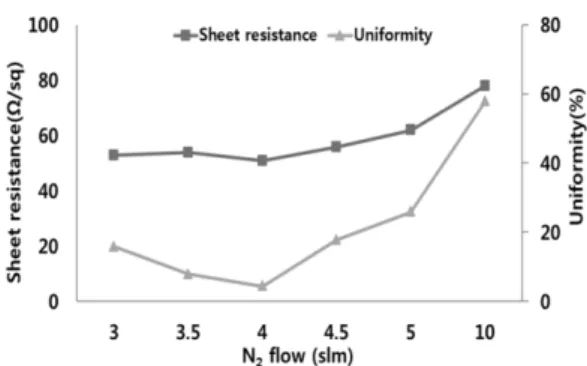
A variation in the sheet resistance and its uniformity for boron doped emitters was investigated with variations in N

2

gas during boron diffusion process. The sheet resistance was observed to be constant (~50 Ω/sq) for N

2

gas in a flow range of 3 slm~4.5 slm.

The sheet resistance was found to increase for the N

2

flow rate of 5 slm and 10 slm. The sheet resistance uniformity, however, was found to be variable with the variation in the N

2

flow rate.

The optimal flow rate for an N

2

gas was found to be 4 slm, resulting in a sheet resistance value of 50 Ω/sq with good uniformity of less than 10%. However, for higher N

2

flow rates, the sheet resistance uniformity was found to be worse and was as high as (~60 %) for 10slm. These results suggest that the N

2

flow rate plays a critical role for sheet resistance uniformity in the boron diffusion process (Fig. 1).

3.2 Variation in process temperature

The process temperature was also varied in order to study its

(3)

Fig. 2. Variation in sheet resistance and lifetime in terms of process temperature

Fig. 3. Variation in sheet resistance and BRL thickness in terms of process temperature

Fig. 4. (a) Optical microscopic image of the patterned electrode (cell-a), (b) SEM image for the Ni/Cu plated cell (cell-a)

Fig. 5. (a) Optical microscopic image of the patterned electrode (cell-b), (b) SEM image for the Ni/Cu plated cell (cell-b)

Fig. 6. EDX (Energy-dispersive X-ray spectroscopy) analysis for Ni/Cu contacts formed at boron diffused emitter. The contents of Si, Ni, Cu and B were observed clearly influence on sheet resistance and minority carrier lifetimes. The

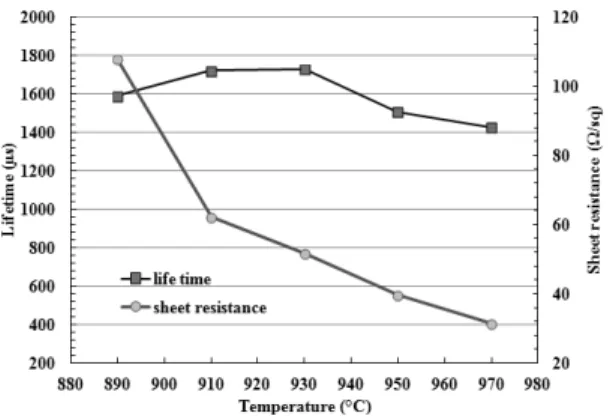
sheet resistance was observed to decrease significantly with the increase in temperature. The minority carrier lifetimes was found to increase slightly for the temperature range of (890ºC~930ºC) and started to decrease at temperatures above 930ºC. Variation between the sheet resistance and lifetime are plotted against the change in the process temperature in Fig. 2. The results also show the dependence of lifetime over the nature of doping. For a heavily doped surface, the lifetime was witnessed to decrease, while for shallow doping, it was observed to increase. The higher lifetime value of 1727.72 μs was achieved for the emitter having 51.74 Ω/sq sheet resistance where a lower value of 1425.33 μs was recorded for the emitter having a sheet resistance of 39.58 Ω/sq.

3.3 Variation in BRL thickness

The BRL thickness during the boron diffusion process was inspected and measured using FE-SEM and is plotted against the temperature values. The graph in Fig. 3 shows the dependence of BRL thickness and sheet resistance on the process temperature.

The thickness of BRL was found to increase with the increase in

the process temperature, and a decrease in the sheet resistance was observed with the increase in the process temperature. The BRL is actually formed along with BSG during the boron diffusion process, and its thickness affects the minority carrier lifetime, sheet resistance and uniformity adversely. Therefore, a minimal BRL thickness is desired as the thicker BRL can negatively affect the open circuit voltage (V

OC

) and short circuit current (I

SC

).

3.4 Ni/Cu plating for PESC type silicon solar cell

The front electrode patterning for two cells (cell-a and cell-b)

are done by the photolithography process, and the optical

microscopic and SEM images of the both the cells are shown in

Fig. 4(a, b) and 5(a, b) respectively. The antireflection coating

(ARC) was opened by dipping the patterned cells in the buffer

(4)

Fig. 7. Solar cell efficiency curve measured with the help of solar simulator (cell-b)

oxide etch (BOE) solution. The finger width of 15 μm and 10.93 μm was observed for cell-a and cell-b, respectively. The finger width of cell-a is larger in comparison to cell-b, which is because of dipping the cell-a for larger time in BOE in order to pattern through the ARC at the cell front area. The SEM images in Fig. 4(b) and 5(b) shows that thin lines of about 38 μm can be formed by adopting the electroplating process for Cu deposition.

Aspect ratios of 0.20 and 0.21 were also observed for cell-a and cell-b, correspondingly. The EDX (Energy-dispersive X-ray Spectroscopy) analysis was also performed in order to analyze the Ni/Cu contacts formed by electroless and light induced plating process and is shown in Fig. 6.

3.5 PESC type solar cell on n-type silicon substrates Two solar cells having a PESC type cell structure on an n-type silicon substrate with Ni/Cu contacts were fabricated.

After performing the initial processing steps (RCA-1, surface texturing and RCA-2 cleaning), the wafers were processed further to form the solar cell. The front surface having a sheet resistance of 60 Ω/sq was doped with boron in order to form a p

+

emitter layer. The rear side of the cell was doped with phosphorus species using a POCl

3

diffusion furnace in order to form phosphorus doped back surface field (BSF). The rear side of the cells was contacted by screen printing the Al paste on the rear, while the Ni/Cu plating process has been conducted to form the front contacts. The efficiencies of the cells fabricated were measured using a solar simulator. The efficiency for the cell labelled as cell-a was measured to be 15.10% (I

SC

= 139.87 mA, V

OC

= 592.0 mV, FF = 72.97, R

ser =

0.353 ohm, R

sht

= 99.61 ohm).

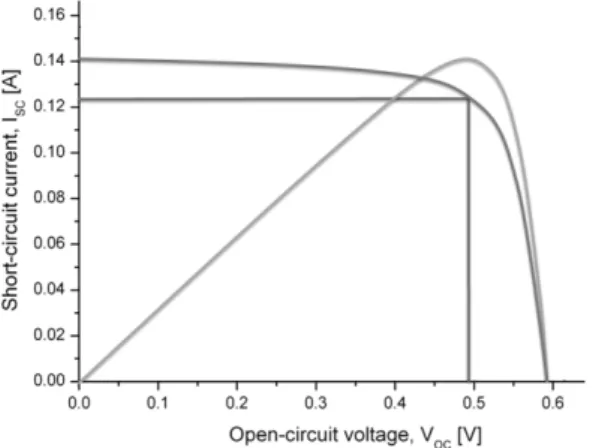
However, the cell labelled as cell-b resulted in an efficiency value of 15.32% (I

SC

= 140.54 mA, V

OC

= 594.4 mV, FF = 73.34,

R

ser

= 0.314 ohm, R

sht

= 76.03 ohm). The finger width of the cell-b was thinner, which resulted in lowering the series resistance that improves I

SC

of the cell. Fig. 7 shows the I-V curve for the cell having 15.32% efficiency and is labeled as cell-b.

4. Conclusions

In this study, the minority carrier lifetime and sheet resistance uniformity for the boron doping process on n-type silicon substrates was investigated. The variation in the N

2

gas and process tem- perature was performed in order to observe its influence on sheet resistance, minority carrier diffusion lengths and BRL thickness.

The role of N

2

gas during the pre-deposition and drive in process was found to have a greater influence on uniformity and sheet resistance during the boron diffusion process. The flow rate of 4slm for an N

2

gas was found to be the optimal flow rate, which resulted in a sheet resistance value of 50 Ω/sq, having a uniformity of less than 10%. Moreover, a decrease in the sheet resistance and minority carrier lifetime occurred with increases in process temperatures. The higher lifetime value of 1727.72 μs was achieved for the emitter having 51.74 Ω/sq sheet resistances where a lower value of 1425.33 μs was recorded for the emitter having a sheet resistance of 39.58 Ω/sq. The increase in the process temperature shows an increase in the BRL thickness, which is responsible for negatively affecting the sheet resistance, minority carrier lifetime and sheet resistance uniformity. Fur- thermore, a solar cell composed of a PESC type structure having Ni/Cu contacts with an efficiency of 15.32% was successfully fabricated.

Acknowledgments

This work was supported by the New & Renewable Energy Core Technology Program of the Korea Institute of Energy Technology Evaluation and Plating (KETEP) funded by the Ministry of Trade, Industry & Energy, Republic of Korea (No.

20133010011780).

References

1. Bandana Singha, C. S. Solanki, “Effect of B-O complexes in N-

type crystalline silicon solar cells”, search & research, Vol-II,

No. 2 (203-206) : (2011).

(5)

2. Bhushan Sopori, Prakash Basnyat, Srinivas Devayajanam, Sudhakar Shet, Vishal Mehta, Jeff Binns, and Jesse Appel,

“Understanding Light-Induced Degradation of c-Si Solar Cells”, Presented at the 2012 IEEE Photovoltaic Specialists Conference, Austin, Texas, June 3 –8, 2012.

3. Jean. P. Rakotoniaina, Otwin Breitenstein, Jianhua Zhao, Aihua Wang, Martin A. Green, Stefan Rein, Stefan W. Glunz, “Local mapping of the oxygen-boron complex in 2x2 cm

2

and 10x10 cm

2

high-efficiency CZ-Si solar cells by lock-in thermography and LBIC”, in 29th IEEE Photovoltaics Specialists Conference, pp. 434 - 437, presented at 29th IEEE Photovoltaics Specialists Conference, New Orleans, Louisiana, USA, 20 - 24 May 2002.

4. A. Kranzl, R. Kopecek, K. Peter, P. Fath, “Bifacial solar cells on multi-crystalline silicon with boron BSF and open rear con- tact”, Vol.1, Photovoltaic Energy Conversion, Conference Record of the 2006 IEEE 4th World Conference, page 968-971, May 2006.

5. J. Benick, B. Hoex, G. Dingemans, W.M.M. Kessels, A. Richter, M. Hermle, S.W. Glunz, “High-Efficiency n-Type Silicon Solar Cells with Front Side Boron Emitter”, 24th European Photovoltaic Solar Energy Conference, page 863-870, 21-25 September 2009, Hamburg, Germany.

6. A. Edler, J. Jourdan, V.D. Mihailetchi, R. Kopecek, R. Harney, D. Stichtenoth, T. Aichele, A. Groc hocki, J. Lossen, “High Lifetime on n-Type Silicon Wafers Obtained after Boron Diffusion”, page 1905-1907, 25th European Photovoltaic Solar Energy Conference and Exhibition / 5th World Conference on Photovoltaic Energy Conversion, 6-10 September 2010, Valencia, Spain.

7. Jianhua Zhao, Aihua Wang, Pietro P. Altermatt, Stuart R.

Wenham and Marltin A. Green, “24% efficient silicon solar cells”, Vol.2, page 1477-1480Photovoltaic Energy Conversion, 1994., Conference Record of the Twenty Fourth. IEEE Photo-

voltaic Specialists Conference - 1994, 1994 IEEE First World Conference, 5-9 Dec 1994, Waikoloa.

8. Atteq ur Rehman and Soo Hong Lee, “Advancements in n-Type Base Crystalline Silicon Solar Cells and Their Emergence in the Photovoltaic Industry”, The Scientific World Journal, page 13, Volume 2013 (2013)

9. Michael Andreas Kessler, Tobias Ohrdes, Bettina Wolpensinger, Robert Bock, Nils-P. Harder, “Characterisation and im- plications of the boron rich layer resulting from open-tube liq- uid source BBR3 boron diffusion processes”, Photovoltaic Specialists Conference (PVSC), 2009 34th IEEE, page 001556- 001561, 7-12 June 2009

10. Phang SP, Liang W, Wolpensinger B, Kessler MA, Macdonald D. Tradeoffs between impurity gettering, bulk degradation, and surface passivation of Boron-Rich layers on silicon solar cells.

IEEE Journal of Photovoltaics. 2013;3(1):261-266.

11. Su-won Yang, Young Kwan Kim, “Boron diffusion into silicon crystal with SiNx layer as a reaction barrier”, Solar Energy Materials and Solar Cells, Vol. 94, Issue 12, December 2010, pages 2187-2190

12. S. Suzuki, M. Dhamrin, N. Ban, G. Al-daby, K. Ogawa, H. Suzuki, S. Yoshiba, K. Furuichi, K. Ka misako, H. Sato, K. Katsuma, K. Kato, “Screen-Printed Boron Diffusion Source for Crystalline Silicon Solar Cell Fabrication”, 25th European Photovoltaic Solar Energy Conference and Exhibition 5th World Conference on Photovoltaic Energy Conversion, 6-10 September 2010, Valencia, Spain, pages 2445-2447

13. A.R. Burgers, L.J. Geerligs, A.J. Carr, A. Gutjahr, D.S. Saynova,

L. Li, X. Zhuo, W. Hongfang, A. H aijiao, H. Hu, P.R. Venema,

A.H.G. Vlooswijk, “19.5% Efficient n-Type Si Solar Cells Made

in Production”, pages 1144-1147, 26th European Photovoltaic

Solar Energy Conference and Exhibition.

수치

Fig. 1. Variation in sheet resistance and its uniformity in terms  of  N 2  flow rate
Fig. 3. Variation in sheet resistance and BRL thickness in terms  of  process temperature
Fig. 7. Solar cell efficiency curve measured with the help of  solar simulator (cell-b)

참조

관련 문서

This study aims to analyze the process and the features of corporate e-Learning as a form of informal learning. For this purpose, the concept of

It is important to recognize the importance of emotional development from early childhood and to help form desirable human relationships. Because they have

The laser-induced doping of Al into CdTe thin films is very simple and effective to dope a multilayered thin film solar cell with a relatively short

movement of atoms from a high concentration region to low concentration region.. Diffusion Movement of atoms to reduce its chemical potential μ... Driving force: Reduction

 Similarly, the photographic position of

The aim of this study was to develop a training program for swallowing and to test its effect on swallowing capacity and nutritional status in stroke

The purpose of this study is to investigate and search the technology for treatment and restoration of abandoned wells through survey of contamination

□ The least-upper-bound property (sometimes called completeness or supremum property) is a fundamental property of the real number system. The least-upper-bound