
Occurrence and Genesis of Obsidian in Gombawi Welded Tuff, Ulleung Island, Korea
12
0
0
전체 글
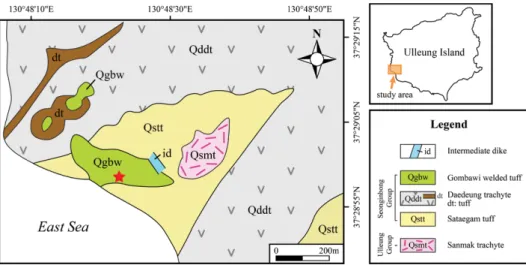
(2) 106. 임지현 · 추창오. 하여 고온상태에서 역-화산재 흐름 퇴적물이 계곡부로 운반된 후, 차가운 지표면과 접촉하였으며 유동성을 띠는 가운 데서 급랭하여 형성된 것으로 보인다. 주요어 : 흑요암, 울릉도, 용결응회암, 냉각균열, 역-화산재 흐름. 1. 서. 론. 화산분출과 정출작용동안 마그마 주변의 온도구배가 큰 상태로 급랭하면 유리질 암석이 생성될 수 있다. 화산기원의 대표적인 유리질 암석은 흑요암(obsidian), 타킬라이트(tachylite), 부석(pumice), 유리질 샤드(glass shard), 화쇄퇴적물 기질의 유리암 등이 있으며, 이들은 고유한 화산분출 특성과 관련성이 깊다. 흑요암은 에티오피아에서 이 암석을 발견한 로마인 Obsius의 이름을 따서 “Obsius의 돌” 이라는 의미로 Obsianus 라고 불렀으나, 17세기 들어 라틴어의 철자 오류로 인하여 Obsidianus로 잘못 기술한 것에서 유래 한다. 흑요암은 흑색의 유리질암으로 화산활동 후기에 잔류 마그마가 분출하거나 유동하여 지표상에서 급랭 하여 형성된다. 흑요암의 화학조성은 대부분 유문암질 에 속하나, 조면암질이나 석영안산암질 흑요암도 드물 게 나타난다. 흑요암은 대개 유문암 돔이나 칼데라 주 변, 또는 용암에서 산출되며 마그마가 급격히 냉각되 어 결정이 형성될 때 생성되므로 유리질 조직을 형성 한다. 흑요암의 대표적인 물리적 특성인 깨짐은 불완 전 패각상(imperfect conchoidal fracture)이고, 투명도 는 중간에서 불량 범위이며, 체적에 비해 낮은 비표면 적(specific surface area)비를 보인다. 흑요암은 균질하. 거나 유동띠(flow banding)를 보이는데 일반적으로 색 깔에 따른 띠가 특징적으로 나타난다. 한편, 뉴질랜드의 타우포(Taupo) 화산지대의 흑요암은 구과상(spherulitic) 이나 유리질의 구상체(globule)로 산출되는데, 흑색 침 상광물 또는 석영, 장석과 같은 반정광물을 함유하기 도 한다(Moore, 2012). 흑요암은 화산암 지대에서만 산출되는데, 백악기 이전 에 형성된 경우 암석 고유의 풍화, 변질에 취약하여 노두 보존이 쉽지 않다. 이로 인해 현재 국내 흑요암의 산출 과 생성환경에 관한 지질학적 연구는 매우 드문 편이다. 이 연구의 목적은 울릉도 남서부 지역에 분포하는 곰 바위용결응회암 내에서 산출하는 흑요암의 발달특징과 광물학적 특성분석을 통하여 그 성인을 고찰하는데 있다.. 2. 연구지역의 지질 동해에 위치하는 울릉도는 신생대 플라이오세 (Pliocene)에서 홀로세(Holocene)까지의 화산활동으로 형성되었다. 초기 화산활동으로 형성된 현무암질암류의 연대는 2.7±0.9-1.37±0.05 Ma이며(Kim and Lee, 1983; Min et al., 1988; Kim et al., 1999; Song et al., 2006), 최후기 화산활동을 지시하는 테프라층 내 탄화목과 퇴적물의 연대는 19-5.6 ka BP이다(Okuno. Fig. 1. Geological map modified from Hwang et al. (2012). The study area bearing obsidian is marked as a star..
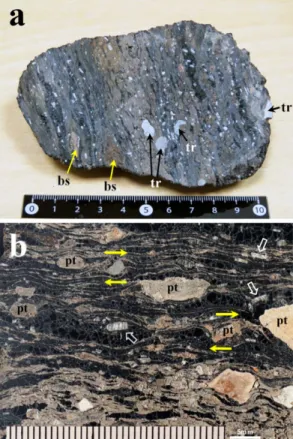
(3) 울릉도 곰바위용결응회암 내 흑요암의 산출특징과 성인. et al., 2010; Im et al., 2012; Kim et al., 2014; Im and Choo, 2015). 울릉도의 광역적인 화산층서는 화산윤회 혹은 부정합을 기준으로 4개의 층군, 즉 현무 암질암류, 울릉층군, 성인봉층군, 나리층군으로 세분된 다(Hwang et al., 2012). 흑요암은 울릉도 서면 남서리 부근에 분포하는 곰바 위용결응회암의 하부에서 국부적으로 산출된다(Fig. 1). 곰바위용결응회암은 성인봉층군에 속하며 대동조면암 과 사태감응회암을 피복하고 있다(Fig. 1). 곰바위용결 응회암은 수평층리가 발달된 사태감응회암과 고각으로 접촉하며(Fig. 2a), 남측 해안 쪽으로 약 20도 경사져 분포한다. 또한, 하부로 갈수록 수십 cm-1 m 직경의 거력(boulder)이 함유된 괴상의 각력질 응회암 양상을. 107. 나타내며 일종의 역-화산재 흐름(block-and-ash flow) 퇴적상을 보여준다(Fig. 2b-2f). 사태감응회암과 곰바위 용결응회암은 침식 및 채움(cut-and-fill) 방식의 퇴적상 을 보인다. 두 암상의 접촉부는 열변질 또는 팔라고나 이트(palagonite)화 작용을 받아 담적색을 나타낸다. 곰바위용결응회암 내 흑요암은 파쇄된 흑요암 입자 들이 기질에서 층리를 이루거나(Fig. 2d), 흑색 유리질 렌즈상으로 산출된다(Fig. 2e, 2f). 파쇄된 흑요암 입자 들은 수 mm 크기로 비교적 분급이 양호하다. 압축 신 장된 흑색 유리편은 층리와 무관하게 신장되어 치밀한 용결엽리와 유상구조(flow structure)를 보여주기도 한 다. 렌즈상 덩어리로 산출되는 흑색 흑요암 내에서 알 칼리장석 반정을 흔하게 함유하여 파리반암(vitrophyre). Fig. 2. Field photographs of the Gombawi welded tuff. (a) A geological boundary between the welded tuff and the Sataegam tuff near the Mushroom rock, a geosite, is shown with high angles. (b) Massive bed characterized by the block-and-ash flow deposit. (c) Basaltic boulders with varying sizes in reddish brown tuff matrix. (d) Pebble-sized breccia and fragmented obsidian scattered in tuff. (e) Matrix-supported massive bed indicating a block-and-ash flow deposit. (f) Enlarged image of the box area in (e) shows partly linear fabrics in tuff matrix mixed with trachyte boulders and breccia..
(4) 108. 임지현 · 추창오. 위용결응회암 하부에서 발달하는 흑요암이다. 흑요암의 조직관찰을 위해 대표적인 시료를 선별하여 한국지질 자원연구원에서 연마편을 제작하였다. 분말시료는 암석 을 파쇄한 다음, 실체현미경을 이용하여 미세암편과 반 정광물이 제거된 흑색 유리질 입자를 선별하여 만들었다. 흑요암 내 비정질의 함량계산과 광물동정은 한국지 질자원연구원 지질자원분석센터의 X-선 회절분석(X-ray diffraction(XRD), Philip X’Pert MPD)을 이용하여 수행 되었다. 회절 패턴은 Cu target(CuKα: 40 kV, 30 mA) 을 이용하여 3-65° 2θ 구간에서 0.01° 스텝 하에서, 스텝 당 0.25초 간격으로 획득하였다. 배경치를 포함한 전체패턴을 대상으로 Siroquant 프로그램 v3.0을 이용 하여 광물함량과 비정질의 양을 계산하였다. 흑요암의 조직관찰과 흑요암 내 유리질, 반정광물, 미세결정의 주성분원소 정량분석은 경상대학교 공동실 험실습관의 전자현미분석기(electron probe X-ray microanalyzer(EPMA), JEOL JXA-8100)를 이용하여 수행되었다. 흑요암 표면의 미세조직관찰과 EDS(energy dispersive spectrometer)에 의한 반정량분석은 한국기 초과학연구원 대구센터의 고분해능주사전자현미경(high resolution scanning electron microscope(HR-SEM),. Fig. 3. Slab specimens of obsidian mixed with rock fragments in the Gombawi welded tuff. (a) Obsidian block shows vitrophyre-like texture with basaltic fragment (bs) and trachytic fragment (tr). Numbers on the scale bar are in cm. (b) Obsidian layers mixed with pumiceous tuff fragments (pt). Yellow arrows around fragments indicate a dextral sense of shearing. Sanidine phenocryst marked as a white arrow at the center is slightly rotated.. 양상을 보이기도 한다(Hwang et al., 2012). 흑요암에는 다양한 종류의 암편과 반정광물들이 포 함되어 있으며 용결구조와 유상구조가 잘 관찰된다 (Fig. 3a). 암편은 주로 회색의 부석질 응회암, 암회색 조면암, 흑적색 현무암, 암회색 조면안산암 등이며, 회 백색의 섬장암이 드물게 함유되어 있기도 하다. 부석 질 파편은 가장자리에서 변질조직이 흔히 발달하나 새 니딘 반정에서는 용식과 같은 변질조직은 관찰되지 않 는다(Fig. 3b). 직경 2-3 mm의 새니딘 반정은 암편과 마찬가지로 약한 입자회전 양상을 보여준다.. 3. 분석방법 연구시료는 울릉읍 서면 해안 인근에 분포하는 곰바. Hitachi S-4800)을 이용하여 수행되었다. 흑요암 유리질에 대한 분광학적 분석은 경북대학교 공동실험실습관의 적외선분광기(fourier transform infrared(FT-IR) spectrometer, Perkin-Elmer Frontier) 를 이용하여 분해능 1 cm-1, 파수(wave number) 4000-400 cm-1 범위 하에서 이루어졌다. 분석 전 시료 는 분말로 제작한 후, KBr과 혼합한 펠릿으로 제작하 여 투과율(transmittance)을 측정하였다.. 4. 결. 과. 4.1. 흑요암의 구성광물 흑요암 유리질은 현미경상에서 거의 균일한 다색성 과 소광에 의한 특유의 간섭색을 나타낸다. 교차니콜 하에서도 완전소광이 아니므로 일반적인 비정질 실리 카와 차별된다. 흑요암 유리질에는 새니딘과 아노소클 레이스 같은 알칼리 장석이 흔히 함유되어 있다. 새니 딘은 단일 반정으로 유리 기질부에 산점상으로 분포하 며(Fig. 4a), 아노소클레이스는 주상 및 탁상의 형태로 군집을 이루거나 특정한 방향성을 띤다. 그 외에도 흑 운모, 휘석, 여러 종류의 철산화물이 관찰된다. 흑요암 의 유리질 내에서는 고배율에서만 관찰되는 μm 이하 크기의 미세결정이 흔히 관찰된다(Fig. 4b)..
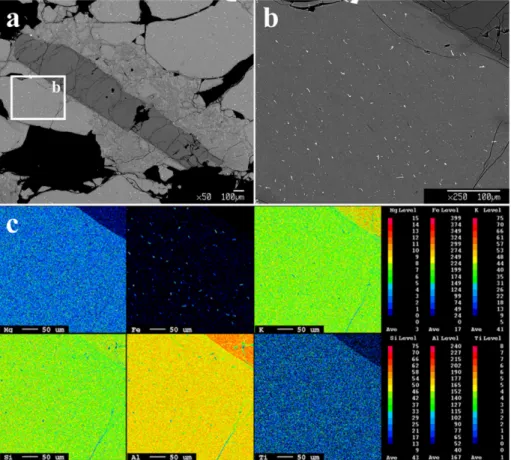
(5) 울릉도 곰바위용결응회암 내 흑요암의 산출특징과 성인. 109. 잘 일치한다. 특히 20-30 °2θ 부근에서 나타나는 높은 배경치는 흑요암의 유리질에 비정질이 상당히 포함되 어 있음을 지시한다. 점토광물과 같은 함수성 이차 변 질광물은 확인되지 않는다. 4.2. 흑요암의 미세조직 BSE(backscattered electron) 이미지상에서 관찰된 흑요암의 유리질 부분은 진주상 균열(pearlitic crack)이 특징적이며, 흔히 구상체의 덩어리가 군집한 형태로 관 찰된다(Fig. 6). 냉각균열은 원형의 큰 균열에서 가장자 리로 갈수록 여러 겹의 구상체 또는 렌즈상 균열로 갈 라지며, 여러 개의 균열이 접촉한 곳에서는 꼭지점을 공유하면서 서로 대칭적인 공액절리(conjugated joint) 양상이 관찰되기도 한다(Fig. 6b). 또한, 유리기질부에 서 균열의 중심부와 가장자리 간의 색 차이를 보인다 (Fig. 6c). 흑요암 기질부에는 μm 크기의 미세광물의 혼염이 흔하며, 이들은 일메나이트 계열의 티탄철석이 다. 미세결정은 구형의 입자로서 거의 등립질을 이루 며, 흑요암 유리 기질부에 산점상으로 분포하는 것이 특징이다(Fig. 7). EPMA 정량분석결과(Table 2), 흑요암의 기질부에 대한 SiO2 함량은 65.43-66.35 wt.%, Na2O+K2O 함 Fig. 4. Photomicrographs of obsidian (sample G1-S6-2). (a) Glass and minerals at low magnification under open nicol. Scale bar is 2 mm. (b) Obsidian glass. Enlarged image of the box marked as (b) in (a) under open nicol. Scale bar is 500 µm. Bt: biotite, Gl: glass, Sa: sanidine.. XRD분석 결과, 흑요암의 흑색 유리질 입자는 대부분 비정질로 되어 있으나 새니딘, 아노소클레이스, 투휘석, 흑운모, 자철석 등을 소량 포함하고 있다(Table 1, Fig. 5). 이 같은 결과는 현미경 관찰에서 나타난 광물조성과도. 량은 8.14-8.53 wt.%로 조면암질 특성을 보여준다. 석 영은 전혀 관찰되지 않는데, 이는 XRD분석 결과와도 잘 일치한다. 울릉도의 화산암은 높은 알칼리 함량을 보이며 대부분 K계열의 분화경향(K2O>Na2O)을 띠는 데(Song et al., 1999), 본 흑요암에서도 K2O 함량이 Na2O 함량보다 높게 나타나 일반적인 울릉도 화산암 류와 비슷한 경향을 보인다. Fe은 약 3 wt.% 내외로 포함되어 있다. EPMA X선 성분도에 따르면, 유리질 에는 Si, Al, Ti, Fe, Mg, K 성분이 균질하게 분포하 며, 함철광물과 티탄광물의 미세결정들이 광범위하게. Table 1. Mineral constituents (wt.%) of obsidian from Ulleung Island, calculated by XRD quantitative analysis Sample no. G3-S2-2 G3-S3-2 C-1-2 G1-S1-2 G1-S2-2 G1-S4-2 G1-S5-2 G1-S6-2 G1-S8-2 G1-S9-2. Glass 95.5 87.6 69.5 65.2 66.5 91.2 59.8 27.3 29.0 22.5. Anorthoclase 6.9 20.5 20.0 1.2 26.7 42.8 33.1 38.4. Sanidine 26.1 10.7 10.4 1.7 11.6 25.9 36.4 35.7. Diopside 2.9 2.9 2.3 1.7 2.1 2.9 1.9 1.7 1.2. Magnetite 1.6 1.6 0.9 1.7 1.0 2.1 2.0 1.5 1.8. Biotite 1.1 1.1 0.3 0.9 0.3 0.3.
(6) 110. 임지현 · 추창오. Fig. 5. XRD diffraction patterns of representative obsidian samples from the Gombawi welded tuff. Obsidian consists of glass and some mineral species. The broadening in the range of 20-30 °2θ is originated from amorphous matrix (glass). An: anorthoclase, Bt: biotite. Di: diopside, Gl: glass, Sa: sanidine.. Fig. 6. BSE images of obsidian (sample G1-S4-2). (a) Obsidian glass, sanidine, and anorthoclase aggregates typical of rock fragment. (b) An enlarged image of the box area in (a) showing orbicular or perlitic cracks in glass. Note decomposition of anorthoclase laths (arrowed area). (c) Orbicular and globular cracks typical of amorphous glass surrounded by large crack domains. Chemical differences are seen in cores (bright grey) and rinds (dark grey) in obsidian glass, as evidenced by BSE contrast. (d) Subround cracks in glass. An: anorthoclase, Di: diopside, Gl: glass, Sa: sanidine..
(7) 울릉도 곰바위용결응회암 내 흑요암의 산출특징과 성인. 111. Fig. 7. BSE images and X-ray element maps of obsidian (sample C1-2). (a) Sanidine (dark grey lath) and glass (grey area) with typical perlitic cracks. Black area is due to cavity derived from a sample loss during polishing preparation. (b) An enlarged image of a box inserted in (a). Note microcrystalline Fe-Ti oxides are included in glass. (C) X-ray element maps showing element distribution in glass. Mg, Fe, K, Ti, Al, and Si in a clockwise direction. Table 2. Major element compositions (wt.%) of obsidian glass (sample C-1-2), obtained using EPMA. Fe assumed as ferrous SiO2 TiO2 Al2O3 FeO MnO MgO CaO Na2O K2O P2O5 Cr2O3 Total. 1 65.43 0.57 19.21 3.19 0.21 0.38 1.20 3.30 5.16 0.10 98.75. 2 65.55 0.54 19.17 3.28 0.17 0.36 1.18 3.44 5.06 0.09 98.84. 3 65.67 0.62 19.44 2.97 0.20 0.39 1.08 3.74 4.79 0.09 0.03 99.02. 4 65.49 0.50 19.33 3.50 0.22 0.42 1.23 3.31 4.83 0.06 98.89. 5 66.35 0.50 19.14 3.27 0.19 0.43 1.20 3.60 4.86 0.05 99.59. 산재하고 있다(Fig. 7c). SEM 분석에서 흑요암의 파단면은 유리질 특유의 매. 끄러운 패각상을 보이며, 일부 시료는 용해공동이 발 달하기도 한다(Fig. 8a). EDS 분석에 의하면 유리질 부분은 Si, Al, Ti, Fe, Na, K가 확인되며, 이들 구성 비는 EPMA 분석치와도 잘 일치한다. 일메나이트는 자형의 포유물로 존재하며, 유리질의 기질이 이를 둘 러싸는 양상을 보인다(Fig. 8b) 4.3. 흑요암의 적외선분광학적 특성 실리카와 관련된 수산기의 진동특성을 살펴보면, 강하 게 결합된 OH 수산기는 3580-3620 cm-1, 그리고 흡착 수는 3400-3500 cm-1에서 비대칭 신축진동(stretching vibration, ν 1)이 나타난다. 이는 실리카 표면에 흡착된 물 분자나 실라놀(silanol, Si-OH)의 O-H 신축진동에 의한 것이다. 1610-1630 cm-1에서는 물 분자의 자유수 (free water)의 H-O-H에 의해서 굽힘 진동(bending vibration, ν 2)이 나타나는데, 이는 실리카의 기질에 포.
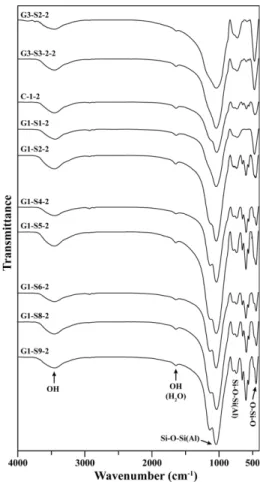
(8) 112. 임지현 · 추창오. Fig. 8. SEM microphotographs of representative obsidians. (a) Sample C1-2 shows typical conchoidal fractures with small dissolution cavities. (b) Euhedral ilmenite (Il) in glass (sample G1-S6-2).. 획된 물 분자나 실리카의 균열에 포획된 물 분자의 굽 힘진동에 의한 것이다(Aines and Rossman, 1984). 한편, 1080 cm-1에서는 Si-O 신축진동, 900-1100 cm-1 의 흡수 띠는 Si-O-Si의 비대칭 신축진동인데, 이는 유 리질의 SiO4 사면체의 결합에 기인한다(Frondel, 1982; Madejova and Komadel, 2001).. Fig. 9. FT-IR spectra of obsidians from Ulleung Island. Typical OH stretching vibration in water are seen at 3420 cm-1 and OH bending vibration at 1600 cm-1. Si-O bands are in 1020 cm-1. No split is found in glass-rich samples such as G3-S2-2. Some show split due to a mixture effect of feldspars.. 본 흑요암에서는 흡착수에 의한 물 분자의 진동 흡 수 띠를 잘 보여준다(Fig. 9). C-1-2, G1-S1-2, G1S2-2, G1-S4-2, 그리고 G1-S6-2에서는 2800 cm-1 부 근에서 작은 흡수 띠가 나타나는데, 이는 수소 결합된 (Si)O-H 그룹의 신축모드로서, 물이 다소 함유된 유리 질의 고유한 특징이다(Davis and Tomozawa, 1996; Efimov and Pogareva, 2006). 1020 cm-1에서는 규산 염의 대표적인 Si-O 흡수 띠가 크게 나타나며, 일부 시료에서는 높은 파수 쪽으로 비대칭 어깨(shoulder)나 피크의 분리현상이 관찰된다. 이들은 실리카 유리질 및 장석과 같은 규산염광물에서의 Si-O 결합에 의한 흡수 띠가 중첩되기 때문인데, 비정질의 함량이 낮을수록 이 러한 중첩현상이 강하게 나타난다. 흑요암에는 미세결 정 또는 장석류의 반정이 흔히 포함되므로 1000 cm-1. 이하에서는 Si-O 결합에 의한 흡수 띠가 나타난다. 본 흑요암에서는 XRD 분석상 비정질의 함량이 높은 시 료에서 흑요암 고유의 실리카 특성이 강하며, 장석류 가 많이 함유될수록 800-500 cm-1 범위에서 Si-O, AlO 결합에 의한 흡수 띠가 복잡하게 나타난다. 한편, FT-IR 분석 결과에 의하면 석영에 의한 흡수 띠는 확 인되지 않으므로 흑요암에는 석영이 존재하지 않는 것 으로 해석된다. 이는 현미경관찰과 XRD, SEM 분석에 서 석영이 검출되지 않는 사실과도 잘 일치한다.. 5. 토. 의. 5.1. 흑요암의 수화변질 화산암의 유리질 암석이나 유문암질 흑요암 중에서.
(9) 울릉도 곰바위용결응회암 내 흑요암의 산출특징과 성인. 수분 함량은 화산폭발에 큰 영향을 미치므로, 이들 유 리질 암석의 조성과 형성특성에 대한 이해는 중요하다 (Westrich et al., 1988; Castro, et al., 2005). 흑요 암이 습윤한 대기 또는 물과 접촉하게 되면 흑요암 표 면에서는 점차 수화반응이 일어난다. 수화정도는 수화 반응 속도와 시간, 또는 흑요암이 산출하는 층준에 따라 서 다양하게 나타날 수 있으며(Stevenson et al., 1993), 흑요암이 심하게 수화변질되면 결국에는 진주암 으로 전이된다(Heide and Heide, 2011). 본 흑요암의 EPMA 정량분석에 의하면 미분석된 성 분의 총합계는 1 wt.% 내외인데, 분석항목에서 제외된 미량성분들을 감안하더라도 이 수치를 수분함량으로 볼 수 있다. 화산성 유리질 암석의 수분함량은 암종마다 다양하다. 수분함량은 흑요암에서 0.1-1.0 wt.% 범위로 소량이며, 진주암(perlite)에는 3-5 wt.%, 송지암 (pitchstone)에서는 4-10 wt.%로 함유된다(Jambon et al., 1992; Tazaki et al., 1992; Clay et al., 2012; Cabrera et al., 2015). 흑요암 내 수분함량은 지역에 따라 다양하며, 미국 California의 Olancha의 흑요암에 서는 0.92 wt.%까지 나타난 바 있다(Friedman and Smith, 1958). 신선한 흑요암에서 수분함량이 1 wt.%를 초과하는 경우는 거의 없다(Heide and Heide, 2011). 본 흑요암의 유리질은 화학조성이 균질하지 않는데, 특히 외곽부에서 수화된 껍질(rind)이 발달한다(Fig. 6). 이 같은 수화변질에 의한 유리질의 조성변화는 흑요암 외에 진주암에서도 흔히 발달한다(Lipman, 1965; Noble, 1965, 1967; Lipman et al., 1969). 흑요암의 중심부는 비교적 균질한 화학조성을 나타내는 반면에 가장자리로 가면서 화학조성 변화가 현저하다. 특히 흑 요암 가장자리에서 상대적으로 Na 함량이 높고, 중심 부에서 K가 높은 것은 이온교환 반응과 관련된 흑요 암의 독특한 수화변질 작용을 지시한다. 흑요암의 이 같은 수화변질은 수소이온의 흡착, 알칼리이온의 이온 교환반응에 크게 영향을 받는다. 즉 물의 흡착, 흑요암 조직의 파괴, 이온교환 등이 수화변질 작용에 복합적. 113. 이온의 교환반응이 수반된 것으로 해석된다. 이처럼 수 화변질작용이 균열을 따라 진행될수록 이온교환 반응 은 쉽게 일어나게 되고, 점차 유리질은 약해지고 분해 된다(Jezek and Noble, 1978). 즉 수화된 껍질이 발 달한 수화층(hydration layer)이 형성되게 되면, 양이온 과 수소이온 간 이온교환 반응이 점차 활발해진다. 대 부분의 흑요암 수화껍질의 두께는 1만년에 평균 100 μm의 속도로 형성되는데(Freidman and Long, 1984), 본 흑요암에서의 수화껍질 두께는 이보다 훨씬 얇은 것이 특징이다. 유리질 암석이 수화, 변질작용을 심하게 받는 경우 점토광물과 같은 함수규산염광물이 생성되기 쉽지만 본 흑요암에서는 이러한 변질광물들 은 관찰되지 않았다. FT-IR 분석 결과 점토광물 구조 수의 존재를 지시하는 흡수 띠는 확인되지 않으므로, 물 분자의 수산기는 흑요암 유리질의 특징적인 냉각균 열의 틈새에 흡착되어 있는 물의 수산기인 것으로 해 석된다. 또한 XRD분석 결과에서도 점토광물의 회절선 은 나타나지 않는다. 본 흑요암에서는 점토광물과 같은 함수성 이차변질 광 물이 생성되지 않았으며, 독특한 수화변질 조직을 고려 할 때, 수화작용은 비교적 약하게 일어난 것으로 보인다. 5.2. 흑요암의 생성환경 일반적으로 휘발성이 높은 유문암질 마그마의 분출 이후, 화산분출 후기 단계에서는 점성이 낮은 상태로 용암이 화도를 넘쳐흐르게 되는데, 고순도의 균질한 흑 요암은 차가운 지표 아래에서 잘 생성된다(Fink, 1983). 그 외에도, 이그님브라이트(ignimbrite)가 고온에서 용 결되고 유리질 전이온도 이상으로 온도가 상승하게 되 면 피아메가 쉽게 형성되며, 심한 용결작용이 일어날 경우에는 국부적으로 흑요암이 형성된다. 흔히 용결작 용은 화쇄류의 퇴적직후나 퇴적동안 집중적으로 일어 난다(Wolf and Wright, 1981; Branney and Kokelaar, 1992).. 인 영향을 미칠 수 있으며, 그 외에 습도, 온도, 흑요 암의 비표면적 등도 중요한 영향인자이다(Petit et al., 1990; Mungall and Martin, 1994).. 본 용결응회암 일부 하부구간에서는 짐하중 구조가 관찰되며, 정치 후에도 유동성(rheology)을 보이는 구 조가 나타난다(Fig. 2f, Fig. 3b). 흑요암에는 띠가 반 복되거나, 동시성 변형 또는 흐름구조가 흔히 관찰된. 흑요암이 물과 접촉하면 물은 흑요암의 표면에서부 터 중심부로 침투하게 되는데, 특히 냉각균열이나 경 계부를 따라 물의 침투작용이 활발하게 일어난다. 그 러므로 흑요암에 발달한 무수한 냉각균열은 물분자가 흑요암과 접촉하는 통로역할을 하는 것으로 볼 수 있 다. 본 흑요암의 수화변질 작용은 Na, K 같은 알칼리. 다. 이는 경사면에 놓인 화쇄퇴적물이 고온에서 점성 을 지닌 채 경사면을 따라 점진적으로 유동한 결과로 보인다. 본 용결응회암에서 발달하는 흐름조직과 파리 반암, 또는 흑요암은 용결응회암이 유동하는 동안 형 성된 피아메 조직과 관련성이 깊다. 짐응력이 집중되어 용결작용이 심한 경우, 화쇄퇴적물은 유체로서 용암처.
(10) 114. 임지현 · 추창오. 럼 유동하게 된다(Wolf and Wright, 1981; Freundt et al., 2000). 곰바위용결응회암과 같은 역-화산재 흐름 퇴적상은 용암 돔의 붕괴로 야기된 사태에 의한 중력 밀도류의 형태로서, 좁은 저지대나 계곡부를 따라 퇴 적된다(Freundt et al., 2000). 이후에 다짐작용과 용 결작용이 일어나면 화쇄퇴적물의 공극감소, 치밀한 조 직형성, 부석질 파편의 구형도 변화, 피아메의 형성 등이 뒤따르며(Michol et al., 2008; Heap et al., 2014), 유리질 전이온도 이상이 되면 그 일부는 용융되고 화 산퇴적물은 흐름특성을 유지하게 된다. 이후 빠른 냉 각작용이 일어나면 흑요암이 생성될 수 있다. 특히 유리질의 전이온도 이상이 되면 용결작용이 활 발하게 일어나게 되는데, 중성 내지 산성 화산암 기원 의 부석질이 풍부한 화쇄류에서 흔하다(Guest and Rogers, 1967; Grunder and Russel, 2005; Wright and Cashman, 2013). 본 흑요암에서 새니딘의 가장자 리가 용식되거나 변질된 증거가 발견되지 않는 것은 새니딘의 용융온도보다 낮은 온도에서 용결되어 유리 질로 전이되었기 때문으로 판단된다. 자형의 일메나이 트를 유리질이 둘러싸는 구조(Fig. 8b)는 용융온도가 낮은 실리카를 중심으로 선택적인 용해작용이 있었던 것으로 해석된다. 미국 비숍(Bishop)응회암의 용결작용은 790oC(Hildreth, 1979), Canary 제도의 Las Canadas 응회암의 용결작용은 740oC(Soriano et al., 2002)에서 발생한 것으로 추정된 바 있다. 본 연구지역에서 흑요암은 일부가 파쇄되어 유리쇄 설암을 생성하거나 심한 파쇄화작용을 겪었는데, 이는 흑요암이 차가운 지표면이나 물과 접촉한 증거이다. 흑 요암은 응회암의 용결작용에 의해 유리질로 전이된 후, 급격한 냉각작용이 발생하였던 것으로 보인다. 이런 현 상은 차가운 지면과 접하는 용암류의 급랭파쇄작용 (quench fragmentation)에 의한 유리쇄설성 각력암 (hyaloclastic breccia)과 외관상 유사하다. 곰바위용결응 회암에서 산출하는 흑요암의 성인은 복합적이며, 현재 연구로는 하나의 메커니즘으로 설명하기가 어렵다. 흑 요암에서 발달하는 조직의 불균질성은 용암의 기공률, 수분함량, 미세결정함량, 점성등과 같은 유성학적 특성 변화로 나타난다(Shields et al., 2016). 요약하면, 연구지역 내 곰바위용결응회암의 발달특 징은 역-화산재 흐름 퇴적상에 해당되며, 용결작용이 현저하다. 이는 용암돔이나 칼데라의 붕괴로 인한 화 산퇴적물이 계곡부에 퇴적되었으며, 이후 용결작용을 겪으면서 흑요암이 생성되었던 것으로 해석된다. 추후 연구에서 흑요암의 실리카 자체의 무질서-질서. 도의 특성연구, 흑요암 내 물의 기원, 포유물의 특성 연구가 보완된다면 흑요암의 성인을 보다 명확하게 설 명할 수 있을 것으로 기대된다.. 6. 결. 론. 곰바위용결응회암은 분급이 불량한 각력과 응회질이 혼재하는 역-화산재 퇴적상이 특징적이며, 흑요암은 적 갈색의 응회암층이 발달하는 하위구간에서 국부적으로 산출된다. 흑요암은 다양한 조직과 함께 주로 흑색 유 리질로 구성되며 알칼리장석 반정 및 적색응회암, 조 면암, 현무암의 암편이 일부 혼재한다. 흑요암은 파동 형, 렌즈상의 덩어리로 산출하거나, 파쇄된 흑요암 입 자들이 얇은 층리를 보인다. 흑요암의 냉각균열은 진 주상 균열이 특징적이며 둥근 또는 구형균열이 중첩되 어 나타나기도 한다. 이는 흑요암이 빠르게 냉각하여 비정질 상태임을 지시한다. 흑요암의 기질부에는 자형 의 알칼리장석 반정 외에도, 투휘석, 흑운모, 티탄철석, 자철석 등이 포획되어 있다. 수화작용은 냉각균열의 가 장자리에서 발달한다. 괴상의 각력질 응회암에서 다양 한 조직을 보여주는 본 흑요암은 용암돔 또는 칼데라 붕괴와 관련된 사태로 인해 뜨거운 각력과 화산재가 계곡부에 급격히 퇴적된 후, 급랭하면서 국부적으로 형 성된 것으로 판단된다.. 사. 사. 이 연구는 한국지질자원연구원 주요연구사업 ‘지질 박물관 기초학술 연구 및 전시 콘텐츠 개발(16-3115)’ 에 의해 지원되었습니다. 이 논문을 세심하게 심사해 주시고 유익한 비평을 해주신 심사위원님께 깊은 감사 를 드립니다.. References Aines R.D. and Rossman, G.R. (1984) Water in minerals? A peak in the infrared. Journal of Geophysical Research, v.89, B6. p.4059-4071. Branney, M.J. and Kokelaar, P. (1992) A reappraisal of ignimbrite emplacement: progressive aggradation and changes from particulate to non-particulate flow during emplacement of high-grade ignimbrite, Bulletine of Volcanology, v.54, p.504-520. Cabrera A., Weinberg, R.F. and Wright, H.M.N. (2015) Magma fracturing and degassing associated with obsidian formation: The explosive–effusive transition. Journal of Volcanology and Geothermal Research,.
(11) 울릉도 곰바위용결응회암 내 흑요암의 산출특징과 성인 v.298, p.71-84. Castro, J.M., Manga, M. and Martin, M.C. (2005) Vesiculation rates of obsidian domes inferred from H2O concentration profiles. Geophysical Research Letters, v.32, 21307. Clay, P.L., O’Driscoll, B., Gertisser, R., Busemann, H., Sherlock, S.C. and Kelley, S.P. (2012) Textural characterization, major and volatile element quantification and Ar-Ar systematics of spherulites in the Rocche Rosse obsidian flow, Lipari, Aeolian Islands: a temperature continuum growth model. Contributions to Mineralogy and Petrology, v.165, p.373-395. Davis, K.M. and Tomozawa, M. (1996) An infrared spectroscopic study of water-related species in silica glasses. Journal of Non-Crystalline Solids, v.201, p.177-198. Efimov, A.M. and Pogareva, V.G. (2006) IR absorption spectra of vitreous silica and silicate glasses: The nature of bands in the 1300 to 5000 cm-1 region. Chemical Geology, v.229, p.198-217. Fink, J.H. (1983) Structure and emplacement of a rhyolite obsidian flow: Little Glass Mountain, Medicine Lake Highland, Northern California. Geological Society of America Bulletin, v.94, p.362-380. Freundt, A., Wilson, C.J.M. and Carey, S.N. (2000) Ignimbrites and block-and-ash flow deposits. In: Encyclopedia of Volcanoes. Sigurdsson, H., Houghton, B., McNutt, S.R., Rymer, H. and Stix, J. (Eds.), Part IV. Explosive volcanism. Academic Press. San Diego, p.581-599. Friedman, I. and Smith, R.L. (1958) The deuterium content of water in some volcanic glasses. Geochimica et Cosmochimica Acta, v.15, p.218-228. Friedman, I. and Long, W. (1984) Volcanic glasses, their origins and alteration processes. Journal of Non-Crystalline Solids, v.67, p.127-133. Frondel, C. (1982) Structural hydroxyl in chalcedony (Type B quartz). American Mineralogist, v.67, p.12481257. Guest, J.E. and Rogers, P.S. (1967) The sintering of glass and its relationship to welding in ignimbrites. Proceedings of the Geological Society of London, 1641, p.174-177. Grunder, A. and Russell, J.K.R. (2005) Welding processes in volcanology: insights from field, experimental, and modeling studies. Journal of Volcanology and Geothermal Research, v.142, p.1-9. Heap, M.J., Kolzenburg, S., Russell, J.K., Campbell, M.E., Welles, J., Farquharson, J.I. and Ryana, A. (2014) Conditions and timescales for welding block-and-ash flow deposits. Journal of Volcanology and Geothermal Research, v.289, p.202-209. Heide, K. and Heide, G. (2011) Vitreous state in nature— Origin and properties. Chemie der Erde, v.71. p.305335. Hildreth, W. (1979) The Bishop Tuff: Evidence for the origin of compositional zonation in silicic magma chambers. Geological Society of America Special Papers, v.180, p.43-76. Hwang, S.K., Hwang, J.H. and Kwon, C.W. (2012) Geological report of the Ulleung Sheet. Korea Institute of Geoscience and Mineral Resources, 84p.. 115. Im, J.H. and Choo, C.O. (2015) A Study on tree-ring dating and speciation of charcoal found in pumiceous deposit of the Quaternary Nari caldera, Ulleung Island, Korea. Economic and Environmental Geology, v.48, p.501-508 (in Korean with English abstract). Im, J.H., Shim, S.H., Choo, C.O., Jang, Y.D. and Lee, J.S. (2012) Volcanological and paleoenvironmental implications of charcols of the Nari Formation in Nari Caldera, Ulleung Island, Korea. Geosciences Journal, v.16, p.105-114. Jambon, J., Zhang, Y. and Stolper, E.M. (1992) Experimental dehydration of natural obsidian and estimation of DH2O at low water contents. Geochimica et Cosmochimica Acta, v.56, p.2931-2935. Jezek, P.A. and Bible, D.C. (1978) Natural hydration and ion exchange of obsidian: an electron microprobe study. American Mineralogist, v.63, p.266-273. Kim, Y.K. and Lee, D.S. (1983) Petrology of alkali volcanic rocks in northern part of Ulrung Island. Korean Institute and Mining Geology, v.16, p.19-36 (in Korean with English abstract). Kim, G.B., Cronin, S.J., Yoon, W.S. and Sohn, Y.K. (2014) Post 19 ka B.P. eruptive history of Ulleung Island, Korea, inferred from an intra-caldera pyroclastic sequence. Bulletin of Volcanology, v.76, p.802-828. Kim, K.H., Tanaka, T., Nagao, K. and Jang, S.K. (1999) Nd and Sr isotopes and K-Ar ages of the Ulreungdo alkali volcanic rocks in the East Sea, South Korea, Geochemical Journal, v.33, p.317-341. Lipman, P.W. (1965) Chemical comparison of glassy and crystalline volcanic rocks. US Geol Survey Bulletin 1201-D. D1-D24. Lipman, P.W., Christiansen, R.L. and van Alstine, R.E. (1969) Retention of alkalies by calc-alkalic rhyolite during crystallization and hydration American Mineralogist, v.54, p.285-291. Madejova, J. and Komadel, P. (2001) Baseline studies of the Clay Minerals Society source clays: Infrared methods. Clays and Clay Minerals, v.49, p.410-432. Michol, K.A., Russell, J.K. and Andrews, G.D.M. (2008) Welded block and ash flow deposits from Mount Meager, British Columbia, Canada. Journal of Volcanology and Geothermal Research, v.169, p.121-144. Min, K.D., Kim, O.J., Yun, S, Lee, D.S. and Kim, K.H. (1988) Applicability of Plate Tectonics to the PostLate Cretaceous Igneous Activity and Mineralization in the Southern Part of South Korea (II). Journal of the Geological Society of Korea, v.24, p.11-40. Moore, P.R. (2012) Obsidian sources of the Taupo volcanic zone, central North Island, New Zealand. Rapa Nui Journal, v.26, p.17-28. Mungall, J.E. and Martin, R.F. (1994) Severe leaching oftrachytic glass without devitrification, Terceira, Azores. Geochimica Cosmochimica Acta, v.52, p.12951303. Noble, D.C. (1965) Ground-water leaching of sodium from quickly cooled volcanic rocks. American Mineralogist, v.50, p.289. Noble, D.C. (1967) Sodium, potassium and ferrous iron contents of some secondarily hydrated natural silicic glasses. American Mineralogist, v.52, p.280-286. Okuno, M., Shiihara, M., Torii, M., Nakamura, T., Kim,.
(12) 116. 임지현 · 추창오. K., Domitsu, H., Moriwaki, H. and Oda, M. (2010) AMS radiocarbon dating of Holocene tephra layers on Ulleung Island, South Korea. Radiocarbon, v.52, p.1465-1470. Petit, J.-C., Della Mea, G., Dran, J.-C., Magonthier, M. C., Mando, P.A. and Paccagnella, A. (1990) Hydratedlayer formation during dissolution of complex silicate glasses and minerals. Geochimica Cosmochimica Acta, v.54, p.1941-1955. Shields, J.K., Mader, H.M., Caricchi, L., Tuffenc, H., Mueller, S., Pistone, M. and Baumgartner, L. (2016) Unravelling textural heterogeneity in obsidian: Shearinduced outgassing in the Rocche Rosse flow. Journal of Volcanology and Geothermal Research, v.310, p.137-158. Song, Y.S., Park, K.H. and Park, M.E. (1999) Major, rareearth and trace geochemsitry of Ulleungdo volcanic rocks. Journal of the Petrological Society of Korea, v.8, p.57-70 (in Korean with English abstract). Song, Y.S., Park, M.E. and Park, K.H. (2006) Ages and Evolutions of the Volcanic Rocks from Ulleung-do and Dok-do. Journal of the Petrological Society of Korea, v.5, p.72-80 (in Korean with English abstract). Soriano, C., Zafrilla, S., Marti, J., Bryan, S., Cas, R. and. Ablay, G. (2002) Welding and rheomorphism of phonolitic fallout deposits from the Las Canadas caldera, Tenerife, Canary Islands. Geological Society of America Bulletin, v.114, p.883-895. Stevenson, C.M., Knaus, E., Mazer, J.M., Bates, J.K. (1993) Homogeneity of water content in obsidian from the coso volcanic field: Implications for obsidian hydration dating. Geoarchaeology, v.8, p.371-384. Tazaki, K., Tiba, T., Aratani, M. and Miyachi, M. (1992) Structural water in volcanic glass. Clays and Clay Minerals, v.40, p.122-127. Westrich, H.R., Stockman, H.W. and Eichelberger, J.C. (1988) Degassing of rhyolitic magma during ascent and emplacement. Journal of Geophysical Research: Solid Earth, v.93, Issue B6, p.6503-6511. Wolf, J.A. and Wright, J.V. (1981) Rheomorphism of welded tuffs. Journal of Volcanology and Geothermal Research, v.10, p.13-34. Wright, H.M.N. and Cashman, K.V. (2013) Compaction and gas loss in welded pyroclastic deposits: evolution of porosity and permeability in the Shevlin Park Tuff. Geological Society of America Bulletin. v.126, p.234247..
(13)
수치


+4

관련 문서
L025-5 Environment Commission Implementing Regulation (EU) 2017/157 of 30 January 2017 renewing the approval of the active substance thiabendazole in accordan ce with
L006-38 Trade/ Food Commission Implementing Regulation (EU) 2017/45 of 10 January 2017 establishing the standard import values for determining the entry price o f certain
KOAASHOW(Korea Automotive Industry Exhibition), 14 th Edition in 2017 Participating in overseas exhibitions as Korea Pavilion. Participating in more than 10 overseas
[r]
그림에서 왼쪽은 현재의 상태를 표현한 것으로 물 -에너지-식량 연관관계가 명확하게 분석되지 않아 (Unknown and unbalanced) 가용 수자원으로부터 생산을 위한 물로
여러 종류의 식당을 , 일반식당, 패밀리레스토랑, 고급식당, 계약급식업체로 나누어 보면 일반식당에서는 고객이 남기고 간 음식물쓰레기
[r]
[r]
