Research Article
Effect of Injection Application of Pig Slurry on Ammonia and Nitrous Oxide Emission from Timothy (Phleum pretense L.) Sward
Sang-Hyun Park
1, Bok-Rye Lee
2, Kwang-Hwa Jeong
3and Tae-Hwan Kim
4,*1
Institute of Environmentally-friendly Agriculture, Chonnam National University, Gwangju 61186, Korea
2
Biotechnology Research Institute, Chonnam National University, Gwangju 61186, Korea
3
National Institute of Animal Science, Rural Development Administration, Wanju-gun 55365, Korea
4
Department of Animal Science, College of Agriculture & Life Science, Chonnam National University, Gwangju 61186, Korea
ABSTRACT
The objective of this study was to determine the effect of injection application of pig slurry on ammonia (NH3) and nitrous oxide (N2O) emission from timothy (Phleum pretense L.) sward. The three treatments were applied: 1) only water as a control, 2) pig slurry application by broadcasting, 3) pig slurry application by injection. The pig slurry was applied at a rate of 200 kg N ha-1. Total NH3
and N2O emission, expressed as a cumulative amount throughout the measurement time (40 days), was 2.68 kg NH3-N ha-1 and 6.58 g N2O-N ha-1, respectively, in the control. The injection application of pig slurry decreased total NH3 and N2O emission by 39.8%
and 33.3%, respectively, compared to broadcasting application of pig slurry. The present study clearly showed that injection application exhibited positive roles in reducing N losses through NH3 and N2O emission.
(Key words : Ammonia, Broadcasting, Injection, Nitrous oxide, Timothy)
Ⅰ . INTRODUCTION
Pig slurry is an important nitrogen resource of nutrients and an alternative organic fertilizer to be recycled animal manure.
However, the application of pig slurry often leads to environmental pollution via nutrient losses to air, soil, water and biosphere (Schröder, 2005). Pig slurry is a main contributor of odors and greenhouse gases such as ammonia (NH
3) and nitrous oxide (N
2O) (Park et al., 2018). NH
3volatilization has influence on the atmosphere quality (Sommer and Huchigs, 2001) and may also be a health hazard (Erisman and Schaap, 2004). It results in nitrogen loss during manure composting and when applied onto field. In addition, NH
3deposition may induce the formation of N
2O in the atmosphere (Moiser, 2001; Sanderson et al., 2006).
N
2O is a trace gas that causes global warming and reduces O
3in stratosphere (Crutzen and Ehhalt, 1977; Rodhe, 1990). It accounts for 5% of the total greenhouse effect (Houghton et al., 1990) and has 290 times higher global warming potential than CO
2(Keith et
al., 2005). These environmental pollutions are mainly caused by livestock housing, manure storage and application of manure onto fields (Sommer and Hutchings, 2001). Consequently, several studies have been reported to decrease these hazardous impact, such as diet management, control during storage and application method (Balsari et al., 2006; Eriksen et al., 2014;
Hoekstra et al., 2010; Webb et al., 2010).
One of the pig slurry application method, broadcasting is commonly used in Korea. However, even if plowing and harrowing of soil are done directly after broadcasting application of pig slurry, bad odor and surface runoff could be occurred during the operation. The pig slurry injection is recent recommended technique in most European countries. Because of strong volatilization of NH
3emission by surface broadcasting with splash plate applicator, broadcasting application has been banned in some countries (Webb et al., 2010). The NH
3volatilization reduced significantly by 90%, when pig slurry was injected, compared to the spread application of pig slurry to soil
* Corresponding author : Tae-Hwan Kim, Department of Animal Science, College of Agriculture & Life Science, Chonnam National University, Gwangju 61186, Korea. Tel: +82-62-530-2126, Fax: +82-62-530-2129. E-mail: [email protected]
(Dendooven et al. 1998). Fangueiro et al. (2017) reported that animal slurry injection is considered the most effective solution to minimize NH
3emission at the field scale. Slurry injection also reduced the N
2O emissions due to the low nitrification activity, which was limited by the anaerobic conditions in the surrounding N pool (Fangueiro et al., 2015).
Thus, this study aimed to evaluate the effects of injection application of pig slurry on hazardous gases such as ammonia (NH
3) and nitrous oxide (N
2O) emission from the timothy sward.
Ⅱ. MATERIALS AND METHODS 1. Experiment design
Field experiments were conducted on a permanent grass sward consisting mainly of timothy Phleum pretense L.). The experimental site was located on a sandy loamy with the chemical properties presented in Table 1. The three treatments were applied; 1) only water as a control, 2) pig slurry application by broadcasting, and 3) pig slurry application by injection. The experimental design consisted of a randomized complete block design with four replications; each treatment block measured 2.5 m × 10 m. Adjacent blocks were separated by a 2 m margin and bordered with 45 cm metal retainers inserted 30 cm deep into the soil to prevent surface runoff and cross-plot contamination. Each treatment block contained of plot (1 m × 1 m) for monitoring the emission of NH
3and N
2O, acrylic glass tubes (20 cm diameter and 30 cm length) for collecting gas samples. The pig slurry used for this experiment was obtained from eco-bio farming association (Namwon-gun, Korea). The N property of pig slurry used in this study is presented in Table 2.
2. Gas emission sampling
To collect ammonia emission, we used ammonia trap system which was modified Dräger Tube method described by Ndegwa et al. (2009). The acrylic chamber to collect NH
3emissions, attached to NH
3-N trapping bottles containing 10 mL of 100 mM sulfuric acid and a vacuum system to pull air through the chambers. The NH
3-N traps flew a rate of approximately 1 L per minute. The collected NH
3in trapping bottle was reacted with sulfuric acid (H
2SO
4) and converted into ammonium sulfate [(NH
4)
2SO
4], which is used to analyze the NH
3emission. The gas sampling to estimate N
2O emission was taken from closed chamber using a syringe through a silicon septum without a vacuum source.
3. Measurement and chemical analysis
N property of pig slurry used for this study was determined according to the method of Bremner (1996). The pH measurement was regularly done after shaking a 1:5 (sample:water, w/v) solution for 1 h on a rotary shaker. Total nitrogen was determined by digestion using the Kjeldahl procedure. Inorganic nitrogen was extracted with 2 M KCl and the NH
4+-N was determined by distillation in an alkaline medium (MgO). The same procedure was used for NO
3--N after reduction with Devarda’s alloy (Lu, 2000).
The pig slurry contained on average (kg m
-3): 1.42 total N, 0.31 NH
4+-N, 0.20 NO
3—N, 0.68 P, 1.11 K with pH
water(1:5) of 8.0. For the determination of NH
3volatilization, the N concentration in collected samples of acid traps was measured. The solution in the form of (NH
4)
2SO
4was quantified by a colorimetric determination with ammonium color reagent (Nessler’s reagent, Sigma, 72190) as described by Kim and Kim (1996).
The N
2O concentration was analyzed by a gas chromatograph (7890A, Agilent technologies, USA) equipped with a thermal conductivity detector (TCD). Separation was achieved with a HP-Plot 5A column (30 m × 0.53 mm × 25 μm) using helium as the carrier gas, at a flow rate of 2 mL min
-1. The N
2O fluxes were calculated as described by Guo et al., (2012).
Total N NH
4+NO
3-Organic N
(g N kg
-1) (mg N kg
-1) (mg N kg
-1) (g N kg
-1)
Liquid fertilizer 1.96 ± 0.06 185.5 ± 0.0 147.2 ± 14.16 1.63 ± 0.07
Values are mean ± SE of three replicates.
Table 1. Nitrogen compounds of swine slurry
4.Calculation
The N
2O fluxes were calculated using the following equation:
F = ρ × (P / 760) × (V / A) × △C / △t)
× [273 / (273 + T)], (1)
where F is the N
2O flux (μg N
2O-N m
-2h
-1), ρ is the density of N
2O at 0°C and 760 mm Hg (kg m
-3), V is the chamber volume (m
3), A is the area from which N
2O was emitted into the chamber (m
2), △C / △t is the rate of N
2O accumulation in the chamber (ppmv N
2O-N h
-1), T is the chamber air temperature in Celsius and P is the air pressure of the experimental site (mm Hg). The altitude of the experimental site for this study is very close to sea level, so P / 760 ≈ 1. Cumulative NH
3and N
2O emissions over the entire experimental period were calculated by summing all daily measurements and period estimations (number of day × mean flux between sampling dates).
5. Statistical analysis
Analysis of variation was conducted to assess the effects of application method on NH
3and N
2O emission. Significant differences between treatments were tested using Duncan’s Multiple Range Test at the 5% level of probability using SAS 9.1.3 software (SAS Institute, Cary, NC, USA).
Ⅲ . RESULTS AND DISCUSSION
In Korea, approximately more than 80% of the manure produced by pig is managed as slurry. The application of pig slurry into the grassland is a meaningful practice to recycle organic resources. The rate, timing and method of pig slurry application are important management factors affecting the efficiency of nitrogen use and pasture growth responses. In the present study, we attempt to estimate the effectiveness of injection application of pig slurry in mitigating ammonia (NH
3) and nitrous oxide (N
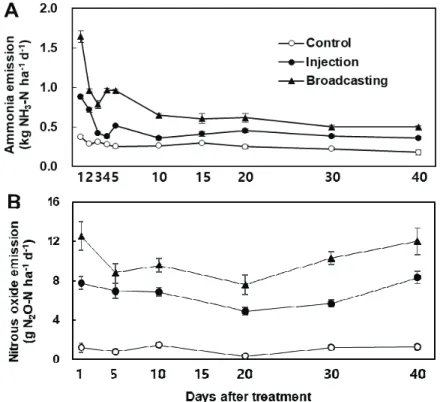
2O) emission compared to broadcasting application. The fastest rate of NH
3emission occurred immediately after application within 5 days, and then the emission decreased quickly in all three treatments; control,
injection and broadcasting (Fig. 1A). This result was consistent with previous reports (Rochette et al., 2001; Sommer and Hutching, 2001), which showed a large portion of NH
3emission occurred at the earlier period after application of slurry. The cumulative amount of NH
3emission was shown in Fig. 2A. The cumulative NH
3emission throughout the period of measurement increased by 203% in broadcasting application of pig slurry compared to control (water). However, injection application of pig slurry lower by 40% compared to broadcasting application. The volatilization of NH
3was significantly reduced by 90 % compared to the application of pig slurry to the soil surface when pig slurry was injected.
(Dendooven et al., 1998). The emissions of NH
3from manures following band spreading, incorporation and injection were 55% (range: 37-67%), 70% (50-82%) and 80% (72-86%) lower than that from surface broadcasted manures, respectively (Hou et al., 2015).
The significant increase of N
2O emission, relative to the control, was observed immediately after broadcasting and injection application of pig slurry (Fig. 1B). The N
2O emissions in injection application decreased strongly during 40 days compared to broadcasting application. Fangueiro et al.
(2017) reported that cattle slurry injection application significantly reduced N
2O emissions during the first 3 days, and between days 4 and 27, the mean N
2O fluxes in injected cattle slurry lower than in soil surface. In this study, the cumulative N
2O emissions were determined 6.6, 40.6 and 60.9 g N
2O-N ha
-1in control, injection and broadcasting application of pig slurry, respectively, at 40 days (Fig. 2B). This result showed that injection application of pig slurry efficiently decreased N
2O emission than broadcasting application.
In conclusion, these result clearly indicated that injection application of pig slurry results in a decrease of ammonia and nitrous oxide emission. It suggests that injection application may recommendable strategy to reduce the hazardous gaseous from manure application. However, we could not explain a significant corresponding increase in N use efficiency.
Therefore, future work should be followed to determine the
fate of N, the mineralization dynamics and N use efficiency
for herbage yield in relation to the effectiveness of the
injection application.
Fig. 1. Changes in absolute amount of ammonia (NH
3, A) and nitrous oxide (N
2O, B) emission from control (○), broadcasting application with pig slurry (▲) and injection application with pig slurry (●). Data are mean ± SE (n=4). Different letters indicate significantly different at p < 0.05 according to the Duncan’s multiple range test.
Fig. 2. Cumulative amount of ammonia (NH
3, A) and nitrous oxide (N
2O, B) emission from control (○), broadcasting application with pig slurry (▲) and injection application with pig slurry (●). Data are mean ± SE (n=4).
Different letters indicate significantly different at p < 0.05 according to the Duncan’s multiple range test.
Ⅳ . ACKNOWLEDGEMENTS
This study was financially supported by the Rural Development Administration Grant (RDA-PJ010099), Republic of Korea.
Ⅴ. REFERENCES
Balsari, P., Dinuccio, E., and Gioelli, F. 2006. A low cost solution for ammonia emission abatement from slurry storage. International Congress Series. 1293:323-326.
Bremner, J.M. 1996. Nitrogen-total. In: Sparks, D.L., Page, A.L., Helmke, P.A., Loeppert, R.H., Soltanpour, P.N., Tabatabai, M.A., Johnston, C.T. and Sumner, M.E. (Ed.), Methods of soil analysis.
Part 3: chemical methods. SSSA Book Series 5. SSSA and ASA.
Madison. pp. 1085-1121.
Crutzen, P.J. and Ehhalt, D.H. 1977. Effects of nitrogen fertilizer and combustion on stratospheric ozone layer. Ambio. 6:112-117.
Dendooven, L., Bonhomme, E., Merckx, R. and Vlassak, K. 1998.
Injection of pig slurry and its effects on dynamics of nitrogen and carbon in a loamy soil under laboratory conditions. Biology and Fertility of Soils. 27:5-8.
Eriksen, J., Nørgaard, J.V., Poulsen, H.D., Poulsen, H.V., Jensen, B.B.
and Petersen, S.O. 2014. Effects of acidifying pig diets on emissions of ammonia, methane, and sulfur from slurry during storage. Journal of Environmental Quality. 43:2086-2095.
Erisman, J.W. and Schaap, M. 2004. The need for ammonia abatement with respect to secondary PM reductions in Europe. Environment Pollution. 129:159-163.
Fangueiro, D., Surgy, S., Fraga, I., Cabral, F. and Coutinho, J. 2015.
Band application of treated cattle slurry as an alternative to slurry injection: Implications for gaseous emission, soil quality, and plant growth. Agriculture, Ecosystems and Environment. 211:102-111 Fangueiro, D., Pereira, J.L.S., Macedo, S., Trindade, H., Vasconcelos, E.
and Coutinho, J. 2017. Surface application of acidified cattle slurry compared to slurry injection: Impact on NH3, N2O, CO2 and CH4
emissions and crop uptake. Geoderma. 306:160-166.
Guo, Y., Li, B., Di, H., Zhang, L. and Gao, Z. 2012. Effects of dicyandiamide (DCD) on nitrate leaching, gaseous emissions of ammonia and nitrous oxide in a greenhouse vegetable production system in northern China. Soil Science and Plant Nutrition.
58:647-658.
Hoekstra, N.J., Lalor, S.T.J., Richards, K.G., O’Hea, N., Lanigan, G.J., Dyckmans, J., Schulte, R.P.P. and Schmidt, O. 2010. Slurry
15NH4-N recovery in herbage and soil: effects of application method and timing. Plant and Soil. 330:357-368.
Hou, Y., Velthof, G.L. and Oenema, O. 2015. Mitigation of ammonia, nitrous oxide and methane emissions from manure management chains: a meta-analysis and integrated assessment. Global Change Biology. 21:1293-1312.
Houghton, J.T., Jenkins, G.J., and Ephraums, J.J. 1990. Climate change: The IPCC assessment. Cambridge University Press. Cambridge. 365pp.
Keith, P.S., Jan, S.F., Kinfe, H. and Nicola, S. 2005. Alternatives to the global warming potential for comparing climate impacts of emissions of greenhouse gases. Climate Change. 68:281-302.
Kim, T.H. and Kim, B.H. 1996. Ammonia microdiffusion and colorimetric method for determining nitrogen in plant tissues.
Journal of the Korean Society of Grassland Science. 16:253-259.
Moiser, A.R. 2001. Exchange of gaseous nitrogen compounds between agricultural system and the atmosphere. Plant and Soil. 228:14-27.
Ndegwa, P.M., Vaddella, V.K., Hristov, A.N. and Joo, H.S. 2009.
Measuring concentration of ammonia in ambient air or exhaust air steam using acid traps. Journal of Environmental Quality. 38:647-653.
Rochette, P., Chantigny, M.H., Angers, D.A., Bertrand, N. and Côté, D.
2001. Ammonia volatilization and soil nitrogen dynamics following fall application of pig slurry on canola crop residues. Canadian Journal of Soil Science. 81:515-523.
Rodhe, H. 1990. A comparison of the contribution of various gases to the greenhouse effect. Science. 248:1217-1219.
Sanderson, M.G., Collins, W.J., Johnson, C.E. and Derwent, R.G. 2006.
Present and future acid deposition to ecosystems: The effect of climate change. Atmospheric Environment. 40:1275-1283.
Schröder, J. 2005. Revisiting the agronomic benefits of manure: a correct assessment and exploitation of its fertilizer values spares the environment. Bioresource Technology
.
96:253-261.Sommer, S.G. and Hutchings, N.J. 2001. Ammonia emission from field applied manure and its reduction. European Journal of Agronomy.
15:1-15.
Park, S.H., Lee, B.R., Jung, K.H. and Kim, T.H. 2018. Acidification of pig slurry effects on ammonia and nitrous oxide emissions, nitrate leaching, and perennial ryegrass regrowth as estimated by 15N-urea flux. Asian-Australasian Journal of Animal Science. 3:457-466.
Webb, J., Pain, B., Bittman, S. and Morgan, J. 2010. The impacts of manure application methods on emissions of ammonia, nitrous oxide and on crop response-A review. Agriculture, Ecosystem and Environment. 137:39-46.
(Received : July 3, 2018 | Revised : September 14, 2018 | Accepted : September 17, 2018)