초등학교시설의 유니버설 디자인에 관한 연구
- 설계지침 분석을 중심으로 -
A Study on the Universal Design in Elementary School Facilities
- Focused on Analysis of Design Guidelines -
이 선 영* 이 민 우**
Rieh, Sun-Young
Lee, Min-Woo
Abstract
In the context of lifelong education program for an aging society and information age, elementary school facilities are expected to accommodate various people in diverse age group and diverse physical abilities. Introduction of the ‘Universal Design’ concept seems inevitable in school environment in terms of public infra structure for community. However, in architectural point of view, unlike foreign examples, simply applied barrier-free and safety standards of domestic guidelines based on dimensional data does not function enough to achieve universal design in authentic manner. This study is focused on this issue and suggests the direction of improvement for architectural design guidelines. Through the comparative analysis of foreign and domestic design guidelines, two principles of universal design-‘Flexibility in Use’, ‘Perceptile Information’- are found to be lacking in the domestic design guidelines for elementary school facilities. It is expected for government authority to develop more concrete guidelines to achieve universal design for school as a basic public space in the community.
키워드:유니버설 디자인, 초등학교, 설계지침, 사용자
Keywords:Universal Design, Elementary School, Design Guideline, User
1. 서론
1)1.1 연구의 배경과 목적
커뮤니티의 가장 기본적인 공공시설로서 초등학교는 다 변화되는 현대사회의 요구와 맞물려 다양한 사용자를 고 려해야 하는 시설로 거듭날 것이 기대되고 있다. 통합교육 시행에 따른 다양한 신체적 능력에 부응하는 시설로의 전 환뿐 아니라 보육시설 및 체육시설, 도서관공간에 이르기 까지 초등학교는 지역주민들에게 정보 이용, 문화 활동, 평생교육 등 지역의 커뮤니티시설로 그 의미가 중요해 지
* Professor, Arch.D., Dept. of Architecture, University of Seoul, Korea
Corresponding Author,
Tel: 82-2-6490-2772, E-mail: [email protected]
** Staff, Gan Sam Architects & Partners, Seoul, Korea 이 논문은 2014년도 서울시립대학교 교내학술연구비에 의하여 연구되었음
고 있다. 복합화사업, 평생교육사업, 돌봄교실과 특수학급 운영 등 새로운 정책이 만들어질 때마다 지역의 초등학교 는 사용자의 스펙트럼이 확대되고 있으나 이를 수용할 수 있는 공간으로의 전환은 미지수이다.
국내 초등학교는 1983년 사회교육법에 의해 학교시설 개
방의 법적 근거가 마련된 이래로 교육기본법, 평생교육법,
국민체육진흥법, 초중등교육법 등에 의해 학교시설이 점차
개방되었고, 1990년대 후반 지식기반사회와 열린교육사회
에 역점을 둔 제 7차 교육과정 시행과 현대화학교에 이은
학교시설 복합화 사업이 맞물리면서 학교시설사업촉진법,
민간투자법 등에 의해 양적 측면에서 크게 강화되었다. 또
한 최근 대두된 다양한 사회적 요구를 수용하기 위한 국민
체육진흥법, 교육기본법, 고등교육법, 초․중등교육법, 사회
교육법, 유아교육법, 영․유아 보육법 등 여러 법령
1)들이
1) 국가법령정보센터(http://www.law.go.kr)의 내용을 정리함.concept context Universal
Design
integrate people with disabilities into the mainstream
Barrier-Free Design
removal of what was perceived to be the most significant obstacle for people with disabilities
Assistive Technology
created specifically to enhance the physical, sensory, and cognitive abilities of people with disabilities help them function more independently in environments oblivious to their needs Table 1. Contextual concept for Universal Design
(유니버설 디자인의 맥락상개념)
학교시설 변화의 근거로 작동하고 있다. 2000년대 들어 교 육과학기술부를 주축으로 시행중에 있는 학교시설 복합화 사업의 내용에 따르면, 정책시행의 범위 내에 기존 교육제 도 하의 학생과 운영위원회 뿐 만 아니라 학교시설에 인 접한 지역사회 구성원까지도 포함시켜 사용자의 다양화를 구체적으로 언급함으로써 그 대상을 명확히 하고 있다. 하 지만 정책과 법령에 의해 명시된 다양한 사용자들의 초등 학교시설 이용에 효과적으로 대응해야 하는 현시점에 이 들이 이용하게 될 학교시설의 실제적인 구현에 있어 핵심 적이라고 할 수 있는 계획지침의 미비로 인해 효과적인 시설개선 및 공간구현에 한계가 우려되고 있다. 정책적으 로 복합화, 시설개방, 평생교육, 보육복지, 통합학급 등을 표방하고 실제로 시설 확충 등의 양적인 개선은 이루었다 고 볼 수 있으나 평생교육시설을 이용할 지역민(성인, 노 인, 장애인), 돌봄 교실 및 방과후 교실 등을 이용할 아동 (유아, 미취학아동 및 아동, 청소년), 통합교육정책에 따라 학교를 함께 이용하게 되는 특수교육대상 아동 등 다양한 초등학교시설 사용자들을 고려한, 보다 구체적인 설계지침 이 이를 진정성 있게 구현하기 위해서는 필수적이다. 본 연구는 일상의 커뮤니티에서 이러한 사회변화를 수용해야 하는 공공재로서의 초등학교가 예측 불가능한 다양한 사 용자의 장소로 거듭날 수 있도록 하는 기본적인 설계방향 을 유니버설 디자인으로 보고 학교시설의 측면에서 이를 정립하고 적용할 수 있는 설계지침의 개선방향을 제시하 는 것을 목적으로 한다.
1.2 연구의 범위 및 방법
현재까지 우리나라의 초등학교 시설을 본격적인 유니버 설디자인과 관련시킨 연구는 찾아보기 힘들다. 복합화 프 로그램과 연계시킨 논문은 다수가 있고 통합교육에 관한 연구들은 별도의 학회를 통하여 활발하게 이루어지고 있 으나 성별, 나이, 장애에 대한 폭넓은 스펙트럼으로 접근 하는 유니버설 디자인과 연결시킬 수 있는 연구는 극히 소수이다. ‘노인복지시설과 초등학교의 교류프로그램에 따 른 복합화계획에 관한 연구’(이은령, 홍익대학교 박사논문, 2009)에서 고령화 사회의 지역사회 복지거점인 초등학교 내 아동-노인 간의 세대간 교류에 초점을 맞추어 복합화 초등학교의 계획 방향을 제시한 바 있으며 그 밖의 유니 버설 디자인과 연계된 지침관련 연구들은 유니버설 디자 인의 원리․원칙을 기준에 따라 특성을 분류한 뒤 사례조 사와 다양한 분석 방법을 통해 결론에 도달하는 방식들이 대동소이하다.
2)배리어프리와 유니버설디자인을 함께 다룬 연구인 ‘배리 어프리 인증 건축물에 대한 유니버설디자인 적용 연구’(최 승철, 경희대학교 박사논문, 2013)에서 유일하게 배리어프 리 인증제도의 장애인중심 평가지침이 건강한 일반인의 요구에 못 미친다는 점을 지적하여 개선방향을 제시하고 있으나 이 역시 공공청사, 노인복지시설, 장애인복지시설., 문화복지시설. 복합문화시설에 국한하여 이루어진 연구로 초등학교의 현황을 짐작하기에는 거리가 있다. 앞으로의 초등학교가 기존의 교육기능을 수행하는 한편, 지역 복지 사회 실현의 중심으로 등장한 복합화 사업 및 고령화․정 보화 시대에 대응하는 평생교육법 제정
3), 저출산 현상에 따른 취학아동 및 학급 수 감소로 인한 교내 유휴시설 증 가
4), 여성의 사회활동 및 맞벌이 부부의 증가
5)로 인한 아 동복지의 필요성 대두
6), 그리고 통합사회 구현을 위한 교 육 통합학급 및 특수학급 정책 시행
7)등에 효과적으로 대 응할 수 있는 공공시설로 거듭나기 위하여 다양한 사용자 들을 고려하는 관점의 연구가 활성화되어야 함을 알 수 있다.
해외의 경우 유니버설디자인과 관련된 학교 공간 연구 는 다양한 신체적 능력을 가진 아동들을 대상으로 주로 학습법을 지원하는 방향으로 발전되어 연구되고 있으며 시설의 경우 다양한 가이드라인과 지침으로 설계방향을
2) ‘사용자 유형분석을 통한 종합병원 공용공간의 유니버설 디자 인 체크리스트 개발에 관한 연구’(이은진 외 1인, 한국실내디자 인학회논문집, 2006), ‘공공도서관 실내 공용공간의 유니버설디 자인 적용성에 관한 연구’(이효창 외 1인, 한국실내디자인학회 논문집, 2007), ‘지역문화시설의 공용공간 디자인에 대한 사용 자 평가연구’(오찬옥, 한국실내디자인학회, 2010) 등이다.
3) 한국교육개발원, 평생교육통계자료집, 2012 4) 서울시교육청, 서울교육통계연보, 2012 5) 보건복지부, 보육통계, 2012
6) 한국교육개발원, ‘엄마품 온종일 돌봄교실’ 운영 실태 및 개선 방안, 2013
7) 교육과학기술부, 특수교육통계, 2012
4 principles 7 Principles
Supportive Design
Size and Space for Approach and Use Simple and Intuitive Use
Low Physical Effort
Adaptable Design
Flexibility in Use Perceptile Information
Tolerance for Error
Accessible Design Equitable Use
Safety Oriented Design -
Table 2. Comparison of Principles of Universal Design (유니버설 디자인의 원칙들의 비교)
Figure 1. Concept Diagram of Universal Design (유니버설 디자인의 모식도)
유도하고 있다. 미국의 경우 ADA
8)에 의하여 배리어프리 공간으로의 전환은 이미 기정사실화 되어있고 공공시설 및 학교안전관련 체크리스트나 가이드라인들이 일반 학교 시설 가이드라인들과 더불어 유니버설 디자인의 속성을 가이드라인으로 수용하고 있다. 영국의 경우 특수교육대상 아동들을 통합교육으로 포용하는 원칙을 실현하기 위한 가이드라인들이 일반학교시설 가이드라인과 더불어 유니 버설디자인의 원칙들을 내재하고 있다. 본 연구는 유니버 설 디자인 전반에 걸쳐 학교시설과 관련한 우리나라의 현 설계지침과 가이드라인이 놓치고 있는 부분을 찾아내어 그 중요성을 부각시키고 계획지침으로 자리 잡게 하는 데 에 목적이 있다. 본 연구의 흐름은 다음과 같다.
2장에서는 유니버설 디자인의 개념과 속성을 파악하기 위해 최근 들어서 그 범위가 확장되고 있는 유니버설디자 인의 개념 및 원리를 정리하여 설계지침 확립을 위한 분 석 틀로 정립하였다. 3장에서는 국내의 법령과 연계시킨 초등학교 설계관련 지침들을 해외 학교관련 설계지침과 비교분석하여 유니버설 디자인의 내용상 적용 가능성과 적용범위의 차이를 알아보았다.
4장에서는 앞서 비교한 국내와 해외의 유니버설 디자인 관련 학교시설 설계지침에서 주목해야 하는 항목을 추출하여 그 특성을 살펴보고 5장 결론에서 개선방향을 제시하였다.
2. 학교시설과 유니버설디자인
유니버설 디자인은 연령과 능력에 관계없이 모든 사람이 가능한 한 이용할 수 있도록 배려된 제품 또는 환경 디자 인을 의미한다. 이는 인간의 다양성을 존중하고, 모든 사람 들의 일상생활에서 일어나는 다양한 활동과 행태를 포괄하 는 개념이다
9). 유니버설 디자인은 법적으로 규정된 사항에
8) ADA, 2010, American Disability Act Standards.
9) Mace, R. Hardie, G. and Place J., Accessible Environments;
Toward Universal Design. in Design Intervention: Toward
의해 만들어지는 결과물이라기보다는, 다양한 행태와 상황 등을 의욕적으로 상정․계획하는, 일종의 과정으로 이해하 는 것이 바람직하다
10). 따라서 물리적, 경제적 한계가 존재 하는 현실에서 모든 경우에 모든 사람들이 사용할 수 있는 환경을 계획․제공하기 위해 어느 정도 범주화된 다양한 사용자 그룹을 만족시키고 또 그들의 특정 행동을 지원하 거나 보조할 수 있는 환경을 계획․제공하는 것이 유니버 설한 디자인이라고 할 수 있다
11). 로널드 메이스(Ronald Mace)는 유니버설 디자인의 개념을 기존의 유사용어들과 비교하면서 무장애 디자인 (Barrier-free design)은 장애 (Disability)와 관련된 기준을, 보조장치(Assistive Techno- logy)는 환경에서 기능적으로 필요한 장치나 장비를 의미 한다고 유니버설 디자인과 명확히 구분하고 있다
12). 즉, 유 니버설 디자인의 관점에서 볼 때 미국의 ADA기준
13)을 준 수하고 있는 사례가 유니버설 디자인이 되려면 충분조건이 될 수 없으므로 다른 차원의 설계가 이루어져야 하는 것이 다.
14)a More Humane Architecture,Van Nostrand Reinhold, New York, p.5, 1991
10) 박정아, 유니버설디자인 환경 및 제품의 디자인 특성 분석 연 구, 연세대학교 박사논문 p.27 2001
11) 배리어프리 측면에서 설계된 장애인화장실이 큰 짐을 들고 들어갈 수 있는 다용도 화장실로 전환될 때 유니버설디자인 이라 할 수 있다고 설명하고 있다.Ibid. p.28
12) 제 1회 국제 유니버설 디자인 대회의 기조연설에서 유니버설 디 자인의 개념을 설명한 것으로 Table 1로 정리됨. Center for Universal Design, North Carolina State University (http://
design.ncsu.edu)
13) ADA, American Disability Act Standards, 2010
14) ADA에서는 휠체어 사용의 접근성과 관련된 사항들을 규정 하는데, 호텔에서 휠체어 사용자들이 사용할 수 있는 화장실 설치에 있어 ADA에서 규정하는 내용만을 준수하면 오른손 잡이용 휠체어 사용자들은 변기를 사용할 수 없게 되므로 법 규는 준수하더라도 모든 사람들이 다 사용할 수 있는 것으로 볼 수 없다는 것이다.
Category Item Criteria UD Principle
Access Road
width of
approach - min. width Size and Space
ramp - max. slope Accessibility
rise of ped. - max. rise Accessibility access - max. rise
- ramp/elevator Accessibility
finish material
- distinction of ped. path - clear division - visibility - nonslip finish
Perceptile Information
Safety
obstacle
- min. surface gap - clear out of
lighting pole &
tree branch
Accessibility
Parking
general - size
- direction sign
Size and Space Perceptile Information
handicapped
- recognizable location - distinguishable
surface
Perceptile Information
Main entry/
Lobby
general - surface material - raised block
Perceptile Information
width of entry
- min. width - distance between
entry
Accessibility Size and Space
entrance door - no revolving door Safety Accessibility
door handle - location/type
Tolerance for Error Low Physical
Effort Simple and Intuitive Use
Corridor width
- min. width (single load/
double load)
Size and Space
finish material - max. rise - nonslip finish
Accessibility Safety
guard rail
- height - continuity - grip condition
Accessibility Safety
Stair
general - width, landing Safety
rise - max. rise Accessibility
Safety
tread - size Accessibility
Safety
guard rail
- shape of grip bar - height
- raised block
Accessibility Safety
Elevator
general - visibility Perceptile
Information front landing - enough space Accessibility
gap - max. gap Safety
interior size - enough space Accessibility entry width - min. width Accessibility Table 3. Korean Design Guidelines for School related to UD principle
(유니버설 디자인 개념관련 한국 학교설계지침)
control panel - location/ height Accessibility control board
for HP - location/ height Accessibility handicapped - braille points Accessibility
mirror - installation Safety
voice support - Installation Accessibility
grip bar - installation Safety
braille points - installation Accessibility
Toilet general
- signage - easy use - lav. & stool for
kid
- nonslip finish
Perceptile Information Low Physical
Effort Simple and Intuitive Use Accessibility
Safety
General
raised block - installation Accessibility braille points
guide map - installation Accessibility voice activator - installation Accessibility vending
machine - braille points Accessibility protection
guard rail - height Safety
유니버설 디자인이라는 용어는 처음 등장했을 때에는 단순히 ‘훌륭한’, ‘보편적인’, 폭넓은 의미로 ‘모든 사람을 위한 디자인’이라고 지칭되었던 것이 시간이 지나면서 좀 더 구체적인 내용으로 발전되었다, 초기에 정립되었던 수 용성(Adaptable design), 지원성(Supportive Design), 접근 성(Accessible Design), 안전성(Safety Oriented Design)이 라는 ‘유니버설 디자인의 4가지 원리’
15)가 발전되어 공평 한 사용(Equitable Use), 사용상의 융통성(Flexibility in Use), 적은 물리적 노력(Low Physical Effort), 쉽게 인지 할 수 있는 정보(Perceptile Information), 오류에 대한 포 용력(Tolerance for Error), 간단하고 직관적인 사용 (Simple and Intuitive Use), 접근과 사용을 위한 크기와 공간(Size and Space for Approach and Use)이라는 ‘유니버설 디자 인의 7가지 원칙’
16)으로 제시되었다. 이것들을 간략화하면 Table 2와 같다. 이와 같은 유니버설디자인의 다양한 양 상을 이해하고 학교시설 설계에 적용시키기 위해서는 현 재 국내의 학교시설에 적용중인 설계지침 및 평가기준들 과 이러한 원리 및 원칙을 비교해 보는 작업이 필요하다.
이는 설계지침 및 평가기준의 유무가 학교시설의 설계를
15) Wolfgang F.E. Preiser, Elaine Ostroff, Universal Design Handbook,18.2, Mcgraw-Hill. 2002
16) Connell, B.R. et al. The Principles of Universal Design, NC State University, The Center for Universal Design, 1997
code country authority title A UK Dept. of Education Primary Schools Building
Handbook(2011)
B UK Save the
Children
School for All: Including Disabled Children in Education (2002)
C UK
Dept. for education and skills
Building Bulletin 77(2005)
D UK
Dept. for education Education funding Agency
Building Bulletin 103 Area guidelines for mainstream schools(2014)
E USA Dept. of Justice ADA Standards for Accessible Design(2010)
F USA GSA Facilities Standards for the Public Building Service(2015)
G USA Virginia Dept. of Education
Guidelines for School Facilities in Virginia’s Public Schools (2013)
H USA WBDG
Whole Building Design Guide-Educational
Facilities(last updated 2010) I USA Delaware Dept.
of Education
School Safety Audit Checklist (2002)
J USA
Virginia Dept. of Criminal Jusstice Services
School Safety Inspection Checklist for Virginia Public School(2013)
K Canada
City of Alberta, Infra structure &
Transportation
Architectural Design Guidelines for Schools(2012)
L Australia Australian Government
Accessibility Design Guide:
Universal design principles for Australia’s aid program (2009-2014)
Table 4. International Universal Design Standards and Guidelines for School (분석대상이 된 해외 학교관련 유니버설 디자인 기준)
진행하는 가이드라인으로 작동하게 되는 실무차원의 관행 에서 볼 때 의미가 있다.
3. 유니버설디자인과 연계된 학교시설 계획지침
3.1 국내의 학교 설계 지침
초등학교와 관련하여, 국내에서 이루어지는 유니버설 디 자인에 대한 고려는 대체적으로 무장애 설계에 초점을 맞 춘 체크리스트의 형태를 띤다. 현재 국내 학교설계에 적용 되는 설계지침은 장애인․노인․임산부 등의 편의증진보 장법, 장애인차별금지법, 특수교육법, 영․유아 보육법등이 있다. 먼저 장애인, 노인, 임산부 등의 편의증진 보장법에 서 다루고 있는 학교환경 관련 항목은 교실, 복도, 화장실, 식당공간에 국한된다. 교실공간에서는 출입문의 폭, 교사 내 통로의 폭, 책상의 크기, 가구설비의 모서리에 대하여 치수와 조건을 적시하고 있으며 복도의 경우 폭에 관한 정보만이 제공되고 있다. 화장실의 경우 출입문, 통로, 화 장실 칸의 규격, 세면대높이, 변기높이, 거울 높이 등이 다 루어지고 있으며 식당역시 출입문과 통로폭에 대한 언급 이 전부이다. 장애인차별금지법에서는 학교시설에 포함되 는 편의시설, 수영장, 실내체육관, 야외경기장, 생활체육공 원의 지침들을 살펴볼 수 있는데 이 법에서 다루고 있는 정보는 접근로 주차구역, 단차이, 경사로/승강기 설치원칙, 장애인용 화장실, 샤워실, 탈의실 등 위생시설, 관람석등이 다. 수영장의 경우 입수 편의를 위한 경사로, 손잡이 등 입수보조시설, 수영장과 연계된 탈의실 진입보조시설, 탈 의 및 샤워 보조기구, 보조 휠체어 등을 언급하고 있다.
실내체육관의 경우나 야외경기장, 생활체육공원의 경우 기 본적인 진입시설이나 접근로에 대하여 설계지침이 나와 있을 뿐 유니버설디자인과 관련된 항목은 발견되지 않는다.
이외에 통합교육원칙에 따라 일반학교로 들어온 특수교육 대상자를 배려하는 특수교육법상 시행령면적기준이나 위 치기준도 단순한 수치만이 언급되거나 추상적인 위치요건 만이 언급되어 있을 뿐이다.
17)이러한 지침 및 법령에 영 유아 보육법과 장애물 없는 생활환경 인증제도
18)의 평가 항목을 종합하여 보면 Table 3을 구성할 수 있다.
19)국내의
17) 특수교육법 시행령상 특수학급의 위치기준은 다음과 같이 명 시되었을 뿐이다. “일반학교의 장은 법 제 21조 제2항에 따라 통합교육을 실시하는 경우에는 특수교육 대상자의 교내 이동 이 쉽고, 세면장․화장실 등과 가까운 곳에 위치한 66제곱미 터 이상의 교실에 특수학급을 설치하여야 한다.”
18) 한국 장애인개발원에서 2011에 개발한 ‘장애물 없는 생활환경 인증제도 체크리스트(2011)’참조,(http:/bf.koddi.or.kr)
설계지침들을 살펴보면 과업지시서나 시설권고조치와 같 은 정부의 법령이나 규제사항은 시설 유지보수 관리에 관한 사항들이 대부분을 차지하고 있고, 체크리스트의 경우 주로 장애인의 접근성에 초점을 맞춘 무장애설계(Barrier-Free Design)에 치중한, 수치기반의 설계지침이 제공되고 있다.
3.2 해외의 학교 설계 지침
국내와는 달리 초등학교와 관련한 해외의 설계가이드라 인들은 핸드북, 체크리스트, 시설가이드, 공공시설에서 준 용되는 가이드 라인 등 다양한 형식을 찾아볼 수 있다.
Table 4의 분석대상 해외자료들은 공공시설의 계획지침 으로서 시설 사용자의 행동을 예상, 그로부터 발생할 위
19) 본 연구에서는 라이프사이클에 따른 어린이와 어른의 신체크 기 차이를 고려한 가구에 대한 내용은 포함하지 않으며 물리 적인 공간에 집중하여 범위를 설정하였다.
Category Criteria Code-Country UD principle
general
- flexibility & adaptability
- flexibility of space use/potential future expansion
- allow flexibility in teaching style to maximize the use of full range
C-UK K-Canada A-UK
Flexibility
- accommodate all users including those with physical, cognitive, auditory or visual limitation
- consider the importance of acoustics and design to reduce echo
K-Canada Accessibility
- provision for extended school use and community use
- area to accommodate enhancement of school facilities for community use - supporting community use
C-UK D-UK/A-UK K-Canada
Accessibility Flexibility - safety is paramount
- avoid sharp edge and projection A-UK Safety
- accessibility & inclusion for SEN(Special Eduction Needs) - accessibility for all
- equitable use/accessibility for all
C-UK F-USA/E-USA K-Canada
Accessibility
- wayfinding begins at the building entrance and is consistent and professional
through out the building F-USA Perceptile information
- ensure adequate natural light and ventilation L-Australia/
B-UK/ A-UK Safety
Site planning
- provision of addition/remodeling/future expansion
- adaptable and flexible to cope with changing needs C-UK Flexibility
- location to support social inclusion C-UK Accessibility
- clear, simple and easily understood layout - easily identifiable entrance by design for public
C-UK
J-USA Perceptile information - passive supervision with good sight lines
- entrances to school property can be observed from the school office, landscape securing visibility
C-UK
I-USA Safety
- Play area, school grounds are fenced I-USA Safety
- wayfinding and signage for local destination - clear signage and visual reference
K-Canada/
L-Australia F-USA
Perceptile information
- building layout considering access road /context C-UK Accessibility
Access Road
- safe access, circulation and egress for all/pedestrian-vehicular segregation C-UK Safety
- accessible and safe paths for all L-Australia Accessibility
Safety - clear signage giving directions, wayfinding scheme to enable inclusion for all
(color/texture/sound) C-UK/F-USA Perceptile information
- clear visual prominence for main entrance K-Canada Perceptile information
- only one cleary marked and designated entrance for visitors - only one entrance designated for public access
I-USA
J-USA Safety
- provide multiple entry to engage with park and public space K-Canada Accessibility
Parking
- securing drop-off zone and waiting area - clearly defined drop-off and pick-up areas
K-Canada
I-USA/ J-USA Safety
- visual surveillance of parking lots from main office is possible - visitors parking located in the main entrance area
I-USA
J-USA Safety
- adequate and safe parking C-UK Size and space
Main entry / Lobby
- covered, sheltered access/weather protection C-UK
K-Canada Low physical effort - entrance lobby is visible from the main office
- visual observation of all visitors - secure space with control over access - CPTED for safety and security
I-USA J-USA C-UK K-Canada
Safety
- simple clear easily understood layout with signage and wayfinding C-UK Perceptile information
- creating multi-sensory environment C-UK Accessibility
- supplemented with smaller breakout areas open, flexible, accessible assembly area - small places for withdrawal
K-Canada C-UK
Flexibility Accessibility Table 5. Foreign Design Guidelines for School related to UD principle(유니버설디자인 개념관련 해외 학교설계지침)
Category Criteria Code-Country UD principle
Corridor
- allowing in between space to activate user’s interaction/ social behavior - variety of informal and social areas to suit learning development
C-UK D-UK
Size and space Flexibility - providing space to allow diverse way of teaching and learning (more than 1.5m) D-UK Size and space
Flexibility
- provide well organized wide clear circulation C-UK Size and space
- color contrast between doors and door frame L-Australia Perceptile information - transparency for adjacent area contrasting color
- doors to corridor and lobby shall have clear glazed panel A-UK Perceptile information Safety - use of color and texture to assist wayfinding C-UK/K-Canada
/A-UK/ F-USA Perceptile information
- keeping clear and free of slip, trip and fall hazard J-USA Safety
- direct access to outdoors C-UK
K-Canada Safety
- consider the age group to ensure walking route for convenient, safe and efficient
access K-Canada Safety
- shape variation in width along their length C-UK
K-Canada
Safety Flexibility - good sight lines for passive supervision
- avoid small unsupervised spaces
C-UK
K-Canada Safety
- providing ample space when classes are facing
C-UK K-Canada D-UK
Flexibility Size and space
- views out at low level for small children C-UK Accessibility
Stair/elevator
- wide stair for diverse learning activity/social seating/informal gathering K-Canada Flexibility
- avoid congestion, conflict and unnecessary travel C-UK Safety
Low physical effort - central stair to be integrated with the principal orientation
- locate stair prompts most visible and provide motivational message on key area - locate elevators out of direct view
K-Canada
Perceptile information simple and intuitive
use
Toilet
- easy approach considering user’s circulation
- design and location for accessibility of handicapped person E-USA Accessibility
- down sizing for safety and scattered location C-UK Safety
- doors secured open and privacy panel installed J-USA Safety
furniture
- select furniture with rounded edges L-Australia Safety
- arrange furniture in flexible layouts L-Australia
C-UK Flexibility
- provide partitions not too high for supervision L-Australia Safety
- avoid furniture with wheels L-Australia Safety
- use of adjustable height furniture C-UK Flexibility
험․장애요소를 방지하거나 바람직한 행동을 유도하려는 해설서 기능이 포함되어 있다.(Table 6 참조) 즉 국내사례 에 비하여 공간설계에 관한 정성적인 접근을 보이는데, 해 외의 지침사례들
20)을 공간구성에 따라 작성한 Table 5에 서 그 차이점을 구체적으로 살펴볼 수 있다. 분석대상이 된 해외 설계지침에서 드러나는 특징을 간단히 정리해 보 면, 초등학교시설은 다양한 사용자가 이용하는 공공시설이 지만 기본적인 교육기능을 수행해야 한다는 관점에서 공 간전반에 걸쳐 주 교육대상인 아동 뿐 만 아니라 저․고
20) 유니버설디자인과 관련된 영국, 미국, 캐나다, 호주 교육당국 의 가이드라인 및 지침을 학교 내 공간별로 연구자가 재구성 하였다.(Table 5 참조)
연령대의 사용자와 장애를 가진 사용자까지도 포함할 수 있는 지침이 작성되어 있음을 알 수 있다.
21)시설 유지보 수관리에 관한 사항과 장애인의 접근성에 초점을 맞춘 수 치기반의 국내 지침과 비교해 볼 때 유니버설디자인의 적 용에 실질적인 도움을 주는 방향이라고 할 수 있다. 즉 다 양한 사용자를 위한 시설의 제공에 있어 법령이나 기준안 에 의한 최소한의 수치기반 지침과 별개로, 해외지침들은 전반적으로 커뮤니티와의 공유나 특수교육대상 아동이라 는 특정 상황이나 특정 사용자의 요구, 행위를 상정한 구
21) Table 5에서는 해외지침상 요구사항을 나라별, 공간별로 명 시하고 연계되었다고 판단되는 유니버설디자인의 원칙을 표 시, 기초자료로 사용하였다.
체적인 서술을 통해 계획의 가이드라인을 제시함으로써, 유니버설 디자인의 개념을 정확히 전달하고 이에 부합되 는 설계로 유도하려는 의도가 깔려 있다. 이는 우리나라의 지식기반 평생교육, 사회통합이라는 현 정책 하의 초등학 교 설계에 있어 건물내 공용공간의 범용성과 관련하여 다 양한 사용자의 요구를 수용하기 위한 구체적이고 정성적 인 설계지침 개발에서 주목해야 하는 속성이다.
4. 설계지침 분석으로 살펴본 유니버설디자인의 적용방식 개선방안
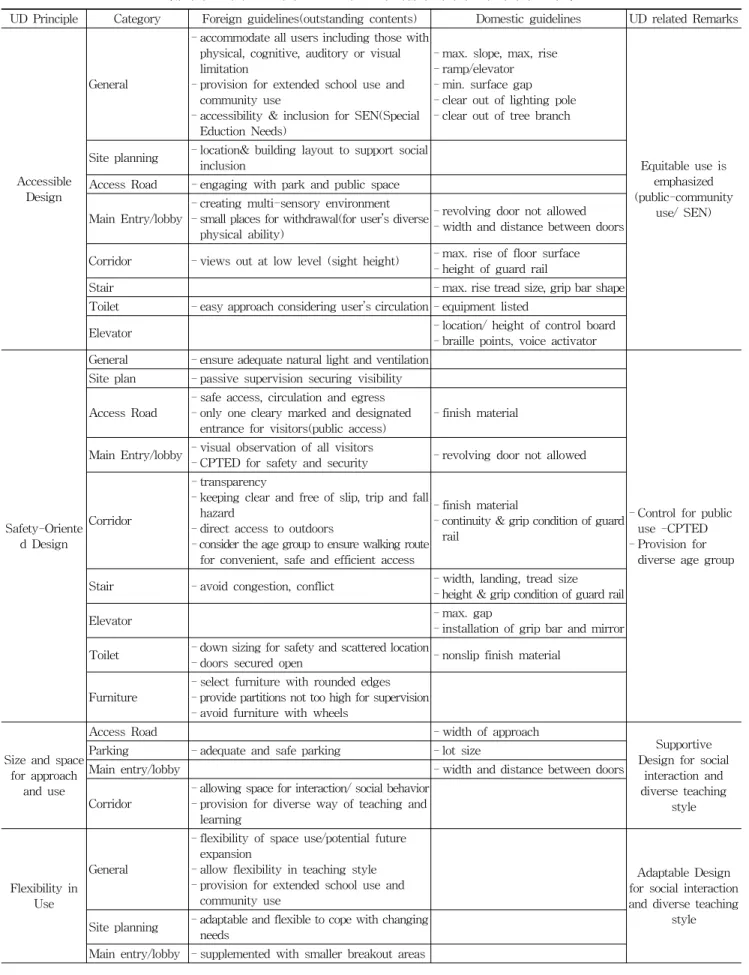
유니버설 디자인이 관련된 우리나라와 해외 다른 나라 의 학교설계 지침과 가이드라인은 비교표 Table 6에서 보 여주는 바와 같이 그 적용방식에 있어 큰 차이를 드러내 고 있다. 우리나라의 지침 및 가이드라인이 무장애건축에 집중되어 있는 반면 해외의 가이드라인은 무장애를 넘어 불특정 다수의 다양한 사용자와 용도를 예측한 공간계획 으로 유도하고 있음을 알 수 있다.
먼저 ‘접근성(Accessible Design)’에서 볼 때 해외 가이 드라인들은 ‘누구를 대상으로 어떤 공간을 제공할 것인가’
에 집중하고 있어 우리나라의 기준들이 제시하는 수치중심 원칙과 차별화되고 있다. 즉 사회적 통합을 지원할 수 있 는 대지의 위치 선정이나 (영국의 Building Bulletin77), 커 뮤니티의 사용을 위한 배려(영국의 Primary School Building Handbook, Area Guidelines for Mainstream Schools, 캐나 다의 Architectural Design Guidelines for School), 특수교 육대상 아동을 포용할 수 있는 공간(영국의 Building Bulletin77) 등으로 표현된 가이드라인을 통하여 궁극적으 로 제공되어야 하는 공간의 성격에 대하여 설계자들이 고 민하도록 유도하고 있다. ‘안전성(Safety-Oriented Design)’
원칙에서 거론되는 항목들의 경우에도 방문객을 위한 출입 구의 개수제한(미국의 School Safety Audit Checklist)이나 감시를 위한 방해받지 않는 시선의 확보, 관리영역에서 시 각적으로 통제 가능한 입구(영국의 Building Bulletin77)등 으로 표현되고 있는 바, 크기를 규정하거나 아이템의 설치 를 유도하는 국내기준과는 다른 성격의 정성적 가이드라인 이다. ‘사용상의 융통성(Flexibility in Use)’, ‘쉽게 인지할 수 있는 정보(Perceptile Information)’원칙에서는 해외지침 과 국내지침 간에 내용뿐 아니라 방향의 차이라는 문제를 드러내고 있다. 즉 ‘사용상의 융통성’ 항목은 관련 국내 가 이드라인 내용이 존재하지 않으나 해외기준의 경우 공공의 사용을 전제한 공간전용이라는 일반적인 원칙부터 가구의
레이아웃상 융통성(호주의 Accessibility Design Guide, 영 국의 Building Bulletin77)이나 높이 조절가능성(영국의 Building Bulletin77)까지 세밀하게 다루고 있는 것을 알 수 있다. 이러한 가이드라인들은 커뮤니티와의 공간공유를 전 제로 미래의 확장가능성이나 교수법의 변화에 대한 공간대 비(영국의 Primary School Building Handbook)까지 개개 인의 다양한 신체능력의 수용원칙과 나아가 시간의 경과에 따른 사용자의 변화 또한 언급하고 있다. ‘쉽게 인지할 수 있는 정보’는 계획의 결과물이 사용자의 경험, 지식, 언어 능력, 몰입도와 상관없이 이해하기 쉬워야 하고 계획의 의 도가 모든 사람에게 쉽게 인식․인지될 수 있어야 하는 원 칙이다. 이를 반영한 해외의 지침들을 살펴보면 일반인이 직관적으로 알 수 있는 빌딩 입구디자인에 대한 요구(미국 의 School Safety Inspection Checklist for Virginia Public School)와 명확하고 쉽게 이해 가능한 배치, 알기 쉬운 길 찾기 및 이를 도와주는 사인시스템과 색채사용(영국의 Building Bulletin77, 미국의 GSA Facilities Standards for the Public Building Service)까지 다양한 선택과 조절에 대한 가이드라인들이 상세히 강조되어 있으나 이는 국내에 서는 거론되고 있지 않은 부분이다. 그밖에 국내 지침이 놓치고 있는 사항으로 거론될 수 있는 것은 사용자의 자의 에 의한 공간조절능력이라고 할 수 있는 ‘간단하고 직관적 인 사용(Simple and Intuitive Use)’, 그리고 ‘적은 물리적 노력(Low Physical Effort)’ 항목이다. 어린아이부터 노인 에 이르기까지 공히 해당공간에 익숙하지 못한 약자들에 대한 배려일 뿐 아니라 일상적으로 사용하는 학교 구성원 에게도 필수적인 항목으로 국내 지침의 경우 출입구에만 적용하고 있으나 해외의 지침에서 명시하고 있듯이 환경조 절을 필요로 하는 공용공간 전반에 걸쳐 점검이 필요한 사 안이다.
이와 별개로 접근성과 안전성에서 국내지침이 상대적으 로 다양한 항목에서 명시된 사실은 우리나라에서 시행중인 다양한 설계관련 인증과도 무관하지 않은 바
22)다양한 성 능 업그레이드를 위한 기준들의 적극적인 도입을 정책추진 에서 참고할 만하다. ‘사용상의 융통성’ 항목은 커뮤니티의 많은 기능이 학교로 들어오면서 요구되는 물리적 환경의 변화일 뿐 아니라 예측할 수 없는 미래 교육환경에 대한 대비이기도 하다. 이는 특히 공간의 프로그래밍과 긴밀하 게 연결되어 있는 사안으로 법령에 부합되는 정책적인 측 면에서 요구되는 학교공간의 다목적기능을 수용하는 데에
22) 장애물 없는 생활환경(Barrier free)설계, 범죄예방 환경설계(CPTED)등이다
UD Principle Category Foreign guidelines(outstanding contents) Domestic guidelines UD related Remarks
Accessible Design
General
- accommodate all users including those with physical, cognitive, auditory or visual limitation
- provision for extended school use and community use
- accessibility & inclusion for SEN(Special Eduction Needs)
- max. slope, max, rise - ramp/elevator - min. surface gap - clear out of lighting pole - clear out of tree branch
Equitable use is emphasized (public-community
use/ SEN) Site planning - location& building layout to support social
inclusion
Access Road - engaging with park and public space
Main Entry/lobby
- creating multi-sensory environment - small places for withdrawal(for user’s diverse
physical ability)
- revolving door not allowed - width and distance between doors
Corridor - views out at low level (sight height) - max. rise of floor surface - height of guard rail
Stair - max. rise tread size, grip bar shape
Toilet - easy approach considering user’s circulation - equipment listed
Elevator - location/ height of control board
- braille points, voice activator
Safety-Oriente d Design
General - ensure adequate natural light and ventilation
- Control for public use -CPTED - Provision for
diverse age group Site plan - passive supervision securing visibility
Access Road
- safe access, circulation and egress - only one cleary marked and designated
entrance for visitors(public access)
- finish material
Main Entry/lobby - visual observation of all visitors
- CPTED for safety and security - revolving door not allowed
Corridor
- transparency
- keeping clear and free of slip, trip and fall hazard
- direct access to outdoors
- consider the age group to ensure walking route for convenient, safe and efficient access
- finish material
- continuity & grip condition of guard rail
Stair - avoid congestion, conflict - width, landing, tread size - height & grip condition of guard rail
Elevator - max. gap
- installation of grip bar and mirror Toilet - down sizing for safety and scattered location
- doors secured open - nonslip finish material
Furniture
- select furniture with rounded edges - provide partitions not too high for supervision - avoid furniture with wheels
Size and space for approach
and use
Access Road - width of approach
Supportive Design for social
interaction and diverse teaching
style Parking - adequate and safe parking - lot size
Main entry/lobby - width and distance between doors
Corridor
- allowing space for interaction/ social behavior - provision for diverse way of teaching and
learning
Flexibility in Use
General
- flexibility of space use/potential future expansion
- allow flexibility in teaching style - provision for extended school use and
community use
Adaptable Design for social interaction and diverse teaching
style Site planning - adaptable and flexible to cope with changing
needs
Main entry/lobby - supplemented with smaller breakout areas
Table 6. Comparison of Foreign and Domestic Guidelines for School related to UD principle (유니버설 디자인 원칙에 관련된 학교설계 지침의 해외기준과 국내기준 비교)
UD Principle Category Foreign guidelines(outstanding contents) Domestic guidelines UD related Remarks
Flexibility in Use
Corridor
- allowing in between space to activate user’s interaction/ social behavior
- variety of informal and social areas to suit learning development
Stair - wide stair for diverse learning activity/social seating/informal gathering
Furniture - arrange furniture in flexible layouts - use of adjustable height furniture
Perceptile information
General - wayfinding consistent and professional through out the building
Adaptable Design for diverse physical
ability Site plan - clear, simple and easily understood layout
Access Road - wayfinding scheme to enable inclusion for all (color/texture/sound)
- distinction of ped. path - clear division
- visibility
Parking - direction sign
Main entry/lobby - simple clear easily understood layout with
signage and wayfinding - surface material
Corridor
- color contrast between doors and door frame - transparency for adjacent area contrasting
color
- use of color and texture to assist wayfinding Stair - integrated with the principal orientation most
visible and out of direct view
Toilet - signage
Elevator - visibility
Simple and Intuitive Use
Main entry/lobby - location/type of door handle
Supportive Design for diverse physical
ability Stair
- central stair to be integrated with the principal orientation
- locate stair prompts most visible
Toilet - easy use
Low Physical Effort
Main entry/lobby - covered, sheltered access/weather protection - location/type of door handle
Supportive Design for diverse physical
ability Stair - avoid congestion, conflict and unnecessary
travel
Toilet - easy use
Tolerance for
Error Main entry/lobby - location/type of door handle
Adaptable Design for diverse physical
ability
있어 가장 중요한 가이드라인으로 정립되어야 한다. 특히 해외의 가이드라인에서 강조하고 있는 상호작용을 위한 공 간의 여유측면이나 주출입구의 다용도 기능을 위한 공간 레이아웃의 원칙은 초등학교 설계에서 민감하게 작용하고 있는 공용공간의 비율과 바로 연결되는 성격으로 정책차원 에서 재고되어야 하는 사항이다. 또 다른 큰 차이를 보이 고 있는 ‘쉽게 인지할 수 있는 정보’원칙은 통합교육 원칙 하에 특수교육을 받고 있는 아동들의 적극적인 시설이용 측면에서
23)특히 주의를 요하는 항목이다. 특히 고령화 사
23) 국내 초등학교의 특수학급 아동의 공간이용과 선호장소에 대 한 연구에서는 통합교육원칙상 특수학급의 위치가 일반학급 과 연결되는 공공적인 완충지대가 되어야 하는 당위성을 논 하고 있다. 윤동현, 이선영, 통합교육을 위한 초등학교 특수학 급영역 설계방향에 관한 연구, 교육시설 21(2) pp.3-10, 2014
회의 학교시설의 개방측면에서 커뮤니티내 불특정 다수가 공공공간으로 학교시설을 사용하게 될 때 예측되는 인지측 면의 수용은 한시바삐 반영되어야 하는 가이드라인이라 할 수 있다.
5. 결론
본 연구에서는 국내 초등학교의 기능이 시대 변화와 사
회적 요구 등에 따라 다양화되는 시설 이용자로 인해 다
변화되는 맥락에서 유니버설 디자인의 적용 가능성을 확
인하기 위하여 관련 지침들을 분석하였다. 이미 시행중에
있는 초등학교 복합화사업과 함께 새로운 교육․복지정책
으로 인해 그 사용자가 더욱 다양해지게 되는 상황임에도
불구하고 학교 내 프로그램의 운용과는 별개로, 학교시설
계획의 초기 단계에서 다양해진 사용자를 고려하는 건축 적 접근에 대한 정책적 기반의 부족함을 알 수 있다.
초등학교는 다양한 생애 주기와 신체적, 인지적 개인차 를 아우르는 커뮤니티의 구성원이 이용하게 되는 공공시 설이자 교육기능을 기본으로 하는 공공공간으로서 다양한 욕구와 기능에 의해 발현되는 사용자들의 예측불가능한 행동 양태들을 수용하는 동시에 지원하는 역할을 수행해 야 한다. 이를 수용하고 지원할 근거가 되는 유니버설 디 자인 개념, 그리고 그에 관련된 국내외의 법규와 설계지침 의 검토를 통하여 국내 초등학교의 설계 지침 제공에 한 계가 있음이 드러났다. 국내 초등학교 설계 지침과 가이드 라인들을 유니버설 디자인의 원칙과 관련하여 해외의 가 이드라인들과 비교분석한 결과 국내 지침 및 가이드라인 이 적극적으로 다루고 있지 못한 속성들이 부각되었으며 유니버설 디자인 원칙 중 ‘사용상의 융통성’원칙과 ‘인지할 수 있는 정보’가 특히 부족한 것으로 드러났다. 특히 해외 사례의 경우 법령 등을 통해 제시되는 수치 기반의 기준 을 제외하고는 다양한 사용자에 따른 의도하지 않은 문제 들과 아동의 교육과 발달을 도모하는 다양한 교육적 장치 들을 건물 전반에 걸쳐 유기적으로 배치․제공하는 관점 의 정성적 서술이 특징적이었다. 이는 우리나라의 초등학 교 복합화 프로젝트의 시행에 있어 다양한 사용자를 위한 공공시설에 관련된 법령․기준․지침이 통합적으로 마련 되어야 함을 시사한다. 즉 성능 업그레이드라는 정책적 지 원차원으로 보다는 계획차원에서 가이드라인으로 제공되 어야 하는 속성이며 공공재로서의 초등학교가 본연의 역 할을 할 수 있도록 하는 기본적인 방향으로 부각되어야 할 사안이다.
References
1. Connell, B. R. et.al., The Principles of Universal Design, NC State University, The Center for Universal Design.
1997
2. Lee, Eun-Ryung, A study on the integration planning for the inter-generational programs between the elderly welfare facilities and elementary schools, Hongik University, Doctoral Thesis, 2009
3. Mace, Ronald, A perspective on universal design, Designing for the 21st Century: An International Conference on Universal Design, 1998
4. Park, Jung-A, Study on the analysis of design characteristics of the environment and product under a Universal Design, Yonsei University, Doctoral Thesis, 2001
5. Preiser, Wolfgang F.E. Ostroff, Elaine, Universal Design Handbook, Mcgraw-Hill, 2002
6. Preiser,Wolfgang F. E. Vischer, Jacqueline and White, Edward T, Design Intervention: toward a more humane architecture, Van Nostrand Reinhold,1991
7. Yoon, Dong-Hyun and Rieh, Sun-Young, A Study on the Design Direction for Special Education Class Area in Elementary Schools for Inclusive Education, Journal of the Korean Institute of Educational Facilities, 21(2) pp.3-10, 2014
접수 2016. 2. 7 1차심사완료 2016. 3. 2 2차심사완료 2016. 3. 17 게재확정 2016. 3. 17