RISK ANALYSIS OF FOREIGN DIRECT INVESTMENTS IN INNOVATIVE PROJECTS: CASE OF UZBEKISTAN
Yoziev Golibjon Lutfullaevich*
Tashkent State University of Oriental Studies, Tashkent, Uzbekistan
ABSTRACT
This study is a review on Risk analysis of foreign direct investments in innovative projects of Uzbekistan. The study will examine SWOT and PESTL analysis as an effective situation analysis tool which plays an important role in the fields of management, marketing, and in any fields of requiring strategic planning. SWOT is an analysis method used to evaluate the ‘strengths’, ‘weaknesses’, ‘opportunities’, ‘threats’ and PESTL is an analysis tool used for measuring the ‘political’, ‘economical’, ‘social’, ‘technological’ and ‘low’ risks involved in a various sphere of economy. In this study, firstly the essence of SWOT and PESTL analysis is explained, secondly the components of SWOT and PESTL analysis is examined. The paper includes risk analysis for further investigation to innovation sector of Uzbekistan economy.
Keywords risk analysis, investment, foreign direct investment, innovation, SWOT analysis, PESTL analysis.
1)
1. Introduction
Modernization and focus on innovative development are necessary factors for the economic growth of any country. Developed countries have achieved economic success using the latest achievements of science and technology (S&T). However, the implementation of innovative technologies is a long, risky and costly process. At the moment, the main source of financing innovation is own funds. Since innovative projects always mean significant costs, riskiness and a long wait for return from invested funds, enterprises often face the problem of limited financial resources. That is why in the new global economy, attracting foreign investment is one of the central tasks facing both the companies and the government (economies try to create favorable conditions for attracting of foreign direct investment).
At the same time, according to the UNCTAD report, positive trends were observed in developing countries, especially in Asia. In 2019 the growth of foreign investment in Central Asian countries amounted to an average of 8-10%. In Uzbekistan this indicator grew 3.2 times ($ 15.9 billion) compared to the indicators of 2018 ($ 4.5 billion), which provided the Republic with leadership among the countries of the region.
So, the purpose of this article is to find out the real problems and potential threats, which foreign investor may face when investing in innovative projects in Uzbekistan.
To analyze the situation, the hybrid model used by combining of SWOT and PESTL methods.
The first method briefly discusses the strengths of the Republic of Uzbekistan as an object of investment and the likely potential for a foreign investor. Weaknesses and real threats to a foreign investor will be analyzed in detail using the second model.
2. SWOT & PESTL analysis: literature review
There are several analytical tools of market estimation. Most popular ones are SWOT and PESTL analysis. The use of SWOT and PESTEL analysis continues to spread among the academic reviewed literature. In the past decade, SWOT and PESTEL research has focused on analyzing organizations for the development of strategic recommendations. SWOT and PESTEL analysis as a methodology for strategic planning, has been extended beyond companies to industries and countries. These tools may be used in a different sphere of economic and social processes.
Seungbum Lee and Patrick Walsh used SWOT and AHP hybrid model. They used the hybrid model for sport marketing outsourcing (Seungbum Lee and Patrick Walsh, 2011). In this paper we try to use SWOT and PESTEL hybrid model for risk analysis of foreign direct investments in innovative projects.
SWOT analysis is a tool used to determine and understand its strength and weaknesses and the opportunities and threats (SWOT - Strength, Weaknesses, Opportunities and Threats. Strengths).
Alongside a general SWOT analysis, is essential to evaluate the relative strength and weaknesses of the company’s leading competitors (John L. Thompson, Frank Martin, 2010:114). So, despite the simplicity, SWOT analysis is a powerful tool for scrutinize capabilities and deficiencies, its market opportunities, and the external threats. Arslan Ayub states that marketers after conducting marketing intelligence evaluate organization’s potentials on the essence of available information through SWOT analysis. According him, strength refers to a company’s capabilities and resources that enable it to gain competitive advantage over its competitors (Arslan Ayub, et al, 2013).
Some authors have a critical view of point on SWOT analysis. They argue that SWOT analysis is defective as a tool for strategic planning. They state because of its subjective, unsystematic, and non-quantitative nature, SWOT analysis has a lack of predictive power. Based on a critique of SWOT analysis, Agarwal et. al. presented an alternative decision-support method that lies in its external environment (Agarwal et al., 2012).
PESTEL is a strategic planning and analytical tool for strategic business planning. It is a one of the best tools which analyze all (political, economic, social, technological, legal, environmental) potential risks and issues. There are various forms of PESTEL analysis: PEST (STEP analysis) – Political, Economic, Sociological, Technological; PESTLE – Political, Economic, Sociological, Technological, Legal, Environmental; PESTEL – Political, Economic, Sociological, Technological, Environmental, Labor; PESTLIED – Political, Economic, Social, Technological, Legal, International, Environmental, Demographic; SLEPT – Social, Legal, Economic, Political, Technological; STEPE – Social, Technical, Economic, Political, and Ecological; STEEPLE – Social/Demographic, Technological, Economic, Environmental, Political, Legal, Ethical; ETPS – Economic, Technical, Political and Social.
Increasing of environmental and ecological issues have encouraged the implementation of another version. Tanya Sammut-Bonnici new version – STEER analytical tool, which incorporates regulatory factors (Tanya Sammut-Bonnici & Galea, David, 2015).
PESTEL analysis is essential for all marketers because of its aid in understanding the impacts of the external factors (Adcock, Halborg, & Caroline, 2001).
Moreover, PESTEL analysis may be used to examine the existing and future position of the industry that an organization originates. For example, Jinbo Song used PESTEL in the framework of analyzing the waste-to-energy (WTE) incineration industry in China. (Jinbo Song et al., 2017).
Such approach aids in strategically planning in order to gain a competitive advantage over other companies in that industry.
There are many analytical works which combined PEST and SWOT tools. In the paper we also combined these tools. According to Tanya Sammut-Bonnici the benefits of combining PEST and SWOT are enhanced when using them in conjunction with Porter’s five (competition in the industry; potential of new entrants into the industry; power of suppliers; power of customers;
threat of substitute products) forces model (Tanya Sammut-Bonnici et al., 2015).
3. Risk analysis of FDI in innovative projects of Uzbekistan: SWOT and PESTL approach
At the modern development stage of Uzbekistan in the framework of market relations liberalization, economic modernization, significantly increases the role of investments attracted to the economy of the country. One of the most important factors for ensuring stable growth in the volume of attracted investments, diversification of their sources and directions of use is the creation of the necessary regulatory framework for the regulation of various issues of investment activity.
Table 1. Dynamic of Foreign Direct Investment inflow of Uzbekistan
Foreign Direct Investment 2016 2017 2018
FDI Inflow (million USD) 134 98 412
FDI Stock (million USD) 9,157 9,254 9,667
Number of Greenfield Investments 23 10 55
FDI Inwards (in % of GFCF*) 0.3 - -
FDI Stock (in % of GDP) 13.5 - -
Source: UNCTAD, 2019
Note: * Gross Fixed Capital Formation (GFCF)
Reforms in Uzbekistan such as the foreign currency market liberalization and establishing special economic zones has made the country a more appealing market for foreign investors.
According to the World Investment Report 2019, in 2018 FDI inflows increased from 98 million to USD 412 million. Mainly FDI focus on the energy sector and arrives from China, Russia, South Korea and Germany.
Here we try to analyze the situation in Uzbekistan, by combining of SWOT and PESTL methods.
The first method briefly discusses the strengths of the Republic. Weaknesses and real threats to a foreign investor will be analyzed in detail using the PESTL method.
SWOT analysis
The strengths of Uzbekistan as an object of foreign direct investment are:
1) convenient geographical location: Uzbekistan connects all CIS countries, which means a reduction in logistics costs. Strategic position between China and Europe increases the essence of geographic location of the country ("New Silk Road");
2) availability and diversified of natural resources (gas, gold, cotton, hydropower potential):
Uzbekistan ranks second in the natural resources per capita sector in the region after Russia.
Therefore, a foreign investor has the opportunity to use natural resources at a lower price than in other world markets;
3) tax system: Uzbekistan has one of the most sparing tax regimes in the world. Thus, income tax for residents is 12%, for non-residents - 20%, corporate tax rate - 20%, VAT rate - 15%, dividends - 5% (10% if the payer or recipient of dividends is a foreign legal entity).
Opportunities for a foreign investor are as follows:
1) Uzbekistan's accession to the WTO. In march of 2020, Uzbekistan developed a WTO accession strategy that will affect a wide range of laws and regulations, including tariff policy, customs control, investors’ rights, intellectual property protection, corruption, etc.;
2) the presence of administrative and political campaigns created in support of an ambitious and comprehensive program for developing the innovative system of Uzbekistan. Given moment in the country there are special economic zones - territories with special legal status and economic benefits for attracting domestic and foreign investors to high-tech sectors of the economy and innovation-oriented industries.
However, Uzbekistan is not only a large market with scientific potential, highly qualified personnel, relatively cheap labor, but it is also a country in which investors may face risks such as economic instability, protectionism, red tape, corruption, etc. Within the framework of this article, it makes sense to combine weaknesses and threats into one category and discuss them in more detail based on the PESTEL model.
PESTL analysis
Political Risks (P). The political situation in the country is very stable. The government is actively pursuing a motivating foreign investment policy.
1) But, key industries are controlled by the government and it has prejudicial effects on foreign investors. Partial state ownership and government influence are common in many key industries, including airlines, mining, energy and telecommunications. Nevertheless, the government regulates investment and capital flows in the raw cotton and silk market in the country.
2) lack of transparency in the tax system. Although relatively low tax rates have been mentioned as the strength of Uzbekistan and an advantage for a foreign investor, there are some obstacles that a foreign investor may encounter. The lack of clear tax laws enables tax inspectors to interpret tax disputes not in favor of investors. In addition, Uzbek taxation is not transparent, since the tax system of Uzbekistan reflects a complex structure, this distinguishes it from the tax systems of other countries.
It is important to note here that a number of studies have shown that political risk is not a factor affecting foreign investment. For example, K. Fatehi-Seda and M. Safizeda (Fatehi-Sede K., et al., 1989) did not find a significant statistical relationship between political stability and FDI. K. Lee and A. Reznik (Li Q., Resnick A., 2003) also concluded that political instability does not have a statistically significant effect on FDI, although they noted that the duration and stability of the political regime helps attract new FDI.
Economic risks (E):
1) dependence on natural resources and on individual industries. Uzbekistan is rich in natural resources, and this is seen as an additional opportunity to minimize costs, however, a strong dependence on the export of natural resources and goods with a poor price scenario for these natural resources affects the stability of the country's economy. Since prices are influenced by so many factors, they are quite unpredictable, which automatically raises uncertainty in the forecast of the development of the economy of Uzbekistan as a whole;
2) depreciation rate of fixed assets. According to the Statistics Committee of Uzbekistan, depreciation of fixed assets in some industries is more than 80%, while the dynamics of their renewal does not exceed 15%. In Uzbekistan, a foreign investor should be ready to invest up to 70% of the funds needed to upgrade funds, while in the world companies invest only up to 20-30%.
3) undiversified investment policy. In 2019 the energy, construction and transportation sectors were the main recipients of investments and the most of attracted FDI (attracted FDI USD 4.2 billion) was invested in the oil and gas sector.
Social risks (S): incompetence. The success of a project is often determined by the people who work on it, and therefore, the return on invested capital will depend on the knowledge of these people and how they apply their knowledge in practice. Earlier, a high level of education was mentioned as a strong point, but during 25 years, the science of Uzbekistan experienced hard times. The equipment at the enterprises is mainly imported, therefore, the investor will have to invest not only in the improvement of equipment, but also in training and re-profiling of personnel.
Innovation Risks (T): lack of a culture of innovation. In most industries, the main internal barrier is the corporate culture, which is dominated by the idea of risk aversion. In addition, Uzbekistan has only recently committed to modernization, so many companies simply do not understand the profitability of investing in innovation and are afraid of any changes.
Legal risks (L): Legislative framework that establishes guarantees and measures to protect the rights of foreign investors engaged in investment activities in the Republic of Uzbekistan has created. The Ministry of Investments and Foreign Trade and the Chamber of Commerce and Industry of Uzbekistan on a contractual basis provide foreign investors with consulting and legal assistance. Nevertheless, there are still a number of problems that hinder the investment attractiveness increasing of the country:
1) bureaucracy and corruption. A serious obstacle that investors face in Uzbekistan is bureaucracy and corruption. Obtaining a building permit requires passing a huge number of authorities and collecting various documents. For example, according to a World Bank report, it takes 246 days to obtain a building permit (versus 152 days in OECD countries).
This level of bureaucracy gives rise to a high level of corruption;
2) weak protection of property rights. The basis for success in investing is legal support for projects and patent protection of inventions. In 2020, The Wall Street Journal and the Heritage Foundation rank Uzbekistan in terms of protection of property rights in 114th place in terms of economic freedom index (57.2 out of 100 points) among 186 countries. One of the reasons for this disappointing result is protectionism.
4. Conclusion
After the reforms on education in 2016 and currency exchange liberalization reform in 2017, there were high expectations for a continuation of essential reforms. These expectations were raised by announcing a number of new reforms in customs, tax system, banking, privatization, and
business. In 2019 the economy of Uzbekistan continued its sustainable growth and the government kept economic stability in the country.
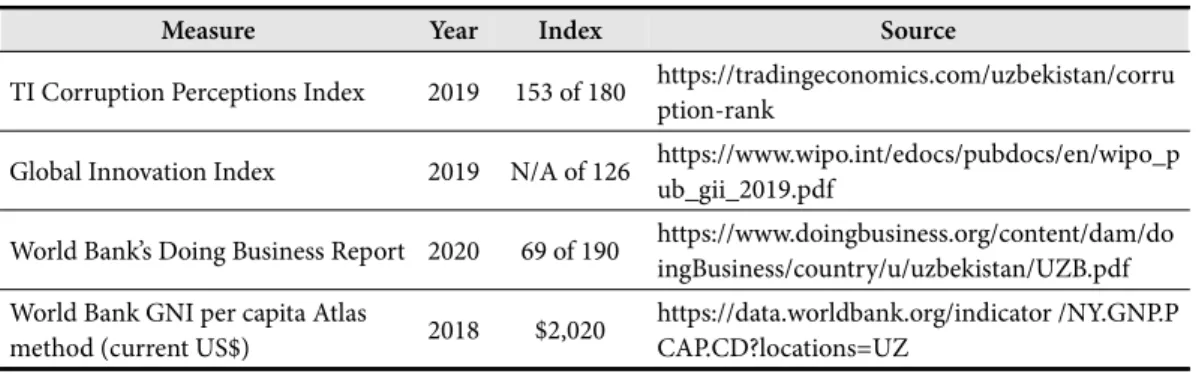
Table 2 Republic of Uzbekistan in a Global rating systems
Measure Year Index Source
TI Corruption Perceptions Index 2019 153 of 180 https://tradingeconomics.com/uzbekistan/corru ption-rank
Global Innovation Index 2019 N/A of 126 https://www.wipo.int/edocs/pubdocs/en/wipo_p ub_gii_2019.pdf
World Bank’s Doing Business Report 2020 69 of 190 https://www.doingbusiness.org/content/dam/do ingBusiness/country/u/uzbekistan/UZB.pdf World Bank GNI per capita Atlas
method (current US$) 2018 $2,020 https://data.worldbank.org/indicator /NY.GNP.P CAP.CD?locations=UZ
The government began pursuing more transparent economic policy and initiated several critical reforms, which resulted in business environment improvement. However, the reform strategy remains not entirely formulated and were not fully completed (Table 2).
The Republic is one of the countries that in 2016-2020 achieved the best results in improving business performance due to regulatory reforms aimed at improving the business environment.
However, the rating values of the country for a number of other indicators are not high enough.
This reduces the investment activity of investors in innovative projects of the country.
Despite all the problems faced the economy of Uzbekistan, the dynamics of the of innovation development is becoming positive. More and more projects are receiving support from domestic and foreign investors, and thanks to state support, Uzbekistan is striving to acquire the title of innovative country. All measures taken by the state to minimize risks and attract investors, as well as all changes that will be applied in Uzbekistan with the accession to the WTO and the implementation of the modernization course, are designed to serve as the basis for a positive investment climate, economic development, and the creation of a powerful scientific and innovative base for sustainable development country as a whole.
Received 3. April. 2020, Revised 17. April. 2020, Accepted 18. April. 2020
References
Ayub, A., Razzaq, A., Aslam, M. S., & Iftekhar, H. A conceptual framework on evaluating SWOT analysis as the mediator in strategic marketing planning through marketing intelligence.
European Journal of Business and Social Sciences, 2, 2013, 91–98.
Dennis Adcock, Al Halborg, Caroline Ross. Marketing: Principles and Practice. Financial Times/Prentice Hall, 2001 - Business & Economics - 534 p.
Fatehi-Sede K., Safi zadeh M. H. The Association Between Political Instability and Flow of Foreign Direct Investment. Management International Review. 1989. Vol. 29, № 4. P. 4–13.
Fatehi-Sedeh, K., and M.H.Safizadeh, “Association Between Political Instability and Flow of Foreign Direct Investment” Management International Review, Vol. 29 (1989), pp. 4-13.
John L. Thompson, Frank Martin, Strategic Management: Awareness & Change. Cengage Learning EMEA, 2010 - Business & Economics - 802 p.
Li Q., Resnick A. Reversal of Fortunes: Democratic Institutions and Foreign Direct Investment Infl ows to Developing Countries. International Organization. 2003. Vol. 57, № 1. P. 175–211.
URL: http://people.tamu.edu/~quanli/research_ papers/reprint_files/IO_2003_fdidem.pdf.
Quan Li and Adam Resnick. Reversal of Fortunes: Democratic Institutions and Foreign Direct Investment Inflows to Developing Countries. International Organization, 2003, vol. 57, is- sue 1, 175-211
Ravi Agarwal, Wolfgang Grassl, Joy Pahl. "Meta-SWOT: introducing a new strategic planning tool", Journal of Business Strategy. (2012), Vol. 33 Iss: 2 pp. 12 - 21
Seungbum Lee and Patrick Walsh. SWOT and AHP hybrid model for sport marketing outsourcing using a case of intercollegiate sport. Sport Management Review, 2011, vol. 14, issue 4, 361-369
Song, Jinbo & Sun, Yan & Jin, Lulu. (2017). PESTEL analysis of the development of the waste-to-energy incineration industry in China. Renewable and Sustainable Energy Reviews. 80. 276-289. 10.1016/j.rser.2017.05.066.
Tanya Sammut-Bonnici & Galea, David. SWOT Analysis. Strategic Management, 2015, Volume 12.
The Law of the Republic of Uzbekistan dated December 25, 2019 No. LRU-598 “On Investments and Investment Activity”.
https://stat.uz/en/431-en2/publik-en/tekushchie-publikatsii-en/6456-fixed-assets-of-uzbekistan https://stat.uz/uploads/docs/sostayanie_sredstv-ru.pdf
(https://mft.uz/en/, http://www.invest.gov.uz/en/) (http://www.chamber.uz/en/index)
http://mineconomy.uz/ru/news/view/3113
https://www.doingbusiness.org/content/dam/doingBusiness/country/u/uzbekistan/UZB.pdf