• 검색 결과가 없습니다.

Emphysematous Cystitis Combined with Prostatic Abscess and Hematogenous Spread of Infection to the Lung and Liver in a Diabetic Patient

N/A
N/A
Protected

Academic year: 2021

Share "Emphysematous Cystitis Combined with Prostatic Abscess and Hematogenous Spread of Infection to the Lung and Liver in a Diabetic Patient"

Copied!
4
0
0

로드 중.... (전체 텍스트 보기)

전체 글

(1)

130

ISSN 2465-8243(Print) / ISSN: 2465-8510(Online) https://doi.org/10.14777/uti.2017.12.3.130 Urogenit Tract Infect 2017;12(3):130-133

http://crossmark.crossref.org/dialog/?doi=10.14777/uti.2017.12.3.130&domain=pdf&date_stamp=2017-12-25

Emphysematous Cystitis Combined with Prostatic Abscess and

Hematogenous Spread of Infection to the Lung and Liver in a Diabetic Patient

Jangwon Lee, Harin Rhee, Il Young Kim

1

, Eun Young Seong, Dong Won Lee

1

, Soo Bong Lee

1

, Ihm Soo Kwak, Sang Heon Song

Biomedical Research Institute and Department of Internal Medicine, Pusan National University Hospital, Busan,

1

Research Institute for Convergence of Biomedical Science and Technology and Department of Internal Medicine, Pusan National University Yangsan Hospital, Yangsan, Korea

Coexistence of emphysematous cystitis and prostatic abscess are rare occurrences.

Here, we report a case of emphysematous cystitis and prostatic abscess in a 65-year-old man with a 5-year history of diabetes mellitus. This case was further complicated by the hematogenous spread of Klebsiella pneumoniae infection from the prostatic abscess to the liver and lung. Computed tomography (CT) imaging revealed a localized gas within the urinary bladder and swelling of the prostate, with fluid accumulation. Multiple low-density lesions were observed in liver segments S3, S4, and S7, suggestive of an inflammatory process. Chest CT scan revealed multiple cavitatory nodules of various sizes, with a ground glass appearance of both lung fields, which suggest septic emboli from severe uro-septicemia. The optimal antibiotic therapy was administered, and a holmium laser enucleation of the prostate operation was subsequently performed. On day 37 post-admission, the patient was discharged in a good condition, without any sequelae.

Keywords: Prostatic abscess; Emphysematous cystitis; Septic emboli

Copyright 2017, Korean Association of Urogenital Tract Infection and Inflammation. All rights reserved.

This is an open access article distributed under the terms of the Creative Commons Attribution Non-Commercial License (http://creativecommons.org/licenses/by-nc/4.0) which permits unrestricted non-commercial use, distribution, and reproduction in any medium, provided the original work is properly cited.

Received: 3 August, 2017 Revised: 25 August, 2017 Accepted: 28 August, 2017

Correspondence to: Sang Heon Song http://orcid.org/0000-0002-8218-6974 Department of Internal Medicine, Pusan National University Hospital, 179 Gudeok-ro, Seo-gu, Busan 49241, Korea

Tel: +82-51-240-7875, Fax: +82-51-240-7898 E-mail: [email protected]

Case Report

Emphysematous cystitis, a relatively rare infection of the bladder caused by gas-producing bacteria, often occurs in immunosuppressed patients [1]. Prostatic abscess presents in immunosuppressed patients, as well as in internal prosthetic patients and in those who underwent recent prostate biopsy. Although both diseases are common in patients with poorly controlled diabetes mellitus, it is rare for both to simultaneously occur. Herein, we describe a case of emphysematous cystitis concomitant with prostatic abscess, with hematogenous spread of infection to the lung and liver. Despite the short duration of infectious manifestation, pathogens may spread to distant organs via the blood stream with poorly controlled diabetes. We report

our experience of this case.

CASE REPORT

A 65-year-old man presented fever for the past three days with gross hematuria and lower abdominal pain to the nephrology outpatient clinic at our institution. He had been suffering from incomplete voiding and poor stream;

however, he was not taking any medication. For the past

5 years, he had been taking medication for type 2 diabetes

mellitus and chronic kidney disease, and had a previous

cerebral infarction. On the initial examination, his body

temperature was 38.5

o

C, pulse rate was 100 beats per

(2)

Jangwon Lee, et al. Systemic Spread of Urinary Tract Infection 131

Urogenit Tract Infect Vol. 12, No. 3, December 2017 Fig. 1. (A) Distended urinary bladder with intraluminal and intramural gas collec- tion. (B) Swelling of the prostate gland, with fluid accumulation. (C) Ill-defined low-density lesions in sections S3, S4, and S7 of the liver. (D) Multiple cavitatory nodules of various sizes with a ground glass appearance of both lung fields.

minute, and blood pressure was 140/80 mmHg. His respiratory rate was 16 breaths per minute, and his oxygen saturation was recorded as 98% in ambient air. His abdomen was distended with mild suprapubic tenderness on palpation. According to a digital rectal examination, his prostate gland was mildly enlarged, soft, non-fluctuant, and moderately tender. The blood test results suggested acute kidney injury (creatinine, 3.32 mg/dl; urea, 64.7 mg/dl), infection (C-reactive protein, 24.2 mg/dl; serum white blood cell count, 23,710/mm

3

), and poorly controlled diabetes mellitus (glycated hemoglobin A1c, 12.5%). Routine urinalysis revealed numerous red- and white-blood cells on high power field examination of the urinary sediment, suggesting urinary tract infection. Plain X-ray images of the kidney, ureter, and bladder revealed gaseous shadows in the lower pelvic area. Plain chest X-ray images revealed a patchy opacification in both lung fields. A computed tomography (CT) scan of the abdomen and chest was subsequently performed. Abdominal CT scan revealed a distended urinary bladder with intraluminal and intramural gas and swelling of the prostate gland with fluid accumulation. This suggested emphysematous cystitis with a concomitant prostatic abscess. In addition, multiple low

density lesions were observed in the liver segments S3,

S4, and S7, which suggested inflammatory process. Chest

CT scan revealed multiple cavitary nodules of various sizes

and a ground-glass appearance of both lung fields. These

findings were highly suggestive of septic emboli due to

severe uro-septicemia (Fig. 1). The patient was admitted

to a hospital for empiric antibiotic therapy, urinary bladder

catheterization, and strict glycemic control with insulin

therapy. Meropenem was used empirically for antimicrobial

coverage of gram-negative rods, including extended-

spectrum beta-lactamases (ESBL) positive organism and

possible anaerobes. By the third day of admission, his blood

and urine specimens presented more than 100,000 CFU/ml

of Klebsiella pneumoniae , and sensitivity was positive for

ceftazidime, cefotaxime, cefepime, ciprofloxacin, and

negative for ESBL. By the tenth day of admission, his fever

subsided, but K. pneumoniae was still cultured from blood

specimens. On the twelfth day, his clinical condition was

improved conspicuously, and his blood sugar levels were

well controlled. On the fourteenth day, blood and urine

cultures were sterile. Blood creatinine level decreased to

1.4 mg/dl (the patient’s previous basal level). Twenty-three

days after admission, the C-reactive protein level was

(3)

132 Jangwon Lee, et al. Systemic Spread of Urinary Tract Infection

Urogenit Tract Infect Vol. 12, No. 3, December 2017

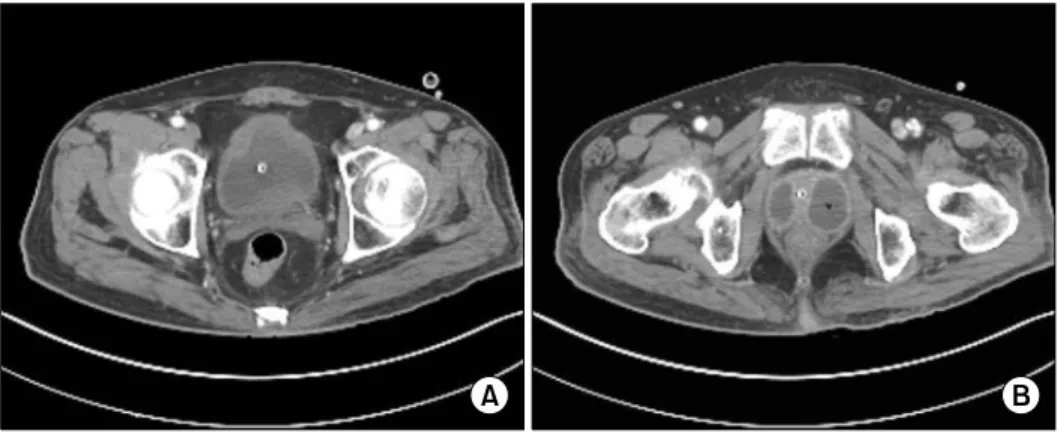
Fig. 2. (A) Interval improvement of em- physematous cystitis. (B) Decreased pro- static abscess size.

decreased to 3.7 mg/dl and subsequent abdominal and chest CT scans showed regression of the intraluminal and intramural gas accumulation in the bladder, septic emboli, and inflammatory low density liver lesions. However, the size of the prostatic abscess cavity showed little impro- vement (Fig. 2). We decided to surgically drain the prostatic abscess. On day 30, holmium laser enucleation of the prostate (HoLEP) operation was performed. Both prostatic lobes were almost fully enucleated. The resected prostate volume was 15 g. The patient was afebrile postoperatively, and subsequent urinalysis revealed no pyuria. His Foley’s urinary catheter was removed on the sixth day post- operatively, with no residual difficulty urinating and no abdominal discomfort. The patient was discharged 37 days after admission.

DISCUSSION

Theoretically, emphysematous cystitis due to urinary tract obstruction caused by a prostatic abscess is possible.

However, to date and to the best of our knowledge, only a few cases have been reported in the literature. Although prostatic abscess and emphysematous cystitis are un- common due to effective antibiotic therapy, these are potentially serious disorders that can, with delayed treatment, lead to death. The mortality rate of prostatic abscess is 3-30% [2]; whereas the prognosis of emphy- sematous cystitis is generally more favorable, with a mortality rate of about 7% [3]. Its incidence has increased in recent years due to the development and routine use of diagnostic imaging methods. The risk factors for both disorders are similar, including urinary retention (e.g., urinary tract obstruction, neurogenic bladder), underlying disease (e.g., diabetes mellitus, chronic kidney disease,

liver cirrhosis, immunocompromised state), and previous urethral procedure (e.g., indwelling catheter, transurethral surgery) [4]. The clinical symptoms of emphysematous cystitis are dysuria, urinary frequency, fever, abdominal pain, and hematuria. In prostatic abscess, symptoms that differentiate the condition from prostatitis include perineal pain, tenesmus, and urinary retention. Palpation of the fluctuant prostate on digital rectal examination should lead to a suspicion of prostatic abscess. However, as clinical features of both disorders are often non-specific, the diagnosis is usually established using imaging techniques, including plain abdominal X-ray, ultrasound, and ab- domino-pelvic CT scan. Transrectal ultrasound (TRUS) is especially useful if prostatic abscess is suspected. CT scan is the imaging modality of choice, as it clearly defines the extent and severity of the disease.

Emphysematous cystitis is caused by gas-forming micro- organisms, mainly Escherichiacoli and K. pneumoniae . Other pathogens include enterococcus; fungi, such as Candida spp.; and anaerobes, such as Clostridium perfringens [5]. These pathogens are also the leading causes of prostatic abscess [6]. It is thought that bacterial fer- mentation of glucose and poor tissue perfusion result in the production of carbon dioxide and hydrogen gas bubbles [7], which dissect the necrotizing tissue in the intraluminal space [8].

K. pneumoniae is a rod-shaped, gram-negative bacterium

with a prominent polysaccharide capsule. This capsule

provides resistance against the host defense mechanisms

[9]. A previous study demonstrated that capsular serotypes

K1/K2 tend to be more resistant and have more virulence

profiles [10]. In the present case, although we did not

investigate the serotypes, bacterial serotype could be one

of the factors for hematogenous spread of infection to the

(4)

Jangwon Lee, et al. Systemic Spread of Urinary Tract Infection 133

Urogenit Tract Infect Vol. 12, No. 3, December 2017

lungs and liver. The treatment of emphysematous cystitis consists of bladder drainage (infected urine and gas) and antibiotic therapy. Treatments for prostatic abscess include surgical drainage and suprapubic catheterization, since urethral instrumentation may aggravate sepsis. No mana- gement guidelines are currently available for the mana- gement of emphysematous cystitis concomitant with pro- static abscess in diabetic patients. We decided against cystostomy. Although minimally invasive treatment, such as TRUS-guided needle aspiration or drainage via trans- perineal or transurethral approach under local anesthesia, is preferred for a prostatic abscess, we performed the HoLEP procedure due to the possibility of a spontaneous rupture of the prostate abscess into the urethra, perineum, or rectum.

In conclusion, emphysematous cystitis and prostatic abscess seldom may coexist. The risk factors associated with each disorder are similar, as are the causative patho- gens. Clinical features are often nonspecific, thus the diagnosis is usually confirmed radiographically. The basic treatment strategy combines adequate and appropriate antibiotic administration, timeous surgical drainage, and strict glycemic control in patients with diabetes mellitus.

We hope that this case will provide some insight for the management of future cases of emphysematous cystitis concomitant with prostatic abscess.

CONFLICT OF INTEREST

No potential conflict of interest relevant to this article was reported.

REFERENCES

1. Mokabberi R, Ravakhah K. Emphysematous urinary tract infections: diagnosis, treatment and survival (case review series). Am J Med Sci 2007;333:111-6.

2. Brawer MK, Stamey TA. Prostatic abscess owing to anaerobic bacteria. J Urol 1987;138:1254-5.

3. Thomas AA, Lane BR, Thomas AZ, Remer EM, Campbell SC, Shoskes DA. Emphysematous cystitis: a review of 135 cases.

BJU Int 2007;100:17-20.

4. Wen SC, Juan YS, Wang CJ, Chang K, Shih MC, Shen JT, et al.

Emphysematous prostatic abscess: case series study and review. Int J Infect Dis 2012;16:e344-9.

5. Juan YS, Chuang SM, Shen JT, Jang MY, Wu WJ, Wang CJ, et al.

Unusual gas pattern in emphysematous cystitis: a case report.

Kaohsiung J Med Sci 2005;21:44-7.

6. Weinberger M, Cytron S, Servadio C, Block C, Rosenfeld JB, Pitlik SD. Prostatic abscess in the antibiotic era. Rev Infect Dis 1988;10:239-49.

7. Sakamoto F, Taki H, Yamagata T, Tsukurimichi S, Ikeda M, Sugiura T, et al. Emphysematous cystitis with severe hemorrhagic anemia resulting from diabetes mellitus type 2.

Intern Med 2004;43:315-8.

8. Chang CB, Chang CC. Emphysematous cystitis: a rare cause of gross hematuria. J Emerg Med 2011;40:506-8.

9. Lederman ER, Crum NF. Pyogenic liver abscess with a focus on Klebsiella pneumoniae as a primary pathogen: an emerging disease with unique clinical characteristics. Am J Gastroenterol 2005;100:322-31.

10. Yeh KM, Kurup A, Siu LK, Koh YL, Fung CP, Lin JC, et al. Capsular

serotype K1 or K2, rather than magA and rmpA, is a major

virulence determinant for Klebsiella pneumoniae liver abscess

in Singapore and Taiwan. J Clin Microbiol 2007;45:466-71.

수치

Fig. 2. (A) Interval improvement of em- em-physematous cystitis. (B) Decreased  pro-static abscess size.

참조

관련 문서