Structural Identification of Antibiotics from Pseudomonas sp. RRj 228, a Antifungal Activity of Collectotrichum acutatum Causing Anthracnose on Pepper
Sang-Yoon Jeon, Yong Gyun Kim, Sang Mong Lee, Hong Joo Son, Hyean Cheal Park, Sun-Tae Kim1, Ki Do Park2, Ui Gum Kang2* and Keun Ki Kim*
Department of Life Science & Environmental Biochemistry, Pusan National University, Miryang 627-706, Korea
1Department of Plant Bioscience, Pusan National University, Miryang 627-706, Korea
2National Institute of Crop Science, RDA. Suwon 441-100, Korea.
Received July 7, 2010 /Accepted August 18, 2010
Microorganisms near the plant rhizosphere usually inhabit the surface or the inside of the plant roots and have a direct effect on plant growth by secreting plant growth promoters or antagonistic materials which protect the root zone system from various pathogens. This study was carried out to identify and isolate the antagonistic materials after isolation of microorganisms showing high antagonistic ac- tivities, in hopes of contributing to the development of sustainable agriculture and the preservation of agricultural environments. A number of antagonistic bacteria were isolated from paddy soil.
Among isolates, RRj 228 showed plant growth promotion and antagonistic activity. RRj 228 was iden- tified asPseudomonas sp. according to the results of physiological properties and genetic methods. On the basis of the results of anti-fungal spectrum against several pathogens by RRj 228, the antagonistic effect of the isolate againstBotrytis cinerea, Pythium ultimum, Phytopthola capsici, and Rhizoctonia solani, especially against red-pepper anthracnose caused byColletotrichum acutatum, was remarkable. The ex- periment evaluating the biological control effect by RRj 228 revealed that the ED50value by the RRj 228 culture against C. acutatum, R. solani and P. ultimum were 0.14 mg/ml, 0.16 mg/ml and 0.29 mg/ml, respectively. An antagonistic substance was isolated and purified by several chromatographies from the RRj 228 culture. The1H and13C assignment of the antagonistic substance was achieved from two-dimensional1H-1H COSY, HMQC, and HMBC. Finally, the antagonistic substance was identified as Phenazine-1-carboxylic acid (C13H8N2O2, M.W.=224).
Key words : Rhizobacteria, anthracnose, antifungal substances, phenazine-1-carboxylic acid
*1Corresponding author
*Tel:+82-55-350-5543, Fax:+82-55-350-5549
*E-mail : [email protected]
*2Corresponding author
*Tel:+82-31-290-6770, Fax:+82-31-290-6773
*E-mail : [email protected]
서 론
고추는 우리나라의 대표 과채류로서 음식에 많이 사용을 하고 있으나 1990년 후반부터 재배면적이 줄어들고 있고, 작 황에 따라 생산량도 차이를 보이고 있다. 고추생산량에 가장 큰 영향을 주는 것은 병해피해와 전년도 가격형성이 가장 큰 요인이 되어지며, 재배농민의 노령화도 하나의 요인으로 볼 수 있다. 병원균의 피해는 Phytophthora capsici에 의한 역병 [16,22,24,25]과 Colletrichum 속 병원균에 의한 탄저병으로 [1,2,5,8,21], 진균에 의한 피해가 대부분이다. 진균병은 발생시 기와 발생부위에 다양한 요인에 따라 차이를 보이고 있으며, 역병은 전 생육기에 걸쳐서 발생된다. 역병은 토양에 가까운 줄기에서부터 발병되어져 식물체를 고사시키며, 고추생산의
약 20%가 감소시키는 피해를 입힌다. 탄저병은 역병과 함께 고추의 최대병해로 주로 과실을 침해하여 수량감소에 직접적 인 영향을 미친다. 발생초기에는 작은 반점이 생기고 점차 확 대되어 둥글게 썩어가며 흑갈색을 띄게 된다. 탄저병의 발생 은 재배지와 기후에 따라 큰 차이를 보인다. 노지재배에서는 장마철에 많이 발생하고, 비가 잦은 해에 많이 발생하며, 하우 스 재배에서는 수분관리를 잘해주면 발생빈도가 적고, 탄저병 은 빗물에 의한 전파양식 때문에 하우스에서는 적게 발생한 다. 고추탄저병으로부터 피해를 줄이기 위해 esterase gene을 삽입하여 고추탄저병 저항성품종 개발 연구[11]와 감염률이 일정 이하인 품종을 저항성 품종으로 선발하는 연구 등이 있 었으나 국내에 재배되는 대부분의 고추품종은 탄저병 감수성 품종이라 할 수 있다. 국내 고추재배에서 발생하는 탄저병의 병원균은Colletotrichum acutatum, C. coccodes, C. dematium, C.
gloeosporioides 및 Glomerella cingulata 5종이 분리 동정되어 보 고[19] 되어있으며,C. acutatum은 국내 고추탄저병원균을 모 니터링 한 결과 주된 탄저병원균이었으며, 이는 고추탄저병 발병의 98.2%를 차지하는 우점종으로 풋고추와 붉은 고추 모
두에 발생하여 많은 피해를 주고[9,14], 유묘와 성묘 및 열매까 지 전 생육기에 강한 병원성을 나타내며 고추재배에 큰 피해 를 주는 것을 확인했다[7]. C. coccodes는 불완전균으로 고추 유묘의 잎과 줄기, 및 어린 과실에 병원성이 강하고,C. gloeo- sporioides는 고추탄저병균 중 제일 강력한 병원균으로 보고되 어 있으며, C. acutatum과 같이 풋고추와 붉은 고추 모두에 병을 발생시킨다. 고온 다습할 때와 강우 시에 발생이 많고 종자전염의 대표적인 균으로 병든 과실의 종자 내 외부에 흡 착하여 전염된다. 고추는 진균에 의한 피해가 심하여 농약사 용을 많이 하는데 주로 생으로 섭취를 하기 때문에 잔류농약 에 대한 주의가 요구되는 대표적인 과채류이다. 최근에는 농 산물안전성에 대한 소비자들의 요구도가 높아짐으로써 농약 의 사용을 줄이고, 천연물과 미생물을 이용한 생물학적 제제 사용이 늘어나고 있어 생물학적 제제의 연구와 개발이 많이 이루어지고 있다. 고추역병을 생물학적으로 방제하기 위해 황 련추출물을 이용한 고추역병균에 대한 항균활성조사[3]와 길 항미생물의 탐색과 길항기작에 대한 연구[13,22,23] 등이 이루 어졌다.
고추탄저병 방제를 위한 길항미생물의 연구는 엽면에서 분 리한B. subtilis [17], 점액세균 Myxococcus 속[6], 토양에서 분 리한Bacillus sp. [20], Pseudomonas sp. [4] 등의 보고가 있다.
본 연구는 논토양에서 분리한Pseudomonas sp. RRj 228을 이용하여C. acutatum에 대한 항균활성과 항균물질에 대한 연 구결과를 보고하여, 고추탄저병원균의 생물학적방제재 개발 에 기초자료를 제공하고자 한다.
재료 및 방법 길항세균 분리
논토양에서 벼의 근권 미생물을 분리하기 위하여 무균적으 로 발아시킨 볍씨를 0.6% agarose 배지 위에 치상하고, 벼 뿌 리로부터 1~2 cm 거리에 논토양 0.5 g을 놓고 28에서 48시간 항온처리한 후, 뿌리를 갈아서 현탁액으로 만든 다음 LC배지 에 도말하여 균주를 분리하였다. 본 연구에 사용한 길항균 RRj 228균주는 농촌진흥청 공동연구팀으로부터 분양 받아 사용하 였다.
길항세균 동정
분리한 길항세균을 동정하기 위하여 Bergey's Manual of Systematic Bacteriology를 이용하여 생리, 생화학적인 특성을 조사하였고[18], 분자유전학적 분류법은 16S rDNA sequence 분석법으로 실시하였다. 추출한 rDNA는 PCR을 수행하여 증 폭시켜서 pGEMT-T vector에 삽입한 후, 염기서열결정은 자동 염기서열분석기(ABI 3100, Applied Biosystem, USA)를 사용 하여 분석하였다. 결정된 염기서열은 NCBI의 등록 염기서열 과 비교하여 분석하여 동정하였다.
길항세균의 항균스펙트럼
순수 분리한 세균 중에서 항균력이 뛰어난Pseudomonas sp.
RRj 228균을 재배작물 주요병원균인Colletotrichum acutatum KACC40804 (고추탄저균), Phytopthola capsici (고추역병균), Botrytis cinerea (잿빛곰팡이균), Pythium ultimum (모잘록병원 균) 및Rhizoctonia solani, Fusarium oxysporum (토양병원균)에 대한 PDA plate 대치배양법으로 항균력을 조사하였다.
Colletotrichum acutatum은 (주)청미바이오에서 분양을 받았으 며, PDA plate는 1/5 strength PDA로 각 병원균과 RRj 228균 을 동시에 접종하여 28oC에서 1~6일 간 배양한 다음 생육저지 대를 측정하여 항균활성스펙트럼으로 조사하였다[10].
배양여액과 배양여액 추출물의 항균효과
Pseudomonas RRj 228을 NB배지에 접종하여 26oC에서 5일 간 정취배양 한 다음, 배양액을 원심분리를 실시하여 배양여 액을 얻고, 배양여액을 고체배지 제조에 0.5배, 10배, 100배의 희석농도로 첨가하였다. 배양여액을 첨가한 배지에 고추탄저 균C. acutatum, 모잘록병균 P. ultimum, 토양병원균 R. solani를 접종하여, 균의 생육정도로 항균효과를 측정하였다. 배양여액 추출물은 CHCl3을 이용하여 배양여액을 추출하고, 회전농축 기로 완전히 농축시킨 다음, DMSO에 녹여 배지에 0.1 mg/ml, 1 mg/ml, 2 mg/ml의 농도로 첨가하였다. 대조구에 는 추출물용해에 사용한 DMSO 500 μl를 첨가하여 균의 생육 정도를 측정하였다.
ED50값은 probit analysis software로 산출하였다. ED50측정 에 사용한 균주는 고추탄저균C. acutatum, 모잘록병균 P. ulti- mum, 토양병원균 R. solani를 배양여액과 추출물을 첨가한 배 지에 접종하여 생육정도를 측정하였다.
항균물질의 분리정제
고추탄저균에 대해 강력한 항균활성을 나타내는 물질을 분 리하기 위하여 RRj 228 균을 NA배지에 접종한 후 26oC에서 2일간 배양한 후 NB배지에 접종하여 26oC에서 5일간 정치배 양하였다. 배양액을 원심분리로 균체를 제거하고 pH를 7.0으 로 조정한 다음 ethylacetate로 추출하여 물질분리에 이용하였 다. 병원균 배양에 추출물을 처리하여 항균활성을 확인하였 고, 항균물질을 분리하기 위하여 open column chromatog- raphy를 실시하였다. 시료를 180 g의 silica gel (Kiesel gel 60, 70-230 mesh: Merck, Germany) column에 가한 다음 n-hex- ane:ethylacetate (4:1, 3:2, 1:1, 2:3, 1:4 v/v) 및 ethylacetate 등 의 용매조건으로 용출시켜 89개의 fraction을 얻었으며, 물질 의 분리 pattern을 확인하기 위하여 TLC를 실시한 다음 Rf값 이 유사한 것을 6개 그룹으로 나누어 회수하였다. 항균활성을 나타내는 물질은 column 용매조건 n-hexane:ethylacetate (4:1)과 n-hexane:ethylacetate (3:2)에서 용출되어져 나왔다. 활 성이 있는 그룹을 농축한 결과 4.67 g의 시료를 획득하였다.
1차 column에서 얻은 항균활성물질을 2차 column으로 80 g 의 silica gel (Kiesel gel 60, 70-230 mesh: Merck, Germany)이 충진된 column에 가한 다음 n-hexane:ethylacetate (1:0, 4:1, 8:5, 8:7, 8:10, 8:20, 8:40 v/v) 및 ethylacetate 등의 용매조건으 로 용출시켜 150개의 fraction을 얻었으며, 물질의 분리 pat- tern을 확인하기 위하여 TLC를 실시하여 Rf값이 유사한 것을 9개 그룹으로 나누어 회수하였다. 활성을 나타내는 6, 7번 그 룹을 농축하여 4 g을 얻어 인접한 물질을 제거하기 위하여 TLC를 실시하였다. TLC는 chloroform:ethylacetate (5:1, v/v) 조건으로 preparative TLC (20×10 cm, 0.25 mm, Kiesel gel 60, F254, Merck)를 실시하였다. TLC를 통하여 78.6 mg의 항 균활성물질을 순수 분리하였다.
항균물질 구조동정
순수 분리한 항균물질의 구조분석을 위하여 질량분석은 double-focusing high-resolution (HR) mass spectrometer (JEOL JMS DX-303: JEOL Ltd, Tokyo, Japan)으로 electron impact (EI) mode, chemical ionization(CI) mode에서 분석하 였고, fast atom bombardment (FAB) mass 방법으로 분자량을 측정하였다. 시료의 matrix로는 glycerol과 Xe를 혼합액으로 사용하였다. 핵자기공명(1H-NMR, 13C-NMR, DEPT, 1H-1H COSY, HMQC, HMBC) 분석은 Bruker AMX-500 (500 MHz) NMR spectrometer (Bruker Analytische Messtechnik Gmbh, Rheinstetten, Germany)로 측정하였다. 분리한 물질은 CD3OD에 녹여 측정하였으며, 내부표준 물질로는 tetra- methyl silane (TMS)을 사용하였다.
결과 및 고찰 길항세균 분리 및 배양
작물의 재배에 있어 근권환경이 아주 중요하며, 근권의 미 생물 생육상이 작물의 생육과 토양환경조성에 많은 영향을 미친다. 작물의 근권미생물에는 병을 일으키는 병원균과 식물 생육 촉진물질을 분비하여 식물의 생장을 촉진하는 생장촉진 균 및 항생물질을 분비하여 병원균의 생육을 억제하는 길항균 등이 생육하고 있다. 식물 생육촉진 활성과 병원균 길항활성 을 동시에 갖는 균주들도 볼 수 있다. 벼 재배지 토양으로부터 벼 뿌리 착생력을 갖는 미생물을 분리하기 위하여 Fig. 1의 A와 같은 방법으로 미생물을 배양한 다음 벼 뿌리로부터 균을 분리하였다. 분리한 균주는 막대기 모양을 하고 있었고, 전자 현미경사진에서 편모를 확인할 수 있었다(Fig. 1B). Photodex- trose agar 배지에 접종하여 배양을 하면 24시간 이후에는 적 황색을 띄다가 일주일 정도 경과하면 다소 색상이 엷어진다 (Fig. 2). 분리한 균주는 벼 뿌리에 대한 착생력이 아주 높았으 며, 식물의 생육을 촉진하는 활성이 있었고, 병원균에 대한 항균활성도 아주 높았다(Fig. 2). 특히 고추탄저균C. acutatum
A B
Fig. 1. Scanning electron microscopy of isolation bacterium from paddy soil.
에 대한 항균활성이 뛰어났다(Fig. 2). 분리한 길항세균의 배양 은 nutrient broth (NB)배지에 접종하여 26oC에서 5~7일간 정 취배양 한 다음 배양여액을 얻고, 배양여액을 물질추출과 항 균실험에 이용하였다.
길항세균의 항균스펙트럼
논토양에서 분리한 길항세균 RRj 228을 배양조건을 달리하 여 항균물질의 생산을 조사한 결과, PBD배지에서 배양하는 것 보다 NB배지에 배양했을 때 항균물질의 생산이 많았으며, 진탕배양보다 정취배양에서 항균물질의 생산이 많았다. 온도 조건은 26oC에서 28oC 범위 내에서는 큰 차이가 없었으며, 배 지의 pH를 조절도 큰 영향이 없었고, 배지의 종류 즉, 영양원 의 종류에 많은 차이를 보였다. 26oC에서 일주일 정취 배양한 다음 배양여액과 용매추출물을 이용하여B. cinerea, C. acuta- tum, F. oxysporum, P. capsici, P. ultimum, R. solani에 대한 plate 대치배양법으로 항균력을 조사하였다(Table 1). 그 결과 고추 탄저균, 고추역병균 및 잿빛곰팡이병원균에 강한 항균활성을 나타냈으며, 시들음병원균에도 좋은 항균활성을 나타냈다. 그 러나 모잘록병원균에는 약한 항균활성을 보였으며, F. oxy-
A B
Fig. 2. Growth inhibition ofC. acutatum(A) andB. cinerea(B) by antagonistic bacteria RRj 228.
Table 1. Antifungal spectrum of plant pathogens by isolated antagonistic bacterium RRj 228
C. acutatum B. cinerea F. oxysporum P. capsici P. ultimum R. solani Pseudomonas sp.
RRj 228 ++++ +++ - ++ ++ ++
Inhibition zone: ++++; > 20 mm, +++; > 15 mm, ++; > 10 mm, +; > 5 mm.
sporum에는 항균활성이 나타나지 않았다. 고추재배에 있어서 탄저병과 역병이 가장 많은 피해를 입히는 병해로서, 역병은 P. capsici가 병원균이고, 탄저병은 C. gloeosporioides와 C. acuta- tum가 강력한 병원성을 가진다. C. acutatum는 국내 탄저병 발병포장에서 분포도를 조사한 결과 가장 많은 분포도를 나타 내며, 전생육기에 탄저병을 일으키기 때문에 방제가 꼭 필요 하다. 더욱이 수확기 과실에도 병이 발생하기 때문에 화학농 약의 사용이 어려워 온도와 습도조절 등의 환경조건을 조절하 여 병해를 축소시키는 것이 중요하며, 수확기에 비가 내릴 경 우에는 탄저병의 발생이 심하므로 RRj 228균이나Burkhoderia sp. AK-17 [12] 등을 이용한 생물제제를 사용하여 탄저병 확산 을 막는 것이 가장 바람직할 것으로 여겨진다. RRj 228균은 잿빛곰팡이병원균에도 좋은 항균활성을 나타내므로 딸기나 잎들깨 등의 잿빛곰팡이병과 고온다습한 환경에서 연작재배 에 의한 병의 다발을 막을 수 있고, 밀폐된 시설하우스의 특이 환경에서 병원성 곰팡이의 피해를 줄일 수 있을 것으로 보여 진다. 시설하우스 뿐만 아니라 일반 노지에도 RRj 228을 이용 한 생물학적 방제시스템을 구축하면 저농약 재배로 안전한 농산물생산이 가능할 것이다.
길항세균 동정
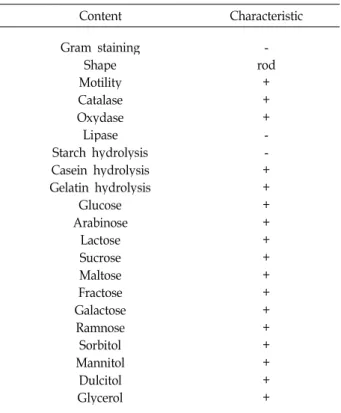
RRj 228을 "Bergey's Manual of Systematic Bacteriology"를 이용한 생리, 생화학적인 특성을 조사결과 gram staining에 음성이었으며 막대형의 호기성균이었다. 효소활성 검사에는 catalase와 oxydase 활성은 나타났으나 lipase 활성은 없었으 며, casein과 gelatin 가수분해력은 보였으나 starch 분해력은 없었다. 배지에 첨가된 탄소원이 arabinose, fructose, gal- actose, glucose, mannitol, sucrose, xylose의 경우에는 생육 중에 산을 생성하고, 탄소원이 lactose, dextrine, ramnose, sor- bitol, maltose, dulcitol의 경우에는 알칼리를 생성하는 것을 확인할 수 있었다(Table 2). 분자유전학적인 분류를 위해 추출 한 DNA로 PCR을 수행한 결과 1,500 bp 정도의 증폭된 DNA 단편을 확인할 수 있었으며, 16S rDNA 부분 염기서열을 GenBank library의 염기서열과 상동성을 조사한 결과 Pseudomonas chlorororaphis, P. Corrugata, P. tolaasii 등 다수의 Pseudomonas 종과 99% 이상의 염기서열 상동성을 나타내었으 므로 Pseudomonas sp.로 분류하고 Pseudomonas sp. RRj 228 균주로 명명하여, 농촌진흥청 농업생명공학연구원 부설 한국 농용미생물보존센터(KACC)에 기탁하여 수탁번호 KACC 1052를 부여 받았다.
Table 2. Physiological properties and carbon utilization of strain RRj 228
Content Characteristic
Gram staining Shape Motility Catalase Oxydase Lipase Starch hydrolysis Casein hydrolysis Gelatin hydrolysis
Glucose Arabinose
Lactose Sucrose Maltose Fractose Galactose Ramnose Sorbitol Mannitol
Dulcitol Glycerol
- rod+
++ -- + ++ ++ ++ + ++ ++ ++
배양여액과 배양여액 추출물의 항균효과
RRj 228 배양 여과액을 0.5배, 10배, 100배의 희석농도로 고 체배지제조에 첨가하여 병원균의 생육억제효과를 조사하였 다. 배양여액의 희석농도에 비례해서 병원균의 생육이 억제되 는 것을 확인했다(Fig. 3). 고추탄저균의 경우에는 배양여액을
Fig. 3. Inhibition of cell growth of plant pathogens by culture filtrate of RRj 228.
Table 3. Antifungal activities of chloroform extract from RRj 228 culture filtrate ED50
(mg/ml)
Probit regression
95% Limits
slope intercept
C. acutatum R. solani P. ultimum
0.140.16 0.29
3.654.01 3.68
1.571.25 2.51
0.460.53 0.63
0.030.01 0.11
10배 희석을 하여 처리하면 탄저균의 생육이 10% 억제되는 것을 확인할 수 있었다.R. solani도 배양여액을 10배 희석하여 처리하면 10% 이상의 병원균생육 억제효과가 나타났다. 사용 한 모든 균주에 2배 희석농도에서는 20~30%의 생육억제효과 를 볼 수 있었다. 고추를 비롯한 과채류재배에 RRj 228배양여 액을 일정농도로 물에 희석하여 살포하거나 관주를 하면 병원 균의 피해를 예방할 수 있다. 배양여액 뿐만 아니라 배양액을 그대로 토양에 관주를 혼합하여 사용하면 PGPR (plant growth-promoting rhizobacterium) 처리효과를 얻을 수 있을 것이다.
배양여액을 원심분리한 다음 CHCl3으로 추출하고, 농축하 여 추출물을 0.1 mg/ml, 1 mg/ml, 2 mg/ml의 농도로 배지조 제에 첨가하여 만든 plate에 병원균을 접종하여C. acutatum, P. ultimum, 및 R. solani의 생육정도를 조사하였다. 사용한 모 든 균주에서 강력한 항균활성이 나타났고, 1 mg/ml의 농도에 서 아주 미약한 생육을 확인할 수 있었으며, 2 mg/ml의 농도 에서는 모든 균주가 전혀 생육을 하지 못했다. 반복실험을 통 하여 얻은 값으로 ED50 분석프로그램에 도입하여 ED50값을 산출한 결과, 고추탄저병원균에 대한 ED50값은 0.14 mg/ml 로 나타났고, 뿌리썩음병원균에 대한 ED50값은 0.16 mg/ml 로 1차 추출물로서는 높은 활성을 나타냈다(Table 3). 골프장 에서는 잔디뿌리썩음 병원균인R. solani피해를 줄이기 위해서 과대한 살균제 사용을 하고 있는 실정으로 이는 수계환경보호 에 큰 문제가 되어지고 있다. 이러한 문제를 해결하기 위하여 미생물제제를 비롯한 생물제제 방제법을 택하고 있다. RRj 228균주의 배양액제제나 생균을 처리하면R. solani방제에 많 은 도움이 될 것으로 사료되어진다.
항균물질 구조동정
Pseudomonas sp. RRj 228균의 배양액으로부터 분리한 228-7 물질의 구조동정은 FAB질량분석,1H-NMR,13C-NMR,1H-1H COSY, HMQC 그리고 HMBC 분석을 통하여 화학적인 구조 분석을 시도하였다. 228-7 물질을 FAB 질량분석에서 [M+H]+ 225과 EI 질량분석에서 [M+H]- 223을 확인되어져 분자량이 224 dalton으로 결정되었다. 정확한 구조를 결정하기 위하여
1H-NMR과13C-NMR 분석을 실시한 결과,1H-NMR 분석에서 하나의 hydroxyl group이 존재함을 알 수 있었고, 13C-NMR 분석에서 탄소수가 13개이며, 1개의 carboxyl group (C-1' δc 166.1 ppm)이 존재하는 것이 관찰되었다(Table 4). 7개의 met hine proton (H-2, δH 8.98 → δC 137.7; H-3, δH 8.05 → δC
Table 4. 13C and1H-NMR data for phenazine-1-carboxylic acid Position 13C 1H (J in Hz)b
1 23 4 56 78 109 11 121'
125.2s 137.7d 130.5d 135.3d 143.6s 144.3s 128.2d 131.9d 133.5d 130.3d 140.3s 140.0s 166.1s
-
8.98 d (J=7.5 Hz, 1H)
8.05 dd (J1=1.5 Hz, J2=1.5 Hz, 1H) 8.53 d (J=8.5 Hz, 1H)
-
-
8.36 d (J=8.3 Hz, 1H)
7.99 dd (J1=1.5 Hz, J2=1.5 Hz, 1H) 8.02 dd (J1=1.0 Hz, J2=1.5 Hz, 1H) 8.29 d (J=8.8 Hz, 1H)
-
-
-
aRecorded at 500 MHz for 1H- and13C-NMR, respectively.
bMultiplicity was established from a DEPT experiment.
130.3; H-4, δH8.53 → δC135.4; H-7, δH8.36 → δC128.2; H-8, δH7.99 → δC131.9; H-9, δH8.02 → δC133.5; H-10, δH8.29
→ δC130.3)을 확인하였다. Liu가S. salina에서 분리한 phena- zine-1-carboxylic acid와 chemical shift를 비교한 결과, me- thine proton의 chemical shift는 일치하였고, C-7과 C-10의 chemical shift가 130.1 ppm과 128.0 ppm에서 128.2 ppm과 130.3 ppm으로 이동하였으나 다른 carbon의 chemical shift는 일치하였다[15].1H-1H COSY 분석을 통하여 양성자들 사이의 cross peak를 관찰하였다. 이상의 결과들을 정리한 결과, me- thine proton chemical shift와 carbon chemical shift 및 분자 량 결과를 종합한 결과 Phenazine-1-carboxylic acid로 동정하 였다(Fig. 4).
N N
COOH
1
3 6 5
10
12
8
1'
Fig. 4. Chemical structure of phenazine-1-carboxylic acid.
감사의 글
이 논문은 부산대학교 자유과제 학술연구비(2년)에 의하여 연구되었음.
References
1. Ahn, I. P., K. H. Uhm, S. Kim, and Y. H. Lee. 2003. Signaling pathways involved in preinfection development of Colletotrichum gloeosporioides, C. coccodes, and C. dematium pathogenic on red pepper. Physiol. Mol. Plant Pathol. 63, 281-289.
2. Ahn, I. P., S. Kim, W. B. Choi, and Y. H. Lee. 2003. Calcium restores prepenetration morphogenesis abolished by poly- amines inColletotrichum gloeosporioidesinfecting red pepper.
FEMS Microbiol. Lett. 227, 237-241.
3. Ahn, S. M., D. S. Lee, M. S. Kim, S. J. Choi, C. S. Choi, J. B. Lee, H. S. Jang, and H. Y. Sohn. 2009. Bioactivity of the extract of Coptis chinensis: In-vitro antifungal activity againstPhytophthora capsiciand growth-promotion effect in red-pepper. Kor. J. Microbiol. Biotechnol. 37, 280-286.
4. Bardas, G. A., A. L. Lagopodi, K. Kadoglidou, and T. K.
Katina. 2009. Biological control of threeColletotrichum linde- muthianum races using Pseudomonas chlororaphis PCL1391 and Pseudomonas fluorescensWCS365. Biological Control 49, 139-145.
5. Chanchaichaovivat, A., P. Ruenwongsa, and B. Panijpan.
2007. Screening and identification of yeast strains from fruits and vegetables: Potential for biological control of post- harvest chilli anthracnose (Colletotrichum capsici).Biological Control 42, 326-335.
6. Chung, J. W., C. Y. Lee, S. C. Yun, and K. Y. Cho. 2008.
Screening of myxobacteria inhibiting the growth of Collectotrichum acutatum causing anthracnose on pepper.
Kor. J. Microbiol. Biotechnol. 36, 21-27.
7. Han, K. S, J. H. Park, Y. K. Han, and J. H. Hwang. 2009.
Pathogenicity and occurrence of pepper seedling an- thracnose caused byColletotrichum acutatum.Res. Plant Dis. 15, 88-93.
8. Kang, K., K. Lee, A. Ishihara, S. Park, Y. S. Kim, and K.
Back. 2010. Induced synthesis of caffeoylserotonin in pepper fruits upon infection by the anthracnose fungus,Colletotrichum gloeosporioides. Scientia Horticulturae124, 290-293.
9. Kim, J. T., S. K. Park, W. B. Choi, Y. H. Lee, and H. T.
Kim. 2003. Identification of Colletotrichumspp. associated with pepper anthracnose in Korea. (Abst.) Plant Pathol. J. 19, 331.
10. Kim, K. K., K. H. Park, S. S. Moon, and K. Y. Kang. 1997.
Isolation and structure identification of antifungal substance fromAspergillus terreus.Agri. Chem. Biotechnol. 40, 593-596.
11. Kim, Y. S., H. H. Lee, M. K. Ko, C. E. Song, C. Y. Bae, Y. H. Lee, and B. J. Oh. 2001. Inhibition of fungal appresso- rium formation by pepper (Capsicum annuum) esterase.Mol.
Plant-Microbe Interact. 14, 80-85.
12. Kim, K. K., Y. K. Kim, H. J. Son, Y. W. Choi, and K. Y.
Kang. 2005. Biological control of perilla culture by Burkhoderia sp. AK-17. J. Korean Soc. Appl. Biol. Chem. 48, 34-39.
13. Lee, J. B., J. H. Shin1, J. O. Jang, K. S. Shin, C. S. Choi, K. W. Kim, M. S. Jo, C. P. Jeon, Y. H. Kim, and G. S. Kwon.
2008. Antifungal activity of Bacillus sp. AM-651 against Phytophthora capsici. Kor. J. Microbiol. Biotechnol. 36, 227-232.
14. Lee, K. H. 2008. Improvement of chemical control method of anthracnose, Rural Development Administration, Region Specialization Project Report.
15. Liu, W. H., M. G. Li, Y. Q. Li, J. Y. Zhao, Z. G. Ding, P.
W. Yang, X. L. Cui, and M. L. Wen. 2008. Cytotoxic metabo- lites ofStreptimonospora salina.Chem. Nat. Comp.44, 503-505.
16. Ozgonen, H. and A. Erkilic. 2007. Growth enhancement and phytophthora blight (Phytophthora capsici Leonian) control by arbuscular mycorrhizal fungal inoculation in pepper.
Crop. Protection 26, 1682-1688.
17. Paik, S. B. and D. W. Kim. 1995. Screening for phyllospheral antagonistic microorganisms for control of red-pepper an- thracnose (Collectotrichum gloeosporioides).Kor. J. Mycol. 23, 190-195.
18. Palleroni, N. J. 1989. Family I. Pseudomonadaceae, In BERGEY‘s Manual Systemic Bacteriology. 1. pp. 141-218. N.
R. KRIEG, (eds.) Williams & Wilkins.
19. Park, K. S. and C. H. Kim. 1992. Identification, distribution and etiological characteristics of anthracnose fungi of red pepper in Korea. Kor. J. Plant Pathol. 8, 61-69.
20. Park, S. M., H. J. Jung, and T. S. Yu. 2006. Screening of an antagonistic bacterium for control of red-pepper an- thracnose, Colletotrichum gloeosporioides. J. Life Science 16, 420-426.
21. Rawlings, S. L., R. J. O’Connell, and J. R. Green. 2007. The spore coat of the bean anthracnose fungusColletotrichum lin- demuthianumis required for adhesion, appressorium devel- opment and pathogenicity. Physiol. Mol. Plant Pathol. 70, 110-119.
22. Sang, M. K., S. C. Chun, and K. D. Kim. 2008. Biological control of phytophthora blight of pepper by antagonistic rhi- zobacteria selected from a sequential screening procedure.
Biological Control 46, 424-433.
23. Woo, S. M. and S. D. Kim. 2008. Structural identification of siderophore (AH18) from Bacillus subtilisAH18, a bio- control agent of phytophthora blight disease in red-pepper.
Kor. J. Microbiol. Biotechnol. 36, 326-335.
24. Yücel, S. 1995. A study on soil solarization and combined with fumigant application to control phytophthora crown blight (Phytophthora capsiciLeonian) on peppers in the East Mediterranean region of Turkey.Crop Protection14, 653-655.
25. Zhang, S., T. L. White, M. C. Martinez, J. A. McInroy, J.
W. Kloepper, and W. Klassen. 2010. Evaluation of plant growth-promoting rhizobacteria for control of phytophthora blight on squash under greenhouse conditions. Biological Control 53, 129-135.
초록:Pseudomonas sp. RRj 228이 분비하는 항균물질의 동정과 고추탄저균 C. acutatum에 대한 항균활성
전상윤․김용균․손홍주․박현철․이상몽․김선태1․박기도2․강위금2*․김근기*
(부산대학교 생명환경화학과, 1부산대학교 식물생명과학과, 2농촌진흥청)
식물 근권미생물은 식물의 뿌리 표면과 내부에 정착하면서 식물생장 촉진물질을 분비하여 식물생육에 직접적 인 영향을 주거나, 항균물질을 분비하여 병원균으로부터 식물 근권환경을 보호하여 식물의 생육을 촉진하게 된 다. 이러한 활성을 갖고 있는 미생물을 분리하여 동정하며, 항균물질을 분리, 동정하여 지속농업의 발전과 농업환 경의 보전을 위하여 연구를 실시하였다. 논토양으로부터 식물생육촉진활성과 항균활성을 갖는 RRj 228균주를 분 리하여, 생리ㆍ생화학적방법과 유전학적 방법으로 동정한 결과, Pseudomonas sp.로 동정되었다. RRj 228균주는 B. cinerea, P. ultimum, P. capsici와 R. solani에도 높은 항균활성을 보였으며, 특히 고추탄저병원균인 C. acutatum에 강력한 항균활성을 나타냈다. RRj 228균의 배양여액을 C. acutatum, R. solani 및 P. ultimum에 대한 ED50값을 측정 한 결과 0.14, 0.16, 0.29 mg/ml로 나타났다. 항균활성물질은 RRj 228 배양여액으로부터 각종 크로마토그라피법으 로 순수분리하고, NMR과 GC/MS 등의 기기분석을 실시하여 구조를 Phenazine-1-carboxylic acid (분자량 224)로 동정하였다.