J. Appl. Biol. Chem. 51(2), 57-60 (2008) Article
Antioxidant Activity of Flavonoids and Their Glucosides from
Sonchus oleraceus L.Jie Yin1, Chuan-Ling Si2, and Myeong-Hyeon Wang1,*
1School of Biotechnology, Kangwon National University, Chuncheon 200-701, Korea
2Tianjin Key Laboratory of Pulp & Paper, Tianjin University of Science & Technology, Tianjin 300222, China
Received December 26, 2007; Accepted February 22, 2008
Eight compounds, including 2 flavones, luteolin (1) and apigenin (2), 2 flavonols, kaempferol (3) and quercetin (4), and 4 flavonoid glucosides, luteolin-7-O-β-D-glucoside (5), apigetrin (6), astragalin (7), and isoquercitrin (8), isolated from the whole herb of Sonchus oleraceus L. were analyzed on the basis of chemical and spectroscopic evidence. This was the first time to report compounds 3, 4, 6, 7 and 8 from the Sonchus oleraceusL. The antioxidant activities of the isolated flavonoids and their glucoside derivatives were evaluated by DPPH free radical-scavenging assay, showing that compounds 1, 3, 4 and 8 exhibited stronger antioxidant activities compared with α- tocopherol and curcumin. Flavonoids containing more hydroxyl groups exhibited better antioxidant activities. The antioxidant activity of flavonols was superior to their corresponding flavones, and that of aglycone are more potent than their glucoside derivatives.
Key words: antioxidant activity, DPPH, flavonoids, Sonchus oleraceus L. Naturally occurring polyphenolic compounds, including
flavonoids, phenolic acids and tannins, have gained much attention as dietary supplements for the prevention of many pathological diseases and for the improvement of human health conditions [Gutteridge and Halliwell, 1994;
Halliwell, 1994; Weisburger et al., 1996]. Food industry is attempting to develop new natural products from plants as safe and effective additives. [Wanasundara and Shahidi, 1998]. Therefore, comprehensive investigation for effective antioxidants from natural sources has been undertaken actively [Scalbert et al., 2000].
Sonchus oleraceus L. (Compositae), a herb native to Europe, North Africa, and Asia, is widely found in moist areas of fields, orchards, roadsides, gardens, or cleared land [Holm et al., 1977]. This plant has been used in folk medicines to treat diseases such as enteritis, diarrhea, pneumonia, hepatitis, appendicitis, chronic bronchopneu- monia, icterus, throat swelling, haematemesis and uraemia [Jiangsu New Medical College, 1977]. Phytochemical investigations of this species resulted in the isolation of flavonoids (mainly luteolin and apigenin derivatives), fatty acids, phenolic acids, volatile essential oils and terpenes [Bai et al., 2007; Hu et al., 2005; Li et al., 2005;
Xu and Liang, 2005; Yin et al., 2007]. In the present work, we report the isolation of 4 flavonoids (1-4) and 4 corresponding glucoside derivatives (5-8) from the
Sonchus oleraceus and their structure-antioxidant activity relationship based on DPPH assay.
Materials and Methods
General procedure. 1H- and 13C-NMR spectra data were recorded on a Bruker Avance DPX 400 MHz NMR spectrometer. EI- and positive FAB-MS were recorded using a Micromass Autospec M363. MeOH-d4 was used as NMR solvents with TMS as an internal standard. A column was packed with Sephadex LH-20 using MeOH- H2O and EtOH-hexane mixture for elution. Eluents were collected using a Gilson FC 204 fraction collector. The columns were washed with acetone-H2O (1 : 1, v/v) when the eluent was colorless. TLC was performed on 25 DC- Plastik-folien Cellulose F (Merk) plates and developed with t-BuOH-HOAc-H2O (3 : 1 : 1, v/v/v, Solvent A) or HOAc-H2O (3 : 47, v/v, Solvent B). Visualization was done by illuminating ultraviolet light (254 and 365 nm), by spraying 1% ethanolic FeCl3, or by heating. Two dimensional TLC was also tried to verify the purification of the isolated compounds. All solvents were routinely distilled prior to use.
Plant material. The whole herb of S. oleraceus was
*Corresponding author
Phone: +82-33-250-6486; Fax: +82-33-241-6480 E-mail: [email protected]
58 Jie Yin et al.
collected in Kangwon province in August, 2006, air-dried for two weeks at room temperature and then finely powdered to be extracted.
Extraction and isolation. Air-dried and ground S.
oleraceus (3.5 kg) was extracted with acetone-H2O (7 : 3).
Removal of the solvent yielded a dark brown extract. The extract was subsequently fractionated with n-hexane, CH2Cl2 and EtOAc with a separatory funnel and then each fraction was freeze-dried to give 18.3 g of n-hexane, 26.1 g of CH2Cl2, 68 g of EtOAc and 402 g of H2O partitioned fractions.
A portion of EtOAc fraction powder (30.0 g) was chromatographed on a Sephadex LH-20 column eluted with MeOH-H2O (4 : 1, v/v) to give 5 major fractions labeled as E1 (1.06 g), E2 (14.7 g), E3 (6.8 g), E4 (4.3 g) and E5 (2.7 g). Fraction E2 was reapplied on the column for further purification with MeOH-H2O (3 : 1, v/v) affording 4 subfractions as E21-E24. E23 was recognized as compound 4 (15 mg). Subfraction E21 was retreated on the column for further purification with MeOH-H2O (1 : 1 and 1 : 3, v/v) and EtOH-hexane (3 : 1 and 1 : 1, v/v), affording compounds 1 (98 mg), 3 (45 mg), 5 (61 mg) and 6 (72 mg). Fraction E4 was resubjected on the column with MeOH-H2O (1 : 1 and 1 : 3, v/v) and EtOH-hexane (2 : 1 and 1 : 1, v/v) in a stepwise manner to yield compounds 2 (106 mg), 7 (38 mg) and 8 (47 mg).
Compound 1. Yellowish amorphous powder; FeCl3 test: Positive (dark brown); Rf: 0.58 (solvent A) and 0.07 (solvent B); EI-MS: Found [M]+ m/z 286; 1H-NMR (400 MHz, MeOH-d4, δ): 6.31 (1H, d, J= 1.8 Hz, H-6), 6.62 (1H, d, J= 1.8 Hz, H-8), 6.59 (1H, s, H-3), 7.10 (1H, d, J= 8.2 Hz, H-5'), 7.51 (1H, dd, J= 2.1 Hz and J= 8.2 Hz, H-6'), 7.59 (1H, d, J= 2.1 Hz, H-2'); 13C-NMR (100 MHz, MeOH-d4, δ): 94.74 (C-8), 99.72 (C-6), 104.25 (C- 3), 105.39 (C-10), 114.20 (C-2'), 116.66 (C-5'), 120.15 (C-6'), 123.79 (C-1'), 146.51 (C-3'), 150.16 (C-4'), 158.81 (C-9), 163.39 (C-5), 164.94 (C-2), 165.19 (C-7), 183.10 (C-4).
Compound 2. Yellowish amorphous powder; FeCl3
test: Positive (dark brown); Rf: 0.79 (solvent A) and 0.05 (solvent B). EI-MS: Found [M]+ m/z 270; 1H-NMR (400 MHz, MeOH-d4, δ): 6.23 (1H, d, J= 1.9 Hz, H-6), 6.53 (1H, d, J= 1.9 Hz, H-8), 6.82 (1H, s, H-3), 6.96 (2H, d, J= 8.1 Hz, H-3',5'), 7.95 (2H, d, J= 8.1 Hz, H-2',6'); 13C- NMR (100 MHz, MeOH-d4, δ): 94.84 (C-8), 99.71 (C-6), 103.69 (C-3), 104.54 (C-10), 116.85 (C-3',5'), 122.04 (C- 1'), 129.37 (C-2',6'), 158.20 (C-9), 162.07 (C-5), 162.34 (C-4'), 164.63 (C-2), 165.07 (C-7), 181.64 (C-4).
Compound 3. Yellowish amorphous powder; FeCl3 test: Positive (dark brown); Rf: 0.55 (solvent A) and 0.00 (solvent B); EI-MS: Found [M]+ m/z 286; 1H-NMR (400 MHz, MeOH-d4, δ): 6.29 (1H, d, J= 2.0 Hz, H-6), 6.59
(1H, d, J= 2.0 Hz, H-8), 7.05 (2H, d, J= 8.3 Hz, H-3',5'), 8.19 (2H, d, J= 8.3 Hz, H-2',6'). 13C-NMR (100 MHz, MeOH-d4, δ): 94.55 (C-8), 99.21 (C-6), 104.21 (C-10), 116.37 (C-3',5'), 123.36 (C-1'), 130.50 (C-2',6'), 136.69 (C-3), 147.05 (C-2), 157.81 (C-9), 160.19 (C-5), 162.35 (C-4'), 165.02 (C-7), 176.64 (C-4).
Compound 4. Yellowish amorphous powder; FeCl3 test: Positive (dark brown); Rf: 0.58 (solvent A) and 0.00 (solvent B); EI-MS: Found [M]+ m/z 302; 1H-NMR (400 MHz, MeOH-d4, δ): 6.29 (1H, d, J= 1.8 Hz, H-6), 6.57 (1H, d, J= 1.8 Hz, H-8), 7.04 (1H, d, J= 8.2 Hz, H-5'), 7.70 (1H, dd, J= 8.2 Hz and J= 2.0 Hz, H-6'), 7.80 (1H, d, J= 2.0 Hz, H-2'); 13C-NMR (100 MHz, MeOH-d4, δ):
94.94 (C-8), 99.56 (C-6), 104.37 (C-10), 116.12 (C-2'), 116.61 (C-5'), 121.89 (C-1'), 123.84 (C-6'), 137.04 (C-3), 146.26 (C-3'), 147.89 (C-2), 148.78 (C-4'), 158.03 (C-9), 162.04 (C-5), 165.49 (C-7), 177.03 (C-4).
Compound 5. Yellowish amorphous powder; FeCl3 test: Positive (dark brown); Rf: 0.49 (solvent A) and 0.09 (solvent B); Positive FAB-MS: Found [M+H]+ m/z 449;
1H-NMR (400 MHz, MeOH-d4, δ): 3.1~3.6 (5H, m, H- 2'',3'',4'',5'',6''), 5.13 (1H, d, J= 8.0 Hz, H-1''), 6.52 (1H, br.
s, 6-H), 6.79 (1H, s, 3-H), 6.93 (1H, br. s, 8-H), 6.93 (1H, d, J= 8.2 Hz, 5-H), 7.42 (1H, dd, J= 8.2 and 1.8 Hz, 6'- H), 7.36 (1H, d, J= 1.8 Hz, 2-H); 13C-NMR (100 MHz, MeOH-d4, δ): 62.11 (C-6), 71.84 (C-4), 74.63 (C-2), 78.60 (C-5), 78.89 (C-3), 96.32 (C-8), 101.30 (C-6), 101.79 (C-1), 104.62 (C-3), 107.12 (C-10), 115.41 (C-2), 118.09 (C-5), 121.21 (C-6), 123.48 (C-1), 147.22 (C-3), 152.05 (C-4), 159.20 (C-9), 163.22 (C-5), 165.31 (C-7), 166.48 (C-2), 184.21 (C-4).
Compound 6. Yellowish amorphous powder; FeCl3 test: Positive (dark brown); Rf: 0.51 (solvent A) and 0.59 (solvent B); Positive FAB-MS: Found [M+H]+ m/z 433;
1H-NMR (400 MHz, MeOH-d4, δ): 3.1~3.6 (5H, m, H- 2'',3'',4'',5'',6''), 5.0 (1H, d, J= 7.1 Hz, H-1''), 6.2 (1H, d, J= 1.9 Hz, H-6), 6.6 (1H, d, J= 1.9 Hz, H-8), 6.6 (1H, s, H-3), 6.8 (2H, d, J= 8.5 Hz, H-3',5'), 7.7 (1H, d, J= 8.5 Hz, H-2',6'); 13C-NMR (100 MHz, MeOH-d4, δ): 62.48 (C-6''), 71.29 (C-4''), 74.76 (C-2''), 77.87 (C-5''), 78.41 (C-3''), 96.10 (C-8), 101.21 (C-6), 101.63 (C-1''), 104.14 (C-3), 107.11 (C-10), 117.08 (C-3',5'), 123.08 (C-1'), 129.69 (C-2',6'), 158.98 (C-9), 162.88 (C-4'), 162.96 (C- 5), 164.82 (C-7), 166.79 (C-2), 184.11 (C-4).
Compound 7. Yellowish amorphous powder; FeCl3 test:
Positive (dark brown); Rf: 77 (solvent A), 0.25 (solvent B);
positive FAB-MS: Found [M+H]+ m/z 449; 1H-NMR (400 MHz, MeOH-d4, δ): 3.20~3.43 (4H, m, H-2",3",4",5"), 3.54 (1H, dd, J= 5.5 and 11.9 Hz, Hb-6"), 3.70 (1H, dd, J= 2.2 and 11.9 Hz, Ha-6"), 5.24 (1H, d, J= 7.3 Hz, H-1"), 6.19 (1H, d, J= 2.0 Hz, H-6), 6.38 (1H, d, J= 2.0 Hz, H-8), 6.88 (2H, d, J= 8.9 Hz, H-3',5'), 8.05 (2H, d, J= 8.91 Hz,
Antioxidant Activity of Sonchus oleraceus L. 59
H-2',6'); 13C-NMR (100 MHz, MeOH-d4, δ): 62.65 (C-6"), 71.36 (C-4"), 75.77 (C-2"), 78.06 (C-3"), 78.43 (C-5"), 94.79 (C-8), 99.91 (C-6), 104.14 (C-1"), 105.76 (C-10), 116.10 (C-3',5'), 122.80 (C-1'), 132.33 (C-2',6'), 135.49 (C- 3), 158.50 (C-9), 159.10 (C-2), 161.60 (C-4'), 163.07 (C- 5), 165.98 (C-7), 179.53 (C-4).
Compound 8. Yellowish amorphous powder; FeCl3 test: Positive (dark brown); Rf: 0.64 (solvent A), 0.07 (solvent B); Positive FAB-MS: Found [M+H]+ m/z 465;
1H-NMR (400 MHz, MeOH-d4, δ): 3.23~3.73 (4H, m, H- 2",3",4",6"), 5.25 (1H, d, J= 7.4 Hz, H-1"), 6.19 (1H, d, J= 2.0 Hz, H-6), 6.38 (1H, d, J= 2.0 Hz, H-8), 6.86 (1H, d, J= 8.5 Hz, H-5'), 7.58 (1H, dd, J= 2.1 and 8.5 Hz, H- 6'), 7.71 (1H, d, J= 2.1 Hz, H-2'); 13C-NMR (100 MHz, MeOH-d4, δ): 62.58 (C-6"), 71.24 (C-4"), 75.75 (C-2"), 78.14 (C-5"), 78.41 (C-3"), 99.91 (C-6), 104.35 (C-1"), 105.72 (C-10), 116.03 (C-2'), 117.60 (C-5"), 123.21 (C- 6), 123.23 (C-1'), 135.65 (C-3), 145.92 (C-3'), 149.87 (C- 4'), 158.48 (C-9), 159.04 (C-2), 163.06 (C-5), 166.01 (C- 7), 179.51 (C-4).
DPPH free radical scavenging assay. The antioxidant activity was determined on the basis of the scavenging activity of the stable DPPH free radical method introduced by Yoshida et al. [1989] with slight modification. MeOH solutions (4 mL) of samples at different concentrations (2~40µg/mL) were added to a solution of DPPH (1.5×10⁻⁴ M, 1 mL) in MeOH. After mixing gently and standing at room temperature for 30 min, the optical density was measured at 517 nm with a UV-visible spectrophotometer. The results were calculated by taking the mean of all triplicate values. IC50 values were obtained through extrapolation from concentration of sample necessary to scavenge 50% of the DPPH free radicals.
Curcumin and α-tocopherol were used as positive controls.
Results and Discussion
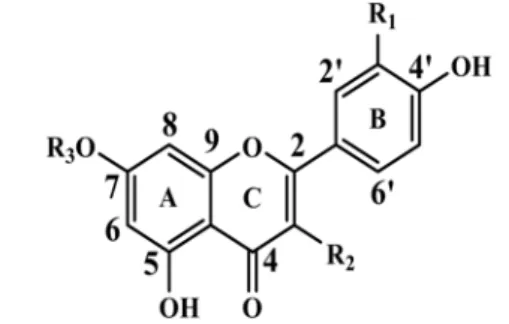
Extraction and isolation. Chromagographic separation of an EtOAc fraction of S. oleraceus led to the isolation of 8 yellow amorphous compounds 1-8 (Fig. 1). Chemical structures of compounds 1-8 were determined as luteolin (1), apigenin (2), kaempferol (3), quercetin (4), luteolin- 7-O-β-D-glucoside (5), apigetrin (6), astragalin (7), and isoquercitrin (8) by comparing the 1H and 13-NMR spectral data with those of reported in literature and a verification of their MS values [Agrawal, 1989; Markham and Chari, 1982; Seidel et al., 2000; Si et al., 2006; Ternai and Markham, 1976; Wenkert and Gottlieb, 1977].
Though compound 1, 2 and 5 have been purified from S.
oleraceus [Bai et al., 2007; Hu et al., 2005; Li et al., 2005; Xu and Liang, 2005], to our knowledge, this was the first time of isolation compounds 3, 4, 6, 7 and 8 from S. oleraceus.
DPPH free radical scavenging assay. The antioxidant activities of the 8 isolated compounds were determined by DDPH assay. The results were presented in Table 1.
Among those, luteolin (1), kaempferol (3), quercetin (4) and isoquercitrin (8) exhibited stronger antioxidant activities comparable to α-tocopherol and curcumin, which were used as positive controls, while the rest compounds showed weak activities. The DPPH results also indicated that compounds 1, 3, 4 and 8 could be mainly responsible for the potent antioxidant effect of the EtOAc soluble fraction of S. oleraceus [Yin et al., 2007]. This fact suggested that the extracts of S. oleraceus had high antioxidant potential and can be used as a useful source for antioxidants.
The antioxidant activity also suggested that the flavonoids with free hydroxyl groups acted as free radical-scavengers, and the hydroxyl group on the β-ring Fig. 1 Structures of compounds isolated from S.
oleraceus. R1=OH, R2=R3=H: luteolin (1), R1=R2=R3=H:
apigenin (2), R1=R3=H, R2=OH: kaempferol (3), R1=R2= OH, R3=H: quercetin (4), R1=OH, R2=H, R3=-β-D- glucoside: luteolin-7-O-β-D-glucoside (5), R1=H, R2=H, R3=-β-D-glucoside: apigetrin (6), R1=H, R2=-O-β-D- glucoside, R3=H: astragalin (7), R1=OH, R2=-O-β-D- glucoside, R3=H: isoquercitrin (8).
Table 1. Antioxidant activities (IC50 values) of the isolated compounds from S. oleraceus
Samples IC50
(µg/mL) (µM)
Controls α-tocopherol 24 56
Curcumin 28 76
Isolated compounds
Luteolin (1) 12 42
Apigenin (2) 39 144
Kaempferol (3) 13 45
Quercetin (4) 11 36
Luteolin-7-O-β-D-glucoside (5) 61 131
Apigetrin (6) 89 206
Astragalin (7) 45 100
Isoquercitrin (8) 22 47
60 Jie Yin et al.
of flavonoids enhanced their antioxidant activities [Akdemir et al., 2001; Pietta, 2000]: Comparing Fig. 1 with Table 1, for flavones, luteolin (12µg/mL) > apigenin (39µg/mL) and for flavonols, quercetin (11µg/mL) >
kaempferol (13µg/mL), meaning that flavonols showed higher antioxidant activities than the corresponding flavones (quercetin (11µg/mL) > lueolin (12µg/mL), and kaempferol (13µg/mL) > apigenin (39µg/mL)). Apigenin, luteolin, kaempferol and quercetin showed comparatively higher antioxidant activity than corresponding glucosides, indicating that the free radical scavenging activities of glycosidic derivatives were significantly reduced when compared with their original flavonoid aglycones.
Acknowledgment. This research was financially supported by the kangwon national University, Institute of Bioscience & Biotechnology.
References
Agrawal PK (1989) Carbon-13 NMR of flavonoids. Elsevier, New York, USA.
Akdemir AS, Tati II, Saraccoglu I, Ismailoglu UB, Sahin- Erdemli I, and Dalis I (2001) Polyphenolic compounds from Geranium pratense and their free radical scaveng- ing activities. Phytochemistry 56, 189-193.
Bai YH, Masayoshi A, and Zhang WB (2007) Study on the chemical constituents of the whole plant of Sonchus ole- raceus L. Journal of Qiqihar University23, 1-3.
Gutteridge JMC and Halliwell B (1994) Antioxidants in Nutrition, Health, and Diesease. Oxford University Press, Oxford, pp. 1-62.
Halliwell B (1994) Free radical, antioxidants, and human disease: Curiosity, cause, or consequence. Lancet 344,
721-724.
Holm LG, Plucknett DL, Pancho JV, and Herberger JP (1977) The world’s worst weeds: Distribution and Biol- ogy, UniversityPress of Hawaii, Honolulu, pp. 436-439.
Hu PZ, Zou CZ, and Zhu Y (2005) Lipid-soluble chemical constituents in Sonchus oleraceus. Acta Bot. Boreal. Occident Sin25, 1234-1237.
Jiangsu New Medical College (1977) The Chinese Medi- cine Dictionary, Shanghai People’s Publishing House, Shanghai, pp. 1286-1288.
Li CG, Qu GR, Niu HY, Dong CX, and Zhu Y (2005) Journal of Henan Normal University (Natural Science)
33, 128-132.
Markham KR and Chari VM (1982) Carbon-13 NMR spec- troscopy of flavonoids, in Harboren JB and Mabry T (eds.), The Flavonoids: Advances in research, Chapman and Hall Ltd., London, UK, pp. 119-134.
Pietta PG (2000) Flavonoids as antioxidants. J Nat Prod 63, 1035-1042.
Scalbert A and Williamson G (2000) Dietary intake and bio- availability of polypenols. J Nutr130, 2073S-2085S.
Seidel V, Bailleul F and Waterman PG (2000) (Rel)-1β,2α- di-(2,4-dihydroxy-6methoxybenzoyl)-3β,4α-di-(4-methox- yphenyl)-cyclobutane and other flavonoids from the aerial parts of Goniothalamus gardneri and Goniothala- mus thwaitesii. Phytochemistry 55, 439-446.
Si CL, Kim JK, Kwon DJ, and Bae YS (2006) Phenolic compounds from the fruits of Paulownia coreana Uyeki.
Mokchae Konghak 34, 79-85.
Ternai B and Markham KR (1976) Carbon-13 NMR stud- ies of flavonoids-I: flavones and flavonols. Tetrahedron
32,565-569.
Wanasundara UN and Shahidi F (1998) Antioxidant and prooxidant activity of green tea extracts in maine oils.
Food Chem63, 335-342.
Weisburger JH, Hara Y, Sulan L, Luo FQ, Pittman B and Zang E (1996) Tea polyphenols as inhibitors of mutige- nicity of major classes carcionogens. Mutat Res371, 57- Wenkert E and Gottlieb HE (1977) Carbon-13 nuclear mag-63.
netic resonance spectroscopy of flavonoid and isofla- vonoid compounds. Phytochemistry 16,1811-1816.
Xu Y and Liang JJ (2005) Chemical Constituent s of Son- chus oleraceus L. J China Pharmaceutial Univ36, 411- Yin J, Kwon GJ and Wang MH (2007) Studies of the anti-413.
oxidant and antiproliferative activities of Sonchus olera- ceus L. extracts. Nutri Res Prac,1, 189-194.