Resistance to Corrosion of Reinforcement of High Volume Fly Ash Concrete
S. O. Kwon1, S. H. Bae1,†, H. J. Lee1, K. M. Lee2, and S. H. Jung3
1Dept. of Civil Engineering, Andong National University, Andong, Korea,
2Dept. of Civil&Environmental Engineering, Sungkyunkwan University, Suwon, Korea,
3Korea Confirmity Laboratories, Seoul, Korea
(Received August 1, 2014; Revised December 19,2014; Accepted December 24, 2014)
Due to the increasing of interest about the eco-friendly concrete, it is increased to use concretes containing by-products of industry such as fly ash(FA), ground granulated blast furnace slag(GGBFS), silica fume(SF), and etc. Especially, these are well known for improving the resistances to reinforcement corrosion in concrete and decreasing chloride ion penetration. The purpose of this experimental research is to evaluate the resistance against corrosion of reinforcement of high volume fly ash(HVFA) concrete which is replaced with high volume fly ash for cement volume. For this purpose, the concrete test specimens were made for various strength level and replacement ratio of FA, and then the compressive strength and diffusion coefficient for chloride ion of them were measured for 28, 91, and 182 days, respectively. Also, corrosion monitoring by half cell potential method was carried out for the made lollypop concrete test specimens to detect the time of corrosion initiation for reinforcement in concrete. As a result, it was observed from the test results that the compressive strength of HVFA concrete was decreased with increasing replacement ratio of FA but long-term resistances against reinforcement corrosion and chloride ion penetration of that were increased.
Keywords : high volume fly ash concrete, corrosion of reinforcement, monitoring, resistance to chloride ion penetration
†Corresponding author: [email protected]
1. Introduction
A large portion of the concrete industry has growing interest in minimizing the use of Ordinary Portland Cement(OPC), because it is generally estimated that the amount of greenhouse gas emitted from the worldwide production of OPC corresponds to approximately 7% of the total greenhouse gas emissions into the Earth's atmosphere.1) As a result, various investigations have been conducted in the cement industry field to reduce green- house gas.2) It should be noted that the processing amount of waste resources and the amount of carbon dioxide(CO2) emitted from the consumption of fossil fuels could be re- duced by using high volume fly ash(HVFA) concrete which was replaced with HVFA for cement volume.3) In addition, by-products of industry such as fly ash, ground granulated blast furnace slag, silica fume, and etc. were well known for improving the resistances to reinforcement corrosion in concrete and chloride ion penetration.4, 5) The purpose of this experimental research is to evaluate the resistance against corrosion of reinforcement of HVFA
concrete. For this purpose, the concrete test specimens were made for various strength level and replacement ratio of FA, and then the compressive strength and diffusion coefficient for chloride ion of them were measured for 28, 91, and 182 days, respectively. Also, corrosion mon- itoring by half cell potential method was carried out for the made lollypop concrete test specimens to detect the time of corrosion initiation for reinforcement in concrete.
2. Experimental work
2.1 Materials and mix proportions
Ordinary portland cement(KS L 5201, Type 1) was used in this study and the physical properties and chemical compositions of that are given in Table 1. For fine ag- gregate and coarse aggregate, river sand and crushed stone with maximum size of 25mm were used, respectively and their physical properties are given in Tables 2 and 3. To control fluidity of concrete mixture, air entraining(AE) and high-range water reducing agent of polycarbonic acid were used as a kind of superplasticizer. To manufacture HVFA concrete specimens, fly ash was used and the phys- ical properties and chemical compositions of that are given
Table 1. Physical properties and chemical compositions of cement Type Specific
gravity
Chemical compositions (wt. %) Loss of
ignition SiO2 Al2O3 Fe2O3 CaO MgO K2O Na2O SO3
Ordinary portland cement
3.15 2.60 20.60 5.92 2.89 61.18 3.32 0.92 0.13 2.43
Table 2. Physical properties of aggregates Type
Maximum size of coarse aggregate (mm)
Density (g/cm3)
Absorption (%)
Unit mass (kg/m3)
Amount of passing 0.08mm sieve (%)
Fineness modulus
River sand - 2.59 1.47 1,597 2.20 2.43
Crushed stone 25 2.65 0.58 1,648 - 7.27
Table 3. Properties of Chemical Admixtures
Type Specific gravity pH Solid content
(%)
Quantity(%)
(by mass of cement) Main component
Superplasticizer 1.05 3~4 18 0.5~2.5 Polycarbonic acid
admixture
Air entraining agent 1.08 12 28 0.002~0.004 Surfactant
Table 4. Physical properties and chemical compositions of fly ash
Type Density
(g/cm3)
Chemical compositions (wt. %)
SiO2 Al2O3 Fe2O3 CaO MgO K2O SO3
Fly ash 2.20 55.1 19.9 10.9 6.00 0.541 2.15 1.33
Table 5. Chemical Compositions of Substitute Ocean Water
Compound NaCl MgCl2∙6H2O Na2SO4 CaCl2 KCl
Concentration (g/L) 24.53 10.40 4.09 1.16 0.695
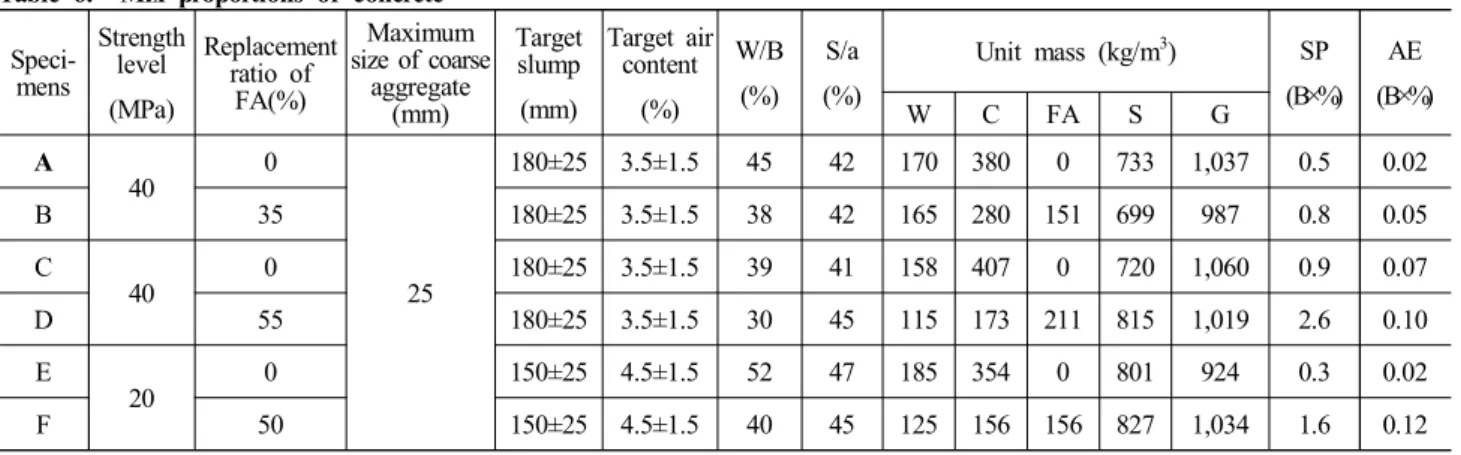
Table 4. Artificial seawater was adopted and prepared in accordance with ASTM D 1141(specification for sub- stitute ocean water).6) Table 5 shows the composition of artificial seawater used in this study. Table 6 presents the mix proportions of concrete specimens with strength level and replacement ratio of fly ash. The target slumps are 150±25mm to 180±25mm and air contents are 3.5±1.5%
to 4.5±1.5% according to the strength level.
2.2 Test specimens
Concrete cylinders(∅100×200mm) were made to measure the compressive strength and diffusion coefficient for chloride ion and lollypop specimens were manufacture to carry out the electrochemical accelerating corrosion test
for reinforcement in concrete(Fig. 1). After casting, all the concrete specimens were demoulded after 24 hours.
The concrete cylinders were cured in the water of 20±3℃
and the lollypop specimens were placed at the normal tem- perature of about 20℃ under the vinyl cover for 14 days until test began.
2.3 Accelerating corrosion test and corrosion monitoring for reinforcement in concrete
In electrochemical accelerating corrosion test of lolly- pop specimens, the periodic cycles of 1 day wet and 1 day dry conditions were applied to accelerate corrosion.
To further accelerate corrosion a constant supply 2 volts was also added, as illustrated in Fig. 2.7) Before half cell
Table 6. Mix proportions of concrete Speci-
mens
Strength level (MPa)
Replacement ratio of
FA(%)
Maximum size of coarse
aggregate (mm)
Target slump
(mm)
Target air content
(%)
W/B (%)
S/a (%)
Unit mass (kg/m3) SP (B×%)
AE (B×%)
W C FA S G
A 40
0
25
180±25 3.5±1.5 45 42 170 380 0 733 1,037 0.5 0.02
B 35 180±25 3.5±1.5 38 42 165 280 151 699 987 0.8 0.05
C
40
0 180±25 3.5±1.5 39 41 158 407 0 720 1,060 0.9 0.07
D 55 180±25 3.5±1.5 30 45 115 173 211 815 1,019 2.6 0.10
E
20
0 150±25 4.5±1.5 52 47 185 354 0 801 924 0.3 0.02
F 50 150±25 4.5±1.5 40 45 125 156 156 827 1,034 1.6 0.12
Fig. 1. Lollypop test specimen.
Fig. 2. Electrochemical accelerating corrosion test.
Fig. 3. Detail of migration set-up.
Fig. 4. Arrangement of migration set-up.
potential measurement begins, power source was turned off for a few minutes until stabilization of the potential of the reinforcement for every potential tested before tak- ing the corresponding value. Half cell potential tests were conducted, following the ASTM C 8768) guidelines to determine the likehood of active corrosion. A saturated copper sulphate electrode(CSE) was used as reference electrode. In this test, 16 to 30 testing days for lollypop test specimens were carried out.
2.4 Diffusion coefficient for chloride ion
The migration set-up was arranged to accelerate the movement of chloride ion under the action of an external electrical field as shown in Figs. 3 and 4.9) A 50±2mm thick slice cutting from concrete test specimen(∅
100×200mm) was used, the catholyte solution was 10%
NaCl by mass and the anolyte solution was 0.3 N NaOH in distilled water. The voltage of 30V was served to the migration set-up by power source at a constant temperature and humidity room under 20±3℃ and 60±5% RH, and then the chloride penetration depth passing through the
Fig. 5. Compressive strength of concrete.
Fig. 6. Potential monitoring of reinforcement in concrete under accelerated corrosion test.
Fig. 7. Time to corrosion initiation.
Fig. 8. Diffusion coefficient of concrete.
concrete slice was monitored during the test duration.
From the measured chloride penetration depth the diffusion coefficient for chloride ion was estimated by Eq. (1):
t
x x
zFE
D RT d -a d
= (1)
where ÷÷
ø ö çç
è æ - - =
= -
0
1 2
1 2
2,
c erf c
zFE RT L
E U a d
and D= non-steady-state migration coefficient(m2/s), z=
absolute value of ion valence, for chloride(z=1), F=
Faraday constant(F=9.648×10⁴ J/(V·mol)), U= absolute value of the applied voltage(V), R= gas constant(R=8.314 J/(K·mol)), T= average value of the initial and final tem- peratures in the anolyte solution(K), L= thickness of the specimen(m), xd= average value of the penetration depths(m), t= test duration(sec), erf–1= inverse of error function, cd= chloride concentration at which the colour changes(cd≈0.07 N for OPC concrete), and c0= chloride concen- tration in the catholyte solution(c0≈2 N).
3. Results and Discussion
3.1 Compressive strength of concrete
Fig. 5 indicates the compressive strengths of HVFA and Ordinary Portland Cement(OPC) concretes with strength level. It was observed that the compressive strength of HVFA concrete was larger than that of OPC concrete when unit binder content was over 400kg/m3 and replace- ment ratio of FA was 35%. On the contrary, it was re- vealed that the compressive strength of HVFA concrete was smaller than that of OPC concrete when unit binder content was under 400kg/m3 and replacement ratio of FA was not less than 50%.
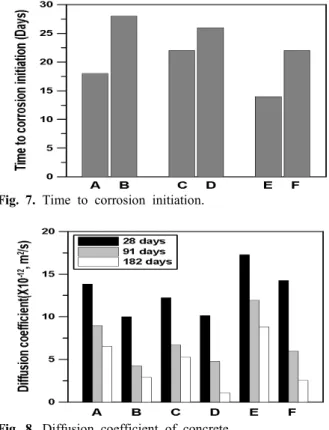
3.2 Corrosion monitoring for reinforcement in concrete Figs. 6 and 7 depict the variation of half cell potential measurements and time of corrosion initiation of re- inforcement in concrete under the accelerated corrosion test. In general, it was well known to be the time of corro- sion initiation of reinforcement when half cell potential measurements reached –350mV.8) It was found that the time of corrosion initiation for HVFA concrete as B, D, and F mixtures was 28, 26, and 22 days, respectively and that of OPC concrete as A, C, and E mixtures was 18, 22, and 14 days, respectively. Thus, it could be concluded that the former had more excellent the resistance to corro- sion of reinforcement than the latter because the time of corrosion initiation of the former increased approximately
1.2 to 1.6 times than the case of the latter.
3.3 Diffusion coefficient for chloride ion
Fig. 8 presents the diffusion coefficients for chloride ion of OPC and HVFA concretes. It was observed that the diffusion coefficient for chloride ion of HVFA con- crete was smaller than that of OPC concrete irrespective of strength level and replacement ratio of FA. It was re- vealed that the diffusion coefficient for chloride ion of HVFA concrete at 28, 91, and 182 days decreased 1.21~1.38, 1.40~2.11, and 2.26~4.90 times, respectively than OPC concrete of equal strength level and the larger the age, the larger was the difference between the former and the latter. Thus, it was thought that the resistance to chloride ion penetration of HVFA concrete largely im- proved with increasing age than OPC concrete. On the other hand, the diffusion coefficient of D and F mixtures at 182 days was found to be decreasing than the case of B mixture. This result proves that factor affecting the long-term diffusion coefficient of HVFA concrete is more effective in replacement ratio of FA than in water-binder ratio.
4. Conclusions
The following conclusions were drawn from the estima- tion of the resistances to reinforcement corrosion and chloride ion penetration for HVFA and OPC concretes.
1. It was observed from the test results that the time of corrosion initiation of HVFA concrete extended ap- proximately 1.2 to 1.6 times than that of OPC concrete.
Thus, it can be concluded that the former has more excellent the resistance to reinforcement corrosion than the later.
2. It was revealed that the diffusion coefficient of HVFA concrete at 28, 91, and 182 days decreased 1.21~1.38, 1.40~2.11, and 2.26~4.90 times, respectively than OPC concrete of equal strength level and the larger the age, the larger was the difference between the former and the latter. Thus, it could be concluded that the resistance
to chloride ion penetration of HVFA concrete largely improved with increasing age.
3. To investigate the resistance to chloride attack of HVFA concrete, it will be necessary to pursue studies on the estimation of critical chloride content for reinforcement corrosion of that.
Acknowledgments
This work was supported by the Nuclear Research &
Development of the Korea Institute of Energy Technology Evaluation and Planning (KETEP) grant funded by the Korea government Ministry of Knowledge Economy.
References
1. K. H. Yang, J. H. Mun, K. S. Lee and J. K. Song, International Journal of Concrete Structures and Materials, 5, 125 (2011).
2. S. O. Kwon, S. H. Bae, M. S. Goo and H. J Lee, Resistance Estimation against Chloride Attack of High Volume Fly Ash Concrete, Proceedings of the 13th Int’l on Recycled Construction Resource Congress, p. 110, Seoul, Korea (2013).
3. S. H. Jung, Y. C. Choi, K. D. Moon and Y. J Choi, Development of green construction materials utilizing high volume coal combustion products, Proceedings of the 12th Int’l on Recycled Construction Resource Congress, p. 169, Seoul, Korea (2012).
4. Y. J. Kim, S. S. Lee, D. S. Kim and J. K. Yoo, Journal of Korea Concrete Institute, 16, 319 (2004).
5. S. H. Bae, J. I. Park, K. M. Lee and S. Choi, Journal of the Korean Society of Civil Engineers, 29, 347 (2009).
6. ASTM D 1141: Standard Practice for the Preparation of Substitute Ocean Water (1998).
7. S. H. Bae, K. M. Lee, J. S. Kim and Y. S. Kim, Journal of the Korean Society of Civil Engineers, 27, 771 (2007).
8. ASTM C 876: Standard Test Method for Half Cell Potentials of Uncoated Reinforcing Steel in Concrete (1991).
9. NT Build 492: Chloride Migration Coefficient from Non-steady-state Migration Experiments, Nordic (1999).