CORROSION SCIENCE AND TECHNOLOGY, Vol.9, No.1(2010), pp.16~19
16
Development of Ultra-High Strength Galvannealed Steel Sheets
Nobuhiro Fujita1,†, Ken-ichiro Matsumura2, Toshiki Nonaka1, and Toshimasa Tomokiyo1
1NAGOYA R&D Laboratories, NIPPON STEEL CORPORATION, Tokai-city, Japan
2HIROHATA R&D Laboratories, NIPPON STEEL CORPORATION, Himeji-city, Japan (Received July 31, 2009; No Revisio, 2010; Accepted February 16, 2010)
Application of ultra-high strength steel sheets is one of the most important methods to satisfy weight reduction and crash safety of a vehicle. Recently, there has been a trend to apply ultra-high strength steel sheets widely to underbody parts in which corrosion resistance is required. In this work, ultra-high strength galvannealed steel sheets with a tensile strength of 1180 MPa were developed. Newly developed ultra-high strength galvannealed steel sheets have comparable properties, such as mechanical properties, spot weldability, crashworthiness and adhesion of coatings, to conventional steel sheets.
Keywords : coating, ultra-high strength, galvanneled steel, weldability, adhesive resistance
†Corresponding author: [email protected]
1. Introduction
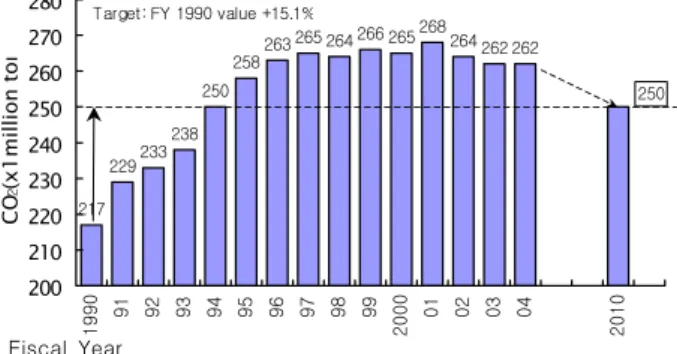
Protecting the environment from global warming is a very important issue. Recently, the regulations for green- house gas emission have been becoming increasingly strict. For example, the Japanese Government officially announced the plan, in which the fuel consumption of gas- oline-fueled automobiles should be reduced by approx- imately 20% by fiscal year 2010 as shown in Fig. 1.1) Automobile manufacturers are therefore making great ef- forts to improve fuel economy, which leads to reducing CO2 emission. One of the most efficient methods of im- proving fuel economy is weight reduction of a vehicle body. On the other hand, the regulations regarding crash- worthiness have also been strict2) so that additional re-
217 229233
238 250
258
263 265 264266 265268 264 262 262
250
200 210 220 230 240 250 260 270 280
1990 91 92 93 94 95 96 97 98 99 2000 01 02 03 04 2010
CO2(x1million ton
Target: FY 1990 value +15.1%
Fiscal Year
Fig. 1. CO2 emission of transport group in Japan.
inforcement may be required, resulting in heavy weight.
To achieve both weight reduction and crash safety, the application of ultra-high strength steel is essential. Several types of ultra-high strength cold rolled and galvannealed steel sheets with a tensile strength of 980 MPa have been developed3),4) and are being applied to automobile parts.4) To obtain more reduction in weight of a vehicle body, it might be useful to obtain a higher range of tensile strength, which leads to more applications of ultra-high strength steel sheets to a wide variety of car components.
In this study, ultra-high strength galvannealed steel sheets with a tensile strength of 1180 MPa were developed.
Various characteristics of newly developed steel are introduced.
2. Experimental procedure
2.1 Manufacturing materials
Galvannealed steel sheets in this study were produced with a thickness of 1.6 mm using industrial production processes, such as a continuous galvannealed process line.
The main compositions of galvannealed steel sheets are carbon and manganese, with wettability in mind. The coat- ing weight of galvannealed steel sheets used in this work was controlled to approximately 40 g/m2.
Certain properties were measured and analyzed as fol- lows:
1) Mechanical properties; tensile tests 2) Spot weldability; joint strength tests
3) Adhesive resistance of coatings; V-bend tests
DEVELOPMENT OF ULTRA-HIGH STRENGTH GALVANNEALED STEEL SHEETS
CORROSION SCIENCE AND TECHNOLOGY Vol.9, No.1, 2010 17 4) Crashworthiness; weight drop tests
2.2 Mechanical properties
Tensile tests were performed under JIS (Japanese Industry Standard, Z 2201).
2.3 Spot weldability
Weldability was evaluated in terms of joint strength and the available welding current ranges were decided as follows. The lower limit of the welding current value was defined as a current for which the weld diameter was equal to four times the square root of the sheet thickness. On the other hand, the upper limit of the welding current value was defined as the maximum current in the current range with no expulsion. Joint strengths were measured using both tensile shear and cross tension tests. The developed steel sheets were compared with other conventional ul- tra-high strength steel sheets with a tensile strength of 980 MPa.
2.4 Adhesive resistance of coatings
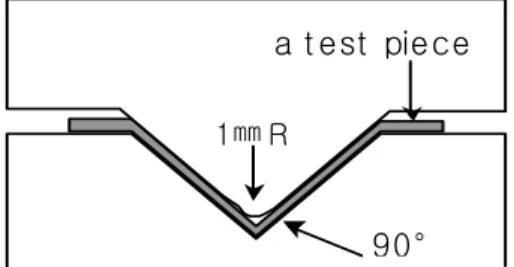
Adhesive resistance of coatings was evaluated by V-bend tests shown in Fig. 2, where specimens were bent using a V-shaped punch at an angle of 90 degrees. When the punch was forced, metal powders were peeled from the surface of the specimen. After applying cellophane tape to the compressive surface of the specimen, the metal powders on the cellophane tape were dissolved in 5% HCl solution. The amounts of metal powders (Zn and Fe) were quantified by Inductively Coupled Plasma spectroscopy and their sum was regarded as the amount of powdering.
X-ray diffraction of each of the coatings was also per- formed for quantitative analysis for the Γ phase (Fe3Zn10), which would influence the adhesive resistance of coatings.
The adhesive resistance of newly developed steels was compared with conventional galvannealed steel sheets with tensile strengths ranging from 270 MPa to 980 MPa.
2.5 Crashworthiness
To evaluate crashworthiness, a drop test shown in Fig.
3 was performed. Specimens had a square cross section
90°
a t est piece
1㎜ R
Fig. 2. Schematic illustration of the V-bend test.
145-160 kgf
Sample Load cell
5-9 m
Distance mesurement
Fig. 3. Schematic illustration of drop weight test.
of 70 mm x 50 mm with spot-welded flanges. The tests were performed under conditions where weights were be- tween 145 kgf and 160 kgf and heights were between 5 m and 9 m. The absorbed energies were measured in bend- ing crash modes considering general usage of ultra-high strength steel sheets. Displacements and loads during crash were measured using laser distance measurements and load cells, respectively. The absorbed energies were obtained at a crash displacement of 100 mm.
3. Results
3.1 Mechanical properties
Table 1 shows the mechanical properties of ultra-high strength steel sheets. The combination of tensile strength and elongation and yield ration for newly developed gal- vannealed steel sheets is comparable to conventional ultra high strength steel sheets with a tensile strength of 980 MPa. In this work, microstructure, which would influence mechanical properties, has been controlled as finely and homogenously as possible. As a result, newly developed steel had a good combination of mechanical properties.
3.2 Spot weldability
Fig. 4 shows the relation between the tensile strength and spot-weld joint strength of ultra-high strength steel
Table 1. Mechanical properties of ultra-high strength steel sheets steel
YP/MPa TS/Ma El/%
Newly developed galvannealed
steel 777 1199 13
Cold-rolled steel
with tensile strength of 980 MPa 624 1009 17 Galvannealed steel
with tensile strength of 980 MPa 640 1030 16
NOBUHIRO FUJITA, KEN-ICHIRO MATSUMURA, TOSHIKI NONAKA, AND TOSHIMASA TOMOKIYO
18 CORROSION SCIENCE AND TECHNOLOGY Vol.9, No.1, 2010
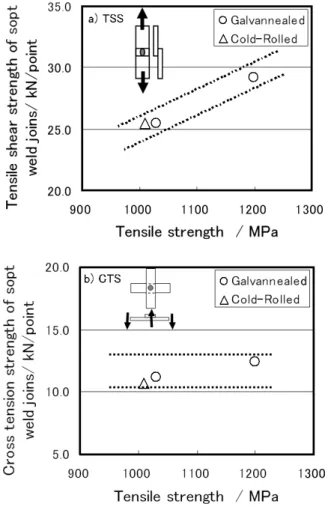
Fig. 4. Relationship between tensile strength and spot weld joint strength of ultra-high strength steel sheets.
sheets with tensile strengths ranging from 980 to 1180 MPa. As the sheet strength increases, the tensile shear strength of the spot-weld joint increases, while the cross tension strength remains almost unchanged. This is a gen- eral phenomenon for high strength steel sheets.5) All the joints fail, not in the weld area but in the base metal of the sheets.
3.3 Adhesive resistance of coatings
Fig. 5 shows the relationship between the Fe content of coatings and amount of powdering. Adhesive resistance of developed steels tends to show the same behaviour as conventional steels with tensile strengths ranging from 270 MPa to 980 MPa. The higher the Fe content, the greater the amount of powdering in all cases.
The relationship between the Fe content and X-ray dif- fraction intensity of the Γ phase (Fe3Zn10) was also inve- stigated. It was found that the diffraction intensity of the Γ phase became higher as the Fe contents increased. This implies that the growth of a hard and fragile Γ phase caus- es adhesive resistance of coatings to deteriorate. This is
0 2 4 6 8 10 12 14
0 5 10 15
Fe content / mass%
Amount of powdering (×10mg)
270MPa 440MPa 980MPa
1180MPa (Developed)
Fig. 5. Relationship between Fe content of coatings and amount of powdering of steel sheets.
0 500 1000 1500 2000 2500 3000 3500
0 500 1000 1500
TS / MPa
Energy absorbed at 100 mm / J
Fig. 6. Changes in the absorbed energies of galvannealed steel sheets with tensile strength evaluated by bending mode drop tests.
a general phenomenon affecting galvannealed steel sheets6) and it thus shows that developed galvannealed ultra-high strength steel sheets have adhesive resistance of coating behaviour equivalent to those of conventional galvan- nealed steel sheets.
3.4 Crashworthiness
Fig. 6 shows changes in the absorbed energies for gal- vannealed steel sheets with tensile strength evaluated by drop tests for bending crash mode. Even when the tensile strength increases up to 1180 MPa, the absorbed energies, measured at 100 mm displacement, increase in proportion to the sheet tensile strength. Furthermore, no failures at spot-welded points in the specimens were found after collision.
According to this increase in absorbed energy, the appli- cation of ultra-high strength steel sheets can be very useful
DEVELOPMENT OF ULTRA-HIGH STRENGTH GALVANNEALED STEEL SHEETS
CORROSION SCIENCE AND TECHNOLOGY Vol.9, No.1, 2010 19 in reducing the thickness of reinforcement parts.
4. Summary
In this study, ultra-high strength galvannealed steel sheets with a tensile strength of 1180 MPa were developed and their performances were evaluated as follows.
1) Comparable mechanical properties and weldability, such as a good combination between tensile strength and elongation and spot-weld joint strength, to conventional galvannealed ultra-high strength steel sheets.
2) The same adhesive resistance as those of conven- tional galvannealed steel sheets
3) Absorbed energy increase corresponding to ultra-high strength
Applications of the developed ultra-high strength gal-
vannealed steel sheets can therefore contribute to both weight reduction and improvement of crashworthiness for a vehicle body.
References
1. The Japan Automobile Manufacturers’ Association, http://www.jama.or.jp
2. Euro N Cap, http://www.eurocap.com
3. N. Fujita, T. Nonaka, T. Tomokiyo, H. Taniguchi, K.
Goto, and K. Yamazaki, SAE 2007-01-0341
4. K. Shiozaki, K. Takagi, N. Yoshinaga, Y. Sakuma, and S. Hiwatashi, JSAE proceedings, p. 5535 (2004).
5. H. Oikawa, T. Kasuya, and T. Tomokiyo, Welding Technology, 56, 157 (2008).
6. Y. Suzuki, Y. Sugimoto, and S. Fujita, J. Sur. Finish.
Soc. Jpn., 58, 183 (2007).