INTRODUCTION
The medical institutions in Korea have recently been endeavoring to cope with the changing environment by providing the patient-centered services. In this atmos- phere, the expectation and the demand on nursing are steadily increasing, in particular on the ability of head nurses who manage the nursing units. As the leaders of nursing units, head nurses have a direct influence on the quality and the productivity of nursing. They integrate clinical and managerial functions, and apply the missions and policies of the hospital to their practices (Perra, 2000). Poor management abilities of head nurses in the general hospitals may cause head nurses to low motiva- tion, low productivity, unnecessary conflict, job dissatis- faction, and demoralization of staff nurses, and may de- crease in the quality of patient care.
Therefore, studies that give basic information to devel-
op programs that facilitate role adaptation of head nurses are needed. However, the role adaptation process of head nurse has not been fully examined in the past in Korea. This study was conducted to explore the experi- ence of head nurses in the general hospitals to suggest useful information for establishing role adaptation pro- grams for head nurses. The purpose of this study is to identify the role adaptation process experienced by head nurses in the general hospitals in Korea.
LITERATURE REVIEW
A symbolic interactionism, which was developed by the social philosopher Mead (1934), is the conceptual framework of the grounded theory. Mead (1934) was in- terested in the problems of interaction and, in seeking human nature; he examined processes associated with adaptation to change and finding a “social niche.” From this he developed the notion of assuming a “role” in
The Role Adaptation Process of Head Nurses in the General Hospitals
Sung Rye Kang, RN, PhD
1. Researcher, Research Institution of Nursing College, Seoul National University
Corresponding author: Sung Rye Kang, RN, PhD, Researcher, Research Institution of Nursing College, Seoul National University, 204, Old-Building, 28, Yengon-dong, Chongro-gu, Seoul 110-799, Korea.
Tel. 82-2-740-8459 Fax: 82-2-745-0617 E-mail: [email protected] .kr Received July 16, 2004 ; Accepted December 8, 2004January 31, 2000
Purpose. The purpose of this study is to identify the role adaptation process experienced by head nurses.
Methods. Data were collected from 10 head nurses with in-depth interviews about their actual experiences. All the interviews were recorded and transcribed. The collected data were analyzed by the grounded theory methodology of Strauss and Corbin.
Results. The core category was identified as “weighing and balancing,” and the role adaptation process was divided into six stages by time sequence: inquiring, approaching to others, bringing people into their fold, working with conviction, avoiding conflicts, and settling.
Conclusion. The results of this study yield useful information for top mangers of nursing to identify, by stages, the demands of the head nurses in their role adaptation process. The findings of this study contributes to developing programs that facilitates the head nurses’ role adaptation.
Key Words: Role, Adaptation, Process
which the individual or “self” would be influenced by others.
According to the symbolic interactionsm, people im- bue meaning with experiences gained in interaction and communication through language. Human beings con- stantly evaluate, and act on events based on their inter- pretation of the meaning of daily events. Inherently, hu- man beings determine meaning and value, and evaluate and translate the experiences for personal use into their lives (Watt, 1993). As a result of interaction, individuals adopt role behaviors that are meaningful responses to the situations in which they find themselves.
Symbolic interactionism was frequently used as a con- ceptual framework in the many studies about the role adaptation process of nursing members, because the practice of nursing involves interactions with nursing staffs, their clients, and other medical service providers (Robert, 1993).
Emerging trends in health care have increased the ex- pectations and responsibilities from a head nurse.
Adams (1991) explains that the new head nurse position must include a more global understanding of issues sur- rounding the entire healthcare system. Facing with this change, head nurses are now being challenged to acquire broader administrative skills and leadership.
Responsibilities of head nurses, essentially, are to pro- mote quality of work life and economic management of the nursing units.
Quality of work life can be defined as the promotion of a safe and clean environment, self-direction in one’s own role development, the promotion of collaboration among the health team workers, and empowerment in staff nurses’ ownership of the unit (Kalo & Jutte, 1996).
Economic management involves the establishment, mon- itoring, and maintenance of the capital and operational budgets, and incorporation of human and material re- sources to the assigned areas (Kilo & Jutte, 1996). Egan (1994) notes that head nurse should reflect the shared culture, assumptions, beliefs, values, and norms involved in nursing work.
As mentioned above, the roles of head nurses have be- come complicated and multi-dimensioned. Head nurses struggle to adapt to the role transition. Most theories of psychological development address the concept of tran- sition as a necessary part of psychological growth (Erikson, 1963; Golan, 1981, p. 5). Transition has been aptly described as “turning point” (Mercer, Nichols, &
Doyle, 1989, p. 2). Change in one’s work or career situa-
tion can be the important transitions. Professional devel- opment is a critical transitional stage in life for many head nurses.
Benner (1986) provides guidelines in viewing the process of the professional development of nurses, in- cluding levels of development. On a continuum from novice to expert, “advanced beginner”, “competent”, and “proficient”, Benner’s stages of professional devel- opment are applied to nurses, as well as to other health care professionals. It is clear that in the early stages of development, novice professionals lack the experience, so that appropriate mentorship and consultation is vital to the new professionals in obtaining this critical experi- ence.
As stated above, symbolic interactionism and role the- ories can lead this study to be fit for the purpose of the study that is to identify the role adaptation process of head nurses as conceptual framework. Head nurses ad- justed to their new roles in relationships with their meaning persons, so symbolic interactionism gives a new prospect to the study. And also role theories can give useful information to identify the new roles of head nurse.
METHODS
Research Design
Grounded theory was selected because of its potential to address the patterns of behaviors within and between members of a particular social group. Also grounded theory is based on symbolic interactionism, which em- phasizes how people view their circumstances, how they interact, and how these process change. Grounded theo- ry is an inductive method used to generate a theoretical framework based on the themes that emerge from the study(Strauss & Corbin, 1991). This study aimed to identify particular behavior patterns in role adaptation process of head nurses. Also the purpose of this study was to explore how they view their work environment, how they interact with their meaningful persons, and how the context change by laps of time in role adapta- tion process of head nurses. As such, this method allows the required flexibility for the nature of this study.
Preparation of Research
The author completed nursing qualitative methodolo- gy for two semesters during doctoral course. Also the author took part in the study group which aimed to
study nursing qualitative research skills with nursing pro- fessors and students of nursing graduate school for two years. Before this study, the author performed two quali- tative studies and the pilot study about the same title of this study with three participants.
Participants
Ten participants were recruited from six general hospi- tals in Seoul and two local cities. The hospitals selected on the basis of general hospital with more than 500 beds, and help was given by the director of nursing de- partment to recruit participants. The author requested to introduce head nurses who less than 2 years as head nurse. Through pilot study, the author found that partici- pants did not have full experience of the role adaptation process until the second year of head nurse because they were still in the process of adaptation. The nursing direc- tors introduced 18 head nurses, and then 10 were cho- sen who agreed to participate interview voluntarily. All of them were female. The median age was 40; 7were married; 2 were Catholics and 3 Protestants, and 5 athe- ists. Four of them had master’s degree of nursing.
Ethical Considerations
Before the study, the author explained to each partici- pant the purpose and progress of the study. They were informed that all data obtained from them would be on- ly used for the study on condition of anonymity. And al- so, they were informed and assured that no adverse con- sequences would follow if they decided against partic- ipation, or at any point during participation if they wished to discontinue the study. Voluntarily, informed and signed consent was obtained from each participant several weeks in advance of the planned data collection.
Research Questions
Can you express the characteristics of your role as a head nurse?
When you were promoted to head nurse, how did you feel about your new job and work place?
Who are the important or meaningful persons in your job as a head nurse?
Can you express about human relationships with others, such as superiors, colleagues, staff nurses, physicians, patients, and their family?
What are the supportive factors in your job?
What are the obstacles in your job?
Can you express your values and beliefs on nursing
as a head nurse?
Do you have special strategies to accomplish your role as a head nurse?
Data Collection
Data were collected from in-depth interviews conduct- ed from April 25, 2002 to Feb. 25, 2003. Several re- search questions were given to participants in the inter- view to extract the experience of participants in their role adaptation process. Each interview lasted over 60 minutes and each participant was interviewed on more than two occasions. All descriptions given by partici- pants in the interview were recorded, and then tran- scribed.
Data Analysis
The contents were analyzed using the method of Strauss and Corbin (1991). It is a comparative method of analysis that uses three major types of coding: open, axi- al, and selective. In this method comparisons on the sim- ilarity and differences between the first and next inter- views and the interview of one participant from another were constantly made.
In open coding, conceptual labels were attached to scattered happenings, events, and other instances of phe- nomena that were collected from in-depth interviews of participants. Codes, themes, and components of the role adaptation process were then extracted from findings in open coding.
In axial coding, a set of procedures was performed, where data were put back together in new ways after open coding, by making connections between compo- nents. This was done by utilizing a coding paradigm that involves conditions, context, action / interaction strate- gies, and consequences.
In selective coding, the core category of this study was extracted as BSP(basic social - psychological process), which was the most basic behavioral pattern in head nurse’s role adaptation. A diagram that shows connec- tions between categories has been drawn in the final stage.
Rigor
The criteria of credibility, applicability, consistency, and neutrality by Sandelowski (1986) were used to en- hance the trustworthiness of the study. For credibility, the transcription of interviews and first analyzed data (open codes) were sent to each participant to confirm
that data show exactly their intents and meanings. Nine out of ten answered that data fully showed their intents and meanings. One of them corrected very small part of data. Efforts were made to meet applicability by having interviews until fully saturated data from the partici- pants. And, in order to enhance the consistency, two persons who received doctorate in nursing and used grounded theory in their dissertation audited the results of the study. For neutrality, the author tried to keep ob- jective attitude without prejudice about participants as well as their experiences.
RESULTS
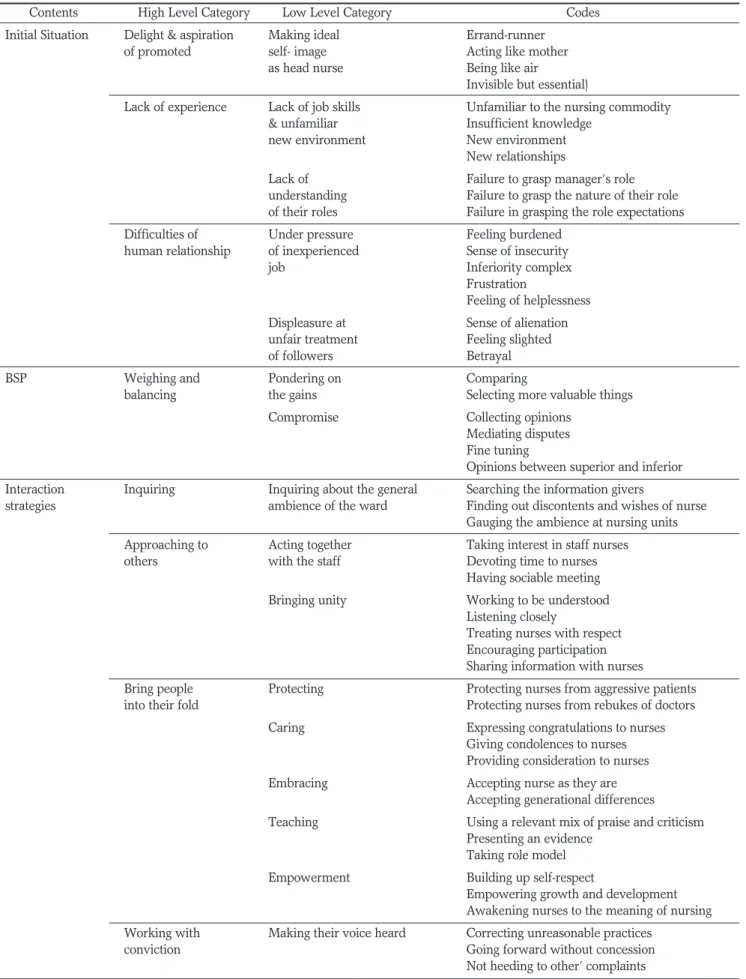
Through open coding of the interviews with the partic- ipants, 100 codes were extracted, from which derived the 32 low level categories and that in turn, produced the 14 high level categories (Table 1). In axial coding, 32 low level categories were connected by utilizing a para- digm of Strauss and Corbin (1991). Among 14 high level categories, 6 categories which were belonged to interac- tion strategies, as major part of the study were addressed as follows.
Inquiring
Participants concentrated their efforts to grasp the real situation of their nursing units by informal way. They chose privately the information givers who were their trust among nursing staffs, and picked up information from them. Participant A and E expressed that point of view as follows:
“If I fail grasp the real situation of nursing unit, I am a head nurse only in name. I really want to know what happened in nursing unite, especially after my leaving the office.”
“I made a information giver. Sometimes I thought she was my spy, but it was necessary for controlling my staffs.”
Approaching to others
Participants focused their efforts to grow intimate with their staffs. They intentionally made opportunities to get along with their staffs in private. And also they respect- ed their staffs and treated their staffs with warmth.
Participant C and I expressed that point of view as fol- lows:
“Sometimes I invited my staffs to my house. I cooked special dishes for them. Eating, chattering, laughing....I
spent time to close with them.”
“I frequently had interview with staffs. I said them...
how is going, do you have any problem, if you need my help, tell me. I would like to be a help to you.”
Bring people into their fold
Participants exerted themselves to bring their staffs in to their fold. For this purpose, they made a favorable im- pression on their staffs. They actively tried to take part in the staffs’ personal affairs such as a wedding and a fu- neral ceremony. And also they tried to protect their staffs from aggressive patients and rebukes from doctors.
Participant B and H described about that as follows:
“If I did not care them, they did not follow me hearti- ly. I would like to attend my staffs’ wedding ceremonies and funeral ceremonies of their parents. It was very im- portant job to me as head nurse.”
“If my staff got an undeserved scolding from physi- cian or patient. I used myself as a shield of my staffs. If I want to bring my staffs into my fold, I must protect my staffs from an unfair treatment.”
Working with Conviction
Participants tried to assert their opinions, and demon- strated their full abilities. They attempted to raised their voice by reflect their belief in their work. Participant D and J expressed that point of view as follows:
“In my experience, head nurse seems the householder of nursing unit. Sometimes I must lead my staffs and manage my nursing unit with strong sense of duty. I did my job according to my own judgment and belief.”
“Several months ago, I suggested to my superior lay- off of a nurse who continuously cause a dispute with patients, physicians, other nurses. I admonished her to correct her bad attitudes. But she did not here me. I had to cut off her to rescue the other one. I was just like sur- geon who cut off unwell part of body to restore a per- son to life.”
Avoiding Conflicts
Participants showed a tendency to flee from the con- flicts with doctors, superiors, and/or patients who had aggressive and authoritarian manner. Head nurses showed withdrawal, indifference, endurance, putting a distance, and closing the doors on their mind. Participant I and G described about that as follows:
“I requested to my superior one more staff because patients steadily increased in my unit. But she did not
Table 1. Codes, Low and High Level Categories
Contents High Level Category Low Level Category Codes
Initial Situation Delight & aspiration Making ideal Errand-runner
of promoted self- image Acting like mother
as head nurse Being like air
Invisible but essential)
Lack of experience Lack of job skills Unfamiliar to the nursing commodity
& unfamiliar Insufficient knowledge
new environment New environment
New relationships
Lack of Failure to grasp manager’s role
understanding Failure to grasp the nature of their role of their roles Failure in grasping the role expectations
Difficulties of Under pressure Feeling burdened
human relationship of inexperienced Sense of insecurity
job Inferiority complex
Frustration
Feeling of helplessness
Displeasure at Sense of alienation
unfair treatment Feeling slighted
of followers Betrayal
BSP Weighing and Pondering on Comparing
balancing the gains Selecting more valuable things
Compromise Collecting opinions
Mediating disputes Fine tuning
Opinions between superior and inferior Interaction Inquiring Inquiring about the general Searching the information givers
strategies ambience of the ward Finding out discontents and wishes of nurse
Gauging the ambience at nursing units Approaching to Acting together Taking interest in staff nurses
others with the staff Devoting time to nurses
Having sociable meeting Bringing unity Working to be understood
Listening closely
Treating nurses with respect Encouraging participation Sharing information with nurses
Bring people Protecting Protecting nurses from aggressive patients
into their fold Protecting nurses from rebukes of doctors
Caring Expressing congratulations to nurses
Giving condolences to nurses Providing consideration to nurses
Embracing Accepting nurse as they are
Accepting generational differences Teaching Using a relevant mix of praise and criticism
Presenting an evidence Taking role model
Empowerment Building up self-respect
Empowering growth and development Awakening nurses to the meaning of nursing Working with Making their voice heard Correcting unreasonable practices
conviction Going forward without concession
Not heeding to other’ complaints
Table 1(cont.). Codes, Low and High Level Categories
Contents High Level Category Low Level Category Codes
Setting guidelines for work Provide general outline of the work Giving autonomy with the details Reduce the nurses’ Making understand nursing needs
resistance to change Reducing resistance to change
Avoiding conflicts Abandoning Withdrawing
Indifference Endurance Putting a distance
Closing the doors of their mind
Settling Capitalizing on Frankness
one’s strong points Listening closely Optimistic attitude Being at ease with others
Accomplishing one’s Understanding deeply life and death with
own growth relationship with patients
Reflecting the meaning of life Learning the rules Increase intimate feeling
of life Giving and taking help with superior
Keeping neutral and living together Connecting facts Supporting facts Family support Taking comfort from family
Receiving help in housework and child-care Encouragement of colleague Advice and encouragement of colleague
Appreciation and cooperation of staffs
Good feelings watching the staff nurses’ growth Winning recognition Praise and encouragement of superior
from the superior Receiving understands on difficulties Winning patients’ trusts Seeing a patient who is healed
Gaining a patient’s full trust Understanding values of nursing A sense of calling and service Obstacles Pressures from the various Total engagement on the job
demands and heavy Taking responsibility for all aspects workload from the job Pressures from possible nursing accidents
Pressures from possible turnover of nurses Difficulties from various role expectations Feeling of Interference and pressure of doctors
powerlessness Insufficient cooperation of other departments due to insufficient One-sided instruction of superiors
authority Having one’s proposal ignored
Disappointment in Increase in odd jobs
inappropriate respect Losing pride due to low social status due to their positions Low level of salary
Role adaptation Advancing Improving nursing Raising level of nursing
quality Enhancing patients’ satisfactions
Evaluating nursing performance Challenging to new nursing needs Keeping security Making satisfactory Making comfortable workplace
working environment Providing sufficient nursing commodity Providing sufficient human resources Making the atmosphere in the ward warmer
listen to me and refused with cold manner. At that time, I made up my mind that I never request anything to her.”
“I was quarreling with a doctor. He roared and threw something to me with anger in front of my staffs and patients. I felt shame without my fault. I have endued their maltreatment since this happening.”
Settling
Participants learned a way to deeply reflect, and ac- cept the meaning of life through their relationship with patients. Although the difficulties and troubles remain in their lives, they mastered a way to accept these as part of their lives. Participant F expressed that point of view as follows:
“When I was toilsome, I went to see patients. I learned how to control my hardship from them. They fight bravely against their disease and accept peacefully their misfortune. They are my teacher of life.”
The paradigm of the role adaptation process
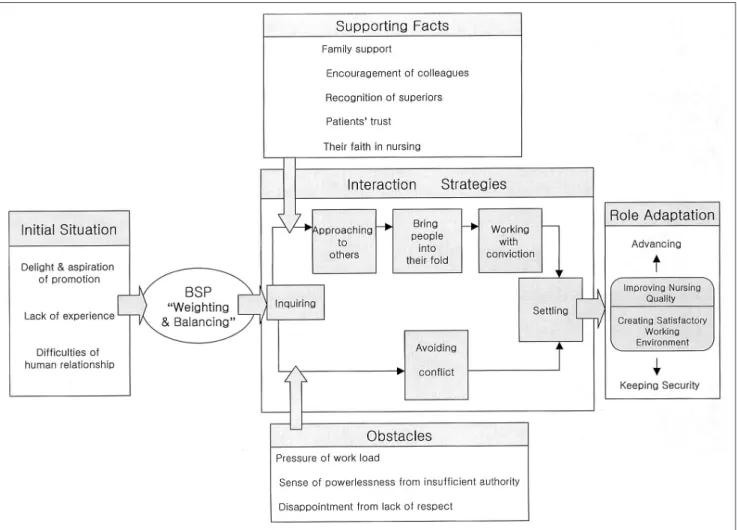
The paradigm of the adaptation process of head nurses was formed by the series of initial situation, basic social - psychological behavior, supporting facts, obstacles, in- teraction strategies, and role adaptation (Figure 1).
In the initial situation, head nurses were delighted in joy of being promoted and their aspirations ran high. In this stage, they aimed to become a kind of errand-run- ner, mother, and air(invisible but essential). However, they faced great difficulties at a same time. They were not fully respected by their staff nurses because of their lack of experience as head nurses. And also they felt the pressures from the new position and the uneasiness in their jobs.
In the initial situation, head nurses who had many dif- ficulties showed a certain behavior pattern:” weighing and balancing” as strategy in order to adapt to their new role. This behavior pattern was basic social- psychologi- cal behavior (BSP) of the role adaptation process. The words of “weighing and balancing” showed that head
Figure 1.The paradigm of the role adaptation process of head nurse.
nurses were seen constantly measuring the gains against the losses without tilting toward to one side.
BSP of the role adaptation process, “weighing and bal- ancing” was expressed into six interaction strategies such as inquiring, approaching to others, bringing people into their fold, working with conviction, avoiding con- flicts, and settling. Inquiring was firstly shown among in- teraction strategies. At this stage, head nurses would qui- etly observe the situation of nursing unit. Head nurses with great anxiety due to unfamiliar environment of their new work place have sought for an information- giver who gave them information about what the actual atmosphere on the units was, how staff nurses appraised on their head nurses, and what staff nurses really expect- ed from their head nurse.
At this point, the important things, which influenced on head nurses’ strategic behavior, “weighing and bal- ancing”, were supporting facts and obstacles. The sup- porting facts that influence role adaptation of head nurs- es were family support, encouragement by their col- leagues, recognition from superiors, patients’ trust on them, and their faith in nursing. Obstacles were pres- sures coming from workload, sense of powerlessness, and disappointment from the lack of respect from peo- ple around them.
Head nurses used positive interaction strategies such as approaching to others, bringing people into their fold, and working with conviction, when they took more sup- porting facts. In approaching others, the head nurses made efforts to build good relationships with their staffs.
Head nurses would attempt to empathize with their staffs, to increase both personal and formal contacts with staff nurses, and to encourage the staffs to take part in decision-making.
In bring people to their fold, the head nurses actively tried to take part in the staffs’ personal affairs. Thus, head nurses would freely express their mourning or con- gratulations to the staffs. And also they tried to protect their staffs from aggressive patients and rebukes from doctors. They tried to get their staffs to their sides by us- ing the “carrot and whip” measure in which they intend- ed to reduce staffs’ resistance and to increase effect of discipline.
In working with conviction, head nurses tried to assert their opinions, and demonstrated their full abilities. In this stage, head nurses attempted to reflect their belief in their work, gave more autonomy to their staffs, empha- sized patient centered nursing, and corrected unreason-
able past practices. If needed, they would drive out a person who was the seed of dispute from their ward.
They identified themselves as a surgeon to scrape out an affected part of body.
On the other hand, head nurses used negative and pas- sive interaction strategies such as avoiding conflicts when they faced overwhelming difficulties and obstacles. In avoiding conflict, head nurses showed a tendency to flee from the conflicts with doctors, superiors, and/or pa- tients who had aggressive and authoritarian manner.
Head nurses showed withdrawal, indifference, en- durance, putting a distance, and closing the doors on their mind.
Settling was the last stage of interaction strategy. In this stage, head nurses arrived at a stable position by dis- covering the wisdom of life and learning the law of sur- vival that allows them to rise to the various roles expec- tations. They learned a way to deeply reflect, and accept the meaning of life through their relationship with pa- tients. Although the difficulties and troubles remain in their lives, they mastered a way to accept these as part of their lives. They also learned how to manage their en- ergy appropriately for the accomplishment of their roles.
How they viewed themselves in the role adaptation was from “advancing” to “keeping security” according to their subjective assessments. “Advancing” refers to actively searching and pursuing their new roles. In
“advancing,” head nurses were seen struggling to im- prove quality of nursing through raising level of nursing, evaluating performance of nursing, enhancing patients’
satisfactions, and challenging to new nursing needs.
“Keeping security” refers to maintaining the status quo and trying not to rock the boat. In “keeping securi- ty”, head nurses put efforts of making satisfactory job environment by creating comfortable workplace, provid- ing sufficient nursing material and human resources, and by making warmer the atmosphere in the ward.
Head nurses perceived that both “advancing” and
“keeping security” were very important things as the re- sults of their role adaptation process. Thus head nurses tried to fulfill both of them in the role adaptation process.
The core category: “Weighing and Balancing”
In the selective coding, the most basic behavioral pat- tern was found by putting together all codes, low level categories, and high level categories and considering the conditions, interactions, and context. The head nurses
were shown to use this particular behavior “weighing and balancing” as their major strategy in adjusting to their roles. The behavior is interpreted as comparing one thing from another, in order to maximize the gains and minimize the losses. They used this core coping strategy against the backdrop of various relationships. And also, head nurses tried to keep their balance without bias in the implementation of their roles.
Firstly, head nurses struggled to overcome conflict prompted by collision between their values and their su- periors’ by using the “weighing and balancing” strategy.
In this case head nurses calculated the profits and losses, if they give up their values and comply with their superi- ors’ or they act up to their opinions. Finally they chose the way that maximize the gains and minimize the loss- es. For example a participant agreed to a labor union, however she gave up her opinion and persuaded her staffs to leave labor union as superior’s demand. She wanted to take good marks in appraisal. Participant E expressed that point of view as follows:
“In performance appraisal, of head nurse head nurses who persuaded staff nurses not to participate in the la- bor union activities received good marks. Although I supported their labor union activities from the bottom of my heart, I have to give pressure on staff nurses not to participate the labor union, my value on labor union is different from my superiors, I, however, followed them in exchange for receiving good marks.”
Secondly, head nurses were seen to do the “weighing and balancing” when their work styles was different from their predecessor’s. Participants tried to calculate their strong and weak points by the comparison their own work style and their predecessor’s. And also they were tuning their work style to their own capacity. In this case, participants showed particular behavior that they demonstrate their style was better than their prede- cessor’s. Participant B expressed that point of view as follows:
“My predecessor made full rounding of patients twice a day and gave her hands to staff nurses. I however, do not think these are important. The most important thing for head nurses is to empower the staff nurses to do their best.”
Lastly, head nurses used the “weighing and balancing”
strategy to control their staffs in their own way. They in- tended to reduce staffs’ resistance and to increase effect of discipline by the “carrot and whip” measure. They discerned that who need a word of praise what is called
“carrot” or who need a scolding what is called “whip.”
In this way, they tried to harmonize a stern leader with a kind leader. Participant A said as follows:
“Do you know a word of carrot and whip? I think an excellent leader is who can use wisely carrot and whip for their belonged persons. I tried to give a warm heart to encourage my staff, but I never overlook a careless mistake of my staffs. I treated them cruelly to correct their careless mistake.”
In using “weighing and balancing”, head nurses have shown two different aspects, positive and negative.
When they used positively “weighing and balancing,” it is related to the interaction strategies such as “approach- ing to others,” “bringing people into their fold,” and
“working with conviction.” By using these positive strategies, head nurses increased both personal and for- mal contacts with staff nurses, and encouraged the staffs to take part in decision-making. And they protected their staffs from aggressive patients and rebukes from the doctors, and succeeded in reducing staffs’ resistance.
They also increased effects of discipline, and acted up to their opinions, and demonstrated their full capacity.
On the other hand, when head nurses used “weighing and balancing” negatively, it was related to the interac- tion strategy, “avoiding conflicts.” By using this negative strategy, head nurses showed a tendency to flee from conflicts with doctors, superiors, and patients who had aggressive and authoritarian manner. Head nurses showed withdrawal, indifference, endurance, putting a distance, and closing the doors on their mind.
Finally, for head nurses, “weighing and balancing” was the best way in which they tuned their values, hopes, and needs with other’s for the sake of harmonious co-ex- istence. In this way, they were able to arrive at their final destination: role adaptation.
DISCUSSION
At the early stage of the role adaptation process, in spite of delight and aspiration, head nurses experienced difficulties because of the lack of experience and knowl- edge on their new role. Amos (2001) stated that head nurse, who did not understand their role and job fully, lost the whole view of the work, and carried out their job in an imperfect way. Therefore, especially in the ear- ly stage of the role adaptation process, the well planned personnel management and well-organized educational program for job training education are required for head
nurses.
In the long journey of role adaptation, head nurses were shown to use the “weighing and balancing” strate- gy as their basic social - psychological behavior pattern in which they would compare one thing from another, in order to maximize the gains and minimize the losses.
And also they used “weighing and balancing “ to co-ex- ist harmoniously with people around them by tuning their values, hopes, and needs to other’s.
In using “weighing and balancing”, head nurses have shown two different aspects, positive and negative.
When they used positively “weighing and balancing,” it is related to the interaction strategies such as “approach- ing to others,” “bringing people into their fold,” and
“working with conviction.”
On the other hand, when head nurses used “weighing and balancing” negatively, it was related to the interac- tion strategy, “avoiding conflicts.”
As was reported by Schroeder and Worrall (2002), head nurses expressed two different coping attitudes for their stress; active and passive. Active coping attitude was manifested in taking challenge, advancing forward, and taking initiative. Passive coping attitude was shown in withdrawal, giving up their opinions, and accepting others unpleasantly. Therefore, the program, which re- spectively converts negative and passive coping attitudes to positive and active coping attitude, is needed in the role adaptation process of head nurses. In addition, the program, which maintains the positive and active atti- tudes, is also needed.
In this study, we observed that the supporting facts and obstacles had influenced on using interaction strategies by head nurses in their role adaptation process. Head nurses increasingly used positive interaction strategies by supporting facts such as family support, encouragement by colleagues, recognition by superiors, and patients’
trust on them.
On the other hand, head nurses more used negative in- teraction strategy by obstacles such as pressures of work load, sense of powerlessness, and disappointment from the lack of respect from people around them, due to the power imbalance in organization, the authoritarian at- mosphere of the nursing department, and the policy of hospitals to attract customers paying little attention to the quality of services.
Corbett (1991) reported that head nurses easily lost creativity and autonomy on their job when they had painful experience from hierarchical and authoritative
organizational environment of hospital. Ballein (1997) said that head nurses had difficulties, when they were not given the proper autonomy and authority to per- form their roles. Thus, the director of nursing depart- ment should consider these supporting facts and obsta- cles in order to make successful adaptation by their head nurses.
How they viewed themselves in the role adaptation was from “advancing” to “keeping security” according to their subjective assessments. “Advancing” refers to actively searching and pursuing their new roles. “Keep- ing security” refers to maintaining the status quo and trying not to rock the boat. In “keeping security”, head nurses put efforts of making satisfactory job environ- ment. Head nurses perceived that both “advancing” and
“keeping security” were very important things as the re- sults of their role adaptation process. Thus head nurses tried to fulfill both of them in the role adaptation process.
At this point, head nurses strongly identified their main role as mediators. Head nurses mediated quarrels between their staff nurses and doctors, patients, and oth- er providers of services. And they also tuned opinions between their staff nurses and superiors. This mediator refers to “integrator” or “coordinator,” which is a key word of nursing management (Gould & Kelly, 2001).
Head nurses, we found, needed the human relationship and communication skills to perform their main role as a mediator. Therefore, director of nursing department should reflect the human relationship and communica- tion skills on the educational programs to make success- ful adaptation of their head nurses.
CONCLUSION
This study was conducted to identify the role adapta- tion process of head nurses. To support role adaptation of head nurses, it was necessary to know what happened actually in the process of role adaptation in advance. For this reason, the qualitative approach was useful for the study. And this study was based on the participants’ ac- tual experiences.
In this study, particular behavior pattern of the role adaptation was extracted as the basic social-psychologi- cal behavior (BSP). Six interaction strategies, inquiring, approaching to others, bringing people into their fold, working with conviction, avoiding conflicts, and settling was identified. The main role, which was perceived by
participants, was also found. The major facts, which in- fluence on role adaptation of head nurses, were extract- ed as supporting facts and obstacles. All of these were connected in real situation and context by initial situa- tion, core category, connecting facts, interaction strategy, and status of role adaptation.
The results of this study provides, we believe, useful information for the directors of nursing department to identify the demands of the head nurses’ role adaptation process. Finally this study contributes to the develop- ment of programs that can facilitate the head nurses’ role adaptation.
To support the role adaptation of head nurses, we need studies to develop policy of the personnel manage- ment and the educational program. We believe the pre- sent study can be utilized for future such studies.
References
Adams, D.(1991). Management Needs Head Nurses and Supervisor; Design Continuing Education Course. J Contin Educ Nurs 2(1), 16-20.
Amos, D.(2001). An evaluation of staff nurse role transition. Nurs Stand 16 (3), 36- 4
Ballein, K .(1997). Enterpreneurial leadership Characteristics of SNEs emerge as their role developments. Nurs Adm Q, 22(2), 60- 69.
Benner P.(1986). From novice to expert. Menlo Park, CA , Addison - Wesley.
Corbett, N.A.S. (1991). Head nurses Perceptions of self derived from an analysis of their conversation. Columbia University Teachers College, Press.
Egan, G. (1994). Cultivate your culture. Manage Today, April 1994, 39-42.
Erikson, E.H.(1963). Childhood and society (2nded.). New York , Free Press.
Golan, N.(1981). Passing through transitions. New York, Free Press.
Gould, D., & Kelly, D. (2001). Clinical nurse managers’ perceptions of factors affecting role performance. Nurs Stand,15(16), 33- 37.
Kalo, B., & Jutte, P. (1996). Head Nurse to Nurse Manger : Easing the Tradition. J Nurs Staff Dev, 12(2), 86-92.
Mead, G.H.(1934). Mind, Self and Society. Chicago, University of Chicago Press.
Mercer, R1.T., Nichols, E.G., & Doyle, G.C. (1989). Traditions in a woman’s life: Major life events in Developmental context.
New York , Springer.
Perra, B. M. (2000). Leadership : the key to quality outcomes. Nurs Adm Q, 24(2),56-61.
Robert, M.C.(1993). Role behavior of nurse case managers.
Doctoral Dissertation. George Mason University.
Sandelowski, M.(1986). The problem of rule in qualitative research.
Adv Nurs Sci, 8(3), 27-37.
Schroeder, M., & Worrall-Carter. L. (2002). Perioperative managers :role stressors and strategies for coping. Contemp Nurse, 13(2), 229-238.
Strauss, A., & Corbin, J. (1991). Basics of qualitative research:
Ground theory procedures and techniques. Newburry Park, Sage Publications.
Watt, S.(1993). The role and preparedness of nurses in manage- ment in the NHS in Scotland Management Development Group, Scotland.