ABSTRACT
Background: Except for data in the Korea Hemophilia Foundation Registry, little is known of the epidemiology of congenital bleeding disorders in Korea.
Methods: Data were obtained from the Korean Health Insurance Review and Assessment Service (HIRA) database.
Results: From 2010 to 2015, there were 2,029 patients with congenital bleeding disorders in the Korean HIRA database: 38% (n = 775) of these patients had hemophilia A (HA), 25%
(n = 517) had von Willebrand disease (vWD), 7% (n = 132) had hemophilia B (HB), and 25%
(n = 513) had less common factor deficiencies. The estimated age-standardized incidence rate (ASR) of HA and HB was 1.78–3.15/100,000 and 0.31–0.51/100,000, respectively. That of vWD was 1.38–1.95/100,000. The estimated ASR of HA showed increase over time though the number of new patients did not increase. Most patients with congenital bleeding disorders were younger than 19 years old (47.8%), and most were registered in Gyeonggi (22.1%) and Seoul (19.2%).
Conclusion: This is the first nationwide population-based study of congenital bleeding disorders in Korea. This study provides data that will enable more accurate estimations of patients with vWD. This information will help advance the comprehensive care of congenital bleeding disorders. We need to continue to obtain more detailed information on patients to improve the management of these diseases.
Keywords: Congenital Bleeding Disorder; Epidemiology; Korea; Nationwide
INTRODUCTION
Congenital bleeding disorders are rare diseases caused by deficiencies of protein cofactors and enzymes involved in blood coagulation.1,2 The most common coagulopathies are von Willebrand disease (vWD), an autosomal inherited bleeding disorder caused by a deficiency or abnormality of von Willebrand factor; hemophilia A (HA); and hemophilia B (HB). HA and HB are X-linked inherited disorders caused by deficiencies of factors VIII and IX, respectively.1
Original Article
Received: Mar 3, 2020 Accepted: Aug 2, 2020 Address for Correspondence:
Jongha Yoo, MD, PhD
Department of Laboratory Medicine, National Health Insurance Service Ilsan Hospital, 100 Ilsan-ro, Ilsandong-gu, Goyang 10444, Republic of Korea.
E-mail: [email protected]
* Present address: Department of Pediatrics, Chungbuk National University Hospital, Cheongju, Korea
© 2020 The Korean Academy of Medical Sciences.
This is an Open Access article distributed under the terms of the Creative Commons Attribution Non-Commercial License (https://
creativecommons.org/licenses/by-nc/4.0/) which permits unrestricted non-commercial use, distribution, and reproduction in any medium, provided the original work is properly cited.
ORCID iDs Hoi Soo Yoon
https://orcid.org/0000-0003-1688-3226 Yujin Han
https://orcid.org/0000-0002-3488-0881 Young Jin Kim
https://orcid.org/0000-0001-8182-2433 Min Jin Kim
https://orcid.org/0000-0003-1645-6101 Ja Min Byun
https://orcid.org/0000-0003-1780-5553
Hoi Soo Yoon ,1 Yujin Han ,2 Young Jin Kim ,2 Min Jin Kim ,3 Ja Min Byun ,4 Taemi Youk ,5 Jae Hee Lee ,6* Tae Sung Park ,2 and Jongha Yoo 7
1Department of Pediatrics, Kyung Hee University School of Medicine, Seoul, Korea
2Department of Laboratory Medicine, Kyung Hee University School of Medicine, Seoul, Korea
3Seegene Medical Foundation, Seoul, Korea
4 Department of Internal Medicine, Seoul National University College of Medicine, National University Hospital, Seoul, Korea
5Research Institute, National Health Insurance Service Ilsan Hospital, Goyang, Korea
6Department of Pediatrics, Chosun University Hospital, Gwangju, Korea
7Department of Laboratory Medicine, National Health Insurance Service Ilsan Hospital, Goyang, Korea
Epidemiology of Congenital Bleeding Disorders: a Nationwide Population- based Korean Study
Oncology & Hematology
Taemi Youk
https://orcid.org/0000-0002-4273-3777 Jae Hee Lee
https://orcid.org/0000-0002-3386-9920 Tae Sung Park
https://orcid.org/0000-0003-4571-2346 Jongha Yoo
https://orcid.org/0000-0002-8294-0543 Disclosure
The authors have no potential conflicts of interest to disclose.
Author Contributions Conceptualization: Park TS, Yoo J.
Methodology: Lee JH. Formal analysis: Yoon HS. Data curation: Youk T. Investigation: Han Y, Kim YJ, Kim MJ, Byun JM. Writing - original draft: Yoon HS. Writing - review & editing: Yoon HS, Lee JH, Park TS, Yoo J.
The Korea Hemophilia Foundation (KHF) publishes an annual report on its patient registry, including patient demographics and data on the utilization of health services.3 However, patients who are not enrolled in the KHF are not properly identified. Some patients are reluctant to register in the KHF for various reasons. Others may not be diagnosed properly.
Therefore, it is difficult to accurately ascertain the number of people with congenital bleeding disorders in Korea. According to the 2018 KHF Annual Report, there were 2,458 registered patients, including 1,889 (77%) with HA, 450 (18%) with HB, and only 136 (5%) with vWD.3 According to the 2018 annual global survey of the World Federation of Hemophilia (WFH), there are 2,423 hemophilia patients in Korea.4 Australia (n = 2,653) and South Africa (n = 2,332), which have similar numbers of hemophilia cases, have 2,146 and 647 vWD patients, respectively. Therefore, some congenital bleeding disorders in Korea might be underestimated.
The epidemiology of congenital bleeding disorders in Korea has not been examined using nationwide population-based data. Therefore, we examined the nationwide incidence of congenital bleeding disorders using the Korean Health Insurance Review and Assessment Service (HIRA) databases.
METHODS
Data source
The National Health Insurance (NHI) is the only public medical insurance system operated by the Ministry for Health, Welfare and Family Affairs in Korea.5,6 The Korean NHI program covers the entire Korean population as a compulsory social insurance system. The HIRA is a government-affiliated organization created to build an accurate claims review and quality assessment system for the NHI.7 The HIRA database is a “fee-for-service” system.
Disease codes used in the database are standardized according to the Korean Classification of Disease, which follows the International Classification of Disease, 10th edition. HIRA databases are open for all investigators with academic purposes. Because the Korean population itself is fairly ethnically homogenous, both the NHI and HIRA databases can be readily used for nationwide analyses. For this study, we utilized information from the HIRA and NHI databases between January 2010 and December 2015. We also used the National Health Insurance Service National Sample Cohort (NHIS-NSC) data for analyzing of population according to residence distribution.
Study population
The study population consisted of patients with congenital bleeding disorders of all ages.
Patients coded as having a diagnosis of congenital bleeding disorder (D660, D670, D680, D681, and D682) from January 2010 to December 2015 were selected. We excluded patients initially diagnosed as having congenital bleeding disorders from January 1, 2005 to December 31, 2009. The reason for excluding patients in this period is that the patients diagnosed before 2010 may have been counted as new patients in 2010. This identified 2,029 patients diagnosed with congenital bleeding disorders between 2010 and 2015.
Statistical analyses
The overall incidence was calculated as the number of patients diagnosed with a congenital bleeding disorder divided by the total number medical beneficiaries in 2010–2015. According to NHI data, the population of Korea was 48,887,027 in 2010 and 51,529,338 in 2015.8 Age- standardized incidence rate (ASR) is defined as weighted average incidence rate of age-
specific rate. The standard population for ASR in our study was obtained from population of the middle of the year (2010–2015) in the Statistics Korea. Ages were grouped as follows: 0–4, 5–9, 10–14, 15–19, 20–24, 70–74, 75–79, 80–84, and ≥ 85 years of age. Descriptive analyses were used to compare children (aged < 19 years) and adults (aged ≥ 19 years). Logistic regression analyses were performed to evaluate incidence rates by age and diagnosis year.
Ethics statement
This study was approved by the Institutional Review Board of the National Health Insurance Service Ilsan Hospital (NHIMC 2019–01–028). Informed consent was waived.
RESULTS
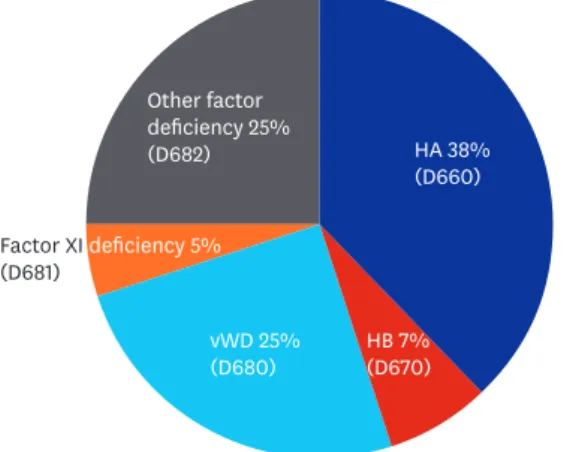
We identified 2,029 patients with congenital bleeding disorders during the 6-year period. The overall incidence of congenital bleeding disorders was 0.78/100,000 person-years. HA was the most frequent disorder with 775 patients identified, accounting for 38% of all patients included between January 2010 and December 2015 (Fig. 1). Although vWD has been widely known as the most common congenital bleeding disorder, only 517 patients with vWD were identified, accounting for 25% of the total number of patients in the 6 years. Patients with HB made up 7%
(n = 132) of the total. Patients with factor XI deficiency accounted for 5% (n = 92) of the total.
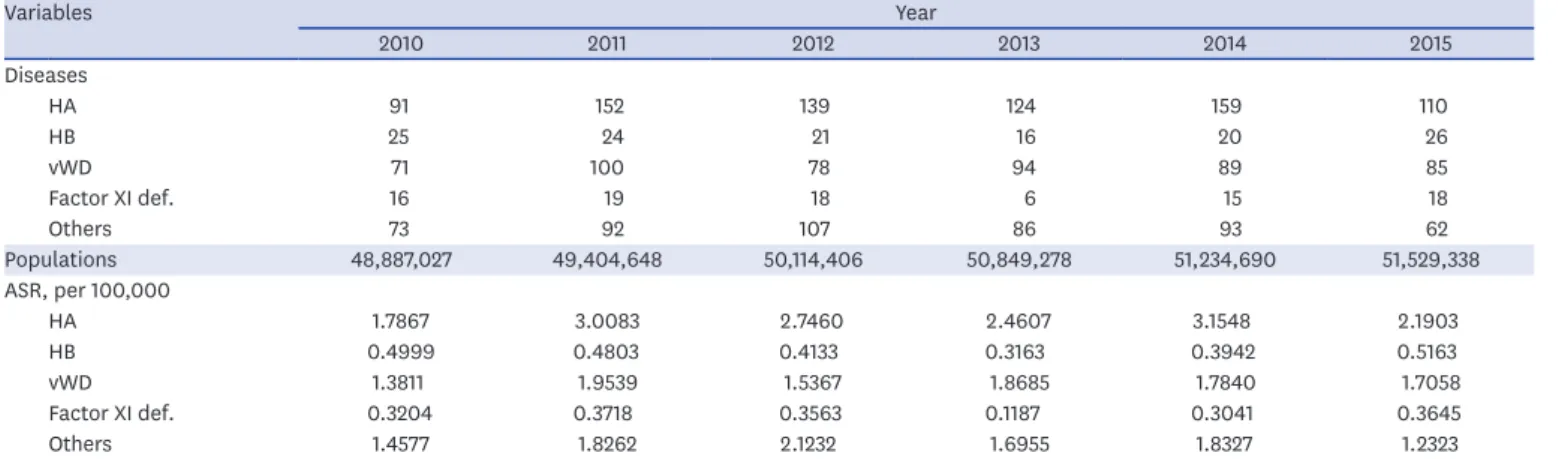
Other rare congenital bleeding disorders were deficiencies of factors I, II, V, VII, X, XII, and XIII, which affected 25% (n = 513). Fig. 2 shows the trend in the numbers of patients registered with congenital bleeding disorders in the last 6 years. These data do not represent a gradual increase or decrease on simple number each year. However, HA had a gradual increase of the estimated ASR in HA from 2010 (1.78/100,000) to 2014 (3.15/100,000) (Table 1).
The estimated ASR of HA is 1.78–3.15/100,000 people per year. That for vWD was 1.38–
1.95/100,000 people per year between 2010 and 2015 (Table 1). Highest proportion (47.8%) of patients with congenital bleeding disorders was diagnosed at age under 19 years old. For all disorders except factor XI deficiency, more than half of patients were diagnosed at < 19 years of age (Fig. 3). The geographic distribution of the patients with congenital bleeding disorders in Korea most in Gyeonggi (22.1%) and Seoul (19.2%) (Table 2). However, the estimated ASR of HA was the highest in Daejeon (5.81/100,000) and that for vWD was the highest in Daegu and Gyeongbuk, respectively (4.78/100,000 and 3.51/100,000).
HA 38%
(D660)
HB 7%
(D670) vWD 25%
(D680) Factor XI deficiency 5%
(D681)
Other factor deficiency 25%
(D682)
Fig. 1. Patients with congenital bleeding disorders reported in the Korean HIRA database from 2010 to 2015.
HIRA = Health Insurance Review and Assessment Service, HA = hemophilia A, HB = hemophilia B, vWD = von Willebrand disease.
0 40 80 120 160
HA HB
No. of cases
vWD Factor XI def. Other factor def.
2010 2011 2012 2013 2014 2015
Fig. 2. Trends in the total numbers of patients with bleeding disorders registered in the Korean HIRA database from 2010 to 2015.
HIRA = Health Insurance Review and Assessment Service, HA = hemophilia A, HB = hemophilia B, vWD = von Willebrand disease.
Table 1. Age standardized incidence rate of each congenital bleeding disorder by year
Variables Year
2010 2011 2012 2013 2014 2015
Diseases
HA 91 152 139 124 159 110
HB 25 24 21 16 20 26
vWD 71 100 78 94 89 85
Factor XI def. 16 19 18 6 15 18
Others 73 92 107 86 93 62
Populations 48,887,027 49,404,648 50,114,406 50,849,278 51,234,690 51,529,338
ASR, per 100,000
HA 1.7867 3.0083 2.7460 2.4607 3.1548 2.1903
HB 0.4999 0.4803 0.4133 0.3163 0.3942 0.5163
vWD 1.3811 1.9539 1.5367 1.8685 1.7840 1.7058
Factor XI def. 0.3204 0.3718 0.3563 0.1187 0.3041 0.3645
Others 1.4577 1.8262 2.1232 1.6955 1.8327 1.2323
HA = hemophilia A, HB = hemophilia B, vWD = von Willebrand disease, ASR = age standardized rate.
0 1,200
400 800
No. of cases
Age, yr Total
< 19 19–39 40–60 > 60 0
500
100 300
No. of cases
Age, yr HA
< 19 19–39 40–60 > 60 400
200
0 60
20 40
No. of cases
Age, yr HB
< 19 19–39 40–60 > 60
0 300
100 200
No. of cases
Age, yr vWD
< 19 19–39 40–60 > 60 0
40
10 30
No. of cases
Age, yr Factor XI def.
< 19 19–39 40–60 > 60 20
0 250
50 150
No. of cases
Age, yr Other factor def.
< 19 19–39 40–60 > 60 200
100
Fig. 3. Distributions of patients with congenital coagulation disorders according to age during 6 years.
HA = hemophilia A, HB = hemophilia B, vWD = von Willebrand disease.
DISCUSSION
A few epidemiology studies have evaluated the incidence of congenital bleeding disorders in Korea. Most have been reported by the KHF.3,4,9,10 To the best of our knowledge, this is the first nationwide study of the entire population to analyze the incidence of congenital bleeding disorders in Korea using HIRA databases.
The most frequent bleeding disorder found in this study was HA (38%), followed by vWD (25%) and HB (7%). This result is very similar to the WFH 2018 Annual Global Survey, in which HA accounted for 51% (173,711), followed by vWD (23%; 78,547) and HB (10%; 34,289).4 However, only 5% (135) of those in the KHF are vWD patients, contrasting studies showing that vWD is known to be one of the most common congenital bleeding disorders.3,11-13 Given the high prevalence of vWD across ethnic groups, there were very few reported patients.14 In Korea, 2,423 hemophilia patients were reported in 2018. South Africa and Australia, which have similar numbers of hemophilia patients, reported significantly more vWD patients, with 2,146 and 647, respectively.4 When patients are diagnosed with congenital bleeding disorders in Korea, registration in the KHF is usually recommended. However, some patients may be reluctant for their disease to be known. Moreover, patients with mild hemophilia or vWD do not feel the need to register with the KHF for treatment because they do not need regular therapy. We found that vWD is likely to be underestimated despite the marked increase in hemophilia patients in Korea determined using nationwide data.
Patients classified as other factor deficiency accounted for a large portion (25%) in our study. Unfortunately, further detailed disease classification was not available due to many limitations in HIRA and NHIS data. A comprehensive study is necessary in order to identify the details of rare congenital bleeding disorders in Korea. Patients with factor XI deficiency accounted for 5% of the total number of patients (92/2,029) recorded for 6 years in this study.
According to KHF, registered patients with factor XI deficiency was 0.9% (23/2,458) by 2018 Table 2. Distributions of patients with congenital coagulation disorders according to region for 6 years
Region HA HB vWD Factor XI def. Others Total %
Gyeonggi 166 (2.23) 35 (0.46) 101 (1.35) 30 (0.39) 117 (1.55) 449 22.1
Seoul 139 (2.37) 20 (0.34) 99 (1.67) 26 (0.43) 105 (1.82) 389 19.2
Gyeongnam 58 (2.83) 9 (0.45) 23 (1.13) 4 (0.19) 78 (3.84) 172 8.5
Gyeongbuk 36 (2.34) 6 (0.36) 52 (3.51) 5 (0.34) 35 (2.23) 134 6.6
Daegu 36 (2.50) 6 (0.40) 70 (4.78) 3 (0.19) 18 (1.25) 133 6.6
Busan 47 (2.29) 9 (0.47) 24 (1.28) 3 (0.15) 38 (1.92) 121 6.0
Daejeon 56 (5.81) 7 (0.73) 11 (1.16) 3 (0.31) 10 (1.07) 87 4.3
Chungnam 39 (3.16) 5 (0.42) 13 (1.05) 1 (0.07) 20 (1.61) 78 3.8
Incheon 36 (2.08) 10 (0.59) 12 (0.70) 6 (0.34) 13 (0.78) 77 3.8
Jeonnam 33 (3.05) 6 (0.49) 22 (2.07) 4 (0.37) 6 (0.49) 71 3.5
Jeonbuk 27 (2.46) 3 (0.30) 20 (1.78) 1 (0.08) 14 (1.25) 65 3.2
Gwangju 24 (2.61) 5 (0.54) 25 (2.73) 1 (0.12) 8 (0.88) 63 3.1
Gangwon 25 (2.78) 1 (0.11) 14 (1.65) 2 (0.23) 15 (1.69) 57 2.8
Chungbuk 11 (1.19) 5 (0.49) 14 (1.51) 1 (0.10) 20 (2.14) 51 2.5
Ulsan 13 (1.93) 1 (0.14) 6 (0.82) 0 (0) 8 (1.19) 28 1.4
Jeju 9 (2.35) 1 (0.25) 6 (1.82) 1 (0.23) 5 (1.48) 22 1.1
Sejong 3 (3.36) 0 (0) 2 (2.17) 0 (0) 0 (0) 5 0.2
Missing data 17 3 3 1 3 27 1.3
Total 775 132 517 92 513 2,029 100.0
Values are expressed as number (age standardized incidence rate).
HA = hemophilia A, HB = hemophilia B, vWD = von Willebrand disease.
in Korea.3 Italian Registry of congenital bleeding disorders also reported similar proportion (0.7%, 82/11,000) in factor XI deficiency by 2015.15
In some countries, the annual prevalence of congenital bleeding disorders has increased in recent decades.4,15-20 The KHF also reported that the number of registered patients had tripled. While the total Korean population increased by 12%, the KHF data showed a 200%
increase in hemophilia from 997 patients in 1991 to 2,148 in 2012.9 We also found a moderate increase of the estimated ASR in HA from 2010 (1.78/100,000) to 2014 (3.15/100,000) though significant change in the simple number of patients with HA did not show from 2010 to 2015.
After stratifying by age group, the greatest proportion of patients in the WFH 2018 Annual Report was younger than 19 years compared to other age groups.4 According to the 2018 KHF, 645 (26.3%) of 2,458 registered patients were < 19 years.3 In our study, the age group with the highest proportion of patients was < 19 years (47.8%), followed by ages 19–39 (24.3%) and 40–59 (18.4%) years. There may be some variation in the age distributions of patients with congenital bleeding disorders across countries. Because they are inherited disorders, they are often diagnosed at an early age. However, some are diagnosed in older patients. The life expectancies of these patients are increasing with active factor therapy, and patients with mild symptoms who are diagnosed at old age are also increasing with advances in diagnostic technology.
The most patients were registered in Gyeonggi (22.1%) and Seoul (19.2%) because these provinces have the largest populations. However, the estimated ASR of HA was the highest in Daejeon (5.81/100,000) and that for vWD was the highest in Daegu and Gyeongbuk, respectively (4.78/100,000 and 3.51/100,000). We guess that it may be affected by the institution according to region. The geographic distribution in other regions was heterogeneous.
There are some limitations to using the HIRA databases. First, the diagnoses of congenital bleeding disorders were based on codes, without laboratory results. Second, other rare congenital bleeding disorders accounting for 25% of the cases in this study, such as deficiencies in factors I, II, V, VII, X, XII, and XIII, were not analyzed separately in this study.
It would be better to study these diseases separately in the future. Third, we did not analyze details about congenital bleeding disorders including the prevalence, mortality rate, viral infection due to treatment, classification according to disease severity, trends in the use of factor concentrates, or the cost of congenital bleeding disorders.
Nevertheless, our study is meaningful as it is the first nationwide population-based study of congenital bleeding disorders in Korea. This retrospective study permitted the calculation of more accurate incidences of these diseases in Korea. We also accurately assessed the number of patients with vWD, who have been poorly identified to date. Our data on the incidence of congenital bleeding disorders may give some useful systematic information. A system for collecting more detailed data on congenital bleeding disorders is needed.
REFERENCES
1. Mannucci PM, Tuddenham EG. The hemophilias--from royal genes to gene therapy. N Engl J Med 2001;344(23):1773-9.
PUBMED | CROSSREF
2. Mannucci PM, Duga S, Peyvandi F. Recessively inherited coagulation disorders. Blood 2004;104(5):1243-52.
PUBMED | CROSSREF
3. Korea Hemophilia Foundation. 2018 annual report Korea Hemophilia Foundation. http://www.kohem.
org/_data/board_list_file/8/2019/1909191104301.pdf. Updated 2019.
4. World Federation of Hemophilia. Report on the annual global survey 2018. http://www1.wfh.org/
publications/files/pdf-1731.pdf. Updated 2019. Accessed February 15, 2020.
5. Kim DS. Introduction: health of the health care system in Korea. Soc Work Public Health 2010;25(2):127-41.
PUBMED | CROSSREF
6. Kim DS. Special issue on the national health care system of South Korea. Soc Work Public Health 2010;25(2):125-6.
PUBMED | CROSSREF
7. Park YT, Yoon JS, Speedie SM, Yoon H, Lee J. Health insurance claim review using information technologies. Healthc Inform Res 2012;18(3):215-24.
PUBMED | CROSSREF
8. Korean Statistical Information Services. Beneficiaries by city/province, age and gender (health insurance
& medical aid). http://kosis.kr/. Accessed December 17, 2016.
9. Kim DH, Kim SK, Park SK, Yoo KY, Hwang TJ, Choi YM. Korea hemophilia foundation registry trends 1991–2012: patient registry, demographics, health services utilization. Haemophilia 2015;21(6):e479-80.
PUBMED | CROSSREF
10. Yoo KY, Kim SK, Kwon SS, Park SK, Yoon HJ, Lee KS, et al. Life expectancy of Korean haemophiliacs, 1991-2012. Haemophilia 2014;20(4):e356-8.
PUBMED | CROSSREF
11. Rodeghiero F, Castaman G, Dini E. Epidemiological investigation of the prevalence of von Willebrand’s disease. Blood 1987;69(2):454-9.
PUBMED | CROSSREF
12. Srivastava A, Rodeghiero F. Epidemiology of von Willebrand disease in developing countries. Semin Thromb Hemost 2005;31(5):569-76.
PUBMED | CROSSREF
13. Leebeek FW, Eikenboom JC. Von Willebrand's disease. N Engl J Med 2016;375(21):2067-80.
PUBMED | CROSSREF
14. Werner EJ, Broxson EH, Tucker EL, Giroux DS, Shults J, Abshire TC. Prevalence of von Willebrand disease in children: a multiethnic study. J Pediatr 1993;123(6):893-8.
PUBMED | CROSSREF
15. Giampaolo A, Abbonizio F, Arcieri R, Hassan HJ. Italian registry of congenital bleeding disorders. J Clin Med 2017;6(3):34-41.
PUBMED | CROSSREF
16. Tu TC, Liou WS, Chou TY, Lin TK, Lee CF, Chen JD, et al. Prevalence, incidence, and factor concentrate usage trends of hemophiliacs in Taiwan. Yonsei Med J 2013;54(1):71-80.
PUBMED | CROSSREF
17. Kang P, Fang Y, Cheng Y, Zhang X, Wang J, Li H, et al. Analysis of haemophilia case information of Shandong Province in China: data from 2010 to 2017. Haemophilia 2019;25(3):e209-11.
PUBMED | CROSSREF
18. Elhadi I, Saed E, Elhory O, Abdallah S, Adam I. Rare clotting factor deficiency among Sudanese children.
Blood Coagul Fibrinolysis 2019;30(6):277-80.
PUBMED | CROSSREF
19. Aznar JA, Altisent C, Álvarez-Román MT, Bonanad S, Mingot-Castellano ME, López MF. Moderate and severe haemophilia in Spain: an epidemiological update. Haemophilia 2018;24(3):e136-9.
PUBMED | CROSSREF
20. Kadhim KAR, Al-Lami FH, Baldawi KH. Epidemiological profile of hemophilia in Baghdad-Iraq. Inquiry 2019;56:46958019845280.
PUBMED | CROSSREF