2020, Vol. 64, No. 5
Printed in the Republic of Korea https://doi.org/10.5012/jkcs.2020.64.5.259
Effect of Different Carrier Agents on Physicochemical Properties of Spray-dried Pineapple ( Ananas comosus Merr.) Powder
Le Pham Tan Quoc
Institute of Biotechnology and Food Technology, Industrial University of Ho Chi Minh City, Ho Chi Minh City, Vietnam.
E-mail: [email protected]
(Received September 26, 2019; Accepted May 21, 2020)
ABSTRACT. The main purpose of this study is to examine the different physicochemical properties of spray-dried products.
The carrier agents and powders after the spray-drying process were analyzed for encapsulation yield, moisture content, color parameters, total polyphenol content (TPC), antioxidant capacity (AC), bulk density, flowability, wettability, hygroscopicity, water solubility index (WSI), particle size and microstructure. The spray-drying process was carried out with different carrier agents including maltodextrin (MD) and the combination of maltodextrin and gum arabic (MD-GA) with MA/GA ratio of 70/
30, dried at the inlet/outlet air temperature of 160 °C/70 °C, 4 bar, airflow rate of 70 m3·h-1 and feed flow rate of 750 mL·h-1. The results showed that the different carrier agents have significant influences on the physicochemical properties of the powder produced by the spray-drying method. In there, while the values of recovery efficiency and flowability of spray-dried products from MD are higher than those of spray-dried products from MD-GA combination, the opposite is true for the values of TPC, AC, bulk density and wettability, whereas hygroscopicity and WSI values are equally represented in both products.
Key words: Encapsulation, Gum arabic, Maltodextrin, Spray-dried product, Structure
INTRODUCTION
Pineapple has a latin name is Ananas comosus and is the only species in the Bromeliaceae family. Pineapple plants originated in South America, mainly in southern Brazil, northern Argentina and Paraguay. In Vietnam, the pineapple varieties are currently grown in Ananas comosus species.
This species is divided into 7 groups including 3 main groups:
Cayen, Queen and Spanish pineapple.1 Pineapples are non- climacteric fruits and should be harvested when ready to eat.
The skin color changes from green to yellow at the base of the fruit. A soluble solids content and an acidity in pine- apple are approximately 12% and 1%, respectively. In addi- tion, this fruit contains many nutrients such as vitamin C, vitamin B complex, fiber, manganese, copper, calcium, zinc, bromelain, and β-carotene. The flesh is free of fat and cho- lesterol leading to low calories. Therefore, this delicious tropical fruit is consumed fresh, canned, dehydrated in jams and juice.
Besides, pineapple can improve the immune system, aids digestion of proteins, reduce symptoms of the common cold and strengthens bones.2
Although, pineapple has many benefits to human health and was widely applied in the food industry but this fruit has high moisture content and highly perishable because of the growth of microorganisms that leads to the low lifespan of fruit. The rapid deterioration in the quality of
pineapple was shown at a decline in sugar content, flavor reduction, excessive softening, and an increase in suscep- tibility to microorganisms during the storage period. Hence, this fruit should be dried to surmount these postharvest losses and to extend the shelf-life for its availability during the off-season.3 Dried products such as powder bring about a significant reduction in volume and weight, minimize the packaging and storage, leading to reducing transportation costs. Currently, there are many drying methods that can produce dried products, for instance, vacuum drying, freezing drying, spray-drying, foam mat drying, etc.4 In there, the spray-drying was widely used in food technology with vari- ous materials from plants or spice, for instance, Polygonum multiflorum Thunb. root,5 guava leaves,6 jaboticaba peels,7 etc.
The spray-drying process is the common method and applied in the production and stabilization of bioactive compounds, especially phenolic compounds, natural col- orants. Because of their sensitivity to temperature, oxygen, light and enzymatic activities, this method needs to be used for storage and processing.8 Besides, the spray-dry- ing method also can keep the quality of the product, main- tains low water activity, extends the shelf-life of the product and would make easier to transport and store.9 Nowadays, the most commonly used carrier agent is maltodextrin with various dextrose equivalent values (DE 1-20). However, other carrier agents were also used such as gum arabic,5 skim
milk powder,10 tapioca starch,11 etc. or a combination of these carrier agents. The addition of carrier agents into the feed solution dramatically affects the properties and sta- bility of powder products. Until now, there are many stud- ies on the spray-dried powder of pineapple.12,13 However, there is limited scientific information about how various carrier agents and drying conditions may affect the phys- icochemical properties of pineapple fruit powder. Hence, this study was carried out to evaluate the physicochemical properties of pineapple fruit powder with emphasis on TPC, AC, recovery efficiency, wettability, water solubility index (WSI), bulk density, flowability, hygroscopicity, the particle size and shape by some types of encapsulating agents (MD and MD-GA).
EXPERIMENTAL
Chemicals and reagents
Maltodextrin (MD) (DE 16-19) was purchased from GPC company (USA) and gum arabic (GA) was supplied by Xiamen Ditai Chemicals company (China). Folin Ciocalteu and DPPH (2,2-diphenyl-1-picrylhydrazyl) reagents were bought from Merck. Trolox reagent (6-hydroxy-2,5,7,8- tetramethylchroman-2-carboxylic) was bought from Sigma- Aldrich (USA) and other chemicals used were of analyt- ical grade.
Sample preparation
The pineapples were harvested from Tien Giang prov- ince (Vietnam) and have a yellow to golden yellow pulp, uniform size (approximately 1 kg/unit) and free of physical damage and fungal infection. They were washed, peeled, removed eyes and cut into small pieces with a size of 3×3 cm.
Then the pineapple flesh was crushed in a Philips blender about 30 seconds. The mixture was added 1.5% enzyme Pectinex (v/w) and incubated in the thermostatic baths at 50 °C for 1.5 hours. After that, it was hydraulically pressed to squeeze out the juice. The received solutions were adjusted the total soluble solids (TSS) to 12° Brix and preserved at 4 °C. In this study, the pineapple juice was added MD (DE 16-19) or MD-GA (70:30) with the same concentration of 16% (w/w). Then, this mixture was filtered through What- man No. 4 filter paper and spray-dried by LabPlant SD- Basic Spray Dryer (England) at the inlet/outlet air tem- perature of 160 °C/70 °C, 4 bar, airflow rate of 70 m3·h-1 and feed flow rate of 750 mL·h-1.
Encapsulation yield (EY)
According to Roccia et al. (2014),14 EY was calculated
as the ratio of the powder weight collected after every spray-drying experiment to the initial amount of solids in the sprayed dispersion volume.
where
m1: The total soluble solids of the spray-dried powders (g) m2: The total soluble solids of the feed weight (g)
Total polyphenol content (TPC)
The TPC was determined according to the Folin Cio- calteu method.15 The results were based on a standard curve obtained with gallic acid. TPC was expressed as mg of gallic acid equivalents per gram of dry weight (mg GAE·g-1 DW).
Antioxidant capacity (AC)
The AC of material and product were determined by DPPH assay.16 Trolox was used as the standard. AC was expressed in TEAC (Trolox equivalent antioxidant capac- ity) determined as μmol of Trolox per gram of dry weight (μmol TE·g-1 DW).
Bulk density
Powder (2 g) was added into an empty graduated cyl- inder (10 mL) and shook for 1 min. The result was deter- mined by the ratio of mass of the powder and the final volume occupied by the powder in the cylinder.17
Flowability
Flowability was determined by using the measurement of the angle of repose (AOR). AOR was calculated by the height and radius of the powder on the flat base when the powder had been poured slowly through the funnel which was held at a fixed height above the flat base.18
Wettability
This parameter was determined by the method of Freudig et al. (1999) with slight modifications.19 The powders were poured into the funnel which is held at a fixed height and fallen down a volume of 100 mL water in a beaker (250 mL) at room temperature. After that, the time for the whole amount of powder to visibly sink beneath the water surface was recorded as an indicator of wettability.
Hygroscopicity
About 1.5 g samples of each powder were placed at 25 °C in an airtight plastic container containing the saturated solution of sodium carbonate. These samples
H m1 m2
--- 100 %× ( )
=
were weighed after 7 days. Eventually, hygroscopicity was determined by gram of adsorbed moisture per 100 g solids (g·100 g-1).20
Water solubility index (WSI)
The method to determine WSI was adapted from Ander- son et al. (1969)with some small changes.21 Powder (1 g) and deionized water (10 mL) were vigorously mixed for 1 min. Then, the mixture was made up to 15 mL by deion- ized water, moved to the centrifuge tube and incubated for 30 minutes at 37 °C. After that, it was centrifuged for 30 minutes at 8000 rpm; the supernatant was separated and dried at 103 °C in an oven. The WSI (%) was expressed as the percentage of dried supernatant to the amount of the original powder.
Color parameters
The color parameters consist of L* (lightness), a* (red- ness and greenness) and b* (yellowness and blueness) val- ues, which were determined using a Chroma Meter CR- 400 (Minolta, Japan).
Scanning electron microscopy (SEM)
The morphology of the material and the spray-dried powder was examined by a Jeol/JSM-7401F scanning elec- tron microscope system. Samples were observed at mag- nification of 1000X.
Particle size and distribution analysis
A laser scattering particle size distribution analyzer (Horiba LA-960, Japan) was used to determine the particle sizes of the spray-dried powder.
Statistical analysis
The experimental data was analyzed by the one-way analysis of variance (ANOVA) method and significant differ- ences among the means from triplicate analysis at p<0.05 were determined by Fisher’s least significant difference (LSD) procedure using Statgraphics software (Centurion XV). The values obtained were expressed in the form of a mean±standard deviation (SD).
RESULTS AND DISCUSSION
EY, moisture, TPC and AC of powder
Table 1 shows that the EY of MDe (maltodextrin and extract after spray-drying) was higher than MD-GAe (the combination of maltodextrin, gum arabic and extract after spray-drying) at the same concentration of 16% (w/w) because GA has the short-chain branched structure and the high hydrophilic nature leading to powder stickiness on the chamber wall. The EY of MDe is higher than that of Krishnaiah et al. (2012),22 the EY of spray-dried powder from Morinda citrifolia L. reached 39.16% when using 5% MD. While the EY of MD-GAe of the received result is lower than in the study of Bazaria and Kumar (2017) (73.27%),23 who worked with spray-dried beetroot juice when using 10% MD and 10% GA. Thereby, the EY depends on various factors such as inlet/outlet temperature, type of carrier agent, feed flow rate, airflow speed, etc. In addition, the EY of the spray- drying process cannot reach the maximum level because of the wet powder stuck to the upper part of the chamber wall.
Essentially, TPC and AC of the spray-dried product were lower than that of fresh material because of the degrada- tion of bioactive compounds at high temperature. However, the results also showed that there was an increase in the TPC and AC of products compared to the initial carrier agent. Typically, the TPC of MD-GA increased from 0.16 to 2.20 mg GAE·g-1 DW and that of MD increased from 0 to 1.99 mg GAE·g-1 DW. While the AC of MD-GA increased from 1.38 to 5.70 µmol TE·g-1 DW and that of MD increased from 0 to 5.24 µmol TE·g-1 DW. This suggests that this method is capable of keeping precious bioactive compounds in herbs and fruits, especially phenolic compounds. The TPC and AC in fresh pineapple of this study are higher than that of study of Almeida et al. (2011) 24 (TPC and AC were 0.381 mg GAE·g-1 DW and 1.33 µmol TE·g-1 DW, respec- tively) and the TPC of MDe is also higher than that of study of Saikia et al. (2015) 25 (0.257 mg GAE·g-1 DW), who spray- dried watermelon juice using MD as carrier agent (DE ≤ 20).
These differences may be due to different original mate- rials, types of carrier agent and different spray-drying con- Table 1. EY, moisture, TPC and AC of carrier agents and powder products
Sample EY, % Moisture, % TPC, mg GAE·g-1 DW AC, µmol TE·g-1 DW
Fresh pineapple MD MD-GA
MDe MD-GAe
- - - 51.65±0.7b 47.31±0.78a
84.41±0.70e 5.98±0.40c 7.12±0.32d 2.66±0.10a 3.31±0.19b
2.64±0.09d - 0.16±0.01a 1.99±0.02b 2.20±0.06c
6.97±0.07d - 1.38±0.26a 5.24±0.22b 5.70±0.10c Different lowercase letters in the same column indicate a statistically significant difference (p<0.05) between various samples.
ditions.
The moisture content of carrier agents after spray-dry- ing is lower than that of carrier agents before spray-drying and the moisture of MDe obtains the lowest value (2.66%).
These results are similar to the study of Quoc and Muoi (2018).5 Besides, Righetto and Netto (2005) also believed that MD is more effective in reducing the moisture con- tent of acerola powder by spray-drying.26 This is probably due to the difference between the chemical structure of both carrier agents; GA is a complex heteropolysaccharide with a highly dispersed structure, containing shorter chains and more hydrophilic groups. Generally, the moisture content of spray-drying products is quite low (<4%) and it caused a reduction of the water activity. Therefore, these products are quite safe to preserve. In addition, the mois- ture of product was influenced by drying temperature, feed flow rate, airflow speed, etc., especially the combination of carrier agents at different ratios.7
Bulk density, flowability, wettability and hygroscop- icity of powder
Bulk density of the original carrier agents decreases rapidly after the spray-drying. MDe and MD-GAe ranged from 0.5 to 0.53 g·mL-1, similar to those reported in other studies.5,27 In the spray-drying process, grain formation occurs quickly at high temperatures, the surface of the liquid droplets dries quickly and forms a waterproof layer on the surface, then the formation of vapor bubbles and droplets are increased in size resulting in a reduction in bulk density. In addition, some studies also suggest that the bulk density of spray- dried product could be influenced by many other factors such as input flow rate, hot airflow, spray pressure, amount of dissolved solids,28 dextrose equivalent value and mois- ture.9
Flowability of before and after spray-drying carrier agents are evaluated through an angle of repose (AOR). AOR of MD increases slowly from 37.57 to 40.54° after the spray- drying process while that of MD-GA decreases sharply from 39.45 to 34.23°. The increase in AOR means that the flowability will decrease and vice versa. This result contrasts with the observation of Carr (1970),29 this author noticed that MDe has a very good flowability (AOR<30°).In this
case, adding GA can change significantly the AOR (or flowability) of the initial material and power product. Besides, the flowability of powders can also be significantly affected by the storage temperature, moisture content of the powder and the relative moisture content of the surrounding air.
The hygroscopic particle will tend to dissolve the com- pounds on the surface, forming a bond between the par- ticles increases the cohesion leading to reduced flowability.30 In addition, flowability depends on the size and shape of particles.31 As the particle size decreases with an increase in the surface area per unit volume and this leads to a decrease in the flowability of the powder. The flow was resisted by frictional forces and the surface bonding par- ticles.
Table 2 shows that the wettability of MD increased sharply from 87.33 to 179.33 seconds, whereas that of MD-GA also dropped significantly from 1153.67 to 298.67 seconds.
This proved that adding GA into MD as a carrier agent strongly affects their wettability. Besides, the wettability could depend on the shape, particle size, moisture and structure of carrier agent. The fluctuations of wettability can be explained according to the assumption of Buffo et al.
(2002) and Fernandes et al. (2014), the water penetrates easily into the pores of the powder with various levels depended on the structure of carrier agents and changes the wettability time.32,33 In addition, the result of MD-GA is contrary to the study of Quoc and Muoi (2018),5 the wet- tability MD and GA after spray-drying are higher than that of initial materials. The mixture of the initial material (MD- GA) in this study is agglomerated, which means the aggre- gation of dispersed materials to material units of larger size, its sink-ability would spend a lot of time.
Hygroscopicity of MDe and MD-GAe are 24.3 and 22.83 g·100 g-1, respectively. They are higher than that of orig- inal powder (nearly 2.5 times). The results of this study also are higher than that of Bazaria and Kumar (2017),23 who spray-dried beetroot juice with MD (DE 10), MD (DE 20), MD (DE 10) - GA and MD (DE 20) - GA (Hygroscopicity ranges from 14.09% to 19.33%). These differences are due to the use of various carrier agents; in addition, the difference in water absorption is thought to be the effect of the drying temperature and moisture content of the product. The adsorp-
Table 2. Bulk density, flowability, wettability and hygroscopicity of carrier agents and powder products
Sample Bulk density, g·mL-1 Flowability (AOR), ° Wettability, s Hygroscopicity, g·100 g-1 MD
MD-GA MDe
MD-GAe
0.67±0.0a 0.71±0.0b 0.50±0.01c 0.53±0.01d
37.57±0.75a 39.45±0.89b 40.54±0.62c 34.23±0.61d
87.33±19.35a 1153.67±13.01b
179.33±7.51c 298.67±23.97d
10.5±1.11a 8.74±0.43a 24.30±0.88b 22.83±2.14b Different lowercase letters in the same column indicate a statistically significant difference (p<0.05) between various samples.
tion of water by a carbohydrate was attributed to the links between the hydrogen present in water molecules and the hydroxyl groups available in the surface crystalline regions of the substrate and as well as the amorphous regions. MD and GA have a large number of ramifications with the hydro- philic groups in molecular. For this reason, they were eas- ily adsorbed the moisture from the surrounding air.9 High hygroscopicity can be considered a disadvantage for the preservation of these products. The type and particle size of carrier agent strongly affect the hygroscopicity. The smaller the particle size is, the greater the hygroscopicity capacity achieve. Moreover, the spray-drying temperature increases with a decrease in the moisture content of the product, leading to an increase of hygroscopicity because the product was also easily adsorbed the moisture from the ambient air.
Water solubility index (WSI) and color parameters of powder
The WSI of carrier agents before and after the spray- drying were significantly different (p<0.05) (Table 3). The WSI of MD and MD-GA strongly increase, nearly 1.5 times (WSI ranges from 92 to 93.67%). These results were lower than another study of Bazaria and Kumar (2017),23 who spray-dried beetroot juice with MD as carrier agent (WSI achieved from 97.47 to 98.54%). However, it was in agree- ment with that of the study of Quoc and Muoi (2018), who produced the spray-dried powder from P. multiflorum Thunb.
root extract.5 Adding GA into MD did not change the WSI of the initial material and powder product in this study.
WSI may be influenced by the type of carrier agent, the spray-drying temperature,34 and the airflow rate.9 In addi- tion, particle size also affected WSI because smaller par- ticle size resulted in the bigger exposed surface, increased contact with the continuous phase and high value WSI.
The color of the product differs from the original carrier agent color. The L* and a* values decreased slightly, whereas b* value increased gradually but that of MD-GA and MD- GAe changed insignificantly. The changes in carrier agent color may be due to browning reactions that occur during the spray-drying process, especially the non-enzymatic browning reactions (caramelization, Maillard reactions and pigment oxidation). These reactions occur due to high sugar con-
tent in pineapple juice and heat supply in the drying cham- ber. Besides, the color parameters were affected by inlet temperature, feed flow rate, airflow rate, soluble solid con- tent,35 and concentration of carrier agent.12
Microstructure and particle size of spray-dried powder Based on the results obtained, the structure of micro- capsules before and after spray-drying was significantly different, typically as MD with spherical shape but uneven size, but after the spray-drying process, the particles have uniform size, smooth surface. Similar to spray-dried products using MD-GA combination, there is adhesion between particles with finer surfaces (Fig. 1 and 2). This will be sim- ilar to the study of Saikia et al. (2015) about micro-mate- rial used is MD (DE£20) and the study of Lim et al. (2012) when they used micro-materials MD-GA (DE 10) as a car- rier agent.25,36 Moreover, Loksuwan (2007) also showed that
Figure 1. Microphotographs of MD (a) and MDe (b) at magnifi- cation of 1000X.
Table 3. Water solubility index (WSI) and color parameters of carrier agents and powder products
Sample Water solubility index (WSI), % L* a* b*
MD MD-GA
MDe
MD-GAe
68.36±3.07a 64.60±4.14a 93.67±1.95b 92±1.48b
97.40±1.76a 90.97±3.36b 95.78±0.46a 94.65±0.66a
-0.25±0.02a 0.26±0.11b -1.14±0.12c -0.61±0.02d
1.59±0.09a 10.75±1.05b 10.23±0.42b 11.61±1.37b Different lowercase letters in the same column indicate a statistically significant difference (p<0.05) between various samples.
the high DE value (DE 24) contains a large amount of low molecular weight sugar, which can act as a plastic, preventing surface shrinkage during spray-drying process and result- ing in the formation of finer particles.37 The change in the shape of the particles is due to the spray-drying materials with high sugar content, the product has an amorphous and partially or completely crystallized surface. This indicates that the characteristics of the material depend on the spray- drying conditions and they also depend on the character- istics of the product.38
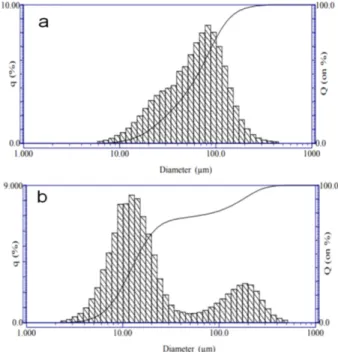
The particle size of MDe, MD-GAe changes significantly and smaller than MD, MD-GA. The average diameter of MD, MD-GA is 75 μm and 72 μm, respectively. The MDe particle diameter ranges from 3 to 500 μm (dmean=51 μm), while the MD-GAe particle diameter is from 2 to 394 μm (dmean=22 μm) (Fig. 3 and 4). The results showed that the diameter of the particle decreased after the spray-drying process. The special thing is that MDe and MD-GAe have a variety of sizes and they are smaller than the size of the original product. The average particle size after spray-dry- ing of the study is different to that of Ferrari et al. (2012) for blackberry powder (MDe and MD-GAe diameter are 48.89 μm and 28.45 μm, respectively).38 This can be explained that the particle size depends on the type of carrier agent,
inlet temperature, inlet flow rate,39 injection pressure, total dry matter content, airflow rate.28 The change in particle size leads to changes in the physical properties of the powder such as wettability, water solubility index (WSI), bulk density, flow- ability, hygroscopicity of spray-dried powder.
Figure 3. Particle size distribution curve of MD (a) and MDe (b).
Figure 2. Microphotographs of MD-GA (a) and MD-GAe (b) at magnification of 1000X.
Figure 4. Particle size distribution curve of MD-GA (a) and MD- GAe (b).
CONCLUSION
All the powder samples were produced by the spray- drying method with different carrier agents which had low moisture content (2.66–3.31%). This was an advantage for the storage and preservation of spray-dried products.
After the spray-drying process, the use of MD-GA com- bination had the highest bulk density, wettability, TPC and AC values; while the use of MD was reached the highest in the encapsulation yield and flowability values. The color and microstructures of powder products changed completely compared to the initial material. These results showed that the type of carrier agent is a very important factor that strongly affects the physicochemical properties of the dried prod- uct. Consequently, depending on the needs of production and the different technology elements that should choose the type of carrier agent appropriately.
Acknowledgments. I am grateful to my co-workers, including Huynh Phat Trien, Tran Thi My Duyen, Le Truong Giang and Le Thi Minh Trang, who supported this study.
The publication cost of this paper was supported by the Korean Chemical Society.
REFERENCES
1. Duong, D. H. Pineapple and its planting techniques: Part 1; Labour and Social Publisher: Hanoi, V. N., 2003; p 22 (in Vietnamese).
2. Lobo, M. G.; Paull, R. E. In Handbook of Pineapple Tech- nology Production; John Wiley & Sons, Inc, Hoboken:
2017; p 257.
3. Saxena, R.; Arora, V. P. S. Indian Food Ind. 1997, 16, 25.
4. Shaari, N. A.; Sulaiman, R.; Rahman, R. A.; Bakar, J. J.
Food Process Preserv. 2017, 41, 1. doi: https://doi.org/
10.1111/jfpp.13467.
5. Quoc, L. P. T.; Muoi, N. V. Chem. Ind. Chem. Eng. Q. 2018, 24, 93. doi: https://doi.org/10.2298/CICEQ170329021Q.
6. Tuan, P. M.; Anh, H. T. V.; Cam, L. T. H.; Chi, V. N. Q.;
Oanh, D. T. B.; Khue, D. B.; Minh, P. D. T.; Tri, M. H.; Sang, N. T. T.; Mai, D. S.; Nghia, T. T. Ann.: Food Sci. Technol.
2016, 17, 34.
7. Silva, P. I.; Stringheta, P. C.; Teófilo, R. F.; Oliveira, I. R.
N. D. J. Food Eng. 2013, 117, 538. doi: https://doi.org/
10.1016/j.jfoodeng.2012.08.039.
8. Castellar, R.; Obon, J.; Alacid, M.; Fernández-López, J. J.
Agric. Food Chem. 2003, 51, 2772. doi: https://doi.org/
10.1021/jf021045h.
9. Phisut, N. Int. Food Res. J. 2012, 19, 1297.
10. Wu, W. D.; Liu, W.; Gengenbach, T.; Woo, M. W.; Sel- omulya, C.; Chen, X. D.; Weeks, M. J. Food Eng. 2014, 123, 130. doi: https://doi.org/10.1016/j.jfoodeng.2013.05.013.
11. Tonon, V. R.; Brabet, C.; Pallet, D.; Brat, P.; Hubinger, D.
M. Int. J. Food Sci. Technol. 2009, 44, 1950. doi: https:/
/doi.org/10.1111/j.1365-2621.2009.02012.x.
12. Jittanit, W.; Niti-Att, S.; Techanuntachaikul, O. Chiang Mai J. Sci. 2010, 37, 498.
13. Mujaffar, S.; Dhun, G. Acta Hortic. 2014, 1047, 315. doi:
https://doi.org/10.17660/ActaHortic.2014.1047.40.
14. Roccia, P.; Martínez, M. L.; Llabot, J. M.; Ribotta, P. D.
Powder Technol. 2014, 254, 307. doi: https://doi.org/10.1016/
j.powtec.2014.01.044.
15. Siddiqua, A.; Premakumari, K. B.; Sultana, R.; Vithya; Sav- itha. Int. J. ChemTech Res. 2010, 2, 205.
16. Soto, C.; Caballero, E.; Pérez, E.; Zúñiga, M. E. Food Bio- prod. Process. 2014, 92, 328. doi: https://doi.org/10.1016/
j.fbp.2013.06.002.
17. Goula, A. M.; Adamopoulos, K. G.; Kazakis, N. A. Drying Technol. 2004, 22, 1129. doi: https://doi.org/10.1081/DRT- 120038584.
18. Geldart, D.; Abdullah, E.; Hassanpour, A.; Nwoke, L.;
Wouters, I. China Particuol. 2006, 4, 104. doi: https://doi.org/
10.1016/S1672-2515(07)60247-4.
19. Freudig, B.; Hogekamp, S.; Schubert, H. Chem. Eng. Process.
1999, 38, 525. doi: https://doi.org/10.1016/S0255-2701(99) 00049-5.
20. Cai, Y.; Corke, H. J. Food Sci. 2000, 65, 1248. doi: https:/
/doi.org/10.1111/j.1365-2621.2000.tb10273.x.
21. Anderson, R. A.; Conway, H. F.; Pfiefer, V. F.; Griffin, J.
R. Cereal Sci. Today 1969, 14, 4.
22. Krishnaiah, D.; Sarbatly, R.; Nithyanandam, R. Chem. Eng.
Res. Des. 2012, 90, 622. doi: https://doi.org/10.1016/j.cherd.
2011.09.003.
23. Bazaria, B.; Kumar, P. J. Food Meas. Charact. 2017, 11, 156. doi: https://doi.org/10.1007/s11694-016-9382-4.
24. Almeida, M. M. B.; Sousa, P. H. M. D.; Arriaga, A. M.
C.; Prado, G. M. D.; Magalhães, C. E. D. C.; Maia, G. A.;
Lemos, T. L. G. D. Food Res. Int. 2011, 44, 2155. doi:
https://doi.org/10.1016/j.foodres.2011.03.051.
25. Saikia, S.; Mahnot, N. K.; Mahanta, C. L. J. Food Process.
Preserv. 2015, 39, 1656. doi: https://doi.org/10.1111/jfpp.
12395.
26. Righetto, M. A.; Netto, F. M. Int. J. Food Prop. 2005, 8, 337. doi: https://doi.org/10.1081/JFP-200060262.
27. Mishra, P.; Mishra, S.; Mahanta, C. L. Food Bioprod. Process.
2014, 92, 252. doi: https://doi.org/10.1016/j.fbp.2013.08.003.
28. Jumah, R. Y.; Tashtoush, B.; Shaker, R. R.; Zraiy, A. F.
Drying Technol. 2000, 18, 967. doi: https://doi.org/10.1080/
07373930008917747.
29. Carr, R. L. Bri. Chem. Eng. 1970, 15, 1541.
30. Teunou, E.; Fitzpatrick, J. J. Food Eng. 1999, 42, 109. doi:
https://doi.org/10.1016/S0260-8774(99)00087-4.
31. Fitzpatrick, J. J.; Delaney, C.; Twomey, T.; Keogh, M. K.
J. Food Eng. 2004, 64, 435. doi: https://doi.org/10.1016/
j.jfoodeng.2003.11.011.
32. Buffo, R. A.; Probst, K.; Zehentbauer, G.; Luo, Z.; Rein- eccius, G. A. Flavour Fragrance J. 2002, 17, 292. doi: https:/
/doi.org/10.1002/ffj.1098.
33. Fernandes, R. V. B.; Borges, S. V.; Botrel, D. A. Carbo- hydr. Polym. 2014, 101, 524. doi: https://doi.org/10.1016/
j.carbpol.2013.09.083.
34. Phoungchandang, S.; Sertwasana, A. ScienceAsia 2010, 36, 40. doi: https://doi.org/10.2306/scienceasia1513-1874.2010.36.040.
35. Saydi, D.; Hatamipour, M. S. Iran. J. Chem. Eng. 2012, 9, 55.
36. Lim, H. K.; Tan, C. P.; Bakar, J.; Ng, S. P. Food Bioprocess
Technol. 2012, 5, 1220. doi: https://doi.org/10.1007/s11947- 011-0555-1.
37. Loksuwan, J. Food Hydrocolloids 2007, 21, 928. doi: https://
doi.org/10.1016/j.foodhyd.2006.10.011.
38. Ferrari, C. C.; Germer, S. P. M.; Alvim, I. D.; Vissotto, F.
Z.; Aguirre, J. M. D. Int. J. Food Sci. Technol. 2012, 47, 1237. doi: https://doi.org/10.1111/j.1365-2621.2012.02964.x.
39. Chegini, G.; Ghobadian, B. Drying Technol. 2005, 23, 657.
doi: https://doi.org/10.1081/DRT-200054161.