ISSN 2234-3806 • eISSN 2234-3814
Ann Lab Med 2012;32:250-256
http://dx.doi.org/10.3343/alm.2012.32.4.250
Influence of a Regular, Standardized Meal on Clinical Chemistry Analytes
Gabriel Lima-Oliveira, M.S.1,2,3,4,*, Gian Luca Salvagno, M.D.1,*, Giuseppe Lippi, Ph.D.5, Matteo Gelati, M.T.1, Martina Montagnana, M.D.1, Elisa Danese, M.D.1, Geraldo Picheth, Ph.D.2, and Gian Cesare Guidi, Ph.D.1,2
Laboratory of Clinical Biochemistry1, Department of Life and Reproduction Sciences, University of Verona, Italy; Post-Graduate Program of Pharmaceutical Sciences2, Department of Medical Pathology Federal University of Parana, Brazil; MERCOSUL3, Sector Committee of Clinical Analyses and In Vitro Diagnostics- CSM 20, Brazil; Brazilian Society of Clinical Analyses on Sao Paulo State4, Brazil; Laboratory of Clinical Chemistry and Hematology, Department of Pathology and Laboratory Medicine5, Academic Hospital of Parma, Italy
Background: Preanalytical variability, including biological variability and patient prepara- tion, is an important source of variability in laboratory testing. In this study, we assessed whether a regular light meal might bias the results of routine clinical chemistry testing.
Methods: We studied 17 healthy volunteers who consumed light meals containing a stan- dardized amount of carbohydrates, proteins, and lipids. We collected blood for routine clini- cal chemistry tests before the meal and 1, 2, and 4 hr thereafter.
Results: One hour after the meal, triglycerides (TG), albumin (ALB), uric acid (UA), alka- line phosphatase (ALP), Ca, Fe, and Na levels significantly increased, whereas blood urea nitrogen (BUN) and P levels decreased. TG, ALB, Ca, Na, P, and total protein (TP) levels varied significantly. Two hours after the meal, TG, ALB, Ca, Fe, and Na levels remained significantly high, whereas BUN, P, UA, and total bilirubin (BT) levels decreased. Clinically significant variations were recorded for TG, ALB, ALT, Ca, Fe, Na, P, BT, and direct biliru- bin (BD) levels. Four hours after the meal, TG, ALB, Ca, Fe, Na, lactate dehydrogenase (LDH), P, Mg, and K levels significantly increased, whereas UA and BT levels decreased.
Clinically significant variations were observed for TG, ALB, ALT, Ca, Na, Mg, K, C-reactive protein (CRP), AST, UA, and BT levels.
Conclusions: A significant variation in the clinical chemistry parameters after a regular meal shows that fasting time needs to be carefully considered when performing tests to prevent spurious results and reduce laboratory errors, especially in an emergency setting.
Key Words: Blood specimen collection, Clinical laboratory techniques, Diagnostic errors, Eating, Fasting, Postprandial period, Reference values, Reproducibility of results, Quality control, Specimen handling
Received: January 26, 2012 Revision received: March 27, 2012 Accepted: May 25, 2012
Corresponding author: Gabriel Lima-Oliveira Av. Pref. Lothário Meissner 632, Jardim Botânico, Curitiba-PR, 80210-170, Brazil Tel: +55-41-33604067
Fax: +55-41-33604067
E-mail: [email protected]
*These authors contributed equally to this work.
© The Korean Society for Laboratory Medicine.
This is an Open Access article distributed under the terms of the Creative Commons Attribution Non-Commercial License (http://creativecom- mons.org/licenses/by-nc/3.0) which permits unrestricted non-commercial use, distribution, and reproduction in any medium, provided the original work is properly cited.
INTRODUCTION
The preanalytical phase is a critical step in the testing process because several procedures are performed and/or oriented by non-laboratory professionals (e.g., nurses, non-technicians, and administrative staff). Adequate fasting time before blood collec- tion [1] is one of the many details [2-5] that should be consid- ered because they may either singularly or collectively influence
the reliability of test results and, thereby, affect the diagnostic outcome, follow-up, or even the therapeutic management of pa- tients [6]. Clinical laboratory results are an essential part of healthcare. It has been estimated that up to 70% of medical de- cisions and procedures, e.g., drug prescriptions, assessments prior to and in the course of further investigations, or dialysis, are strongly dependent upon laboratory data [7]. An adequate time of fasting is typically required for glucose and lipid profile
ISSN 2234-3806 • eISSN 2234-3814
(triglycerides, total cholesterol, and fractions) assessment. The Clinical Laboratory Standards Institute/National Committee for Clinical Laboratory Standards (CLSI/NCCLS) H3-A6 [8] currently recommends to verify the patient’s diet for particular restrictions and/or fasting. Moreover, the document contains important in- formation, e.g., time and diet restrictions, which vary according to the test performed, restrictions that are necessary to ensure accurate test results, and procedures for holding meals and no- tifying appropriate personnel that the patient’s blood specimen has been drawn. All measures mentioned above should be in agreement with the institutional policy. Nevertheless, the CLSI/
NCCLS H3-A6 [8] does not contain clear indications about the standardization of fasting time and levels of discretion in estab- lishing the most appropriate procedures. Lippi et al. [1] recently showed that a light meal can alter routine hematological tests.
The aim of this study was, therefore, to assess whether a regular light meal might bias the results of routine clinical chemistry testing.
METHODS
The study population consisted of 17 healthy volunteers (8 women and 9 men; mean age ±standard deviation: 29±4 yr), who were recruited among the laboratory personnel. The re- search was carried out according to the principles of the Decla- ration of Helsinki. The protocol was approved by the ethics committee and informed consent for testing was obtained from all participants.
1. Collection of diagnostic blood specimens
The collection of diagnostic blood specimens was carried out by a single expert phlebotomist, following the international CLSI standards [8]. All volunteers were maintained seated for 15 min prior to phlebotomy in order to eliminate possible interferences of blood distribution due to different postures [9]. After this in- terval, a vein was located on the forearm by using a subcutane- ous tissue transilluminator device (Venoscópio IV plus; Duan do Brasil, Brazil) for preventing venous stasis interference due to the use of the tourniquet [2, 3]. All blood samples were collected directly into 3.5 mL vacuum tubes containing gel and lithium heparin (Terumo Europe, Leuven, Belgium) using a 20 gauge straight needle (Terumo Europe NV, Leuven, Belgium). To elimi- nate any possible interference due to either the contact phase or tissue factor, about 2 mL blood were preliminarily collected in a discard tube without additive (Vacuette®; Greiner Bio-One GmbH, Kremsmünster, Austria). The first blood sample was col-
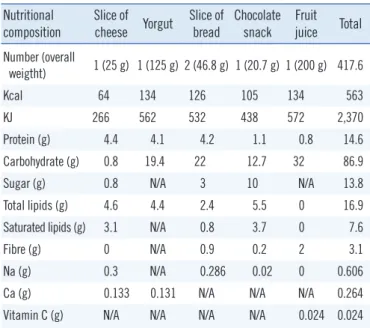
lected between 8:00 and 8:30 a.m. after an overnight fast. Im- mediately after blood collection, the volunteers consumed a light meal, containing standardized amounts of carbohydrates, protein, and lipids. The meal was based on commercial food regularly purchased at a shop and included 1 slice of cheese, 1 yogurt, 2 slices of bread, a chocolate snack, and a fruit juice as previously described [1]. The exact composition of the meal is shown in Table 1. Subsequent blood samples were collected at 1, 2, and 4 hr after the end of the meal. Each phase of sample collection was appropriately standardized, including the use of needles and vacuum tubes from the same type and lots. No specimens were discarded due to unsatisfactory attempts, e.g.
problems in locating a suitable vein.
2. Processing of diagnostic blood specimens
All tubes were left in upright position for 30 min at room temper- ature (20°C) to ensure complete blood stability before centrifu- gation [10]. After centrifugation at 1,200 g for 10 min at room temperature (according to the instructions of the manufacturer), plasma was separated, stored in aliquots, and kept frozen at -70°C until measurement. No sample showed hemolysis or lipe- mia at visual inspection.
3. Laboratory testing
All plasma aliquots were thawed at the same time. The routine clinical biochemistry tests were performed in duplicate immedi- ately after thawing on the same instrument cobas® 6000
<c501> module (Roche Diagnostics GmbH, Penzberg, Ger-
Table 1. Nutritional composition of light meal Nutritional
composition Slice of
cheese Yorgut Slice of
bread Chocolate snack Fruit
juice Total Number (overall
weigtht) 1 (25 g) 1 (125 g) 2 (46.8 g) 1 (20.7 g) 1 (200 g) 417.6
Kcal 64 134 126 105 134 563
KJ 266 562 532 438 572 2,370
Protein (g) 4.4 4.1 4.2 1.1 0.8 14.6
Carbohydrate (g) 0.8 19.4 22 12.7 32 86.9
Sugar (g) 0.8 N/A 3 10 N/A 13.8
Total lipids (g) 4.6 4.4 2.4 5.5 0 16.9
Saturated lipids (g) 3.1 N/A 0.8 3.7 0 7.6
Fibre (g) 0 N/A 0.9 0.2 2 3.1
Na (g) 0.3 N/A 0.286 0.02 0 0.606
Ca (g) 0.133 0.131 N/A N/A N/A 0.264
Vitamin C (g) N/A N/A N/A N/A 0.024 0.024
Abbreviation: N/A, not available.
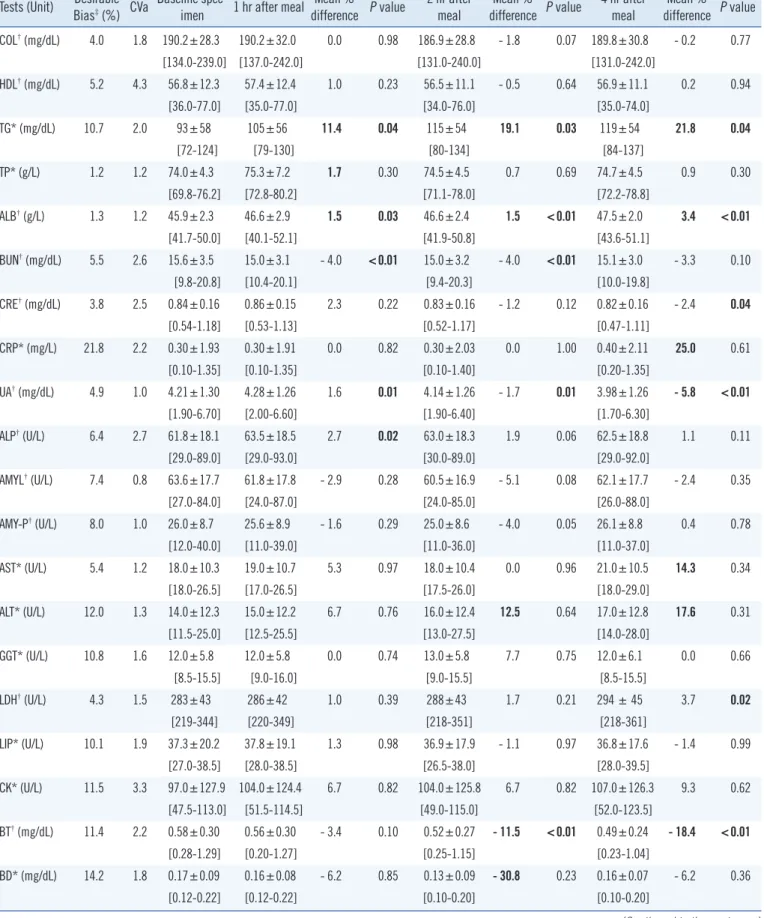
many), according to the manufacturer’s specifications and us- ing proprietary reagents. The panel of tests included the follow- ing: total cholesterol (COL), HDL cholesterol, triglycerides (TG), total protein (TP), albumin (ALB), blood urea nitrogen (BUN), creatinine (CRE), C-reactive protein (CRP), uric acid (UA), alka- line phosphatase (ALP), amylase (AMYL), pancreatic amylase (AMY-P), AST, ALT, γ-glutamyltransferase (GGT), lactate dehy- drogenase (LDH), lipase (LIP), creatine kinase (CK), total biliru- bin (BT), direct bilirubin (BD), P, Ca, Mg, Fe, Na, K, and Cl. The instrument was calibrated against appropriate proprietary refer- ence standard materials and verified with the use of proprietary quality controls. Our evaluation of the within-run precision by in- ternal quality control on the cobas® 6000 <c501> module (Roche Diagnostics GmbH) showed low coefficients of variation (Table 2).
4. Statistical analysis
The significance of differences between samples was assessed by using the paired t-test after verifying normality by employing the D’Agostino-Pearson omnibus test. Because non-normal dis- tribution was found for TG, TP, CRP, AMY-P, AST, ALT, GGT, LIP, CK, BD, Mg, and Cl, results were assessed by using Wilcoxon ranked-pairs test. The level of statistical significance was set at P <0.05. Finally, the biases at 1, 2, and 4 hr after intake of a standardized meal were compared with the current desirable quality specifications for bias (B), derived from biological varia- tion [11].
RESULTS
The results of this investigation are shown in Table 2; clinically significant variations are shown in Fig. 1 and 2. One hour after ingestion of the meal, significant increases were observed in TG, ALB, UA, ALP, Ca, Fe, and Na, whereas BUN and P were signif- icantly decreased. However, a clinically significant variation ac- cording to the current desirable quality specifications [11] was only observed for TG, ALB, Ca, Na, P, and TP (the increase in TP was not statistically significant according to the Mann-Whit- ney test). Two hours after ingestion of the meal, TG, ALB, Ca, Fe, and Na remained significantly increased, whereas BUN, P, UA, and BT were significantly decreased. Clinically significant variations were recorded for TG, ALB, ALT, Ca, Fe, Na, P, BT, and BD (the increase in ALT and decrease in BD were not sta- tistically significant according to the Mann-Whitney test). Four hours after ingestion of the meal, TG, ALB, Ca, Fe, Na, LDH, P, Mg, and K were significantly increased, while UA and BT were
significantly decreased. Clinically significant variations were re- corded for TG, ALB, ALT, Ca, Na, Mg, K, CRP, AST, UA, and BT (the increases in CRP, AST, and ALT were not statistically signifi- cant according to the Mann-Whitney test).
DISCUSSION
Clinical laboratory services are a vital part of healthcare systems [7]. Appropriateness in ordering and interpreting results of labo- ratory testing is an unquestionable part of the physician’s clini- cal background, and is characterized by both her/his cumulated experience and updated scientific knowledge [12]. On the other hand, ensuring appropriateness requires increased feedback between clinicians and laboratory professionals [13]. Outpatients are usually referred to clinical laboratories with test request forms of the referring physician. In such a situation -if the physician had requested a lipid profile or glucose determination among other routine tests such as ions, proteins and/or enzymes-the laboratory staff recalls the need for indicating a fasting time be- fore blood collection, as suggested by international and local guidelines. Alternatively, when the same outpatient shows a test request form without request for a lipid profile or glucose deter- mination, no need of indicating a fasting time appears strictly justified, more so as the new instruments and diagnostic kit datasheets inform that there is no expected interference.
Nevertheless, this appears more of a habit rather than an evi- dence-based practice according to research findings. In fact, the influence of a regular meal has never been evaluated as re- ported in our protocol and to the best of our knowledge. Our re- sults show that such a practice, on the basis of analytical infor- mation, is appropriate for many routine clinical chemistry labo- ratory tests (e.g. COL, HDL, CRE, AMYL, AMY-P, GGT, LIP, CK, and Cl). Consequently, the laboratory quality managers can ac- curately standardize the procedures. For other very important biochemistry markers, this is, however, unjustified. Food intake triggers several physiologic responses that could affect labora- tory blood biochemical markers. A meal load increases hydro- chloride acid in the stomach and bicarbonate in the blood (“al- kaline tide”) [14]. In addition, several hormones are stimulated (e.g., insulin, glucagon) and molecules from the gut enter the blood stream [15, 16]. Therefore, the resultant effect of food in- take on serum marker concentrations reflects the interactions of several elements. In our study, the only component of the lipid profile affected by a light meal was TG. This neutral fat was ab- sorbed and a clinically significant increase in serum levels was observed. Our lipid results are in agreement with those reported
Table 2. Postprandial variation of the routine clinical chemistry tests after a light meal Tests (Unit) Desirable
Bias‡ (%) CVa Baseline spec-
imen 1 hr after meal Mean %
difference P value 2 hr after
meal Mean %
difference P value 4 hr after
meal Mean % difference P value COL† (mg/dL) 4.0 1.8 190.2±28.3 190.2±32.0 0.0 0.98 186.9±28.8 - 1.8 0.07 189.8±30.8 - 0.2 0.77
[134.0-239.0] [137.0-242.0] [131.0-240.0] [131.0-242.0]
HDL† (mg/dL) 5.2 4.3 56.8±12.3 57.4±12.4 1.0 0.23 56.5±11.1 - 0.5 0.64 56.9±11.1 0.2 0.94
[36.0-77.0] [35.0-77.0] [34.0-76.0] [35.0-74.0]
TG* (mg/dL) 10.7 2.0 93±58 105±56 11.4 0.04 115±54 19.1 0.03 119±54 21.8 0.04
[72-124] [79-130] [80-134] [84-137]
TP* (g/L) 1.2 1.2 74.0±4.3 75.3±7.2 1.7 0.30 74.5±4.5 0.7 0.69 74.7±4.5 0.9 0.30
[69.8-76.2] [72.8-80.2] [71.1-78.0] [72.2-78.8]
ALB† (g/L) 1.3 1.2 45.9±2.3 46.6±2.9 1.5 0.03 46.6±2.4 1.5 <0.01 47.5±2.0 3.4 <0.01
[41.7-50.0] [40.1-52.1] [41.9-50.8] [43.6-51.1]
BUN† (mg/dL) 5.5 2.6 15.6±3.5 15.0±3.1 - 4.0 <0.01 15.0±3.2 - 4.0 <0.01 15.1±3.0 - 3.3 0.10
[9.8-20.8] [10.4-20.1] [9.4-20.3] [10.0-19.8]
CRE† (mg/dL) 3.8 2.5 0.84±0.16 0.86±0.15 2.3 0.22 0.83±0.16 - 1.2 0.12 0.82±0.16 - 2.4 0.04
[0.54-1.18] [0.53-1.13] [0.52-1.17] [0.47-1.11]
CRP* (mg/L) 21.8 2.2 0.30±1.93 0.30±1.91 0.0 0.82 0.30±2.03 0.0 1.00 0.40±2.11 25.0 0.61
[0.10-1.35] [0.10-1.35] [0.10-1.40] [0.20-1.35]
UA† (mg/dL) 4.9 1.0 4.21±1.30 4.28±1.26 1.6 0.01 4.14±1.26 - 1.7 0.01 3.98±1.26 - 5.8 <0.01
[1.90-6.70] [2.00-6.60] [1.90-6.40] [1.70-6.30]
ALP† (U/L) 6.4 2.7 61.8±18.1 63.5±18.5 2.7 0.02 63.0±18.3 1.9 0.06 62.5±18.8 1.1 0.11
[29.0-89.0] [29.0-93.0] [30.0-89.0] [29.0-92.0]
AMYL† (U/L) 7.4 0.8 63.6±17.7 61.8±17.8 - 2.9 0.28 60.5±16.9 - 5.1 0.08 62.1±17.7 - 2.4 0.35
[27.0-84.0] [24.0-87.0] [24.0-85.0] [26.0-88.0]
AMY-P† (U/L) 8.0 1.0 26.0±8.7 25.6±8.9 - 1.6 0.29 25.0±8.6 - 4.0 0.05 26.1±8.8 0.4 0.78
[12.0-40.0] [11.0-39.0] [11.0-36.0] [11.0-37.0]
AST* (U/L) 5.4 1.2 18.0±10.3 19.0±10.7 5.3 0.97 18.0±10.4 0.0 0.96 21.0±10.5 14.3 0.34
[18.0-26.5] [17.0-26.5] [17.5-26.0] [18.0-29.0]
ALT* (U/L) 12.0 1.3 14.0±12.3 15.0±12.2 6.7 0.76 16.0±12.4 12.5 0.64 17.0±12.8 17.6 0.31
[11.5-25.0] [12.5-25.5] [13.0-27.5] [14.0-28.0]
GGT* (U/L) 10.8 1.6 12.0±5.8 12.0±5.8 0.0 0.74 13.0±5.8 7.7 0.75 12.0±6.1 0.0 0.66
[8.5-15.5] [9.0-16.0] [9.0-15.5] [8.5-15.5]
LDH† (U/L) 4.3 1.5 283±43 286±42 1.0 0.39 288±43 1.7 0.21 294 ± 45 3.7 0.02
[219-344] [220-349] [218-351] [218-361]
LIP* (U/L) 10.1 1.9 37.3±20.2 37.8±19.1 1.3 0.98 36.9±17.9 - 1.1 0.97 36.8±17.6 - 1.4 0.99
[27.0-38.5] [28.0-38.5] [26.5-38.0] [28.0-39.5]
CK* (U/L) 11.5 3.3 97.0±127.9 104.0±124.4 6.7 0.82 104.0±125.8 6.7 0.82 107.0±126.3 9.3 0.62
[47.5-113.0] [51.5-114.5] [49.0-115.0] [52.0-123.5]
BT† (mg/dL) 11.4 2.2 0.58±0.30 0.56±0.30 - 3.4 0.10 0.52±0.27 - 11.5 <0.01 0.49±0.24 - 18.4 <0.01
[0.28-1.29] [0.20-1.27] [0.25-1.15] [0.23-1.04]
BD* (mg/dL) 14.2 1.8 0.17±0.09 0.16±0.08 - 6.2 0.85 0.13±0.09 - 30.8 0.23 0.16±0.07 - 6.2 0.36
[0.12-0.22] [0.12-0.22] [0.10-0.20] [0.10-0.20]
(Continued to the next page)
Table 2. (Continued from the previous page) Postprandial variation of the routine clinical chemistry tests after a light meal Tests (Unit) Desirable
Bias‡ (%) CVa Baseline
specimen 1 hr after meal Mean %
difference P value 2 hr after meal Mean %
difference P value 4 hr after
meal Mean % difference P value P† (mg/dL) 3.2 3.0 3.9±0.4 3.6±0.4 - 8.3 <0.01 3.7±0.3 - 5.4 <0.01 4.1±0.4 4.9 <0.01
[2.8-4.5] [2.5-3.9] [2.9-4.2] [3.4-4.9]
Ca† (mg/dL) 0.8 0.7 9.1±0.2 9.3±0.2 2.2 <0.01 9.4±0.2 3.2 <0.01 9.4±0.3 3.2 <0.01
[8.8-9.5] [8.9-9.7] [9.0-9.8] [9.0-10.0]
Mg* (mg/dL) 1.8 1.2 2.15±0.14 2.12±0.15 - 1.4 0.16 2.16±0.16 0.5 0.67 2.22±0.14 3.2 0.04
[2.08-2.24] [2.02-2.18] [2.06-2.22] [2.14-2.36]
Fe† (μg/dL) 8.8 2.6 77±24 83±28 7.2 <0.01 85±29 9.4 <0.01 82±28 6.1 0.03
[44-127] [43-140] [46-140] [43-145]
Na† (mmol/L) 0.3 1.0 138.8±1.9 140.4±2.0 1.1 <0.01 139.7±2.1 0.6 <0.01 139.4±2.2 0.4 0.04
[134.0-142.0] [135.0-145.0] [135.0-145.0] [135.0-143]
K† (mmol/L) 1.8 1.5 4.20±0.20 4.16±0.33 - 1.0 0.72 4.24±0.19 0.9 0.72 4.46±0.37 5.8 0.01
[3.67-4.53] [3.69-4.71] [3.92-4.56] [3.98-5.40]
Cl* (mmol/L) 0.5 1.8 103.5±2.2 103.7±2.1 0.2 0.89 103.8±1.9 0.3 0.79 103.4±1.8 - 0.1 0.72
[102.5-105.0] [103.0-105.5] [103.0-105.0] [102.5-105.0]
*Non-normal distribution; the values were median±SD [25-75th interquartile range]; P value represents the significance by Wilcoxon ranked-pairs test;
†Normal distribution; the values were mean±SD [range: minimum-maximum]; P value represents the significance by paired t-test. Bold P values indicate statistical significance (P <0.05) and bold mean % differences represent clinically significant variations, when compared with desirable bias [11]; ‡Desirable bias specification based on biological variation.
Abbreviations: COL, total cholesterol; TG, triglycerides; TP, total protein; ALB, albumin; BUN, blood urea nitrogen; CRE, creatinine; CRP, C-reactive protein;
UA, uric acid; ALP, alkaline phosphatase; AMYL, amylase; AMY-P, pancreatic amylase; GGT, γ-glutamyltransferase; LDH, lactate dehydrogenase; LIP, lipase;
CK, creatine kinase; BT, total bilirubin; BD, direct bilirubin.
Percentage variation (%)
10
5
0
-5
-10 Baseline 1 2 3 4 Time (hr)
Fig. 2. Percentage of postprandial variation in serum levels of iron and electrolytes after a light meal. Percentage variation (%) were the differences of analytes serum levels from baseline (time 0) to the different studied times. The analytes were P, Ca, Mg, Fe, Na, and K.
P Ca Mg
Na Fe
K TG
ALB CRP UA AST ALT BT BD
Percentage variation (%)
35 25 15 5 -5 -15 -25
-35 Baseline 1 2 3 4 Time (hr)
Fig. 1. Percentage of postprandial variation in serum levels of several analytes after a light meal. Percentage variation (%) were the differences of analytes serum levels from baseline (time 0) to the different studied times.
The analytes were TG, triglycerides; ALB, albumin; CRP, C-reactive protein;
UA, uric acid; AST; ALT; BT, total bilirubin; and BD, direct bilirubin.
by Cohn et al. [17]. Of the major non-protein nitrogen compounds of clinical relevance in serum (BUN, CRE, and UA), only UA showed a clinically significant difference. TP and CRP showed no statistically significant variations. Serum ALB consistently in- creased after a light meal. This is in agreement with other stud- ies, which showed that feeding stimulates ALB synthesis and this event might improve the storage of essential amino acids
[18-21]. From the results of the enzyme panel studied, only AST and ALT showed a clinically significant increase after 4 hr of light meal ingestion. Ryan et al. demonstrated that the serum concentration of ALT decreases with alimentary restriction [22].
Meyer et al. [23] showed that the minimum BT concentration was measured 4 hr after supper. A fasting state increases he- patic uptake of non-esterified fatty acids and interferes with the
hepatic clearance of bilirubin, thus, contributing to unconjugated hyperbilirubinemia of fasting [24]. Our results showed that after 2 hr of a light meal, serum levels of bilirubin were clinically sig- nificantly decreased as compared to the fasting state. Insulin secretion after a meal induces significant changes in ions [25- 29], routinely measured in clinical laboratories.
When looking at the above results, these parameters might be regarded as clinically irrelevant. However, such a conclusion would be wrong with respect to the current quality specifications for bias, derived from biological variation (Table 2) [11]. Quality managers of medical laboratories consider the quality specifica- tions derived from biological variation [11] both very important and useful in daily practice [30-33]. With regard to ALB, this assay is frequently prescribed by physicians in order to evaluate symptoms of liver disorders or kidney diseases, to assess an un- explainable weight loss with symptoms associated with malnu- trition, or to screen prior to a planned surgery. Patients in critical care settings are sometimes in need of human ALB concentrate infusion [34], but the administration might be delayed due to in- appropriate decisions based on inobservance of the fasting time.
Patients with chronic kidney disease often experience secondary hyperparathyroidism [35] as a consequence of hyperphospha- temia, hypocalcemia, and reduced levels of 1,25-dihydroxy-vita- min D [36]. In end-stage kidney disease patients, secondary hy- perparathyroidism is associated with renal bone disease as well as with increased cardiovascular morbidity and mortality [37, 38].
Clinical guidelines for the treatment of disturbances in mineral and bone metabolism in patients with chronic kidney disease and, in particular, with end-stage kidney disease include recom- mendations for clinical interpretation of plasma Ca levels [39].
The present results show that although the target concentrations for Ca, P, and Ca×P product are sometimes close to the normal range, even in patients with end-stage kidney disease [40], the fasting time before blood collection can significantly influence P and Ca levels. Even in this case, caring physicians unaware of the patient’s real situation can adopt inappropriate treatments as a consequence of inadequate fasting time observance.
In conclusion, the significant variation of several clinical chem- istry parameters after a regular meal demonstrates that the fast- ing time needs to be carefully considered when performing test- ing in order to prevent spurious results and reduce laboratory er- rors, especially in the emergency setting. We suggest that the laboratory management should standardize the fasting time for all laboratory tests, independent of a lipid profile request.
Authors’ Disclosures of Potential Conflicts of Interest
No potential conflicts of interest relevant to this article were re- ported.
Acknowledgements
Our special thanks for all volunteers from Laboratory of Clinical Biochemistry, Department of Life and Reproduction Sciences, University of Verona, Italy.
REFERENCES
1. Lippi G, Lima-Oliveira G, Salvagno GL, Montagnana M, Gelati M, Picheth G, et al. Influence of a light meal on routine haematological tests. Blood Transfus 2010;8:94-9.
2. Lima-Oliveira G, Salvagno GL, Lippi G, Montagnana M, Scartezini M, Pi- cheth G, et al. Elimination of the venous stasis error for routine coagula- tion testing by transillumination. Clin Chim Acta 2011;412:1482-4. 3. Lima-Oliveira G, Lippi G, Salvagno GL, Montagnana M, Scartezini M,
Guidi GC, et al. Transillumination: a new tool to eliminate the impact of venous stasis during the procedure for the collection of diagnostic blood specimens for routine haematological testing. Int J Lab Hematol 2011; 33:457-62.
4. Loh TP, Saw S, Chai V, Sethi SK. Impact of phlebotomy decision support application on sample collection errors and laboratory efficiency. Clin Chim Acta 2011;412:393-5.
5. Lippi G, Lima-Oliveira G, Nazer SC, Moreira ML, Souza RF, Salvagno GL, et al. Suitability of a transport box for blood sample shipment over a long period. Clin Biochem 2011;44:1028-9.
6. Young DS. Effects of preanalytical variables on clinical laboratory tests.
3rd ed. Washington, DC: AACC Press, 2007.
7. Hallworth M, Hyde K, Cumming A, Peake I. The future for clinical sci- entists in laboratory medicine. Clin Lab Haematol 2002;24:197-204. 8. Clinical Laboratory Standards Institute. Procedures for the collection of
diagnostic blood specimens by venipuncture. 6th ed. CLSI H3-A6 docu- ment. Wayne, PA: Clinical Laboratory Standards Institute, 2007. 9. Guder WG, Narayanan S, Wisser H, Zawta B. Diagnostic samples: from
the patient to the laboratory: the impact of preanalytical variables on the quality of laboratory results. 4th ed. New York: Wiley-Blackwell, 2009. 10. Clinical Laboratory Standards Institute. Procedures for the handling and
processing of blood specimens for common laboratory tests. 4th ed.
CLSI H18-A4 document. Wayne, PA: Clinical Laboratory Standards In- stitute, 2010.
11. Ricós C, Alvarez V, Cava F, García-Lario JV, Hernández A, Jiménez CV, et al. Current databases on biological variation: pros, cons and prog- ress. Scand J Clin Lab Invest 1999;59:491-500.
12. Guidi GC and Lippi G. Laboratory medicine in the 2000s: programmed death or rebirth? Clin Chem Lab Med 2006;44:913-7.
13. Pagni A and Plebani M. The laboratory and the general practitioner. Clin Chim Acta 1999;280:13-24.
14. Johnson CD, Mole DR, Pestridge A. Postprandial alkaline tide: does it exist? Digestion 1995;56:100-6.
15. Batterham RL, Cowley MA, Small CJ, Herzog H, Cohen MA, Dakin CL, et al. Gut hormone PYY(3-36) physiologically inhibits food intake. Nature 2002;418:650-4.
16. Korbonits M, Blaine D, Elia M, Powell-Tuck J. Metabolic and hormonal changes during the refeeding period of prolonged fasting. Eur J Endo- crinol 2007;157:157-66.
17. Cohn JS, McNamara JR, Cohn SD, Ordovas JM, Schaefer EJ. Postpran- dial plasma lipoprotein changes in human subjects of different ages. J Lipid Res 1988;29:469-79.
18. De Feo P, Horber FF, Haymond MW. Meal stimulation of albumin synthe- sis: a significant contributor to whole body protein synthesis in humans.
Am J Physiol 1992;263:E794-9.
19. Caso G, Feiner J, Mileva I, Bryan LJ, Kelly P, Autio K, et al. Response of albumin synthesis to oral nutrients in young and elderly subjects. Am J Clin Nutr 2007;85:446-51.
20. Hunter KA, Ballmer PE, Anderson SE, Broom J, Garlick PJ, McNurlan MA. Acute stimulation of albumin synthesis rate with oral meal feeding in healthy subjects measured with [ring-2H5]phenylalanine. Clin Sci (Lond) 1995;88:235-42.
21. Jefferson LS. Lilly Lecture 1979: role of insulin in the regulation of pro- tein synthesis. Diabetes 1980;29:487-96.
22. Ryan MC, Abbasi F, Lamendola C, Carter S, McLaughlin TL. Serum ala- nine aminotransferase levels decrease further with carbohydrate than fat restriction in insulin-resistant adults. Diabetes Care 2007;30:1075-80. 23. Meyer BH, Scholtz HE, Schall R, Müller FO, Hundt HK, Maree JS. The
effect of fasting on total serum bilirubin concentrations. Br J Clin Phar- macol 1995;39:169-71.
24. Cowan RE and Thompson RP. Fatty acids and the control of bilirubin levels in blood. Med Hypotheses 1983;11:343-51.
25. Al-Rubeaan K, Siddiqui K, Abu Risheh K, Hamsirani R, Alzekri A, Alas- eem A, et al. Correlation between serum electrolytes and fasting glucose and Hb1Ac in Saudi diabetic patients. Biol Trace Elem Res 2011;144: 463-8.
26. Rohrscheib M, Tzamaloukas AH, Ing TS, Siamopoulos KC, Elisaf MS, Murata HG. Serum potassium concentration in hyperglycemia of chron- ic dialysis. Adv Perit Dial 2005;21:102-5.
27. Gozansky DM and Herman RH. Water and sodium retention in the fast- ed and refed human. Am J Clin Nutr 1971;24:869-71.
28. Bloom WL. Inhibition of salt excretion by carbohydrate. Arch Intern Med 1962;109:26-32.
29. Fernández-Real JM, López-Bermejo A, Ricart W. Cross-talk between iron metabolism and diabetes. Diabetes 2002;51:2348-54.
30. Ricós C, Cava F, García-Lario JV, Hernández A, Iglesias N, Jiménez CV, et al. The reference change value: a proposal to interpret laboratory re- ports in serial testing based on biological variation. Scand J Clin Lab In- vest 2004;64:175-84.
31. Westgard J. Desirable Biological Variation Database Specifications. http:
//www.westgard.com/biodatabase1.htm (Updated on Jan 2012).
32. Cembrowski GS, Tran DV, Higgins TN. The use of serial patient blood gas, electrolyte and glucose results to derive biologic variation: a new tool to assess the acceptability of intensive care unit testing. Clin Chem Lab Med 2010;48:1447-54.
33. Plebani M and Lippi G. Biological variation and reference change val- ues: an essential piece of the puzzle of laboratory testing. Clin Chem Lab Med 2012;50:189-90.
34. Boldt J. Use of albumin: an update. Br J Anaesth 2010;104:276-84. 35. Kestenbaum B and Belozeroff V. Mineral metabolism disturbances in
patients with chronic kidney disease. Eur J Clin Invest 2007;37:607-22. 36. Locatelli F, Cannata-Andía JB, Drüeke TB, Hörl WH, Fouque D, Heim-
burger O, et al. Management of disturbances of calcium and phosphate metabolism in chronic renal insufficiency, with emphasis on the control of hyperphosphataemia. Nephrol Dial Transplant 2002;17:723-31. 37. Block GA, Hulbert-Shearon TE, Levin NW, Port FK. Association of serum
phosphorus and calcium x phosphate product with mortality risk in chronic hemodialysis patients: a national study. Am J Kidney Dis 1998; 31:607-17.
38. Young EW, Akiba T, Albert JM, McCarthy JT, Kerr PG, Mendelssohn DC, et al. Magnitude and impact of abnormal mineral metabolism in hemo- dialysis patients in the Dialysis Outcomes and Practice Patterns Study (DOPPS). Am J Kidney Dis 2004;44:34-8.
39. National Kidney Foundation. K/DOQI clinical practice guidelines for bone metabolism and disease in chronic kidney disease. Am J Kidney Dis 2003;42(S3):S1-201.
40. Ferrari P, Singer R, Agarwal A, Hurn A, Townsend MA, Chubb P. Serum phosphate is an important determinant of corrected serum calcium in end-stage kidney disease. Nephrology (Carlton) 2009;14:383-8.