The Role of People, Information, and Technology in LIS
Education: Driving a Call for Action Towards the UN 2030
Agenda
Heesop Kim
Department of Library & Information Science Kyungpook National University
Daegu, Korea
E-mail: [email protected]
Reysa C. Alenzuela *
Central Philippine University Iloilo City, PhilippinesE-mail: [email protected] [email protected]
Open Access
Accepted date: November 21, 2016 Received date: September 22, 2016 *Corresponding Author: Reysa C. Alenzuela
Lecturer
Central Philippine University Iloilo City, Philippines E-mail: [email protected]
All JISTaP content is Open Access, meaning it is accessible online to everyone, without fee and authors’ permission. All JISTaP content is published and distributed under the terms of the Creative Commons Attribution License (http:/ creativecommons. org/licenses/by/3.0/). Under this license, authors reserve the copyright for their content; however, they permit anyone to unrestrictedly use, distribute, and reproduce the content in any medium as far as the original authors and source are cited. For any reuse, redistribution, or reproduction of a work, users must clarify the license terms under which the work was produced.
ABSTRACT
Around the world, public access to information plays a crucial role in improving lives and facilitating development. People, technology, and information, which also represent common themes of i-Schools, are deemed relevant in adapting to these global challenges. The main purpose of this research is to identify the orientation of curriculums in LIS Schools in South Korea toward technology, information, and people for graduate schools of library and information science. This research also correlates the directions of the schools with the UN 2030 Agenda. Using the Wilson model, this study examines the orientation of courses offered. The result of classification and content analysis revealed that courses offered are leaning towards technology and information content. Courses reviewed in the light of developing knowledge and skills of information professionals to facilitate the fulfillment of global goals can make libraries more responsive to the changing times.
Keywords: UN 2030 Agenda, LIS Education, iSchool, South Korea
http://dx.doi.org/10.1633/JISTaP.2016.4.4.2
1. INTRODUCTION
Librarians are movers and shakers that catapult information and communication technology (ICT) infrastructure, help people develop the capacity to ef-fectively use information, and preserve local knowledge to ensure ongoing access for future generations. With these aims, libraries need to forge dynamism to keep the balance of knowledge, skills, and attitude in man-aging people, technology, and information. Dynamic programs and projects begin with innovative and skilled pools of library professionals. Graduate studies is one of the avenues to enhance knowledge and skills of present and prospective library professionals. People, technolo-gy, and information are deemed relevant in the chang-ing times and in adaptchang-ing to global challenges. More importantly, libraries are entrusted with a major role in driving progress across the UN 2030 Agenda.
In September 2015, the heads of state and government and high representatives decided on new global Sustain-able Development Goals (SGDs)—a historic decision on a comprehensive, far-reaching, and people-centered set of universal and transformative goals and targets, for the full implementation of the agenda by 2030. This agenda is a plan of action for people, planet, and prosperity. It also seeks to strengthen universal peace in larger free-dom. All countries and all stakeholders act in collabora-tive partnership to implement this plan. The following 17 SGDs aim to stimulate action over the next fifteen years:
1. End poverty in all its forms everywhere.
2. End hunger, achieve food security and improved nutrition, and promote sustainable agriculture. 3. Ensure healthy lives and promote well-being for
all at all ages.
4. Ensure inclusive and equitable quality education and promote lifelong learning opportunities for all.
5. Achieve gender equality and empower all women and girls.
6. Ensure availability and sustainable management of water and sanitation for all.
7. Ensure access to affordable, reliable, sustainable, and modern energy for all.
8. Promote sustained, inclusive, and sustainable eco-nomic growth, full and productive employment, and decent work.
9. Build resilient infrastructure, promote inclusive and sustainable industrialization, and foster inno-vation.
10. Reduce inequality within and among countries. 11. Make cities and human settlements inclusive, safe,
resilient, and sustainable.
12. Ensure sustainable consumption and production patterns.
13. Take urgent action to combat climate change and its impacts.
14. Conserve and sustainably use the oceans, seas, and marine resources for sustainable develop-ment.
15. Protect, restore, and promote sustainable use of terrestrial ecosystems, sustainably manage forests, combat desertification, and halt and reverse land degradation and halt biodiversity loss.
16. Promote peaceful and inclusive societies for sus-tainable development, provide access to justice for all, and build effective, accountable, and inclusive institutions at all levels.
17. Strengthen the means of implementation and revitalize the global partnership for sustainable development.
The inclusion of libraries and access to information as part of national and regional development plans hopes to contribute to meeting this UN 2030 Agenda, “Transforming our World: the 2030 Agenda for Sustain -able Development.” Amidst the changing platform, LIS practitioners and educators incessantly advance the im-portance of libraries.
The 17 SDGs and 169 targets demonstrate the scale and ambition of this new universal agenda. They seek to build on the Millennium Development Goals and com-plete what they did not achieve. They seek to realize the human rights of all and to achieve gender equality and the empowerment of all women and girls. They are inte-grated and indivisible and balance the three dimensions of sustainable development: economic, social, and en-vironmental. The goals and targets will stimulate action over the next 15 years in areas of critical importance for humanity and the planet.
guidelines and information on how libraries meet the 17 SDGs; however, nothing mentions about how the cur-riculum will develop skills of information professionals to be able to manage information and foster libraries that will meet the agenda.
Post-graduate programs are the key to developing skills for increased advocacy and visibility in the local community. This will enable libraries to succeed in im-plementing the need of access of information. Advocacy is essential to secure recognition for the role of libraries as engines of local development. Thus, the researchers ventured to look into the post-graduate LIS programs in South Korea as it brings in the above advocacy into skillsets to be honed in the fulfillment of the UN 2030 Agenda.
2. OBJECTIVES
The main purpose of this study is to identify the orientation of curriculums in South Korea toward tech-nology, information, and people for graduate schools of library and information science as it correlates the directions of the schools with the UN 2030 Agenda.
Specifically, this study aims to:
1. examine the orientation of post-graduate courses offered in LIS schools in South Korea using the Wilson model;
2. analyze the interaction of three important com-ponents advanced in the information studies field along with other disciplines; and
3. correlate the course offerings to their significance in fulfilling the 2030 Agenda for Sustainable De-velopment.
3. METHODOLOGY
3.1. Grounded Theory and the Typology for Information Studies
As a general method for comparative analysis, the researchers anchored on grounded theory (Pickard, 2013). This study used the mixed method of research approaching an inquiry or investigation that combines or associates both qualitative and quantitative forms. This methodology is deemed appropriate as combining different data collection strategies and analyses can
pro-vide a more meaningful result. Furthermore, data from the qualitative and quantitative strands can be collected sequentially or concurrently (Creswell, 2009).
Glasser and Strauss (1967) advanced that theories should be “grounded” in the data collected in the field and not imposed by a set of predispositions brought about by the researcher. Using Wilson’s typology as a general theoretical framework, courses were catego-rized. From this categorization a conceptualization was derived. In order to avoid the pitfall of fitting data into existing categories on the assumption that categories may have emerged from the data, the researcher an-alyzed the data along with documents such as course objectives, programs, institutional and departmental goals, and policies from institutions where the course came from. Concepts from related studies were also consulted vis-à-vis data analysis. Documentary analysis has become an essential part as the researcher per-formed data collection simultaneously with analysis in order to develop the theory or concept during each step.
the evidence and emerging categories is a continuous commentary of the researcher on the data in the form of memos (Glaser, 1998). It helped gather insights and allowed refinement of classification.
3.2. Demographic Profile
Table 1 shows the total number of schools offering post-graduate courses in South Korea. Out of the 42 LIS schools, 30 offer Master degree programs in Li-brary and Information Science (archives excluded) and 22 have Ph.D. courses. Among the institutions, 27 that offer master’s degrees responded and 20 offering Ph.D. programs sent the list of courses offered in their LIS programs (Table 2).
4. REVIEW OF RELATED LITERATURE
People in schools of library and information science differ very much in their theoretical orientation and on what problems they focus (Ollson, 1995). Those focused on the use of IT have a tendency to prefer the term “information science” while people engaged in library history often prefer “library studies” (Hjorland, 2001). The field can be approached from different angles, using different disciplinary perspectives. As Ribeiro (2007) describes, “a new perspective of con-vergence has as its object of study on information and is seen as a unified and interdisciplinary field that
convokes other disciplines in an obvious and profitable interdisciplinarity.”
Numerous studies have sought to define the field and to examine links, relations, and overlap between infor-mation science and other fields. Jaeger, Golbeck, Druin, and Fleischmann (2010) noted that, “as the research and education in the field become more interdisciplin-ary, previous approaches to curriculum will likely be insufficient to serve the goals of doctoral education, and a comprehensive and ongoing discussion will be necessary to support the development of new programs across the field.” Golde and Dore (2004) noted that it is important to think in “discipline-specific ways in all matters related to doctoral education—in this case, the preparation of new faculty, the nature of doctoral edu-cation differs among disciplines, and not surprisingly, the preparation of new faculty also differs among dis-ciplines.” Barry et al. (2008) point out that interdiscipli-narity is not historically novel, but has been central to the evolution of disciplines.
In Korea, the LIS curriculum development has been the emphasis of various research efforts. Analysis of LIS curriculum development from many different per-spectives was the center of studies of Park (2000), Noh (2005), and Oh and Chang (2006). Kim (1998), Hahn (1998), and Um (2003) looked into the LIS develop-ment under the academic departdevelop-ment system in Korea. Central to this study is the Wilson model. Wilson (2001) posits that information studies may be seen as
Table 1. Total Number of Schools Offering Post Graduate Courses in South Korea
Institutions Offering Post Graduate Programs n
Master’s Degree 30
Ph.D. 22
Table 2. Total Number of Schools Participating in the Survey Offering Post-Graduate Courses in South Korea Institutions Offering Post Graduate Programs n
Master’s Degree 27
resulting from the interaction among four fields, which are information content, information systems, people, and organization. The map is useful to show the possi-ble relationships among subjects and the intersections of the fields.
4.1. Mapping the Curriculum Towards UN 2030 Goals
LIS is deemed most functional and useful in current society if it leads to creation of a theoretical, conceptu-al, and methodological identity, so that more coherent and integrated results are obtained. That convergence among disciplines is accompanied by a mutual integra-tion of disciplinary epistemologies (Van den Besselaar & Heimeriks, 2001).
Beyond knowledge of information resources, access, technology, and management, the ability to use this knowledge in providing the highest quality informa-tion services, should match a set of attitudes, skills, and values. This will enable practitioners to work effectively and contribute positively to their organizations, clients, and profession.
Information studies may be seen as resulting from the interaction among these four fields, which are in-formation content, inin-formation systems, people, and organization (Wilson, 2001). The Wilson model used in the analysis shows the possible relationships among subjects and the intersections of the fields. This typol-ogy of the areas related to information studies logically derived can be used in different ways: 1) to identify the curriculum areas that may be of importance in the construction of a degree program, 2) to identify all of the sub-fields as areas of interest and construct a broad curriculum, and 3) to focus on one particular main field, such as information systems, and select from its intersections with other fields those that would make up a useful and interesting special program or area of concentration.
In this macro analysis of more than 1,000 courses, Wilson’s typology served as main reference to classify the course offerings that connect to the UN 2030 Agen-da. Based on the abovementioned model, the following categories are explained below:
A – Information content. This category deals with the management of information content as the traditional function of libraries and information services more of-ten referred to as “information sources.”
B – Information systems. Information Systems exists as a separate field of study, sometimes independently but more often as a part of computer science depart-ments or business schools. This category includes courses wherein the orientation as a discipline is to-wards information in organizational settings, and in this context the term is used to identify not only the technology but also the human systems through which information sources and resources may be organized and managed.
C – People. This category covers studies both on information users and information providers in the sense of those who manage information providing or-ganizations that have information systems and services, and it also covers those who manage the information providing organizations and organizations that have information systems and services within them.
D – Organization. This category focuses on organiza-tions such as publishers that produce information con-tent and that constitute an important part of the infor-mation chain; libraries and other inforinfor-mation agencies that have traditionally managed information content and organizations in which information is managed and within which people use information.
E – Policy, planning, and strategy. It can be observed that there are subfields which may appear repetitive or duplicating, such as AB and BA, AC and CA, or BC and CB. The interactions among these subfields are treated differently as to orientation. For example, in the case of AB (information and technology) and BA (systems acting on content), the peculiarity lies in the fact that the former emphasizes information as the main focus while the latter underscores systems or technology in its essential function with content or information.
Assignments of fields and how they are perceived in a particular country may vary. For this study, the fol-lowing subfields have evolved:
AB - Information and technology. This category deals with courses on production of information with the use of technology.
ABC - Information seeking and searching. This cat-egory is focused on information content in systems as used by people.
AC - Information content organized to fulfill the in-formation needs of a specific group of users (Bronstein, 2007). This category includes courses that emphasize the organization of information, organization that is planned around a specific group of users.
ACD - Information content, people, and organiza-tions; courses that deal with the role of information content in the information society/ organization and information content interacting with people.
AD - Information content in organizations. This category includes courses that emphasize the roles that information content organizations play and that constitute an important part of the information chain in society at large. This study also deals with issues on information in general.
BA- Systems acting on content; information retrieval systems. This category includes courses that emphasiz-es technology and its relation to the development and delivery of information.
BC - Principles of information systems design based on human/ system interaction. This category includes courses that emphasize the design of information sys-tems, taking into account elements of human interac-tion with the system.
BCD - Information systems, people, and organiza-tion. This category includes courses that emphasize the design of information systems, taking into account ele-ments of human interaction with the system as it affects a bigger organization or institution.
BD - Systems and organizations. This category in-cludes courses emphasizing systems role in information producing organizations or in the society at large.
CA - People interacting with information content (Bronstein, 2007). This category includes courses that emphasize user interaction with organized information content; it covers topics such as information use, infor-mation literacy, and reading.
CAB - People interacting with information content and information systems, and their role in the informa-tion society (Bronstein, 2007). This category includes courses that deal with issues involving the organization of information in information systems, and user inter-action with information content through information systems. In other words, this category includes courses dealing with information behavior in general, informa-tion seeking and searching, user studies, and the use of formal and informal information channels.
CAD - People interacting with information content in specific organizations. This category includes cours-es that emphasize the user’s interaction with organized information content in a specific organization (i.e. type of library) as well as the roles and functions of infor-mation professional in a particular organization. It also covers user issues in a specific library (Bronstein, 2007). CB - People interacting with information systems (Wilson, 2001). This category includes courses empha-sizing different elements of the human side in comput-er/human interaction. It deals with people interacting with systems, information seeking, and searching.
CBD - Systems managers in organizations. This cate-gory includes courses that focus on the role of systems managers or people working within the system and its relation to the bigger organization or institution.
DA - Content producing organizations; human re-source management. This category includes courses that deal with the study of human behaviour as it af-fects the content producing organization.
DB - Organizational information systems. This cate-gory includes courses emphasizing the functions of in-formation systems in content producing organizations.
DC - Management. This category includes courses dealing with basic strategy and planning other man-agement functions in the context of content producing organizations.
Although this study used a single paradigm, the in-teractions between the fields were unique and specific to this study. Various theories served as bases along with previous studies in library and information sci-ence. The information collected was analyzed using the content-analysis method and then grouped under cate-gories extracted from the data.
5.1. Information, Technology, and People and the Overarching Relationships
Tables 3 and 4 provide the result of the classification and content analysis that revealed the orientation of courses offered towards B (information systems) and A (information content). Emphasis on technology has be-come an important core component of courses in LIS. Analyzing the content of this category, the key concepts apply scientific methods to problem solving using
tech-nology. Information systems exists as a separate field of study, sometimes independently but more often as a part of computer science (Wilson, 2001). Moreover, emphasis on the management of information content as the traditional function of libraries and information services often referred to as“information sources” is the focus of master’s degree programs in LIS schools.
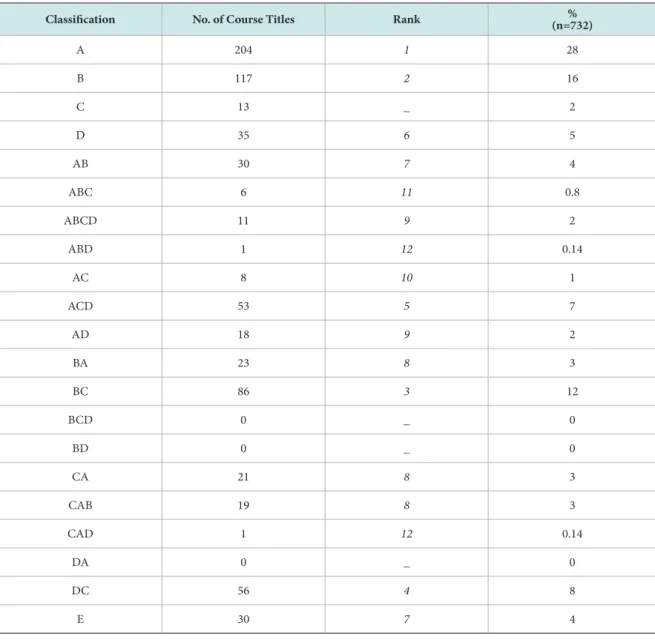
Table 3 shows that 27 respondent-schools have ori-entations to integrate people (C) as a component. The
Table 3. Master’s Degree Courses in South Korea
Classification No. of Course Titles Rank (n=732)%
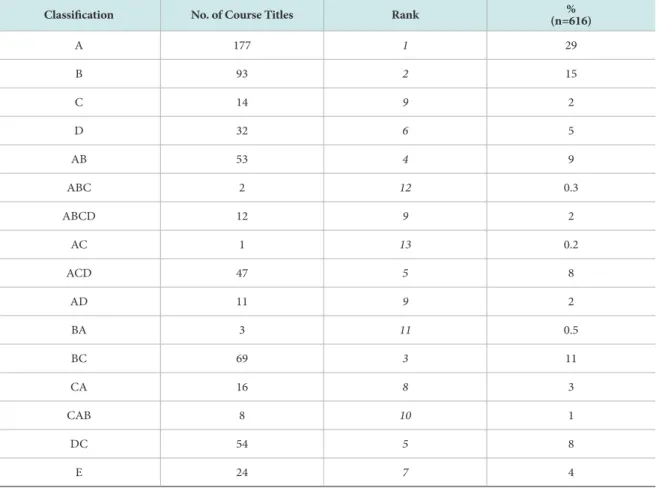
Table 4. Doctoral Degree Courses in South Korea
Classification No. of Course Titles Rank (n=616)%
A 177 1 29 B 93 2 15 C 14 9 2 D 32 6 5 AB 53 4 9 ABC 2 12 0.3 ABCD 12 9 2 AC 1 13 0.2 ACD 47 5 8 AD 11 9 2 BA 3 11 0.5 BC 69 3 11 CA 16 8 3 CAB 8 10 1 DC 54 5 8 E 24 7 4
three subfields in top rank are: 1) BC, which focuses on disciplines that deal with information designs based on hucomputer interaction; 2) DC, which is on man-agement principles, as manman-agement of people is an in-dispensible component. At some point, master’s cours-es in SK are more focused towards traditional library management; and 3) ACD, which emphasizes services to users and interactions between library, users, and services. A need to integrate fundamental management principles is due to the fact that a variety of managerial roles in an academic library are found necessary both in traditional and modern libraries.
For Ph.D. courses, the interdisciplinary characteristic of LIS is primarily driven by emerging technology and the changing context of the work; that, on the doctoral level, communicates across disciplinary boundaries.
Like any other fields, the main component of LIS doc-toral programs is research. Results in Table 4 show that both A (information content) and B (information sys-tems) have the highest number of course offerings. The result of classification further revealed the dispersion into other fields and subfields. Ph.D. courses in South Korea have similar programs offered in master’s degree courses.
5.2. Courses and Direction Towards the Fulfillment of UN 2030 Agenda
that address the 17 goals, the following dynamic pro-grams and functions have been performed by librarians:
1. Provide platforms to ensure that all men and women, in particular the poor and the vulnera-ble, have equal rights to economic resources, as well as access to basic services through computer literacy and guided access to the Internet and lo-cally relevant knowledge.
2. Publish the outcomes of crop trials, agriculture policy analysis, and information on the growing farm finance movement through libraries. 3. Facilitate universal access to sexual and
repro-ductive health-care services, particularly through health care information sources.
4. Facilitate in achieving literacy and numeracy. 5. Use information as a vital social and political
equalizer.
6. Create strategies to support and strengthen the participation of local communities in improving water and sanitation management.
7. Retrieve and present complex data to non-expert users with specific needs.
8. Provide programs for people to find jobs through their public library.
9. Increase access to information and communica-tions technology, working with schools and local communities.
10. Provide inclusive services to diverse and under-represented populations to ensure equality of access to information in a range of institutional settings.
11. Strengthen efforts to protect and safeguard the world’s cultural and natural heritage.
12. Provide a forum to build credible voices to adopt sustainable practices and to integrate sustainabili-ty information.
13. Build decision-support tools for policymaking, climate data, natural resource management, and so on.
14. Provide access to data, research, and knowledge that supports informed research and public ac-cess to information about coastal conservation. 15. Communicate information on preservation of
indigenous knowledge, influencing local deci-sion-making about fundamental aspects of life such as hunting, fishing, land use, and water management.
16. Ensure public access to information and protect fundamental freedoms, in accordance with na-tional legislation and internana-tional agreements. 17. Use libraries spaces to fully operationalize
sci-ence, technology, and innovation capacity-build-ing mechanisms
5.3. Courses, Typology, and UN 2030
Agenda on Sustainable Development Goals Information
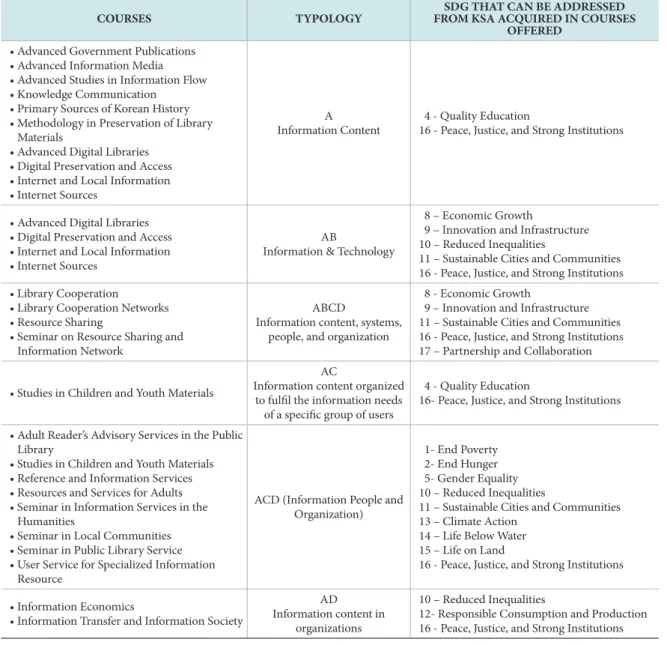
Acquisition of knowledge and skills related to infor-mation sources and services remain to be the focus of post-graduate programs in LIS schools in South Korea. Sample subject titles have been extracted and analyzed in the succeeding discussions. Table 5 provides a matrix of sample courses offered in LIS post-graduate pro-grams that are classified under A and related subfields along with the SGDs fulfilled by the learning outcomes of the courses.
As to the area on “Information” the researchers deem that it has addressed SGD 4 (quality education). The knowledge and skills of librarians about diverse infor-mation sources and their ability to retrieve, provide, and preserve local knowledge and information sources in various formats is essential in promoting quality ed-ucation, whether it is in a formal setting for academic and research libraries or informal and life-long learning as provided by public libraries.
(in-Table 5. Sample LIS Courses with Emphasis on Information and the SDGs addressed
COURSES TYPOLOGY FROM KSA ACQUIRED IN COURSES SDG THAT CAN BE ADDRESSED OFFERED
• Advanced Government Publications • Advanced Information Media • Advanced Studies in Information Flow • Knowledge Communication • Primary Sources of Korean History • Methodology in Preservation of Library
Materials
• Advanced Digital Libraries • Digital Preservation and Access • Internet and Local Information • Internet Sources
A
Information Content 4 - Quality Education16 - Peace, Justice, and Strong Institutions
• Advanced Digital Libraries • Digital Preservation and Access • Internet and Local Information • Internet Sources
AB
Information & Technology
8 – Economic Growth
9 – Innovation and Infrastructure 10 – Reduced Inequalities
11 – Sustainable Cities and Communities 16 - Peace, Justice, and Strong Institutions • Library Cooperation
• Library Cooperation Networks • Resource Sharing
• Seminar on Resource Sharing and Information Network
ABCD
Information content, systems, people, and organization
8 - Economic Growth
9 – Innovation and Infrastructure 11 – Sustainable Cities and Communities 16 - Peace, Justice, and Strong Institutions 17 – Partnership and Collaboration • Studies in Children and Youth Materials
AC
Information content organized to fulfil the information needs of a specific group of users
4 - Quality Education
16- Peace, Justice, and Strong Institutions • Adult Reader’s Advisory Services in the Public
Library
• Studies in Children and Youth Materials • Reference and Information Services • Resources and Services for Adults • Seminar in Information Services in the
Humanities
• Seminar in Local Communities • Seminar in Public Library Service • User Service for Specialized Information
Resource
ACD (Information People and Organization)
1- End Poverty 2- End Hunger 5- Gender Equality 10 – Reduced Inequalities
11 – Sustainable Cities and Communities 13 – Climate Action
14 – Life Below Water 15 – Life on Land
16 - Peace, Justice, and Strong Institutions • Information Economics
• Information Transfer and Information Society
AD
Information content in organizations
10 – Reduced Inequalities
12- Responsible Consumption and Production 16 - Peace, Justice, and Strong Institutions novation and infrastructure), 10 (reduced inequality),
11 (cities and communities), and 16 (peace and justice). Sustained, inclusive economic growth; full and pro-ductive employment; industrialization and innovation; reduced inequality; sustainable cities and communities, and global partnership towards peace and justice can be facilitated with working knowledge of information and technology as well as by knowledge of how
informa-tion interacts with systems, people, and organizainforma-tions (society) through availability of information sources, technology, and collaboration in learning spaces. Skills in networking and resource sharing are also essential in the fulfillment of the abovementioned goals.
emphasizing the organization of information planned around a specific group of users. Similarly, it can sup-port sustainable economic growth and industrializa-tion, and foster innovaindustrializa-tion, sustainable cities and com-munities, and strengthen the means of implementation and revitalize the global partnership for sustainable development. Likewise, ability to provide services and creativity in programming through courses that deal with the role of information content in the information society/ organization and information content interact-ing with people (ACD) facilitates advancement of qual-ity education and free access to information. Courses that emphasize the roles that information content orga-nizations constitute as an important part of the society at large can help address SGD 1 (no poverty), 10 (re-duced inequalities), 12 (responsible consumption), and 16 (peace and justice). Learning spaces are not isolated from socio-economic issues as information is a driving force for development.
5.4. Technology
The analysis of courses revealed that technology as an essential component is given emphasis in LIS stud-ies. Information content has become interdependent with the systems. With the growing web and online resources, knowledge on information facilitated using technology can facilitate services that transcend the limitation of time and space. Leveraging technology and understanding human-computer interaction can address all areas of the agenda. Ending poverty can be facilitated with online financial literacy programs. Skills in providing resources or directing resources and access to basic services such as computer literacy, retrieving and presenting complex data to non-expert users with specific needs, and understanding the dynamics of in-formation that can be utilized by experts and common users,are the essential preparations needed by students. Table 6 provides sample courses classified under B (in-formation systems) and other subfields which have an orientation towards technology.
Subjects such as Informatics, Information Analytics, and Big Data can equip learners with skills to provide platforms in using information as a vital social and po-litical equalizer, building decision-support tools for pol-icymaking, climate data, natural resource management, and so on. Technical knowledge built upon courses on information retrieval, digital contents, and human/
computer interaction can help transform complex data to non-expert users and increase access to information and communications technology, working with the communities ensuring public access to information. 5.5. People
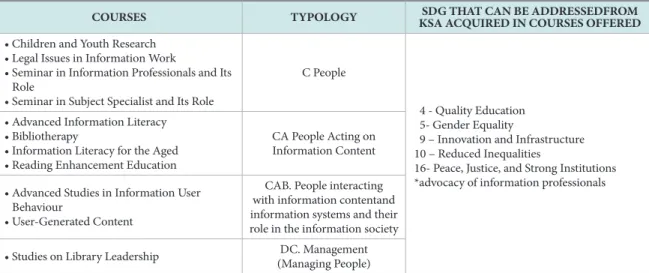
A shift to user-centered approaches prompts infor-mation professionals to extend into functions that edu-cate users facilitating independent research and self ini-tiative to learn new skills. Courses that hone the skills of librarians to promote empowerment, sustainability, and awareness of international issues are most relevant in this age. Knowledge of technology and informa-tion should be coupled with skills to transmit these two important tools to people or users with different needs. Table 7 provides a matrix of sample courses and the SGDs addressed. Courses that deal with informa-tion literacy or cater to users with specific needs can promote lifelong learning opportunities, and develop programs that increase awareness on gender equality, minority empowerment, and sustainable development.
6. CONCLUSION
Table 6a. Sample LIS Courses with Emphasis on Technology and the SDGs addressed
COURSES TYPOLOGY FROM KSA ACQUIRED IN COURSES SDG THAT CAN BE ADDRESSED OFFERED
• Informatics
• Analysis of Web Information Resources • Big Data in Digital Age
• Building Research of Digital Content • Information Analytics on the Humanities • Information Analytics on Science and
Technology
B
Information Technology
ALL • Advanced Web-based Information Processing
• Information Retrieval
• Cognitive Information Retrieval
BA
Systems acting on content or retrieval system • Advanced Metadata
• Human/Computer Interaction • Information Access Systems: Indexing,
Abstracting, and Other Access Systems
BC
Principles of information systems design based on human/ system interaction
Table 6b. Sample LIS Courses with Emphasis on People and the SDGs addressed
COURSES TYPOLOGY KSA ACQUIRED IN COURSES OFFEREDSDG THAT CAN BE ADDRESSEDFROM
• Children and Youth Research • Legal Issues in Information Work
• Seminar in Information Professionals and Its Role
• Seminar in Subject Specialist and Its Role
C People
4 - Quality Education 5- Gender Equality
9 – Innovation and Infrastructure 10 – Reduced Inequalities
16- Peace, Justice, and Strong Institutions *advocacy of information professionals • Advanced Information Literacy
• Bibliotherapy
• Information Literacy for the Aged • Reading Enhancement Education
CA People Acting on Information Content • Advanced Studies in Information User
Behaviour
• User-Generated Content
CAB. People interacting with information contentand information systems and their role in the information society • Studies on Library Leadership (Managing People)DC. Management present leaders to monitor and implement the vision,
stimulating action over the next fifteen years.
7. RECOMMENDATIONS
Overall, the researchers strongly recommend that for the fulfillment of these goals and making libraries more responsive to needs in these changing times,
promi-nent. Local context approaches to implementing SDGs are expected. The national government can emphasize or de-emphasize various goals depending on the local situation, but it is our role to ensure that libraries and access to information are not left behind. Institutional-ization of advocacies, that is, creating laws and imple-menting guidelines that are binding to strengthen the support for SDGs and other library advocacies, begins with learning how to do it. Strategies and the key mes-sage that access to information is an essential tool in national development and global concerns must start in the classrooms. Sharing of knowledge through various forms of cooperation and networking is our bastion to address the challenges.
ACKNOWLEDGEMENTS
This research was supported in part by Kyungpook National University A.S Research Fund, 2014.
The researchers are greatly indebted to the following institutions and LIS Departments who cooperated in the survey conducted.
REFERENCES
Becker, S., Crandall, M., Coward, C., Sears, R., Carlee, R., Hasbargen, K., & Ball, M. A. (2012). Building digital communities: A framework for action. In -stitute of Museum and Library Services. Retrieved from https://dlib.lib.washington.edu/research-works/handle/1773/19676.
Bronstein, J. (2007).Current trends in library and in-formation studies curricula around the world: Looking for the user‐centred approach. Journal of Information, Communication and Ethics in Society, 5(2/3), 59-78.
IFLA ALP. (2012). How libraries contribute to sustain-able development & the SDGs. Retrieved from http://www.ifla.org/files/assets/alp/103-fbradley-alp.pdf.
International Federation of Library Associations and Institutions. (2012). Guidelines for Professional Library/Information Educational Programs. Re-trieved from http://www.ifla.org/files/assets/set/
publications/guidelines/guidelines-for-profession-al-library-information-educational-programs.pdf. Kim, S.-S. (1998). A research on the LIS curriculum
based on education purpose. Journal of Korean Li -brary and Information Science Society, 28, 355-83. Hahn, B.-H. (1998). A study on the curricula of library
and information science for the school program. Journal of the Korean Society for Library and Infor-mation Science, 32(4), 5-29.
OECD (1998). Interdisciplinarity in science and technol -ogy. Paris: Directorate for Science, Technology, and Industry, OECD.
Prebor, G. (2010). Analysis of the interdisciplinary nature of library and information science. Journal of Librarianship and Information Science, 42(4), 256–267. DOI: 10.1177/0961000610380820. Noh, Y. (2005). A study on development and utilization
of specialized programs in curriculum of library and information science. Journal of the Korean Society for Library and Information Science, 39(1), 59-80. Retrieved from http://dx.doi.org/10.4275/ KSLIS.2005.39.1.059.
Oh, K., & Chang, Y. (2006). A study on the library and information science education and research devel-opment in Korea. Journal of the Korean Society for Library and Information Science, 23(2),185-206. Park, I. (2000). A study of the present status and
cur-riculum reformation of library and information science program in Korea. Journal of the Korean Library and Information Science Society, 31(2), 197-221.
Ribeiro, F. (2007). An integrated perspective for profes-sional education in libraries, archives and muse-ums: A new paradigm, a new model. Journal of Ed-ucation for Library and Information Science, 48(2), 116.
Turner, A., Welch, B., & Reynolds, S. (2013). Learning spaces in academic libraries – A review of evolving trends. Australian Academic and Research Libraries, 44(4), 226-234.
UNESCO. (2015). Incheon Declaration. Retrieved from http://en.unesco.org/world-education-fo-rum-2015/incheon-declaration.
United Nations (2015). Sustainable Development Knowledge Platform. Retrieved from https://sus- tainabledevelopment.un.org/post2015/transform-ingourworld.
Wilson, T. D. (2001). Mapping the curriculum in in-formation studies. New Library World, 102(11/12), 436.
LIS Schools Master’s Degree Ph.D.
Cheongju University
Chungnam National University
Chonbuk National University
Chung Ang University
Chonnam National University
DaeguCatholic University
Daejin University
Eui University University
Dongduk Women’s University
Ewha Women’s University
Gwangju University
Hannam University
Hansung University
Incheon National University
Joenju University
Joongbu University
Kangnam University
Kyungpook National University
Kyongj University
Keimyung University
Myongji University
Pusan NationalUniversity
Seoul Women’s University
Silla University
Sookmyung Women’s University
Sungkyukwan University