ISSN 2234-3806 • eISSN 2234-3814
http://dx.doi.org/10.3343/alm.2016.36.5.450
Analytical and Clinical Validation of Six Commercial Middle East Respiratory Syndrome Coronavirus RNA Detection Kits Based on Real-Time Reverse-
Transcription PCR
Mi-Na Kim, M.D.1, Young Jin Ko, M.D.1, Moon-Woo Seong, M.D.2, Jae-Seok Kim, M.D.3, Bo-Moon Shin, M.D.4, and Heungsup Sung, M.D.1
Department of Laboratory Medicine1, University of Ulsan College of Medicine and Asan Medical Center, Seoul; Department of Laboratory Medicine2, Seoul National University College of Medicine, Seoul National University Hospital, Seoul; Department of Laboratory Medicine3, Hallym University College of Medicine, Hallym University Kangdong Sacred Heart Hospital, Seoul; Department of Laboratory Medicine4, Inje University, Sanggye Paik Hospital, Seoul, Korea
Background: During the 2015 outbreak of Middle East Respiratory Syndrome coronavirus (MERS-CoV), six different commercial MERS-CoV RNA detection kits based on real-time reverse-transcription polymerase chain reaction (rRT-PCR) were available in Korea. We performed analytical and clinical validations of these kits.
Methods: PowerChek (Kogene Biotech, Korea), DiaPlexQ (SolGent, Korea), Anyplex (Seegene, Korea), AccuPower (Bioneer, Korea), LightMix (Roche Molecular Diagnostics, Switzerland), and UltraFast kits (Nanobiosys, Korea) were evaluated. Limits of detection (LOD) with 95% probability values were estimated by testing 16 replicates of upstream of the envelope gene (upE) and open reading frame 1a (ORF1a) RNA transcripts. Specificity was estimated by using 28 nasopharyngeal swabs that were positive for other respiratory viruses. Clinical sensitivity was evaluated by using 18 lower respiratory specimens. The sensitivity test panel and the high inhibition panel were composed of nine specimens each, including eight and six specimens that were positive for MERS-CoV, respectively.
Results: The LODs for upE ranged from 21.88 to 263.03 copies/reaction, and those for ORF1a ranged from 6.92 to 128.82 copies/reaction. No cross-reactivity with other respira- tory viruses was found. All six kits correctly identified 8 of 8 (100%) positive clinical speci- mens. Based on results from the high inhibition panel, PowerChek and AccuPower were the least sensitive to the presence of PCR inhibition.
Conclusions: The overall sensitivity and specificity of all six assay systems were sufficient for diagnosing MERS-CoV infection. However, the analytical sensitivity and detection ability in specimens with PCR inhibition could be improved with the use of appropriate internal controls.
Key Words: MERS coronavirus, Real-time reverse transcription polymerase chain reaction, Validation, Lower respiratory specimen, Commercial kits
Received: September 22, 2015 Revision received: February 27, 2016 Accepted: May 16, 2016
Corresponding author: Mi-Na Kim Department of Laboratory Medicine, University of Ulsan College of Medicine and Asan Medical Center, 88 Olympic-ro 43-gil, Songpa-gu, Seoul 05505, Korea Tel: +82-2-3010-4511
Fax: +82-2-478-0884 E-mail: [email protected]
© The Korean Society for Laboratory Medicine This is an Open Access article distributed under the terms of the Creative Commons Attribution Non-Commercial License (http://creativecom- mons.org/licenses/by-nc/4.0) which permits unrestricted non-commercial use, distribution, and reproduction in any medium, provided the original work is properly cited.
INTRODUCTION
During the 2015 outbreak of Middle East Respiratory Syndrome
coronavirus (MERS-CoV), a total of six different commercial MERS-CoV RNA detection kits based on real-time reverse-tran- scription polymerase chain reaction (rRT-PCR) were available in
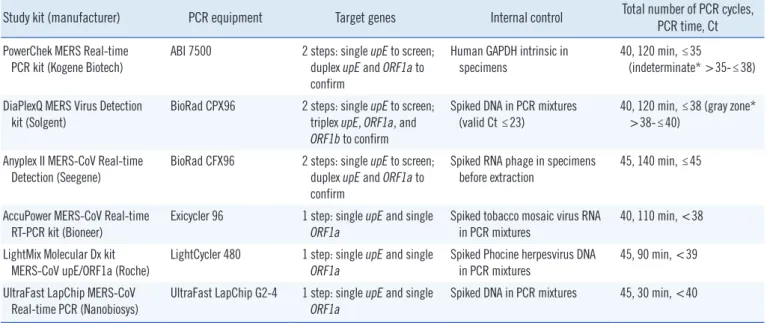
Korea. Of those, the PowerChek MERS Real-time PCR (Kogene Biotech, Seoul, Korea), DiaPlexQ MERS Virus Detection (SolGent, Daejeon, Korea), and Anyplex II MERS-CoV (upE) Real-time De- tection kits (Seegene, Seoul, Korea) comprised two steps: single gene targeting of the region upstream of the envelope gene (upE) for screening, and multiple gene targeting of both upE and open reading frame 1a (ORF1a) for confirmation. The AccuPower MERS-CoV Real Time RT-PCR (Bioneer, Daejeon, Korea), Light- Mix Molecular Dx MERS-CoV upE/ORF1a (Roche Molecular Di- agnostics, Basel, Switzerland), and UltraFast LabChip MERS- CoV Real-time PCR kits (Nanobiosys, Seoul, Korea) used one step to simultaneously detect both upE and ORF1a using two single gene-targeting reagents. None of these kits have been ap- proved for diagnostic use; however, they were urgently intro- duced into clinical laboratories on June 4, 2015 because the timely diagnosis of MERS-CoV infections was essential during the nationwide MERS-CoV outbreak in Korea [1, 2].
The WHO and United States Centers for Disease Control and Prevention (US CDC) provided guidelines for the molecular di- agnosis of MERS-CoV [3, 4], and since June 6, 2013 the US CDC has made novel coronavirus rRT-PCR assays [5] available free of charge under emergency use authorization [6]. Although at least three commercial rRT-PCR assays for MERS-CoV detec- tion were available from Altona Diagnostics, Fast Track Diagnos- tics [3], and PrimerDesign (http://www.genesig.com) before the 2015 outbreak in Korea, only RealStar MERS-CoV (Altona Diag- nostics, Hamburg, Germany) had been approved for the in vitro
diagnosis of MERS-CoV by Conformité Européenne (CE) and authorized for emergency use only in the United States. There- fore, all six commercial kits evaluated in this study had not been validated for diagnostic use. This study was designed to analyti- cally and clinically validate the six above-mentioned commercial MERS CoV RNA detection kits.
METHODS
During July 6-10, 2015, each kit was validated by using the equipment recommended by each manufacturer (Table 1). To determine analytical sensitivity, the limits of detection (LOD) with 95% probability values was determined by using upE and ORF1a RNA transcripts supplied by the Institute of Virology, University of Bonn Medical Centre [7]. The original concentra- tion of both RNA transcripts was 1.0 ×10⁵ copies/μL. These were diluted to six concentrations in 0.5-log steps from 100 to 0.3 copies/reaction, and kits were tested by using 5-8-μL sam- ples of RNA eluates per reaction. For the Nanobiosys kit, which used 2.4-μL samples per reaction, a 0.5-log higher concentra- tion was added for the LOD validation. Each concentration was tested by using 16 replicates, with the exception of PowerChek, for which 12 replicates were used. A probit regression analysis in R Studio (R Studio Inc.; https://www.rstudio.com/) was per- formed to determine the 95% cut-off values. The PowerChek, AccuPower, LightMix, and UltraFast LabChip kits used the prim- ers and probes from the WHO-recommended rRT-PCR assay [7,
Table 1. Specifications of the six commercial kits for MERS-CoV RNA detection
Study kit (manufacturer) PCR equipment Target genes Internal control Total number of PCR cycles, PCR time, Ct PowerChek MERS Real-time
PCR kit (Kogene Biotech) ABI 7500 2 steps: single upE to screen;
duplex upE and ORF1a to confirm
Human GAPDH intrinsic in
specimens 40, 120 min, ≤35
(indeterminate* >35-≤38) DiaPlexQ MERS Virus Detection
kit (Solgent) BioRad CPX96 2 steps: single upE to screen;
triplex upE, ORF1a, and ORF1b to confirm
Spiked DNA in PCR mixtures
(valid Ct ≤23) 40, 120 min, ≤38 (gray zone*
>38-≤40) Anyplex II MERS-CoV Real-time
Detection (Seegene) BioRad CFX96 2 steps: single upE to screen;
duplex upE and ORF1a to confirm
Spiked RNA phage in specimens
before extraction 45, 140 min, ≤45 AccuPower MERS-CoV Real-time
RT-PCR kit (Bioneer) Exicycler 96 1 step: single upE and single
ORF1a Spiked tobacco mosaic virus RNA
in PCR mixtures 40, 110 min, <38 LightMix Molecular Dx kit
MERS-CoV upE/ORF1a (Roche)
LightCycler 480 1 step: single upE and single ORF1a
Spiked Phocine herpesvirus DNA in PCR mixtures
45, 90 min, <39 UltraFast LapChip MERS-CoV
Real-time PCR (Nanobiosys) UltraFast LapChip G2-4 1 step: single upE and single
ORF1a Spiked DNA in PCR mixtures 45, 30 min, <40
*Retesting required using new specimens collected after 24 hours.
Abbreviations: MERS-CoV, Middle East Respiratory Syndrome coronavirus; Ct, cycle threshold.
8]. The primers and probes used by the DiaPlexQ and Anyplex kits were modified from the WHO-recommended rRT-PCR as- say, but covered almost the same regions of upE and ORF1a (personal communication with confidentiality of the sequences).
However, the Anyplex kit was validated only for upE because the oligonucleotide-binding site for ORF1a was beyond the span of the RNA transcripts used in this study.
To evaluate the analytical and clinical specificity of the kits, 28 respiratory virus-positive nasopharyngeal swabs were used to
determine cross-reactions with human RNA or other respiratory viruses, including human coronaviruses. Using the Anyplex II RV16 kit (Seegene) with duplicate specimen preparations, these specimens were confirmed as positive for only single species of the following viruses: influenza virus A (n=2), influenza virus B (n=2), human parainfluenza virus 1 (n=2), human parainflu- enza virus 2 (n=2), human parainfluenza virus 3 (n=2), respi- ratory syncytial virus A (n =2), respiratory syncytial virus B (n=2), human adenovirus (n=2), human bocavirus (n=2), hu-
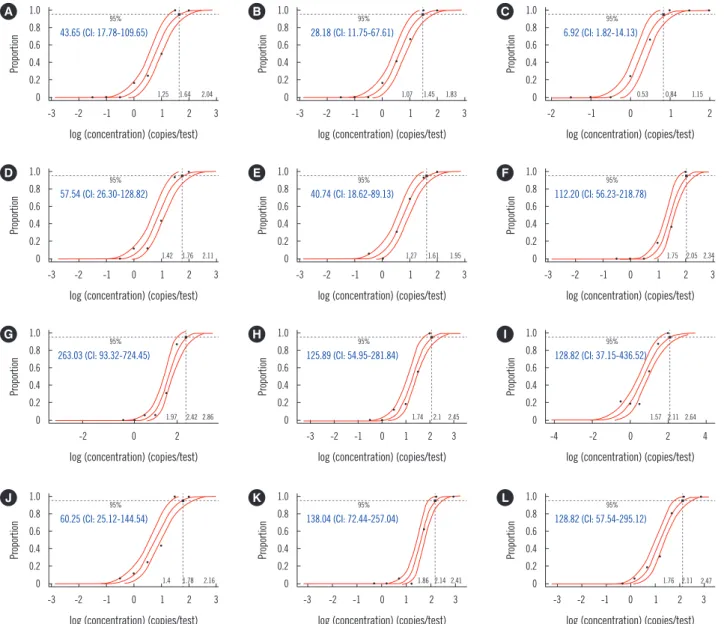
Fig. 1. LOD of the six commercial kits for MERS-CoV RNA detection with 95% confidence intervals (CI). LOD was determined by probit re- gression analysis for the 16 replicate assays of each of six concentrations of upE and ORF1a RNA transcripts from 0.3-100 copies/reaction with 0.5 log dilution. (A) upE with PowerChek single, (B) upE with PowerChek duplex, (C) ORF1a with PowerChek duplex, (D) upE with Di- aPlexQ single, (E) upE with DiaPlexQ triplex, (F) ORF1a with DiaPlexQ triplex, (G) upE with AccuPower single, (H) ORF1a with AccuPower single, (I) upE with LightMix single, (J) ORF1a with LightMix single, (K) upE with UltraFast single, and (L) ORF1a with UltraFast single.
LODs of each assay were denoted in copies per test (blue letters).
Abbreviations: LOD, limit of detection; MERS-CoV, Middle East Respiratory Syndrome coronavirus.
1.0 0.8 0.6 0.4 0.2 0
1.0 0.8 0.6 0.4 0.2 0
1.0 0.8 0.6 0.4 0.2 0
1.0 0.8 0.6 0.4 0.2 0
1.0 0.8 0.6 0.4 0.2 0
1.0 0.8 0.6 0.4 0.2 0
1.0 0.8 0.6 0.4 0.2 0
1.0 0.8 0.6 0.4 0.2 0
1.0 0.8 0.6 0.4 0.2 0
1.0 0.8 0.6 0.4 0.2 0
1.0 0.8 0.6 0.4 0.2 0
1.0 0.8 0.6 0.4 0.2 0 -3 -2 -1 0 1 2 3
-3 -2 -1 0 1 2 3
-2 0 2
-3 -2 -1 0 1 2 3
-3 -2 -1 0 1 2 3
-3 -2 -1 0 1 2 3
-3 -2 -1 0 1 2 3
-3 -2 -1 0 1 2 3
-2 -1 0 1 2
-3 -2 -1 0 1 2 3
-4 -2 0 2 4
-3 -2 -1 0 1 2 3 log (concentration) (copies/test)
log (concentration) (copies/test)
log (concentration) (copies/test)
log (concentration) (copies/test)
log (concentration) (copies/test)
log (concentration) (copies/test)
log (concentration) (copies/test)
log (concentration) (copies/test)
log (concentration) (copies/test)
log (concentration) (copies/test)
log (concentration) (copies/test)
log (concentration) (copies/test)
ProportionProportionProportionProportion ProportionProportionProportionProportion ProportionProportionProportionProportion
95%
95%
95%
95%
95%
95%
95%
95%
95%
95%
95%
95%
43.65 (CI: 17.78-109.65)
57.54 (CI: 26.30-128.82)
263.03 (CI: 93.32-724.45)
60.25 (CI: 25.12-144.54)
28.18 (CI: 11.75-67.61)
40.74 (CI: 18.62-89.13)
125.89 (CI: 54.95-281.84)
138.04 (CI: 72.44-257.04)
6.92 (CI: 1.82-14.13)
112.20 (CI: 56.23-218.78)
128.82 (CI: 37.15-436.52)
128.82 (CI: 57.54-295.12) A
D
G
J
B
E
H
K
C
F
I
L
1.25
1.42
1.97
1.4
1.07
1.27
1.74
1.86
0.53
1.75
1.57
1.76 1.64
1.76
2.42
1.78
1.45
1.61
2.1
2.14
0.84
2.05
2.11
2.11 2.04
2.11
2.86
2.16
1.83
1.95
2.45
2.41
1.15
2.34
2.64
2.47
man metapneumovirus (n =2), human rhinovirus (n =2), hu- man coronavirus 229E (n=2), human coronavirus OC43 (n=2), and human coronavirus NL63 (n=2).
To evaluate the clinical sensitivity of the assays, 18 specimens from the lower respiratory tract, including 14 known positive specimens, were obtained from five institutions. The RNA elu- ates of nine specimens that remained after initial clinical MERS- CoV rRT-PCR testing were used following storage of <2 months at -70°C at each institution. The other nine specimens were manually prepared in our laboratory without any pretreatment and were found to be inadequate for evaluating clinical sensitiv- ity owing to the extremely high levels of PCR inhibition. There- fore, only the first nine specimens were used to evaluate clinical sensitivity, and the other nine specimens with high inhibition were used to evaluate the effects of PCR inhibition on positive results. In addition to determining the numbers of positives and negatives, the cycle threshold (Ct) values of the target genes and internal control were analyzed.
RESULTS
The LODs for upE varied from 21.88 to 263.03 copies/reaction, and those of ORF1a varied from 6.92 to 128.82 copies/reaction (Fig. 1). According to the probit regression analysis, the 95%
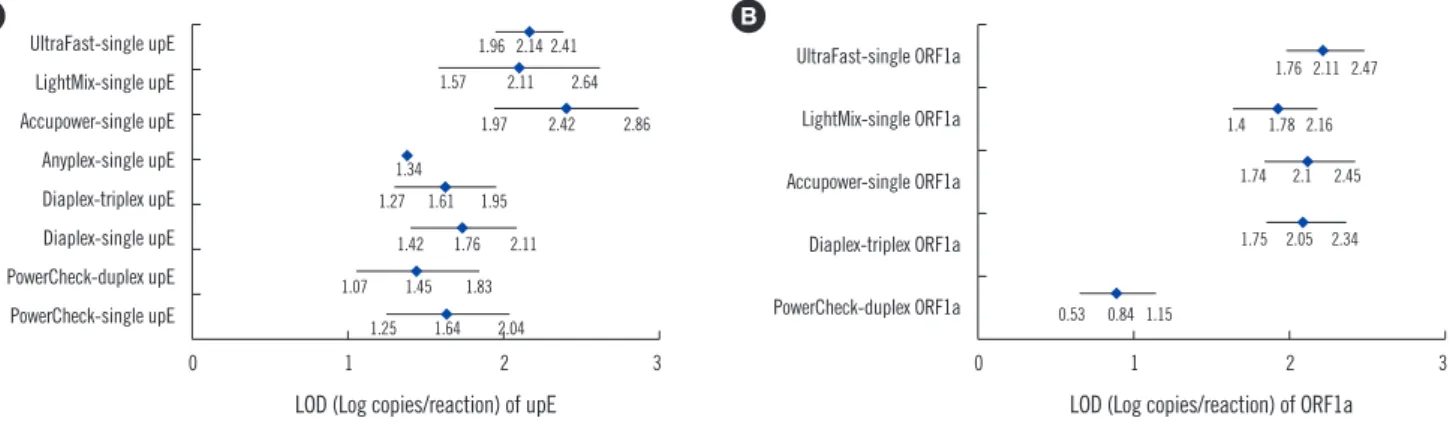
confidence intervals (CI) for upE and ORF1a were found to overlap among the tested kits, with the exception of ORF1a by the PowerChek kit (Fig. 2). The LODs for upE using both the single and multiple gene-targeting formats of the 2-step kits were 1.64 and 1.45 log copies/reaction for the PowerChek kit and 1.76 and 1.61 log copies/reaction for the DiaPlexQ kit (Fig.
2). The LOD for upE was 1.34 log copies/reaction for the Any-
plex kit, but no CI value could be calculated because there were no positive reactions at 1.0 log copy/reaction, while all 16 repli- cate specimens were positive at 1.5 log copies/reaction. In con- trast, although the LODs for upE and ORF1a using the LightMix kit were 2.11 log copies/reaction and 1.78 log copies/reaction, respectively, trailing of positives was observed at much lower concentrations than these LODs (Fig. 1). The LODs for upE of three different 1-step kits, the AccuPower, Light Mix, and Ultra- fast kits, were >2.0 log copies/reaction, which was less sensi- tive than those of three different 2-step kits; however, this differ- ence was not significant (Fig. 2). The LODs for ORF1a varied less—i.e., from 1.78 to 2.11 log copies/reaction—with the ex- ception of the PowerChek kit, which was considerably lower at 0.84 log copies/reaction (Fig. 2). None of the kits tested in this study showed cross-reactivity with other respiratory viruses.
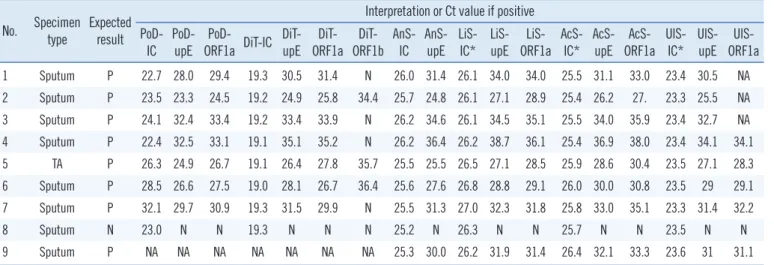
Based on validation tests including 28 specificity panel and nine clinical specimens, the clinical sensitivities of detecting upE and ORF1a were 100% (95% CI, 0.60-1.00) for all study kits. Specificity was 100% (95% CI, 0.79-1.00). The positive samples showed a wide range of Ct values, with values between 7.6 and 11.6 resulting from all kits (Table 2). The Ct values of the internal control varied most with PowerChek, from 22.7- 32.1, while those of DiaPlexQ, Anyplex, AccuPower, LightMix, and UltraFast all varied by <1.0 (Table 2). ORF1b, tested by the DiaPlexQ kit, was detected in only five positive specimens (62.5%). The upE results of the UltraFast kit were not available for three positive specimens because one of the capillary PCR chambers holding these specimens leaked.
The effect of PCR inhibition determined by testing the nine high inhibition specimens revealed that 3-5 of the six known positive specimens were found negative or invalid by each kit
UltraFast-single upE LightMix-single upE Accupower-single upE Anyplex-single upE Diaplex-triplex upE Diaplex-single upE PowerCheck-duplex upE PowerCheck-single upE
UltraFast-single ORF1a LightMix-single ORF1a Accupower-single ORF1a Diaplex-triplex ORF1a PowerCheck-duplex ORF1a
Fig. 2. Comparison of LOD of the six commercial kits for MERS-CoV RNA detection. The log LOD values of upE (A) and ORF1a (B) with 95% confidence intervals (CI) are shown, but there were no CI values for Anyplex single upE. The 95% CI values overlapped among the kits, except for the LOD of ORF1a with PowerChek duplex.
Abbreviations: See Fig. 1.
0 1 2 3 0 1 2 3
LOD (Log copies/reaction) of upE LOD (Log copies/reaction) of ORF1a
A B
1.96 2.14 2.41
1.76 2.11 2.47 1.57 2.11 2.64
1.97 2.42 2.86 1.4 1.78 2.16
1.34 1.27 1.61 1.95
1.74 2.1 2.45
1.42 1.76 2.11 1.75 2.05 2.34
1.07 1.45 1.83
0.53 0.84 1.15 1.25 1.64 2.04
(Table 3). The Ct values of the internal controls from all speci- mens were high or extended beyond the total amplification cy- cles, and, therefore, false negative results were eliminated owing to internal control failure, except for those of the PowerChek and AccuPower kits. With the AccuPower kit, the mean internal control Ct value for the high inhibition specimens was consider- ably prolonged to 30.1±0.69 compared with 25.7±0.31 for the sensitivity test specimens; however, there was no established cut-off point, indicating that PCR inhibition was not acceptable in the PCR reaction. On the other hand, Ct values for the sensi- tivity test specimens and the high inhibition specimens using
the PowerChek kit were not significantly different at 25.3±3.2 and 27.0±3.1, respectively. The LightMix kit produced two un- certain results with known positive specimens and one uncer- tain result with a known negative specimen (Table 3).
There were no positive results detected by any of the kits among the four negative specimens included in the sensitivity test and high inhibition panels (Tables 2 and 3).
DISCUSSION
The LOD for the upE and ORF1a rRT-PCR kits was analyzed Table 2. Clinical sensitivities of the six commercial kits for MERS-CoV RNA detection
No. Specimen
type Expected result
Interpretation or Ct value if positive PoD-
IC PoD-
upE PoD-
ORF1a DiT-IC DiT- upE
DiT- ORF1a
DiT- ORF1b
AnS- IC
AnS- upE
LiS- IC*
LiS- upE
LiS- ORF1a
AcS- IC*
AcS- upE
AcS- ORF1a
UlS- IC*
UlS- upE
UlS- ORF1a 1 Sputum P 22.7 28.0 29.4 19.3 30.5 31.4 N 26.0 31.4 26.1 34.0 34.0 25.5 31.1 33.0 23.4 30.5 NA 2 Sputum P 23.5 23.3 24.5 19.2 24.9 25.8 34.4 25.7 24.8 26.1 27.1 28.9 25.4 26.2 27. 23.3 25.5 NA 3 Sputum P 24.1 32.4 33.4 19.2 33.4 33.9 N 26.2 34.6 26.1 34.5 35.1 25.5 34.0 35.9 23.4 32.7 NA 4 Sputum P 22.4 32.5 33.1 19.1 35.1 35.2 N 26.2 36.4 26.2 38.7 36.1 25.4 36.9 38.0 23.4 34.1 34.1 5 TA P 26.3 24.9 26.7 19.1 26.4 27.8 35.7 25.5 25.5 26.5 27.1 28.5 25.9 28.6 30.4 23.5 27.1 28.3 6 Sputum P 28.5 26.6 27.5 19.0 28.1 26.7 36.4 25.6 27.6 26.8 28.8 29.1 26.0 30.0 30.8 23.5 29 29.1 7 Sputum P 32.1 29.7 30.9 19.3 31.5 29.9 N 25.5 31.3 27.0 32.3 31.8 25.8 33.0 35.1 23.3 31.4 32.2
8 Sputum N 23.0 N N 19.3 N N N 25.2 N 26.3 N N 25.7 N N 23.5 N N
9 Sputum P NA NA NA NA NA NA NA 25.3 30.0 26.2 31.9 31.4 26.4 32.1 33.3 23.6 31 31.1
*The internal control Ct value was determined by using an rRT-PCR reaction for upE.
Abbreviations: MERS-CoV, Middle East Respiratory Syndrome coronavirus; Ct, cycle threshold; IC, internal control; N, negative; P, positive; TA, tracheal aspirate; PoD, PowerChek duplex; DiT, DiaPlexQ triplex; AnS, Anyplex single; LiS, LightMix single; AcS, AccuPower single; UlS, UltraFast single; N, Negative, NA, not available.
Table 3. Test results of the six commercial kits for MERS-CoV RNA detection using a high inhibition panel No. Specimen
type Expected result
Interpretation or Ct value if positive PoD-
IC PoD- upE PoD-
ORF1a DiT- IC DiT-
upE DiT- ORF1a DiT-
ORF1b AnS- IC AnS-
upE LiS-IC* LiS-upE LiS- ORF1a AcS-
IC* AcS- upE AcS-
ORF1a UlS- IC* UlS-
upE UlS- ORF1a 10 Sputum P 22.9 27.2 28.5 In 20.3 23.2 27.9 29.4 21.6 26.6 28.5 28.0 30.0 29.1 32.4 In 21.4 24.0
11 Sputum P 28.4 34.5 35.7 In Inv Inv Inv In Inv 32.1(U) 38.3(U) N 29.7 N N In Inv Inv
12 Sputum P 30.2 N N In Inv Inv Inv In Inv 31.1(U) N 5(U) 31.7 N N In/31.6 Inv Inv
13 Sputum P 24.1 25.1 25.6 In 20.1 21.7 26.0 In Inv 26.9 29.7 29.7 29.6 32.5 35.8 In 31.6 31.6
14 Sputum P 22.4 N N In Inv Inv Inv In Inv 28.6 U/5 5(U) 29.4 N N In Inv Inv
15 Sputum P 27.2 N N In Inv Inv Inv In Inv 31.0(U) 38.7(Inv) N 30.3 N N In/29.2 Inv Inv
16 Sputum N 30.8 N N In Inv Inv Inv In Inv 26.1 27.4(U) N 29.8 N N In/28.4 Inv Inv
17 Sputum N 26.6 N N In Inv Inv Inv In Inv 26.8 N N 30.9 N N 25.0 N N
18 Sputum N 30.7 N N In Inv Inv Inv 38.8 N 26.8 N N 30.4 N N 23.3 N N
*The internal control Ct value was determined using an rRT-PCR reaction for upE. However, the internal control Ct values in the rRT-PCR reactions for both upE and ORF1a were denoted with UltraFast single if one was positive and the other was negative.
Abbreviations: In, inhibition; Inv, invalid; U, uncertain; other abbreviations are as defined in Table 2.
with the same RNA transcripts used to evaluate RealStar MERS- CoV (Altona Diagnostics), which is the only kit thus far approved for diagnosis [9]. When comparing the analytical sensitivities of assay systems, it is important to use consistent evaluation con- ditions; moreover, the quality of the source material is critical. It is often difficult to find traceable source materials for the molec- ular diagnosis of viral infections, as only a few international stan- dards have been established to date [10-12]. As with RealStar MERS-CoV [9], all target gene-binding sites for upE, ORF1a, and ORF1b used in the study kits were based on the oligonucle- otide sequences of WHO-recommended primers and probes [3], and the upE and ORF1a target sites were located within the RNA transcripts used in this study. Whole genome sequences of MERS-CoV isolates obtained during the 2015 Korean out- break were determined by the Korea National Institute of Health and Seoul National University (gb|KT029139.1|) and the Guang- dong Provincial Center for Disease Control and Prevention (gb|KT036372.1). Both sequences closely clustered with a strain isolated during the spring 2015 outbreak in Riyadh, Saudi Arabia (gb|KT026454.1|) [13]. Therefore, the primers and probes used in this study were most likely not affected by se- quence variations in the MERS-CoV strains circulating in this outbreak. The RNA transcripts used to assess the analytical sensitivity in detecting upE and ORF1a [9] were not expected to have target mismatches with the primers and probes used in this study. Therefore, the LOD of all kits was analyzed by using identical source materials, and the data were comparable among various kits as well as with data from previous evalua- tions of RealStar MERS-CoV [9].
The LODs for upE of the kits assessed in this study indicated approximately 10-fold lower sensitivity than the previously re- ported 95% cut-off value of 5.3 copies/reaction for RealStar MERS-CoV [9]. The overall sensitivities for detecting upE of the kits evaluated herein were consistently lower than that of the RealStar MERS-CoV kit (Fig. 2). Only the LOD for ORF1a using the PowerChek duplex kit was similar to that of the RealStar kit:
9.3 copies/reaction using the RealStar MERS-CoV kit in com- parison with 6.9 copies/reaction using the PowerChek kit.
Therefore, the lower sensitivities of the kits evaluated in com- parison with that of RealStar MERS-CoV could be attributed to their performances rather than instability in source materials. In comparison with RealStar MERS-CoV [9], all of the kits analyzed herein have room for improvement in their sensitivity, with the exception of ORF1a testing with the PowerChek kit. Unlike the other tested kits, the LightMix kit demonstrated a markedly trail- ing tendency to yield positive results down to much lower con-
centrations than its LOD and an uncertain result to even a known-negative specimen (Fig. 1). These findings suggest that the effort to increase sensitivity may result in more uncertainty and therefore negatively impact specificity. The previous study on the clinical sensitivity of RealStar MERS-CoV produced four discrepant results among 19 specimens, of which three speci- mens (oral, nasal, and urine specimens) showed high Ct values using the RealStar kit, but not using the comparison assay (and vice versa for one nasal specimen) [9]. This could be a result of RealStar MERS-CoV having a higher sensitivity or lower specific- ity than the other assay. Using the 2-step kits tested in this study, the LODs for upE using multiple gene-targeting formats were comparable to those obtained using single gene-targeting formats (Fig. 2). Therefore, implementing a 2-step approach, including performing the first screening step with a single gene- targeting format, was not beneficial in terms of sensitivity.
In the present study, the LOD was analyzed by using a 0.5-log dilution series because a 0.5-log dilution is considered “within physiological variation or not significant” in viral kinetics [14].
However, this was limited in that the 0.5-log dilution scale was too wide to estimate the CI value for the Anyplex kit (Fig. 1), and estimation of the LOD by probit regression analysis seemed to be less appropriate for the LightMix kit with a trailing tendency to much lower concentrations. The LOD for ORF1b using the DiaPlexQ kit was not measured, but the low sensitivity of this kit in detecting ORF1b in clinical specimens is consistent with a previous report, in which testing for ORF1b was less sensitive than testing for ORF1a or upE [7, 8].
No cross-reactivity was observed with other respiratory vi- ruses, including human coronavirus, in any assays included in this study. These findings are consistent with previous evalua- tions that used the primers and probes recommended by WHO [7-9]. Therefore, all assay systems demonstrated adequate specificity.
The clinical sensitivities of the kits were all 100% (Table 2).
Because the sensitivity test panel comprised various positive specimens with a wide range of Ct values, this high sensitivity validated their diagnostic performance for MERS-CoV infection, particularly from sputum specimens, although the number of positive specimens was small. One of the strengths in the pres- ent study was determining the effects of PCR inhibition on clini- cal sensitivity and the importance of internal controls (Table 3).
The internal controls of the PowerChek kit were not affected by the inhibition. This could be because the PowerChek kit uses a less sensitive internal control that is intrinsic to human cells, al- though the PCR efficiency of this kit itself was also less affected.
The positivity rates for kits when testing the high inhibition panel correlated with their analytical sensitivities, as only PowerChek detected 50% of known-positive specimens. Based on these findings, it is clear that clinical sensitivity can be significantly af- fected by the presence of PCR inhibitors, and analytical sensi- tivity may be affected by PCR inhibition-prone specimens such as sputum specimens. Therefore, optimization of the pretreat- ment and RNA extraction procedures is necessary to improve the sensitivity of MERS-CoV molecular diagnostics, especially for testing sputum specimens.
There were some noteworthy limitations of this study, includ- ing: 1) the number of specimens used to test clinical sensitivity was relatively small; 2) the reproducibility of the assay results was not validated; and 3) the effects of inhibition were qualita- tively estimated. In conclusion, the commercial kits evaluated in this study demonstrated variable analytical sensitivities; how- ever, the overall clinical sensitivity and specificity were same and were sufficient for diagnosing MERS-CoV infection. The performance of the individual kits could be improved in terms of their analytical sensitivity, and identification of PCR inhibition with the use of appropriate internal controls is essential.
Authors’ Disclosures of Potential Conflicts of Interest
No potential conflicts of interest relevant to this article were re- ported.
Acknowledgments
This study was granted by the Korea National Institute of Health (4837-301-210-13). The authors thank Jiyoung Lim of Bioneer Corporation for performing the probit regression analysis.
REFERENCES
1. Cowling BJ, Park M, Fang VJ, Wu P, Leung GM, Wu JT. Preliminary epi-
demiological assessment of MERS-CoV outbreak in South Korea, May to June 2015. Euro Surveill 2015;20:7-13.
2. Park HY, Lee EJ, Ryu YW, Kim Y, Kim H, Lee H, et al. Epidemiological investigation of MERS-CoV spread in a single hospital in South Korea, May to June 2015. Euro Surveill 2015;20:1-6.
3. WHO. Laboratory testing for Middle East Respiratory Syndrome Corona- virus 2014. http://www.who.int/csr/disease/coronavirus_infections/
WHO_interim_recommendations_lab_detection_MERSCoV_092014.
pdf (Updated on Sep 2014).
4. Center for Disease Control and Prevention. Laboratory testing for Middle East Respiratory Syndrome Coronavirus (MERS-CoV). http://www.cdc.
gov/coronavirus/mers/lab/lab-testing.html (Updated on Jun 2014).
5. Lu X, Whitaker B, Sakthivel SK, Kamili S, Rose LE, Lowe L, et al. Real- time reverse transcription-PCR assay panel for Middle East respiratory syndrome coronavirus. J Clin Microbiol 2014;52:67-75.
6. Center for Disease Control and Prevention. Information for Laboratories.
http://www.cdc.gov/coronavirus/mers/lab/index.html (Updated on Dec 2015).
7. Corman VM, Müller MA, Costabel U, Timm J, Binger T, Meyer B, et al.
Assays for laboratory confirmation of novel human coronavirus (hCoV- EMC) infections. Euro Surveill 2012;17. pii: 20334.
8. Corman VM, Eckerle I, Bleicker T, Zaki A, Landt O, Eschbach-Bludau M, et al. Detection of a novel human coronavirus by real-time reverse-tran- scription polymerase chain reaction. Euro Surveill 2012;17. pii: 20285.
9. Corman VM, Ölschläger S, Wendtner CM, Drexler JF, Hess M, Drosten C.
Performance and clinical validation of the RealStar MERS-CoV Kit for detection of Middle East respiratory syndrome coronavirus RNA. J Clin Virol 2014;60:168-71.
10. Madej RM, Davis J, Holden MJ, Kwang S, Labourier E, Schneider GJ.
International standards and reference materials for quantitative molecu- lar infectious disease testing. J Mol Diagn 2010;12:133-43.
11. Kraft CS, Armstrong WS, Caliendo AM. Interpreting quantitative cyto- megalovirus DNA testing: understanding the laboratory perspective.
Clin Infect Dis 2012;54:1793-7.
12. Schnepf N, Scieux C, Resche-Riggon M, Feghoul L, Xhaard A, Gallien S, et al. Fully automated quantification of cytomegalovirus (CMV) in whole blood with the new sensitive Abbott RealTime CMV assay in the era of the CMV international standard. J Clin Microbiol 2013;51:2096-102.
13. Cotten M. Preliminary analysis of Middle East respiratory syndrome coronavirus (MERS-CoV) sequences from Korea and China. http://viro- logical.org/t/preliminary-analysis-of-middle-east-respiratory-syndrome- coronavirus-mers-cov-sequences-from-korea-and-china/143 (Updated on Jun 2015).
14. Clinical and Laboratory Standards Institute. Quantitative molecular methods for infectious disease. Approved guideline-second edition, MM06-A2. Wayne, PA: Clinical and Laboratory Standard Institutete, 2010.