*These authors contributed equally as first authors.
†These authors contributed equally as corresponding authors.
Address reprint requests to : Park, Jin-Hee
College of Nursing · Research Institiute of Nursing Science, Ajou University, 164 Worldcup-ro, Yeongtong-gu, Suwon 16499, Korea Tel: +82-31-219-7019 Fax: +82-31-219-7020 E-mail: [email protected]
Address reprint requests to : Jang, Sun Joo
Red-Cross College of Nursing, Chung-Ang University, 221 Heukseok-dong, Dongjak-gu, Seoul 06974, Korea Tel: +82-2-820-8934 Fax: +82-2-824-7961 E-mail: [email protected]
Received: July 23, 2020 Revised: August 7, 2020 Accepted: August 11, 2020 Published online August 31, 2020
This is an Open Access article distributed under the terms of the Creative Commons Attribution NoDerivs License. (http://creativecommons.org/licenses/by-nd/4.0) If the original work is properly cited and retained without any modification or reproduction, it can be used and re-distributed in any format and medium.
J Korean Acad Nurs Vol.50 No.4, 501 https://doi.org/10.4040/jkan.20167
Analysis of Research Topics and Trends in the Journal of Korean Academy of Nursing to Improve Its International Influence
Yu, Soyoung
1,* · Kim, Jeung-Im
2,* · Park, Jin-Hee
3,†· Jang, Sun Joo
4,†· Suh, Eunyoung E.
5· Song, Ju-Eun
3· Im, YeoJin
61College of Nursing, CHA University, Pocheon
2School of Nursing, Soonchunhyang University, Cheonan
3College of Nursing · Research Institute of Nursing Science, Ajou University, Suwon
4Red-Cross College of Nursing, Chung-Ang University, Seoul
5College of Nursing · Research Institute of Nursing Science, Seoul National University, Seoul
6College of Nursing Science · East-West Nursing Research Institute, Kyung Hee University, Seoul, Korea
Purpose: The purpose of this study was to analyze articles published in the Journal of the Korean Academy of Nursing (JKAN) between 2010 and 2019, along with those published in three international nursing journals, to improve JKAN’s international reputation. Methods: The overall characteristics of JKAN’s published papers and keywords, study participants, types of nursing interventions and dependent variables, citations, and cited journals were analyzed. Additionally, the keywords and study designs, publication-related characteristics, journal impact factors (JIF), and Eigenfactor scores of International Journal of Nursing Studies (IJNS), International Nursing Review (INR), Nursing & Health Sciences (NHS), and JKAN were analyzed and compared. Results: Among the four journals, JKAN’s score was the lowest in both the journal impact factor and Eigenfactor score. In particular, while the JIF of INR and NHS has been continuously increasing; JKAN’s JIF has remained static for almost 10 years. The journals which had cited JKAN and those which JKAN had cited were mainly published in Korean. Conclu- sion: JKAN still has a low IF and a low ranking among Social Citation Index (E) journals during the past 10 years, as compared to that of four international journals. To enhance JKAN’s status as an international journal, it is necessary to consider publishing it in English and to continuously improve the conditions of other publications.
Key words: Knowledge Discovery; Review Literature as Topic; Journal Impact Factor; Publications
INTRODUCTION
Nursing science research in Korea officially began with the publication of the Journal of Nurses Academic Society (JNAS)—
Korea’s first nursing journal—subsequently renamed as the Jour-
nal of Korean Academy of Nursing (JKAN). It was the official journal of the Korean Academy of Nursing which was established in 1970, and in 2005, renamed the Korean Society of Nursing Science (KSNS). In 2001, JKAN was listed on the Korea Citation Index, and on Medline and Scopus in 2004. As part of the con-
tinued efforts to develop JKAN as a competitive nursing journal, its Korean title was restated in English beginning with the Octo- ber 2008 issue, and in the same year it was listed on both the Social Science Citation Index (SSCI) and Science Citation Index Expanded (SCIE) journal lists [1].
Research accumulates new knowledge and verifies existing knowledge and based on the creation and accumulation of such relevant academic knowledge, studies are developed and con- ducted. The creation and accumulation of knowledge in nursing is accomplished through research that reflects the uniqueness of nursing [2]. Research is essential to develop, refine, and expand nursing professionals’ basic scientific knowledge. This is achieved through a continuous process of feedback in the field of re- search-theory-practice, and by developing new theories and methodologies required for the expansion and development of this study area [3]. Thus, it is necessary to analyze the accumulated research trends as well as the future direction of the development of research and knowledge, based on the results of the analysis [4]. In addition, as nursing science is a study targeting humans based on practicalities; it is crucial to establish a knowl- edge-based system of nursing through research and practice [1,5].
Korea’s nursing research trends can be established through papers published in JKAN. These trends were identified and an- alyzed through articles published right from: its first issue up to 1999 [6]; 2004~2006 [7]; 2007~2008 [3]; and the first issue to 2010 [8]. However, this analysis had limitations since it only tar- geted articles in JKAN, whereas for grasping the global trends in nursing research, it was necessary to compare and analyze pa- pers published in international nursing science journals having the highest citation index in the field, and thereafter, discuss further improvements to be made. This will also be a good opportunity to explore the academic development of nursing as a science by applying and developing useful knowledge in practice and theory, as well as for JKAN to become a high-profile journal both do- mestically and internationally through its qualitative growth.
Therefore, this study analyzed research papers published in JKAN during the last decade according to their research meth- odologies, as well as compared and analyzed papers registered in: the internationally recognized International Journal of Nursing Studies (IJNS); the International Council of Nurses (ICN)’s offi-
cial journal, the International Nursing Review (INR); and Japan’s leading nursing journal, Nursing & Health Sciences (NHS). Such analysis will help to figure out why JKAN’S impact factor (IF) is about 0.5. Furthermore, it will generate suggestions on the strat- egies and development directions for improving JKAN’s IF as well as propose a possible direction for nursing research in Ko- rea.
METHODS
1. Study designIt was a descriptive study for analyzing articles published in JKAN from 2010~2019 and articles in IJNS, INR, and NHS during 2015~2019.
2. Data collection
This study’s data were comprised of papers published from 2010~2019 in JKAN, and papers published in three other journals from 2015~2019 by searching PubMed. Specifically, the following data were collected for analysis.
1) Annual characteristics such as the number of papers, En- glish papers, overseas authors, published in JKAN from 2010~2019
2) Keywords; study participants; types of nursing interven- tions and dependent variables; citing and cited journals in JKAN papers from 2010~2019
3) Publication characteristics of IJNS, INR, NHS, and JKAN 4) Journal Imfact Factor (JIF) and Eigenfactor scores of IJNS,
INR, NHS and JKAN from 2010~2019
5) Keywords and study design of papers in IJNS, INR, NHS, and JKAN from 2015~2019
3. Journal evaluation indicator
This study’s aim was to evaluate the following two indices as journal evaluation indicators from 2010~2019.
1) Journal Impact Factor
JIF is the basis upon which Eugene Garfield proposed the de- velopment of a citation index in 1955, and has since been used as a way to measure the reliability and importance of journals [9].
Articles that generate the maximum citations generally appear to
be important or influential. Previous studies have shown that when choosing a journal to submit a paper, researchers accord the highest priority to JIF, from among the various indicators [10].
The publication time span used to calculate each year’s JIF score is the preceding two calendar years. Thus, the calculated score for a journal in 2018 would include citations to articles published in 2016 and 2017 [9].
2) Eigenfactor score
Eigenfactor score was introduced by the Journal Citation Re- ports (JCR) in 2007 to assess the journal’s total impact. It also measures the number of times articles from the journal published in the past five years have been cited in the JCR year. However, unlike the IF, the eigenfactor score counts citations to journals in both the sciences and social sciences, and eliminates self-cita- tions; as well as discounts every reference from one article in a journal to another article from the same journal. It is scaled so that the sum of the eigenfactor score of all journals listed in Thomson’s JCR is 100 [11,12]. When calculating the eigenfactor score, highly cited journal quotes have a higher weight than those of lesser cited journals [13]. This score—a new bibliometric indi- cator—ranks the journals by a similar algorithm as the Google’s Page Rank, and reflects not only the number of citations but also the citation source’s prestige [14,15].
4. Data analysis
1) The annual characteristic, such as the number of papers,
English papers, and overseas authors, published in JKAN during 2010~2019 were analyzed using frequency and percentage. The top 10 keywords per year were extracted according to their fre- quency, and the points of change in major words were also checked for the existence of annual differences and to determine which keywords constantly appeared.
2) JIF, eigenfactor score, citing, and cited journal indexes of IJNS, INR, NHS, and JKAN were confirmed through the Web of Science index.
3) Keyword analysis of the papers in IJNS, INR, NHS, and JKAN from 2015~2019 were visualized as a Word Cloud through the word cloud generator (http://wordcloud.kr/), and the study design was analyzed with frequency and percentage.
5. Ethical considerations
We were informed that this research was not subject to review because study subject is not human subjects.
RESULTS
1. Descriptive characteristics of JKAN1) The annual publication status of JKAN
Author characteristics, study design, participants, data collec- tion methods, types of nursing interventions, and de pen dent variables during 2010~2019 are listed in Table 1.
JKAN published a total of 809 papers from 2010~2019, with 111 and 60 papers in 2012 and 2018, respectively. The main
Table 1. The Annual Publication Status of JKAN
Categories Publication year
2010 2011 2012 2013 2014 2015 2016 2017 2018 2019 Total
Number of papers 89 87 111 81 72 91 81 70 60 67 809 (100.0)
Number of English papers 0 12 20 3 3 14 4 6 6 7 75 (9.3)
Author characteristics
Number of author
1 19 18 13 10 4 9 2 3 1 3 82 (10.1)
2 39 37 49 45 44 51 50 48 40 44 447 (55.3)
3 or 4 24 20 32 19 17 20 23 16 12 16 199 (24.6)
≥ 5 7 12 17 7 7 11 6 3 7 4 81 (10.0)
Number of overseas authors’ papers (partial) 6 5 11 3 1 6 1 1 0 3 37 (4.6)
Number of overseas authors’ papers (all) 0 0 1 1 0 0 1 0 1 3 7 (0.9)
First author of each paper
Professor 70 67 88 68 54 74 65 55 49 57 647 (80.0)
Nurse 13 8 13 6 12 13 11 10 7 9 102 (12.6)
Researcher 1 6 5 1 1 1 3 3 3 1 25 (3.1)
Graduate student 5 6 5 6 5 3 2 2 1 0 35 (4.3)
Table 2. Keywords Top 10 in 2010~2019 of JKAN Order
Year
2010 2011 2012 2013 2014 2015 2016 2017 2018 2019
1 Aged Depression Depression Depression Qualitative research
Quality of life Depression Qualitative research
Quality of life Qualitative research 2 Depression Quality of life Aged Aged Quality of life Depression Qualitative
research
Depression Reproducibility of results
Aged
3 Quality of life Adolescent Self-efficacy Qualitative research
Aged Self-efficacy Quality of life Health behavior
Aged Depression
4 Internet Education Quality of life Quality of life Dementia Aged Self-efficacy Quality of life Qualitative research
Self-efficacy
5 Adolescent Aged Qualitative research
Adolescent Stress Qualitative research
Women Aged Adolescent Reliability
and validity 6 Education Qualitative
research
Adolescent Education Adolescent Anxiety Stress Self-efficacy Self-efficacy Stress
7 Social support Self-efficacy Education Self-efficacy Depression Meta-analysis Aged Social support Students Adolescent 8 Stress Elderly Elderly Dementia Social support Adolescent Social support Cognitive
therapy
Depression Child
9 Elderly Social support Health behavior
Stress Education Education Meta-analysis Adolescent Dementia Dementia
10 Dementia Stress Stress Social support Self-efficacy Dementia Dementia Education Stress Quality of life
Table 3. Publication Characteristics of IJNS, INR, NHS and JKAN Categories
Journal
JKAN IJNS INR NHS
Journal title Journal of Korean Academy of Nursing
International Journal of Nursing Studies
International Nursing Review Nursing and Health Science
Country Korea United Kingdom Switzerland Japan
Chief editor’s country Korea United Kingdom Australia Australia
Editor’s term of office 2 years Not limited Not limited Not limited
Editor’s country 4 countries More than 8 countries More than 8 countries More than 8 countries Publishing
organization
KOREAN SOCIETY OF NURSING SCIENCE
PERGAMON-ELSEVIER SCIENCE LTD
International Council of Nurses
Nursing and Health Sciences at Yamaguchi University Publishing company © MEDrang Inc. © 2020 Elsevier B.V. © John Wiley & Sons
Australia, Ltd
© John Wiley & Sons Australia, Ltd ISI Journal Citation
Reports © Ranking 2018
116/120 (Nursing) 114/118 (Nursing, Social
Science)
1/120 (Nursing) 1/118 (Nursing, Social
Science)
38/120 (Nursing) 36/118 (Nursing, Social
Science)
57/120 (Nursing) 55/118 (Nursing, Social
Science)
Language Korean/English English English/Spanish/
Partly Chinese (Taiwan)
English
Year of publication 1970 1963 1953 1999
Issue cycle Bimonthly (Online) Monthly Quarterly (Print/Online) Quarterly (Online) Published papers for
5 years (Range/yr)
374 (60-93) 919 (162-218) 283 (51-58) 687 (130-142)
Author nationality Partly international International International International
Indexed at SCI-E SCIE/SSCI SCIE/SSCI SCIE/SSCI SCIE/SSCI
JKAN = Journal of Korean Academy of Nursing; IJNS = International Journal of Nursing Studies; INR = International Nursing Review; NHS = Nursing
& Health Science; SCIE = Science Citation Index Expanded; SSCI = Social Sciences Citation Index.
publishing language was Korean, and for 10 years, the total number of English papers was 75 (9.3%), which was less than even 10%. With regard to the number of co-authors, 447 (55.3%) papers had two authors, 35 included some foreign authors, and 7 (0.9%) had only foreign authors. In addition, the first authors comprised university professors in 647 (80.0%) of the published papers. The details of the research design, participants, types of nursing interventions, and dependent variables (2010~2019) are presented in Appendix 1. While various research designs were applied, the most common were non-experimental studies com- prising 317 surveys. The highest number of research participants were middle-aged in both healthy and patients and 163 studies were conducted on healthcare providers. Health education was the most common type of nursing intervention with 108 cases, and the types of dependent variables such as knowledge, attitude, and behavioral outcomes had 113 cases.
2) JKAN’s top 10 keywords during 2010~2019
JKAN usually presents three or more keywords for each paper.
Table 2 comprises the top 10 keywords in frequency order from 2010~2019. The keywords “Depression,” “Qualitative Research,”
“Quality of life,” “Aged,” and “Stress” were ranked at the top of each year and the main keywords were similar for 10 years.
2. Comparison of JKAN, IJNS, INR, and NHS
1) Publication characteristics of IJNS, INR, NHS, and JKAN Table 3 shows a comparison of the publication characteristics of IJNS, INR, NHS, and JKAN. While the countries differ in all the four journals; except for JKAN, the other journals were in English. JKAN’s chief editor’s term of office was limited to two years, but the other three journals had no such restrictions. Ad- ditionally, there were differences in the composition of editors of at least eight countries. In terms of publishing companies, Else- vier was identified as IJNS’s publisher and Wiley as the publisher for INR and NHS. The 2018 ISI JCR was ranked 1st, 38th, and 57th by IJNS, INR, and NHS, respectively, and JKAN was ranked 116th among 120 journals, in 2019.
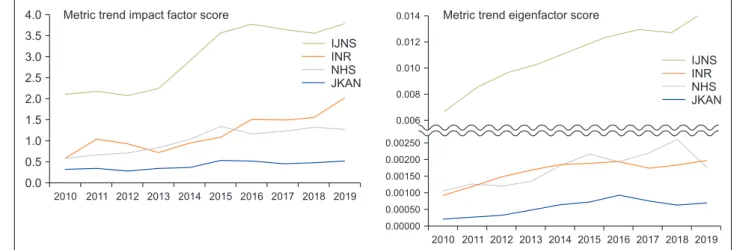
2) Changes in key indicators of journals during 2010~2019 Figure 1 shows the last 10 years’ JIF and eigenfactor score trends in the IJNS, INR, and NHS, as well as in JKAN. As com- pared to the other three journals, JKAN’s score was the lowest in both the JIF and eigenfactor score. In particular, while the JIF scores of INR and NHS have kept increasing, that of JKAN has remained static for almost 10 years.
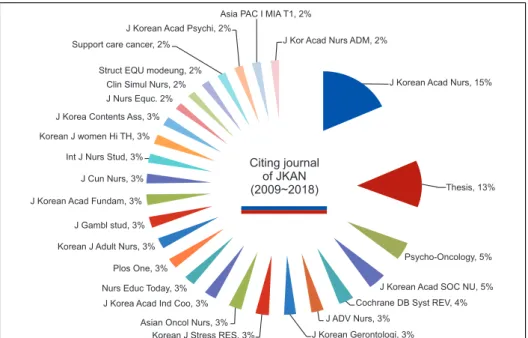
3) Journal relationships: citing and cited journals of JKAN Figure 2A shows an analysis of the journals that cited articles
IJNS = International Journal of Nursing Studies; INR = International Nursing Review;
NHS = Nursing and Health Science; JKAN = Journal of Korean Academy of Nursing.
Figure 1. Changes in key indicators of four journals during 2010~2019.
IJNS INR NHS JKAN
2010 0.014
0.012
0.010
0.008
0.006 0.00250 0.00200 0.00150 0.00100 0.00050 0.00000
2011 2012 2013 2014 2015 2016 2017 Metric trend eigenfactor score
2018 2019 2010
4.0 3.5 3.0 2.5 2.0 1.5 1.0 0.5 0.0
2011 2012 2013 2014 2015 2016 2017 2018 2019 Metric trend impact factor score
IJNS INR NHS JKAN
in JKAN during the last decade, as reported in the Web of Sci- ence (https://mjl.clarive.com/journal-profile, accessed in May 28, 2020). During the 10-year period, a total of 1,203 papers, books, and other articles from JKAN were cited, while 803 articles that were not covered in the journal articles were excluded. There- fore, JKAN’s self-citation rate was 18.0%, and it was 13.0% for
the additionally cited thesis or doctoral dissertations. Among the top 20 journals cited papers in JKAN 13 journals were published only in Korean.
Figure 2B shows the results of the top 20 journals analyzed from among JKAN’s “cited” journals during the last decade, as reported in the Web of Science (https://mjl.clarive.com/jour- Figure 2A. Citing journals of JKAN papers (N = 1203).
J Korean Acad Fundam, 3%
J Gambl stud, 3%
Korean J Adult Nurs, 3%
Plos One, 3%
Nurs Educ Today, 3%
J Korea Acad Ind Coo, 3%
J Korean Gerontologi, 3%
J ADV Nurs, 3%
Cochrane DB Syst REV, 4%
J Korean Acad SOC NU, 5%
Psycho-Oncology, 5%
Thesis, 13%
J Korean Acad Nurs, 15%
J Kor Acad Nurs ADM, 2%
Asia PAC I MIA T1, 2%
J Korean Acad Psychi, 2%
Support care cancer, 2%
Struct EQU modeung, 2%
Clin Simul Nurs, 2%
J Nurs Equc. 2%
J Korea Contents Ass, 3%
Korean J women Hi TH, 3%
Int J Nurs Stud, 3%
J Cun Nurs, 3%
Asian Oncol Nurs, 3%
Korean J Stress RES, 3%
*The full name is omitted because each journal name is an official abbreviation.
Citing journal of JKAN (2009~2018)
Figure 2B. Cited journals of JKAN.
Cin-Comput Inform NU, 3%
Cited journal of JKAN (2009~2018) Int J ENV RES Pub HE, 3%
Plos One, 3%
Iran J Public Health, 3%
Cochrane DB syst REV, 4%
JPN J Nurs SCI, 5%
J Clin Nurs, 5%
J ADV Nurs, 5%
J Nurs manage, 6%
Asian Oncol Nurs, 7%
Asian Nurs RES, 8%
J Korean Acad Nurs, 25%
J Immigr Minor Healt, 2%
J Exerc Rehabh, 2%
J Cun Diagn RES, 2%
J Perianesth Nurs, 2%
J Nurs Scholarship, 2%
BMJ Open, 2%
Holist Nurs Pract, 2%
APPL Nurs RES, 2%
Public Health Nurs, 2%
Nurs Educ Today, 2%
Medicine, 2%
*The full name is omitted because each journal name is an official abbreviation.
nal-profile, accessed in May 28, 2020). JKAN was cited in a to- tal of 490 journals over a decade, which made it the most fre- quently cited journal. Asian Nursing Research and Asian Oncol- ogy Nursing were the second and third most cited journals, re- spectively; all the top three journals were published in Korean only.
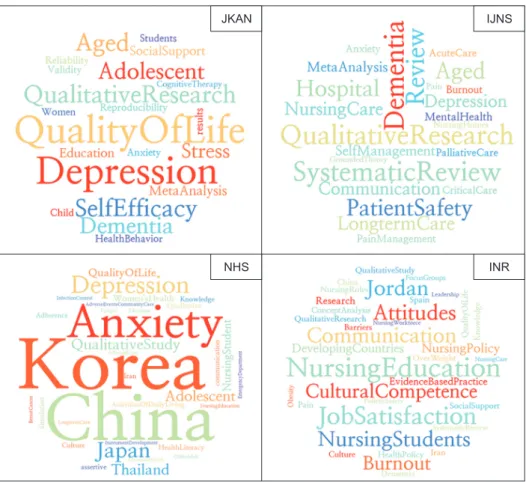
4) Keyword analysis of published articles (2015~2019) Figure 3 represents word clouds with 50 keywords from among the keywords of the articles published in four journals during 2015~2019. The word clouds presented using the word cloud generator, (http://wordcloud.kr/), and JKAN identified words/phrases such as the “Quality of life,” ”Depression,” and
“Qualitative Research” as the main keywords. However, in the case of IJNS, keywords such as “Qualitative Research,” “Sys- tematic Review,” and “Dementia” were found to be large, and
many related studies were also found. Conversely, INR had rela- tively large keywords such as “Nursing Education,” “Job Satisfac- tion,” and “Nursing Students,” and in NHS, the keywords com- prised the authors’ countries such as “Korea,” “China,” and “Ja- pan,” that mainly reflected the authors of Asian countries.
5) Study design of the published articles (2015~2019) The changes in the proportion of quantitative research in four journals during the preceding five years were as follows: the av- erage rate of change in JKAN and IJNS was not large at 82.9%
and 87.8%, respectively; while that of INR ranged from 55.2~82.4% and NHS from 58.5~81.7%, confirming a relatively large change. Among the experimental studies, JKAN had the highest rate (28.7%), followed by IJNS, NHS, and INR at 13.5%, 12.8%, and 6.0%, respectively. The randomized controlled trials (RCT) rates for IJNS, JKAN, NHS, and INR were 11.8%, 6.2%,
IJNS = International Journal of Nursing Studies; INR = International Nursing Review;
NHS = Nursing and Health Science; JKAN = Journal of Korean Academy of Nursing.
Figure 3. Word cloud of keywords of four journals during 2015~2019.
JKAN IJNS
INR NHS
6.1%, and 0.4%, respectively. JKAN had the lowest rate of quali- tative research with an average of 9.2%, followed by IJNS, INR, and NHS at 10.7%, 18.4%, and 29.1%, respectively. The propor- tion of systematic review papers published for five years was the highest with IJNS at 25.9%, followed by INR’s 7.4%, JKAN’s 2.7%, and NHS’s 2.0% (Table 4).
DISCUSSION
Academic research can be intense, stimulating, and rewarding.
A part of the research process includes writing a paper and sub- mitting it to a journal [16]. When choosing a journal, scientists often refer to the JCR ratings to prioritize well-regarded journals.
Mainstream scientific journals, including nursing journals, have a social mission to meet quality standards, thus, they should be evaluated using scientific measurement tools [15]. Since such evaluations are important to both academia and funding institu- tions; it was pertinent to check the status of JKAN—the official journal of the KSNS—which is celebrating its 50th anniversary as an international nursing journal. With this in mind, we compared JKAN with three eminent journals and discussed the findings as well as future developments.
First, we found that the proportion of English-written papers was less than 10% and non-Korean authors were below 1%, ever
since JKAN had been indexed in SCI (E). This can be viewed as an obstacle to competing with similar journals having worldwide audiences. The proportion of English-written papers should, therefore, be gradually increased with a view to eventually transforming JKAN into an international journal within a few years. This process would include, but not be limited to, recruit- ing full-time editors and authors who are more representative of an international audience. In terms of citations, JKAN’s rating was the lowest among the four journals featured. The reason for the low number of citations probably stemmed from the fact that most of papers were in Korean, which made it difficult for non-Koreans to access them. INR, one of the journals featured in the comparison, also published in Spanish since its members included nurses and researchers from many countries. Moreover, journals and papers having country names in their titles, ab- stracts, or keywords systematically receive fewer citations, and are published in journals with lower IF as compared to those which do not include country names in the same fields [17].
Therefore, corrections should be made to exclude the word ‘Ko- rean’ from JKAN’s title.
Second, we are of the opinion that since this was a professional rather than a scientific research, most of the papers did not pro- vide new nursing knowledge. The number of articles published annually ranged from a minimum of 60 to a maximum of 111. In Table 4. Study Design of Published Articles of Four Journals in 2015~2019
Categories
NHS INR IJNS JKAN
’15 ’16 ’17 ’18 ’19 5 yrs* ’15 ’16 ’17 ’18 ’19 5 yrs* ’15 ’16 ’17 ’18 ’19 5 yrs* ’15 ’16 ’17 ’18 ’19 5 yrs*
Quantitative studies 58 48 48 38 51 70.6 42 32 42 43 41 70.7 138 187 136 163 183 87.8 80 66 52 51 57 82.9
Experimental 12.8 6.0 13.5 28.7
RCT 4 6 5 2 4 6.1 1 0.4 22 18 20 29 19 11.8 5 7 4 1 6 6.2
Non-RCT 6 10 4 2 1 6.7 3 5 2 1 5 5.7 1 7 2 1 5 1.7 20 16 18 17 12 22.5
Non-experimental 35 22 26 27 36 42.7 28 16 25 23 23 40.6 61 71 38 43 62 29.9 40 24 22 27 25 37.4 Instrument
develop/validity
9 6 5 2 9 9.0 1 3 2 1 3 3.5 2 7 2 5 3 2.1 11 13 5 2 9 10.8
Mixed method 3 1 1 1.5 1 1 4 2 2.8 9 4 5 4 2.4 3 1 1 1.4
Review 4.9 17.7 39.9 4.6
SR 1 4 2 2.0 5 2 4 6 4 7.4 33 44 48 56 57 25.9 1 1 2 3 3 2.7
Non-SR 4 4 2 2.9 3 6 8 8 4 10.2 19 31 22 24 33 14.0 3 2 1 1 1.9
Qualitative studies 13 22 21 27 17 29.1 7 18 12 4 11 18.4 21 28 15 16 18 10.7 6 8 11 4 5 9.2
Concept analysis 3 1.1 1 2 1 4 0.9 2 2 1 1.4
Others 1 0.3 2 5 4 8 9 9.9 3 2 1 0.7 5 5 5 4 5 6.5
Total 71 71 69 65 68 51 58 58 55 61 162 218 153 181 205 91 81 70 60 67
JKAN = Journal of Korean Academy of Nursing; IJNS = International Journal of Nursing Studies; INR = International Nursing Review; NHS = Nursing
& Health Science; SR = Systematic review; RCT = Randomized clinical trial.
*Percentage (%).
addition, an evaluation of the effects was required since many of the studies targeted a middle-aged population and most of the applied nursing interventions included health education. The most distinctive point was that the main keywords of the articles in JKAN had hardly changed over the last decade. Since the key- words presented by authors represent the words in their articles, it is a matter of concern that there have been no significant changes in the annual order of frequency of the top 10 keywords for 10 years. Thus, it is necessary to retrospect on whether re- search is being repeatedly conducted on the same topics or whether JKAN was disinclined toward accepting new research topics. This should not be overlooked since it forms part of our efforts as nursing scientists to continually publish interesting and upgraded articles. The comparison of keywords in Figure 3 showed that more diverse keywords were presented in IJNS and INR than in JKAN.
Third, a comparison of the four journals revealed significant differences in the trends of study design and main keywords over five years. Although these findings may be the result of each journal having its own unique characteristics and goals; it is still worthwhile to note the differences in research trends. In the case of IJNS, the first ranked journal, the proportion of systematic review with meta-analysis research was six times that of JKAN’s. This proportion has gradually increased over the past five years which suggests that the systematic review and me- ta-analysis research publication rates have also increased, espe- cially since such research is at the top of the hierarchy of evi- dence. Another prominent difference was JKAN’s being five times stronger than other well-regarded international journals in terms of the design ratio of experimental studies. JKAN also had the highest proportion of experimental studies. Most of IJNS’s experimental studies being RCTs was a feature that distinguished it from other journals; particularly since RCTs are the hallmark of evidence-based nursing and form the basis for translating re- search data into clinical practice. JKAN, therefore, has to find a way to encourage researchers to conduct RCTs with rigorous experimental design.
The fourth issue to be considered is self-citation. According to the Web of Science data, JKAN’s self-citation rate was the high- est among the four journals. Self-citations constitute a significant portion of the citations which JKAN gives and receives each year.
A journal’s eigenfactor score can be considered a reflection of its importance to the scientific community. The eigenfactor score calculation is based on the number of times articles from the journal published in the past five years have been cited in the JCR year, but it also considers which journals have contributed these citations so that highly cited journals will influence the net- work more than lesser cited ones. References from one article in a journal to another article from the same journal are removed, so that the eigenfactor score is not influenced by journal self-ci- tation [11,12]. Therefore, the self-citation rate should be reduced to improve JKAN’s journal influence and eigenfactor score.
Finally, there are problems with the appointment of editors in JKAN. While the editors-in-chief of IJNS, INR, and NHS, are appointed in a professional, full-time capacity with no limits to their term of office; JKAN replaces its editor-in-chief every two years, which can be an obstacle to the maintenance and develop- ment of academic journal expertise. The three journals also differ from JKAN in that their editorial committees are composed of professors from at least eight countries, and their journals as well as citation indexes are managed by big publishers. Elsevier man- ages IJNS, while Wiley manages INR and NHS.
Based on an evaluation of 120 nursing journals’ citation indexes, JKAN 116th ranked in 2019. While there could be several rea- sons for JKAN’s citation index being so very low, one can as- sume it is because more than 90% of the journals are Kore- an-language papers rather than English-language ones. In par- ticular, the fact that even NHS which publishes six times a year in English, has a higher citation index than JKAN, clearly shows the direction in which JKAN should publish in English in the fu- ture.
CONCLUSION
This study aims to suggest a plan for enhancing JKAN’s repu- tation based on an analysis of three eminent international jour- nals. Related journals are indispensable elements in the process of developing a single academic field, and this is applicable to nursing, especially in the case of JKAN, which is a leading Ko- rean nursing journal. However, it is difficult to say that JKAN has developed over a period of more than 10 years since 2008, when it was indexed in the SSCI and SCIE. This fact reveals the
existence of problems compared to other international journals, i.e., low IF and low ranking among 120 SCI (E) journals.
To improve JKAN’s IF, we—editors—suggest the following:
Publishing it in English and providing an academic environment that would attract research papers rather than just a lot of pro- fessional papers, for enthusiastic development in nursing knowl- edge. It is also imperative to change JKAN’s title from the name of a specific country to a general name.
In 2020, JKAN stands at the turning point of the 50th anni- versary of its founding. With in-depth reflection, the influence and quality of JKAN may find an outstanding place in the next decade.
CONFLICTS OF INTEREST
The authors declared no conflict of interest.
ACKNOWLEDGEMENTS
We celebrate the 50th anniversary of KSNS together with re- searchers across the world. It is an honor to be authors and members of JKAN’s editorial board. We are grateful for the sup- port provided by KSNS, Heejoo Kim and Medrang.
AUTHOR CONTRIBUTIONS
Conceptualization or/and Methodology: Yu S & Kim JI & Park JH & Jang SJ & Suh EE & Song JE & Im YJ.
Data curation or/and Analysis: Yu S & Kim JI & Park JH &
Jang SJ.
Funding acquisition: None.
Investigation: Park JH & Jang SJ & Suh EE & Song JE & Im YJ.
Project administration or/and Supervision: Yu S & Kim JI.
Resources or/and Software: None.
Validation: Yu S & Kim JI & Park JH & Jang SJ & Suh EE &
Song JE & Im YJ.
Visualization: Yu S & Kim JI & Park JH & Jang SJ.
Writing original draft or/and Review & editing: Yu S & Kim JI
& Park JH & Jang SJ.
REFERENCES
1. Kim JI, Suh EE, Song JE, Im Y, Park JH, Yu S, et al. De- velopment of caring as a human science: 50 years of history of the Korean Society of Nursing Science. Journal of Korean Academy of Nursing. 2020;50(3):313-332.
https://doi.org/10.4040/jkan.20142
2. Roy C. Key issues in nursing theory: Developments, challeng- es, and future directions. Nursing Research. 2018;67(2):81- 92. https://doi.org/10.1097/NNR.0000000000000266
3. Shin HS, Hyun MS, Ku MO, Cho MO, Kim SY, Jeong JS, et al. Analysis of research papers published in the Journal of the Korean Academy of Nursing-focused on research trends, intervention studies, and level of evidence in the research.
Journal of Korean Academy of Nursing. 2010;40(1):139-149.
https://doi.org/10.4040/jkan.2010.40.1.139
4. Oermann MH, Shaw-Kokot J, Knafl GJ, Dowell J. Dissemina- tion of research into clinical nursing literature. Journal of Clini- cal Nursing. 2010;19(23-24):3435-3442.
https://doi.org/10.1111/j.1365-2702.2010.03427.x
5. Poradzisz M, Florczak KL. Transformative research:
A new frontier for nursing? Nursing Science Quarterly.
2018;31(2):117-120.
https://doi.org/10.1177/0894318418755741
6. Choi KS, Song MS, Hwang AR, Kim KH, Chung MS, Shin SR, et al. The trends of nursing research in the Journal of the Korean Academy of Nursing. Journal of Korean Academy of Nursing. 2000;30(5):1207-1218.
https://doi.org/10.4040/jkan.2000.30.5.1207
7. Suh YO, Park JS, Yang JH, Kim HW, Suk MH, Shin HS, et al.
Analysis of research papers published in the Journal of Korean Academy of Nursing. Journal of Korean Academy of Nursing.
2007;37(6):1013-1019.
https://doi.org/10.4040/jkan.2007.37.6.1013
8. Choe MA, Kim NC, Kim KM, Kim SJ, Park KS, Byeon YS, et al. Trends in nursing research in Korea: Research trends for studies published from the inaugural issue to 2010 in the Journal of Korean Academy of Nursing and the journals published by member societies under Korean Academy of Nursing Science.
Journal of Korean Academy of Nursing. 2014;44(5):484-494.
https://doi.org/10.4040/jkan.2014.44.5.484
9. Nestor MS, Fischer D, Arnold D, Berman B, Del Rosso JQ.
Rethinking the journal impact factor and publishing in the digital age. Journal of Clinical and Aesthetic Dermatology.
2020;13(1):12-17.
10. Gaston TE, Ounsworth F, Senders T, Ritchie S, Jones E. Fac- tors affecting journal submission numbers: Impact factor and peer review reputation. Learned Publishing. 2020;33(2):154- 162. https://doi.org/10.1002/leap.1285
11. Bergstrom C. Eigenfactor: Measuring the value and prestige
of scholarly journals. College & Research Libraries News.
2007;68(5):314-316. https://doi.org/10.5860/crln.68.5.7804 12. Moed HF. Measuring contextual citation impact of scientific
journals. Journal of Informetrics. 2010;4(3):265-277.
https://doi.org/10.1016/j.joi.2010.01.002
13. Liu XZ, Fang H. A comparison among citation-based journal indicators and their relative changes with time. Journal of In- formetrics. 2020;14(1):101007.
https://doi.org/10.1016/j.joi.2020.101007
14. Kianifar H, Sadeghi R, Zarifmahmoudi L. Comparison between impact factor, eigenfactor metrics, and SCimago journal rank indicator of pediatric neurology journals. Acta Informatica Medica. 2014;22(2):103-106.
https://doi.org/10.5455/aim.2014.22.103-106
15. Cantín M, Muñoz M, Roa I. Comparison between impact fac- tor, eigenfactor score, and SCImago journal rank indicator in anatomy and morphology journals. International Journal of Morphology. 2015;33(3):1183-1188.
https://doi.org/10.4067/S0717-95022015000300060
16. Peterson K. Guide to life science careers [Internet]. Cam- bridge: NPG Education; c2014 [cited 2020 Jul 2]. Available from: https://www.nature.com/scitable/ebooks/guide-to-life- science-careers-14053951/.
17. Fox CW, Burns CS. The relationship between manuscript title structure and success: Editorial decisions and citation per- formance for an ecological journal. Ecology and Evolution.
2015;5(10):1970-1980. https://doi.org/10.1002/ece3.1480
Appendix 1. The Annual Publications Characteristics of JKAN (2010~2019)
Categories Year
2010 2011 2012 2013 2014 2015 2016 2017 2018 2019 Total Research
design
Experi mental design
Randomized control trial 3 4 2 3 2 5 7 4 1 6 37
Non-Randomized control trial 21 26 33 20 16 20 16 18 17 12 199
Research methods Systematic review & Meta-analysis 0 2 3 4 3 5 3 3 4 3 30
Survey 45 34 46 26 33 34 27 25 23 24 317
Literature review 1 3 0 7 1 3 2 0 0 1 18
Methodological 9 7 13 11 8 11 13 4 7 9 92
Q-method 0 1 2 2 0 0 0 0 2 1 8
Factor analysis 1 0 1 0 0 0 0 0 0 0 2
Systemic dynamic 0 0 0 0 0 2 0 0 1 1 4
Qualitative research
Grounded theory 3 4 4 3 2 4 4 2 2 2 30
Phenomenological 1 2 2 4 5 2 4 9 1 3 33
Ethnography 1 0 1 0 0 0 0 0 1 0 3
Others 0 4 4 1 2 5 5 5 1 5 32
Research partici- pants
Healthy person Preschooler 6 0 2 4 4 1 1 0 2 1 21
Adolescent 4 7 5 1 3 5 1 3 2 4 35
Early adult 2 11 0 5 10 6 10 1 5 3 53
Middle age 15 3 18 3 2 6 6 4 1 7 65
Elders 11 8 12 4 5 10 4 4 3 2 63
Patient Preschooler 1 1 3 2 2 1 1 0 0 2 13
Adolescent 1 2 1 1 1 1 1 0 2 0 10
Early adult 1 0 0 4 0 2 2 0 2 0 11
Middle-aged 17 8 30 6 10 14 15 24 12 15 151
Elders 4 18 4 8 12 9 9 3 6 4 77
Others Caregiver 6 1 9 9 4 5 3 8 5 1 51
Healthcare provider 15 15 17 20 9 16 22 15 15 19 163
Article/instrument 4 7 6 12 7 12 6 7 4 7 72
Organization 0 3 3 1 2 2 0 1 1 1 14
Rats, cells, microorganism 2 3 1 1 1 1 0 0 0 1 10
Types of nursing intervention Nursing skills 7 3 5 3 4 3 1 2 2 6 36
Health education 6 12 17 12 11 12 12 10 8 8 108
Nursing administration 1 0 0 0 0 0 0 0 0 1 2
Psychosocial intervention 1 4 8 2 4 4 6 7 3 1 40
Alternative therapy 5 7 3 3 0 4 3 1 4 0 30
Others 4 4 2 3 0 1 3 2 1 2 22
Types of dependent variables Clinical endpoints 11 15 14 10 8 11 8 4 10 9 100
Functional status 0 5 4 2 2 5 2 3 4 1 28
Perceptual outcomes 2 6 3 1 0 3 3 4 2 1 25
Knowledge, attitude, behavioral outcomes
8 9 16 14 9 10 16 17 5 9 113
Emotional outcomes 7 8 11 4 5 4 5 5 7 1 57
Others 1 1 0 1 1 0 0 1 0 1 6
JKAN = Journal of Korean Academy of Nursing.