Analysis of Mechanical Characteristics of Polymer Sandwich Panels Containing Injection Molded and 3D Printed Pyramidal Kagome Cores
K. M. Yang, J. H. Park * , T. G. Choi * , J. S. Hwang ** , D. Y. Yang ** , and M.-Y. Lyu *,†
Design and Engineering Program Department, Graduate School of Nano IT Design Fusion, Seoul National University of Science and Technology, 232 Gongneung-ro, Nowon-gu, Seoul 139-743, South Korea
*
Department of Mechanical System Design Engineering, Seoul National University of Science and Technology, 232 Gongneung-ro, Nowon-gu, Seoul 139-743, South Korea
**
School of Mechanical Aerospace & Systems Enginieering, KAIST, 291 Daehak-ro, Yuseong-gu, Deaejeon, Republic of Korea (Received November 15, 2016, Revised November 16, 2016, Accepted November 22, 2016)
Abstract: Additive manufacturing or 3D printing is a new manufacturing process and its application is getting growth.
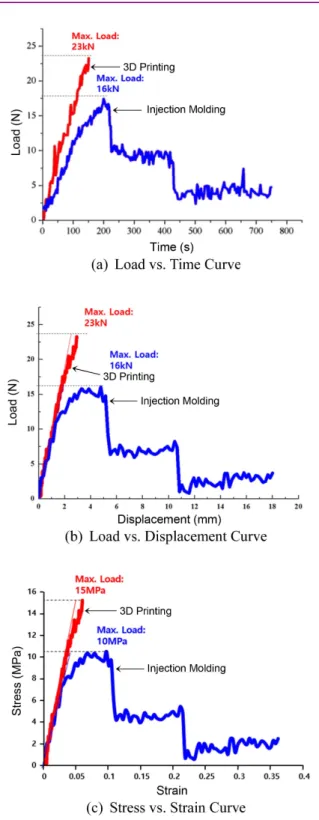
However, the product qualities such as mechanical strength, dimensional accuracy, and surface quality are low compared with conventional manufacturing process such as molding and machining. In this study not only mechanical characteristics of polymer sandwich panel having three dimensional core layer but also mechanical characteristics of core layer itself were analyzed. The shape of three dimensional core layer was pyramidal kagome structure. This core layer was fabricated by two different methods, injection molding with PP resin and material jetting type 3D printing with acrylic photo curable resin. The material for face sheets in the polymer sandwich panel was PP. Maximum load, stiffness, and elongation at break were examined for core layers fabricated by two different methods and also assembled polymer sandwich panels. 3D printed core showed brittle behavior, but the brittleness decreased in polymer sandwich panel containing 3D printed core. The avail- ability of 3D printed article for the three dimensional core layer of polymer sandwich panel was verified.
Keywords: 3D printing, injection molding, pyramidal kagome core, sandwich panel, mechanical characteristics
Introduction
3D 프린팅은 제품개발 초기 단계에서 발생되는 오류의 수 정 및 시행착오를 줄일 수 있고 개발비용 및 시간을 줄일 수 있는 제작기법으로 각광받고 있다.
13D 프린팅에 관한 ASTM 규격 대표공정으로는 ‘Material Extrusion, Material Jetting, Binder Jetting, Sheet Lamination, Vat Photopolymerization, Powder Bed Fusion, Directed Energy Deposition’ 이 있다.
23D 프린팅 공정 중 material jetting 방식은 재료를 이차원 프린터 처럼 제팅하여 단면적을 제작하는 방식이다. 이 방식은 정교 한 형상을 출력할 수 있는 장점이 있다. 그러나 3D프린팅은 약한 강도를 갖고 있어 시제품 제작과 형상유지 용도로 활용 하고 있고 완제품 제작으로는 많이 사용되지 않고 있는 현실 이다. 따라서 3D 프린팅 조형물의 강도에 대한 연구가 필요 하다.
최근 들어 경량화 소재가 큰 화두가 되고 있다. 고분자의 경 량화 방법은 다양하다. 소재의 물성을 증대시켜 적은 양을 사 용하게 하는 방법, 내부에 폼을 형성하게 하여 비강성을 높이
는 방법, 유리섬유나 카본섬유를 이용한 복합소재를 사용하 는 방법, 그리고 샌드위치 복합판재를 사용하여 비강성을 높 이는 방법 등이 소재의 경량화를 위한 방법들이다.
3-9샌드위 치 복합판재의 경우 코어층의 구조에 따라 복합판재의 강성 은 크게 다르다. 피라미달 카고메 코어(pyramidal kagome core) 를 사용한 고분자 복합판재는 카고메 구조의 고강성으로 역학적 특성이 매우 우수하다. 이렇게 코어의 특별한 디자인 으로 새로운 소재를 개발하지 않고 기존소재를 사용하여 판 재의 경량화와 강성을 높일 수 있다.
10-12그러나 카고메 코어 는 복잡한 3차원 형상을 갖고 있어 기존의 고분자 성형 방법 으로는 자유로운 형상 제작이 어렵다. 또한 복잡하고 정교한 피라미달 카고메 코어를 생산 하기 위해 높은 금형 비용이 들 고 다양한 형상 디자인에 제약을 받는다.
10,11따라서 복잡한 형 상을 구현하기 위한 성형방법의 연구가 필요하다.
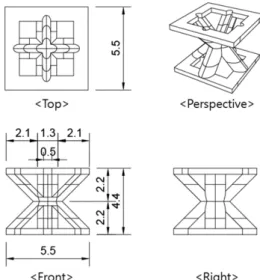
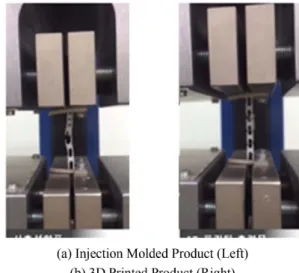
본 연구에서는 피라미달 카고메 코어를 갖고 있는 고분자 복합 판재에서 코어의 형상을 사출성형과 3D 프린팅으로 제 작하여 코어 층 자체와 복합판재의 강도를 평가하였다. 이 평 가를 통하여 3D 프린팅 조형물의 유용성을 분석 하였다. 3D 프린팅 조형물 단독으로는 강성을 요구하는 용도에 한계가 있 지만 다른 부품과의 조합에 사용된다면 그의 유용성을 확보
†