• 검색 결과가 없습니다.

Current Modeling for Accumulation Mode GaN Schottky Barrier MOSFET for Integrated UV Sensors

N/A
N/A
Protected

Academic year: 2021

Share "Current Modeling for Accumulation Mode GaN Schottky Barrier MOSFET for Integrated UV Sensors"

Copied!
6
0
0

로드 중.... (전체 텍스트 보기)

전체 글

(1)

is changed by the gate oxide thickness and Schottky barrier height, but it is hardly changed by the doping concentration. For a GaN SB MOSFET with ITO source and drain electrodes, the calculated threshold voltage was 3.5 V which was similar to the measured value of 3.75 V and the calculated drain current was 1.2 times higher than the measured.

Keywords: Schottky barrier, UV sensor, thermionic emission, MOSFET, gallium nitride.

1. INTRODUCTION

Gallium nitride and related devices have been studied due to its excellent material properties such as high breakdown voltage, high mobility, high velocity saturation and wide bandgap, which are more than suitable for high frequency power devices [1,2].

There have been various GaN based transistors, such as hetero- junction field-effect transistors (HFET) [3] and high electron mobility transistors (HEMT) [4], etc. GaN Schottky barrier MOSFET has low off-state current, because it has high hole barrier which prevent the leakage current. And GaN-based Shottky-Barrier MOSFET can be used for the active pixel sensor (APS) type UV image sensor by integration with a Scottky electrode based GaN UV photodiode [5]. So it becomes miniaturized than the existing UV sensor by using the Si-based circuit and GaN MSM UV Sensor. There has been a work to model GaN SB-MOSFET by fitting the data that is obtained from the TCAD simulation to the experimental data [7].

In this work, the drain current of the SB MOSFET was modeled mathematically by considering thermionic emission and tunneling

components was calculated for accumulation mode. The electron concentration was substituted by the channel electron concentration for modeling the thickness of depletion layer below the schottky contact, because the barrier width is changed by it.

The pinch-off voltage was considered. Also a simple mathematical model of drain current was developed by using quantum model. The calculated drain current was close to the measured value of the experimental data.

2. MODELING

Fig. 1 (a) shows an implementation example of the Schottky barrier MOSEFT fabricated on a high-resistive n-type GaN substrate using ITO as electrodes for source and drain. Fig. 1 (b) and (c) show the energy band diagram of a metal-semiconductor contact and channel electron concentration with variation of gate voltage. The tunneling current is suppressed by the thick Schottky barrier in equilibrium i.e. no gate bias as shown in Fig. 1 (a).

But the channel electron concentration increases by an increased positive gate voltage, so as to increase the diffusion current. For the drift current is exactly same with the diffusion current in a quasi-equilibrium condition, the electric field increases accordingly, which makes the energy band sharper in slope and the narrower in width as shown in Fig. 1 (b).

If a drain voltage is applied in this condition, tunneling current can be flowed through the thinner Shottky barrier width. The channel electron concentration N

ch

is

School of Electronics Engineering, College of IT Engineering, Kyungpook National University, Daegu 702-701, Korea.

+

Corresponding author: [email protected]

(Received: Jan. 23, 2017, Revised: Mar. 16, 2017, Accepted: Mar. 17, 2017)

This is an Open Access article distributed under the terms of the Creative Commons Attribution Non-Commercial License(http://creativecommons.org/

licenses/bync/3.0) which permits unrestricted non-commercial use, distribution,

and reproduction in any medium, provided the original work is properly cited.

(2)

(1)

(2)

(3)

where W is the Schottky barrier width, is the tunneling probability.

2.1 Thermionic emission

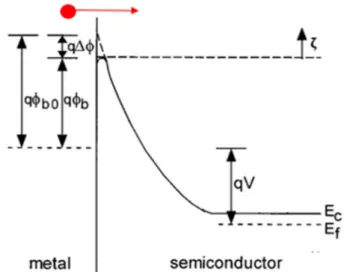
At the source junction, a reverse biased Schottky contact, there are two major current components: thermionic and tunneling emission. Fig. 2 shows the energy band diagram of a Schottky contact at the reverse bias and electrons flow from the metal over

the energy barrier into the semiconductor. Thermionic emission can be expressed by [7]

(4)

where is the quantum transmission coefficient of the electron above the effective Schottky barrier height, is the Richardson constant. Assuming no significant loss in the process, thermionic emission can be expressed by integrating Eq. (5).

(5)

2.2 Tunneling

Fig. 3 presents the energy band diagram of the reverse biased metal semiconductor junction, and defines relevant

(7) where is the effective mass, η and W(η) are the Shottky barrier height and width for the tunneling electron, as shown in Fig. 3. In this work, W(η) was modeled by approximating the conduction band to a triangular shape and using the ratio,

(8) where is the Schottky barrier width for a reversely biased condition [9].

Tunneling probability can be expressed by substituting Eq. (8) into Eq. (7)

T ( ) η

T ( ) ζ

A∗

m∗

W qV (

b

) Fig. 1. Schematic cross-section of SB MOSFET(a), whose energy

band diagram showing channel electron concentration at low gate voltage(b), and high gate voltage(c).

Fig. 2. Schematic conduction band diagram of a reversely biased

metal-semiconductor contact: electrons flow from the metal

into the semiconductor over the energy barrier.

(3)

(9)

can be approximated as , because is very small in GaN. The Schottky barrier width is changed by the channel electron concentration . Tunneling current density of the SB MOSFET can be expressed by

(10)

The lowering of the Schottky barrier height, is typically expressed

(11)

where is the surface field which is the slope of the energy band.

(12) Eq. (12) can be modified to Eq. (13), because the schottky barrier width is changed by the channel electron concentration.

(13)

Schottky barrier lowering equation of the SB MOSFET can be found by substituting Eq. (13) into Eq. (11).

(14)

where is all the substrate charge present in the n-type substrate expressed by [10]

(17)

Because is dominant compared with other terms in the accumulation region, can be simplified.

(18)

As you can see in Fig. 4, is very small in the accumulation region when using the n-GaN substrate, because almost gate voltage is applied to the . So Eq. (16) can be modified to the Eq. (24).

(19)

Channel electron concentration is expressed finally by

(20)

2.4 Drain current at accumulation mode SB MOSFETs

Drain current equation is expressed

(21) where and W are the channel thickness and width respectively, is the drain current density composed of

qV

b

q∅

b

+ qV qV

n

W qV (

b

) N

ch

Δ∅

E

s

W

dep

Q

sub

e

q∅s ---kT

Q

sub

s

V

ox

V

g

V

fb

2 ε

s

kTN

d

e

q∅s ---kt

c

ox

---

≅ +

T

ch

J

D

Fig. 3. Conduction band diagram of a reversely biased Schotttky

contact used in explaining the tunneling current.

(4)

thermionic emission and tunneling current. Finally the drain current can be expressed by combining the two components

(24)

where is the channel thickness in the accumulation region expressed by [11]

(25)

Gate voltage dependent channel thickness can be found by substituting Eq. (20) into Eq. (25).

(26)

2.5 Pinch-off voltage of accumulation mode SB MOSFETs Since the contact resistance of the drain side end is very small due to forward bias, most of the drain bias is applied between the semiconductor and the gate. If the drain voltage was larger than , the drain current starts saturating, because there is not enough channel electrons at the drain end. Therefore the pinch-off voltage can be expressed by

(27)

3. RESULTS AND DISCUSSIONS

3.1 Calculation for GaN SB MOSFET using ITO S/D electrodes

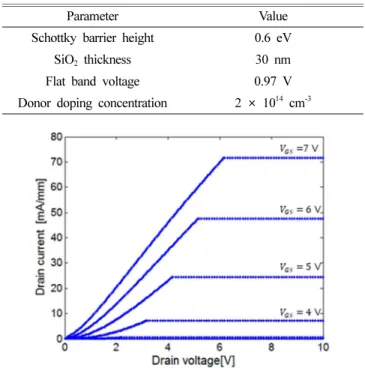
Fig. 5 shows published output I-V characteristics of the n-type GaN SB MOSFET using ITO S/D electrodes [11], which has Schottky barrier height of 0.6 eV. The gate oxide of was 30 nm thick. The channel doping concentration was not clearly explained in the paper, and cm

-3

of donor doping

T

ch

V

G

– V

fb

SiO

2

2 10 ×

14

Fig. 4. Schematic energy band diagram of the MOS gate structure in the accumulation region for an n-type GaN substrate.

Fig. 5. Measured output I-V characteristics of the n-type GaN SB MOSFET using ITO S/D electrodes [11].

Table 1. Summary of the model parameters for an n-type GaN SB MOSFET

Parameter Value

Schottky barrier height 0.6 eV

SiO

2

thickness 30 nm

Flat band voltage 0.97 V

Donor doping concentration 2 × 10

14

cm

-3

Fig. 6. Calculated output I-V characteristics of an n-type GaN SB

MOSFET using ITO S/D electrodes.

(5)

concentration was assumed. The gate length and width are 10 um and 100 um respectively, and the calculated flat band voltage is - 0.65 V when using gold as a gate. Table 1 shows the parameters used in the calculation.

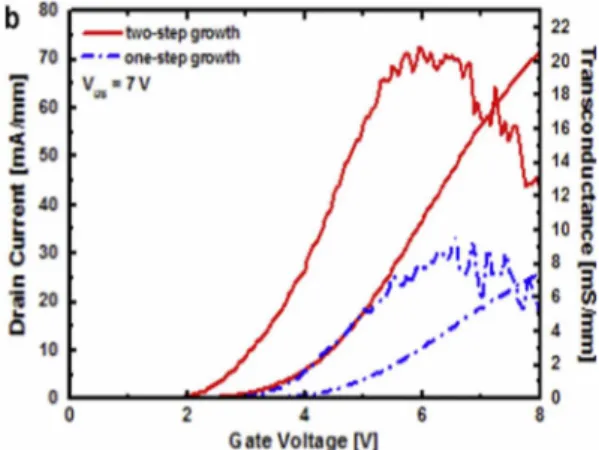
As shown in Fig. 6, calculated drain current is 1.2 times larger than the measured value. Fig. 7 and Fig. 8 show the measured and the calculated transfer I-V characteristics of GaN SB MOSFET using ITO S/D electrodes respectively.

3.2 Drain current of n-GaN SB MOSFET for various conditions

In Fig. 9, the drain current is hardly changed by doping concentration. As the Schottky barrier width is changed by doping concentration expressed in Eq. (2), the drain current is changed by the doping concentration at the off state. After being turned on, the barrier width is inversely proportional to the channel electron concentration as mentioned above, because the channel electron

concentration is more important parameter than the doping concentration in the accumulation region.

In Fig. 10, the drain current decreases and threshold voltage increases as the Schottky barrier height is high. In Fig. 11, the drain current increases with oxide thickness decrease. As oxide thickness becomes thin, channel electron concentration increase, so barrier width is narrow which increases the tunneling current.

4. CONCLUSIONS

The drain current of the SB MOSFET was calculated for its accumulation mode. The drain current was modeled by an Fig. 8. Calculated transfer I-V characteristics of an n-type GaN SB

MOSFET using ITO S/D electrodes.

Fig. 10. Calculated output I-V characteristics of n-type GaN SB MOSFETs using parameters of Table 1 except for the Schottky barrier height (a) 0.7 eV, and (b) 0.8 eV.

Fig. 11. Calculated output I-V characteristics of n-type GaN SB

MOSFETs using parameters of Table 1 except for the oxide

thickness (a) 40 nm, and (b) 50 nm.

(6)

equation which is composed of thermionic emission and tunneling with consideration of the image force lowering and substitution of the channel electron concentration for the depletion electron concentration in the tunneling current equation, because barrier width is changed by the channel electron concentration. Pinch-off voltages were considered in the accumulation and inversion mode.

For accumulation mode GaN SB MOSFET with ITO electrodes for source and drain, the calculated threshold voltage was 3.5 V which was similar to the measured value of 3.75 V and calculated drain current was 1.2 times higher than the measured value. Also, the drain current is changed by the gate oxide thickness and Schottky barrier height, but it is hardly changed by the doping concentration. At accumulation mode n-type GaN SB MOSFETs, drain current is changed by the gate oxide thickness and Schottky barrier height, but it is hardly changed by the doping concentration.

ACKNOWLEDGMENT

This study was supported by the BK21 Plus project funded by the Ministry of Education, Korea (21A20131600011), and NRF- 2013R1A1A2012441

REFERENCES

[1] H. C. Lee, S. Y. Hyun, H. I. Cho, C. Ostermaier, K. W. Kim, S. I. Ahn, K. I. Na, J. B. Ha, D. H. Kwon, C. K. Hahn, S.

H. Hahm, H. C. Choi, and J. H. Lee, “Enhanced Electrical Characteristics of AlGaN/GaN Heterostructure Field-Effect Transistor with p-GaN Back Barriers and Si Delta-Doped

Layer”, J. Appl. Phys., Vol. 47, No. 4S, pp. 2824-2827, 2008.

[2] V. A. Dmitriev, et al., “Electric breakdown in GaN p-n junc tions”, Appl. Phys. Lett., Vol. 68, No. 2, pp. 229-231, 1996.

[3] Y.?F. Wu, et al., “Very high breakdown voltage and large transconductance realized on GaN heterojunction field effect transistors”, Appl. Phys. Lett., Vol. 69, No. 10, pp.

1438-1440, 1996.

[4] M. Asif Khan, et al., “High electron mobility transistor based on a GaN/Al

x

Ga

1-x

N heterojunction”, Appl. Phys.

Lett., Vol. 63, No. 10, pp. 1214-1215, 1993.

[5] C. J. Lee, et al., “Hybrid UV Active Pixel Sensor Imple- mented Using GaN MSM UV Sensor and Si-Based Cir- cuit”, IEEE Sens. J., Vol. 15, No. 9, pp. 5071 - 5074, 2015.

[6] Ayse Merve Ozbek, “Schottky Barrier GaN FET Model Creation and Verification using TCAD for Technology Evaluation and Design”, NCSU Master Thesis, 2008:

J. Park et.al,“Analytical Model of Source Injection for N- type Enhancement Mode GaN-based Schottky Source/

Drain MOSFET, ISDRS 2009”

[7] C. Y. Chang, et al., “Carrier transport across metal-semi- conductor barriers”, Solid-State Electron., Vol. 13, No. 6, pp. 727-740, 1970.

[8] E. J. Miller, et al., “Gate leakage current mechanisms in AlGaN/GaN heterostructure field-effect transistors”, J.

Appl. phys., Vol. 88, No. 10, pp. 5951-5958, 2000.

[9] C. C. Hu, Modern Semiconductor Devices for integrated circuits, Pearson, New Jersey, p. 154, 2010.

[10] M. H. Lean, et al., “Effect of gaseous void on bipolar charge transport in layered polymer film”, J. Phys. D: Appl. Phys., Vol. 47, No. 7, p. 075303, 2014: Y. Taur, Fundamentals of Modern VLSI Devies, Cambridge University Press, New York, pp. 79-80, 2009.

[11] D. S. Kim et al., “Performance enhancement of GaN SB

MOSFET on substrate using two-step growth method”,

Microelectronic Engineering, Vol. 88, No. 7, pp. 1221-

1224, 2011.

수치

Fig. 3 presents the energy band diagram of the reverse biased metal semiconductor junction, and defines relevant
Fig. 3. Conduction band diagram of a reversely biased Schotttky contact used in explaining the tunneling current.
Table 1. Summary of the model parameters for an n-type GaN SB MOSFET
Fig. 11. Calculated output I-V characteristics of n-type GaN SB MOSFETs using parameters of Table 1 except for the oxide thickness (a) 40 nm, and (b) 50 nm.

참조

관련 문서

• Changed the name to Clock tool example use case: Configure LPSPI to SPLL BUS_CLK at 48 MHz and peripheral clock at 24MHz FIRC in RUN mode on S32K14x on page 15. •

So, the presence of a grain removes a strange barrier between unitary dynamics and the collapse of the wave vector, which is a hindrance for modeling dynamics, since the use

When pin 42 (GSET) is high (simultaneous gain set mode), the full-scale output current for both DACs is determined by the ratio of the internal reference voltage (1.2 V) and

PWM mode implements current limiting using an internal comparator that trips at 2 A for both bucks (typical). If the output is shorted to ground the device enters a timed

Furthermore, to protect against reverse current in the power MOSFET, the UVLO circuit keeps the charge in shutdown mode if V IN falls to within 70mV of the battery voltage, If

Which transformation proceeds by short-range diffusion?.. Diffusion Transformations in solid.. 5.5.5 Spinodal Decomposition.. Spinodal mode of transformation has no

- Transition to H-mode: state with reduced turbulence at the plasma edge - Formation of an edge transport barrier: steep pressure gradient at the edge...

Using RTM1688-2, Silicon Surface-Barrier Detector that can measure both Radon and Thorium at the same tome, Radon concentration was measured for 10 kinds of construction