J. Exp. Biomed. Sci. 14 (2008) 233–238
Adiponectin Level in Non-Pregnant Women, Pregnant Women without Diabetes and Pregnant Women with Diabetes
Yoon-Kyung Jo1 and Jee-Aee Im2,†
1Department of Clinical Laboratory Science, Dongnam Health College, Suwon, 440-714, Korea.
2Sport and Medicine Research Center, INTOTO Inc., Seoul, Korea
Gestational diabetes mellitus (GDM) is a common complication during pregnancy and one of the main causes of adverse fetal-maternal outcomes. However, the pathogenesis of GDM has not been clearly stated. Adiponectin, an adipose tissue-derived plasma protein, is involved in regulation of insulin resistance and glucose hemostasis, and thus is a key modulator of insulin action and glucose metabolism. In this study, we investigated to compare serum adiponectin levels in pregnant women with diabetes, pregnant women who are without diabetes, and non-pregnant women, and to evaluate relationship between serum adiponetin levels and metabolic parameters. Forty-one pregnant women with diabetes, fifty-nine pregnant women without diabetes and forty non-pregnancy women were recruited. Adiponectin levels were significantly lower in pregnant women with diabetes when compared to non-pregnant women and pregnant women without diabetes. Pregnant women without diabetes at second trimester had lower adiponectin levels compared to non-pregnant women. Adiponectin was negatively correlated with BMI, fasting insulin, HOMA-IR, total cholesterol, and triglyceride. In conclusion, this study confirmed that the decreased level of adiponectin precedes the onset of abnormal glucose level during pregnancy and also normal pregnant women had lower adiponectin levels compared to non-pregnant women. This knowledge may help to identify strategies for lowering the occurrence of GDM in women who are at high risk of developing the disorder.
Key Words: Gestational diabetes mellitus, Adiponectin
INTRODUCTION
Gestational diabetes mellitus (GDM) is a common complication during pregnancy and one of the main causes of adverse fetal-maternal outcomes (Sun and Yang, 2007).
The most common theory is that GDM is caused by reduced insulin sensitivity combined with the anti-insulin hormones, which is increasingly secreted by the placenta during pregnancy, such as human placental lactogen, pro- lactin, glucocorticoid, and progesterone (Hod et al., 2003;
Cunningham et al., 2005). GDM affects roughly 4~8% of pregnancies (Hadden, 1985; Beischer et al., 1996; Buchanan
and Kjos, 1999). Women with a history of GDM have risk of developing type 2 diabetes mellitus (T2DM) (Henry and Beischer, 1991). Therefore, GDM can be a model of the early events in the natural history of T2DM (Kjos and Buchanan, 1991).
Recent studies have suggested the broad role of adipo- kines in the control of glucose metabolism during pregnancy.
Adiponectin, an adipose tissue-derived plasma protein, is involved in regulation of insulin resistance and glucose hemostasis, and thus is a key modulator of insulin action and glucose metabolism (Mazaki-Tovi et al., 2005). It is found to be related with diabetes, obesity, coronary heart disease, obstructive sleep syndrome apnea (Zhang et al., 2007) and breast cancer (Hou et al., 2007). Previous studies have shown hypoadiponectinemia in pregnancies compli- cated by GDM, as compared to normal pregnancies (Worda et al., 2004; Cortelazzi et al., 2007). Pregnancy is a unique situation in which there is a physiological increase in
*Received: November 24, 2008
Accepted after revision: December 13, 2008
†Corresponding author: Jee-Aee Im, Sport and Medicine Research Center, INTOTO Inc., 1304, ACE High-end Tower 2, 222-14, Guro 3-dong, Guro-gu, Seoul, Korea.
Tel: 82-2-6340-5533, Fax: 82-2-6340-5905 e-mail: [email protected]
insulin resistance, because of several factors: the progressive increase in postprandial glucose and insulin response in late gestation, a 50% decrease in insulin-mediated glucose disposal, and a 200~250% increase in insulin secretion to maintain euglycemia in the mother (Malek et al., 2001;
Ramos et al., 2003). As an increase in maternal adipose tissue is a common feature of normal gestation, detailed understanding of gestational changes in adiponectin is required to elucidate both physiologic role related to insulin action in the pregnant state. However, little has been reported about adiponectin expression in normal pregnant women.
In this study, we compared serum concentrations of adiponectin in normal pregnant women to those in non- pregnant women, also, compared serum adiponectin levels between pregnant women with diabetes and pregnant women without diabetes, and investigated the relationship between serum adiponetin levels and metabolic parameters.
MATERIALS AND METHODS 1. Subjects
Forty-one women with GDM were diagnosed by the American Diabetes Association criteria (American Diabetes Association, 2003). Diagnostic criteria for abnormal glucose metabolism during pregnancy are as follows: for all women with 50 g glucose challenge test ≥130 mg/dl, 75 g OGTT was performed and the cut-off value of fasting, 1, 2, and 3 hours glucose level after glucose intake were 95, 180, 155 and 140 mg/dl, respectively. GDM was diagnosed in those women who had two abnormal values out of the four results. Forty non-pregnancy women and fifty-nine non- GDM women were also recruited. Subjects with pre-existing diabetes and hypertension, pre-eclampsia, polycystic ovarian syndrome, chronic systemic or inflammatory diseases, or current use of corticosteroids were not included in this study.
All subjects with GDM were not treated with insulin or any medications. All pregnancies were singletons and estimation of gestational age was based on routine ultrasonographic screening.
2. Anthropometric evaluation and Biochemical analyses
Body weight was measured to the nearest 0.1 kg on an electronic scale. Patients were weighed in light clothing without shoes. Height was measured to the nearest 0.1 cm using a stadiometer. Body mass index (BMI) was calculated as weight/height2 (kg/m2). Serum levels of fasting glucose, total cholesterol, HDL-cholesterol, and triglyceride levels were assayed using an ADVIA 1650 Chemistry system (Siemens, Tarrytown, NY, USA). LDL-cholesterol was calculated by Friedewald's formula, if serum triglyceride levels were below 400 mg/dL. Fasting insulin was meas- ured by electrochemiluminescence immunoassay (Roche, Indianapolis, IN, USA). Insulin resistance was estimated by the homeostasis model assessment of insulin resistance (HOMA-IR) index [(Insulin (μIU/ml) × Fasting blood glucose (mg/dl)/18) / 22.5]. Adiponectin (AdipoGen, Seoul, Korea) levels were measured by enzyme-linked immuno- sorbent assay.
3. Statistical analyses.
Data are expressed as mean ± SD. Variables such as fasting insulin, HOMA-IR, triglyceride and adiponectin levels were logarithmically transformed prior to statistical analysis to approximate a normal distribution. Baseline characteristics and adiponectin levels among three groups were compared using an analysis of variance (ANOVA).
Pearson correlation coefficients were calculated to evaluate a relationship between adiponectin levels and study variables such as age, BMI, blood pressure, glucose tolerance indices, and lipid profiles. Significance was defined at the 0.05 level of confidence. All calculations were performed using the Statistical Package for Social Sciences software, version 15.0 (SPSS Inc., Chicago, IL, USA).
RESULTS
The clinical characteristics of study subjects are shown in Table 1. Pregnant women with diabetes had significantly higher levels of BMI. However, there was no significant difference in age and blood pressure among the study
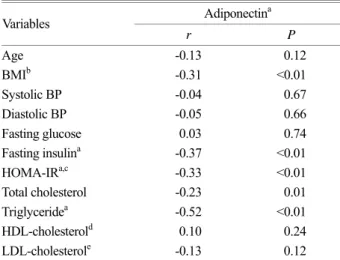
subjects. Weight gain at second trimester was not different between pregnant women with diabetes and pregnant women without diabetes, Pregnant women with diabetes had significantly higher levels of fasting glucose, fasting insulin, HOMA-IR, total cholesterol, and triglyceride than non-pregnant women or pregnant women without diabetes (P<0.01, respectively) (Table 2). Adiponectin levels were significantly lower in pregnant women with diabetes when compared to non-pregnant women and pregnant women without diabetes (P<0.01). Furthermore, the pregnant women without diabetes had lower adiponectin levels than non- pregnant women (Table 3). Adiponectin was negatively correlated with BMI (r=-0.31, P<0.01), fasting insulin (r=-0.37, P<0.01), HOMA-IR (r=-0.33, P<0.01), total cholesterol (r=-0.23, P=0.01), and triglyceride (r=-0.52, P<0.01). Whereas, age, SBP, DBP, fasting glucose, HDL-
cholesterol and LDL-cholesterol were not correlated with adiponectin (Table 4).
DISCUSSION
In this study, we confirmed that serum adiponectin levels are significantly lower in pregnant women with diabetes Table 3. Serum adiponectin levels in study subjects
Group Adiponectin (mg/dl)
Non-pregnant women (N=40) 8.7±3.9
Non-GDM (N=59) 3.8±1.8a
GDM (N=41) 3.1±1.4b,c
P-value <0.01 P-values are calculated by ANOVA.
a Non-pregnant women versus Non-GDM P<0.01, b Non-GDM versus GDM P<0.05, c Non-pregnant women versus GDM P<0.01
Table 4. Correlations between adiponectina levels and various parameters
Adiponectina Variables
r P
Age -0.13 0.12
BMIb -0.31 <0.01
Systolic BP -0.04 0.67
Diastolic BP -0.05 0.66
Fasting glucose 0.03 0.74
Fasting insulina -0.37 <0.01
HOMA-IRa,c -0.33 <0.01
Total cholesterol -0.23 0.01
Triglyceridea -0.52 <0.01
HDL-cholesterold 0.10 0.24
LDL-cholesterole -0.13 0.12
Coefficients (r) and P-values were calculated by the Pearson correlation model.
a Values have been analysed after log-transformation, b Body mass index, c Homeostasis model assessment insulin resistance, d High density lipoprotein cholesterol, e Low density lipoprotein cholesterol.
Table 1. Clinical characteristics of study subjects
Group Age (years) BMIa (Kg/m2) Weight gain (kg) Systolic BP Diastolic BP
Non-pregnant women (N=40) 30.5±5.4 20.5±2.2 111.4±11.3 67.2±10.6
Non-GDM b (N=59) 31.8±3.2 21.7±3.2 7.8±3.3 111.0±11.4 65.0±10.1
GDM (N=41) 30.9±3.5 23.0±3.7 6.7±4.0 117.8±14.3 71.0±12.3
P-value 0.27 <0.01 0.14 0.07 0.23
P-values are calculated by ANOVA. a Body mass index, b Gestational diabetes mellitus.
Table 2. Glucose and lipid parameters of study subjects Group Fasting glucose
(mg/dl) Fasting insulina
(µIU/ml) HOMA-
IRa,b Total cholesterol
(mg/dl) Triglyceridea
(mg/dl) HDL-cholesterolc
(mg/dl) LDL-cholesterold (mg/dl) Non-pregnant
women (N=40) 80.5±4.8 3.7±1.7 0.8±0.4 161.4±26.1 69.5±28.7 59.5±16.3 88.0±21.0 Non-GDM e
(N=59) 76.0±9.3 6.3±3.1 1.2±0.7 225.2±34.3 177.4±58.6 69.5±14.1 120.3±28.7 GDM (N=41) 83.4±13.7 8.1±4.6 1.7±1.1 231.1±42.2 232.0±154.2 68.2±13.2 116.5± 30.2
P-value <0.01 <0.01 <0.01 <0.01 <0.01 <0.01 <0.01 P-values are calculated by ANOVA.
a Values have been analyzed after log-transformation, b Homeostasis model assessment insulin resistance, c High density lipoprotein cholesterol, d Low density lipoprotein cholesterol, e Gestational diabetes mellitus.
compared to the non-pregnant women and pregnant women without diabetes. The results of the present study are line with the findings of previous studies (Ranheim et al., 2004;
Williams et al., 2004; Worda et al., 2004). Thus, it seems that GDM is associated with low production of adiponectin, an insulin sensitivity-related adipocytokine. Recent studies reporting that pregnancies with GDM are associated with low adiponectin levels during the 2nd trimester (Kinalski et al., 2005; Ategbo et al., 2006; Retnakaran et al., 2007). The variation of adiponectin level during pregnancy is just contrary to the levels of TNF-α and leptin, and the level of adiponectin is lower in GDM women than in controls, showing a decreasing trend with the progress of pregnancy.
This suggests that the low level of adiponectin may induce severe insulin resistance before the onset of GDM and that adiponectin may be related to the pathogenesis of abnormal glucose metabolism during pregnancy. Earlier reports found in 968 pregnant women the same result that the adiponectin level was <6.4 mg/ml in 73% of GDM women and 33% of the controls (Williams et al., 2004). The risk of GDM in women with an adiponectin level of <6.4 mg/ml was 4.6 times as that in those with the level of >6.4 mg/ml. This finding was consistent with the fact that low level of adipo- nectin is the risk factor for T2DM. However, more studies are required to postulate this theory for GDM.
Furthermore, in the present study, pregnant women without diabetes at second trimester had lower adiponectin levels compared to non-pregnant women. Human pregnancy is characterized by metabolic changes that promote adipose tissue accretion in early gestation, followed by insulin resistance and facilitated lipolysis in late pregnancy (Ramos et al., 2003). Also, recent findings show that adiponectin secretion and adiponectin mRNA levels in white adipose tissue decline as gestation progresses, even in lean women, suggesting that there are pregnancy-associated factors that reduce adiponectin levels (Catalano et al., 2006). Differences in circulating adiponectin between pregnant and nonpregnant women have not been a focus of previous investigation, although some reports have considered other aspects of plasma adipenectin during pregnancy (Cseh et al., 2004;
Williams et al., 2004). Williams's study (2004) found that lower plasma concentrations of adiponectin in early preg-
nancy were associated with increased risk of GDM; defining subjects with prepregnancy BMI >25 as overweight, they noted that GDM occurred significantly more often in over- weight subjects. However, other studies show no significant change of maternal serum adiponectin during all trimesters of normal pregnancy (Mazaki-Tovi et al., 2007; Mastorakos et al., 2007) while others show progressive decrease (Catalano et al., 2006; Fuglsang et al., 2006). In the present investigation, adiponectin was inversely correlated with insulin, HOMA-IR, total cholesterol and triglyceride. All of these results are in good agreement with previous reports.
Adiponectin, the most abundant of adipose-specific proteins, is known to modulate the action of insulin via activation of AMP-activated protein kinase in the muscle and the liver (Yamauchi et al., 2002). Serum adiponectin levels were found to correlate directly with whole-body insulin sensi- tivity in patients with obesity and T2DM (Weyer et al., 2001). The adiponectin level is also known to correlate with the level of insulin resistance, as well as HOMA-IR, in the various races (Weyer et al., 2001; Inoue et al., 2005).
Adiponectin is negatively correlated to 2h plasma glucose and insulin concentrations of the oral glucose tolerance test in pregnancies with and without GDM (Tsai et al., 2005) and positively to insulin secretion sensitivity index only in pregnancies with GDM (Retnakaran et al., 2005). Im et al (2006) and Park et al (2004) confirmed that plasma adipo- nectin levels were inversely correlated with levels of BMI, fasting glucose, fasting insulin, HOMA-IR, triglyceride, and LDL-cholesterol, but positively correlated with HDL- cholesterol in normal population. These data are in line with the prediction of insulin sensitivity for both glucose and lipid metabolism by plasma adiponectin levels.
We recognize that the cross-sectional nature of this study precludes comment on causality in the levels of adiponectin in pregnant women with or without diabetes. Clearly, further study is warranted to elucidate the potential role of adipo- nectin in regulating insulin resistance and development of GDM.
In conclusion, this study confirmed that the decreased level of adiponectin precedes the onset of abnormal glucose level during pregnancy and also pregnant women had lower adiponectin levels compared to non-pregnant women. This
knowledge may help to identify strategies for lowering the occurrence of GDM in women who are at high risk of developing the disorder.
Acknowledgements
This work was supported by Dongnam Health College Research Fund in 2007.
REFERENCES
American Diabetes Association. Gestational diabetes mellitus.
Diabetes Care 2003. 26: S103-S105.
Ategbo JM, Grissa O, Yessoufou A, Hichami A, Dramane KL, Moutairou K, Miled A, Grissa A, Jerbi M, Tabka Z, Khan NA. Modulation of adipokines and cytokines in gestational diabetes and macrosomia. J Clin Endocrinol Metab. 2006.
91: 4137-4143.
Beischer NA, Wein P, Sheedy MT, Steffen B. Identification and treatment of women with hyperglycaemia diagnosed during pregnancy can significantly reduce perinatal mortality rates.
Aust N Z J Obstet Gynaecol. 1996. 36: 239-247.
Buchanan TA, Kjos SL. Gestational diabetes: risk or myth? J Clin Endocrinol Metab. 1999. 84: 1854-1857.
Catalano PM, Hoegh M, Minium J, Huston-Presley L, Bernard S, Kalhan S, Hauguel-De Mouzon S. Adiponectin in human pregnancy: implications for regulation of glucose and lipid metabolism. Diabetologia 2006. 49: 1677-1685.
Cortelazzi D, Corbetta S, Ronzoni S, Pelle F, Marconi A, Cozzi V, Cetin I, Cortelazzi R, Beck-Peccoz P, Spada A. Maternal and foetal resistin and adiponectin concentrations in normal and complicated pregnancies. Clin Endocrinol (Oxf). 2007. 66:
447-453.
Cseh K, Baranyi E, Melczer Z, Kaszas E, Palik E, Winkler G.
Plasma adiponectin and pregnancyinduced insulin resistance.
Diabetes Care 2004. 27: 274-275.
Cunningham FG, Gant NF, Leveno KJ, GilstrapIII LC, Hauth JC, Wenstrom KD. Williams Obstetrics. 23th ed. New York:
McGraw-Hill; 2005: 127-128.
Fuglsang J, Skjaerbaeck C, Frystyck J. A longitudinal study of serum adiponectin during normal pregnancy. BJOG. 2006.
113: 110-113.
Hadden DR. Geographic, ethnic and racial variations in the incidence of gestational diabetes mellitus. Diabetes 1985. 34:
8-12.
Henry OA, Beischer NA. Long-term implications of gestational diabetes for the mother. Baillieres Clin Obstet Gynaecol. 1991.
5: 461-483.
Hod M, Jovanovic L, Di Renzo GC. Textbook of diabetes and pregnancy. London: Martin Dunitz. 2003. 32-64.
Hou WK, Xu YX, Yu T, Zhang L, Zhang WW, Fu CL. Adipo- cytokines and breast cancer risk. Chin Med J. 2007. 120:
1592-1596.
Im JA, Kim SH, Lee JW, Shim JY, Lee HR, Lee DC. Association between hypoadiponectinemia and cardiovascular risk factors in nonobese healthy adults. Metabolism 2006. 55: 1546-1550.
Inoue M, Maehata E, Yano M, Taniyama M, Suzuki S. Correlation between the adiponectin-leptin ratio and parameters of insulin resistance in patients with type 2 diabetes. Metabolism 2005.
54: 281-286.
Kinalski M, Telejko B, Kuźmicki M, Kretowski A, Kinalska I.
Tumor necrosis factor alpha system and plasma adiponectin concentration in women with gestational diabetes. Horm Metab Res. 2005. 37: 450-454.
Kjos SL, Buchanan TA. Gestational diabetes mellitus. N Engl J Med. 1991. 341: 1749-1756.
Malek A, Sager R, Schneider H. Effect of hypoxia, oxidative stress and lipopolysaccharides on the release of prostaglandins and cytokines from human term placental explants, Placenta 2001.
22: S45-S50.
Mastorakos G, Valsamakis G, Papatheodorou D. The role of adipocytokines in normal pregnancy: visfatin levels in early pregnancy predict insulin sensitivity. Clin Chem. 2007. 53:
1-10.
Mazaki-Tovi S, Kanety H, Sivan E. Adiponectin and human pre- gnancy. Curr Diab Rep. 2005. 5: 278-281.
Mazaki-Tovi S, Kanety H, Pariente C, Hemi R, Wiser A, Schiff E, Sivan E. Maternal serum adiponectin levels during human pregnancy. J Perinatol. 2007. 27: 77-81.
Park KG, Park KS, Kim MJ, Kim HS, Suh YS, Ahn JD, et al.
Relationship between serum adiponectin and leptin concen- trations and body fat distribution. Diabetes Res Clin Pract.
2004. 63: 135-142.
Ramos MP, Crespo-Solans MD, del Campo S, Cacho J, Herrera F.
Fat accumulation in the rat during early pregnancy is modulated by enhanced insulin responsiveness. Am J Physiol Endocrinol Metab. 2003. 285: E318-E328.
Ranheim T, Haugen F, Staff AC, Braekke K, Harsem NK, Drevon CA. Adiponectin is reduced in gestational diabetes mellitus in normal weight women. Acta Obstet Gynecol Scand. 2004.
83: 341-347.
Retnakaran R, Hanley AJ, Raif N, Hirning CR, Connelly PW, Sermer M, Kahn SE, Zinman B. Adiponectin and beta cell dysfunction in gestational diabetes: pathophysiological impli- cations. Diabetologia 2005. 48: 993-1001.
Retnakaran R, Connelly RW, Maguire G. Decreased high molecular weight adiponectin in gestational diabetes: implications for the pathophysiology of type 2 diabetes. Diabet Med. 2007.
24: 245-252.
Sun WJ, Yang HX. Maternal and fetal outcomes in pregnant women with abnormal glucose metabolism. Chin J Obstet Gynecol (Chin). 2007. 42: 377-381.
Tsai PJ, Yu CH, Hsu SP, Lee YH, Huang IT, Ho SC, Chu CH.
Maternal plasma adiponectin concentrations at 24 to 31 weeks of gestation: negative association with gestational diabetes mellitus. Nutrition 2005. 21: 1095-1099.
Weyer C, Funahashi T, Tanaka S, Hotta K, Matsuzawa Y, Pratley RE, Tataranni PA. Hypoadiponectinemia in obesity and type 2 diabetes: close association with insulin resistance and hyperinsulinemia. J Clin Endocrinol Metab. 2001. 86: 1930
-1935.
Williams MA, Qiu C, Muy-Rivera M, Vadachkoria S, Song T, Luthy DA. Plasma adiponectin concentrations in early pre- gnancy and subsequent risk of gestational diabetes mellitus. J Clin Endocrinol Metab. 2004. 89: 2306-2611.
Worda C, Leipold H, Gruber C, Kautzky-Willer A, Knöfler M, Bancher-Todesca D. Decreased plasma adiponectin concen- trations in women with gestational diabetes mellitus. Am J Obstet Gynecol. 2004. 191: 2120-2124.
Yamauchi T, Kamon J, Minokoshi Y, Ito Y, Waki H, Uchida S, Yamashita S, Noda M, Kita S, Ueki K, Eto K, Akanuma Y, Froguel P, Foufelle F, Ferre P, Carling D, Kimura S, Nagai R, Kahn BB, Kadowaki T. Adiponectin stimulates glucose utilization and fatty-acid oxidation by activating AMP- activated protein kinase. Nat Med. 2002. 8: 1288-1295.
Zhang XL, Yin KS, Li C, Jia EZ, Li YQ, Gao ZF. Effect of continuous positive airway pressure treatment on serum adiponectin level and mean arterial pressure in male patients with obstructive sleep apnea syndrome. Chin Med J. 2007.
120: 1477-1481.