J. Milk Sci. Biotechnol.
Vol. 33. No. 3, pp. 167~170(2015)
167
Next Generation Dairy Processing Science and Technology:
Functional and Rational in Dairy Industry
Haykuhi Charchoghlyan
Dept. of Asia, Catholic University of Daegu, Gyeongsan 712-702, Korea
Abstract
The dairy industry, as part of the broader agricultural sector, is classified as a basic industry to the Korea economy. Basic industries provide income to a region by producing an output, purchasing production inputs, services and labor. An integrated, multidisciplinary approach for the next generation of dairy products with added health benefits represent the direct economic contribution. The commercialization of “nutritional” functional foods can only be successful if the consumer is confident in the scientific validity of the claims. Modern biotechnologies such as genomics, genetic expression and biomarkers of health performance suggested to whole dairy products, such as fluid milk, butter, cheese, ice cream and frozen dessert products (German, 1999). The following definition makes the point that dairy products can provide a nutritional value beyond the basic nutritional requirements: 1) The dairy industry has the opportunity to improve the health and well-being of its customers and/or to reduce their risk of disease through dairy products with added activities. 2) Functional dairy products are those that can be demonstrated to benefit target functions in the body in a way that improves the state of health and /or reduces the risk of disease. They are food products that are consumed as part of a normal diet rather than pills or supplements. 3) Dairy products based on functionality will need to link the scientific basis of such functionality to the communication of its benefit to the general public. 4) Both the efficacy and the safety of the food components with health benefits will require evidence based on the measurement of scientific biomarkers relevant to their biological responses and health end points. 5) Sound evidence from human studies based on intermediate health end points using accepted biomarkers will provide the basis for promotional messages divided into two categories-enhanced function and reduced risk of disease.
6) Success in solving key scientific and technological challenges will only be achieved by interdisciplinary research programs to exploit the scientific concepts in functional dairy science.
Keywords: functional dairy products, food vehicle, probiotics, paraprobiotics
* Corresponding author: Haykuhi Charchoghlyan, Dept. of Asia, Catholic University of Daegu, Gyeongsan 712-702, Korea. Tel:
+82-53-850-3398, E-mail: [email protected]
What are Functional Dairy Products?
Functional foods have been broadly defined as ‘foods similar in appearance to conventional foods that are consumed a part of a normal diet and have demonstrated physiological benefits and/or reduce the risk of chronic disease beyond basic nutritional functions. Dairy foods are central to this sector: they are good delivery system for functional foods (yogurts, milk drinks, spreads) and are also rich in compounds which can be extracted and used as functional ingredients in other food types (Sawalha, 2014).
With regard to improvement of gut health and lipid metabolism, successes in cholesterol reduction were followed by new inno- vations including: probiotics, which are live bacteria that not only protect the gut from undesirable microbial species but also encourage the effective modulation of the host immune system;
fibers, which modify intestinal digestion and absorption rates, and influence rheology and motility; prebiotic of oligosaccharides (e.g. bifidogenic carbohydrates) which via fermentation, both encourage a beneficial microflora and provide products that enhance intestinal-cell differentiation and health; and growth factors that promote the optimal development of intestinal and immune systems.
Organoleptic functionalities (texture and flavor) are more easily
Journal of Milk Science & Biotechnology 제33권 제3호(2015) 168
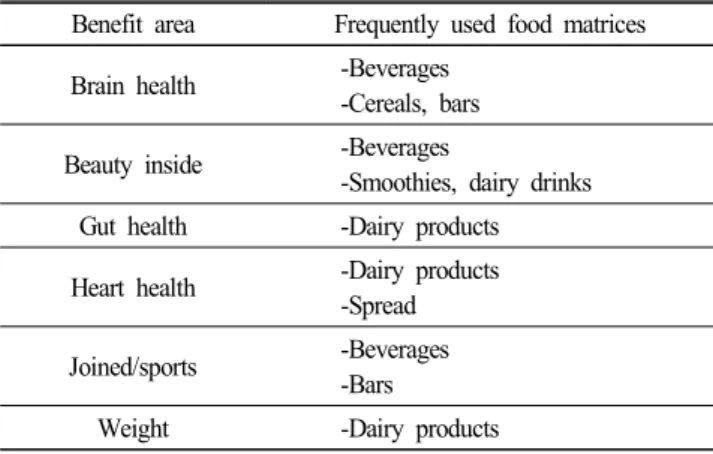
Table 1. Functional foods benefit area and frequently used food matrices
Benefit area Frequently used food matrices Brain health -Beverages
-Cereals, bars Beauty inside -Beverages
-Smoothies, dairy drinks Gut health -Dairy products Heart health -Dairy products
-Spread
Joined/sports -Beverages
-Bars
Weight -Dairy products
detected by the consumer while scientific evidence will make confident to consumers if the extra dimension of health benefits over foods are applied.
The last factor is that consumers are generally looking for convenience. Therefore beverages on-the-go shots as well as bars may have a higher chance of market success than other functional food products (Table 1).
Success Story of Probiotics for Promoting Health
Probiotics are live bacteria that not only protect the gut from undesirable microbial species but also encourage the effective modulation of the host immune system, due to improvement of gut health and lipid metabolism, successes in cholesterol re- duction as well. Gut protection as a functionality is not defined by single molecules but by living bacteria and their metabolic products (Cencic, 2010). The next stage in the development of probiotic functional foods requires a very new approach. The
Table 2. Criteria used to define a probiotic microorganism
Safety criteria
Be of human origin Non-pathogenic in nature
Generally recognized as safe (GRAS)
Functional criteria
Be resistant to destruction by gastric acid and bite salts Adhere to intestinal epithelial tissue
Be able to colonize the gastrointestinal tract, even in short term Modulate immune responses
Produce antimicrobial substances
Influence human metabolic activities (i.e. cholesterol assimilation, lactase activity, vitamin production) Technological criteria Be resistant to destruction by technical processing
Be subjected to scale-up processes
benefits of ingesting living bacteria can only result when multiple properties are simultaneously expressed by a single strain or appropriate mixtures of strains. Probiotic bacteria must simul- taneously survive in the food in high numbers, survive gastric pH, survive intestinal bile acids, adhere to or interact with the intestinal surface, colonize the intestinal environment, displace pathogenic bacterial competitors and prevent immune sensitization by the host. Many microorganisms could be considered as potential probiotics but only a few able to satisfy the necessary criteria. The functional criteria of probiotics should be esta- blished based on both in vitro and in vivo assays, and the results should be also reflected in controlled human studies.
Through clinical, animal, and cellular experiments, researchers have shown that probiotic preparations consisting of dead cells and their metabolites can also be biological response modifiers (Taverniti and Guglielmetti, 2011). This paradox of probiotics has been concisely reviewed by Adams (2010) and Taverniti et al. (2011), who reported probiotics as ‘paraprobiotics’ or ‘ghost probiotics’. The impact of probiotics can be attributed to their molecular components, and their effects can be mediated by either live or dead cells. Nevertheless, scientific evidence implies that inactivated microbes and their metabolites positively affect human and animal health (Kataria et al., 2009; Adams, 2010;
Hor et al., 2014). Hence, products designed with heat-killed strain Lactobacillus acidophilus LB from human origin Lactéol strain (Coconnier et al., 1997) have been imported and marketed since early 1998 (Lactéol Fort from PUMC Pharmaceutical Co., Ltd and Fermenti Lattici Tindalizzati from Frau, AF United S.p.a).
An overview of the most significant criteria to define a probiotic microorganism is presented in Table 2.
Presently, the most attractive potential use of probiotics is in
Next Generation Dairy Processing Science and Technology: Functional and Rational in Dairy Industry 169
the fight against abnormal intestine microorganisms. This covers a wide range of conditions, such as virulent enteropathogens, with its wide virulence variability, rotavirus, diarrhea associated with the use of antibiotics and small-bowel bacterial overgrowth (a frequent condition of the elderly or of patients administered with drugs that suppress gastric acid secretion). The last two conditions are most often not associated with an enteropathogen but with a globally disturbed ecology that can alter digestive and absorptive intestinal functions or promote inflammatory gut- barrier damage.
Concluding Remarks
Probiotic potential is very exciting, for the next generation of scientific advances to add further physiological and pro- tective properties to the already-existing spectrum of benefits assembled by screening available bacteria. The rate of these advances will depend on the sciences of bacterial and human physiology, and genetics, and the extent to which the scientist community and the health authorities are open to a new way of promoting health and preventing disease, using milk as a food vehicle.
References
1. Adams, C. A. 2010. The probiotic paradox: live and dead cells are biological response modifiers. Nutritional Research Review 23:37-46.
2. Altuntas, E. G. 2013. Bacteriocins: A natural way to combat with pathogens. In A. Mendez-Vilas, (Eds.), Microbial patho- gens and strategies for combating them: Science, technology and education (pp. 1005-1015). Formatex.
3. Amalaradjou, M. A. and Venkitanarayanan, K. 2011. Effect of trans-cinnamaldehyde on inhibition and inactivation of Cronobacter sakazakii biofilm on abiotic surfaces. Journal of Food Protection 74:200-208.
4. Awaisheh, S. S., Al-Nabulsi, A. A., Osaili, T. M., Ibrahim, S. and Holley, R. 2013. Inhibition of Cronobacter sakazakii by heat labile bacteriocins produced by probiotic LAB isolated from healthy infants. Journal of Food Science 78:1416-1420.
5. Aymerich, T., Picouet, P. A. and Monfort, J. M. 2008. Decon- tamination technologies for meat products. Meat Science 78:
114-129.
6. Cencic, A. and Chingwaru, W. 2010. The role of functional
foods, nutraceuticals and food supplements in intestinal health. Nutrients 611-625.
7. Coconnier, M. H., Levin, V., Bernet-Camard, M. F., Hudault, S. and Servin, A. L. 1997. Antibacterial effect of the adhering human Lactobacillus acidophilus strain LB. Antimicrobial Agents and Chemotherapy 41:1046-1052.
8. German, B., Schiffrin, E. J., Reniero, R., Mollet, B., Pfeifer, A. and Neeser, J. R. 1999. The development of functional foods: Lessons from the gut. Trends Biotechnol. 492-499.
9. Hayes, M., Barrett, E., Ross, R. P., Fitzgerald, G. F., Hill.
C. and Stanton, C. 2009. Evaluation of an antimicrobial ingredient prepared from a Lactobacillus acidophilus casein fermentation against Enterobacter sakazakii. Journal of Food Protection 72:340-346.
10. Hor, Y. Y. and Liong, M. T. 2014. Use of extracellular extracts of lactic acid bacteria and bifidobacteria for the inhibition of dermatological pathogen Staphylococcus aureus.
Dermatological Sinica 32:141-147.
11. Huys, G., Botteldom, N., Delvigne, F., Vuyst, L. D., Heyndrickx, M., Pot, B. and Daube, G. 2013. Microbial characterization of probiotics-advisory report of the working group “8651 Probiotics” of the Belgian Superior Health Council (SHC).
Molecular Nutritional Food Research 57:1479-1504.
12. Iversen, C. and Forsythe, S. (2004). Risk profile of Enterobacter sakazakii, an emergent pathogen associated with infant formula. Trends in Food Science & Technology 14:443-454.
13. Kataria, J., Li, N., Wynn, J. L. and Neu, J. 2009. Probiotic microbes: Do they need to be alive to be beneficial?
Nutrition Reviews 67:546-550.
14. Kornacki, J. L. 2014. An environmental sampling approach to product risk assessment. Food Safety Magazine 2:14-19.
15. Mkrtchyan, H., Gibbons, S., Heidelberger, S., Zloh, M. and Limaki, K. H. 2010. Purification, characterisation and iden- tification of acidocin LCHV, an antimicrobial peptide pro- duced by Lactobacillus acidophilus n.v. Er 317/402 strain Narine. International Journal of Antimicrobial Agents 35:
255-260.
16. Muytjens, H. I., Roelofs-Willemse, H. and Jaspar, G. H. 1988.
Quality of powdered substitutes for breast milk with regard to members of the family Enterobacteriaceae. Journal Clinical Microbiology 26:743-746.
17. Sawalha, S. 2014. Functional food. Austin J. Nutri. Food Sci. 1022.
18. Taverniti, V. and Guglielmetti, S. 2010. The immunomo-
Journal of Milk Science & Biotechnology 제33권 제3호(2015) 170
dulatory properties of probiotic microorganisms beyond their viability (ghost probiotics: proposal of paraprobiotic concept).
Nutrition Research Reviews 23:37-46.
19. Taverniti, V. and Guglielmetti, S. 2011. The immunomodu- latory properties of probiotic microorganisms beyond their
viability (ghost probiotics: proposal of paraprobiotic concept).
Genes Nutrition 6:261-274.
Received 2 September, 2015 Revised 12 September, 2015 Accepted 17 September, 2015