http://dx.doi.org/10.5369/JSST.2013.22.6.393 pISSN 1225-5475/eISSN 2093-7563
1. INTRODUCTION
Visual sensors have been widely used in various areas of computer vision to overcome several problems. One of these visual sensors is an omni-directional camera that provides a wide field of view of a scene that might cover almost a hemisphere or the entire 360° circle along the equator of a sphere. A fisheye lens is one of the most efficient ways to construct an omni-directional vision system [1-3]. Although fisheye lens cameras, which can be simply achieved by using a fisheye lens, provide us with the advantage of a wide angle of view, their images usually exhibit considerable distortion.
Several approaches have been reported to solve the behavior of fisheye lens images in the rotation and distance estimation for self-localization issues [2]. Self-localization is defined as the problem of finding the angle of rotation of a camera with respect to a reference direction and determining the distance of movement when a camera has moved from a certain reference position to a test position.
Zhao et al. proposed the use of calibration of the fisheye lens and analyzed the localization error parameters [4]. In calibrating the fisheye lens, their method included various parameters in order to reflect the characteristics of the fisheye lens system, thus introducing more computational complexity. Fu et al. proposed a landmark tracking with an embedded omni-directional vision system [5]. In their method, the navigator follows landmarks in order to localize the automatic guided vehicles. If the landmarks cannot be obtained, the localization is not successfully confirmed. Another method was proposed to estimate the distance of movement of a robot with a mounted omni- directional vision system with respect to the reference point in indoor environments that might possess natural color transitions by calculating the closest color transition in the environment [6]. However, in order for the system to work, a meaningful color transition should be observed in the environment, and its geometric map must be also known.
Xiong and Choi [7] proposed a self-localization method based on a fisheye lens and scale invariant feature transform (SIFT) [8] for indoor mobile robots. They discussed key point extraction, non-ceiling point removal, and keypoint calibration, but they did not provide the estimated distance and rotation of the mobile robot.
In this paper, we propose methods of estimating the rotation and the distance of a camera by using a fisheye lens system. First, we estimate the possible rotation of the camera direction at the new position because the correction of rotation is preferable during feature point matching at a
Estimation of Rotation of Camera Direction and Distance Between Two Camera Positions by Using Fisheye Lens System
Tewodros A. Aregawi
1, Oh-Yeol Kwon
1, Soon-Yong Park
2, and Sung-Il Chien
1,+Abstract
We propose a method of sensing the rotation and distance of a camera by using a fisheye lens system as a vision sensor. We estimate the rotation angle of a camera with a modified correlation method by clipping similar regions to avoid symmetry problems and suppressing highlight areas. In order to eliminate the rectification process of the distorted points of a fisheye lens image, we introduce an offline process using the normalized focal length, which does not require the image sensor size. We also formulate an equation for calculating the distance of a camera movement by matching the feature points of the test image with those of the reference image.
Keywords : Vision sensor, Fisheye lens, Distance estimation, Rotation estimation
1
School of Electronics Engineering, Kyungpook National University, 80 Daehakro, Bukgu, Daegu, 702-701 Korea
2
School of Computer science and Engineering, Kyungpook National University, 80 Daehakro, Bukgu, Daegu, 702-701 Korea
+
Corresponding author: [email protected] (Received : Aug. 26, 2013, Accepted : Nov. 1, 2013)
This is an Open Access article distributed under the terms of the Creative Commons
Attribution Non-Commercial License(http://creativecommons.org/licenses/by-
nc/3.0)which permits unrestricted non-commercial use, distribution, and
reproduction in any medium, provided the original work is properly cited.
later stage. We estimate the rotation angle of the camera with a correlation method by clipping similar regions and suppressing the highlight areas of the images. The next step is to estimate the distance of the camera movement from the reference position to the new position called a test position. Image distortions occurring due to the nature of a fisheye lens require a complicated calibrating or rectifying method [4], but in our case, the concept of the normalized focal length, which is simply measured in an offline experiment, is introduced to avoid such rectification.
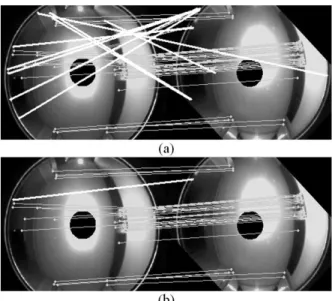
Salient points or feature points are defined and matched between two images, as we have developed an equation for finding the distance on the basis of a pair of matched points. For minimizing the error in distance estimation, these feature points should be quite stable and are obtained using the SIFT, which was also used elsewhere along with the Harris corner [8].
Section 2 presents the rotation estimation to find the direction of a camera, and Section 3 discusses the formulation of the distance estimation equation based on a normalized focal length and matching feature points.
Section 4 provides the experimental setup and results of our rotation and distance estimation. Section 5 concludes our work.
2. ROTATION ESTIMATION
In this section, we discuss a method for determining the rotation angle of a camera with respect to a reference position by using a correlation method. Further, we propose a method to overcome the problems in correlation, such as symmetry, and highlight areas to improve the accuracy of the angle estimation.
A camera can be placed in any direction with respect to its original orientation at the reference position. In this case, the camera captures images at the reference position as well as its new position, called a test position. Thus, we determine the angle of rotation of the camera by using these two images with a correlation method. The correlation method is used to compare the similarity of the two signals, resulting in a signal that shows the similarity between them and reaches its maximum when the two signals match best. Therefore, the maximum peak of the correlation of the two images corresponds to the estimated angle of the camera.
However, the image and its rotated image might look
similar, especially when the image contents are symmetric with respect to a rotation point or the center of the image in our case. Furthermore, highlights might appear inside an image area due to the lighting conditions of the environment. These two cases reduce the accuracy in estimating a rotation angle. Therefore, to solve the symmetry problem we remove a small portion of the central region of the image with careful radius selection. In addition, the highlight area detected with the help of Otsu’s thresholding method [9] is reduced in the grey level, leading to a reduction of its influence in the correlation.
The angle of rotation tells us how many degrees an image has rotated with respect to the original direction at the reference position. Now, we can re-rotate the rotated image by the estimated angle so that the camera direction of the test image is aligned with that of the reference image. This step is important for the distance estimation stage.
3. DISTANCE ESTIMATION
The overall distance estimation procedure for a camera moved from a reference position is presented in this section. We first explain a method of determining the normalized focal length of fisheye lens system to remove the rectification process of the distorted regions. Then, we develop a distance estimation formula by using the normalized focal length and a pair of matching feature points of two images. Finally, we discuss the selection of stable matching feature points to be utilized in the distance estimation.
3.1 Determination of the normalized focal length of the fisheye lens
It is known that fisheye lens images suffer from geometric distortion. The distortions in a fisheye lens can be explained when we observe the distance between two points in an image scene. The same distance within one image becomes bigger when the two points are projected around the center of the image than when projected around the boundary. Therefore, in order to deal with the distortion of the pixels, we introduce the concept of the normalized focal length for the fisheye lens system.
For this, we derive a relationship of the distance between
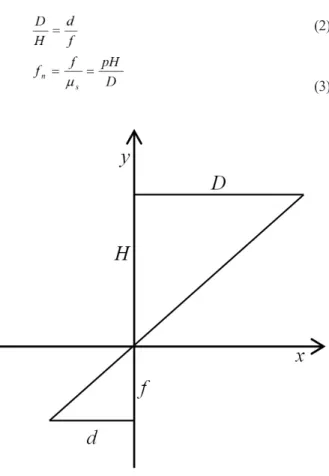
two positions of the camera in the real world and the displacement of the pixels in the corresponding image plane. We have illustrated this situation in Fig. 1, showing that when the camera travels a distance D, the pixels in the image plane move a distance d from the center. H denotes the height from the camera to the ceiling of the environment, and f represents the focal length of the fisheye lens camera, which is variable depending on its position from the center of the image. If the distance d in the image plane is divided by the pixel size of the complementary metal oxide semiconductor (CMOS) sensor, we can convert it to the corresponding pixel value denoted as p. Therefore,
where μ
sis the pixel size of the camera sensor, and d is the corresponding actual distance traveled on the image plane.
On the basis of the relationship between the camera’s moved distance and the shift of the corresponding pixels in the image plane, as shown in Fig. 1, we have:
where f
nis now called the normalized focal length of the fisheye lens camera. From Equation (3), we can deduce that even though the pixel size of the CMOS sensor is not provided, if we can measure p and D, we can obtain the normalized focal length, f
n. This f
nis required at the stage of distance estimation of a camera movement, but it varies depending on the pixel position (p) of a fisheye image. So it is necessary to obtain a lookup table for f
nversus p.
For this, we place an object on the ceiling as a marker pointing to the center of the camera sensor. The camera is moved in a horizontal direction relative to the marking object capturing images at an interval of 25 cm for a total of 600 cm. The height, H, is set to 140 cm. Besides, the movement of the pixels (p) in the image plane at each interval can be registered. We can observe from Fig. 2 that the normalized focal length drops as the marker object moves from the center of the image to the outer boundary.
3.2 Distance estimation formula
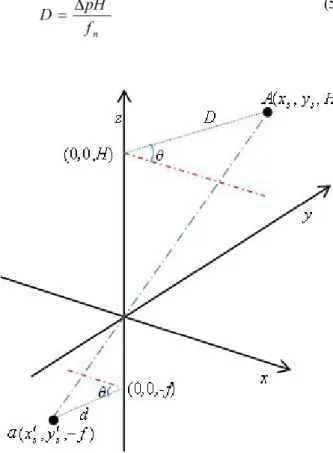
A camera can move in any arbitrary direction in the xy- plane from a reference position to another test position. To figure out this situation, we have devised a model that calculates the actual distance moved by the camera and the displacement of image points in the image plane. In Fig. 3, the camera sensor points along the z-axis. Then, the original scene point at (0,0,H) moves to point A(x
S,y
S,H) by a distance D, whereas its corresponding image point moves from point (0,0,-f ) to point a(x
′S,y
′S,-f ) by a distance (1)
(2)
(3)
Fig. 1. An image model for estimating variable focal length of fisheye lens.
Fig. 2. Graph of normalized focal length versus pixel movement from center.