INTRODUCTION
Several cardiac diseases such as rheumatic and degenerative valve disease, as well as endocarditis, may affect multiple valves and require double and triple valve surgery (1). Triple valve surgery (either replacement of aortic, mitral, and tricuspid valves, or combined replacement of aortic and mitral valves with tricuspid valve repair) is still a challenge for most of the surgeons due to prolonged periods of cardiopulmonary bypass and aortic cross-clamp times (1, 2). Recently, reported oper- ative mortality after triple valve surgery is about 13% (3).
Moreover, multiple valve replacement exposes the patients to added long-term prosthetic valve-related morbidities such as endocarditis, thromboembolism, anticoagulation-related hemorrhage, and paravalvular leak compared with single valve replacement (1). Finally, triple valve surgery has been asso- ciated with diminished long-term survival, with reported survival at 5 and 10 yr of 75% and 61%, respectively (3),
although recent surgical results were improved compared with those of previous articles.
The current study describes the experience with 160 pati- ents who underwent triple valve surgery (TVS) at a single center in an attempt to define early and late clinical outcomes and analyze independent predictors of adverse results.
MATERIALS AND METHODS
From February 1990 to May 2006, 160 consecutive pati- ents with multiple valve disease underwent TVS at Sejong General Hospital. Clinical, operative, and outcome variables were reviewed retrospectively. The following variables were analyzed in this study: 1) preoperative variables: gender (fe- male), old age, preoperative New York Heart Association (NYHA) class IV, congestive heart failure, hypertension, dia- betes, peripheral vascular disease, cerebrovascular disease, pre-
818
Sung Ho Shinn1, Sam-Sae Oh2, Chan Young Na2, Chang-Ha Lee2, Hong-Gook Lim2, Jae Hyun Kim2, Kil Soo Yie3, Man Jong Baek4, and Dong Seop Song5
Department of Thoracic and Cardiovascular Surgery1, Hanyang University Guri Hospital, College of Medicine, University of Hanyang, Guri; Department of Cardiovascular Surgery2, Sejong General Hospital, Bucheon; Department of Thoracic and Cardiovascular Surgery3, Kangwon National University Hospital, College of Medicine, Kangwon National University, Chuncheon; Department of Thoracic and Cardiovascular Surgery4, Korea University Guro Hospital, College of Medicine, University of Korea, Seoul; Department of Thoracic and Cardiovascular Surgery5, Sanbon Medical Center, College of Medicine, University of Wonkwang, Gunpo, Korea
Address for correspondence Sam-Sae Oh, M.D., Ph.D.
Department of Cardiovascular Surgery, Sejong General Hospital, 91-121 Sosabon 2-dong, Sosa-gu, Bucheon 422-711, Korea
Tel : +82.32-340-1151, Fax : +82.32-349-3005 E-mail : [email protected]
DOI: 10.3346/jkms.2009.24.5.818
Short- and Long-Term Results of Triple Valve Surgery: A Single Center Experience
Triple valve surgery is usually complex and carries a reported operative mortality of 13% and 10-yr survival of 61%. We examined surgical results based on our hos- pital’s experience. A total of 160 consecutive patients underwent triple valve surgery from 1990 to 2006. The most common aortic and mitral valve disease was rheumat- ic disease (82%). The most common tricuspid valve disease was functional regur- gitation (80%). Seventy-four percent of the patients were in New York Heart Asso- ciation (NYHA) class III and IV. Univariate and multivariable analyses were performed to identify predictors of early and late survival. Operative mortality was 6.9% (n=11).
Univariate factors associated with mortality included old age, preoperative renal failure, postoperative renal failure, pulmonary complications, and stroke. Of them, postoperative renal failure and stroke were associated with mortality on multivari- able analysis. Otherwise, neither tricuspid valve replacement nor reoperation were statistically associated with late mortality. Survival at 5 and 10 yr was 87% and 84%, respectively. Ninety-two percent of the patients were in NYHA class I and II at their most recent follow-up. Ten-year freedom from prosthetic valve endocarditis was 97%; from anticoagulation-related hemorrhage, 82%; from thromboembolism, 89%;
and from reoperation, 84%. Postoperative renal failure and stroke were significant- ly related with operative mortality. Triple valve surgery, regardless of reoperation and tricuspid valve replacement, results in acceptable long-term survival.
Key Words : Triple valve surgery; Renal Failure; Stroke
Received : 3 August 2008 Accepted : 28 November 2008
operative renal failure, endocarditis, previous heart surgery, and ejection fraction (<0.4); 2) operative variables: tricuspid valve replacement, urgency, and aortic annular enlargement;
3) postoperative variables: reexploration, heart block, post- operative pulmonary complications, renal failure, stroke, and pericardial effusion.
Patients characteristics
There were 53 men and 107 women with mean age of 60.5
±19.1 yr (range, 32-75 yr). The majority of patients were in NYHA functional class III or IV. Thirty two patients (20%) had undergone previous cardiac surgery. One hundred fifty- four patients (96%) were operated on electively, and 6 patients (4%) were operated on urgently. The complete clinical pro- file of the patients is summarized in Table 1. Choice of the prosthesis was determined on the basis of the patient’s age, special request, and comorbid factors. In the aortic position, 137 mechanical and 20 bioprosthetic valves were implanted.
The majority of mechanical prostheses included the St. Jude (St. Jude Medical Inc, Minneapolis, MN, U.S.A.) (n=66), Carbomedics (Carbomedics Inc, Austin, TX, U.S.A.) (n=24), and Omniscience (Medical CV Inc, Inner Grove Heights, MN, U.S.A.) (n=19) valves. Besides, Sorin (Sorin Biomedi- cal, Saluggia, Italy) (n=9), Edwards Mira (Edwards Lifesciences, Irvine, CA, U.S.A.) (n=9), and other mechanical valve (n=10) were used. The type of bioprosthesis was the Carpentier-Ed- ward pericardial valve (Edwards Lifesciences) (n=16) and Han-
cock II porcine valve (Medtronics Inc, Minneapolis, MN, U.S.A.) (n=4). Similarly, 137 mechanical and 20 bioprosthet- ic valves were implanted in the mitral position, including the St. Jude (n=61), Carbomedics (n=24), Omniscience (n=
20), Mira (n=11), Sorin (n=10), and other mechanical valve (n=11). The type of bioprosthesis was the Carpentier-Edward pericardial valve (Edwards Lifesciences) (n=14) and Hancock II porcine valve (Medtronics Inc.) (n=6). Only 12 valves were implanted in the tricuspid valve position, and they included 5 mechanical and 7 bioprosthetic valves: St. Jude (n=3), Car- bomedics (n=1), Edwards Mira (Edwards Lifesciences) (n=1), Hancock II (n=5), and Carpentier-Edward pericardial valve (n=2).
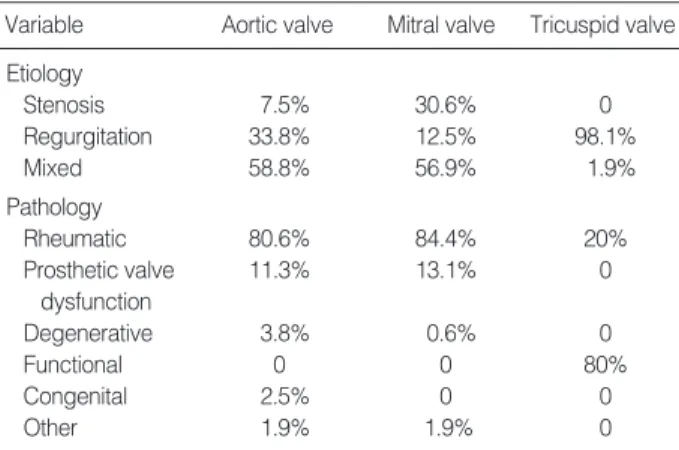
The most common aortic valve and mitral valve disorder was rheumatic valve disease, followed by prosthetic valve dysfunction. In contrast, the most common tricuspid valve disease was functional regurgitation secondary to left heart disease, followed by rheumatic valve disease. The complete list of valve disease presentation and pathologic diagnosis is presented in Table 2.
Operative technique
Intraoperative transesophageal echocardiography was per- formed in all patients to assess the extent and severity of valve disease and the quality of the replacement or repair postop- eratively. All procedures were done through a median ster- notomy. Valve operations were performed under the usual methods of cardiopulmonary bypass with a single aortic cross- clamp technique. Myocardial protection strategies usually included antegrade cardioplegia introduced directly into the coronary ostia and retrograde cardioplegia through a coronary sinus cannula. Moderate hypothermia was used, and the core temperature was allowed to drift to 28℃to 32℃. Improved protection of the ventricles was provided by topical hypother- mia with saline ice slush. A Biomedicus biopump (Medtron- ic) has been used in all patients since 1992. Distal coronary anastomoses were performed first, followed by the valve pro-
NYHA class
I 1 (0.6%)
II 41 (25.6%)
III 105 (65.6%)
IV 13 (8.1%)
Congestive heart failure 54 (33.8%)
Atrial fibrillation 99 (61.9%)
Hypertension 36 (22.5%)
Diabetes 14 (8.8%)
Cerebrovascular disease 11 (6.9%)
Peripheral vascular disease 3 (1.9%)
Renal failure 1 (0.6%)
Endocarditis 3 (1.9%)
Remote 1 (0.6%)
Active 2 (1.3%)
Previous cardiac surgery 32 (20%)
Mitral valve surgery 29 (18.1%)
Aortic valve surgery 24 (15%)
Tricuspid valve surgery 1 (0.6%)
Other 1 (0.6%)
Ejection fraction
>0.60 58 (36.3%)
0.40-0.59 86 (53.8%)
0.20-0.39 15 (9.4%)
<0.20 1 (0.6%)
Table 1. Clinical profile of patients
NYHA, New York Heart Association.
Variable Aortic valve Mitral valve Tricuspid valve Etiology
Stenosis 7.5% 30.6% 0
Regurgitation 33.8% 12.5% 98.1%
Mixed 58.8% 56.9% 1.9%
Pathology
Rheumatic 80.6% 84.4% 20%
Prosthetic valve 11.3% 13.1% 0
dysfunction
Degenerative 3.8% 0.6% 0
Functional 0 0 80%
Congenital 2.5% 0 0
Other 1.9% 1.9% 0
Table 2. Etiologic distribution of preoperative valve disease and pathologic diagnosis
cedures. After excision of the aortic valve, the mitral valve was approached, usually through the interatrial groove, and was assessed for possible repair versus replacement. If mitral annular reconstruction was needed in the case of extensive calcification, it was performed with the utilization of gluta- raldehyde-fixed bovine pericardium before implantation of the prosthesis. After the mitral valve procedure, the aortic valve was replaced (or infrequently repaired). Then tricuspid valve repair was performed with either a modified De Vega technique or Kay technique or with an annuloplasty ring.
Less frequently, the tricuspid valve was replaced. Finally the proximal coronary anastomoses were performed. The opera- tive data are listed in Table 3.
Anticoagulation
In the postoperative period, anticoagulation with warfarin was initiated for all patients if there was no evidence of active bleeding. Target international normalized ratio (INR) was 2.5-3.0 in all patients. When triple bioprosthesis were im- planted, anticoagulation was just recommended in the first 6 months postoperatively for patients without atrial fibrilla- tion.
Follow-up
Late outcomes were determined from clinical records when available or from written correspondence with patients’ physi- cians and direct patient contact with telephone interviews when necessary. All follow-up data were collected by our re- search personnel and 7 patients were lost to follow-up. The mean and median follow-up was 5.7±5.2 and 6.3 yr, ranged from 1 month to 16 yr. Echocardiographic data at latest fol- low-up were collected by contacting referring cardiologists.
Statistical analysis
Statistical analysis was performed with SPSS software 10.0 (SPSS Inc, Chicago, IL, U.S.A.). Descriptive statistics are re- ported as mean±standard deviation for continuous variables and as frequencies and percentages for categorical variables.
Unrelated two-group comparisons were done with unpaired, two-tailed Student’s t tests for continuous variables and chi- square or Fisher’s exact test for categorical data. Predictors of perioperative mortality were identified using univariable and multivariable logistic regression analysis. Long-term sur- vival and freedom from morbid events were estimated using the Kaplan-Meier method. Cox regression was used to deter- mine the independent predictors of late outcomes. The appro- priateness of variable transformations was determined by means of univariate analysis. Variables with a univariate P value of less than 0.05 or those with known biologic signifi- cance, but failing to meet this critical chi-square level, were submitted to multivariable models.
RESULTS Operative mortality and morbidity
The hospital mortality was 6.9% (11 patients). Five pati- ents died due to multiorgan failure and sepsis, three due to postoperative stroke, two due to low cardiac output, and one due to sudden cardiac arrest. In the postoperative period, the incidence of complications was 28.8% (n=46 patients, in some patients there were more than one complication). Twelve patients (7.5%) required reexploration of the mediastinum for bleeding, and 11 (6.9%) required placement of a perma- nent pacemaker for heart block. Other morbidities included stroke in 10 patients (6.3%), renal insuffiency in 8 patients (5%, Cr ≥2.0 mg/dL), tamponade in 6 patients (3.8%), pul- monary complications (included pneumonia, atelectasis, and pleural effusions) in 5 patients (3.1%), sternal infection in 5 patients (3.1%), and sepsis in 2 patients (1.3%). Univariate analysis revealed the following variables to be associated with increased operative mortality: old age (P=0.003), preopera- tive renal failure (P=0.004), postoperative pulmonary com- plications (P=0.038), postoperative renal failure (P<0.001),
Aortic valve procedures
Repair 3
Replacement 157
Mechanical valve 137
Bioprosthetic valve 20
Aortic annular enlargement 8
Mitral valve procedures
Repair 3
Replacement 157
Mechanical valve 137
Bioprosthetic valve 20
Tricuspid valve procedures Repair
De Vega 120
Kay 8
Annuloplasty ring 7
Edge to edge stitch 14
Commissurotomy 5
Other 3
Replacement 12
Mechanical valve 5
Bioprosthetic valve 7
Additional procedures
CABG 3
Ascending aortic replacement 5
ASD closure 2
Maze operation 64
Other 2
Cardiopulmonary bypass time (min) 199.5±77.1 Aortic cross-clamp time (min) 159.9±59.3 Table 3. Operative data
CABG, coronary artery bypass grafting.
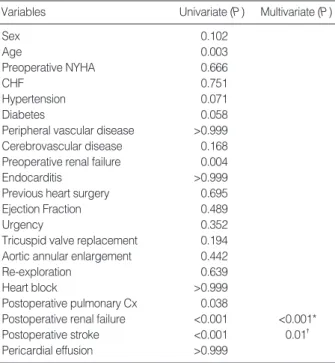
and postoperative stroke (P<0.001). Postoperative renal fail- ure (P<0.001, OR=44.6, 95% CI 6.3-316.1) and postopera- tive stroke (P=0.01, OR=13.6, 95% CI 1.85-100.71) remain- ed significant on multivariable analysis (Table 4).
Late mortality and morbidity
During the follow-up period, an additional 12 patients died (8.1%), with 10 of them of cardiac origin: congestive heart failure (n=3), arrhythmia (n=3), prosthetic valve endo- carditis (It was occurred during follow-up, n=2), acute myo- cardial infarction (n=1), and anticoagulation related hemor- rhage (n=1). The other 2 deaths were due to noncardiac causes.
Univariate and multivariate analysis revealed only pros- thetic valve endocarditis as significant (P=0.017, 0.011 res- pectively, OR=27.60 95% CI 2.16-352.21). Otherwise, nei- ther tricuspid valve replacement nor reoperation were statis- tically associated with late mortality (Table 5).
Five-year and 10-yr survival was 86.9±3.0% and 83.9±
3.6%, respectively, as illustrated in Fig. 1. Ten-year freedom from prosthetic valve endocarditis was 96.6±2.0% (Fig. 2).
Ten-year freedom from thromboembolism was 89.3±3.4%, whereas 10-yr freedom from anticoagulation related hemor- rhage was 82.4±4.3% (Fig. 2). Ten-year freedom from other valve-related morbidities, such as structural valve deteriora- tion, valve thrombosis, and paravalvular leakage was 88.7± 3.9%, 96.0±2.4%, and 97.8±1.5%, respectively.
Reoperations
Twenty patients required late reoperation. Ten-year freedom from reoperation was 84.3±4.3% (Fig. 2). The causes for reoperation were as follows: pannus formation (n=9), para- valvular leakage of mitral valve (n=4), mitral valve thrombo- sis (n=2), failure of tricuspid valve repair (n=2), failure of aor- tic valve and/or mitral valve repair (n=2), prosthetic valve dys- function after double valve replacement (n=1), acute throm- bosis of aortic valve (n=1), and prosthetic valve endocarditis (n=1).
Late NYHA functional class
On the latest follow-up, 130 patients were alive. Among them, 17 (13.1%) were in NYHA class I, 102 (78.5%) in class II, and 11 (8.5%) in class III. All but three of the patients had normally functioning prosthetic valves at the latest echo- cardiographic study. Three patients are thought to be reop- erated in the future: structural valve deterioration (n=2), and prosthetic valve endocarditis (n=1).
DISCUSSION
Combined surgery for aortic, mitral, and tricuspid valves (TVS) and reoperative TVS remains a formidable challenge.
*OR=44.6, 95% CI 6.3-316.1; �OR=13.6, 95% CI 1.85-100.71.
NYHA, New York Heart Association functional class; CHF, congestive heart failure; Cx, complication.
Univariate (P) Multivariate (P) Variables
Sex 0.102
Age 0.003
Preoperative NYHA 0.666
CHF 0.751
Hypertension 0.071
Diabetes 0.058
Peripheral vascular disease >0.999 Cerebrovascular disease 0.168 Preoperative renal failure 0.004
Endocarditis >0.999
Previous heart surgery 0.695
Ejection Fraction 0.489
Urgency 0.352
Tricuspid valve replacement 0.194 Aortic annular enlargement 0.442
Re-exploration 0.639
Heart block >0.999
Postoperative pulmonary Cx 0.038
Postoperative renal failure <0.001 <0.001*
Postoperative stroke <0.001 0.01�
Pericardial effusion >0.999 Table 4. Risk factor analysis for operative mortality
*OR=27.60 95% CI 2.16-352.21.
Univariate (P) Multivariate (P) Variables
Previous heart surgery 0.461 Tricuspid valve replacement 0.580
Reoperation 0.665
Prosthetic valve endocarditis 0.017 0.011*
Table 5. Risk factor analysis for late mortality
Fig. 1. Long-term survival.
Survival (%)
100 90 80 70 60 50 40 30 20 10
00 2 4 6 8 10 12 14 16 18
160 103 79 59 48 41 34 18 3
Number at risk
Follow-up year
5 yr survival 86.9±3.0%
10 yr survival 83.9±3.6%
Despite substantial improvements in myocardial protection and CPB techniques, TVS is still a challenge for more ad- vanced valvular disease and complexity of the operation. In addition, outcomes of TVS are often complicated by differ- ent underlying pathophysiologic conditions, associated car- diovascular diseases, and concomitant operative procedures.
The hospital mortality of 6.9% in this study compares favor- ably with that in other studies, which indicated that opera- tive mortality ranged from 13% to 31% (3-5). Alsoufi and colleagues (3) failed to find the independent risk factors for perioperative mortality after TVS. Gersh and colleagues (1) found that preoperative NYHA class IV was the only signif- icant variable influencing hospital mortality. In our study, we found that old age, preoperative renal failure, postopera- tive renal failure, postoperative pulmonary complications, and postoperative stroke are risk factors for perioperative mor- tality with univariate analysis, but only postoperative renal failure and stroke are independent risk factors on multivari- able analysis. As for NYHA class, the low incidence of NYHA class IV compared with that in other studies did not reach statistical significance (3, 6).
There are reports describing short and long-term survivals for surgery (3, 7, 8). Alsoufi and colleagues (3) presented that the actuarial survival rates were 75% and 61% at 5, 10 yr
after TVS. Galloway and colleagues (7) showed that patients undergoing TVS had a 5-yr actuarial survival of 62%. Yilmaz and colleagues (8) reported that the actuarial survival rates were 85%, 72%, and 48% at 5, 10, and 15 yr after TVS. In our study we found a 5-yr and 10-yr survival of 87% and 84%, respectively. We believe that improved perioperative care, including increased experience with complex surgical procedures and improved myocardial protection, and improv- ed postoperative care, including treatment of congestive heart failure and decreased valve-related complications, contribut- ed to the very good long-term survival rates observed in our study. In addition, the low incidence of NYHA class IV in our patient population may be another important factor in favor of better long-term survival rates.
Unfortunately, the experience of prosthetic valve replace- ment in the tricuspid position is limited and the optimal choice for the tricuspid valve is still controversial. Some au- thors point out that tricuspid repair or replacement had no significant effect on mortality after surgery (9). On the other hand some authors report that replacement is associated with a high risk and a late mortality (10, 11). However, we did not find tricuspid valve replacement as an independent risk factor.
In addition, 20 cases of reoperation were performed. Ten-
Fig. 2. Long-term freedom from morbid events. (A) Long-term freedom from prosthetic valve endocarditis. (B) Long-term freedom from thromboembolism. (C) Long-term freedom from anticoagulation-related hemorrhage. (D) Long-term freedom from reoperation
Freedom from PVE (%)
100 90 80 70 60 50 40 30 20 10 0
0 2 4 6 8 10 12 14 16 18
160 103 79 59 48 41 34 18 3
Number at risk
Follow-up year A
10 yr 96.6±2.0%
Freedom from thrombormbolism (%)
100 90 80 70 60 50 40 30 20 10 0
0 2 4 6 8 10 12 14 16 18
160 103 79 59 48 41 34 18 3
Number at risk
Follow-up year B
10 yr 89.3±3.4%
Freedom from hemorrhage (%)
100 90 80 70 60 50 40 30 20 10 0
0 2 4 6 8 10 12 14 16 18
160 103 79 59 48 41 34 18 3
Number at risk
Follow-up year C
10 yr 82.4±4.3%
Freedom from reoperation (%)
100 90 80 70 60 50 40 30 20 10 0
0 2 4 6 8 10 12 14 16 18
160 103 79 59 48 41 34 18 3
Number at risk
Follow-up year D
10 yr 84.3±4.3%
year freedom from reoperation was 84% and was thought to be lower than 92% in another study (3). However, we did not find a reoperation as an risk factor of late mortality.
Prosthetic valve-related complications have been reported to be more common in patients undergoing TVS compared with single valve replacement (1, 5). In our study 86% of prosthetic valves were mechanical. Although we did not com- pare valve morbidities among patients undergoing single valve surgery versus TVS in our institute, our valve-related com- plications in this study were comparable to the reported rate after single valve replacement in other recently published series (12, 13). Addtionally, prosthetic valve endocarditis was found to be the only risk factor of late mortality on the univariate and multivariate analysis, as we had anticipated.
Thromboembolism and bleeding complications are the major problems due to anticoagulation (2, 8, 14). Alsoufi and col- leagues (3) reported a probability of freedom from throm- boembolism of 88% at 10 yr and from anticoagulation-relat- ed hemorrhage of 83% at 10 yr. In our study these rates were 89% and 82%, respectively, for the same period. Current in- ternational normalized ratio target levels of 2.5 to 3.5 are advocated after mitral valve replacement using a mechanical prosthesis, similarly we recommend international normalized ratio target levels of 2.5 to 3.0 after multiple valve replace- ment.
TVS may be required in patients with rheumatic valve dis- ease, prosthetic valve dysfunction, and endocarditis. TVS pro- cedures are complex, and major cardiac reconstruction is often needed, increasing the complexity of these procedures. None- theless, short-term and long-term outcomes have improved when compared with older reports. We found acceptable rates of perioperative mortality for TVS with good long-term results.
The majority of TVS patients are in NYHA class I or II during follow-up, and long-term valve-related complications rates are similar to patients undergoing single valve replacement.
The good results after TVS in patients with advanced valvu- lar heart disease justifies aggressive surgical therapy in these patients.
However, a number of limitations are inherent to this anal- ysis design: a retrospective single center study with a relatively small sample size and the lack of information about the pre- operative pulmonary artery pressure in our patients as this preoperative factor may influence the surgical outcome. Anoth- er limitation of this study is as follows: several surgeons were involved and we cannot expect the same surgical technique.
Different patient characteristics and various kinds of substi- tuted valves make a heterogenous group. These may influ- ence outcome and prognostic factors.
In conclusion, postoperative renal failure and stroke are sig- nificantly related with operative mortality. To alleviate the operative mortality, we have to take account of reducing the incidence of postoperative complications. Triple valve surgery,
regardless of reoperation and tricuspid valve replacement, which are considered as risk factor of mortality, results in acceptable long-term survival.
REFERENCES
1. Gersh BJ, Schaff HV, Vatterott PJ, Danielson GK, Orszulak TA, Piehler JM, Puga FJ, Pluth JR, McGoon DC. Results of triple valve replacement in 91 patients: perioperative mortality and long-term follow-up. Circulation 1985; 72: 130-7.
2. Carrier M, Pellerin M, Bouchard D, Perrault LP, Cartier R, Hebert Y, Basmadjian A, Page P, Poirier NC. Long-term results with triple valve surgery. Ann Thorac Surg 2002; 73: 44-7.
3. Alsoufi B, Rao V, Borger MA, Maganti M, Armstrong S, Feindel CM, Scully HE, David TE. Short- and long-term results of triple valve surgery in the modern era. Ann Thorac Surg 2006; 81: 2172-7.
4. Brown PS Jr, Roberts CS, McIntosh CL, Swain JA, Clark RE. Late results after triple-valve replacement with various substitute valves.
Ann Thorac Surg 1993; 55: 502-8.
5. Mullany CJ, Gersh BJ, Orszulak TA, Schaff HV, Puga FJ, Ilstrup DM, Pluth JR, Danielson GK. Repair of tricuspid valve insuffiency in patients undergoing double (aortic and mitral) valve replacement.
Perioperative mortality and long-term (1 to 20 years) follow-up in 109 patients. J Thorac Cardiovasc Surg 1987; 94: 740-8.
6. Akay TH, Gultekin B, Ozkan S, Aslim E, Saritas B, Sezgin A, Asla- maci S. Triple-valve procedures: impact of risk factors on midterm in a rheumatic population. Ann Thorac Surg 2006; 82: 1729-34.
7. Galloway AC, Grossi EA, Baumann FG, LaMendola CL, Crooke GA, Harris LJ, Colvin SB, Spencer FC. Multiple valve operation for advanced valvular heart disease: results and risk factors in 513 pa- tients. J Am Coll Cardiol 1992; 19: 725-32.
8. Yilmaz M, Ozkan M, Boke E. Triple valve surgery: a 25-year expe- rience. Anadolu Kardiyol Derg 2004; 4: 205-8.
9. Wei J, Chang CY, Lee FY, Lai WY. De Vega’s semicircular annu- loplasty for tricuspid valve regurgitation. Ann Thorac Surg 1993;
55: 482-5.
10. Kaul TK, Mercer JL. Tricuspid valve replacement: factors influenc- ing early and late mortality. Thorac Cardiovasc Surg 1990; 38: 229- 35.
11. Scully HE, Armstrong CS. Tricuspid valve replacement. Fifteen years of experience with mechanical prosthesis and bioprosthesis. J Tho- rac Cardiovasc Surg 1995; 109: 1035-41.
12. Emery RW, Krogh CC, Arom KV, Emery AM, Benyo-Albrecht K, Joyce LD, Nicoloff DM. The St. Jude Medical cardiac valve pros- thesis: a 25-year experience with single valve replacement. Ann Tho- rac Surg 2005; 79: 776-82.
13. Vesey JM, Otto CM. Complications of prosthetic heart valves. Curr Cardiol Rep 2004; 6: 106-11.
14. Edmunds LH Jr, Clark RE, Cohn LH, Grunkemeier GL, Miller DC, Weisel RD. Guidelines for reporting morbidity and mortality after cardiac valvular operations. Ann Thorac Surg 1996; 62: 932-5.