INTRODUCTION
The percutaneous cardiopulmonary support system (PCPS) has gained wide acceptance in circulatory support because it produces favorable results and remarkable advances in catheters and membrane oxygenators (1, 2). PCPS is currently used for severe cardiac failure, cardiogenic shock, and/or postop- erative cardiac support (3-5). Although PCPS can easily be started using a heparin-coated circuit, a centrifugal pump, and membrane oxygenators, some PCPS patients cannot be easily weaned from its support. In addition, PCPS has been associated with clinical problems, including left ventricular afterload, limb ischemia, decreased platelet count, bleeding, inguinal infection, and complications from multiple organ failure (MOF) (6). Thus, determining the indicators for start- ing and discontinuing PCPS remain clinically problematic.
To determine factors predicting the outcome of PCPS, we retrospectively reviewed results of patients treated with PCPS for severe cardiopulmonary failure.
MATERIALS AND METHODS
We retrospectively reviewed the medical records of patients treated with PCPS at Yonsei University Health System bet- ween November 2005 and December 2007. Our study fol- lowed the guidelines of the Institutional Review Board of Yonsei University College of Medicine (Yonsei IRB No. 4- 2007-0248).
PCPS system
The PCPS system consists of a hollow-fiber microporous membrane oxygenator, a centrifugal pump, arterial and venous cannulae, and standard 3/8-inch tubing. The blood-contact surfaces of these components were heparin-coated. PCPS was established with venous drainage (17 Fr or 19 Fr) from the femoral vein (the tip of the tube was placed in the right atrium) and arterial blood was basically returned to the femoral artery using a 17 Fr or 19 Fr arterial cannula. We used a Capiox SP Pump Controller Sp-101 and Capiox circuit (Terumo Co., To- kyo, Japan). Initial PCPS flow ranged from 2.0 to 3.0 L/min/m2
1064
Suk-Won Song1, Hong-Suk Yang2, Sak Lee2, Young-Nam Youn2, and Kyung-Jong Yoo2
Department of Thoracic and Cardiovascular Surgery1, Gangnam Severance Hospital, Yonsei University College of Medicine, Seoul; Department of Cardiovascular Surgery2, Yonsei Cardiovascular Center, Severance Hospital, Yonsei University College of Medicine, Seoul, Korea
Address for correspondence Kyung-Jong Yoo, M.D.
Department of Cardiovascular Surgery, Yonsei Cardiovascular Center, Severance Hospital, Yonsei University College of Medicine, 134 Sinchon-dong, Seodaemun-gu, Seoul 120-752, Korea Tel : +82.2-2228-8485, Fax : +82.2-313-2992 E-mail : [email protected]
DOI: 10.3346/jkms.2009.24.6.1064
Earlier Application of Percutaneous Cardiopulmonary Support Rescues Patients from Severe Cardiopulmonary Failure Using the APACHE III Scoring System
Percutaneous cardiopulmonary support (PCPS) is a widely accepted treatment for severe cardiopulmonary failure. This system, which uses a percutaneous approach and autopriming devices, can be rapidly applied in emergency situations. We sought to identify the risk factors that could help predict in-hospital mortality, and to assess its outcomes in survivors. During a 2-yr period, 50 patients underwent PCPS for the treatment of severe cardiopulmonary failure, and of those, 22 (44%) were clas- sified as survivors and 28 (56%) as non-survivors. We compared the 2 groups for risk factors of in-hospital mortality and to establish proper PCPS timing. Twenty patients underwent PCPS for acute myocardial infarction, 20 for severe cardiopul- monary failure after cardiac surgery, 7 for acute respiratory distress syndrome, and 3 for acute myocarditis. Multivariate analysis showed that an acute physiology, age, and chronic health evaluation (APACHE) III score ≥50 prior to PCPS was the only significant predictor of in-hospital mortality (P=0.001). Overall 18-month survival was 42.2%. Cox analysis showed patients with APACHE III scores ≥50 had a poor prognosis (P=0.001). Earlier application of PCPS, and other preemptive strategies designed to optimize high-risk patients, may improve patient outcomes. Identifying patients with high APACHE scores at the beginning of PCPS may predict in-hospi- tal mortality. Survivors, particularly those with higher APACHE scores, may require more frequent follow-up to improve overall survival.
Key Words : Extracorporeal Membrane Oxygenation; Outcomes
Received : 3 August 2008 Accepted : 31 December 2008
to maintain optimal hemodynamics, adjusted for each patient.
Activated clotting time was maintained at 180-200 sec and a heparin bolus was used at the time of cannulation followed by a continuous intravenous infusion of heparin during PCPS use.
Indications for PCPS application
Patients with severe cardiac failure are indicated for PCPS at our hospital if their peak systolic blood pressure is less than 80 mmHg and their cardiac index is less than 1.8 L/min/m2 for more than 30 min after the correction of hypovolemia,
hypoxemia, and acidosis while under maximal medical treat- ment. PCPS is also indicated for rapid deterioration of car- diac output that is unresponsive to intra-aortic balloon pump- ing (IABP), in patients who could not be discontinued from cardiopulmonary bypass after cardiovascular surgery, for res- piratory arrest, and for acute respiratory distress syndrome (ARDS). The decision to initiate and continue PCPS thera- py was made by the physician in charge (Table 1).
Indications for PCPS termination
PCPS flow was gradually decreased while monitoring hemo- dynamics through a transesophageal or transthoracic echocar- diogram when terminating PCPS. If an indwelling Swan- Ganz catheter was present, continuous cardiac output or pul- monary artery pressure was maintained using a sufficient preload of catecholamine followed by administration of the required dose after hemodynamic stabilization. PCPS could then be terminated when PCPS flow was between 1.5 and 2.0 L/min and the hemodynamics were stable, i.e., mean sys- tolic blood pressure was greater than 80 mmHg, central ve- nous pressure was less than 15 mmHg, and pulse pressure was greater than 30 mmHg.
Prognostic factors for in-hospital mortality
The patients were divided into 2 groups: those who were
PCPS, percutaneous cardiopulmonary supporting system; AMI, acute myocardial infarction; PCI, percutaneous coronary intervention; ARDS, acute respiratory distress syndrome.
Variables
Non- survivors
(n=28)
Survivors (n=22)
Postoperative cardiogenic shock (n=13) 9 4 Postoperative intractable arrhythmia (n=7) 4 3
AMI-PCI (n=11) 3 8
Pre-PCI cardiogenic shock (n=6) 3 3
Post-PCI cardiogenic shock (n=3) 2 1
Cardiogenic shock due to acute myocarditis (n=3) 2 1
Postoperative ARDS (n=1) 1 0
ARDS (n=6) 4 2
Table 1. Indications for PCPS
Values are expressed as mean±SD or as n (%).
OR, odds ratio; CI, confidence interval; BSA, body surface area; APACHE, acute physiology, age, and chronic health evaluation; CPR, cardiopulmonary resuscitation; IABP, intraaortic balloon pump; CRRT, continuous renal replacement therapy; MRSA, methicillin-resistant Staphylococcus aureus; ICU, intensive care unit.
Variables Non-survivors (n=28) Survivors (n=22) P value OR CI
Age (yr) 61.3±11.5 67.2±11.3 0.229
Gender, males, n (%) 18 (64.3) 12 (54.5) 0.379 3.425 0.515-22.727
BSA (m2) 1.72±0.08 1.61±0.19 0.103
APACHE III score 64.9±14.8 46.5±10.2 0.004
Epinephrine (μg/kg/min) 0.04±0.08 0.00±0.02 0.248
Norepinephrine (μg/kg/min) 0.54±1.04 0.13±0.38 0.196
Dopamine (μg/kg/min) 10.65±26.7 0.01±0.02 0.115
Dobutamine (μg/kg/min) 8.68±14.12 0.41±1.50 0.098
CPR, n (%) 13 (46.4) 6 (27.3) 0.417 2.250 0.407-12.439
CPR time (min) 39.9±39.2 25.0±24.9 0.415
Surgery 15 (53.6) 5 (22.7) 0.042 3.923 1.132-13.602
Ischemic heart disease 17 (60.7) 18 (81.8) 0.131 0.343 0.092-1.289
IABP, n (%) 4 (14.3) 5 (22.7) 0.339 0.250 0.023-2.696
CRRT, n (%) 15 (53.6) 2 (9.1) 0.004
MRSA infection, n (%) 16 (57.1) 3 (13.6) 0.039 8.350 1.154-59.003
Preparation time (min) 19.1±14.4 20.6±9.0 0.812
Initial pump flow (L/min) 2.90±0.39 2.38±0.66 0.037
Total pump time (hr) 45.6±40.0 16.5±19.8 0.003
Ventilation time (day) 21.7±37.2 4.8±4.4 0.185
ICU stay (day) 24.7±36.5 10.7±7.1 0.260
Hospital stay (day) 26.9±36.0 28.0±27.5 0.935
Table 2. Univariate analysis of in-hospital mortality
successfully weaned from PCPS and discharged from the ICU, and those who eventually died in hospital. The two groups were compared with respect to age, gender, body surface area, cardiopulmonary resuscitation (CPR), CPR time, surgery, ischemic heart disease, use of IABP, use of continuous renal replacement therapy, and whether or not the patient had me- thicillin-resistantStaphylococcus aureus (MRSA) infection. The PCPS flow, acute physiology, age, and chronic health evalu- ation (APACHE) III score, and dose of catecholamine used (epinephrine, norepinephrine, dopamine, and dobutamine) over the 72-hr period beginning at the time PCPS began were also compared between the 2 groups (Table 2).
Measurement of APACHE score
The APACHE III prognostic system, which was developed in the United States based on data collected from 17,440 ICU admissions at 42 ICUs, consists of 2 components: an APA- CHE III score, which can provide initial risk stratification for severely ill hospitalized patients within independently defined patient groups; and an APACHE III predictive equa- tion, which uses the APACHE III score and reference data on major disease categories and treatment locations immedi- ately prior to ICU admission to provide risk estimates for in- hospital mortality of individual ICU patients. A 5-point in- crease in APACHE III score (range, 0 to 299) has been shown to be independently associated with a statistically significant increase in the relative risk of hospital death within each of the 78 major medical and surgical disease categories. All of the 50 patients who required PCPS were scored according to the APACHE III prognostic system (7). APACHE III scores were calculated by summing the acute physiological score, age score, and chronic health evaluation scores. Acute physiolog- ical scores were calculated by summing scores for 17 variables before initiating PCPS. APACHE III scores were recorded for 72 hr after PCPS application.
Statistical analysis
Data were analyzed using SPSS for Windows, version 12.0 (SPSS, Inc, Chicago, IL, U.S.A). Categorical variables were compared using chi-square or Fisher’s exact tests, and con- tinuous variables were compared using Student’s t or Mann- Whitney U tests as appropriate. The risk of ICU mortality associated with selected factors was evaluated using stepwise binary logistic regression analysis to estimate odds ratio (OR) and their 95% confidence interval (CI). Continuous variables were dichotomized using the median values as cutoff. A P value ≤0.05 according to univariate analysis was the crite- rion for submitting variables to the model. Goodness of fit was assessed using the Hosmer and Lemeshow chi-square test.
The relative risk, defined as the ratio of incidence among ex- posed to that among non-exposed subjects, was used to sum- marize the strength of the association between risk factors
and pulmonary complications. The 95% CIs of the relative risk were calculated using Miettinen’s test-based approach.
Unless otherwise stated, results are expressed as mean±stan- dard deviation (SD) for continuous variables, and as percent- ages for categorical variables. Estimates of survival were ob- tained using the Kaplan-Meier method. Cox proportional hazards methodology was used to model the probability of survival as a function of time and to assess differences in sur- vival associated with various patient characteristics. Risk ratios (also referred to as hazard ratios) and 95% CIs are presented to indicate significance in multivariate models. Multivariate modeling was initially executed using forward selection, fol- lowed by confirmation using backward selection. No vari- able was forced to remain in a model, and variables associat- ed with a P value ≤0.05 were maintained in the model. Sta- tistical comparisons were made using chi-square analysis or analysis of variance (ANOVA) followed by Fisher’s protect- ed least significant difference.
RESULTS
In total, 50 patients (30 men, 20 women), of mean age 64.6
±11.6 yr (range, 46 to 92 yr), were treated with PCPS for severe cardiopulmonary failure in the ICU. Of the 20 patients who had undergone cardiovascular surgery, 15 used cardiopul- monary bypass (4 on-pump coronary artery bypass grafting, 4 valve surgery, 4 aortic surgery, 3 congenital heart surgery;
mean total cardiopulmonary bypass time, 215 min; mean aortic cross clamp time, 175 min), 3 underwent off-pump coronary artery bypass grafting, 1 pericardiectomy, and 1 peri- cardial window formation. Twenty patients suffered from acute myocardial infarction with unstable hemodynamics.
The indications for PCPS are listed in Table 1.
Nineteen patients (38%) went into cardiac arrest prior to PCPS application, 3 went into cardiogenic shock before per- cutaneous coronary intervention (PCI), 3 after PCI, 11 after cardiac surgery (including 1 patient with postoperative int- ractable arrhythmia), and 2 had ARDS. The mean CPR time before PCPS application was 40.7±42.6 min (range, 7 to 144 min). Intraaortic balloon pumps were needed in 9 patients (18%). Renal failure was evident in 17 patients (34%) who were treated with continuous infusions of diuretics, low-dose dopamine, and eventually renal replacement therapy (hemo- dialysis in 16 patients, and peritoneal dialysis in 1 patient).
Invasive nutritional support was used in almost all patients.
Nineteen patients (38%) were diagnosed with a clinically significant MRSA infection at some stage during hospital- ization.
Patient outcomes
PCPS was successfully terminated in 22 patients (44%).
Of 28 patients (56%) in whom PCPS could not be terminat-
ed, 9 died of persistent cardiac failure, 9 of MOF, 9 of sepsis, and 1 of respiratory failure due to ARDS. For all patients, the mean duration of PCPS support was 29.1±33.0 hr (range, 18 min to 126.2 hr) and the mean ICU stay was 17±25 days (range, 2 to 110 days). Bleeding complications occurred in 2 patients, with 1 each having upper gastrointestinal tract bleeding and hemopericardium. Lower limb ischemia occurred in 2 patients as a thrombotic complication associated with the insertion of the arterial cannula. One of these patients had to undergo a below-knee amputation, despite a Fogarty thromboembolectomy in the right popliteal artery. The other patient required transmetatarsal amputation of the left foot.
Clinical prognostic factors in patients undergoing PCPS
Twenty one variables were examined for possible associa- tions with hospital mortality (Table 2). Variables first under- went univariate analysis and then underwent multivariate
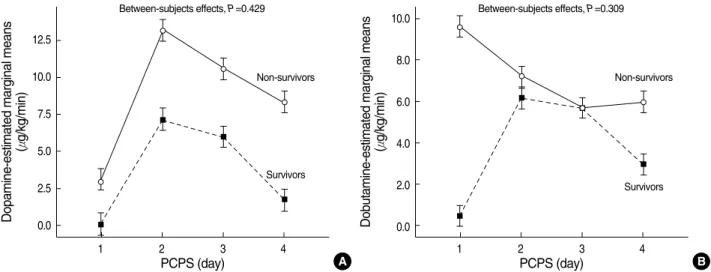
analysis, adjusting for confounders, if they were found to be significant. Univariate analysis showed that the following 6 variables were associated with in-hospital mortality: a higher APACHE III score, surgery, continuous renal replacement therapy, MRSA infection, initial PCPS flow, and a longer total pump time. The incidence of cardiac arrest prior to PCPS application did not differ between survivors and non-survi- vors, nor did the incidence of IABP insertion (P=0.339). Figs.
1, 2 show the serial change of catecholamine dose required (dopamine, dobutamine, epinephrine, and norepinephrine).
Non-survivors required a higher dosage of catecholamine for the first 72 hr after initiation of PCPS, but the difference was not significant (P>0.05). Fig. 3 shows the change of APACHE III scores over 72 hr. The 2 groups showed significant differ- ences on a repeated generalized linear model (P=0.025).
Stepwise forward binary logistic regression analysis iden- tified that an APACHE III score 50 or greater prior to PCPS was the most significant factor related to prognosis (OR,
Survivors
Fig. 1. Serial catecholamine dose administered during PCPS to survivors and nonsurvivors. (A) Dopamine, (B) Dobutamine. The two groups did not differ significantly using a repeated generalized linear model (P>0.05).
Dopamine-estimated marginal means (μg/kg/min) 12.5
10.0
7.5
5.0
2.5
0.0
1 2 3 4
PCPS (day)
Non-survivors Between-subjects effects, P=0.429
Survivors
A Dobutamine-estimated marginal means (μg/kg/min)
10.0
8.0
6.0
4.0
2.0
0.0
1 2 3 4
PCPS (day) B
Fig. 2. Serial catecholamine dose administered during PCPS to survivors and non-survivors. (A) Epinephrine, (B) Norepinephrine. The two groups did not differ significantly using a repeated generalized linear model (P>0.05)
Epinephrine-estimated marginal means (μg/kg/min) 0.04
0.03
0.02
0.01
0.00
1 2 3 4
PCPS (day)
A
Norepinephrine-estimated marginal means (μg/kg/min) 0.6
0.5
0.4
0.3
0.2
0.1
0.0
1 2 3 4
PCPS (day) B
A
Non-survivors
Survivors Between-subjects effects, P=0.309
Non-survivors Between-subjects effects, P=0.562
Survivors
Between-subjects effects, P=0.369
Non-survivors
14.351; CI, 3.127-72.338; P=0.001). This result was con- firmed using a stepwise, backward binary logistic regression analysis. Patients with an APACHE III score higher than 50 on the initial day of PCPS had an in-hospital mortality of 73.5% (25 of 34) (Table 3).
Survival
Patient follow up was complete (median follow-up, 12.7 months; range, 2.0 to 19.6 months). Overall 18-month sur- vival was 42.2%. Cox proportional hazard regression analy- sis showed that patients with APACHE III scores ≥50 had a poor prognosis. Overall survival at 18 months was 78.8%
for patients with APACHE scores <50 and 26.1% for patients with APACHE III scores ≥50 (P=0.001) (Fig. 4). At last follow up, 11 patients were in the NYHA functional class I, 7 patients in class II, and 4 patients in class III.
DISCUSSION
Recent developments in medical engineering have resulted in innovations that have transformed PCPS into a compact, battery-powered, portable heart-lung machine that can be implemented rapidly in any area of the hospital using thin- walled cannulas inserted via the femoral vessels (8). Because PCPS is a portable and powerful resuscitative tool, it has been
effectively used for the treatment of cardiac failure in various situations, including postcardiotomy low cardiac output syn- drome (6, 9), prolonged cardiopulmonary resuscitation (10), and acute myocardial infarction (10). In addition, PCPS has been used prophylactically in high-risk coronary patients need- ing percutaneous stent revascularization (12). When used for cardiac arrest during coronary intervention in the catheteri- zation laboratory, PCPS has demonstrated a late survival rate ranging between 57% and 64% (13-15) and a late survival rate ranging between 56% and 66.7% for postoperative low output syndrome (9).
Between February 1998 and October 2005, before the intro- duction of the PCPS system, we used an extracorporeal mem- brane oxygenator (ECMO), but the outcomes were dismal, with an ECMO in-hospital mortality rate of 91.6% (11 of 12) (data not shown here). After switching to the PCPS sys- tem, however, this rate was reduced significantly, to 56% (28 of 50). However, PCPS is limited in its ability to promote the recovery of left ventricular function in the presence of seriously damaged myocardium.
To clarify the effectiveness of PCPS, we analyzed the back- ground, characteristics, and the prognosis of patients who underwent PCPS for the treatment of severe cardiopulmonary failure due to various causes, including postcardiac surgery, ARDS, acute myocardial infarction, and acute myocarditis.
We found that a higher APACHE III score at the beginning of PCPS, higher initial pump flow, and longer duration of bypass time were predictors of poor outcome of PCPS. Al-
No., number; OR, odds ratio; CI, confidence interval; APACHE, acute physiology, age, and chronic health evaluation.
Variables Category No. (%)
non-survivors
No. patients OR 95% CI P value
APACHE III score ≥50 34 25 (73.5) 14.35 3.13-72.34 0.001
<50 15 3 (20.0) 1
Table 3. Multivariate logistic regression analysis of in-hospital mortality
APACHE III score
70
65
60
55
50
45
0 1 2 3
PCPS (day)
Non-survivors Between-subjects effects, P=0.025
Survivors
Fig. 3. Serial APACHE III scores during PCPS of survivors and non- survivors. The two groups differed significantly using a repeated generalized linear model (P=0.025).
Fig. 4. Overall survival in patients with PCPS relative to initial APACHE III scores. Overall survival at 18 months was 87.5% for patients with APACHE scores <50 and 28.8% for patients with APACHE III scores
≥50 (P=0.001).
Cumulative survival
100
80
60
40
20
0
0 2 4 6 8 10 12 14 16 18 20
Months after PCPS
APACHE III <50 78.8%
APACHE III ≥50 26.1%
though PCPS was initially used to save the lives of patients with severe cardiac failure who required an extreme dose of catecholamine and in whom IABP was not sufficient to main- tain circulation, indications for PCPS have widened. We found that APACHE III score ≥50 and serial changes in APACHE III score during the first 72 hr were predictive of in-hospital mortality.
Then, how can we reduce PCPS in-hospital mortalities?
This study revealed several factors could predict PCPS mor- tality. To improve APACHE III scores at the beginning of PCPS, an earlier application of PCPS would be helpful to break a vicious circle and reduce initial pump flow, and the duration of bypass time. Since October 2005, our policies for PCPS application have changed in several aspects. We performed early orotracheal intubation and full sedation for several days, especially in ARDS patients, with early, low- dose steroid therapy as guidelines indicated. When deciding to apply PCPS, we did not hesitate to apply PCPS to patients who suffered from severe cardiopulmonary failure with hemo- dynamic compromise. If needed, early bedside tracheotomies were performed. Ultimately, we have undertaken aggressive and early preemptive management to break this vicious circle.
We observed 2 instances of PCPS-related bleeding and 2 thrombotic complications. Before using the PCPS system, cannulas were not heparin-coated, requiring us to maintain an activated clotting time of 250 sec or greater, thus leading to a 50% (6/12, data not shown here) incidence of bleeding complications. Use of heparin-coated cannulas and tubes has enabled us to maintain an activated clotting time of about 180-200 sec. Thrombotic complications after removing PCPS cannulas may be prevented by routine performance of distal lower limb perfusion at the beginning of PCPS. Moreover, when removing the PCPS catheter, the proximal and distal parts of the femoral artery should be clamped, a sufficient amount of blood should be flushed to remove any thrombus in the lumen, and the femoral artery should be repaired.
Among the limitations of this study were its retrospective design and the presence of typical institutional biases regard- ing patient selection. However, we sought to analyze a rela- tively homogenous population by using patients with cardio- vascular disease. Although survival from PCPS was the pri- mary end point, we should have evaluated other significant patient outcomes after discharge, including comfort, advance- ment of oral nutrition, improved patient-family communica- tion, and simplified nursing care. Since these measurements could not be easily abstracted and quantified, these analyses were not undertaken.
In conclusion, our findings indicate that earlier application of PCPS, which lowers initial APACHE III scores, as well as other preemptive strategies designed to optimize high-risk patients, may improve patient outcomes. Identifying patients with high APACHE scores at the beginning of PCPS may predict the risk of in-hospital mortality. Survivors from PCPS, particularly those with higher initial APACHE scores, may
require more careful and frequent short-term follow up.
ACKNOWLEDGMENTS
The authors are grateful to Soon-Young Sul, RN, Hee-Jung Lee, RN, Sun-Hee Lim, RN, and Eun-A Kang, RN for their contributions in collecting data found in this article.
REFERENCES
1. Phillips SJ, Ballentine B, Slonine D, Hall J, Vandehaar J, Kongtah- worn C, Zeff RH, Skinner JR, Reckmo K, Gray D. Percutaneous initiation of cardiopulmonary bypass. Ann Thorac Surg 1983; 36:
223-5.
2. Vogel RA, Shawl F, Tommaso C, O’Neill W, Overlie P, O’Toole J, Vandormael M, Topol E, Tabari KK, Vogel J. Initial report of the National Registry of Elective Cardiopulmonary Bypass Supported Coronary Angioplasty. J Am Coll Cardiol 1990; 15: 23-9.
3. Magovern GJ Jr, Magovern JA, Benckart DH, Lazzara RR, Sakert T, Maher TD Jr, Clark RE. Extracorporeal membrane oxygenation:
preliminary results in patients with postcardiotomy cardiogenic shock.
Ann Thorac Surg 1994; 57: 1462-8.
4. Mair P, Hoermann C, Moertl M, Bonatti J, Falbesoner C, Balogh D.
Percutaneous venoarterial extracorporeal membrane oxygenation for emergency mechanical circulatory support. Resuscitation 1996;
33: 29-34.
5. Younger JG, Schreiner RJ, Swaniker F, Hirschl RB, Chapman RA, Bartlett RH. Extracorporeal resuscitation of cardiac arrest. Acad Emerg Med 1999; 6: 700-7.
6. Hata M, Shiono M, Orime Y, Yagi SY, Yamamoto T, Okumura H, Kimura SI, Nakata KI, Kashiwazaki S, Choh S, Negishi N, Sezai Y.
Strategy of circulatory support with percutaneous cardiopulmonary support. Artif Organs 2000; 24: 636-9.
7. Knaus WA, Wagner DP, Draper EA, Zimmerman JE, Bergner M, Bastos PG, Sirio CA, Murphy DJ, Lotring T, Damiano A. The APA- CHE III prognostic system. Risk prediction of hospital mortality for critically ill hospitalized adults. Chest 1991; 100: 1619-36.
8. Kurusz M, Zwischenberger JB. Percutaneous cardiopulmonary by- pass for cardiac emergencies. Perfusion 2002; 17: 269-77.
9. Hayashi Y, Ohtake S, Sawa Y, Nishimura M, Ichikawa H, Satoh H, Yamaguchi T, Suhara H, Sakaguchi T, Matsuda H. Percutaneous cardiopulmonary support with heparin-coated circuits in postcar- diotomy cardiogenic shock. Efficacy and comparison with left heart bypass. Jpn J Thorac Cardiovasc Surg 2000; 48: 274-9.
10. Chen YS, Chao A, Yu HY, Ko WJ, Wu IH, Chen RJ, Huang SC, Lin FY, Wang SS. Analysis and results of prolonged resuscitation in cardiac arrest patients rescued by extracorporeal membrane oxy- genation. J Am Coll Cardiol 2003; 41: 197-203.
11. Aiba T, Nonogi H, Itoh T, Morii I, Daikoku S, Goto Y, Miyazaki S, Sasako Y, Nakatani T. Appropriate indications for the use of a per- cutaneous cardiopulmonary support system in cases with cardiogenic shock complicating acute myocardial infarction. Jpn Circ J 2001;
65: 145-9.
12. Sua@rez de Lezo J, Pan M, Medina A, Pavlovic D, Romero M, Segura J, Ruiz M, Ojeda S, Mun)oz J, Rodriguez M. Percutaneous cardiopul- monary support in critical patients needing coronary interventions with stents. Catheter Cardiovasc Interv 2002; 57: 467-75.
13. Mooney MR, Arom KV, Joyce LD, Mooney JF, Goldenberg IF, Von Rueden TJ, Emery RW. Emergency cardiopulmonary bypass sup- port in patients with cardiac arrest. J Thorac Cardiovasc Surg 1991;
101: 450-4.
14. Shawl FA, Domanski MJ, Punja S, Hernandez TJ. Percutaneous cardiopulmonary bypass support in high-risk patients undergoing percutaneous transluminal coronary angioplasty. Am J Cardiol 1989;
64: 1258-63.
15. Shawl FA, Domanski MJ, Wish MH, Davis M. Percutaneous car- diopulmonary bypass support in the catheterization laboratory: tech- nique and complications. Am Heart J 1990; 120: 195-203.