Transcriptional Regulation of Proteoglycans and
Glycosaminoglycan Chain-synthesizing Glycosyltransferases by UV Irradiation in Cultured Human Dermal Fibroblasts
Various kinds of glycosaminoglycans (GAGs) and proteoglycans (PGs) have been known to be involved in structural and space-filling functions, as well as many physiological regulations in skin. To investigate ultraviolet (UV) radiation-mediated regulation of GAGs and PGs in cultured human dermal fibroblasts, transcriptional changes of many types of PGs and GAG chain-synthesizing enzymes at 18 hr after 75 mJ/cm2 of UV irradiation were examined using quantitative real-time polymerase chain reaction methods. Hyaluronic acid synthase (HAS)-1, -2, and -3 and hyaluronidase-2 mRNA expressions were significantly increased by UV irradiation. Expressions of lumican, fibromodulin, osteoglycin,
syndecan-2, perlecan, agrin, versican, decorin, and biglycan were significantly decreased by UV irradiation, while syndecan-1 was increased. Expressions of GAG chain-synthesizing glycosyltransferases, xylosyltransferase-1, β1,3-glucuronyltransferase-1, β1,4-
galactosyltransferase-2, -4, exostosin-1, chondroitin polymerizing factor, and chondroitin sulfate synthase-3 were significantly reduced, whereas those of β1,3-
galactosyltransferase-6, β1,4-galactosyltransferase-3, -7, β-1,3-N-acetylglucosaminyltran sferase-2, and -7 were increased by UV irradiation. Heparanase-1 mRNA expression was increased, but that of heparanase-2 was reduced by UV irradiation. Time-course investigation of representative genes showed consistent results. In conclusion, UV irradiation may increase hyaluronic acid production through HAS induction, and decrease other GAG productions through downregulation of PG core proteins and GAG chain- synthesizing glycosyltransferases in cultured human dermal fibroblasts.
Key Words: Glycosaminoglycans; Proteoglycans; Glycosyltransferases; Ultraviolet Radiation;
Dermal Fibroblasts Jeong-Eun Shin*, Jang-Hee Oh*,
Yeon Kyung Kim, Ji-Yong Jung, and Jin Ho Chung
Department of Dermatology, Seoul National University College of Medicine, Institute of Dermatological Science, Medical Research Center, Seoul National University, Laboratory of Cutaneous Aging Research, Clinical Research Institute, Seoul National University Hospital, Seoul, Korea
*Jeong-Eun Shin and Jang-Hee Oh contributed equally to this work.
Received: 6 July 2010 Accepted: 25 January 2011 Address for Correspondence:
Jin Ho Chung, MD
Department of Dermatology, Seoul National University Hospital, 101 Daehang-no, Jongno-gu, Seoul 110-744, Korea Tel: +82.2-2072-2414, Fax: +82.2-742-7344 E-mail: [email protected]
This study was supported by a grant of the Korea Healthcare Technology R&D Project, Ministry of Health & Welfare, Republic of Korea (A080283), by a grant (0420070470) from the SNUH Research Fund, by the Korea Research Foundation Grant funded by the Korean Government (MOEHRD) (KRF-2007-355-E00014), and by a research agreement with the Amore-Pacific Corporation, Seoul, Korea.
DOI: 10.3346/jkms.2011.26.3.417 • J Korean Med Sci 2011; 26: 417-424 Dermatology
INTRODUCTION
Ultraviolet radiation has been known to induce premature skin aging during long human life time (1-4). In photoaged skin, dra- matic changes of dermal components such as loss of collagen fiber and deposition of elastotic materials have been found (2, 5); however, changes of glycosaminoglycans (GAGs) during ag- ing and their regulatory mechanisms have not been well-estab- lished.
GAGs are long polysaccharide chains consisting of specific disaccharide units, and have structural and physiological regu- latory functions (6). Hyaluronic acid (HA) is the most abundant GAG in dermis, synthesized by HA synthase (HAS)-1, -2, and -3 in the plasma membrane of dermal fibroblasts, and secreted to the extracellular spaces as GAG form alone (7). HA turnover is tightly regulated by hyaluronidase-1, -2, and its receptor CD44 (8). Hyaluronidase-2, glycosylphosphatidylinositol-linked to
the plasma membrane, cleaves HA, followed by CD44-mediat- ed uptake of HA, and hyaluronidase-1 disintegrates it within lysosome (8).
Other GAGs, such as chondroitin sulfate (CS), dermatan sul- fate (DS), keratan sulfate (KS), heparan sulfate (HS), and hepa- rin (HP), are synthesized in endoplasmic reticulum (ER) and Golgi apparatus as glycosylation to the core proteins of their re- lated proteoglycans (PGs) by numbers of common and GAG type-specific glycosyltransferases (9-11).
Lumican, fibromodulin, osteoglycin, and keratocan, which are members of KSPGs, and decorin, biglycan, and epiphycan, members of CS/DSPGs, belong to small leucine-rich PG family.
Some of them have been reported to be involved in collagen fibril formation in cornea, tendon, and/or skin (12-17). Decorin and biglycan are reported to have critical roles in collagen and elas- tic fibril formation, and versican, a large CSPG, is also involved in elastic formation of microfibrils (17, 18). Epiphycan is known
to play roles in maintenance of the joint integrity, but its expres- sion is restricted to cartilage and testis (19). Perlecan, agrin, and collagen XVIII are ubiquitous basement membrane HSPGs, which play essential structural roles and contribute to local gra- dient formation of HS-binding cytokines, chemokines, and growth factors (20). Perlecan was reported to contribute to epi- dermal layer formation in the artificial skin model by inhibition of keratinocyte apoptosis (21). Syndecan-1 to -4 are plasma mem- brane-expressed HSPGs, and known to be involved in cell ad- hesion, migration, and signal transduction (22).
The initial common tetrasaccharide glycosylation for GAGs on serine residues of PG core proteins is started with a xylose addi- tion in ER by xylosyltransferase-1 and -2, followed by adding two galactoses in cis/medial Golgi by β1,3-galactosyltransferase (B3GALT)-6 and β1,4-galactosyltransferase (B4GALT)-7, and the glucuronic acid is added in the trans Golgi by β1,3-glucuro- nyltransferase (B3GAT)-1, -2, and -3 (6). Thereafter, KS chain elongation is mediated by B4GALT1-4 and β-1,3-N-acetylglu- cosaminyltransferase (B3GNT)-1, -2, and -7 (23). CS chain elon- gation is mediated by chondroitin polymerizing factor (CHPF), CHPF2, CS synthase (CHSY)-1, -3, CS N-acetylgalactosaminyl- transferase (CSGALNACT)-1, and -2, and DS chain is converted from CS chain by DS epimerase (10). HS and HP chain elonga- tion is mainly mediated by exostosin-1, -2, and exostosin-like-1 to -3 are partly involved (6). Degradation of HS is mediated by
heparanase-1, which has important roles in inflammatory re- sponse (20). Heparanase-2 was recently cloned, and its loss of function mutation was found in all urofacial syndrome patients, but its functionality is not still clear (24).
In this study, for estimating GAG and PG expressional changes and their involvement in skin photoaging process, single dose of UV-induced transcriptional changes of various PGs and GAG chain-synthesizing or degrading enzymes were investigated in primary human dermal fibroblasts.
MATERIALS AND METHODS Cell culture and UV irradiation
Primary human dermal fibroblasts, which were isolated by out- growth from foreskin of 7- to 30-yr old healthy donors, were cul- tured in Dulbecco’s Modified Eagle’s Medium (DMEM, Gibco- BRL, Grand Island, NY, USA) containing 10% fetal bovine serum (FBS), 2 mM glutamine, penicillin (100 U/mL), and streptomy- cin (100 μg/mL). Cells were incubated at 37°C in a humidified atmosphere containing 5% CO2, and grown up until > 95% con- fluence. Thereafter, cells were serum-starved with fresh medi- um with 0% FBS for 24 hr, washed twice with phosphate buff- ered saline (PBS), and then irradiated with 0 or 75 mJ/cm2 of UV under thin layer of PBS. Phillips TL 20W/12 RS florescent sun lamps with an emission spectrum between 275 and 380 nm
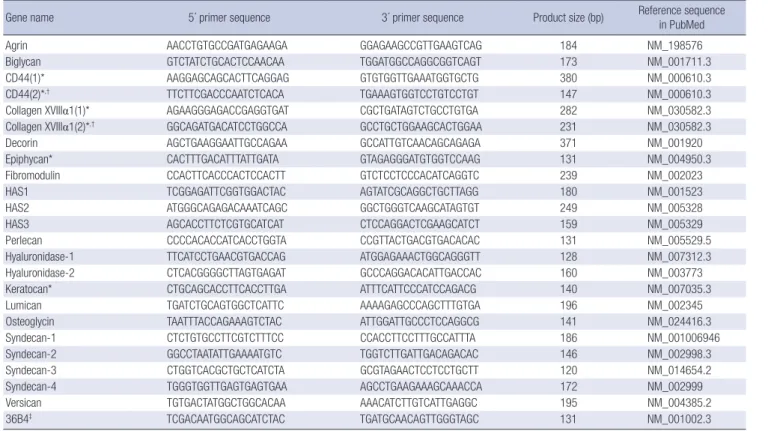
Table 1. Real-time PCR primer sequences for HA-related genes and proteoglycans
Gene name 5´ primer sequence 3´ primer sequence Product size (bp) Reference sequence
in PubMed
Agrin AACCTGTGCCGATGAGAAGA GGAGAAGCCGTTGAAGTCAG 184 NM_198576
Biglycan GTCTATCTGCACTCCAACAA TGGATGGCCAGGCGGTCAGT 173 NM_001711.3
CD44(1)* AAGGAGCAGCACTTCAGGAG GTGTGGTTGAAATGGTGCTG 380 NM_000610.3
CD44(2)*,† TTCTTCGACCCAATCTCACA TGAAAGTGGTCCTGTCCTGT 147 NM_000610.3
Collagen XVIIIα1(1)* AGAAGGGAGACCGAGGTGAT CGCTGATAGTCTGCCTGTGA 282 NM_030582.3
Collagen XVIIIα1(2)*,† GGCAGATGACATCCTGGCCA GCCTGCTGGAAGCACTGGAA 231 NM_030582.3
Decorin AGCTGAAGGAATTGCCAGAA GCCATTGTCAACAGCAGAGA 371 NM_001920
Epiphycan* CACTTTGACATTTATTGATA GTAGAGGGATGTGGTCCAAG 131 NM_004950.3
Fibromodulin CCACTTCACCCACTCCACTT GTCTCCTCCCACATCAGGTC 239 NM_002023
HAS1 TCGGAGATTCGGTGGACTAC AGTATCGCAGGCTGCTTAGG 180 NM_001523
HAS2 ATGGGCAGAGACAAATCAGC GGCTGGGTCAAGCATAGTGT 249 NM_005328
HAS3 AGCACCTTCTCGTGCATCAT CTCCAGGACTCGAAGCATCT 159 NM_005329
Perlecan CCCCACACCATCACCTGGTA CCGTTACTGACGTGACACAC 131 NM_005529.5
Hyaluronidase-1 TTCATCCTGAACGTGACCAG ATGGAGAAACTGGCAGGGTT 128 NM_007312.3
Hyaluronidase-2 CTCACGGGGCTTAGTGAGAT GCCCAGGACACATTGACCAC 160 NM_003773
Keratocan* CTGCAGCACCTTCACCTTGA ATTTCATTCCCATCCAGACG 140 NM_007035.3
Lumican TGATCTGCAGTGGCTCATTC AAAAGAGCCCAGCTTTGTGA 196 NM_002345
Osteoglycin TAATTTACCAGAAAGTCTAC ATTGGATTGCCCTCCAGGCG 141 NM_024416.3
Syndecan-1 CTCTGTGCCTTCGTCTTTCC CCACCTTCCTTTGCCATTTA 186 NM_001006946
Syndecan-2 GGCCTAATATTGAAAATGTC TGGTCTTGATTGACAGACAC 146 NM_002998.3
Syndecan-3 CTGGTCACGCTGCTCATCTA GCGTAGAACTCCTCCTGCTT 120 NM_014654.2
Syndecan-4 TGGGTGGTTGAGTGAGTGAA AGCCTGAAGAAAGCAAACCA 172 NM_002999
Versican TGTGACTATGGCTGGCACAA AAACATCTTGTCATTGAGGC 195 NM_004385.2
36B4‡ TCGACAATGGCAGCATCTAC TGATGCAACAGTTGGGTAGC 131 NM_001002.3
*Not detected in human dermal fibroblasts with listed primer pairs; †Additional primer pair was applied for the undetected genes, but not detected; ‡36B4 was used as an endogenous control gene.
(peak, 310-315 nm) were used as a UV source with a Kodacel filter (TA401/407; Kodak, Rochester, NY, USA) to block UV-C, which has wavelengths below 290 nm. UV strength was mea- sured using a Waldmann UV meter (model 585100, Waldmann, Villingen-Schwenningen, Germany). After UV treatment, cells were incubated with fresh medium with 0% FBS, and further incubated for 6, 12, 18, or 24 hr.
Quantitative real-time polymerase chain reaction (PCR) Total RNA was extracted from UV-irradiated or sham-irradiated cultured dermal fibroblasts using the Trizol method (Invitro- gen, Carlsbad, CA, USA), and 1 μg of total RNA was converted to cDNA using First Strand cDNA Synthesis Kit (MBI Fermen- tas, Vilnius, Lithuania) according to the manufacturer’s instruc- tions. To quantitatively estimate the mRNA expression of target genes (Tables 1, 2), PCR was performed on a 7500 Real-time PCR System (Applied Biosystems, Foster City, CA, USA) using the SYBR Premix Ex TaqTM (Takara Bio Inc., Shiga, Japan) accord- ing to the manufacturer’s instructions, using the primer pairs in the Tables 1, 2. The PCR conditions were 50°C for 2 min, 95°C for 2 min, followed by 40 cycles at 95°C for 22 sec and 60°C for 1 min.
Data were analyzed using the comparative Ct method, normal- ized to 36B4, and presented as the fold changes in gene expres- sion of UV-irradiated cells, relative to the control sham-irradiat-
ed cells. These experiments were carried out in duplicate or trip- licate, and independently repeated at least three times.
Statistics
Statistical analyses between UV-irradiated and control sham- irradiated samples in same time point were performed using Mann-Whitney U-test. P values below 0.05 were considered as statistically significant. Results were presented as mean fold changes ± standard deviation versus control sham-irradiated cells.
RESULTS
UV-induced mRNA expression of HA-related genes and various PGs in cultured primary human dermal fibroblasts
UV irradiation is a major cause of skin photoaging, and the in- duction of MMP-1 and reduction of procollagen by UV irradia- tion is the most well-known phenomena (1, 2). In our previous studies, statistically significant induction of MMP-1 in primary human dermal fibroblasts was observed at 75 mJ/cm2 or higher doses of UV irradiation (25), 75 mJ/cm2 of UV irradiation well caused both MMP-1 induction and type I procollagen reduction in human dermal fibroblast Hs27 (26). Therefore, we decided to Table 2. Real-time PCR primer sequences for GAG chain-synthesizing and degrading enzymes
Gene name 5´ primer sequence 3´ primer sequence Product size (bp) Reference sequence
in PubMed
B3GALT6 TATCAGTGGCGTTTCTCACG ACGGTACAGGCACCAAGTTC 242 NM_080605
B3GAT1 ATTCTGAAGACCAGAGAGCA GGATCCAAGACAGCCTTATG 152 NM_054025
B3GAT2(1)* GTGGAAAACGGCAAAGTTGT TGCTTTCGGTTCCAGTTCTT 207 NM_080742.2
B3GAT2(2)*,† AGTCTGGAGCTCTTCCAGGA TACCAGCCAACAACTTTGCC 122 NM_080742.2
B3GAT3 CCAAGATGAAGCAGGAGGAG GGTCAGGACTTGGAAAACCA 164 NM_012200.2
B3GNT1 AGGCCAAGTACCCCAACTCT TGGAGCGACATTTCTTACCC 122 NM_006876
B3GNT2 AGGGCCTCTAAACCCTTCAA GCCAAATTCCAGAAACAGGA 170 NM_006577
B3GNT5 ACTCCTCCCCAACAAGGTCT TTTAACCCCAAACTGGCAAC 206 NM_032047
B3GNT7 TGACCCTCAAGGAGATCCAC TGTTGTCTTTCCTGCGAATG 198 NM_145236
B4GALT1 AGTGACGTGGACCTCATTCC CCGATGTCCACTGTGATTTG 446 NM_001497
B4GALT2 CGGTCATCATCCCCTTTAGA AGGGAGATCCGGTTGAAGAT 436 NM_001005417
B4GALT3 CTGGCTGGGATGAAGATCTC ACCAGGAGGTCAAATCTGTG 113 NM_003779.2
B4GALT4 GCTGTTGACTTTGTGCCTGA GCCTGGTGGATGACGTAGAT 438 NM_212543
B4GALT6 CATACCTCCCCTGTCCAGAA GCGATTACGGAAAGGAATGA 191 NM_004775
B4GALT7 AGATCCGGCACCACATCTAC CAGCCTCAGGAAAGCCATAG 174 NM_007255.1
CHPF GAACGCACGTACCAGGAGAT TGCAAGTCCAGCGTGTATTC 368 NM_024536
CHPF2 TGAACTGGCCAAAAATAGGG TCTGCACAGGAGAAGGTGTG 315 NM_019015
CHSY1 CCCTCCTTCATGAGGTTTCA CACAGGGACCGTCATTTTCT 324 NM_014918
CHSY3 CAATGAGAATGCCAAGAGCA TGCTGAAGATAGGCATGACG 177 NM_175856
CSGALNACT1* CAGAAAGGGACAAAGGGACA GAAGTTGGCAGCTTTGGAAG 320 NM_018371
CSGALNACT2 CAGCAGCTGGTTCACAAAAA AAAAGACCAGGAACCGGAGT 200 NM_018590
Exostosin-1 TCATCAGCAGAGCCAGATTG CACAGAAGCCAGTGAGGTGA 141 NM_000127
Exostosin-2 GAGTGCATCAACAAGTTTGC ATGTTGGGGAAGCTCTTCAG 122 NM_207122
Heparanase-1 TTTTCCAGGTGGTTGAGAGC CCCAATTTATCCAGCCACAT 133 NM_001098540
Heparanase-2 TGATCCGGGACAAACTAAGG TGCAGCAGGTACTGGTGAAC 166 NM_021828
Xylosyltransferase-1 TGTCTACGATGAGCCTGACG AAGCGGTCAGCAAGGAAGTA 186 NM_022166
Xylosyltransferase-2 GGTGGCATTCCTATCCAAGA GTCAGCACGAACCAGTCAGA 192 NM_022167
*Not detected in human dermal fibroblasts with listed primer pairs; †Additional primer pair was applied for the undetected genes, but not detected.
use 75 mJ/cm2 of UV for our experiment.
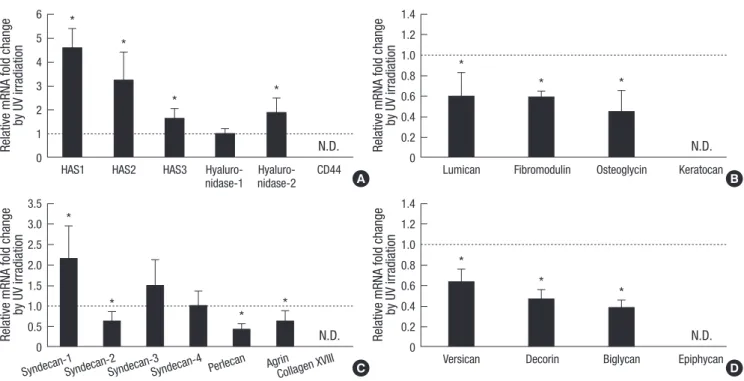
In order to investigate the UV-induced transcriptional changes of HA-related genes and various PGs, cultured primary human dermal fibroblasts were irradiated with 75 mJ/cm2 of UV, and their mRNA expressions were determined by quantitative real- time PCR at 18 hr after UV irradiation (Fig. 1).
First, we examined UV-induced mRNA expression of HA-re- lated genes, including HAS1-3, hyaluronidase-1, -2, and CD44 (Fig. 1A). The mRNA expressions of HAS1-3 and hyaluronidase- 2 were significantly increased compared to sham-irradiated con- trol at 18 hr after UV exposure, while that of hyaluronidase-1 was not changed significantly (Fig. 1A). CD44 mRNA expression was not detected with two different primer pairs (Fig. 1A, Table 1).
UV-induced mRNA expressions of members of KSPGs, HSP- Gs, and CS/DSPGs were also investigated (Fig. 1B-D). The mRNA expression levels of KSPGs such as lumican, fibromodu- lin, and osteoglycin were significantly downregulated at 18 hr by UV irradiation compared to sham-irradiated control, while ker- atocan was not detected (Fig. 1B). The mRNA expression levels of some HSPGs such as syndecan-2, perlecan, and agrin were significantly reduced, but that of syndecan-1 was significantly increased at 18 hr by UV irradiation (Fig. 1C). Those of syndecan- 3 and -4 were not changed by UV irradiation, and collagen XVIII was not detected with two different primer pairs (Fig. 1C, Table 1). The mRNA expression levels of CS/DSPGs such as versican, decorin, and biglycan were also significantly decreased by UV irradiation, while epiphycan was not detected (Fig. 1D).
UV-induced mRNA expression of GAG chain-synthesizing glycosyltransferases in primary cultured human dermal fibroblasts
Since UV-mediated regulation of GAG production may be affect- ed by regulation of not only core proteins but also GAG chain- synthesizing glycosyltransferases, we also investigated mRNA expressions of common and GAG type-specific glycosyltrans- ferases in human dermal fibroblasts by quantitative real-time PCR at 18 h after UV irradiation (Fig. 2).
The glycosyltransferases responsible for the common tetra- saccharide were firstly examined (Fig. 2A). The mRNA expres- sions of xylosyltransferase-1 and B3GAT1 were significantly re- duced by UV irradiation, and those of B3GALT6 and B4GALT7 were increased by UV irradiation (Fig. 2A). Those of xylosyltran- sferase-2 and B3GAT3 were not changed significantly, while that of B3GAT2 was not detected with two different primer pairs (Fig.
2A, Table 2).
KS chain-synthesizing glycosyltransferases were also investi- gated, and reduced mRNA expressions of B4GALT2 and B4GALT4 by UV irradiation were observed, while B4GALT3, B3GNT2, and B3GNT7 mRNA levels were increased (Fig. 2B). B4GALT1 and B3GNT1 mRNA expressions were not significantly changed by UV irradiation (Fig. 2B).
An HS chain-synthesizing glycosyltransferase, exostosin-1, was significantly downregulated by UV irradiation, but exosto- sin-2 did not changed compared to sham-irradiated control (Fig. 2C). An HS-degrading enzyme, heparanase-1, was signifi-
Fig. 1. Fold changes of UV-induced mRNA expression of HA-related genes and various proteoglycans (PGs) in cultured human dermal fibroblasts. Human dermal fibroblasts were incubated for 18 hr after 75 mJ/cm2 of UV irradiation. Total RNA was isolated from UV-irradiated or sham-irradiated cells, converted to the cDNA, and applied to the quantitative real-time polymerase chain reaction experiments for each target genes. (A) Changes of HA-related genes. (B) Changes of KSPGs. (C) Changes of HSPGs. (D) Changes of CS/DSPGs. Values are mean fold changes ± standard deviation (SD) (n = 3 or 4). *P < 0.05 versus control sham-irradiated cells. N.D. means not detected in both control and UV-irradiated cells. HAS, hyaluronic acid synthase.
Relative mRNA fold change by UV irradiationRelative mRNA fold change by UV irradiation Relative mRNA fold change by UV irradiationRelative mRNA fold change by UV irradiation
*
*
* * *
*
*
*
*
*
*
*
* *
N.D.
N.D.
N.D.
N.D.
HAS1 HAS2 HAS3 Hyaluro- Hyaluro- CD44 nidase-1 nidase-2
Syndecan-1
Syndecan-3 Syndecan-2
Syndecan-4 Perlecan Agrin Collagen XVIII
Lumican Fibromodulin Osteoglycin Keratocan
Versican Decorin Biglycan Epiphycan 6
5 4 3 2 1 0
3.5 3.0 2.5 2.0 1.5 1.0 0.5 0
1.4 1.2 1.0 0.8 0.6 0.4 0.2 0
1.4 1.2 1.0 0.8 0.6 0.4 0.2 0 A
C
B
D
Relative mRNA fold change by UV irradiation Relative mRNA fold change by UV irradiation
Relative mRNA fold change by UV irradiation Relative mRNA fold change by UV irradiation
*
*
* *
*
*
* *
*
*
*
*
* N.D.
N.D.
Xylosyltra- nsferase-1
B4GALT1 Xylosyltra-
nsferase-2
B4GALT2 B3GALT6
B4GALT3 B4GALT7
B4GALT4 B3GAT1
B3GNT1 B3GAT2
B3GNT2 B3GAT3
B3GNT7
CHPF CHPF2 CHSY1 CHSY3 CSGAL CSGAL NACT1 NACT2 Exostosin-1 Exostosin-2 Heparanase-1 Heparanase-2
2.5 2.0 1.5 1.0 0.5 0
3.5 3.0 2.5 2.0 1.5 1.0 0.5 0
3.0 2.5 2.0 1.5 1.0 0.5 0
2.0
1.5
1.0
0.5
0
*
A B
C D
Fig. 2. Fold changes of UV-induced mRNA expression of GAG chain-synthesizing glycosyltransferases in cultured human dermal fibroblasts. Human dermal fibroblasts were incubated for 18 hr after 75 mJ/cm2 of UV irradiation. Total RNA was isolated from UV-irradiated or sham-irradiated cells, converted to the cDNA, and applied to the quantitative real-time polymerase chain reaction experiments for each target genes. (A) Changes of GAG chain-synthesizing common glycosyltransferases. (B) Changes of KS chain-synthesizing glycosyltransferases. (C) Changes of HS chain-synthesizing glycosyltransferases and heparanases. (D) Changes of CS and DS chain-synthesizing glycosyltransferases. Values are mean fold changes ± SD (n = 3 or 4). *P < 0.05 versus control sham-irradiated cells. N.D. means not detected in both control and UV-irradiated cells. B3GALT, β1,3- galactosyltransferase; B4GALT, β1,4-galactosyltransferase; B3GAT, β1,3-glucuronyltransferase; B3GNT, β-1,3-N-acetylglucosaminyltransferase; CHPF, chondroitin polymerizing factor; CHSY, chondroitin sulfate synthase; CSGALNACT, chondroitin sulfate N-acetylgalactosaminyltransferase.
Fig. 3. Time-dependent fold changes of UV-induced mRNA expression of HA-related genes, proteoglycans, and GAG chain-synthesizing glycosyltransferases in cultured human dermal fibroblasts. Human dermal fibroblasts were incubated for 6, 12, 18, or 24 hr after 75 mJ/cm2 of UV irradiation. Total RNA was isolated from UV-irradiated or sham- irradiated cells, converted to the cDNA, and applied to the quantitative real-time polymerase chain reaction experiments for each target genes. (A) Changes of HAS2, osteoglycin, syndecan-1, perlecan, and decorin. (B) Changes of xylosyltransferase-1, B3GNT1, B4GALT2, exostosin-1, and CHPF. Values are mean fold changes ± SD (n = 3 or 4). *P < 0.05 versus control sham-irradiated cells at each time point.
Relative mRNA fold change by UV irradiation 5 4 3 2 1
0 HAS2 Osteoglycin Sydecan-1 Perlecan Decorin
*
*
*
* * * *
*
*
*
* * * * *
A
24 hr 18 hr 12 hr 6 hr 0 hr
Relative mRNA fold change by UV irradiation 3.0 2.5 2.0 1.5 1.0 0.5
0 Xylosyltransferase-1 B3GNT1 B4GALT2 Exostosin-1 CHPF
* *
*
*
* *
* *
B
24 hr 18 hr 12 hr 6 hr 0 hr
cantly increased, but heparanase-2 was decreased by UV irra- diation (Fig. 2C).
CS chain-synthesizing glycosyltransferases, including CHPF, CHPF2, CHSY1, CHSY3, CSGALNACT1, and CSGALNACT2, were investigated, and CHPF and CHSY3 were found to be sig- nificantly downreglated by UV irradiation (Fig. 2D). The mRNA expressions of CHPF2, CHSY1, and CSGALNACT2 were not significantly changed, while CSGALNACT1 was not detected (Fig. 2D).
Time-dependent mRNA expression of several PGs and GAG chain-synthesizing glycosyltransferases by UV irradiation in primary cultured human dermal fibroblasts To further verify those changes, UV irradiation-induced time- dependent changes of several representative proteoglycans and GAG chain-synthesizing glycosyltransferases at 6, 12, 18, and 24 hr after irradiation were additionally investigated (Fig. 3). By UV irradiation, decorin, perlecan, osteoglycin, xylosyltransferase-1, and exostosin-1 showed decreased mRNA expression patterns in various times points, and syndecan-1 showed increased pat- terns (Fig. 3). HAS2 showed reduced mRNA expression at 6 hr, but increased mRNA expression at 18 and 24 hr after UV irradi- ation (Fig. 3). B4GALT2 and CHPF showed UV-mediated signif- icant decrease of mRNA expression only at 18 hr, and B3GNT1 did not show any significant change (Fig. 3).
DISCUSSION
In this study, we tried to examine overall regulation of GAG pro- duction by UV irradiation in human dermal fibroblasts for the estimation of GAG changes and their contributions in skin pho- toaging process, and demonstrated that the mRNA levels of var- ious PGs containing KS, HS, CS, or DS were downregulated by UV irradiation, while those of HAS family members were in- creased. These results suggest that UV irradiation may result in an increased HA production but reduced other GAG produc- tion in human dermis.
UV-induced increase of HAS1, 2, and 3 expression is similar with the previous report that mRNA expressions of HAS1 and HAS2 increased at 24 hr following UV irradiation, but not HAS3 (7). In that study, mRNA levels of hyaluronidase-2 and -3 were increased at 24 hr after UV irradiation but not hyaluronidase-1 (7), similar with our result that hyaluronidase-2 expression was increased by UV irradiation, but not hyaluronidase-1. However, other study showed that hyaluronidase-1 and -2 mRNA had no changes at 12 hr and 24 hr after UV-irradiation in cultured nor- mal human keratinocytes (27). Time-course experiments of HAS2 showed significant increase of mRNA by UV irradiation at 18 and 24 hr, and significant decrease at 6 hr. This early decrease is also consistent with previous data (7), but its meaning remains unelucidated. CD44 mRNA expression was not detected in der-
mal fibroblasts in our experiment, although it can be detected in cultured normal human keratinocytes with same primers (data not shown), which should be further investigated.
Transcriptional levels of all detected PGs were downregulat- ed by UV irradiation, except syndecan-1, -3, and -4. Time-course experiments of decorin, osteoglycin, perlecan, and syndecan-1 also revealed consistent patterns of UV effects. These downreg- ulation of core protein expression may imply reduction of relat- ed GAG production. No evidence on UV irradiation-mediated PG expressions has been published, except decorin. Immuno- histochemical stain and mRNA expression of decorin were re- ported to be decreased in UVA or UVB-irradiated human skin (28).
As similar, mRNA expressions of several GAG chain-synthe- sizing glycosyltransferases were also reduced by UV irradiation, including xylosyltransferase-1, B3GAT1 (GAG chain initializing enzymes), B4GALT2, B4GALT4 (KS-synthesizing enzymes), ex- ostosin-1 (an HS-synthesizing enzyme), CHPF, and CHSY3 (CS- synthesizing enzymes), while those of B3GALT6, B4GALT7 (GAG chain initializing enzymes), B4GALT3, B3GNT2, and 7 (KS-syn- thesizing enzymes) were increased. Increase of heparanase-1 mRNA expression was also observed. In time-course experi- ments, xylosyltransferase-1 showed decreased mRNA expres- sion from 6 to 24 hr, but B4GALT2 and CHPF showed decreased pattern only at 18 hr, implying their relatively less decrease than that of PGs. No evidence on UV irradiation-mediated GAG chain- synthesizing glycosyltransferase expressions has been publish- ed. These results imply that UV irradiation-induced transcrip- tional changes of GAG chain-synthesizing glycosyltransferases are complicated, but may result in reduced GAG production through significant downregulation of xylosyltransferase-1 and exostosin-1 expression, which are the first enzyme initializing GAG-chain synthesis and HS/HP chain synthesis enzyme, re- spectively (6).
Since detected KSPGs and CS/DSPGs are involved in colla- gen and/or elastic fiber network formation (12-18), their reduc- tion may have weakening effects on dermal matrix structures with downregulation of procollagen I by UV.
Since perlecan has anti-apoptotic function by growth factor binding affinity in dermal-epidermal junction (21), downregu- lation of perlecan and agrin by UV irradiation may result in in- creased keratinocyte apoptosis in epidermis.
Syndecans are known to modulate inflammatory processes in the lung by regulating chemokines, and act as co-receptors for several growth factors and chemokines, mediating various intracellular signaling (20). Therefore, UV-induced changes of syndecan-1 and -2 expressions may participate in inflammato- ry regulation induced by UV. However, further evidence should be necessary.
In this study, we examined mRNA transcriptional changes of various PGs and glycosyltransferases by UV irradiation, which
may imply increase of HA and decrease of other GAGs; howev- er, there is limitation of our study that protein level changes of each target were not investigated, and it will be our next goal of further study. In our speculation, UV-induced increase of HA seems to be an unexpected beneficial result. Therefore, it is pos- sible that, since GAGs are involved in maintenance of tissue wa- ter (6), decrease of GAGs may cause temporary unbalance of water homeostasis, and thereby increase of HA may be induced for its rescue.
In conclusion, UV irradiation may increase HA production through induction of HAS mRNA expressions, and decrease other GAG productions through downregulation of various PG core proteins and GAG chain-synthesizing glycosyltransferases in cultured human dermal fibroblasts.
REFERENCES
1. Chung JH. Photoaging in Asians. Photodermatol Photoimmunol Pho- tomed 2003; 19: 109-21.
2. Chung JH, Seo JY, Choi HR, Lee MK, Youn CS, Rhie G, Cho KH, Kim KH, Park KC, Eun HC. Modulation of skin collagen metabolism in aged and photoaged human skin in vivo. J Invest Dermatol 2001; 117: 1218-24.
3. Kim EJ, Kim MK, Jin XJ, Oh JH, Kim JE, Chung JH. Skin aging and pho- toaging alter fatty acids composition, including 11,14,17-eicosatrienoic acid, in the epidermis of human skin. J Korean Med Sci 2010; 25: 980-3.
4. Jin XJ, Kim EJ, Oh IK, Kim YK, Park CH, Chung JH. Prevention of UV-in- duced skin damages by 11,14,17-eicosatrienoic acid in hairless mice in vivo. J Korean Med Sci 2010; 25: 930-7.
5. Seo JY, Lee SH, Youn CS, Choi HR, Rhie GE, Cho KH, Kim KH, Park KC, Eun HC, Chung JH. Ultraviolet radiation increases tropoelastin mRNA expression in the epidermis of human skin in vivo. J Invest Dermatol 2001; 116: 915-9.
6. Taylor KR, Gallo RL. Glycosaminoglycans and their proteoglycans: host- associated molecular patterns for initiation and modulation of inflam- mation. FASEB J 2006; 20: 9-22.
7. Averbeck M, Gebhardt CA, Voigt S, Beilharz S, Anderegg U, Termeer CC, Sleeman JP, Simon JC. Differential regulation of hyaluronan metabo- lism in the epidermal and dermal compartments of human skin by UVB irradiation. J Invest Dermatol 2007; 127: 687-97.
8. Carrino DA, Onnerfjord P, Sandy JD, Cs-Szabo G, Scott PG, Sorrell JM, Heinegård D, Caplan AI. Age-related changes in the proteoglycans of human skin. Specific cleavage of decorin to yield a major catabolic frag- ment in adult skin. J Biol Chem 2003; 278: 17566-72.
9. Trowbridge JM, Gallo RL. Dermatan sulfate: new functions from an old glycosaminoglycan. Glycobiology 2002; 12: 117R-25R.
10. Pavão MS, Vilela-Silva AC, Mourão PA. Biosynthesis of chondroitin sul- fate: from the early, precursor discoveries to nowadays, genetics approa- ches. Adv Pharmacol 2006; 53: 117-40.
11. Van Vactor D, Wall DP, Johnson KG. Heparan sulfate proteoglycans and the emergence of neuronal connectivity. Curr Opin Neurobiol 2006; 16:
40-51.
12. Chakravarti S, Magnuson T, Lass JH, Jepsen KJ, LaMantia C, Carroll H.
Lumican regulates collagen fibril assembly: skin fragility and corneal opacity in the absence of lumican. J Cell Biol 1998; 141: 1277-86.
13. Svensson L, Aszódi A, Reinholt FP, Fässler R, Heinegård D, Oldberg A.
Fibromodulin-null mice have abnormal collagen fibrils, tissue organiza- tion, and altered lumican deposition in tendon. J Biol Chem 1999; 274:
9636-47.
14. Liu CY, Birk DE, Hassell JR, Kane B, Kao WW. Keratocan-deficient mice display alterations in corneal structure. J Biol Chem 2003; 278: 21672-7.
15. Tasheva ES, Koester A, Paulsen AQ, Garrett AS, Boyle DL, Davidson HJ, Song M, Fox N, Conrad GW. Mimecan/osteoglycin-deficient mice have collagen fibril abnormalities. Mol Vis 2002; 8: 407-15.
16. Reed CC, Iozzo RV. The role of decorin in collagen fibrillogenesis and skin homeostasis. Glycoconj J 2002; 19: 249-55.
17. Corsi A, Xu T, Chen XD, Boyde A, Liang J, Mankani M, Sommer B, Iozzo RV, Eichstetter I, Robey PG, Bianco P, Young MF. Phenotypic effects of biglycan deficiency are linked to collagen fibril abnormalities, are syner- gized by decorin deficiency, and mimic Ehlers-Danlos-like changes in bone and other connective tissues. J Bone Miner Res 2002; 17: 1180-9.
18. Reinboth B, Hanssen E, Cleary EG, Gibson MA. Molecular interactions of biglycan and decorin with elastic fiber components: biglycan forms a ternary complex with tropoelastin and microfibril-associated glycopro- tein 1. J Biol Chem 2002; 277: 3950-7.
19. Nuka S, Zhou W, Henry SP, Gendron CM, Schultz JB, Shinomura T, John- son J, Wang Y, Keene DR, Ramirez-Solis R, Behringer RR, Young MF, Hook M. Phenotypic characterization of epiphycan-deficient and epi- phycan/biglycan double-deficient mice. Osteoarthritis Cartilage 2010;
18: 88-96.
20. Parish CR. The role of heparan sulphate in inflammation. Nat Rev Im- munol 2006; 6: 633-43.
21. Melching LI, Fisher WD, Lee ER, Mort JS, Roughley PJ. The cleavage of biglycan by aggrecanases. Osteoarthritis Cartilage 2006; 14: 1147-54.
22. Tkachenko E, Rhodes JM, Simons M. Syndecans: new kids on the sig- naling block. Circ Res 2005; 96: 488-500.
23. Funderburgh JL. Keratan sulfate: structure, biosynthesis, and function.
Glycobiology 2000; 10: 951-8.
24. Pang J, Zhang S, Yang P, Hawkins-Lee B, Zhong J, Zhang Y, Ochoa B, Agundez JA, Voelckel MA, Fisher RB, Gu W, Xiong WC, Mei L, She JX, Wang CY. Loss-of-function mutations in HPSE2 cause the autosomal re- cessive urofacial syndrome. Am J Hum Genet 2010; 86: 957-62.
25. Kim MK, Shin JM, Eun HC, Chung JH. The role of p300 histone acetyl- transferase in UV-induced histone modifications and MMP-1 gene tran- scription. PLoS One 2009; 4: e4864.
26. Cho S, Kim HH, Lee MJ, Lee S, Park CS, Nam SJ, Han JJ, Kim JW, Chung JH. Phosphatidylserine prevents UV-induced decrease of type I procolla- gen and increase of MMP-1 in dermal fibroblasts and human skin in vivo.
J Lipid Res 2008; 49: 1235-45.
27. Kakizaki I, Itano N, Kimata K, Hanada K, Kon A, Yamaguchi M, Taka- hashi T, Takagaki K. Up-regulation of hyaluronan synthase genes in cul- tured human epidermal keratinocytes by UVB irradiation. Arch Biochem Biophys 2008; 471: 85-93.
28. Gambichler T, Tomi NS, Skrygan M, Altmeyer P, Kreuter A. Significant decrease of decorin expression in human skin following short-term ultra- violet exposures. J Dermatol Sci 2007; 45: 203-5.
AUTHOR SUMMARY
Transcriptional Regulation of Proteoglycans and Glycosaminoglycan
Chain-synthesizing Glycosyltransferases by UV Irradiation in Cultured Human Dermal Fibroblasts
Jeong-Eun Shin, Jang-Hee Oh, Yeon Kyung Kim, Ji-Yong Jung, and Jin Ho Chung
Glycosaminoglycans (GAGs) and proteoglycans (PGs) are involved in structural and space-filling functions, as well as many physiological regulations in skin. However, their changes during photoaging have not been well-elucidated. Therefore, ultraviolet (UV) irradiation-mediated transcriptional changes of many types of PGs and GAG chain-synthesizing enzymes were investigated in human dermal fibroblasts. After UV irradiation, hyaluronic acid synthase (HAS) 1-3 and hyaluronidase-2 mRNA expressions were increased, and expressions of lumican, fibromodulin, osteoglycin, syndecan-2, perlecan, agrin, versican, decorin, and biglycan were decreased, while syndecan-1 was increased. Expressions of GAG chain-synthesizing glycosyltransferases, xylosyltransferase-1, β1,3-glucuronyltransferase-1, β1,4-galactosyltransferase-2, -4, exostosin-1, chondroitin polymerizing factor, and chondroitin sulfate synthase-3 were reduced, whereas β1,3-galactosyltransferase-6, β1,4-galactosyltransferase-3, -7, β-1,3-N-acetylglucosa minyltransferase-2, and -7 expressions were increased. Heparanase-1 expression was increased, but heparanase-2 was reduced.
Therefore, UV irradiation may increase HA production through HAS induction, and decrease other GAG productions through downregulation of PG core proteins and GAG chain-synthesizing glycosyltransferases in cultured human dermal fibroblasts.